
A/B Testing Sustainability Messages that Convert
Discover how A/B testing sustainability messages can turn passive awareness into measurable action. Explore proven strategies, real-world case studies, and implementation steps to boost recycling, reduce contamination, and drive circular behavior change.
AI & DIGITAL ENGAGEMENT IN SUSTAINABILITY
1. Context: Why A/B Testing Sustainability Messages Matters Now
Sustainability communication has entered a harder, more accountable phase. For years, many public agencies, NGOs, recycling programs, consumer brands, waste-tech startups, and circular economy teams treated communication as education. They published guides, ran awareness campaigns, posted “do your part” messages, and hoped people would act.
That model is no longer enough.
In 2026, sustainability teams are expected to prove that their messages change behavior. They need to show that people recycled correctly, downloaded the app, returned packaging, joined the reuse program, reduced food waste, completed an e-waste drop-off, booked a repair, or followed local disposal instructions. Awareness still matters, but awareness without measurable action is weak evidence.
The urgency is clear. The World Bank’s What a Waste 3.0 reports that the world generated 2.6 billion tonnes of municipal solid waste in 2022. Without major policy and investment shifts, that figure could rise to 3.9 billion tonnes by 2050, a 50% increase. The same report shows that only 21% of global waste is handled through recycling, composting, or anaerobic digestion, while almost one third of global waste is still not properly managed.
This creates a brutal communication reality. People may care about sustainability, but care does not automatically become action. A resident may believe recycling is important and still place plastic bags in the recycling cart. A shopper may prefer lower-impact packaging and still misunderstand the difference between “recyclable” and “made with recycled content.” A household may want to reduce food waste and still throw out edible leftovers every week. A business may support circularity and still fail to train staff on sorting, repair, reuse, or reverse logistics.
That gap between belief and behavior is where A/B testing becomes essential.
A/B testing sustainability messages means testing different versions of a message to see which one drives the intended action. One message might use social proof. Another might use cost savings. Another might use a simple instruction. Another might focus on the consequence of doing the wrong thing. The winning version is not the one the team likes best. It is the one that changes behavior with measurable proof.
This matters because sustainability messages now compete in an overloaded digital environment. Residents receive emails, texts, push notifications, social posts, app alerts, city updates, utility reminders, and brand claims every day. A vague message like “Recycle responsibly” is easy to ignore. A specific message like “Plastic bags do not go in your blue cart. They can jam sorting equipment. Check your local drop-off option before pickup” is more likely to help someone act correctly.
The rise of AI search and answer systems has also changed the way people find sustainability information. People no longer rely only on printed guides, city websites, or brand FAQ pages. They ask Google, ChatGPT, Gemini, Perplexity, app chatbots, smart assistants, and QR-linked product pages. These systems reward content that is clear, structured, specific, and current. If sustainability teams use vague language, outdated instructions, or unsupported claims, they lose visibility and trust.
Trust is one of the biggest reasons A/B testing now matters. Greenwashing skepticism has become a serious barrier. Consumers, residents, regulators, journalists, and funders are more alert to unsupported environmental claims. A 2026 Trellis article citing Sustainable Packaging Coalition research reported that 48% of consumers do not understand the difference between packaging that is “recyclable” and packaging “made with recycled content.” That confusion weakens trust and creates poor disposal decisions at the exact moment action is needed.
For sustainability teams, this means message quality is not a cosmetic issue. It affects participation, compliance, material quality, funding, brand credibility, and operational cost. A confusing message can increase contamination. A weak call to action can reduce event attendance. A poorly timed reminder can lead to missed pickup. An exaggerated claim can damage public trust. A generic app prompt can fail to convert new users. A clear, tested, localized message can do the opposite.
A/B testing gives teams a way to improve without guessing. Instead of debating opinions in a meeting, teams can test actual audience response. Instead of assuming people need more education, they can test whether people need simpler instructions, better timing, stronger proof, fewer steps, or a more relevant benefit.
In sustainability, that practical difference is huge. The goal is not better messaging for its own sake. The goal is cleaner recycling streams, less wasted food, more reuse, higher return participation, more repair activity, better app adoption, and stronger circular outcomes.
In 2026, the strongest sustainability organizations will be the ones that treat communication as a measurable behavior-change system. They will test messages, track real action, learn from results, and keep improving. That is how sustainability communication moves from awareness to proof.
2. The Core Problem and Operational Stakes
The central problem is simple: most sustainability messages are built to inform, not to convert.
They explain the issue. They describe the goal. They use responsible language. They may even look polished. But they often fail at the moment that matters most, which is getting a person to take one specific action.
This is not because people do not care. It is because sustainability behaviors are often inconvenient, confusing, local, time-sensitive, and dependent on context. Recycling rules vary by city. Composting rules vary by building. Packaging claims vary by product. E-waste collection requires planning. Repair takes effort. Reuse programs need trust. Return systems need convenience. Food waste reduction requires routine change inside the household.
A message has to overcome those barriers. Many do not.
A city may send a recycling email that says, “Help us reduce contamination.” The problem is that the resident may not know what contamination means. A brand may print “recyclable where facilities exist.” The problem is that the customer does not know whether facilities exist near them. A food waste campaign may say, “Plan your meals.” The problem is that the household needs a reminder before shopping, not a general slogan. An e-waste campaign may say, “Dispose responsibly.” The problem is that the person needs the nearest drop-off point, accepted item list, opening hours, and proof that the device will be handled safely.
This is why awareness does not equal action.
The Recycling Partnership’s 2024 State of Recycling report shows the scale of the action gap in the United States. It reports that 73% of U.S. households have recycling access, but only 43% of all households participate. Among households with access, 59% use their recycling service, and among those users, only 57% of recyclable material is actually placed in recycling containers.
That means communication cannot stop at “you have access.” It has to drive correct, repeated use.
The operational stakes are high. When sustainability messages fail, the consequences show up in the system. Recycling contamination increases. Material recovery facilities face higher sorting costs. Local governments spend more on education without improving outcomes. Brands invest in circular packaging that consumers do not understand. Apps get downloads but low retention. Reuse programs struggle with return rates. Food waste campaigns create interest but limited household change. Grant-funded pilots produce weak evidence. Public trust declines.
Waste systems are already under financial pressure. UNEP’s Global Waste Management Outlook 2024 warned that global waste generation and poor waste management could carry sharply rising direct and external costs by 2050 if the world continues on its current path. Reuters coverage of the report noted that annual costs could rise to around $640 billion, including external costs linked to pollution, greenhouse gas emissions, biodiversity loss, and health damage.
This makes message testing a cost-control tool, not just a communications tactic. If better prompts reduce contamination, fewer materials are rejected. If clearer reuse instructions increase returns, more packaging cycles through the system. If tested reminders improve food waste separation, organics programs become more efficient. If app onboarding messages improve completion, residents are more likely to receive future collection alerts and sorting guidance.
The same logic applies to funding and reporting. Municipalities, NGOs, public-private partnerships, and circular economy startups are now expected to show credible impact. Grant reports cannot rely on vague statements like “we reached 50,000 residents.” Funders want to know what changed. Did contamination fall? Did participation rise? Did people use the tool? Did returns increase? Did waste decline? Did a specific audience behave differently after the intervention?
A/B testing helps answer those questions.
It also reduces internal waste. Many sustainability teams operate with limited budgets and small staff. They cannot afford to spend months promoting messages that do not work. Testing helps them find better-performing messages faster and reuse what they learn across channels.
For example, a waste authority may discover that apartment residents respond better to “Check before you toss” than “Recycle right.” A food waste nonprofit may find that cost-saving messages perform better with families, while climate-impact messages perform better with younger urban users. A packaging brand may find that “Scan for local recycling instructions” performs better than “Learn about our sustainable packaging.” A reuse platform may find that “Return your container in 10 seconds” beats “Join the circular economy.”
These findings are not small creative preferences. They shape program design.
The stakes also include equity. Poorly tested sustainability campaigns can accidentally serve only the easiest-to-reach audiences. App-only messages may miss older residents, low-income households, or people with limited digital access. English-only campaigns may fail multilingual communities. QR-only labels may exclude people without reliable mobile data. Broad citywide averages may hide poor results in multifamily housing, rural areas, or high-turnover neighborhoods.
A/B testing can reveal those gaps when teams segment results properly. It can show whether a message works across different housing types, languages, age groups, income bands, routes, or neighborhoods. This matters because sustainability programs often depend on mass participation. A campaign that performs well only among already-engaged residents may look successful on surface metrics but fail at system level.
Another major issue is message fatigue. People are tired of vague environmental appeals. They have seen too many claims, too many symbols, too many pledges, and too many reminders with unclear personal relevance. In 2026, sustainability messages need to earn attention quickly. They need to be specific, useful, and credible.
This is especially important for mobile channels. Push notification benchmarks show that generic messages often perform modestly, while contextual campaigns perform much better. Batch’s 2025 push notification benchmark found that contextual campaigns in the mobility category reached open rates of 18.5% on Android and 23.4% on iOS, while generic campaign performance in top categories was far lower. The lesson for sustainability teams is clear: context beats broad broadcasting.
A recycling reminder sent the night before collection is more useful than a generic sustainability message sent at noon on a random day. A food waste prompt before grocery shopping is more useful than a general food waste fact after the shopping trip is done. A QR label on packaging is more useful at the moment of disposal than a long brand sustainability page buried on a website.
The operational stakes can be summarized in one sentence: untested sustainability messages waste attention, budget, trust, and time.
Tested messages help teams do the opposite. They turn communication into a practical system for behavior change. They help teams decide what to say, who to say it to, when to say it, where to deliver it, and how to prove whether it worked.
3. Key Concepts: AI Engagement, Behavior Change, Digital Tactics, and A/B Testing Defined
To build sustainability messages that convert, teams need a shared language. Words like “engagement,” “conversion,” “behavior change,” and “impact” are often used loosely. That creates confusion inside teams and weak reporting outside them. A strong campaign starts by defining what each concept means and how it will be measured.
AI engagement refers to the use of artificial intelligence to improve how people interact with sustainability programs, services, apps, and messages. It can help segment audiences, personalize content, analyze behavior, generate message variants, summarize feedback, predict likely drop-off points, and recommend the next best message.
In a recycling app, AI engagement might identify that users in one neighborhood search for “plastic bags” and “Styrofoam” more than other items. The team can use that insight to test targeted sorting messages. In a food waste campaign, AI might detect that users abandon the pledge page after reading a long explanation. The team can test a shorter landing page. In a reuse program, AI might identify users who returned packaging once but did not return again. The team can test a follow-up reminder with a clearer benefit.
AI is not a substitute for human judgment. It should not make unsupported environmental claims, invent impact numbers, or replace local operational knowledge. Its value is speed, pattern recognition, and personalization. Humans still need to verify accuracy, compliance, ethics, accessibility, and local relevance.
Behavior change is the measurable shift from current behavior to desired behavior. In sustainability, this usually means moving people from passive awareness to repeated action. The desired action might be putting the right material in the right bin, setting a recycling reminder, returning a reusable container, dropping off e-waste, booking a repair, separating food scraps, choosing a refill option, or reading a QR-linked disposal guide.
Good behavior-change messaging does not assume people act only because they care. It looks at ability, motivation, timing, friction, social norms, trust, and prompts. A resident may want to recycle correctly but lack clear instructions. A shopper may want to return packaging but not know where. A household may want to reduce food waste but forget until it is too late. A business may support sustainability but fail to train staff because the process is not built into daily operations.
This is why behavior-change models matter. The COM-B model, for example, looks at capability, opportunity, and motivation. Fogg’s Behavior Model looks at motivation, ability, and prompt. Both point to the same practical truth: a message must arrive when the person can act, must make the action feel doable, and must give a clear cue.
A message like “Help save the planet” may increase motivation, but it does not improve ability. A message like “Rinse cans, flatten cardboard, keep plastic bags out” improves ability. A message like “Set your cart out tonight before 8 p.m.” gives a timely prompt. A message like “Most households on your route recycled correctly this week” adds social proof. A message like “One plastic bag can contaminate your cart” adds consequence.
Digital tactics are the delivery methods used to reach people and guide action. These include SMS, email, push notifications, in-app prompts, landing pages, QR codes, chatbots, social posts, digital signage, item search tools, customer portals, dashboards, and automated reminders.
Each tactic has a different role. SMS is strong for urgent reminders because it is short and immediate. Push notifications work well for app users and time-sensitive actions. Email works better for education, progress reports, and longer explanations. In-app prompts work when the user is already inside the tool. QR codes work well at physical decision points, such as packaging, bins, depots, repair counters, or event signage. Chatbots are useful when users have specific questions and need guided answers.
The channel should match the behavior. If the target behavior is “set out your recycling cart tonight,” a push notification or SMS may work better than a blog post. If the target behavior is “understand new composting rules,” an email or landing page may be better. If the target behavior is “check whether this package is locally accepted,” a QR-linked guide is better than a generic brand page.
A/B testing is the process of comparing two or more message variants to see which one performs better against a defined goal. In sustainability, the goal should be tied to behavior, not vanity metrics. The strongest tests measure actions like completed onboarding, reminder setup, item search use, correct sorting, reduced contamination, return participation, repair bookings, or event attendance.
A simple A/B test might compare two push notifications for a recycling app. Version A says, “Collection is tomorrow. Set your bin out tonight.” Version B says, “Most neighbors set their bins out the night before. Set yours out tonight.” If version B produces more reminder confirmations or fewer missed set-outs, the team learns that social proof helped. If version A performs better, the team learns that direct clarity beat peer comparison.
The key is to test meaningful differences. Testing “Recycle today” against “Recycle now” teaches very little. Testing clarity against social proof, convenience against consequence, reward against progress, or personal benefit against environmental benefit teaches much more.
Conversion is the completed action the campaign is trying to drive. In commercial marketing, conversion might mean a purchase. In sustainability communication, conversion might mean downloading an app, completing onboarding, booking a repair, joining a reuse program, registering for an e-waste event, scanning a QR code, using an item lookup tool, setting a reminder, or placing the correct material in the correct stream.
This definition is important because many sustainability campaigns stop too early. They report impressions, opens, clicks, and scans. Those numbers can help diagnose performance, but they do not prove behavior change. A QR scan is not the same as correct disposal. A click is not the same as return participation. An email open is not the same as reduced food waste.
A stronger measurement chain connects digital behavior to physical outcome. For example, a plastic bag contamination campaign might track message delivery, QR scans, item search use, reminder setup, and cart audit results. A reuse program might track message exposure, return location lookup, container return, and repeat return within 30 days. A food waste campaign might track pledge completion, reminder use, self-reported household waste reduction, and measured waste where possible.
Segmentation means dividing audiences into meaningful groups. This can be based on location, housing type, engagement level, behavior history, app stage, language, age group, route, building type, or program status. Segmentation matters because sustainability barriers vary. Multifamily residents may face different recycling problems than single-family households. New app users may need onboarding. Committed users may need progress feedback. Businesses may need compliance clarity. Young renters may respond to convenience. Parents may respond to cost savings and routine support.
Localization means adapting the message to local rules, infrastructure, culture, and service conditions. This is critical in sustainability because rules are not universal. One city may accept cartons. Another may not. One region may support curbside composting. Another may require drop-off. One packaging format may be recyclable in theory but not accepted locally. A/B testing should never improve conversion by spreading inaccurate instructions.
Message-market fit is the alignment between message, audience, channel, timing, and action. A message has strong fit when it answers the audience’s immediate question, removes a barrier, and makes the next action easy. A message has weak fit when it is too broad, too late, too complicated, too generic, or disconnected from what the person can actually do.
The best sustainability teams treat these concepts as connected. AI engagement helps identify patterns. Behavior-change thinking helps shape the message. Digital tactics deliver the prompt. A/B testing compares versions. Conversion tracking measures action. Localization protects accuracy. Segmentation improves relevance. QA protects trust.
Together, these pieces turn sustainability communication from a broadcast activity into a measurable behavior-change system.
4. The A/B Testing Model for Sustainability Messages
A strong A/B testing model for sustainability messages starts with one discipline: test behavior, not opinions.
Many campaigns begin with a creative debate. One person likes a softer tone. Another wants urgency. Another prefers a climate angle. Another wants a cost-saving message. Another wants the brand voice to sound inspiring. These discussions can help, but they should not decide the final message. The audience should decide through action.
The testing process begins with a specific circular behavior. This behavior should be narrow enough to measure. “Increase sustainability awareness” is too broad. “Increase app users who complete recycling reminder setup during onboarding” is measurable. “Reduce plastic bag contamination in curbside recycling on three routes” is measurable. “Increase e-waste drop-off registrations among residents aged 25 to 44” is measurable. “Increase reusable container returns within seven days of purchase” is measurable.
Once the behavior is selected, the team should define the baseline. Baseline data shows what is happening before the test. Without it, the team cannot know whether the campaign improved anything. Baseline data might include current contamination rate, current app onboarding completion, current QR scan rate, current event registration, current return rate, current repair booking rate, or current food waste pledge completion.
The next step is audience segmentation. The team should identify who needs to act and why they may not be acting now. For example, low-performing recycling routes may have contamination because residents are confused, because signage is weak, because carts are shared, because turnover is high, or because collection rules changed. Each cause needs a different message.
After segmentation, the team forms a hypothesis. A useful hypothesis connects the audience, message, and expected behavior. For example: “For new recycling app users, a convenience message will produce higher reminder setup than an environmental impact message because the user is trying to solve a household task.” Or: “For residents on high-contamination routes, a consequence-based plastic bag message will reduce contamination more than a general recycling reminder because the main barrier is misunderstanding the harm caused by bags.”
The message variants should be built around one main difference. If version A uses social proof and version B uses loss aversion, keep the CTA, channel, timing, and design as similar as possible. If everything changes at once, the result becomes harder to interpret.
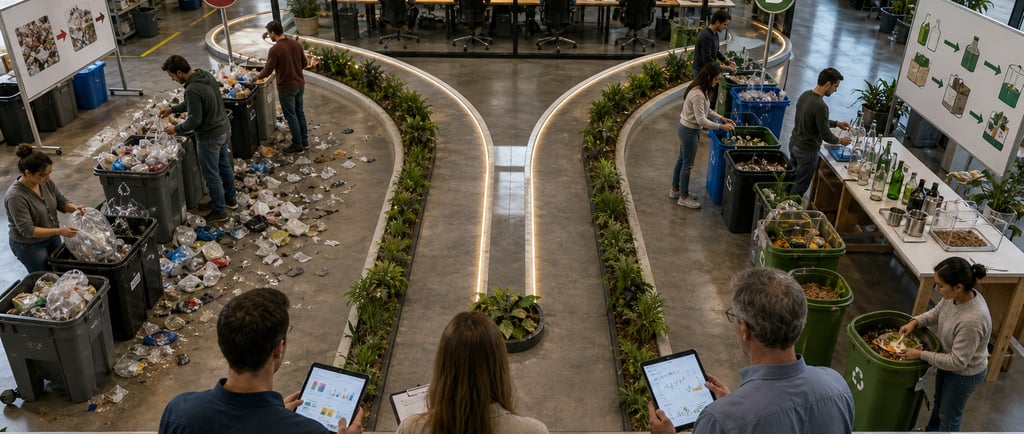
A practical sustainability test might compare these two messages for a recycling app onboarding screen:
Version A, social proof: “Join thousands of households using reminders to recycle on time.”
Version B, convenience: “Never miss pickup again. Set your recycling reminder in 10 seconds.”
If version B wins, the team learns that convenience is the stronger angle at that moment. If version A wins, the team learns that participation norms carry more weight for that audience.
Another test might compare two food waste SMS reminders:
Version A, savings angle: “Before you shop, check your fridge. Using what you already bought can cut wasted groceries this week.”
Version B, environmental angle: “Before you shop, check your fridge. Less wasted food means less waste sent to landfill.”
If the savings angle wins among families, while the environmental angle performs better among younger urban users, the team should not declare only one universal winner. It should use the insight to personalize future messages.
Another test might compare two QR-linked packaging prompts:
Version A, instruction-first: “Scan to check if this package is accepted in your local recycling program.”
Version B, claim-first: “Scan to learn how this package supports circular packaging.”
If version A drives more scans and better disposal guide completion, the brand learns that practical guidance beats broad sustainability storytelling at the disposal moment.
The next step is choosing the right channel. The channel should be selected based on the action, not internal convenience. If the behavior is urgent, use SMS or push. If it requires explanation, use email or a landing page. If it happens at a physical object, use QR. If it happens inside an app, use in-app prompts. If it depends on public participation, use social proof across social, community channels, and local media.
Email remains useful, especially for opted-in audiences and longer sustainability education. MailerLite’s 2026 benchmark article reports that the average email open rate in 2025 was 43.46%, slightly higher than 2024’s 42.35%. That makes email a strong owned channel, but only when it is connected to clear next steps and not treated as a passive newsletter dump.
Push notifications are better for timely action, but they need consent and context. Airship’s 2025 push notification benchmark notes that Android opt-in rates have historically been higher than iOS rates, but Android 13 and above now require consent, meaning brands and public apps must earn notification permission more carefully. For sustainability apps, this makes onboarding messages critical. People must understand why reminders are useful before they allow them.
After channel selection, the team defines the test duration and sample. The test should run long enough to capture normal behavior. A recycling collection reminder may need at least one or two collection cycles. A food waste pledge may need several weeks to show repeat behavior. An app onboarding test may produce results faster if user volume is high. A small municipal program may need directional testing across matched routes because perfect sample sizes are not always realistic.
Randomization is important. If version A goes to engaged users and version B goes to inactive users, the result is biased. If version A runs before a holiday and version B runs after, timing may distort results. If version A runs in single-family homes and version B runs in multifamily buildings, housing type may explain the difference. A clean test either randomizes within the same audience or uses matched groups with similar conditions.
The team should also decide what counts as a win before the test begins. This prevents cherry-picking results later. The main metric should be tied to the behavior. Secondary metrics can help explain what happened.
For example, in a recycling app onboarding test, the main metric might be completed reminder setup. Secondary metrics might include button clicks, screen completion, push opt-in, and seven-day retention. In a contamination campaign, the main metric might be reduction in targeted contaminants. Secondary metrics might include QR scans, item search use, SMS clicks, and customer service questions. In a reuse campaign, the main metric might be return completion. Secondary metrics might include return location lookup, reminder opt-in, and repeat return within 30 days.
Once the test runs, the team should analyze more than the overall winner. They should look at performance by audience segment. Did one message perform better among apartment residents? Did another perform better among homeowners? Did one version work better for new users but worse for returning users? Did one channel drive more action but more opt-outs? Did one message improve clicks but not final behavior?
This level of analysis prevents shallow decisions.
A message can win on clicks and lose on impact. For example, “Win rewards for recycling” might get more clicks than “Keep plastic bags out of recycling,” but if the reward message does not reduce contamination, it is not the better operational message. A fear-based message might drive short-term action, but if it increases complaints or distrust, it may not be suitable for long-term use. A detailed message might perform poorly as an SMS but work well as a landing page.
The final step is iteration. A/B testing is not a one-time campaign trick. It is a learning cycle. The winning version becomes the new baseline. The team then tests the next variable: CTA, timing, personalization, channel, visual, landing page, or reminder sequence.
A mature sustainability testing cycle might look like this:
Month one tests the behavioral angle. Month two tests the CTA. Month three tests timing. Month four tests audience personalization. Month five tests follow-up messages. Month six tests retention and repeat action.
Over time, this builds a message library based on evidence. The team learns which messages work for which audience, which channels fit which behaviors, and which claims build trust. This library becomes useful for grant reporting, internal training, partner campaigns, seasonal planning, and future program design.
The most important lesson is that sustainability A/B testing must stay connected to real-world systems. The goal is not more clicks. The goal is better outcomes: cleaner recycling, less food waste, more reuse, more repair, higher returns, better sorting, lower confusion, and stronger public trust.
That is the standard for sustainability messaging in 2026. It has to be tested. It has to be specific. It has to be measurable. And it has to help people act.
5. Implementation Playbook: How to Build A/B Tests for Sustainability Messages That Drive Real Behavior
A/B testing sustainability messages only works when the test is tied to a real action. A better subject line is useful, but it is not the goal. A higher click rate is useful, but it is not the proof. The proof is behavior: fewer contaminated recycling carts, more completed app onboarding, more food waste pledges, more return scheme participation, more repair bookings, more reuse sign-ups, more verified drop-offs, and more residents following local disposal rules.
This distinction matters in 2026 because sustainability programs now operate under heavier pressure. Global waste systems are strained, public budgets are tighter, and funders want evidence that communication budgets lead to measurable outcomes. The World Bank’s What a Waste 3.0 estimates that only 21% of global waste is treated through recycling, composting, or anaerobic digestion, while almost one third of global waste is still not properly managed. That means communication teams cannot treat messaging as soft awareness work anymore. Messaging has to help close the gap between intent and action.
A strong implementation plan starts with one clear question: what exact behavior should change?
Do not begin with “we need a recycling campaign.” Begin with a narrow behavior. For example: “We need more residents in multifamily housing to stop placing plastic bags in curbside recycling.” Or: “We need more app users to set collection reminders in their first session.” Or: “We need households to separate food waste before pickup day.” This level of precision matters because each behavior has a different barrier. Confusion needs clarity. Apathy needs relevance. Distrust needs proof. Forgetfulness needs reminders. Low motivation needs social proof, incentives, or immediate personal benefit.
Once the behavior is defined, the next step is to map the audience by readiness level. A first-time resident who does not understand the local recycling rules should not receive the same message as a committed recycler who already uses the app. A renter in a high-turnover apartment building should not receive the same message as a homeowner who has been on the same collection route for 12 years. A business user handling packaging returns has different concerns from a household trying to sort dinner leftovers.
For most sustainability programs, the audience can be split into five practical groups.
The first group is unaware. They do not know the rule, service, app, or program exists.
The second group is aware but confused. They care, but they do not know what action to take.
The third group is interested but inactive. They have seen the message before, but they have not acted.
The fourth group is active but inconsistent. They recycle, return, reuse, or compost sometimes, but their behavior drops when life gets busy.
The fifth group is already committed. They can be nudged into deeper participation, referrals, volunteering, reporting, or advocacy.
Each segment needs a different test. For unaware audiences, test clarity against curiosity. For confused audiences, test simple instructions against visual examples. For inactive audiences, test social proof against consequence-based messaging. For inconsistent audiences, test reminders against rewards. For committed audiences, test recognition against deeper participation.
The most common mistake is testing two weak messages against each other. “Recycle today” versus “Do your part” is not a serious test. Both are vague. Both assume the audience already knows what to do. A stronger test compares two clear psychological angles. For example, a social proof version might say, “Most households on your street set out recycling correctly this week.” A loss-aversion version might say, “Plastic bags in recycling can send the whole cart to landfill.” A convenience version might say, “Check any item in 5 seconds before it goes in the bin.” A personal progress version might say, “You kept 12 pounds of material out of landfill this month.”
The test should isolate one main variable at a time. If the first version uses a different headline, image, call to action, delivery time, and audience segment, the result will be hard to interpret. You will know that one version won, but you will not know why. For clean learning, change one primary element per test. Test the behavioral angle first. Then test the call to action. Then test the delivery channel. Then test the timing. This keeps the learning useful across future campaigns.
For example, a city recycling app might run the following sequence. In month one, it tests social proof against consequence-based messaging for onboarding completion. In month two, it tests “Set my reminder” against “Get my pickup alert” as the CTA. In month three, it tests push notification timing, 6 p.m. the night before collection versus 8 a.m. on collection day. In month four, it tests a household progress message against a neighborhood progress message. By the end of four months, the team has built a practical message library based on observed behavior, not opinion.
Channel selection also needs discipline. SMS is useful for urgent, short actions. Push notifications are useful for reminders and app behavior. Email is better for explanation, monthly progress, grant updates, and community storytelling. In-app prompts work when the user is already engaged and close to the desired action. QR-linked landing pages are useful at bins, depots, drop-off points, repair sites, and packaging touchpoints. Social posts are useful for public awareness and norm-building, but they are often weaker for direct proof unless connected to trackable actions.
The best sustainability A/B tests use layered messages. A single message rarely changes behavior on its own. A resident may see a social post, receive a collection reminder, scan a QR label, check an app search result, and then act correctly at the bin. The test should respect that path. Instead of measuring only one click, build a funnel that tracks exposure, engagement, intent, and action.
A practical funnel for a recycling contamination campaign might look like this: resident sees a plastic bag warning message, resident clicks or scans the local “what goes where” guide, resident searches for “plastic bag,” resident receives a pre-collection reminder, cart audit shows no plastic bags in the next collection cycle. That final step is the one that matters. Without it, the campaign may only prove that people clicked, not that they changed behavior.
This is where digital and physical measurement need to connect. The Recycling Partnership’s cart-tagging work shows why direct feedback matters. In a Washington contamination reduction case study, one city saw carts tagged for bagged recyclables decrease by 50% by week four, while carts tagged for loose plastic bags dropped by 21%. That result came from connecting outreach with real cart-level feedback, not relying only on awareness metrics.
The implementation process should follow a clear monthly rhythm.
Start with a baseline. Measure current contamination, app completion, drop-off attendance, missed collection complaints, repair bookings, return participation, or pledge completion before launching the test. If no baseline exists, run a two-week observation period. This gives you a starting point and protects the project from inflated claims.
Next, write the hypothesis. A good hypothesis is specific. For example: “Residents who receive a consequence-based message about plastic bags contaminating recycling will be more likely to use the item search tool than residents who receive a general environmental message.” Or: “A reminder sent the evening before collection will reduce missed set-outs more than a reminder sent the morning of collection.” The hypothesis should name the audience, the message difference, the expected behavior, and the measurement point.
Then build the variants. Use clear, plain language. Sustainability teams often over-explain because the topic is complex. The user does not need a policy essay at the moment of action. They need a clear reason, a clear instruction, and a clear next step. “Plastic bags do not go in curbside recycling. Check where they go before pickup.” That will often beat a longer message about circular economy benefits.
After that, assign traffic or recipients fairly. Randomization matters. If version A goes to high-engagement users and version B goes to low-engagement users, the test result will be biased. If version A runs on a weekday and version B runs on a holiday weekend, timing may distort the result. If version A appears in one neighborhood and version B appears in a different neighborhood, the result may reflect local collection quality rather than message quality. A clean test either randomizes within the same audience or uses matched groups with similar conditions.
The test also needs a sample size that can produce a useful result. Small municipal programs may not have enough volume for perfect statistical confidence every time, but they can still use disciplined directional testing. For low-volume programs, run tests longer, combine multiple similar routes, or focus on large behavioral differences rather than tiny lifts. For high-volume apps or email lists, use statistical significance thresholds before declaring a winner.
Once the test is live, monitor it, but do not interfere too early. A/B tests can swing during the first few hours or days. Early adopters may behave differently from the broader audience. Give the test enough time to capture normal behavior patterns unless there is a clear harm, broken link, delivery failure, or public complaint.
When the test ends, do not only ask which version won. Ask why it won, where it won, and who it won with. A version may perform better overall but worse for a priority segment. A message may increase clicks but fail to change final behavior. A push notification may lift app use but also increase opt-outs if overused. Sustainability teams need to protect both short-term conversion and long-term trust.
Finally, document every test. Keep a message archive with the date, audience, channel, hypothesis, variants, result, learning, and next test. Over time, this becomes a strategic asset. It helps new staff avoid repeating failed messages. It gives funders evidence of learning. It helps communications, operations, and policy teams align around what works in the field.
6. Measurement and QA: How to Prove Message Quality, Behavior Change, and Program Impact
Measurement is where sustainability messaging either becomes credible or collapses into vague reporting. A campaign that says it “raised awareness” may sound useful, but it will not satisfy serious funders, regulators, public agencies, or operational teams unless it can connect communication to measurable outcomes.
The first rule is simple: measure the action closest to the environmental result.
For recycling contamination, the key metric is not impressions. It is contamination rate, cart audit results, MRF inbound audit data, rejected loads, or targeted contaminant reduction. For food waste prevention, the key metric is not likes. It is household food waste reduction, pledge completion, food redistribution volume, collection participation, or measured changes in disposal patterns. For repair and reuse, the key metric is not landing page visits. It is repair bookings, reuse transactions, item diversion, repeat participation, or verified avoided disposal.
This matters because waste outcomes are financially material. UNEP’s Global Waste Management Outlook 2024 warns that municipal solid waste generation is on track to rise sharply by 2050, and poor waste management carries major direct and external costs, including pollution, greenhouse gas emissions, ecosystem harm, and public health impacts. Messaging that reduces contamination, improves sorting, or increases reuse is not a soft communications win. It can reduce system costs and improve material recovery.
A strong measurement plan separates metrics into four layers.
The first layer is delivery. Did the message reach people? This includes SMS delivery rate, email delivery rate, push notification delivery, QR scan count, app banner exposure, and landing page load success. If delivery fails, the message cannot work.
The second layer is engagement. Did people notice and interact? This includes open rate, click-through rate, QR scan depth, search tool use, video completion, reply rate, time on page, and CTA clicks. These are useful diagnostic metrics, but they are not enough.
The third layer is conversion. Did people complete the intended digital step? This includes app onboarding, reminder setup, event registration, pledge completion, return location lookup, repair booking, collection request submission, or item disposal guide completion.
The fourth layer is verified behavior or operational outcome. This is the layer that matters most. It includes lower contamination, increased capture rate, reduced missed pickups, more returns, higher repair completion, more clean material collected, fewer customer service complaints, fewer rejected loads, or measured reduction in avoidable waste.
The best reports connect all four layers. For example, a campaign might show that 42,000 residents received a message, 8,600 clicked or scanned, 3,200 used the item search tool, and targeted cart audits showed a 17% reduction in plastic bag contamination on matched routes. That story is much stronger than “we got 8,600 clicks.”
Quality assurance begins before the test goes live. Every message should be checked for accuracy, clarity, accessibility, localization, compliance, and measurement readiness.
Accuracy is critical because recycling and waste rules vary by region, hauler, material recovery facility, building type, and collection contract. A message that is correct in one city may be wrong in another. “Pizza boxes go in recycling” may be true in one program and false in another depending on grease levels, fiber markets, and local rules. Dynamic content, QR labels, and app-based disposal guides can help, but only if the source data is maintained.
Clarity matters because confusion is one of the biggest causes of incorrect disposal. Recycle Coach positions its app around localized collection reminders and “what goes where” search tools that help residents sort items correctly. That is the right direction for A/B testing because the message can move from broad education to specific decision support at the moment the resident needs it.
Accessibility should be built into the test, not added later. Messages should be readable on mobile screens. They should avoid jargon. They should work for residents with low literacy, limited time, or limited English. Visual instructions should have alt text. QR-linked pages should load quickly and work without unnecessary account creation. SMS messages should not rely on images. Push notifications should make sense without requiring the user to open the full app.
Localization is also part of QA. A message that says “your bin” may not fit apartment buildings with shared carts. A message about curbside pickup may not fit rural drop-off systems. A reward message may not work where incentives are restricted by policy. A neighborhood comparison may be powerful in one culture but intrusive in another. A/B testing should reveal these differences, but the team needs to design for them first.
Compliance is especially important in 2026 because sustainability claims face more scrutiny. Messages should avoid exaggerated claims, vague environmental benefit statements, and unsupported impact numbers. If the campaign says “this saves carbon,” the calculation should be documented. If it says “most residents participate,” the participation number should be current and local. If it says “recyclable,” it should reflect actual access and local acceptance, not only theoretical recyclability.
The Ellen MacArthur Foundation’s Global Commitment reporting shows why precision matters. Its 2025 progress report notes that brand and retail signatories increased the share of reusable, recyclable, or compostable plastic packaging to 72% in 2024, but that figure still reflects a specific reporting group and category, not the entire global packaging market. Sustainability messaging must handle numbers with that same care. Broad claims need boundaries.
Measurement QA also requires clean tracking. Every variant needs a unique link, QR code, UTM structure, app event, or campaign ID. Each conversion event should be defined before launch. “Engaged user” should mean the same thing across reports. If one campaign defines conversion as a click and another defines it as completed onboarding, performance comparisons become misleading.
For physical outcomes, field QA is just as important. Cart audits should use consistent sampling rules. Staff should be trained to identify contaminants the same way. Routes should be comparable. Weather, holidays, collection delays, and service disruptions should be noted because they can influence results. If a route missed collection during the test week, that data should not be treated as normal.
A good QA review asks these questions before launch:
Is the behavior specific enough to measure?
Is the audience segment clearly defined?
Are the variants meaningfully different?
Is only one major variable changing?
Are the claims accurate?
Are links, QR codes, and app events working?
Is the test long enough?
Is the sample large enough to produce useful learning?
Are we measuring the final behavior, not only the click?
Is there a plan to document the result?
Once the test ends, quality assurance continues with interpretation. Avoid declaring victory too quickly. A 12% higher click-through rate may not matter if final conversions are unchanged. A message that performs well for early adopters may fail with low-engagement residents. A reward message may drive short-term sign-ups but weaken intrinsic motivation if overused. A fear-based message may lift action but create distrust if it feels exaggerated.
The strongest sustainability teams use a balanced scorecard. They look at conversion lift, cost per action, verified behavior change, complaint rate, opt-out rate, equity impact, operational cost, and repeat behavior. A message that wins on conversion but drives high opt-outs may not be a true winner. A message that performs slightly lower overall but works better in underserved neighborhoods may be more valuable for public programs.
The final output of measurement should be a learning loop. Each campaign should produce one clear decision: scale, revise, pause, or retest. Scale means the result is strong enough to use across more audiences. Revise means the message had promise but needs adjustment. Pause means the result did not justify continued spend. Retest means the result was unclear, underpowered, or affected by external factors.
This turns sustainability messaging into an evidence practice. It also protects teams from the common trap of chasing novelty. The goal is not to keep creating more messages. The goal is to find the few messages that reliably change behavior, then adapt them by audience, channel, and context.
7. Case Studies: What Real-World Sustainability Testing Teaches Us
Case studies matter because sustainability communication is highly contextual. What works in a food waste campaign may not work in e-waste collection. What works for suburban households may not work in dense apartment buildings. What works in a high-trust community may fail in a market where residents suspect greenwashing. Still, the strongest examples reveal repeatable patterns: clarity beats complexity, direct feedback beats passive education, local proof beats generic claims, and measurement beats assumption.
Case Study 1: Cart Tagging and Direct Feedback in Curbside Recycling
Cart tagging is one of the clearest examples of message testing connected to physical behavior. Instead of sending broad “recycle right” reminders and hoping residents comply, cart tagging gives direct feedback at the point where the mistake happens. If a cart contains plastic bags, food waste, hoses, textiles, or other contaminants, the household receives a visible tag explaining the issue and the correct action.
The Recycling Partnership’s Washington case study shows the power of this approach. After implementing cart tagging, the city recorded a 50% reduction in carts tagged for bagged recyclables by week four and a 21% reduction in carts containing loose plastic bags. The lesson is not only that cart tagging works. The deeper lesson is that feedback close to the behavior can outperform generic awareness messaging because it removes ambiguity and makes the correction personal.
For A/B testing, this creates several message opportunities. One route might receive a tag that explains the operational consequence: “Plastic bags jam sorting equipment.” Another route might receive a simpler instruction: “No plastic bags in recycling.” Another might include a QR code leading to a local item guide. Another might include a neighbor norm: “Most carts on this route were plastic-bag free this week.” Each version can be compared against cart audit results.
This kind of testing is valuable because recycling contamination is expensive and disruptive. Contaminants can reduce material quality, slow sorting, increase labor needs, damage equipment, and send recoverable material to disposal. A campaign that reduces one high-volume contaminant can improve both financial and environmental outcomes.
Case Study 2: Recycle Coach and Localized Digital Guidance
Localized recycling apps show how A/B testing can shift from broad education to personal decision support. Recycle Coach provides collection reminders, localized sorting search, and resident education tools. Its public success story for Cal-Waste reports contamination falling from 19% to 11% after targeted education through the platform, a 43% reduction.
The important lesson for sustainability teams is that app-based communication is not only a broadcast channel. It is a behavioral support system. A resident does not need to remember every rule. They need to know where to check the rule in seconds. This changes the kind of messages worth testing.
Instead of testing “Recycle more” against “Help the planet,” a program can test prompts such as “Not sure where it goes? Search it before pickup” against “One wrong item can contaminate the cart. Check first.” The conversion event is not a click for its own sake. It is item search use, reminder setup, or correct sorting behavior measured through audits or contamination reports.
This is also where AI engagement can help. AI can cluster item searches, identify common confusion points, and recommend future tests. If many residents search for “pizza box,” “plastic bag,” “coffee cup,” and “Styrofoam,” the next campaign should target those items. If searches spike before holidays, push notification timing should adjust. If one neighborhood searches for bulky items more often, the message can highlight local drop-off or collection options.
Case Study 3: Food Waste Reduction and Target-Measure-Act Discipline
Food waste is one of the strongest areas for behavior-focused messaging because the benefits are personal, financial, and environmental. People may care about emissions, but they also care about grocery bills, meal planning, convenience, and household routines. That gives campaign teams many angles to test.
WRAP’s UK Food and Drink Pact Annual Progress Report 2024 to 2025 shows the value of disciplined measurement. It reports that 88% of businesses on the Food Waste Reduction Roadmap have set a waste reduction target, 59% are achieving reductions relative to baseline year, and some businesses using Target-Measure-Act have achieved 40% food waste reduction, with one business saving £77,000 over the year.
For sustainability message testing, the lesson is clear: behavior change improves when messaging is tied to target-setting and measurement. A household food waste campaign should not only say, “Waste less food.” It can test messages around saving money, using leftovers, planning meals, freezing food, or making waste visible. A business campaign can test messages around margin protection, kitchen routines, staff pride, and reporting compliance.
The best food waste A/B tests measure specific behaviors. Did households complete a meal planning checklist? Did they opt into a reminder before grocery day? Did they use a leftover recipe guide? Did commercial kitchens log pre-consumer waste more consistently? Did food redistribution volumes increase? Did avoidable waste decline during the campaign period?
UNEP’s Food Waste Index work reinforces the importance of measurement, with expanded global estimates and methodology guidance for countries tracking food waste under SDG 12.3. This makes message testing more than a marketing exercise. It becomes part of a wider public accountability system for waste prevention.
Case Study 4: Plastic Packaging, Consumer Trust, and Claim Precision
Plastic packaging communication is difficult because consumers often face mixed signals. A package may be technically recyclable but not accepted locally. A brand may claim recycled content, but the consumer may not know whether to believe it. A recycling symbol may be visible, but the disposal instruction may still be unclear. This creates a trust problem.
The Ellen MacArthur Foundation’s Global Commitment 2024 report shows that more than 1,000 organizations, including businesses representing 20% of all plastic packaging produced globally and more than 50 government signatories, are working toward a common circular economy vision for plastic. That scale is important, but it also raises expectations. Consumers, regulators, and NGOs increasingly expect sustainability claims to be specific and verifiable.
For A/B testing, this means packaging and disposal messages should be tested for comprehension and trust, not only conversion. A QR-linked guide might test “Scan for local recycling instructions” against “Check if this package is accepted near you.” A reuse program might test “Return this pack” against “Bring this pack back for cleaning and reuse.” A recycled-content claim might be paired with plain proof: percentage, material source, and what the consumer should do after use.
The goal is to reduce confusion and skepticism. A message that creates a click but leaves the user unsure about disposal may fail. A message that makes a smaller claim but gives clear local instructions may perform better over time because it builds trust.
Case Study 5: Digital Recycling Education in Universities and Campuses
Campuses are useful testing grounds because they combine dense foot traffic, repeated behavior, diverse audiences, and visible waste stations. They also have high turnover, which makes repeated education necessary. In 2025, Penn State announced the launch of the Recycle Coach app and updated waste station signage across its campuses to give users recycling guidance at their fingertips.
A campus program can test multiple message formats in a controlled way. One residence hall might see a bin-area QR code with simple disposal guidance. Another might receive app-based reminders before move-out week. Dining areas might test food waste prompts focused on portion choice. Event spaces might test signage with contamination warnings. The strongest tests connect digital scans and app engagement with actual waste audits by location.
Campuses also show why message timing matters. A recycling message during move-in week should focus on cardboard, packaging, and setup waste. A message during finals week should focus on convenience. A message before holiday break should focus on donation, reuse, and food disposal. The same sustainability goal needs different creative depending on the moment.
8. Advanced A/B Testing Patterns for Sustainability Teams in 2026
Basic A/B testing compares two versions. Advanced testing asks better questions. It explores audience differences, timing, channel fit, message fatigue, and long-term behavior. Sustainability teams that want lasting results need to move beyond headline tests and build a richer testing practice.
One useful pattern is message-angle testing. This compares different behavioral drivers. A recycling program might test clarity, consequence, social proof, convenience, and identity. Clarity says what to do. Consequence explains what happens if the action is wrong. Social proof shows that peers are acting. Convenience reduces perceived effort. Identity connects the action to the person’s self-image, such as being a responsible neighbor or careful household.
Another pattern is timing testing. Sustainability actions are often time-sensitive. Collection reminders work best close to pickup. Event reminders work best when people can still plan. Food waste prompts may work before grocery shopping or meal preparation. Repair reminders may work after product registration or warranty expiration. The message may be strong, but if it arrives at the wrong moment, it fails.
A third pattern is channel testing. The same message can perform differently across SMS, email, push, social, signage, QR, website, chatbot, and in-app banners. SMS may win for urgent action. Email may win for monthly reports. Push may win for app users. QR may win at packaging or bin-level decisions. Social may win for norm-building and reach. Testing should reveal which channel supports which behavior.
A fourth pattern is commitment testing. People are more likely to follow through when they make a small commitment first. A campaign can test “Take the pledge” against “Set your reminder” against “Choose your goal.” The follow-up sequence can then test whether committed users perform better than users who only clicked an information page.
A fifth pattern is feedback testing. Feedback can be personal, household-level, route-level, building-level, or city-level. A resident may respond to “Your household recycled correctly this week.” Another may respond to “Your building reduced contamination by 14%.” Another may respond to “Your neighborhood is close to hitting this month’s target.” Feedback should be tested carefully because it can motivate, but it can also discourage if framed poorly.
A sixth pattern is trust testing. This is vital for sustainability. Some audiences distrust environmental claims. Test messages that show proof against messages that use broad purpose language. For example, “Your returned bottle is washed and reused up to 20 times” may beat “Help build a circular future” because it is concrete. “Accepted locally: paper, cardboard, cans, and bottles” may beat “Recycle responsibly” because it removes doubt.
A seventh pattern is friction testing. Sometimes the message is fine, but the path is too hard. Test shorter forms, fewer fields, guest access, one-tap reminders, saved addresses, faster landing pages, and clearer maps. A sustainability campaign can lose conversions because of UX issues that have nothing to do with the message.
An eighth pattern is equity testing. Sustainability programs should check whether a winning message works across languages, income levels, housing types, age groups, disability needs, and digital access levels. A push notification test may look strong overall but exclude residents without smartphones. A QR-only campaign may fail older users or people with limited data access. A strong measurement system should reveal these gaps.
A ninth pattern is retention testing. One-time participation is easier than repeated behavior. A resident might attend one e-waste drive but not return next quarter. A household might use the food waste tool once but stop after two weeks. Test follow-up messages that encourage repeat action. Measure whether users act again after 7, 30, 60, and 90 days.
A tenth pattern is operational cost testing. A message that increases participation may also increase call center volume if it creates confusion. A campaign that drives more drop-offs may strain staff if timing is poor. A repair campaign may flood partners with low-quality inquiries if eligibility is unclear. A/B testing should measure both conversion and operational load.
These advanced patterns help teams mature from “which message got more clicks?” to “which communication system produces cleaner material, better participation, lower confusion, lower cost, and higher trust?”
Conclusion: The Future of Sustainability Messaging Belongs to Teams That Test, Prove, and Improve
A/B testing sustainability messages is no longer a marketing extra. It is a core operating method for any organization trying to move people from awareness to action. The world does not need more vague sustainability slogans. It needs clearer instructions, better timing, stronger trust, lower friction, and proof that communication changes behavior.
The most effective sustainability teams in 2026 will not ask, “What message do we like best?” They will ask, “What message helps this audience complete this action in this context, and can we prove it?” That shift changes everything.
For municipal teams, A/B testing can reduce contamination, improve collection behavior, increase app adoption, and strengthen grant reporting. For NGOs, it can turn awareness campaigns into measurable participation. For circular economy startups, it can improve onboarding, retention, and return behavior. For brands, it can make reuse, refill, repair, and recycling instructions clearer and more trusted. For funders and regulators, it can create stronger evidence that sustainability programs are producing real outcomes.
The best approach is practical. Start with one behavior. Build two strong message variants. Measure the action that matters. Connect digital engagement to operational data. Learn from the result. Then test again.
When sustainability messages are tested this way, they become more than words. They become part of the infrastructure of behavior change. They help residents sort correctly, households waste less food, customers return products, citizens trust circular systems, and organizations prove impact with evidence.
That is the standard sustainability communication now has to meet.
Connect
Your trusted partner for scrap metal procurement.
CONTACT
About
haroon@tdcventures.com
+1-307-655-7593
© 2025. All rights reserved.
NEWSLETTER