
Additive Spares for Electronics: Printing Metal Parts
Discover how additive spares for electronics enable on‑demand metal 3D printing, cut repair downtime, reduce e‑waste, and drive circularity across XR devices and beyond.
IMMERSIVE TECH RECYCLING & CIRCULAR ELECTRONICS
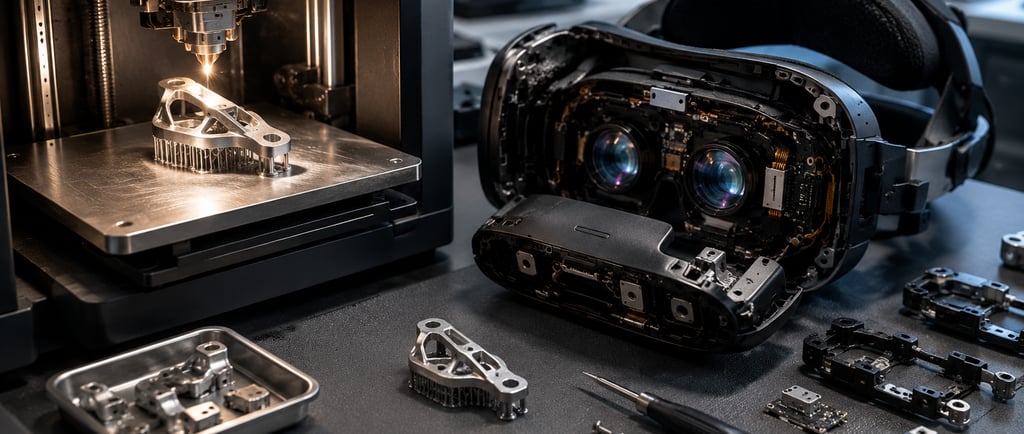
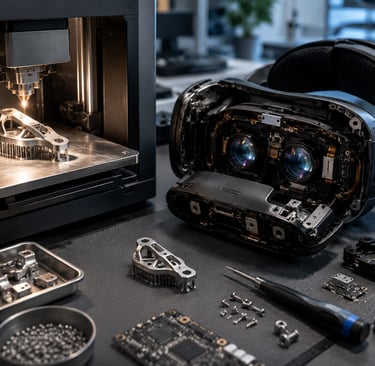
Context: Why Additive Spares Matter for XR and Circular Electronics
The global electronics landscape is in a state of rapid transformation. With the proliferation of XR devices—spanning augmented reality (AR), virtual reality (VR), and mixed reality (MR)—hardware cycles have compressed, and end-user expectations around device longevity and sustainability are rising sharply. According to IDC, the XR device market is projected to grow at a CAGR of 48% through 2028, with millions of units entering enterprise and consumer channels every year.
This surge challenges conventional electronics supply chains. Traditionally, managing spare parts meant juggling global supply lines, predicting demand long in advance, and tying up capital in static inventories. Lead times for critical metal components could stretch into months, while obsolete parts would clog up warehouses, eventually heading for landfill. The European Environmental Agency estimates that electronics now account for over 9 million metric tons of e-waste produced annually in Europe alone.
Environmental concerns and regulatory pressures add another imperative. E-waste regulations such as the EU's WEEE directive and initiatives around "right-to-repair" directly penalize manufacturers and service providers who fail to enable accessible, efficient repair and recycling. TCO Certified reports that up to 80% of a device's lifetime carbon footprint is determined at the design and manufacturing stage—so enabling circularity and local repair can dramatically reduce overall impact.
Additive manufacturing—specifically, the local production of metal parts on-demand—has emerged as a strategic response. The convergence of mature 3D printing technology, digital inventory management, and advanced recycling protocols unlocks a model where OEMs (Original Equipment Manufacturers), repair networks, and industrial print bureaus can keep repair workflows agile, compliant, and sustainable.
Key Takeaway:
In a market demanding higher service levels, faster device recovery, and rigorous sustainability, additive spares empower organizations to shrink time-to-repair, minimize waste, and deliver circular electronics at scale.
2. Defining the Opportunity: On-Demand Metal Printing for Repair
Why is this such a watershed moment for the electronics and XR sector? Because additive manufacturing (AM) overcomes decades-old friction points in spare part logistics and lifecycle management. Instead of relying solely on mass-manufactured, pre-stocked inventory, repair networks can now leverage digital catalogs and print high-precision metal spares on-demand—where and when needed.
The Numbers Behind the Opportunity
Cost Savings: McKinsey's 2023 survey on digital manufacturing found that companies adopting additive spares reduced their spare parts inventory costs by between 30-60%, while slashing part delivery times by up to 90%.
Sustainability: The Ellen MacArthur Foundation estimates that local, on-demand part production can reduce the carbon footprint of replacement components by up to 70%, considering both material efficiency and transport savings.
Compliance and Brand Value: A 2022 Accenture study revealed that 67% of electronics OEMs cite regulatory risk as a major driver for adopting service-based, repair-first supply models.
Strategic Advantages
Agility and Responsiveness: When a client or field technician needs a replacement metal bracket for an XR device, a digital request triggers the local additive bureau to print the required part, reducing device downtime from weeks to days—or even hours.
Inventory Optimization: By holding digital files instead of physical stock, organizations avoid inventory obsolescence and only produce what's needed, when it's needed.
Circular Value Chain: Failed or obsolete metal parts are reclaimed, processed, and converted back into printable feedstock, creating a closed-loop system that is both eco-friendly and cost-effective.
Risk of Non-Adoption
Organizations that cling to legacy models face increased regulatory scrutiny, rising costs associated with overstock and waste, and the reputational risk of being slow or non-compliant in a market actively rewarding circularity. TCO Certified compliance, for instance, is fast becoming a purchasing criterion for enterprise and procurement teams in Europe, North America, and parts of Asia.
Industry Insight:
Leading XR OEMs now treat local additive manufacturing capabilities as both a compliance requirement and a branding opportunity—demonstrating innovation, responsibility, and customer-centricity in a crowded market.
3. Key Concepts: Additive Manufacturing, Design for Repair, Circular Models
In order to execute an additive spares strategy for electronics recycling and XR repair, a few foundational concepts must be deeply understood and smartly applied:
Additive Manufacturing (AM)
AM, commonly known as 3D printing, revolutionizes metal component production by enabling precise, layer-by-layer fabrication from digital CAD models. This contrasts with subtractive methods like machining or casting, which waste material and lock designs into inflexible molds.
Materials: Common feedstocks for electronics include stainless steel, aluminum alloys, and titanium—all able to provide the durability required for hinges, brackets, and connectors in XR devices.
Adaptability: AM allows for rapid iteration, making it possible to update parts as device designs evolve, supporting both legacy and next-gen hardware.
XR (Extended Reality)
XR is the collective term for AR, VR, and MR devices. These platforms are increasingly modular, with field-replaceable subassemblies designed to keep pace with advances in optics, sensors, and user controls.
Frequent Updates: Innovations in head and hand tracking, haptic feedback, and wireless communication mean hardware often changes annually.
Repair Complexity: The intricacy of compact XR assemblies means that metal spares—often custom-fitted—are critical to device uptime.
Design for Repair and Circularity
Design for repair means building products with future servicing in mind, incorporating features like easily accessible fasteners, replaceable modules, and clear material labeling.
Disassembly: Devices designed for fast, non-destructive disassembly save time in both repair and recycling.
Recyclability: Digital tagging (RFID, QR codes) links parts to material specifications and recycling methods, a practice now common in advanced OEM service ecosystems.
Circular Electronics
Circular models break the "take-make-waste" cycle by maximizing the reuse, repair, and recycling of electronics. They depend on local networks of print bureaus, efficient digital asset management, and robust reverse logistics.
Service-Based Supply Models
Major electronics brands increasingly shift from product sales to delivering uptime or usage as a service ("Device-as-a-Service"), where fast, reliable repair via additive spares ensures continuous, sustainable operations.
Example:
HP's Device-as-a-Service offering now includes guaranteed parts availability via additive manufacturing partnerships, enhancing customer retention for enterprise XR deployments.
4. Framework: Designing, Collecting, Refurbishing, and Recycling at Scale
Executing an effective additive spares cycle involves more than just printing parts—it's a data-driven, closed-loop workflow that optimizes every stage of the repair and recycling process.
1. Design for Additive Repair
Digital Twins: Modern electronics part libraries increasingly rely on digital twins—comprehensive virtual replicas that contain geometry, materials, and lifecycle data.
Modularity: Parts are designed to be easily swapped out and identified, which also aids automated QA downstream.
Material Tagging: By embedding data (via RFID, serialization, or laser etching), material characteristics and recycling protocols travel with the part, simplifying EOL (end-of-life) management.
2. Collection and Digital Inventory
Field Data Collection: IoT-enabled devices and field technician mobile apps allow low-friction reporting and scanning of failed modules.
Legacy Part Capture: Even aged, discontinued hardware can be brought into the system by 3D scanning original parts and creating compatible CAD files.
Impact Prioritization: Data analytics prioritize which spares to digitize and inventory based on real-world failure rates and turnaround time benefits.
3. Refurbishment and Additive Production
Feedstock Qualification: The quality of recycled metal feedstock is monitored via spectrometry and sample printing to guarantee performance metrics.
Local Print Bureaus: Distributed certified sites ensure proximity to the point of need, slashing carbon impact from shipping and delays.
Autonomous QA: Vision-based AI systems inspect printed parts for geometric and metallurgical conformity, automatically rejecting defective prints.
4. Recycling and EOL Loop
Sorting Automation: Optical and robotic systems separate reusable and recyclable metals at collection hubs, preserving material purity.
Feedstock Conversion: Advanced induction and atomization processes transform reclaimed metal into new print-grade powders or wire.
Traceability: Blockchain-enabled traceability logs every transaction, batch, and material flow for compliance and auditability.
Future Outlook:
Emerging regulations in both the EU (Circular Economy Action Plan) and US (Secure E-Waste Export and Recycling Act) reward companies proactively demonstrating closed-loop control over critical materials, especially for products containing valuable metals.
5. Implementation Playbook: Building an Additive Spares Program for XR and Circular Electronics
An additive spares program should not begin with the printer. It should begin with the repair problem. In XR electronics, the most valuable printed spare is rarely the most complex part. It is the part that blocks device recovery, delays service, forces unnecessary replacement, or keeps usable hardware trapped in a warehouse because one small metal component is unavailable.
In 2026, this matters more than it did even two years ago. XR device shipments are shifting from traditional headsets toward lighter glasses and enterprise-specific devices. IDC reported that XR shipments expanded 44.4% in 2025 and forecasted 33.5% growth in 2026, with much of the increase coming from smart glasses without displays. This means the repair ecosystem is moving toward smaller, lighter, more distributed device fleets with thinner housings, more delicate hinge systems, higher sensor density, and tighter thermal tolerances. Additive spares can support this shift, but only when the program is designed around part risk, material control, repair economics, and compliance from day one.
Step 1: Identify the parts that actually create repair bottlenecks
The first stage is a failure-rate and service-delay audit. Every OEM, repair network, recycler, and enterprise device manager should start by ranking metal parts across three questions.
Which parts fail often?
Which parts have long procurement lead times?
Which parts cause full-device replacement when they are missing?
For XR devices, strong candidates often include internal brackets, hinge pins, visor supports, lens-frame carriers, cable strain-relief clips, docking contacts, heat spreader mounts, battery-retention plates, sensor alignment fixtures, controller trigger mechanisms, screw bosses, and small structural fasteners. These parts may look low-value on a bill of materials, but they often control whether a headset, controller, smart-glasses frame, or enterprise training device can return to service.
The best additive spares programs separate parts into three groups. The first group contains low-risk non-load-bearing components, such as covers, guards, clips, and service fixtures. These are best for early pilots. The second group contains moderate-risk functional components, such as brackets, mounts, and alignment features. These require stronger QA, material testing, and installation controls. The third group contains safety-critical or high-stress parts, such as load-bearing hinges, headband tension systems, and metallic battery-retention assemblies. These should only move into additive production after engineering validation, repeated testing, and clear liability approval.
This ranking prevents the common mistake of treating additive manufacturing as a general replacement for conventional production. It is not. In repair, additive manufacturing is most powerful when it removes specific barriers: minimum order quantities, tooling delays, discontinued part availability, regional logistics delays, and spare-part waste.
Step 2: Build a digital inventory before building print capacity
Digital inventory is the operating layer behind additive spares. Instead of holding thousands of slow-moving physical parts across regions, the organization holds approved design files, print instructions, material specifications, inspection criteria, and revision history. This is where the cost advantage appears.
The global additive manufacturing market reached $24.2 billion in 2025, according to Wohlers Report 2026 coverage, after reaching $21.8 billion in 2024. The growth rate is no longer only about prototyping. It is increasingly about production, spares, maintenance tools, and qualified end-use parts.
For XR and electronics repair, digital inventory should include more than CAD files. Each approved spare should have a full digital part package covering:
Part name and device compatibility.
Approved material and alloy grade.
Manufacturing process, such as laser powder bed fusion, binder jetting, directed energy deposition, or wire-based metal additive manufacturing.
Build orientation and support strategy.
Required post-processing, including heat treatment, polishing, machining, coating, or passivation.
Critical dimensions and tolerances.
Surface-finish requirements.
Mechanical test requirements.
Inspection plan.
Approved print sites.
Revision history.
Repair installation guidance.
End-of-life material handling notes.
This level of detail matters because a printed part is not automatically equal to an approved part. A bracket printed in the wrong orientation can behave differently. A hinge printed with poor powder control can fatigue early. A contact mount with poor surface finish can damage nearby cables. A part that fits during installation may fail after repeated thermal cycling.
The digital inventory must act as a controlled production record, not a casual file repository.
Step 3: Validate the business case part by part
Additive spares should earn their place in the repair operation. A practical business case should compare additive production with conventional spare-part sourcing across total lifecycle cost, not only unit cost.
A conventionally manufactured bracket may cost $1.40 per unit at high volume, while the printed version may cost $8 to $20. On paper, additive manufacturing appears more expensive. In repair reality, the printed part can still win if the conventional spare requires a six-week lead time, a 5,000-unit minimum order, cross-border freight, storage cost, obsolescence risk, and device downtime.
The right calculation includes:
Lost device uptime.
Technician wait time.
Warehouse carrying cost.
Obsolete stock write-off risk.
Tooling cost.
Minimum order quantity.
Shipping emissions.
Warranty exposure.
Customer satisfaction.
Compliance value.
In enterprise XR deployments, downtime is expensive. A training program using 300 headsets does not fail because all devices break. It fails when enough small failures accumulate and replacements are not available. Additive spares can protect service continuity by keeping low-volume, high-delay parts available without carrying years of physical inventory.
Step 4: Choose the right metal process for the right spare
Metal additive manufacturing is not one process. The chosen process changes cost, strength, tolerances, finish, and scale.
Laser powder bed fusion is strong for high-precision parts with complex geometry, such as sensor brackets, compact mounts, and lightweight internal structures. It can produce excellent detail, but it often requires more expensive powder handling, support removal, and post-processing.
Binder jetting can support higher-volume metal production and is relevant where many small parts are needed, but shrinkage during sintering must be controlled carefully. HP's Metal Jet work points to the broader trend of using binder-style metal AM for production quantities and mass customization rather than only prototypes.
Directed energy deposition and wire arc additive manufacturing are more relevant for larger metal repair components, tooling, industrial fixtures, and near-net-shape parts. They are usually less suited to tiny XR components but may help with repair tooling, jigs, fixtures, and collection-line equipment.
CNC machining should still be used where it is cheaper, faster, and more reliable. Additive manufacturing should not replace good machining when the part is simple, high-volume, and readily available. The strongest playbook combines printing, machining, coating, and inspection into one controlled part-recovery system.
Step 5: Lock the material strategy before scaling
Material choice determines repair reliability and recycling value. Common metal choices for electronics and XR spares include stainless steels, aluminum alloys, titanium alloys, copper alloys, and nickel-based alloys for high-heat or high-wear use cases.
For XR repair, aluminum can support lightweight structural components, stainless steel can support durable brackets and fasteners, titanium can support strength-sensitive lightweight assemblies, and copper alloys can support thermal or conductive components. However, recycled feedstock adds another layer of control. Recycled metal powder or wire can support circularity, but only when chemistry, contamination, particle size, oxygen pickup, flowability, and reuse cycles are tracked.
Powder reuse is especially important. Metal powder that has been through multiple build cycles can change in ways that affect final part quality. A responsible program tracks virgin-to-reused powder ratios, batch history, test coupons, and failed build data. Recycled material should be used where it meets performance requirements, not where it simply helps a sustainability claim.
Step 6: Use certified distributed production, not uncontrolled local printing
Local production is one of additive manufacturing's strongest advantages, but local does not mean uncontrolled. A print bureau in Germany, Canada, Pakistan, Singapore, or the United States should not be free to interpret part files differently. Each approved site should follow the same production recipe, material specification, inspection plan, packaging method, and repair documentation.
This is where railway and mobility examples are useful. Siemens Mobility reports more than 2,100 different parts in virtual stock and more than 31,000 printed and sold customer parts through its rail services additive program. It also reports more than 10% CO₂ reduction through additive manufacturing. Deutsche Bahn says it has produced well over 100,000 parts using 3D printing since 2015 and uses a structured process covering part identification, CAD creation, printing, and quality testing. These examples are not XR-specific, but they prove the operating model: qualified digital inventory plus certified production plus maintenance demand.
Electronics repair networks should copy the discipline, not the exact part mix. XR devices need tighter miniaturization, cleaner handling, and stronger cosmetic controls, but the same logic applies.
Step 7: Connect additive spares to repair intake, refurbishment, and recycling
Additive spares should sit inside the full circular workflow. A headset enters the repair hub. The technician scans the device. The system identifies the failed subassembly. If the required spare exists in physical stock, the repair proceeds. If it does not, the system checks whether an approved additive spare exists. If yes, a local qualified print site receives the job. The part is printed, inspected, installed, and linked to the device service record. If the device is beyond repair, recoverable metal parts are sorted, logged, and sent for recycling or future feedstock conversion.
This creates a loop between repair and recycling. Devices that cannot be recovered still provide material intelligence. The organization learns which parts fail, which alloys appear most often, which printed spares perform well, and which designs should be changed in the next product revision.
The playbook becomes stronger each month because service data improves the digital inventory.
6. Metrics, Compliance, and Performance Measurement
An additive spares program needs clear measurement. Without metrics, it becomes a technical experiment. With metrics, it becomes a repair, compliance, and circularity system.
The baseline challenge is large. The Global E-waste Monitor 2024 reported 62 million tonnes of e-waste generated in 2022, with only 22.3% formally collected and recycled. It also projected global e-waste to reach 82 million tonnes by 2030. For electronics brands, this means repairability and parts availability are no longer side issues. They are part of product risk, procurement risk, and regulatory readiness.
Time-to-repair metrics
The first metric is time-to-repair. For XR electronics, this should be measured from repair intake to device return, not from print start to print finish. A printed bracket that takes four hours to manufacture is not useful if the file approval process takes 12 days.
Track median time-to-repair, 90th percentile repair time, and emergency repair time. Separate repairs by part type, device model, region, and customer segment. If enterprise training devices in North America return to service in three days but the same device type in the Middle East takes 19 days, the issue may not be technical. It may be digital inventory coverage, print-site access, customs delay, or missing QA authority.
Spare-part availability metrics
The strongest additive programs track physical availability and digital availability separately. Physical availability asks whether the part is sitting in a warehouse. Digital availability asks whether the part can be produced from an approved digital package.
This distinction is critical. A product line may have only 40% physical spare coverage but 85% digital spare coverage. That changes service planning. The repair network no longer needs to stock every slow-moving metal spare everywhere. It needs to stock fast-moving parts physically and hold slow-moving, long-tail parts digitally.
Useful metrics include:
Percentage of repair-blocking metal parts digitized.
Percentage of approved additive files with complete QA packages.
Percentage of repairs served from digital inventory.
Number of obsolete parts restored through additive production.
Average print-site distance from repair hub.
Percentage of parts printed within the same region as demand.
Inventory and waste metrics
Additive spares should reduce overstock and obsolete inventory. Measure the value of physical spares avoided, the number of parts printed on demand, the number of unused legacy parts written off, and the reduction in emergency freight.
Inventory waste is often hidden. A company may believe it is protecting service quality by stocking large quantities of low-demand metal spares. In reality, many parts never move before the device generation changes. Additive manufacturing changes the inventory logic from "buy and hope" to "approve and produce when needed."
Carbon and transport metrics
A credible sustainability case should measure avoided shipping, avoided overproduction, reduced warehousing, and material yield. Claims should be conservative. Do not claim every printed part reduces carbon. A printed part may use more energy than a conventionally stamped part if it is high-volume, simple, and produced close to the repair hub. The sustainability advantage is strongest when additive manufacturing avoids tooling, reduces scrap, removes long-distance freight, prevents device replacement, or enables a product to remain in use longer.
Siemens Mobility's public additive spare-part service claims more than 10% CO₂ reduction through additive manufacturing in rail spares. That figure should not be copied directly into electronics without study, but it is a useful benchmark showing that measured carbon reduction is possible when digital inventory, local production, and maintenance demand are aligned.
Quality metrics
Quality metrics should cover fit, function, fatigue, surface finish, rejection rate, rework rate, installation success, field failure, and repeat repair. Additive spares need a feedback loop from repair technicians. If a printed hinge bracket passes inspection but technicians report difficult installation, the design may need a tolerance adjustment. If a part fits well but fails after 300 cycles, the material, orientation, or post-processing path may need revision.
Recommended quality indicators include first-pass yield, inspection rejection rate, dimensional drift by printer, powder-batch failure correlation, installation-time variance, and field return rate.
Compliance metrics
The EU repair landscape has changed. The Directive on common rules promoting the repair of goods was adopted on June 13, 2024 and entered into force on July 30, 2024. Member States must transpose it into national law by July 31, 2026. The European Commission will also establish a European Repair Platform by July 31, 2027 to help consumers find repairers.
For electronics brands, additive spares can support compliance when it improves parts availability, repair access, documentation, and reasonable repair timing. It can also support future Digital Product Passport readiness. The EU's Ecodesign for Sustainable Products Regulation expands ecodesign policy beyond energy-related products and introduces Digital Product Passport requirements for covered product categories. Early product categories begin from 2027, but the data discipline should start now.
A strong compliance dashboard should track:
Repairable part coverage.
Spare-part availability by model and region.
Average repair completion time.
Reasonable repair cost ratio compared with replacement.
Availability of repair instructions.
Availability of tools.
Part serialization and traceability.
Material composition records.
Recycling instructions.
Evidence of non-obstruction, meaning software, hardware, or parts policies do not block legitimate repair.
The goal is simple: prove that the organization can keep devices in use longer, document the method, and show regulators or enterprise buyers that repair is practical, accessible, and controlled.
7. Enhanced Case Studies: What Other Industries Already Prove
XR electronics is still an emerging category for additive spares, but the strongest evidence comes from adjacent sectors with similar service challenges: rail, automotive, aerospace, industrial equipment, and consumer appliances. These sectors deal with long asset lives, low-volume spares, discontinued components, strict safety expectations, and service downtime. XR repair teams should study them closely.
Case Study 1: Deutsche Bahn and the long-tail spare-parts problem
Deutsche Bahn is one of the clearest examples of additive manufacturing used for maintenance continuity. Since 2015, it has produced well over 100,000 parts using 3D printing technologies. Its printed part range includes fan wheels, lamp brackets, signal-box protective housings, fire-extinguisher covers, tablet holders, and coat hooks. Deutsche Bahn also describes a value chain that identifies printable parts, creates CAD data, prints the part, and conducts quality testing through certified partners.
The lesson for XR electronics is not that headset parts are like train parts. They are not. The lesson is that long-tail maintenance can be served by a controlled digital spare system. Many electronics repair failures come from small, low-volume components that are not worth mass production after a model ages. Additive manufacturing gives those parts a second life.
For XR OEMs, this could mean maintaining service for discontinued enterprise headsets, military training devices, industrial AR glasses, and educational VR fleets. A device that is no longer in mass production may still be mission-relevant for a customer. Additive spares can extend support without forcing the OEM to reopen conventional tooling.
Case Study 2: Siemens Mobility and virtual stock
Siemens Mobility's rail additive program is a strong example of virtual stock in practice. The company reports more than 110 customers, more than 2,100 different parts in virtual stock, and more than 31,000 printed and sold customer parts. Siemens also states that additive manufacturing helps maintain original parts, improve designs using 3D data, and produce parts without tooling.
For XR electronics, virtual stock is the strategic center. A manufacturer can create approved files for the most failure-prone metal parts and authorize regional production when demand appears. This reduces the need to forecast every spare for every market. It also supports faster product iteration. If a headset bracket fails more often than expected, the OEM can update the spare design, validate the revision, and push the new approved file to certified print partners.
This is especially relevant for enterprise XR, where deployments may be customized by customer, sector, or region. A logistics company using ruggedized smart glasses may need different mount durability than a hospital using lighter clinical training headsets. Additive spares can support controlled variation without creating a warehouse nightmare.
Case Study 3: Siemens RRX Rail Service Center and lead-time reduction
In 2025, Siemens Mobility's RRX Rail Service Center in Dortmund was reported to be using additive manufacturing for on-demand replacement parts and tooling, with manufacturing time for selected parts reduced by up to 95%.
The XR takeaway is direct. Time-to-repair can become a competitive metric. A brand that can return enterprise devices in 48 to 72 hours has a stronger service proposition than a brand that takes three to six weeks because a small metal part must move through a global supply chain.
For large enterprise XR deployments, this changes buying criteria. Procurement teams do not only ask about device features. They ask about uptime, support windows, replacement logistics, device availability, warranty performance, and sustainability reporting. Additive spares help answer those questions with operational proof.
Case Study 4: HP Metal Jet and the move toward production quantities
HP's metal additive manufacturing materials describe Metal Jet as a production-oriented metal printing path, especially for mass customization and larger quantities of individualized parts. HP's case-study library also points to real-world applications across industrial, transportation, and consumer goods sectors.
For electronics, this matters because additive manufacturing is moving beyond one-off emergency printing. Binder-style metal processes can support repeatable small-batch production when parts are validated. XR repair networks can use this for standardized repair spares, service tools, jigs, test fixtures, and replacement parts that do not justify conventional tooling but have enough demand to justify process qualification.
Case Study 5: Digital spare parts as a supply-chain resilience tool
A 2025 Metal AM discussion of digital warehouses described the appeal of cloud-based digital twins produced locally and on demand, especially as companies face trade barriers, logistics disruption, and tariff exposure. The article also warned that digital warehouses require more than storing files. They need certification, qualification, security, and production controls.
This is the hidden lesson for XR. A digital spare-parts library can reduce supply-chain risk, but it also creates a new kind of risk. If files are stolen, modified, printed by unapproved sites, or used without revision control, the repair network can introduce safety, quality, and IP exposure. The more valuable the digital inventory becomes, the more it must be protected.
8. Risk, Governance, Quality Assurance, and IP Protection
Additive spares can make electronics repair faster, cleaner, and less wasteful. They can also create serious risk if deployed casually. Metal parts inside XR devices sit near batteries, optics, sensors, cables, displays, microphones, cameras, and skin-contact surfaces. A small dimensional error can affect comfort. A poor surface finish can cut insulation. A weak bracket can shift optics. A contaminated metal part can corrode or interfere with nearby electronics.
Engineering risk
The first risk is mechanical performance. Printed metal parts can differ from machined, cast, or stamped parts because layer orientation, porosity, residual stress, heat treatment, and surface finish affect behavior. A part may pass a basic fit check but fail under cyclic loading, vibration, sweat exposure, or thermal cycling.
XR devices make this harder because many parts experience repeated small loads rather than obvious heavy loads. A smart-glasses hinge may open and close thousands of times. A headband tension mechanism may face repeated flexing. A controller trigger bracket may experience fast cycles during gaming, training, or simulation. These are fatigue problems, not only static strength problems.
The governance answer is part classification. Low-risk cosmetic or protective parts can follow a lighter validation path. Functional parts need dimensional inspection, mechanical testing, and installation validation. Safety-adjacent parts need stricter fatigue, environmental, and field-performance testing.
Material and contamination risk
Metal feedstock must be controlled. Powder-bed systems require strict handling because moisture, oxidation, particle-size variation, and contamination can affect part quality. Reused powder should be tracked by batch and build history. Recycled metal input should be tested before it enters a qualified part path.
For circular electronics, the temptation is to claim that old device metal can become new printed spares. In some cases, this will be possible. In many cases, recovered metal will first be downcycled, refined, blended, or used in lower-risk applications. A credible circular program should be honest about this. The strongest claim is not "every part becomes a new part." The strongest claim is "every metal stream is identified, routed, recovered, and used at the highest qualified value."
Regulatory and liability risk
Right-to-repair rules increase pressure to make repair available, but they do not remove product safety obligations. A manufacturer that prints a spare still owns the responsibility to ensure that spare is fit for purpose. A third-party repair network using printed spares must understand warranty, liability, IP, and safety boundaries.
The EU repair directive also bans practices that obstruct repair, including certain software or hardware barriers. That increases pressure on OEMs to support legitimate repair channels, but it also makes quality control more important. Repair access should expand with documentation, approved parts, and clear process controls, not through uncontrolled part substitution.
IP and file-security risk
Digital inventory is valuable intellectual property. A metal spare file can reveal device geometry, tolerances, assembly logic, and sometimes design weaknesses. If a file is leaked, counterfeit parts can appear quickly. If a file is altered, the difference may be invisible until field failure.
A secure additive spares program should include encrypted files, role-based access, watermarking, controlled print authorization, file-expiry rules, site-level certification, audit logs, and revision control. Print partners should receive only the files they need, only for approved orders, and only through controlled systems.
Cyber-physical risk
Additive manufacturing sits between digital and physical operations. That creates cyber-physical risk. A compromised file can become a compromised part. A changed build orientation, altered wall thickness, or hidden internal void can affect device safety while appearing normal from the outside.
For critical parts, organizations should require digital file verification before printing, machine-parameter control, in-process monitoring, and post-build inspection. AI-based quality prediction is becoming more relevant here. Research on metal printing quality prediction using thermal sensing and multimodal machine learning shows how printer data can help identify quality issues before they become field failures.
Brand risk
A poorly executed additive spare can damage trust. Customers do not care that the part was printed if the device fails again. Enterprise buyers care about uptime, safety, warranty clarity, and cost. Sustainability teams care about proof, not claims. Procurement teams care about documented service levels.
The governance rule is simple: additive spares must be invisible in the best way. The repaired device should perform as expected, the service record should be complete, the warranty position should be clear, and the customer should experience faster recovery without added risk.
9. Future Trends: Where Additive Spares Are Heading Through 2030
Additive spares for electronics are still early, but the direction is clear. By 2030, the most advanced repair systems will combine digital inventory, part passports, AI-assisted design, certified distributed manufacturing, recycled material streams, and automated inspection. XR devices will be one of the pressure points because they sit at the intersection of wearables, enterprise hardware, optics, sensors, batteries, and frequent product updates.
Trend 1: Digital Product Passports will turn spare-part data into a compliance asset
The EU's Digital Product Passport direction will push companies to maintain better product and material records. From 2027, certain product categories will start requiring DPPs under the Ecodesign for Sustainable Products Regulation, and the scope is expected to expand over time.
For additive spares, this creates a major advantage. A printed spare can carry a data record from day one: material batch, print site, production date, inspection status, repair order, installation device, and end-of-life routing. That record can support warranty, compliance, recycling, and carbon reporting.
In XR, this could become especially useful because devices combine many material streams in small packages. A part passport can tell a recycler whether a component is aluminum, stainless steel, titanium, copper alloy, coated metal, or part of a mixed assembly. That reduces sorting error and improves material recovery.
Trend 2: AI-assisted design will improve repair parts, not only replicate them
Early additive spare programs often copy the original part. The next phase will improve it. AI-assisted design can identify where the original bracket failed, reduce weight, add reinforcement, remove stress concentrators, improve cable clearance, or make disassembly easier.
This matters for XR because many hardware generations are pushed quickly to market. Field data often reveals small mechanical weaknesses after deployment. Additive spares allow a company to repair today's device with a better part while feeding lessons into tomorrow's design.
The result is a repair loop that informs product design. Instead of treating repair data as a warranty cost, the OEM treats it as engineering intelligence.
Trend 3: Local repair networks will become part of enterprise XR procurement
Enterprise buyers will increasingly ask where devices can be repaired, how fast spares can be produced, how long parts will remain available, and whether repair data can support sustainability reporting. For healthcare, industrial training, defense, education, and remote fieldwork, downtime can be more expensive than the device itself.
This will shift procurement from device price to lifecycle value. An XR vendor with documented additive spare coverage, regional repair partners, and clear recovery metrics will have an advantage over a vendor that depends on centralized replacement logistics.
Trend 4: Recycled feedstock will move from marketing claim to controlled material stream
The e-waste challenge is not only about volume. It is also about lost material value. The Global E-waste Monitor 2024 warns that billions of dollars in strategically valuable resources are lost through poor collection and recycling, and only 1% of rare earth element demand is currently met by e-waste recycling.
By 2030, leading electronics companies will track recovered metals more carefully. Some recovered material will become new feedstock after refining and qualification. Some will go into lower-risk parts, repair tools, fixtures, or non-critical housings. Some will enter broader secondary metal markets. The key change is traceability. Companies will need to know what was recovered, where it went, and whether it returned value.
Trend 5: Hybrid manufacturing will become standard
The future is not "3D print everything." It is hybrid production. A part may be printed near-net shape, then CNC-machined for critical faces, polished for cable contact, coated for corrosion resistance, and laser-marked for traceability. Another part may be conventionally manufactured for current models but held as a digital spare after the model becomes obsolete.
This hybrid model is best for electronics because tolerances are tight and surfaces matter. Additive manufacturing creates design freedom and on-demand supply. Traditional finishing creates precision and reliability.
Trend 6: Additive repair tooling may scale faster than additive replacement parts
For XR repair operations, the fastest early wins may come from printed tools, not printed spares. Custom jigs, alignment fixtures, battery-removal guides, optical calibration holders, screw organizers, sensor positioning tools, and disassembly aids can reduce technician time and repair damage.
These tools may not enter the device, so they often carry lower regulatory risk. Yet they can improve repair speed, yield, and consistency. A repair network should include tooling in its additive roadmap, especially during the first 90 days.
Trend 7: Right-to-repair will push OEMs toward controlled openness
Repair laws are moving toward availability, reasonable pricing, and reduced obstruction. This does not mean every file will become public. It does mean OEMs will need better answers for independent repair, approved repair partners, parts access, and repair documentation.
Additive spares can support this through controlled licensing. An OEM can authorize certified repairers to produce specific parts under defined rules, with file access, material requirements, inspection instructions, and traceable service records. This balances repair access with safety and IP protection.
10. Competitive Differentiation: How Additive Spares Become a Market Advantage
Additive spares are often described as an operations tool. That understates their value. In XR and circular electronics, additive spares can become a brand, sales, compliance, and customer-retention advantage.
Faster uptime as a sales argument
Enterprise XR customers do not only buy devices. They buy working fleets. If devices sit broken because a small bracket, hinge, or mounting plate is unavailable, the customer sees the product as unreliable even if the core technology is strong.
A vendor that can show regional repair capacity, digital spare coverage, and measured time-to-repair can sell uptime. This is powerful in training, healthcare, manufacturing, logistics, and education, where XR devices are used in scheduled programs.
A practical sales claim could be: "For approved metal spares, we can produce regionally through certified partners instead of waiting for overseas spare shipments." That is specific and credible when backed by metrics.
Lower lifecycle cost for enterprise buyers
Additive spares can reduce the total cost of ownership by extending device life, reducing emergency freight, lowering spare-part waste, and avoiding unnecessary replacement. This is especially relevant when devices are bought in fleets.
For example, if a company operates 1,000 XR headsets and 8% become unusable each year due to small mechanical failures, that is 80 devices at risk. If additive spares recover even half of those devices, the financial effect can be meaningful. At $800 per device, recovering 40 devices avoids $32,000 in replacement cost before counting downtime, shipping, labor, and sustainability value.
The financial case becomes stronger as devices age. Conventional spare availability often weakens after product refresh cycles. Digital spare coverage can preserve service continuity for legacy models.
Stronger sustainability reporting
Sustainability claims are weak without proof. Additive spares create measurable proof points: devices repaired, parts printed on demand, inventory avoided, shipping reduced, obsolete parts restored, metals recovered, and material batches tracked.
This supports ESG reporting, enterprise procurement documentation, and circular economy commitments. It also helps avoid vague green claims. Instead of saying "we support circularity," the company can say: "This program returned 4,200 devices to service, avoided 11,000 replacement parts in storage, and produced 73% of approved low-volume metal spares within the demand region."
The exact numbers will vary, but the structure is clear. Additive spares make circularity measurable.
Better regulatory readiness
Repair obligations, ecodesign rules, DPP requirements, and e-waste rules are converging. Companies that build additive spare systems now will be better prepared for documentation-heavy markets. The advantage is not only compliance. It is speed. When regulation requires spare-part availability, repair records, material data, or product lifecycle evidence, the company already has the data architecture.
Protection against supply shocks
Supply-chain shocks are now a normal business risk. Tariffs, shipping delays, raw material disruptions, regional conflict, supplier insolvency, and sudden demand spikes can all affect spare availability. Digital inventory plus certified regional production gives companies another option.
It does not replace global supply chains. It gives the repair network a backup path for low-volume, high-delay, or discontinued parts.
Better product design through repair intelligence
The best additive spares programs improve future products. Every printed spare creates data: why the original failed, how often it failed, where it failed, which region saw the issue, which device model was affected, and whether the printed revision performed better.
That intelligence can guide design for repair. Future XR devices can use more accessible fasteners, better material labeling, stronger hinge geometries, modular brackets, standard screw sizes, and parts designed for additive replacement after the original production run ends.
A stronger partner ecosystem
Additive spares create partnership opportunities with print bureaus, recyclers, ITAD providers, repair shops, enterprise service providers, and compliance platforms. A strong OEM does not need to own every printer. It needs to own the specifications, approvals, data, and quality controls.
This model can also create new revenue. OEMs can offer certified spare access, service subscriptions, repair kits, enterprise uptime packages, and approved circularity reporting. For independent repair networks, additive spares can create a premium service tier if they can prove quality, traceability, and compliance.
Enhanced Case Studies for XR and Circular Electronics Application
Enterprise XR training fleet: extending device life with printed brackets
Consider a manufacturing company using 500 VR headsets for safety training across five facilities. After 18 months, the most common failure is not display damage or processor failure. It is a small internal metal bracket that holds the head strap tension assembly in place. The OEM has limited physical spare stock because the model has already been refreshed. Conventional parts require a 10-week procurement cycle.
A digital spare program scans and validates the original bracket, redesigns it for better fatigue resistance, prints it regionally in stainless steel, and adds an inspection process for critical dimensions. The repair network restores devices that would otherwise be replaced.
The financial impact is clear. If 60 devices fail over a year and 45 are recovered through a $28 printed part plus labor instead of a $700 replacement device, the avoided replacement exposure is over $31,000 before shipping and downtime. The sustainability impact is also meaningful because the device stays in use and avoids premature recycling.
Industrial AR glasses: regional production for remote service teams
A mining, oil and gas, or field-service company using AR glasses may operate in remote regions where spare logistics are slow. A small metal temple hinge or sensor mount failure can make the glasses unusable. A central warehouse model may leave field teams waiting weeks.
With additive spares, the OEM can approve a regional print partner to produce the hinge component under controlled conditions. The repair hub receives parts locally, installs them with documented procedures, and updates the service record. Over time, the company sees which regions experience higher hinge failure, likely due to dust, heat, sweat, or handling. The design team then adjusts the next revision.
This model supports uptime and product learning at the same time.
Electronics recycler and ITAD provider: moving from harvest-only to repair-first
Many electronics recyclers recover value by dismantling devices and selling material streams. Additive spares can move some operations higher up the value chain. Instead of sending every damaged XR device to teardown, the recycler can triage devices into repairable, parts-harvest, and material-recovery categories.
If a device is missing a small metal part, the recycler can install an approved additive spare and sell the device into a refurbished channel. If the device is not repairable, metal components can be recovered, sorted, logged, and routed into qualified recycling streams.
This supports the waste hierarchy: reuse first, repair second, parts recovery third, material recycling fourth, disposal last.
OEM service program: printed service tools as the first 90-day win
An XR OEM may find that printing replacement parts takes six months of validation, but printing repair tools takes four weeks. The company starts with custom battery-removal guides, optical alignment fixtures, controller trigger test jigs, and screw-retention trays. These tools reduce repair damage and technician time.
This creates early savings while the company builds the harder additive spare pipeline. It also trains the organization in digital inventory, file control, print partner management, and technician feedback before moving into device-installed metal parts.
Embedded Toolkit: Practical Tools for Teams Building Additive Spares Programs
Part Selection Checklist
Use this checklist before approving any XR or electronics part for additive spare development.
Is the part a recurring repair blocker?
Does the part have long lead times or poor availability?
Is the part low-volume or at risk of becoming obsolete?
Does failure of this part cause full-device replacement?
Can the part be safely printed with available metal processes?
Does the printed version need post-processing?
Are tolerances clear?
Are load, fatigue, heat, corrosion, sweat, and vibration conditions understood?
Can the part be inspected reliably?
Can the part be serialized or linked to a repair record?
Is the IP owner clear?
Is the warranty position clear?
Is there a recycling or end-of-life handling note?
If the answer is unclear on safety, load, material, or IP, the part should not move into production yet.
90-Day Pilot Plan
During the first 30 days, build the inventory map. Pull repair records, warranty claims, technician notes, and spare-part purchase history. Identify the top 25 repair-blocking metal parts. Rank them by failure frequency, lead time, repair value, and risk.
During days 31 to 60, select five pilot parts. Choose three low-risk repair tools or non-load-bearing parts, one moderate-risk functional bracket, and one obsolete legacy part. Build the digital package for each one. Create CAD files, material specs, print instructions, inspection criteria, and technician installation notes.
During days 61 to 90, print controlled batches through one or two qualified partners. Inspect every part. Install only approved pilot parts. Track technician feedback, installation time, fit issues, rejection rate, and device return performance. At the end of the pilot, decide which parts move into controlled service use and which require redesign.
Digital Part Record Template
Each additive spare should have a digital record containing:
Part ID.
Device model.
Device generation.
Part function.
Risk class.
Original manufacturing method.
Additive process.
Approved alloy.
Approved print sites.
CAD revision.
Build orientation.
Post-processing steps.
Critical dimensions.
Inspection method.
Test coupon requirements.
Installation instructions.
Repair warranty note.
Material recovery note.
File access rules.
Approval owner.
Last review date.
This record is the difference between a serious repair system and a folder full of print files.
KPI Dashboard
A useful additive spares dashboard should track:
Average time-to-repair.
90th percentile time-to-repair.
Parts printed by region.
Parts printed by device model.
Print rejection rate.
Installation success rate.
Field failure rate.
Physical inventory avoided.
Obsolete parts restored.
Devices returned to service.
Replacement devices avoided.
Emergency freight avoided.
Carbon estimate per repair path.
Repair cost compared with replacement cost.
Percentage of priority parts digitized.
Percentage of digital parts with complete QA package.
Percentage of repairs with traceable part records.
Governance Rules
No part should be printed for device installation without an approved digital record.
No print site should produce parts without site approval.
No file should be shared without access controls.
No recycled feedstock should be used in a qualified spare without material testing.
No high-risk part should enter service without mechanical validation.
No claim about carbon or circularity should be published without a measurement method.
No repair channel should install printed spares without training and documentation.
Decision Rule: Print, Stock, Machine, or Redesign
Print the part when demand is low or uncertain, lead time is long, tooling is unavailable, geometry benefits from AM, or regional production improves repair speed.
Stock the part when demand is high, failure is predictable, unit cost is low, and conventional supply is reliable.
Machine the part when geometry is simple, tolerances are tight, volume is moderate, and CNC is faster or cheaper.
Redesign the part when the same failure keeps recurring, installation is difficult, fatigue performance is weak, or repair requires too much disassembly.
Conclusion: Additive Spares Are Becoming a Core Circular Electronics Capability
Additive spares are no longer a side experiment for advanced manufacturing teams. In 2026, they belong inside the core repair, refurbishment, and circularity strategy for electronics and XR devices. The pressure is coming from every direction: faster XR hardware cycles, rising e-waste volumes, right-to-repair obligations, spare-part availability requirements, enterprise uptime demands, and buyer scrutiny of sustainability claims.
The strongest use case is not printing every metal part. It is printing the right parts, under the right controls, for the right repair problems. A small bracket, hinge component, mount, clip, guide, or fixture can decide whether a device returns to service or becomes waste. When that part is digitized, validated, produced locally, inspected properly, and linked to a service record, additive manufacturing turns spare-part scarcity into a managed repair capability.
The organizations that win will not be the ones with the most printers. They will be the ones with the best part-selection logic, the cleanest digital inventory, the strongest quality controls, the clearest compliance records, and the tightest connection between repair data and product design.
For XR and circular electronics, additive spares offer a practical path to longer device life, lower waste, faster service, better regional resilience, and stronger customer trust. The opportunity is real, but it requires discipline. Treat additive manufacturing as part of a controlled lifecycle system, and it becomes a competitive advantage. Treat it as casual local printing, and it becomes risk.
The future of electronics repair will be measured by how quickly, safely, and responsibly usable devices can return to service. Additive spares will be one of the tools that makes that future possible.
Connect
Your trusted partner for scrap metal procurement.
CONTACT
About
haroon@tdcventures.com
+1-307-655-7593
© 2025. All rights reserved.
NEWSLETTER