
AI-Coached Recycling Ambassadors: Digital Tactics for Behavior Change
Discover how AI-coached recycling ambassadors use digital tools, personalized nudges, and real‑time feedback to turn recycling confusion into measurable circular action. Learn the tactics that boost participation, cut contamination, and help municipalities achieve zero‑waste goals.
AI & DIGITAL ENGAGEMENT IN SUSTAINABILITY
Instant Answer
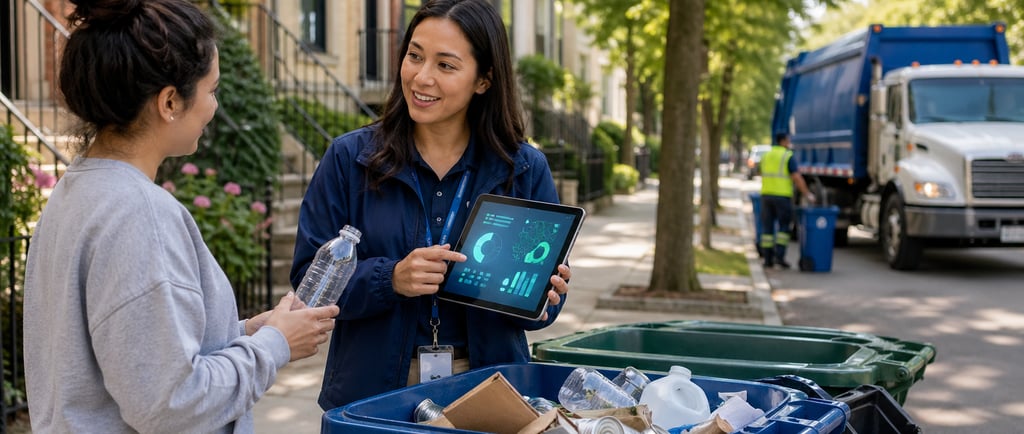
AI-coached recycling ambassadors are local advocates leveraging digital tools and AI engagement features to transform recycling behavior. Through apps, personalized conversation scripts, gamified incentives, and real-time feedback, they move households from mere awareness to sustained, measurable circular action, playing a crucial role in municipal and NGO-led sustainability initiatives.
Context and Why It Matters for Municipal Sustainability
Municipalities, NGOs, and community organizers consistently grapple with an enduring challenge: despite widespread recognition that recycling is essential for environmental stewardship, actual participation often falls short of local sustainability targets. Frontline recycling education has reached saturation—pamphlets, posters, school visits, and public service announcements have all played their part, yet landfill diversion rates frequently plateau at 30-45%, well behind ambitions for circular cities.
This is where the digital revolution, powered by AI engagement, creates unprecedented opportunity. By equipping recycling ambassadors with smart coaching platforms and data-driven outreach, cities and organizations shift recycling from an occasional activity to a resilient community norm. This approach moves beyond traditional programmatic awareness, fostering a culture where the right recycling habits are reinforced continuously, not just during annual campaigns.
From an operational standpoint, digital recycling ambassador programs offer triple bottom-line impact:
Climate: Consistent, correct recycling slashes landfill methane emissions and augments overall carbon reduction efforts, aligning with UN Sustainable Development Goals (SDGs) for responsible consumption and climate action.
Cost: Higher diversion rates reduce municipal waste hauling expenses and landfill tipping fees. A U.S. EPA study found cities with engaged recycling programs saved 20–35% per ton on waste processing.
Community: When trusted local peers drive change—armed with technology and data—trust and social proof accelerate adoption. Think of it as neighbor-to-neighbor influence, supercharged by AI.
Globally, there's a rising urgency for municipalities to modernize sustainability outreach: cities like Toronto, Amsterdam, and Singapore have declared tech-enabled resident engagement key to achieving zero-waste or circular economy goals by 2030.
2. Defining the Opportunity: Closing the Gap from Awareness to Action
Despite years of informational campaigns, recycling rates commonly stagnate, especially in diverse, high-density, or transient neighborhoods. The "last mile" challenge persists: moving residents from knowledge to habitual, measurable action.
Why does this gap remain?
Information Overload: Residents often receive generic recycling advice, resulting in confusion or message fatigue.
Complexity in Rules: Local recycling rules change by city or even block, leading to unintentional errors and contamination.
Lack of Real-Time Support: Traditional helplines or mailers can't answer spontaneous questions or correct mistakes in-the-moment.
Social Norms: Without visible, peer-driven participation, recycling may be perceived as optional or unimportant.
The AI-powered ambassador opportunity:
AI-enhanced digital tools fundamentally change the dynamic by enabling:
Personalized nudges delivered via app notifications, tailored to each household's recycling history and local rules
Real-time chatbots or ambassador check-ins that offer clarity precisely when needed ("Is pizza box cardboard recyclable?")
Dashboards that track not only participation but cumulative community progress, reinforcing collective motivation
Rapid reporting and escalation—ambassadors can flag and resolve barriers quickly, from language access to missed collections
Operational significance:
For municipalities, optimized "last mile" recycling engagement drives multiple measurable benefits:
Reduced Waste Costs: Analytics surface which blocks or buildings need targeted interventions, maximizing the return on outreach investments.
Improved Environmental Outcomes: Pilot studies (e.g., from WRAP UK and Keep America Beautiful) show well-targeted digital ambassador interventions can boost correct recycling behaviors by 30–45% within a year.
Strengthened Community Credibility: Ongoing, AI-backed, face-to-face coaching cultivates lasting trust, increasingly vital in cities seeking public buy-in for broader climate and zero-waste policies.
This model transforms the recycling journey from a fragmented, educational push to a continuous behavior change process—whether residents are new arrivals or old hands.
3. Key Concepts and Definitions for AI Engagement in Recycling
A few essential terms set the foundation for effective, jargon-free communication and program design:
AI Engagement: Utilization of machine learning algorithms to analyze participants' behaviors and deliver context-appropriate tips, reminders, or incentives. For example, an app might prompt a family to set out bins on collection day, or suggest composting during peak yard waste months.
Digital Recycling Ambassadors: Local field workers or volunteers empowered with mobile devices, AI-optimized scripts, and real-time analytics dashboards. These aren't just tech support—they are empathetic, culturally attuned guides for their communities.
Behavior Change Journey: The mapped conversion path a resident travels—from awareness ("I should recycle"), to intention ("I plan to start"), through action ("I'm sorting every week") to maintenance ("This is my habit"). Understanding this journey is critical for effective intervention.
Recycling Apps: Dedicated mobile or web applications used to educate, track behavior, resolve questions, and facilitate two-way communication. Leading apps integrate gamification, push notifications, and feedback mechanisms.
Circular Actions: Specific resident behaviors that advance the circular economy, including correct bin sorting, e-waste drop-off, food scraps composting, and proactive reuse initiatives (such as swapping unwanted items with neighbors).
These concepts form the semantic backbone of AI-driven recycling programs. By tightly aligning language with municipal standards and behavioral science, programs achieve clarity and scalability.
4. Core Framework: The Digital-Driven Recycling Ambassador Model
The AI-Coached Circular Action Framework
A robust ambassador-led recycling strategy works within a clearly defined, digitally powered system:
Four Stages:
Connect: Recruit and onboard local ambassadors using data on neighborhood credibility and communication strengths. Platform onboarding focuses on ease-of-use, ensuring no digital literacy barriers.
Engage: Actionable messaging delivered via the ambassador's app, optimized for timing, language, and resident preference. AI suggests which families need encouragement or troubleshooting, preventing drop-off.
Motivate: Integrated gamification (badges, points, competitions) and AI-personalized praise sustain motivation, addressing the "slip-back" problem common in behavior change initiatives.
Measure: Embedded data collection tracks household actions, app engagement, and program impact with transparency. Escalations and systemic issues are surfaced to municipal leaders for rapid, data-driven responses.
Step-by-Step Process
Recruit the Right Ambassadors:
Use census and social network data to map influencers and trusted leaders.
Prioritize multilingual and culturally diverse representatives.
Focus recruitment on zones with historic recycling underperformance for maximum impact.
Equip With Digital Tools:
Provide durable smartphones pre-loaded with reliable recycling apps.
Offer virtual onboarding and ongoing tech support, such as instant chat helplines.
Map Target Audiences:
Leverage GIS data, building layouts, and landlord engagement for targeted outreach in apartment complexes or "recycling deserts."
Personalize Coaching Scripts:
Develop modular scripts that adapt based on seasonality (e.g., holiday packaging), local events, and trending rejection reasons from municipal sorters.
AI-Assisted Messaging:
Fine-tune nudge timing to match household schedules—e.g., "Remind Mr. Chen at 8 PM; he recycles after dinner."
Use conviction-based language (e.g., "Let's beat last week's record!") to boost motivation.
Facilitate Two-Way Conversations:
Instant Q&A features allow residents to upload photos ("Is this yogurt cup recyclable?"); AI or ambassador provides answers within minutes.
System flags unanswered queries for municipal escalation.
Gamify and Incentivize:
Implement building- or block-level competitions—winner gets local recognition or green service rewards.
Integrate with city loyalty programs for added incentive ("Green Points convertible into transit credits").
Feedback Loops:
Share weekly or biweekly "You recycled X kg—here's how it helps cut emissions!" feedback with both individuals and groups.
Celebrate collective milestones in community forums or local events.
Escalation and Problem Solving:
Aggregate recurring questions ("What about greasy pizza boxes?") and direct them to central FAQ updates or live ambassador group training.
Address physical barriers (lack of bins, collection delays) through integrated reporting tools.
Measure and Adjust:
Use real-time dashboards displaying engagement, correct sorting, and "problem zones."
AI pinpoints residents or blocks showing reduced participation, flagging for personalized outreach.
Worked Example – Municipal Program Scenario
City of Greenhaven (Example):
In 2023, Greenhaven, a mid-sized city facing below-average recycling engagement, deployed an AI-augmented ambassador cohort across three low-performing neighborhoods. Each ambassador managed outreach to 200–300 households using the "GreenCoach" recycling app:
Residents received weekly skill-building tips ("Try removing lids to prevent contamination.")
Earned "Green Points" for consistent sorting, with monthly leaderboards for friendly neighborhood rivalry
Data collection was anonymized, and aggregate progress was visualized both for ambassadors and in public dashboards for transparency and competition
Result:
After six months, over 70% of previously disengaged households participated, with aggregate recycling rates rising above 50%. Ambassador feedback revealed key challenges in multilingual messaging, which were swiftly resolved by AI-driven script adaptation, highlighting the flexibility and responsiveness of the digital approach.
Digital Tactics That Make Recycling Ambassadors More Effective
AI-coached recycling ambassadors work best when digital tools reduce confusion, shorten response time, and turn local recycling rules into clear household guidance. The goal is simple: help residents know what to do, when to do it, and why it matters.
This matters because most recycling loss happens before material ever reaches a facility. The Recycling Partnership's 2024 State of Recycling Report found that only 21% of residential recyclable material is captured in the U.S., while 76% is lost at the household level. That means the largest improvement opportunity is not only at the MRF, the collection route, or the policy level. It is inside kitchens, garages, apartment trash rooms, shared bin areas, and curbside set-out moments. Households need repeated, local, practical support.
The strongest ambassador programs use digital tools to make that support timely and specific. Instead of saying "recycle more," the ambassador can say, "In this building, cardboard goes in the blue cart, plastic bags go back to retail drop-off, and food-stained paper goes in organics if your city accepts it." That difference matters. Generic education creates awareness. Local coaching changes behavior.
The First Tactic: Material Lookup Tool
One of the most effective tactics is the material lookup tool. Residents do not need another long PDF. They need a fast answer when they are holding a yogurt cup, pizza box, aerosol can, coffee pod, plastic film bag, or broken household item. A mobile lookup tool gives the ambassador a single source of truth. It also reduces inconsistent answers between city staff, haulers, landlords, and volunteers.
The Second Tactic: Image-Assisted Recycling Support
The second tactic is image-assisted recycling support. A resident can upload a photo of an item, a messy bin, or a confusing package. The app can classify the material, suggest the correct stream, and route unclear items to a human ambassador or municipal staff member. Research into mobile recycling apps shows that app use can raise recycling intention, especially when users see the app as useful, easy to use, and trusted. One cited recycling app experiment reported recycling rates rising from 20% to 40%, while contamination dropped from 40% to 2%, showing how feedback, points, and direct visibility can shift behavior when the system is well designed.
The Third Tactic: Personalized Reminders
The third tactic is personalized reminders. Collection-day alerts are useful, but AI-coached programs go further. They can segment reminders by household type, language, building type, and past confusion. A single-family household may need a reminder about bin set-out time. A high-rise resident may need a message about keeping plastic bags out of mixed recycling. A student building may need move-out guidance. A restaurant-adjacent apartment block may need contamination reminders tied to food packaging.
The Fourth Tactic: Ambassador Script Support
The fourth tactic is ambassador script support. AI can help ambassadors explain difficult recycling rules in plain language. It can offer short scripts for common questions, translate key guidance, suggest tone, and surface the most relevant local examples. This is especially important in multilingual communities where recycling rules may already feel confusing. The ambassador remains the trusted face. The AI becomes the behind-the-scenes coach that helps them answer faster and more consistently.
The Fifth Tactic: Feedback After Action
The fifth tactic is feedback after action. Residents are more likely to keep participating when they see proof that their effort counted. Weekly or monthly updates can show kilograms diverted, contamination reduced, building participation improved, or missed set-outs recovered. This should be presented at the household, building, block, or neighborhood level, depending on privacy rules. The message should connect personal effort to visible community progress.
The Sixth Tactic: Targeted Education After Contamination
The sixth tactic is targeted education after contamination. The Recycling Partnership's case study on personalized recycling education found that contamination decreased by 22.5% after households received tailored mailers and feedback. The lesson is clear: correction works best when it is specific, timely, and respectful. AI-coached ambassadors can apply the same principle across digital channels, in-person visits, cart tags, landlord notices, app messages, and community meetings.
The Seventh Tactic: Uncertainty Capture
The seventh tactic is uncertainty capture. A resident who is unsure about one item is giving the city useful intelligence. If 500 residents ask about black plastic trays, compostable packaging, lithium batteries, or shredded paper in the same month, that is not just a household problem. It is a system communication problem. The ambassador platform should log these questions, group them by topic, and push the highest-volume confusion points back into city FAQs, app content, building posters, and hauler training.
This is where digital recycling ambassadors become more than outreach staff. They become a live listening system for the recycling program. They reveal what residents misunderstand, where infrastructure fails, which materials cause the most confusion, and which messages actually change behavior.
Building the Ambassador Program: Recruitment, Training, and Field Operations
A strong recycling ambassador program starts with trust. The best ambassador is not always the person with the most technical knowledge. It is often the person residents already recognize, listen to, or feel comfortable approaching. That may be a tenant leader, school volunteer, neighborhood association member, waste picker cooperative representative, faith community organizer, student leader, property manager, youth climate volunteer, or local nonprofit worker.
Recruitment should focus on four traits: local credibility, communication ability, digital comfort, and consistency. Recycling knowledge can be trained. Trust is harder to manufacture. In high-density cities, ambassadors should match the languages and living patterns of the area. In rural areas, they may need to understand transfer station habits, informal reuse networks, and seasonal waste peaks. In university towns, they may need to handle student turnover, move-in contamination, and end-of-term disposal surges.
Training should be practical. Ambassadors need to understand the local material list, common contaminants, collection schedule, escalation process, safety protocol, app workflow, privacy rules, and tone of communication. They should also learn how to avoid shaming residents. Recycling errors are often caused by confusing rules, unclear packaging, lack of bin access, poor signage, or outdated assumptions. A resident who puts a plastic bag in the bin may be trying to do the right thing. The ambassador's role is to redirect, not scold.
The training model should include five layers.
First: Local Recycling Rules
First, local recycling rules. Ambassadors must know what is accepted, what is not accepted, what is accepted elsewhere, and what causes the highest cost or risk. Lithium batteries, plastic bags, textiles, food waste, hoses, cords, propane cylinders, and sharps need special attention because they can damage equipment, start fires, or create safety hazards.
Second: Resident Psychology
Second, resident psychology. People do not change habits because they receive a brochure. They change when the new action is easy, clear, timely, socially reinforced, and connected to a benefit they understand. WRAP's long-running Recycling Tracker continues to study the gap between attitudes, knowledge, and behavior, which shows why recycling campaigns need repeated measurement rather than one-off messaging.
Third: Digital Tool Use
Third, digital tool use. Ambassadors should be trained on the app, CRM, dashboard, issue reporting form, photo upload process, translation tools, offline mode, and escalation categories. They should practice real field scenarios: a resident asks about greasy cardboard, a landlord says bins are overflowing, a senior cannot use the app, a non-English-speaking household needs printed guidance, or a resident reports missed pickup.
Fourth: Conversation Skills
Fourth, conversation skills. Ambassadors need short, clear scripts. They should know how to handle frustration, correct misinformation, and explain local rules without sounding bureaucratic. A useful script might be: "You are right that this looks recyclable, but our local facility cannot sort this item. Put it in the trash here, or use this drop-off option if you want to keep it out of landfill."
Fifth: Field Safety and Boundaries
Fifth, field safety and boundaries. Ambassadors should not inspect private waste without permission, enter unsafe areas, confront hostile residents, or collect sensitive personal data. They should have a clear escalation path for illegal dumping, hazardous waste, harassment, blocked access, pests, and overflowing containers.
The operating structure should be simple. Each ambassador can be assigned a zone, building cluster, school district, event route, or community group. For residential programs, a manageable workload may be 150 to 300 households per ambassador during active rollout, depending on building type and contact intensity. For high-rise programs, one ambassador may cover several buildings if property managers support communication. For rural programs, the same ambassador may combine digital outreach with transfer station visits and community events.
Weekly check-ins matter. Ambassadors should review the top resident questions, contamination patterns, app engagement, complaints, missed collections, and success stories. This prevents the program from becoming a disconnected volunteer effort. It becomes a managed behavior change operation.
The best programs also create ambassador feedback loops. Ambassadors should be able to tell city staff when the recycling rules are unclear, when signage does not match app guidance, when bins are placed badly, when a building needs more capacity, or when residents keep asking about the same item. Their field knowledge can improve the entire waste system.
Measurement, KPIs, and Proof of Impact
AI-coached recycling ambassador programs need strong measurement because recycling outcomes are easy to overclaim. A city cannot rely only on app downloads, social media reach, event attendance, or number of flyers distributed. Those numbers show activity. They do not prove behavior change.
The core measurement question is this: did the program increase correct participation and reduce material loss?
A complete measurement system should track participation, capture, contamination, resident engagement, service barriers, and financial effect. Participation measures whether households are using the system. Capture measures how much recyclable material is being placed in the correct stream. Contamination measures how much wrong material is entering that stream. Engagement measures whether residents are using app features, asking questions, opening reminders, attending events, or responding to ambassador outreach. Service barrier data shows whether the problem is behavior, access, capacity, collection reliability, signage, or policy design.
The Recycling Partnership's 2024 findings show why this distinction matters. If 76% of recyclable material is still being thrown away by households, then a program that only reduces contamination may still leave major recyclable volume in the trash. Cities need to measure both cleaner recycling and more complete recycling.
Useful KPIs include:
Recycling participation rate: the percentage of households setting out recycling or using shared recycling systems within a given period.
Capture rate: the percentage of available recyclable material that reaches the recycling stream.
Contamination rate: the percentage of non-accepted material found in recycling.
Set-out consistency: how often participating households recycle across multiple collection cycles.
Question resolution time: how quickly residents receive answers through ambassadors or the app.
Top confusion items: the materials residents ask about most often.
Repeat error rate: whether the same household, building, or zone keeps making the same mistakes.
Building or block improvement: changes in contamination, participation, and material volume after ambassador visits.
Cost per improved household: total program cost divided by households showing measurable improvement.
Avoided disposal cost: landfill or incineration cost avoided through higher recovery.
MRF quality effect: fewer rejected loads, lower sorting burden, or improved bale quality where data is available.
Measurement should be designed before rollout, not after. A city should establish a baseline for at least four to eight weeks, longer if seasonal patterns are strong. Baseline data may include route audits, cart audits, MRF sampling, app use, tonnage records, contamination reports, and resident surveys. After that, the program should compare intervention zones with similar non-intervention zones where possible.
This is important because waste behavior changes by season. Holidays increase packaging. Spring cleaning changes bulky waste. Student move-out periods raise contamination and dumping. Tourism shifts public bin loads. Weather affects participation. Without a baseline and comparison zones, a city may confuse seasonal variation with program success.
Good measurement also respects privacy. Household-level data should be limited, protected, and used only when necessary. Public dashboards should show aggregate results by neighborhood, route, building group, or program area. The purpose is to guide better service, not shame residents.
Case evidence supports direct, tailored feedback. The Recycling Partnership's personalized education case study reported a 22.5% contamination decrease. Recycle Coach reports that Cal-Waste reduced contamination from 19% to 11% after using targeted education, a 43% decrease. A WRAP-linked "Not Sure Box" intervention in Dorset reduced recycling contamination by almost half by giving residents a direct place to put items they were unsure about. These examples point to the same lesson: feedback must meet people at the moment of uncertainty.
The strongest KPI is not a single number. It is a connected view of behavior, material quality, and cost. A program is working when more residents participate, more recyclable material is captured, contamination falls, operating teams report fewer recurring issues, and residents show better confidence in the system.
Case Studies and Global Lessons for 2026
AI-coached recycling ambassador programs sit at the intersection of three proven ideas: local trust, timely feedback, and digital guidance. Around the world, different programs have tested parts of this model. The lesson for 2026 is that technology alone does not fix recycling behavior. But technology paired with trusted human support can make recycling easier, more consistent, and more measurable.
The United States offers one of the clearest starting points. Residential recycling has major room for improvement. The Recycling Partnership reports that only 21% of residential recyclable material is captured, while 76% is lost at the household level. That gap shows why resident behavior, access, communication, and service design must be treated as core infrastructure, not soft outreach.
The Recycling Partnership's personalized education work is especially relevant. Its case study showed contamination falling by 22.5% after households received tailored education. That is a strong signal for ambassador programs. The message cannot be generic. It must reflect the actual errors residents make, the actual items they touch, and the actual rules in their city.
Recycle Coach provides another practical example. Its reported Cal-Waste case showed contamination dropping from 19% to 11% after targeted education, which equals a 43% reduction. This matters because contamination is not only an environmental issue. It creates operational cost, slows sorting, lowers material value, and can lead to rejected loads.
The UK adds another useful lesson through WRAP's long-running citizen behavior work. WRAP has tracked recycling attitudes, knowledge, and actions for more than two decades through its Recycling Tracker. That long view matters because recycling behavior is not fixed. It changes with packaging formats, policy updates, media attention, service design, and household routines. Cities should treat ambassador messaging as a living program, not a static campaign.
The "Not Sure Box" trial in Dorset shows how a simple intervention can reduce contamination by giving residents a better option at the exact point of confusion. Instead of forcing a guess, the system allowed uncertainty to be captured and corrected. The trial reduced contamination by almost half. For AI-coached ambassadors, this is a powerful design lesson. Do not punish uncertainty. Capture it, answer it, and use it to improve the system.
Deposit return pilots add another layer. A 2024 study of Portugal's deposit return pilot found that deposit systems can change consumer behavior, with success shaped by economic incentives, communication, and location. This is directly relevant to ambassadors because rewards alone are not enough. People need to know where to return items, how the system works, what they receive, and why participation is worth the effort.
Mobile recycling app research also points in the same direction. A study on resident acceptance of mobile apps for household recycling found that intention to use a recycling app positively affects intention to recycle. This supports the use of digital tools, but with an important caution: adoption depends on usefulness, ease, trust, and social fit. A poorly designed app will not save a weak program. A useful app in the hands of a trusted ambassador can improve the resident experience.
The global waste context raises the stakes. UNEP's Global Waste Management Outlook 2024 projects municipal solid waste generation rising from 2.1 billion tonnes in 2023 to 3.8 billion tonnes by 2050. It also estimates that direct waste management costs were USD 252 billion in 2020, rising to USD 361 billion when hidden costs such as pollution, health damage, and climate impacts are included. Without urgent change, global annual costs could reach USD 640.3 billion by 2050.
The OECD's plastics outlook adds pressure. Without stronger action, plastic waste is projected to nearly triple by 2060, with about half going to landfill and less than one-fifth recycled. That makes household sorting, packaging clarity, return systems, and local engagement more important, not less.
The global lesson is clear. High-performing recycling systems need infrastructure, policy, material markets, and public participation. AI-coached ambassadors help connect those pieces at street level. They translate rules into action, turn confusion into feedback, and give cities a better way to understand what residents actually need.
Risks, Barriers, and Ethical Guardrails
AI-coached recycling ambassador programs can fail if cities treat them as a tech project instead of a public trust project. Residents are not data points. Ambassadors are not robots. Recycling behavior is shaped by housing, income, language, access, disability, culture, time pressure, and trust in local institutions. Any program that ignores those realities will produce shallow engagement and uneven results.
The First Risk: Digital Exclusion
The first risk is digital exclusion. Not every resident has a smartphone, stable internet, app confidence, or comfort using digital tools. Seniors, low-income households, new immigrants, people with disabilities, and residents in underserved areas may be left out if the program relies too heavily on apps. The solution is a blended model. Digital tools should support SMS, printed guides, phone hotlines, community events, QR posters, building notices, and in-person help. The ambassador should be able to serve residents who never download the app.
The Second Risk: Language Mismatch
The second risk is language mismatch. Recycling rules are already complex. Poor translation makes them worse. AI translation can help, but it must be checked by local speakers, especially for material names, cultural references, and instructions. Cities should test messages with residents before wide rollout. A phrase that sounds clear in English may not explain the same action in Urdu, Punjabi, Spanish, Arabic, Mandarin, Tagalog, Polish, or Somali.
The Third Risk: Privacy Overreach
The third risk is privacy overreach. Recycling behavior can reveal household routines, consumption patterns, family size, medical waste, income indicators, and religious or cultural practices. Programs should collect the least data needed to improve service. They should avoid unnecessary household scoring, public shaming, or punitive ranking. Data should be aggregated wherever possible, and residents should know what is collected, why it is collected, how long it is kept, and who can access it.
The Fourth Risk: Bias in Targeting
The fourth risk is bias in targeting. If AI keeps flagging the same low-income buildings or immigrant neighborhoods as "problem zones," the program can become stigmatizing. The real cause may be poor bin access, overcrowded waste rooms, confusing signage, landlord neglect, missed pickups, or lack of translated guidance. The system should always ask: is this a behavior problem, a service problem, or an infrastructure problem?
The Fifth Risk: Ambassador Burnout
The fifth risk is ambassador burnout. Recycling ambassadors often deal with repetitive questions, resident frustration, bad odors, overflowing bins, landlord resistance, and emotional labor. If they are volunteers, the risk is even higher. Programs need clear roles, paid positions where possible, recognition, training refreshers, safety support, and realistic workloads. A strong ambassador program should protect the people carrying the message.
The Sixth Risk: Misinformation
The sixth risk is misinformation. AI can produce wrong answers if the local rules are outdated, incomplete, or poorly structured. That is dangerous in recycling because rules vary by city, hauler, MRF, contract, material market, and processing technology. The AI system should only answer from verified local data. When unsure, it should route the question to a human reviewer instead of guessing.
The Seventh Risk: Measuring the Wrong Thing
The seventh risk is measuring the wrong thing. Downloads do not equal recycling. Open rates do not equal clean material. Event attendance does not equal household habit. Cities should not claim success unless they can show material or behavior change through audits, contamination checks, capture estimates, set-out patterns, or credible survey results.
The Eighth Risk: Ignoring the Informal Recycling Sector
The eighth risk is ignoring the informal recycling sector. In many regions, waste pickers and informal collectors already perform critical recovery work. AI-coached ambassador systems should not erase them. They should include them where appropriate, protect livelihoods, improve safety, and connect informal recovery knowledge with formal circular economy goals.
Ethical program design should follow a few clear rules. Make participation easy. Explain data use plainly. Keep humans in the loop. Avoid punishment-first messaging. Provide non-digital access. Test language with real residents. Protect ambassador safety. Separate household support from enforcement unless the city has a clear legal basis and public communication plan.
The purpose of AI in this model is not surveillance. It is support. It should make recycling easier for residents, easier to explain for ambassadors, and easier to improve for municipalities.
The 2026 to 2030 Outlook: Where AI-Coached Recycling Ambassadors Are Headed
Between 2026 and 2030, recycling ambassador programs will likely become more connected to broader circular economy systems. The ambassador will no longer focus only on blue-bin behavior. Their role will expand into food scraps, reuse, repair, e-waste, textiles, bulky waste, deposit return, take-back programs, battery safety, and product stewardship.
This shift is already necessary. Waste volumes are rising, municipal budgets are under pressure, and recycling systems are being asked to prove environmental performance. UNEP projects municipal solid waste rising to 3.8 billion tonnes by 2050, while global annual waste-related costs could reach USD 640.3 billion without stronger action. Cities cannot afford public confusion at that scale.
The First Trend: Hyper-Local Recycling Guidance
The first major trend is hyper-local recycling guidance. Residents will expect answers that match their exact address, building type, hauler, collection schedule, and accepted material list. National guidance will still matter, but the useful answer will be local. AI-coached ambassadors will help cities keep that guidance current across apps, chatbots, QR codes, printed signs, and live conversations.
The Second Trend: Photo-Based Sorting Assistance
The second trend is photo-based sorting assistance. Residents will increasingly expect to scan or photograph items and receive clear disposal guidance. This will be especially useful for confusing packaging, multi-material items, foodservice containers, and items with misleading recycling symbols. The challenge will be accuracy. Image recognition must be tied to local acceptance rules, not generic material recognition.
The Third Trend: Predictive Outreach
The third trend is predictive outreach. Instead of waiting for contamination to spike, cities will use historical data, weather, holidays, move-in cycles, event calendars, and collection records to predict where support is needed. Ambassadors can then focus on high-risk moments: holiday packaging peaks, student move-out, festival cleanup, storm debris, tourist seasons, or new organics rollout.
The Fourth Trend: Reward Integration
The fourth trend is reward integration. Deposit return systems, green points, local business rewards, transit credits, school challenges, and building competitions will become more common. But rewards must be designed carefully. A reward system should encourage correct behavior, not gaming. It should also avoid excluding residents who lack digital access or live in buildings with poor infrastructure.
The Fifth Trend: Connection to Product Stewardship
The fifth trend is connection to product stewardship. As more jurisdictions expand rules for packaging, batteries, electronics, textiles, and hazardous household waste, ambassadors will help residents navigate where items go. This is especially important for lithium batteries and e-waste, where incorrect disposal can create fire and safety risks.
The Sixth Trend: Stronger Public Dashboards
The sixth trend is stronger public dashboards. Residents will want to see whether their effort matters. Cities will want to show progress to funders, regulators, and taxpayers. Dashboards can show diversion trends, contamination reductions, program reach, common questions, and neighborhood milestones. The best dashboards will be transparent without exposing personal household data.
The Seventh Trend: AI-Supported Training for Frontline Waste Workers
The seventh trend is AI-supported training for frontline waste workers. Ambassadors, call center staff, property managers, school coordinators, transfer station workers, and hauler customer service teams will use shared knowledge bases. This can reduce inconsistent answers and make program communication more reliable.
The Eighth Trend: Circular Economy Storytelling
The eighth trend is circular economy storytelling. Recycling alone will not carry the full sustainability message. Ambassadors will explain how correct sorting connects to manufacturing, local jobs, emissions reduction, compost quality, reuse systems, and material security. The Ellen MacArthur Foundation defines a circular economy as one where products and materials are kept in circulation through reuse, repair, remanufacture, recycling, and composting. AI-coached ambassadors can help residents understand their role in that larger system.
By 2030, the most effective programs will not look like one-off recycling campaigns. They will look like local circular action networks. Ambassadors will be supported by verified local data, AI-assisted scripts, multilingual tools, resident feedback systems, route-level performance metrics, and public dashboards. The human role will become more important, not less. AI will handle the sorting of information. Ambassadors will handle trust, context, and behavior change.
Conclusion: From Recycling Awareness to Measurable Circular Action
AI-coached recycling ambassadors offer municipalities, NGOs, haulers, schools, housing providers, and community groups a practical way to close the gap between recycling knowledge and recycling behavior.
The core problem is no longer awareness alone. Most residents know recycling matters. The harder problem is daily execution. People face confusing labels, changing local rules, limited bin access, inconsistent building systems, language barriers, uncertainty about materials, and low confidence that their effort matters. That is why traditional education often stalls. It informs people, but it does not always support them at the moment of action.
AI-coached ambassadors change that pattern. They bring local trust, digital guidance, personalized messaging, real-time answers, and measurable feedback into one operating model. They help a resident decide what to do with a confusing item. They help a property manager fix a recurring contamination issue. They help a city identify which materials cause the most confusion. They help a municipal program move from broad messaging to targeted behavior change.
The data shows why this matters. In the U.S., only 21% of residential recyclable material is captured, and 76% is lost at the household level. Globally, municipal solid waste is projected to rise from 2.1 billion tonnes in 2023 to 3.8 billion tonnes by 2050. Plastic waste is also projected to nearly triple by 2060 without stronger intervention. These numbers make one point clear: recycling systems cannot reach their potential if households remain confused, unsupported, or disconnected from results.
The strongest programs will treat ambassadors as part of the recycling infrastructure. They are not campaign extras. They are the human layer that connects policy, collection, sorting, education, digital tools, and resident behavior.
For cities, the opportunity is clear. Start with a baseline. Recruit trusted local ambassadors. Give them verified digital tools. Build multilingual support. Track real outcomes. Protect resident privacy. Measure contamination, capture, participation, and service barriers. Use every resident question as a signal. Update the system continuously.
AI can make recycling information faster, clearer, and more personal. Ambassadors can make it trusted, local, and human. Together, they can turn recycling from a confusing household chore into a measurable circular action that residents understand, repeat, and take pride in.
Connect
Your trusted partner for scrap metal procurement.
CONTACT
About
haroon@tdcventures.com
+1-307-655-7593
© 2025. All rights reserved.
NEWSLETTER