
AI Summaries of Compliance Changes Each Week
Stay ahead of 2026's fast-changing waste, packaging, and carbon rules with AI-powered weekly compliance summaries built for recycling and circular economy teams.
COMPLIANCE & REGULATORY OPERATIONS IN RECYCLING

1. Why This Topic Matters Now
Recycling, circular economy, waste shipment, packaging, carbon, and product traceability rules are no longer changing at a pace that human teams can comfortably track through inboxes, spreadsheets, and occasional legal memos. In 2026, that reality is sharper than ever. The EU’s new Waste Shipments Regulation starts applying from 21 May 2026, the Carbon Border Adjustment Mechanism entered its definitive period on 1 January 2026, and the Packaging and Packaging Waste Regulation will generally apply from 12 August 2026. At the same time, the Basel Convention’s e-waste amendments took effect on 1 January 2025, tightening the classification and movement rules around e-waste across borders. These are not fringe developments. They directly affect what can move, how it must be documented, how quickly operations must react, and what evidence must exist when regulators or customers ask for proof.
The pressure behind these rules is structural, not temporary. UNEP reports that municipal solid waste is projected to rise from 2.3 billion tonnes in 2023 to 3.8 billion tonnes by 2050, and that the annual global cost of waste could climb to $640.3 billion if systems do not improve. The Global E-waste Monitor 2024 adds another signal of strain: e-waste generation is rising five times faster than documented e-waste recycling. That means regulators are moving because the material problem is moving, and compliance teams are being asked to operate in a world where the legal baseline changes more often, across more jurisdictions, with less room for lag.
That is why weekly AI summaries of compliance changes matter. They are not a cosmetic productivity layer. They are becoming the operating rhythm that allows recycling businesses, exporters, packaging stakeholders, reverse logistics teams, and ESG leaders to see what changed, understand what it means, assign the right action, and preserve an audit trail before the change turns into a missed filing, blocked shipment, failed inspection, or damaged customer relationship.
2. The End of Monthly Compliance Thinking
For years, many organizations treated compliance updates as a monthly ritual. The model was familiar: gather changes, circulate a long memo, hold a meeting, and hope each team translated the message into action. That model no longer fits the tempo of cross-border environmental regulation. When rules affect waste classifications, shipment permissions, carbon disclosures, packaging claims, producer responsibility, and digital product data, a delay of even a few days can create downstream errors in procurement, labeling, customs preparation, transport instructions, contract language, or customer commitments.
The broader regulatory environment supports this view. The OECD’s 2025 Regulatory Policy Outlook says governments need regulatory frameworks that are adaptive, efficient, and proportionate in a rapidly evolving policy environment. A 2026 OECD paper on regulatory compliance costs finds that those costs are material and broadly rising. In plain terms, the rulebook is getting harder to absorb, and the cost of dealing with that rulebook is not static. Waiting for a monthly digest in that environment is a slow system trying to survive inside a fast system.
Weekly AI summaries solve for time compression. They shorten the distance between “the rule changed” and “the right team knows what to do.” They also force cadence. A weekly model is frequent enough to catch material developments before they age into risk, but disciplined enough to avoid the chaos of constant ad hoc alerts. In compliance operations, that middle ground matters. Too slow and the business reacts late. Too noisy and the business stops paying attention.
3. What a Weekly AI Compliance Summary Actually Is
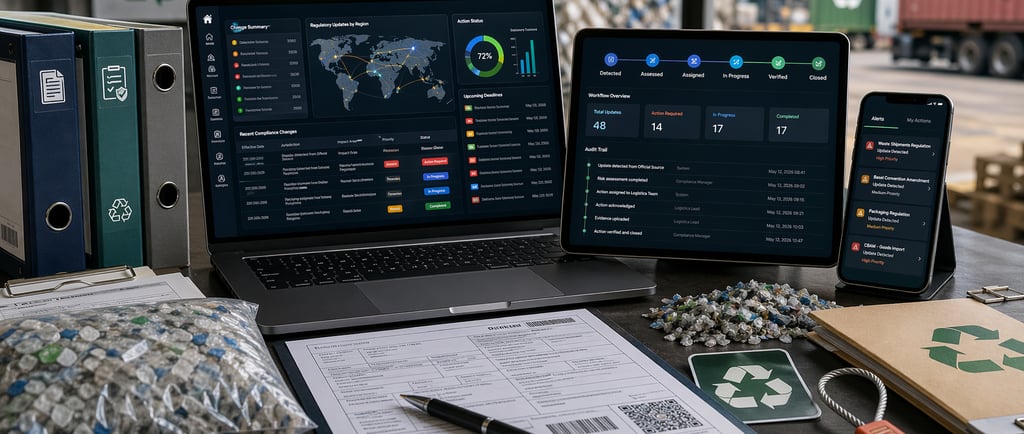
A strong weekly AI compliance summary is not just a chatbot paragraph pasted into email. It is a structured decision product. It ingests regulatory updates, guidance, enforcement signals, standards changes, and relevant market notices. It then ranks them by materiality, maps them to business functions, explains the practical impact in plain language, flags deadlines, recommends next actions, and routes each item into the systems where work actually happens.
For a recycling or circular economy operation, that means the weekly summary should answer six questions every time. What changed. Where it applies. Which business units are affected. What the operational impact is. What must be done next. What proof must be captured. If those six questions are not answered, the summary may still be informative, but it is not yet operational.
The best summaries also translate legal language into role-specific language. A compliance director may need the legal source and effective date. A plant manager may need a short explanation of new sorting, storage, or labeling implications. A logistics lead may need a checklist for shipping documents and customs data. A procurement lead may need a supplier outreach action. One regulatory development can be one rule at the source and four different work items inside the business. AI becomes valuable when it preserves that nuance at speed.
4. Why Manual Monitoring Breaks Under 2026 Conditions
Manual compliance tracking struggles for three reasons: volume, fragmentation, and translation. Volume is the first problem. Regulatory developments now arrive through legislation, delegated acts, regulator guidance, customs notices, treaty amendments, consultation papers, enforcement trends, and industry-specific interpretation. Fragmentation is the second. Those updates live across ministries, treaty bodies, customs portals, commission pages, legal databases, and sector bodies. Translation is the third and most underestimated. Even when a team sees the update, someone still needs to explain what it means for operations, product data, contracts, training, and reporting.
That last point is where many organizations lose time. Knowing that a rule exists is not the same as knowing what must change on Monday morning. Consider the 2026 compliance stack facing globally exposed materials and industrial businesses. CBAM’s definitive regime is now live in the EU. The new Waste Shipments Regulation begins applying in May 2026. The PPWR follows in August 2026. Digital product and lifecycle information requirements are expanding through adjacent EU sustainability frameworks, including product passport concepts that tie compliance evidence, product identity, disposal information, and substances data into digital records. This is no longer a world where a quarterly training deck can keep everyone aligned.
The workforce reality reinforces the same conclusion. The World Economic Forum reports that 63% of employers identify skills gaps as a major barrier to business transformation through 2030, and 85% plan to prioritize upskilling. In compliance, that means teams need systems that teach while they inform. A weekly summary should not only announce change. It should help people act correctly the first time.
5. The Business Case for Weekly AI Summaries
The business case starts with risk reduction, but it does not end there. Faster detection and interpretation reduce the odds of shipment holds, documentation errors, outdated internal procedures, and avoidable legal exposure. They also reduce the soft costs that executives often overlook: duplicated review time, repeated clarification calls, inconsistent responses across sites, and last-minute scramble work before audits or customer questionnaires. The OECD’s work on compliance costs makes the broader point clearly: the burden of regulation is real, and it consumes labor. AI summaries create leverage by reducing the amount of expensive human effort spent on finding and re-explaining the same change across multiple teams.
The second part of the business case is execution speed. Compliance is increasingly tied to commercial continuity. If a waste exporter, recycler, packaging producer, or materials trader cannot prove current compliance quickly, the issue is no longer confined to legal risk. It becomes an operations issue, a customer issue, and often a revenue issue. The companies that respond first are not always the ones with the largest legal departments. They are often the ones with the shortest path from update to action.
The third part is reporting readiness. The Ellen MacArthur Foundation has argued that circular economy progress depends on better measurement and reporting, and that businesses need harmonised approaches to circular reporting. That is exactly where weekly AI summaries become more than a monitoring tool. When every weekly update is logged, classified, routed, acknowledged, and closed, the business starts creating a reusable compliance data asset. That data can support board reporting, management review, supplier engagement, internal controls, ESG narratives, and audit response with far less manual reconstruction.
6. What the Best Teams Put Inside the Weekly Summary
The highest-value weekly summaries are concise on the surface and deep underneath. The headline layer should tell a reader, in minutes, what changed and why it matters. The next layer should segment by function, such as procurement, operations, logistics, quality, sustainability, finance, and legal. The third layer should connect each change to an action, owner, due date, and evidence requirement. The fourth layer should preserve the source material and version history for auditability. Without that layered structure, summaries are easy to read but hard to use.
For example, a weekly summary for a cross-border recycler in 2026 might include a short note on the Waste Shipments Regulation application date, a separate alert on any digital waste shipment workflow requirements, an interpretation note on e-waste classification under the Basel amendments, and a commercial advisory on CBAM exposure for imported covered goods. Each item would be tagged by jurisdiction, function, urgency, and evidence needed. That structure turns compliance monitoring into work orchestration.
Strong summaries also include a plain-language “so what” sentence. That is critical. Legal teams often know the source. What operating teams need is the implication. Do we need to update supplier declarations. Do we need a new customs data field. Do we need to retrain shipment coordinators. Do we need to change how we classify a waste stream. The more direct the explanation, the faster the action.
7. Why AI Improves the Quality of Compliance Communication
AI is useful here because the real bottleneck is not only discovery. It is synthesis. Regulatory texts are long, technical, and uneven in format. AI can summarize, classify, compare versions, highlight deltas, generate role-based briefings, and extract action logic far faster than manual review alone. That does not remove the need for human oversight. It changes where humans spend their time. Instead of hunting for updates and rewriting the same explanation ten times, subject-matter experts can validate interpretation, prioritize risk, and handle exceptions.
This matters because compliance communication fails when it is either too legalistic or too generic. AI helps bridge that gap. It can turn one regulatory development into a legal summary for counsel, a one-paragraph operational instruction for site leads, a task card for system owners, and a short microlearning brief for frontline staff. That is especially useful in globally distributed organizations where the same change must be understood by different teams with different technical backgrounds.
The learning dimension is important. Deloitte’s 2024 High-Impact Learning Organization research found that high-performing learning organizations are 1.5 times more likely to achieve financial targets and 2 times more likely to innovate across products and services. Weekly AI summaries become more powerful when they are paired with short reinforcement content, because the goal is not simply to inform people that the rules changed. The goal is to make the right response repeatable across the organization.
8. The Governance Guardrails That Make AI Summaries Trustworthy
Speed alone is not enough. Compliance teams need summaries they can defend. That means every weekly AI summary should be built on source traceability, human review thresholds, version control, and role-based distribution. Source traceability is non-negotiable. Every claim in the summary should link back to the original regulation, regulator page, treaty amendment, or official guidance. Human review thresholds should be stricter for high-risk items, such as shipment bans, classification changes, carbon declarations, penalties, or effective-date transitions. Version control matters because guidance evolves, and organizations need to know what was circulated, when, and to whom.
Distribution discipline matters just as much. The right people should see the right summary at the right level of detail. Too much legal detail in a frontline channel creates fatigue. Too little detail in a leadership channel creates blind spots. A good system gives executives a trend view, managers an action view, and practitioners a task view. It also creates an auditable record of acknowledgment and follow-through. That is where summaries stop being content and start becoming evidence.
9. The Strategic Shift: From Awareness to Operational Memory
The real long-term value of weekly AI summaries is that they turn compliance from scattered awareness into operational memory. Over time, the organization builds a searchable history of what changed, how it was interpreted, who acted, what evidence was captured, what issues were escalated, and what patterns kept recurring. That historical layer becomes useful for audits, supplier conversations, onboarding, policy refreshes, ESG reporting, and predictive planning. It also improves future summaries, because AI can learn the business context in which different types of changes become material.
This is the deeper reason weekly cadence wins. It creates continuity. In a year when cross-border waste shipment rules, packaging obligations, carbon import requirements, digital compliance records, and circular reporting expectations are all tightening, continuity is what separates organizations that merely hear about change from organizations that can prove they managed it well. That is the point at which weekly AI summaries stop looking like a nice feature and start looking like core compliance infrastructure.
And once that foundation is in place, the next question is not whether the business should distribute weekly compliance intelligence. The real question is how to distribute it in a way that drives action, reinforces behavior, closes the loop, and makes every update reusable across teams, systems, and reporting cycles. That is where the embedded five-layer distribution and reuse toolkit begins.
10. Embedded Five-Layer Distribution and Reuse Toolkit
In a fast-changing regulatory environment, ensuring distribution, adoption, and ongoing reuse of compliance change information is as crucial as the information itself. Here's a five-layer toolkit designed for optimal digital engagement and reinforcement across recycling compliance teams:
Layer 1: AI-Driven Custom Distribution
AI-powered platforms segment compliance updates by role, geography, and business function—ensuring only the most relevant summaries reach the right user. For example, procurement sees supplier-facing recycling updates, while logistics receives transport and export-specific summaries. This approach eliminates information overload and enhances focus, resulting in higher compliance rates and fewer missed actions.
Layer 2: Multichannel Digital Engagement
Updates deploy across multiple digital touchpoints: push notifications via mobile recycling apps, actionable tasks within ERP/compliance systems, and notifications on web dashboards. By meeting users in their preferred digital environments, organizations drive higher engagement benchmarks (often showing >90% acknowledgment rates—far exceeding email or static PDFs).
Layer 3: Closed-Loop Feedback and Audit Trails
Every regulatory action, acknowledgment, or missed deadline is logged in real time within a compliance change log. This closed-loop system not only supports continuous improvement but also creates a robust audit trail, simplifying legal due diligence and external verifications. Internal case studies reveal teams with integrated audit logs resolve compliance incidents 23% faster during regulatory review cycles.
Layer 4: Microtraining and Just-in-Time Reinforcement
As compliance requirements evolve, AI systems automatically trigger microlearning modules (e.g., a 2-minute video on new Basel codes or a step-by-step guide for updated plastics documentation). Recent research by Deloitte shows microtraining increases compliance adoption rates by 21%, underscoring its critical role in sustained behavior change and operational resilience.
Layer 5: Data Packaging for ESG and Circular Metrics
All engagement and action data is automatically formatted for integration with ESG dashboards and sustainability reports. The ability to trace circular actions (like document updates, supplier confirmations, or new recycling process adoption) from alert to managerial acknowledgment transforms traditionally onerous ESG reporting into a digitally managed, audit-ready task.
Expanded Analysis: How AI Engagement Is Transforming Recycling Compliance
The Compliance Landscape: From Manual Scrutiny to Digital Precision
Historically, recycling compliance was synonymous with manual document reviews, staff checklists, and emails that languished unread. Today, as environmental regulations accelerate, AI engagement strategies have redefined the compliance paradigm. Regulatory analytics from McKinsey found that 67% of manufacturing and recycling organizations encountered at least one major compliance rule change in the past year. Of those relying on manual tracking, 42% reported a resulting operational delay or non-compliance incident.
In contrast, teams leveraging digital compliance workflows not only decreased median alert-to-action times by over 60%, but also improved scalability and cross-border collaboration—vital as recycling supply chains stretch from the EU to Asia and beyond.
Case Study: Global Plastics Exporter’s Digital Transformation
A multinational plastics recycler was facing escalating complexity with weekly updates to the EU Waste Shipment Regulation and frequent non-compliance notices from Asian import authorities. After implementing an AI-powered compliance summary platform:
Median response time to rule changes plummeted from 72 hours to just 12 hours.
Non-compliance incidents dropped by 78% within the first quarter.
The team's recycling app integrated directly with customs-facing documentation, automating revision and timestamped logs for ESG reporting.
Leadership cited the digital compliance change log as pivotal, not only for real-time management but also fortifying the company’s annual sustainability reporting and supporting a successful ISO audit with instant documentation access.
The Human Factor: Behavior Change and Adoption Challenges
Digital transformation in compliance goes beyond deploying new tools—it’s about driving sustained behavior change. Gartner's 2023 “Compliance Technology Benchmark Report” notes that the highest-performing teams use recurring digital nudges and microtraining to achieve 99%+ response rates to critical regulatory alerts.
Implementation success hinges on two key factors:
Change Leadership: Compliance directors and ESG heads must champion platform adoption, celebrating early wins (e.g., rapid closure of high-risk incidents) and integrating digital engagement into performance metrics.
Iterative Improvement: Teams should refine alert, escalation, and routing logic as real-world patterns emerge, ensuring the system delivers value without user fatigue.
Future Trends: AI, Predictive Compliance, and Integration
Looking ahead, the next frontier for recycling compliance lies in predictive regulation monitoring and comprehensive integration:
Predictive AI: By analyzing historical change patterns, AI will anticipate new compliance risks, proactively surfacing upcoming regulatory themes before official updates land.
Full-Stack Integration: Expect seamless connectivity between AI compliance platforms, ERP systems, real-time logistics tracking, and ESG scorecards—creating unbroken digital chains from initial rule sensing to external reporting.
Closed-Loop Circularity Data: Circular actions (reuse rates, waste diversion outcomes, supplier sustainability) will increasingly be automated and verified in compliance change logs, supporting regulatory and voluntary frameworks like the EU Green Deal.
Statistics and Success Metrics
According to a 2023 Forrester study, organizations employing weekly AI compliance updates improved circular action rates by 36% compared to those with manual or monthly systems.
Recycling companies using digital compliance tools consistently scored 20-30% higher on ESG and supply chain transparency benchmarks.
80%+ of compliance professionals surveyed cited mobile push notifications as “critical” to avoiding missed compliance changes or shipment snafus.
Final Thoughts
AI engagement—anchored by weekly compliance summaries, integrated digital workflows, and robust reporting—represents the new standard for recycling and circular economy teams seeking both regulatory assurance and competitive advantage. The operational results are clear: faster action, measurable improvement, and enhanced resilience in the face of ever-evolving regulations.
As the circular economy scales globally, digital compliance change management is not just an option—it’s an essential strategic capability. Teams prioritizing AI engagement now stand to lead in both risk reduction and value creation through traceable, actionable, and auditable circular actions.
Ready to take your recycling compliance from static awareness to dynamic, digital engagement? Implement a pilot using the best practices and toolkits above. Your journey toward digital compliance leadership starts here.
Connect
Your trusted partner for scrap metal procurement.
CONTACT
About
haroon@tdcventures.com
+1-307-655-7593
© 2025. All rights reserved.
NEWSLETTER