
AR-Guided Disassembly for Smartphones: Time & Yield Gains in Electronics Recycling
Discover how AR-guided smartphone disassembly slashes teardown time by up to 40%, lifts component yield, and prepares e‑waste lines for scalable, high‑value circularity.
IMMERSIVE TECH RECYCLING & CIRCULAR ELECTRONICS
Instant Answer
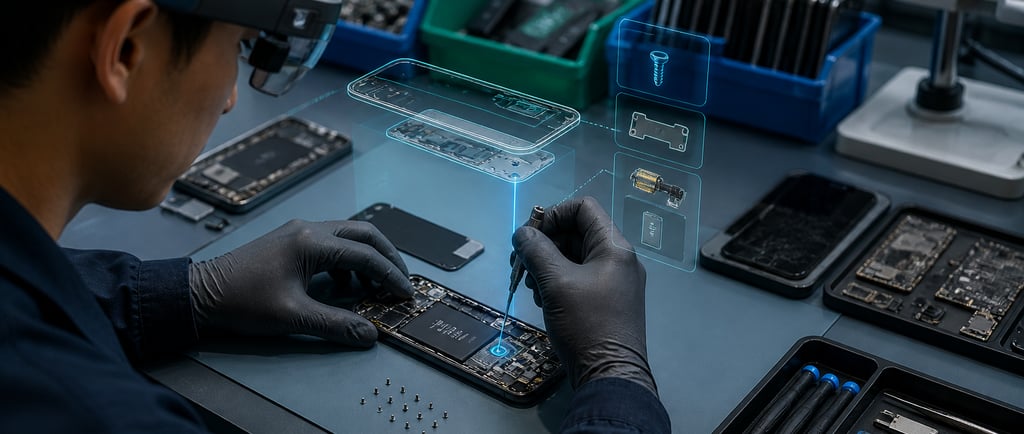
AR-guided disassembly leverages augmented reality (AR) technology by overlaying step-by-step, visual instructions directly onto smartphones slated for recycling or repair. These AR-driven workflows streamline processing on disassembly lines, reducing time per unit by 20–40% (ref. pilots by iFixit, Deloitte, and several OEMs) while significantly increasing yield by minimizing errors and preventing component damage. The result? Higher throughput, increased material recovery, and a future-ready solution for e-waste and refurbishment operations.
Table of Contents
Context: The Stakes in Smartphone Disassembly for XR Recycling Teams
The Problem and Opportunity: Bottlenecks and Breakthroughs
Key Concepts: XR, AR-Guided Disassembly, and Design for Repair
Core Framework: End-to-End AR-Guided Disassembly for Circular Electronics
Implementation Playbook: From Planning to Line Integration
Measurement and QA: Speed, Yield, and Skills Scorecard
Case Patterns and Scenarios: What Success Looks Like
FAQs: AR Disassembly in Recycling Operations
Five-Layer Distribution & Reuse Toolkit (SEO, AEO, GEO, AIO, SXO)
Competitive Differentiation: Market Gaps & Superior Approach
1. Context: The Stakes in Smartphone Disassembly for XR Recycling Teams
Each year, over 50 million metric tons of e-waste are generated worldwide, with smartphones contributing a rapidly growing share as consumers upgrade devices every 2–3 years. Industry reports forecast that by 2027, approximately 1.7 billion smartphones will be retired annually, representing a massive reservoir of recoverable value, from precious metals like gold and cobalt to reusable high-value display and logic modules.
E-waste recyclers, electronics refurbishers, and OEM service arms are now under pressure not only from regulators but also from ESG-driven investors and downstream buyers to maximize both the quantity and quality of recovered components. Public concern around environmental impact, rare earth mineral depletion, and landfill usage means organizations are being held to new transparency and efficiency standards.
Yet, manual disassembly remains dominant—even at large-scale facilities in the US, EU, and APAC—which results in persistent friction: high labor investments, unpredictable throughput, inconsistent part yields, and frequent costly breakage. For operators, these constraints directly erode margins and stifle the ability to scale sustainably. The rise of ever more complex product architectures—think waterproof adhesives and stacked PCB layouts—further exacerbate the problem, creating bottlenecks at every teardown step.
Introducing AR-Guided Disassembly:
AR-guided workflows offer a breakthrough. By superimposing actionable digital instructions, real-time labels, and 3D markers directly onto a technician's field of view (via smart glasses, tablets, or heads-up displays), AR systems remove ambiguity and skill-dependency. Staff do not need to hunt for manuals or cross-reference grainy PDFs—every step is precisely mapped to the device, with prompts that account for model-specific quirks, DfR (Design for Repair) features, and safety-critical precautions.
Real-World Adoption:
Organizations in Europe and Asia, such as Fairphone's partners and RemoTech, are already reporting dramatic improvements in both speed and yield metrics after deploying AR disassembly solutions. With regulatory and economic stakes only rising, understanding, piloting, and ultimately integrating AR-guided disassembly is quickly becoming the new industry baseline for competitive, high-throughput electronics circularity.
2. The Problem and Opportunity: Bottlenecks and Breakthroughs
The Problem: Disassembly Friction, Variable Yield & Missed Potential
Despite global digitization, the majority of electronics recycling and refurbishment lines still depend on purely manual teardown methods. Key challenges include:
Variable Disassembly Times: Time per device can swing wildly (e.g., 7–20 minutes), depending on technician experience, device complexity, and even the time of day. This unpredictability derails line balancing and capacity planning.
High Failure Rate: Manual intervention introduces a high risk of error: connectors are torn, battery tabs are punctured, and intricate parts are broken. iFixit's open teardown studies show breakage rates for critical modules can exceed 30% in poorly trained hands.
Skill Bottlenecks: Rapid staff turnover and the need to cross-train new hires on a rotating roster of device models lead to steep ramp-up curves and inconsistent output.
Underutilization of DfR Features: When technicians don't leverage design-for-repair elements—labelled connectors, adhesive pull-tabs, modular shelves—the intended reusability is lost, defeating manufacturers' sustainability investments.
The Opportunity: Digital Guidance for Scalable, High-Quality Output
AR-powered disassembly brings profound benefits:
Eliminate Guesswork: Real-time, step-matched overlays on smart devices mean even novice technicians can deconstruct the most intricate smartphones with minimal risk of damage, narrowing performance gaps between new and veteran staff.
Throughput Gains: Studies from RemoTech Europe and internal pilots at US e-waste facilities achieved average time reductions of 23–43% across mixed models, with the best-performing lines doubling output per shift after full AR integration.
Yield Optimization: Computer vision and guided workflow steps minimize process errors and surfacing bottlenecks, resulting in up to 18% more components recovered in pristine, resellable condition—a margin driver for commodity/hard-to-source modules.
Continuous Workflow Intelligence: Automated data capture for every teardown (action times, skipped steps, error flags) feeds analytics used to optimize future workflows, train teams more efficiently, and predict equipment or part failures.
Operational and Financial Impact
Increased Revenue: Every device processed quicker means higher line throughput, supporting increased sales to OEM repair and refurb markets.
Margin Uplift: Fewer damaged parts translate directly to higher resale/recycling value, especially for rare modules like Taptic engines or OLED panels.
Reduced Training Costs: Standardized, AR-driven onboarding shrinks time-to-competency for new staff by 30–60%.
Agility to Scale: AR-guided lines are less vulnerable to skill mismatches, so ramping up new facilities or onboarding emerging device designs becomes standardized and less risky.
In essence, AR-guided disassembly represents both a technological and operational leap—addressing root causes of yield loss and inefficiency while future-proofing recycling and refurb businesses against the rapidly evolving electronics landscape.
3. Key Concepts: XR, AR-Guided Disassembly, and Design for Repair
Immersive Tech in Electronics Recycling: XR and AR Defined
XR (Extended Reality): An umbrella term covering AR (Augmented Reality), VR (Virtual Reality), and MR (Mixed Reality). In the context of electronics recycling, XR creates interfaces where physical devices and digital guidance co-exist, enabling intuitive, hands-on work even for complex multi-step tasks.
AR (Augmented Reality): Unlike VR, which immerses users in a fully virtual space, AR projects visual data—work instructions, step-by-step prompts, 3D overlays—into the technician's direct view of the actual device. AR can be accessed via tablets, smartphones, or specialized smart glasses (like Microsoft HoloLens or RealWear Navigator 500).
AR-Guided Disassembly: How It Works and Why It Matters
Step Sequencing & Mapping: After device recognition (via QR, model ID, or computer vision), the AR system presents technicians with contextual visual prompts—"Remove this screw," "Unclip battery connector here"—literally overlaid on the exact component.
Embedded Computer Vision: Most modern AR systems use image recognition to confirm correct steps (e.g., detecting if a connector was removed) before advancing, instantly flagging mistakes and preventing "skip ahead" errors.
Action Logging: Every action and error is timestamped and attributed to specific operators, building a base for skill benchmarking, QA analysis, and continuous process improvement.
Design for Repair (DfR): The Bridge to Circularity
DfR Features: Modern smartphones increasingly feature engineered repair aids—think pull-tabs for batteries, labelled fastener types, or modular display frames. However, these aren't always intuitive. AR platforms integrate and visualize DfR cues for technicians in real-time, maximizing their effectiveness.
OEM Integration: Industry leaders are now including AR-ready digital twins with new device launches, making instant deployment on AR-guided lines possible without custom content development.
Operational Metrics: Throughput and Yield Defined
Throughput: The volume of devices (or specific high-value modules) processed per hour or shift. A key KPI for line profitability and scale.
Yield: The percentage of recoverable value per device—factoring in undamaged, resellable components vs. loss/damage and unusable fractions.
By fusing these elements—XR as the digital platform, AR as the interface, DfR as the enabler, and computer vision as the guardrail—organizations can unlock dramatic gains in both the quantity and value of electronics circularity efforts.
4. Core Framework: End-to-End AR-Guided Disassembly for Circular Electronics
SEE-DO-RECOVER: A Closed-Loop Framework for Smart Disassembly
This proven model provides the structure for high-yield AR-guided smartphone disassembly, adaptable for any operation from boutique repair to large-volume recycling plants.
Step 1: SEE — Real-Time Visual Mapping
Load the device profile into the AR platform, which overlays exact 3D prompts and highlights DfR features recognized in the device under teardown.
Devices are auto-identified either by scanning a code, using device geometry analysis, or tapping into intake records.
Step 2: DO — Action-by-Action Guided Steps
The operator follows prompted step sequences ("Unscrew here," "Lift tab now"), with AR overlays marking precise touchpoints. Hands-free operation (through smart glasses) allows safe, two-handed tool use even on intricate assemblies.
The system verifies completion via sensors or manual confirmation before moving to the next step, preventing common error cascades.
Step 3: RECOVER — Intelligent Data Capture & Yield Logging
Every completed action, anomaly, or error is automatically recorded in real time. This creates a rich trail of performance data for QA and future workflow optimization.
The system aggregates data across shifts and lines, pushing insights to dashboards for yield trends, process bottlenecks, and retraining needs.
Implementation Playbook: From Planning to Line Integration
AR-guided smartphone disassembly should not begin with headsets, software licenses, or a vendor demo. It should begin with a clear view of where value leaks from the current process. In most electronics recycling and refurbishment operations, the largest losses come from inconsistent teardown times, avoidable component damage, battery handling risk, poor model identification, weak line balancing, and training gaps between experienced and new technicians.
The business case is stronger in 2026 than it was even two years ago. Global e-waste reached 62 million tonnes in 2022, equal to 7.8 kg per person, and only 22.3% was documented as formally collected and recycled. The same global monitor projects e-waste to reach 82 million tonnes by 2030, while documented collection and recycling is not keeping pace. That means every serious electronics recycler is competing for a larger stream of devices, but also facing more pressure to recover higher-value fractions with less waste.
For smartphones, the opportunity sits in the gap between bulk recycling and controlled disassembly. A shredded smartphone can still yield metals, but a carefully disassembled smartphone can preserve displays, cameras, batteries, speakers, vibration motors, charging ports, logic boards, frames, and resale-grade modules. That difference matters because the value of a device is not only in its grams of gold, copper, cobalt, aluminum, and rare earth elements. It is also in the condition of its reusable components.
A strong AR-guided disassembly rollout follows six practical stages.
First, map the current teardown baseline. Operators should record the average time per device model, the fastest and slowest teardown times, the damage rate by component, the percentage of devices routed to repair, refurbishment, parts harvesting, and material recovery, and the number of units each technician processes per shift. A mixed-model line should not settle for one average. An iPhone, Samsung Galaxy, Google Pixel, Xiaomi, Oppo, or older low-cost Android device may each have different adhesives, fastener layouts, battery access risks, connector placement, and display removal steps.
The baseline should include at least 500 to 1,000 units across common models before any AR system is installed. A smaller pilot can work, but it may exaggerate gains if the sample includes easier devices or more experienced workers. The best operators measure time and yield across three worker groups: new hires, mid-level technicians, and senior teardown specialists. This creates a fair view of whether AR closes the skill gap or simply makes already-good workers slightly faster.
Second, choose the first use case carefully. The best starting point is rarely the full teardown of every smartphone model. A better pilot usually starts with one high-value, high-error, high-volume workflow. Battery removal is often a strong candidate because punctures and thermal risk carry safety, insurance, and downtime consequences. Display removal is another strong use case because OLED and premium screen assemblies can retain meaningful resale value if removed cleanly. Logic board removal also matters because board damage can reduce both refurb value and downstream metal recovery quality.
The pilot should target one of three outcomes. The first is speed, measured by reduced minutes per unit. The second is yield, measured by more reusable components recovered without damage. The third is training compression, measured by faster time-to-competency for new staff. Trying to chase all three at once can blur accountability. The strongest pilots define one primary outcome and two secondary outcomes.
Third, build model-specific digital work instructions. AR works when guidance is precise. It fails when it simply turns a PDF manual into a floating screen. Each device profile should include exact screw locations, screw type warnings, cable and connector alerts, adhesive softening cues, battery risk flags, pull-tab direction, heat guidance where allowed, tool choice, force warnings, component grading rules, and pass/fail checks.
This is where regulation is pushing the market in a useful direction. From June 20, 2025, the EU's ecodesign and energy labelling rules apply to smartphones and tablets placed on the EU market. These requirements include durability, repairability, battery endurance, and spare-parts availability expectations. For recyclers and refurbishers, this means future device streams should contain more repair-related data, clearer repairability signals, and stronger pressure on OEMs to support recoverable design.
The EU Batteries Regulation also matters. Article 11 on removability and replaceability of portable batteries is scheduled to apply from February 2027, with guidance already under discussion. This does not remove the need for skilled disassembly. It changes the nature of the task. If batteries become easier to remove with commercially available tools, AR can help operators exploit that design shift at scale by reducing mistakes, standardizing steps, and speeding up safe removal.
Fourth, choose the right hardware for the work cell. Smart glasses are attractive because they keep both hands free, but they are not always the right first device. Tablets can work well for bench-based disassembly, especially if the facility is testing AR for the first time. Smart glasses are more useful where the technician needs continuous guidance, voice control, step confirmation, and minimal interruption.
The hardware decision should account for lighting, bench height, tool positioning, protective eyewear, gloves, camera focus distance, battery safety rules, worker comfort, field of view, hygiene, device durability, and shift length. A headset that works for a 20-minute demo may not work across an eight-hour shift. Weight, heat, eye strain, fogging, and cleaning procedures matter. So does the worker's ability to ignore unnecessary overlays and focus on the physical device.
Fifth, connect AR to the operating system of the facility. A stand-alone AR guide is useful. A connected AR workflow is much more valuable. The AR system should integrate with intake records, device grading, inventory, parts harvesting, repair routing, warehouse systems, quality checks, and downstream sales channels. When a device enters the facility, the system should know its model, storage capacity where relevant, lock status, condition grade, declared issue, target route, and priority.
This matters because the same phone may deserve different disassembly logic depending on its commercial route. A device headed for parts harvesting needs a different process than one headed for certified refurbishment. A cracked-display phone with a good logic board may require careful board extraction. A water-damaged phone may need a different safety path. A device with battery swelling should trigger a safety-first path, not a normal teardown sequence.
Sixth, train people around the system, not under it. AR should not be presented as a surveillance tool or a replacement for worker skill. It should be positioned as a precision aid. Technicians should help refine the instructions, flag confusing overlays, report steps where the system slows them down, and identify model-specific tricks that only experienced workers know.
The best pilots create a feedback loop between technicians, line supervisors, safety officers, quality teams, and content builders. Every week, the team should review which steps took longer than expected, where technicians paused, where errors occurred, which instructions were ignored, and which overlays caused confusion. This turns AR into a living process tool rather than a fixed training artifact.
A realistic pilot can run in 8 to 12 weeks. The first two weeks should focus on process mapping and baseline data. Weeks three and four should create digital instructions and prepare hardware. Weeks five to eight should run the controlled pilot. Weeks nine to twelve should refine the workflow, compare results against baseline, and decide whether to scale. A facility with strong data discipline may move faster. A facility with poor baseline measurement should move slower, because weak measurement creates false confidence.
The key is to avoid treating AR as a novelty. The goal is not to make disassembly look futuristic. The goal is to reduce time, recover more value, lower risk, and create repeatable performance across workers and models.
Measurement and QA: Speed, Yield, and Skills Scorecard
AR-guided disassembly succeeds only if it proves measurable gains. The facility needs a scorecard that tracks speed, yield, safety, quality, learning, and financial value. Without measurement, AR becomes another expensive pilot that looks impressive on a tour and fails under production pressure.
The first metric is takt time by model and step. Takt time should not be measured only as total minutes per phone. It should break down each stage: intake confirmation, case opening, display removal, battery isolation, battery removal, connector release, camera removal, logic board removal, frame separation, parts sorting, component grading, and final material routing. This tells the team whether AR speeds the entire process or only shifts the bottleneck to another step.
A good target for the first pilot is a 15% to 25% reduction in time per unit for novice or mid-level technicians. Stronger results are possible when the existing process is weak, training is inconsistent, or model variation is high. Public AR manufacturing studies outside electronics recycling have shown meaningful speed and error benefits. One study comparing HoloLens-based work instructions with other model-based instruction formats reported 16% time savings over tablet AR instructions, with lower error rates than non-AR users. Taqtile has also reported field maintenance and training cases where AR work instructions reduced errors by more than 50% in one defense training setting and 92% in a U.S. Air Force maintenance assessment. These are not smartphone recycling results, but they show why guided visual work instructions can matter in complex hands-on tasks.
The second metric is reusable component yield. This is where AR can create more financial value than time savings. A one-minute reduction in teardown time matters. But recovering an undamaged OLED display, camera module, charging board, or logic board can matter more. Facilities should measure yield in three layers.
The first layer is physical recovery: was the part removed? The second is quality recovery: was the part removed without damage? The third is commercial recovery: did the part pass testing, grading, and resale requirements? A part that is physically recovered but fails testing should not be counted as full yield. A part that is recovered cleanly but cannot be sold because it lacks traceability should also be separated from resale-grade yield.
The third metric is damage rate by failure mode. "Part damaged" is too vague. A useful QA system should classify failures as torn flex cable, punctured battery, cracked display, stripped screw, missing screw, damaged connector, bent frame, board scratch, heat damage, cosmetic damage, ESD event, contamination, wrong bin, or incomplete removal. Each failure mode should be tied to a process step and model type.
The fourth metric is worker learning rate. AR can reduce the burden on senior technicians by helping new staff reach acceptable performance faster. The facility should track how many units a new worker must process before reaching the target standard. For example, before AR, a new hire may need 200 units and three weeks to reach 90% of the target output rate with acceptable damage levels. With AR, that target may fall to 100 units and one to two weeks. The exact numbers will vary, but the principle is clear: training compression has real cost value.
The fifth metric is process adherence. AR systems can log whether each step was completed, skipped, repeated, reversed, or manually overridden. This data should not be used to punish workers without context. It should be used to identify unclear instructions, poor station layout, weak tool access, model-specific surprises, or shortcuts that might be valid. When many experienced workers skip the same AR step and still produce better results, the instruction may be wrong.
The sixth metric is safety. Smartphone disassembly carries specific hazards, especially around lithium-ion batteries. QA should track battery punctures, swollen battery incidents, heat exposure events, smoke events, glove or tool failures, ESD incidents, and near misses. A facility that improves speed but increases safety incidents has not improved the process.
The seventh metric is financial yield per device. This is the metric that makes the case to leadership. It combines labor time, parts value, damage reduction, resale value, material recovery, training cost, safety incidents, rework, and rejected components. A strong AR pilot should estimate value per 1,000 devices before and after deployment.
For example, assume a facility processes 1,000 mixed premium smartphones. If AR reduces teardown time from 14 minutes to 11 minutes, the facility saves 3,000 labor minutes, or 50 labor hours. If labor cost is $22 per hour fully loaded, that is $1,100 in labor savings per 1,000 phones. But if the same pilot increases resale-grade display recovery by 6 percentage points and the average resale-grade display value is $35, that may add $2,100 per 1,000 phones. If battery puncture incidents fall and rework declines, the total value can rise further. The point is simple: labor savings matter, but preserved component value often carries the larger upside.
The eighth metric is data quality. AR-guided disassembly creates a new source of operational intelligence. But bad data can mislead managers. A QA lead should audit whether model recognition is accurate, whether workers are confirming steps correctly, whether camera verification works under real lighting, whether manual overrides are coded properly, and whether scrap, repair, and parts streams are being tagged consistently.
A mature scorecard should answer five questions every week. Are devices moving faster? Are more parts being recovered in usable condition? Are safety incidents falling or staying controlled? Are new workers reaching target performance faster? Is the facility earning more value per device after AR costs?
When the answer is yes across those five questions, AR is no longer a pilot. It is a production capability.
Case Patterns and Scenarios: What Success Looks Like
The strongest evidence for AR-guided smartphone disassembly will come from recycling and refurbishment operators that publish full production data. That evidence is still limited. But related case patterns from electronics recovery, industrial AR, OEM disassembly robotics, and repairability regulation show where the market is heading.
Apple's Daisy robot is the clearest example of how much value major OEMs see in controlled device disassembly. Apple says Daisy can disassemble multiple iPhone models and recover materials more effectively than conventional recycling methods. Apple announced in 2019 that Daisy would process iPhones returned through Best Buy in the U.S. and KPN in the Netherlands. Reporting in 2024 and 2026 placed Daisy's capacity at up to 1.2 million iPhones per year for a single unit.
Daisy is robotics, not AR. But the lesson for AR-guided disassembly is direct. Apple built dedicated disassembly systems because controlled teardown can recover materials and parts that are harder to capture through bulk processing. Most recyclers cannot afford custom robotics for every model and brand. AR can act as a more flexible middle path: human dexterity plus digital guidance, model-specific instructions, and measurable QA.
A second case pattern comes from industrial AR work instructions. In manufacturing and maintenance, AR has repeatedly been tested as a way to reduce errors, shorten training, and guide complex physical tasks. The 2026 research literature continues to examine HoloLens-based AR work instructions in real manufacturing settings, reflecting a shift from lab demos to practical production analysis. For smartphone teardown, the same logic applies. The task is small-scale, high-precision, multi-step, and prone to expensive mistakes. A technician must remember hidden connectors, different screw lengths, adhesive behavior, heat sensitivity, cable routing, and part grading rules. That is exactly the type of work where visual guidance can reduce cognitive load.
A third case pattern comes from right-to-repair and product design regulation. The EU's smartphone and tablet rules have created a stronger baseline for repairability, battery endurance, spare parts, and consumer information. This creates a better environment for AR-guided disassembly because the physical product and the digital workflow can become more aligned. When devices are designed with repair and parts access in mind, AR can help workers recognize and use those features correctly.
A fourth case pattern comes from high-value e-waste material recovery. The Royal Mint's precious metals recovery facility in Wales was designed to process up to 4,000 tonnes of printed circuit boards per year and recover valuable metals including gold, copper, silver, and palladium. This case is not about smartphone AR, but it shows the economics behind cleaner upstream separation. The better the input stream, the more predictable the recovery process becomes. AR-guided smartphone disassembly can improve upstream sorting by separating batteries, boards, cameras, displays, frames, magnets, and other components before downstream treatment.
A fifth scenario is the mixed-brand refurbisher. This operator receives thousands of used phones from trade-in programs, insurance returns, enterprise refresh cycles, and carrier channels. The facility's biggest problem is model variation. Senior technicians know the quirks, but new hires damage parts. AR helps by identifying the model, loading the correct sequence, warning about fragile connectors, and logging mistakes. The gain may be less about absolute speed and more about reducing variance between workers.
A sixth scenario is the battery safety line. Here, the facility is less focused on parts resale and more focused on safe, controlled battery removal before shredding or material separation. AR can highlight battery location, swelling indicators, safe pry zones, pull-tab direction, heat restrictions, and isolation steps. It can also force a safety confirmation before the worker proceeds. In this case, the best KPI may be fewer incidents, fewer near misses, and faster battery removal without increased risk.
A seventh scenario is the OEM-authorized repair and harvesting partner. This operator needs traceability. It cannot simply remove parts and sell them into informal channels. It needs chain-of-custody, component grade, test results, and route history. AR can create a digital record during teardown, capturing who removed the part, from which device, under which process, and with what grade. That data can support warranty decisions, resale confidence, and compliance.
An eighth scenario is the emerging-market recycler upgrading from informal teardown to documented processing. In many regions, e-waste processing still includes unsafe manual methods. AR alone cannot fix poor infrastructure, weak worker protection, or informal trade flows. But when paired with proper safety controls, training, collection systems, and downstream partnerships, AR can help standardize safer disassembly practices and improve material separation. This matters because the Global E-waste Monitor shows documented collection and recycling remains far below total generation, and large amounts of recoverable value remain outside formal systems.
The pattern across all these scenarios is consistent. AR does not need to replace people. It needs to reduce avoidable mistakes, shorten learning curves, create reliable process data, and preserve more value per device.
FAQs: AR Disassembly in Recycling Operations
What is AR-guided smartphone disassembly?
AR-guided smartphone disassembly uses augmented reality to place visual instructions over the real device while a technician works. The system may run on smart glasses, a tablet, or a bench-mounted screen with camera support. It can show screw locations, connector warnings, battery removal steps, tool guidance, safety alerts, and component grading prompts.
Is AR-guided disassembly only for large recyclers?
No. Large facilities may gain the most from connected systems, dashboards, and multi-line deployment, but smaller refurbishers can still benefit from AR-guided work instructions for high-value models and common failure points. A small operation may start with tablet-based guidance for battery and display removal before moving to smart glasses or computer vision.
Does AR replace skilled technicians?
No. AR supports skilled work. It helps newer technicians avoid common mistakes and helps experienced technicians maintain consistency across many models. The best systems improve worker performance rather than deskill the job. Experienced technicians are still needed to handle exceptions, diagnose damage, refine instructions, and train the system.
What smartphone parts benefit most from AR-guided removal?
The strongest candidates are displays, batteries, camera modules, logic boards, charging ports, speaker modules, vibration motors, frames, and high-value connectors. Displays and batteries often matter most because display damage affects resale value and battery damage affects safety.
How much time can AR save?
A realistic first target is 15% to 25% time reduction for selected workflows, especially with novice and mid-level workers. Larger gains are possible where the current process depends heavily on memory, paper manuals, or senior staff intervention. Related AR assembly and maintenance studies have shown lower error rates and time savings in complex work instruction tasks, including reported 16% time savings in a HoloLens work-instruction study compared with tablet AR.
How does AR improve yield?
AR improves yield by reducing wrong tool use, skipped steps, connector damage, excessive force, heat misuse, battery punctures, and part misclassification. It also helps technicians follow model-specific teardown paths rather than using one generic method across different phones.
What data should an AR system capture?
At minimum, the system should capture model ID, route decision, step start and finish times, skipped steps, manual overrides, component outcome, damage type, worker ID, station ID, safety flags, and final part grade. More advanced systems can capture images, computer vision confirmations, tool usage, and downstream test results.
What is the biggest mistake facilities make when piloting AR?
The biggest mistake is starting with technology rather than process economics. A facility should first identify where time, value, and safety are being lost. Then it should choose one workflow with a clear baseline and a clear target. A broad demo across too many models usually produces weak evidence.
How does AR connect to right-to-repair regulation?
Right-to-repair rules and ecodesign requirements can make devices easier to service, document, and disassemble. AR can turn those design improvements into consistent shop-floor practice. EU rules applying from June 20, 2025 require new durability, repairability, energy labelling, and spare-parts-related measures for smartphones and tablets sold in that market.
Is AR better than robotics?
It depends on the operation. Robotics can be powerful for high-volume, narrow-scope, repeatable disassembly. Apple's Daisy shows what dedicated robotics can do for selected iPhone models at large scale. AR is more flexible for mixed-brand, mixed-condition, and lower-volume environments where human dexterity is still needed.
Can AR help with compliance?
Yes, if the system captures reliable records. AR can document the process used, the worker, the device model, the removed parts, the safety steps, and the final route. This can support internal QA, buyer confidence, ESG reporting, repair partner requirements, and regulatory audits.
What should a facility buy first?
A facility should not buy first. It should measure first. The first investment should be a baseline study of time, yield, damage, training, and safety. After that, the facility can test a tablet-based AR workflow, a smart-glasses workflow, or a camera-guided bench setup depending on the use case.
Competitive Differentiation: Market Gaps and Superior Approach
Most AR disassembly content fails because it sounds like a technology pitch. It focuses on headsets, 3D overlays, digital twins, and futuristic factory images. Operators do not buy that. They buy lower cost per unit, higher recovered value, fewer damaged parts, safer battery handling, faster worker training, and better audit records.
The first market gap is weak baseline measurement. Many facilities do not know their true teardown time by model, true damage rate by component, or true yield per worker group. They may know total daily output, but not where value is lost. A superior AR approach starts with measurement before deployment. It treats AR as a process control tool, not a gadget.
The second gap is generic work instructions. A generic "remove back cover, disconnect battery, remove board" sequence is not enough. Smartphone disassembly is model-specific. Screw length, adhesive strength, connector layout, heat tolerance, and part value differ across devices. A superior approach builds and updates digital work instructions by model, condition, and recovery route.
The third gap is poor integration with grading and resale. Many AR systems can guide a worker through a task, but they do not connect the removed part to testing, grading, inventory, and sales. That limits financial proof. A superior approach connects AR data to the full parts recovery chain, from device intake to final resale or materials routing.
The fourth gap is underused worker knowledge. Experienced technicians know which steps are risky, which tools work best, and where manuals are wrong. If the AR vendor builds instructions without worker input, the system will feel imposed and may slow the line. A superior approach turns senior technicians into workflow editors and QA partners.
The fifth gap is treating compliance as a reporting task after the fact. In electronics recycling, compliance should be captured during the work. AR can create a record of battery removal, hazardous handling, component routing, and part grading as the process happens. This is stronger than trying to reconstruct the process later from paper notes or batch-level assumptions.
The sixth gap is ignoring the coming repairability shift. Regulations are making repairability, spare parts, durability, and battery access more visible. EU smartphone and tablet rules already apply from June 20, 2025, and battery removability requirements under the EU Batteries Regulation are set to apply from February 2027. Recyclers and refurbishers that build AR-ready workflows now will be better placed to handle devices designed under these rules.
The seventh gap is confusing automation with autonomy. Full robotic disassembly is attractive, but it can be expensive, narrow, and hard to adapt across mixed device streams. Apple's Daisy is impressive, with reported capacity of up to 1.2 million iPhones per year, but it is also a specialized OEM system. Most recyclers need a flexible path that works across brands, models, conditions, and volumes. AR-guided human disassembly can fill that middle ground.
The eighth gap is weak financial storytelling. A vendor may claim "30% faster disassembly," but the buyer needs to know what that means per 1,000 devices, per shift, per month, and per facility. The superior approach translates operational gains into money. It shows labor hours saved, component value preserved, rework avoided, incidents reduced, and training time cut.
The strongest positioning for AR-guided smartphone disassembly in 2026 is simple: it is the bridge between manual teardown and full automation. It keeps human judgment where human judgment still matters, adds digital precision where mistakes are costly, and creates the data trail that modern circular electronics operations need.
Future Trends: Where AR-Guided Smartphone Disassembly Goes Next
The next phase of AR-guided disassembly will be shaped by regulation, AI, robotics, digital product records, repairability scoring, and the economics of critical materials.
The first trend is AI-assisted work instruction generation. Today, creating AR teardown instructions can be time-consuming. Teams need device scans, manual steps, 3D assets, safety notes, and QA rules. Over the next few years, AI systems will help convert repair manuals, teardown videos, CAD files, technician notes, and historical repair data into draft work instructions. Human review will still be necessary, especially for safety-critical steps, but content creation will become faster.
The second trend is computer vision verification. Early AR systems often depend on manual confirmation. The next stage is visual proof. The system will recognize whether the correct screw was removed, whether a connector is still attached, whether a battery is swelling, whether a display has cracked, or whether a part was placed in the wrong bin. This can reduce false confirmations and improve QA.
The third trend is digital product passports and richer device-level data. As product transparency rules grow, recyclers may gain better access to information about materials, parts, repair steps, battery chemistry, and safe handling. This could make AR workflows more accurate and easier to update. It could also improve downstream reporting for ESG, critical mineral recovery, and compliance.
The fourth trend is repairability-led product design. The EU's 2025 smartphone and tablet rules and the 2027 battery removability requirements are part of a broader shift toward products that last longer, can be repaired more easily, and provide better information to consumers and repairers. If device design becomes more repair-friendly, AR can help recyclers capture that value by showing workers exactly how to access reusable parts without damage.
The fifth trend is hybrid human-robot disassembly. Full robotics will remain useful for high-volume, predictable streams. Human technicians will remain better for mixed-condition devices, exceptions, and judgment-heavy tasks. AR can sit between the two. It can guide humans, collect process data, and identify which steps are ready for partial automation. Over time, facilities may use AR data to decide which teardown steps should be assigned to robots, cobots, heated separation tools, or manual benches.
The sixth trend is yield-based procurement. Buyers of recovered parts and materials will increasingly care about traceability, quality, and consistency. A recycler that can prove clean removal, grade history, safe handling, and batch-level composition may earn better buyer confidence than one selling poorly documented mixed fractions. AR can support that proof.
The seventh trend is insurance and safety value. Lithium-ion battery incidents are a serious concern across e-waste, transport, storage, and recycling. AR-guided battery workflows can help standardize safe handling, flag high-risk devices, and document safety steps. Facilities may eventually use this data in risk reviews, insurance discussions, and customer audits.
The eighth trend is workforce redesign. Many recycling facilities struggle with turnover, training gaps, and inconsistent performance. AR can make the job easier to learn, but it also creates new roles. Facilities will need AR workflow editors, teardown data analysts, QA reviewers, digital instruction managers, and technician trainers who can translate shop-floor knowledge into digital guidance.
The ninth trend is circularity reporting with stronger evidence. Companies no longer need vague claims about recycling more. They need proof. How many devices were processed? How many batteries were removed safely? How many displays were recovered for reuse? How many boards went to precious metal recovery? How much material was lost? How much value was preserved? AR-guided disassembly can feed these answers directly from the line.
The tenth trend is regional specialization. Europe will likely push AR adoption through compliance, repairability, and circular economy regulation. North America may push adoption through labor cost, trade-in programs, and enterprise device recovery. Asia may push adoption through volume, OEM-linked refurbishment, and parts supply chains. Africa, Latin America, and South Asia may use simpler AR tools to support safer formalization and better training where informal e-waste handling remains common.
The future is not one perfect automated recycling plant. It is a network of smarter disassembly environments, each using the right mix of people, AR, robotics, product data, safety systems, and recovery partners.
Conclusion: AR-Guided Disassembly Is a Practical Path to Higher-Value Electronics Circularity
Smartphone recycling has reached a point where bulk processing alone is not enough. The world is generating more e-waste, formal collection and recycling remain too low, and billions of dollars in recoverable materials are still being lost. In 2022, only 22.3% of global e-waste was documented as properly collected and recycled, while global e-waste generation is projected to reach 82 million tonnes by 2030.
At the same time, smartphones are becoming too valuable, too complex, and too regulated to treat as simple scrap. Inside each device are reusable components, recoverable critical materials, safety risks, compliance obligations, and commercial opportunities. The operators that win will be the ones that recover more value per device, not only more weight per tonne.
AR-guided disassembly offers a practical route forward. It does not require every recycler to build an Apple-style robot. It does not ask technicians to become software engineers. It gives the worker better instructions, the supervisor better process visibility, the QA team better evidence, and the business better control over time, yield, safety, and recovered value.
The strongest use cases are clear: battery removal, display harvesting, logic board extraction, worker training, model-specific teardown, component grading, and compliance records. The strongest pilots are also clear: start with a baseline, choose one valuable workflow, build precise model-specific guidance, test hardware under real shift conditions, connect the workflow to inventory and QA, and measure results per 1,000 devices.
In 2026, AR-guided disassembly should be viewed as a serious operating method for circular electronics. It is not a visual gimmick. It is a way to standardize skilled work, preserve component value, reduce avoidable damage, improve safety, and prepare for a market where repairability, traceability, and recovery performance matter more every year.
The future of smartphone recycling will not be defined by who processes the most devices. It will be defined by who recovers the most usable value from each device, with the least waste, the strongest evidence, and the safest process. AR-guided disassembly belongs at the center of that future.
Connect
Your trusted partner for scrap metal procurement.
CONTACT
About
haroon@tdcventures.com
+1-307-655-7593
© 2025. All rights reserved.
NEWSLETTER