
AR Overlays for On-Site Training
Discover how AR overlays and AI engagement are transforming on-site training for MRFs, recycling yards, and OEMs. Learn actionable frameworks to boost safety, cut contamination, and drive measurable circular outcomes.
AI & DIGITAL ENGAGEMENT IN SUSTAINABILITY
Introduction: Context for Industrial Training Teams
Industrial training teams working in environments like Material Recovery Facilities (MRFs), recycling yards, and original equipment manufacturers (OEMs) face rapidly shifting demands. As sustainability regulations tighten and the push for circularity accelerates, these organizations must upskill teams continuously—on the fly, on the floor, and without sacrificing productivity targets.
Yet, high staff turnover, the increasing complexity of recycling equipment, and the rise in differentiated materials streams magnify the challenge. For industrial operators and maintenance leaders, it’s a dual mandate: deliver measurable performance improvement while ensuring that every worker not only recalls procedures, but reliably executes sustainable practices under pressure.
Digital innovation, particularly through the convergence of AI engagement and AR overlays, is fundamentally changing the playbook for on-site industrial training. These technologies act as real-time, AI-powered copilots, turning traditional training into dynamic, context-sensitive coaching—right where circular actions happen.
Why Now? The Rising Stakes
Global data shows that improper recycling handling causes 25–40% of MRF throughput to be contaminated, undermining both operational efficiency and sustainability goals (Source: EPA, Eunomia). Meanwhile, industrial safety incidents attributable to improper equipment use still account for a significant portion of recordable events. The cost of ‘missed training translation’—when knowledge isn’t applied on the line—has never been higher, especially as ESG and circular accountability moves from aspiration to audit.
2. Defining the Problem: Traditional Training Limitations
Despite significant investment in field digitalization, “last mile” training gaps persist:
Static Materials: Manuals, videos, and slideware struggle to keep pace with changing protocols and evolving process bottlenecks.
Knowledge Siloes: Key learnings remain locked within individual ‘tribal’ experts or depart when senior staff leave.
Low Real-World Transfer: Studies by the Association for Talent Development (ATD) indicate that only about 15% of classroom or e-learning content is reliably applied on the shop floor or MRF line.
Slow Onboarding: New hires may take weeks to reach proficiency, tying up experienced staff for shadowing and reducing net productivity.
Inefficient Feedback Loops: Most digital learning management systems (LMS) lack the means to measure or reinforce in-the-moment circular actions—like correct sort, safe lockout, or timely reporting.
The Real-World Impact
These limitations undermine process consistency, driving up defect rates, rework, injuries, and losing crucial momentum on sustainability programs. For example, in one mid-sized MRF, a 10% error rate on plastics sorting increased downstream bale rejections by 18%—a direct revenue and landfill cost implication.
Key takeaways:
There is a critical need for real-time, actionable training that meets workers where mistakes most often happen.
Measurable behavior change—not just awareness—needs to be the North Star for sustainability-linked industrial training.
3. Key Concepts: AR, AI Engagement, and Circular Actions
Augmented Reality (AR) Overlays in Context
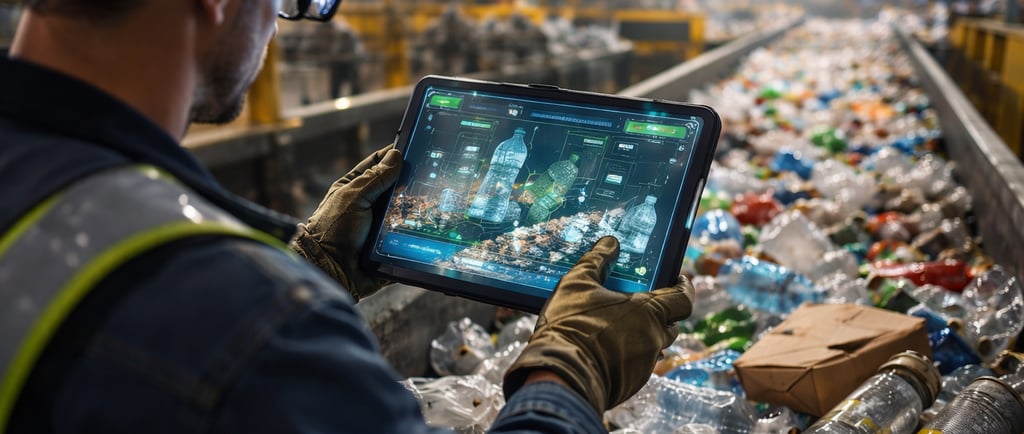
AR overlays transform any industrial environment into an interactive classroom. By layering digital guides, caution zones, animated arrows, and stepwise instructions onto real-world objects (conveyors, sort belts, balers), AR overlays enable “learning by doing”—but with the safety net of instant guidance. Workers can use smart glasses, rugged tablets, or phones to see exactly where and how to take action, reducing ambiguity and error.
AI Engagement: From Passive Learning to Dynamic Coaching
AI-driven engagement extends static AR overlays into adaptive performance tools:
Personalized Prompts: AI analyzes operator input, previous errors, and job context to deliver customized tips and “what’s next” guidance.
Error Recognition: Utilizing computer vision or workflow data, AI identifies deviations and nudges operators to improve—before defects compound.
Microlearning Nudges: The system can trigger just-in-time knowledge refreshers, such as quick quizzes or best practice reminders, enhancing retention and reducing repeat mistakes.
Escalation Loops: If errors persist, AI can automatically notify supervisors for targeted intervention.
Circular Actions: The Heart of Sustainable Behavior Change
Circular actions are observable, measurable steps that close the material loop or enhance operational circularity:
Sorting materials accurately (e.g., pulling 5 polypropylene at the right drop point)
Performing equipment checks and reporting near-misses in real time
Properly flagging and isolating contamination sources
Coaching peers on procedure updates or quality requirements in the flow of work
Integration with Recycling Apps
Recycling apps—mobile or web-based—support these actions by logging material streams, tracking contamination, and giving visibility into process KPIs and staff contributions. When AR overlays integrate with such apps, they create a unified ecosystem for training, measurement, and continuous improvement.
4. Operational Framework: AR Training for Sustainable Behavior
The Behavior Change Acceleration Model (BCAM) for AR Training
To break the “knowing–doing” gap and deliver sustained impact, industrial training programs are moving toward a robust, evidence-based framework—the BCAM.
In-Depth Breakdown of Each Phase:
Target Task Identification: Use root cause analysis and error logs to determine which behaviors most affect circularity outcomes or introduce the highest risk. For instance, on a high-speed plastics line, this may be the correct sorting of film plastics—a top contamination cause.
Pathway Mapping: Conduct process mapping using video audits, IoT sensor data, and operator interviews to pinpoint high-frequency error zones. Visual tools—like spaghetti diagrams—help trainers identify where AR overlays will be most valuable.
AR Overlay Design: Collaborate with operators to build tailored overlays. Good design practices include minimal cognitive overload (clear arrows, color coding for go/no-go), just-in-time tips, and masking irrelevant details to enhance focus.
AI-Driven Adaptation: Implement AI engines that refine overlay prompts based on historical performance, process changes, and operator learning curves. For example, if a new policy requires stricter contamination checks, AI can flag updates and reinforce them during shift transitions.
On-Site Piloting: Roll out AR overlays with a pilot group, capturing engagement metrics, error logs, and granular feedback. Use this drip-feed model to minimize disruption and quickly iterate designs.
Digital-Nudge Loop: Connect overlay events (e.g., sort verified, check completed) to your recycling app’s digital QA system. This enables point-of-action scoring (badges, recognition, escalation) and feeds into process analytics for supervisors.
Outcome Capture & Adjustment: Regularly benchmark performance (pre/post overlay deployment) using agreed KPIs: error reduction, time savings, operator self-reported confidence, and material purity. Use learnings to refine overlays and AI modules, maximizing impact.
Real-World Example: AR Overlay for Paper/Baled Plastics Line
When an operator moves to sort a bale, AR smart glasses display color-coded lights on target materials, while AI monitors hand movements and item identification. If a mis-sort occurs, an overlay provides an instant correction cue and quick context (“PET is non-conforming—see training tip”). Successes and errors update the QA dashboard automatically, giving supervisors real-time insight and allowing targeted support.
Analysis: Why This Works
Numerous studies validate that contextual, in-the-moment cues outperform static training by over 60% on long-term retention (Neuroscience of Learning, Harvard). On-site AR not only builds technical proficiency but also creates psychological safety, reducing fear of making mistakes and boosting operator engagement—key drivers in high-turnover industrial teams.
5. Implementation Playbook: Checklist & Decision Points
Launching AR overlays and AI engagement is as much about change management as it is about technology. The following extended checklist and decision process will help ensure a robust, operator-friendly rollout.
Comprehensive Checklist for AR Training Deployment
Document Current Behaviors: Use shadowing, video recording, or digital audit tools to baseline operator actions, identifying both strengths and process gaps.
Prioritize Training Bottlenecks: Distill error logs, downtime reports, and supervisor insights to determine where AR and AI can move the needle most.
Choose Fit-for-Purpose Devices: Consider deployment environments. For humid, dust-prone MRFs, ruggedized tablets with large screens outperform consumer-grade phones or fragile AR headsets for initial pilots.
Integrate with App Ecosystem: Sync AR overlays with recycling or QA apps to enable real-time scoring, logging, and escalation.
Define Measurable Metrics: Connect each overlay or AI module to a key outcome—such as reducing sort errors by 50% over 30 days, or achieving a minimum overlay usage rate of 85%.
Select High-Impact Pilot Tasks: Start with tasks that have high error rates, safety risks, or regulatory visibility.
Prototype Quickly, Pilot Early: Use simple, low-fidelity overlays. Don’t overengineer at the start; rapid iteration based on user feedback is more valuable.
Integrate AI Feedback Loops: Deploy micro-learning nudges and escalation paths (e.g., if repeated error on bale ejection, prompt a refresher video).
Test in Controlled Conditions: Pilot overlays with a small group, monitoring cognitive load, usability, and workflow impact.
Gather Deep Feedback: Use direct interviews, digital surveys, and in-app comments to surface pain points and design flaws.
Iterate and Refine: Keep overlays visually clear, easy to follow, and free from information overload.
Expand Gradually: After validating impact, extend overlays to additional tasks and operator groups, prioritizing by risk and workflow criticality.
Connect to Recognition Tools: Leverage digital badges, shift-based leaderboards, or simple peer shout-outs to reinforce positive behavior changes.
Set Up Escalation Paths: Ensure persistent errors trigger supervisor review and hands-on troubleshooting, supported by overlay analytics.
Train Supervisors: Equip front-line leads with playbooks for module troubleshooting and data interpretation.
Review Metrics Weekly: Analyze overlay usage, engagement dips, and error rates for continuous optimization.
Update for Change: Rapidly refresh overlays and AI modules as processes or equipment evolves.
Manage Devices Proactively: Create clear routines for charging, damage checks, and software updating—preventing common sources of failure.
Advanced Decision Points for Implementation Leaders
Adoption Plateau: If staff engagement drops off, revisit overlay complexity, gather live feedback, and run usability workshops to break down barriers.
Impact Stagnation: If error rates are unchanged, conduct process audits and validate that overlays accurately reflect operational workflows—not just SOPs.
Supervisor Engagement: If supervisors are not leveraging overlay data, run dedicated analytics training or embed KPIs into shift leader scorecards.
Decision Tree in Action:
High error rate triggers additional AI microlearning.
Overlays ignored? Push visual prompts closer to actual touchpoints or interventions.
Data not used? Integrate dashboards into daily huddles or shift reports.
Common Failure Patterns to Avoid
AR overlays that distract or overwhelm operators
Devices unfit for challenging industrial conditions
Lack of frontline operator co-design, resulting in poor fit-to-workflow
Failure to integrate AR events into core recycling or QA systems, limiting data’s impact on continuous improvement
6. Measurement Frameworks That Prove AR Training Is Working
The biggest mistake industrial teams make with AR training is treating rollout as success. Deployment is not impact. A headset count, app login, or completion certificate tells you almost nothing about whether workers are safer, faster, more accurate, or better at circular tasks. In 2026, the standard has to be higher. If AR overlays are going to earn budget and survive scrutiny from operations, EHS, quality, and finance, they need to be measured like any other production system, with clear leading indicators, lagging indicators, and direct links to cost, risk, and material performance. That standard matters because workplace injuries still carry a huge economic burden. The National Safety Council estimates the total cost of work injuries in 2024 at $181.4 billion, with medically consulted injuries averaging $48,000 each and 102 million days lost tied to work injuries. At the same time, U.S. manufacturing still faced a 3.1% annual average job openings rate in 2025, while transportation, warehousing, and utilities sat at 4.1%, which means many industrial employers are still operating with thin staffing and constant training pressure.
A strong measurement architecture starts with one basic rule: every overlay must map to one observable action. If the overlay says “inspect battery housing seal,” the system should be able to record whether the worker opened the inspection sequence, completed the check, took the required photo or confirmation step, flagged an anomaly, and escalated if needed. If the overlay says “remove PET contamination before bale close,” the system should record not only completion, but the quality of the result downstream. This is where many pilots fail. They measure interaction with the tool, not performance in the work. The better model is to connect overlay events to plant outcomes. Volvo’s deployment points in this direction. PTC reports that Volvo reduced update and validation time for configuration and QA checklists from more than a day to less than an hour, while also reducing quality-operator training time to less than two weeks. That is the kind of measurement logic leaders should follow: content update speed, onboarding speed, and quality impact in one chain.
The most useful framework is a five-layer model. The first layer is adoption. Are workers actually using the overlay at the point of work, at the right stage of the task, with enough consistency for the tool to matter? Measure session starts per shift, step completion rate, repeat use by task type, supervisor-assisted sessions, and drop-off points inside the sequence. If workers open the overlay but abandon it at step three every time, that is not a motivation problem first. It is usually a design problem, a poor fit to workflow, or bad device ergonomics. Adoption must also be segmented by shift, tenure, language, and task complexity. New hires may depend on the overlay heavily. Experts may only use it during changeovers, new SOPs, or rare maintenance tasks. That is healthy, as long as usage matches need. Deloitte’s 2026 human capital research makes this point at a broader level: traditional change management and training are often too slow for the current pace of work, and AI-supported learning is shifting toward skill application in the flow of work. AR overlays should be measured against that standard, not against old LMS completion logic.
The second layer is proficiency. This is where the program starts to justify itself. Measure time to first independent task completion, time to certified proficiency, rework frequency in the first 30 days, number of supervisor interventions per operator, and error recurrence rate after correction. If a new operator needs twelve shadowing sessions before independent work without AR and six with AR, that is a real gain. If correction prompts reduce repeat contamination mistakes over the next two weeks, that is a stronger gain because it shows retention under real pressure. Recent safety research supports this focus on transfer, not just exposure. A 2024 systematic review and meta-analysis covering 37 papers across 13 industries found that AR had a significant positive impact on safety training overall, while a separate 2024 comparative study found AR training outperformed slide-based training for long-term retention in risk identification, risk assessment, and risk response.
The third layer is operational performance. This is where plant leadership pays attention. For sorting environments, measure contamination rate, missed recovery opportunities, bale reject rate, line stoppages caused by mis-sorts, and yield by material family. For maintenance or equipment training, measure mean time to complete procedures, first-time-right completion, maintenance-induced downtime, tool change duration, and start-up losses after intervention. Harpak-ULMA’s customer result is a strong benchmark for what good performance measurement looks like. PTC states that an AR-enabled complex tool rebuild dropped from 40 hours to 8 hours with zero errors, which is an 80% time reduction and a reported $250,000 saving per line in downtime and labor training costs. DHL’s vision-picking case adds another benchmark from logistics. DHL reports a 25% increase in efficiency from smart-glasses-guided picking, while Coca-Cola saw a 6% to 8% improvement in picking performance and 99.9% accuracy. Those are not vanity numbers. They show why industrial leaders increasingly want performance dashboards tied directly to guided work.
The fourth layer is safety and compliance. This cannot be reduced to recordables alone. Lagging indicators such as OSHA-recordable incidents, near-miss frequency, lost-time cases, lockout-tagout breaches, and procedural deviations still matter, but the leading indicators are where AR becomes powerful. Measure hazard recognition accuracy, step-sequence compliance, completion of critical checks, time to report unsafe conditions, use of escalation pathways, and supervisor response time after alerts. OSHA continues to require employers to establish injury and illness reporting procedures and train employees to use them, while federal penalty levels remain significant, with serious or other-than-serious violations at up to $16,550 per violation and willful or repeated violations at up to $165,514 per violation after the 2025 adjustment. For any site with recurring procedural misses, the business case for better in-the-moment guidance is not theoretical. It sits inside exposure, insurance, investigations, and avoidable disruption.
The fifth layer is circularity and sustainability performance. This is where AR training becomes more than a workforce tool. It becomes a materials-performance system. Measure contamination by stream, capture rate of target recyclables, correct isolation of hazardous or problem materials, reprocessing losses, quality complaints from downstream buyers, and audit-ready traceability of critical inspection steps. The EPA’s recent recycling system assessment makes the link between education and material quality very clear. In one Brooklyn, Ohio program, contamination dropped from 38% to 20% in eight weeks through direct inspection and “Oops” tagging. In another case cited by EPA, WM’s camera-based contamination feedback reduced contamination by 89% in three months during a Northern California pilot, while driver education reduced MRF contamination by 16% in 2020. Those are not AR projects, but they prove the operating principle: timely, specific, behavior-linked feedback changes material outcomes. AR overlays take that principle onto the floor and into the worker’s field of view.
Once these five layers are in place, industrial teams should shift to a scorecard cadence. Daily reviews should focus on adoption and critical task misses. Weekly reviews should focus on proficiency, repeat errors, and shift-level comparisons. Monthly reviews should focus on safety, quality, contamination, downtime, and financial effect. Quarterly reviews should answer a harder question: which overlays deserve to scale, which need redesign, and which should be retired? This is where many mature programs gain speed. They stop treating all content as equal. A high-value overlay is one that changes behavior in a high-risk, high-frequency, or high-cost task. A low-value overlay may still be useful, but it should not compete for the same budget or leadership attention.
A final point matters for credibility. Do not measure AR in isolation if the site is also changing staffing, incentives, layout, SOPs, or material mix. Use pre/post baselines, matched task groups, and, where possible, a control area. If a plant installs new conveyor sensors, changes contamination thresholds, and launches AR in the same month, leadership will need careful attribution logic. Otherwise, the program will either overclaim or get unfairly dismissed. The right posture is disciplined and practical: measure behavior first, then process effect, then financial effect. When those three line up, the case becomes difficult to argue against.
7. Advanced Case Studies and What They Mean for Recycling, MRF, and OEM Training
The most useful case studies are not the flashiest ones. They are the ones that show a repeatable path from instruction to execution to measurable result. In AR training, the strongest examples usually come from manufacturing, packaging, logistics, and connected-worker environments, because those sectors have been forced to solve the same core problems that recycling and heavy industrial sites face: skills gaps, process drift, high consequence errors, and the constant tension between throughput and precision.
Start with Volvo Group. This is one of the clearest examples of AR moving beyond pilot theater. According to PTC, Volvo used augmented reality as part of a broader digital thread to improve quality operations. The company cut checklist update and validation time from more than one day to less than one hour. It also reduced quality-operator training time to less than two weeks and positioned the program against a 0 parts-per-million quality goal. This matters because it shows AR succeeding in a difficult environment, where procedures change, quality standards are strict, and training content has to stay current across multiple sites. For MRFs and recycling plants, the direct lesson is obvious: if your contamination criteria, inspection logic, or accepted material specifications shift often, static content will always lag. AR works best when it is wired into process change, not bolted on after the fact.
Now look at Harpak-ULMA. PTC reports that a customer used AR work instructions to complete a complex tool rebuild in 8 hours instead of 40, with zero errors. The reported savings reached $250,000 per line in downtime and labor training costs. This case matters for another reason. It shows AR doing two jobs at once: compressing task time and reducing dependence on scarce expert labor. In industrial recycling, this has immediate relevance for baler rebuilds, shredder maintenance, conveyor changeovers, optical sorter calibration, and contamination-response protocols that are currently trapped inside the heads of senior technicians. When one expert retires or leaves, performance should not collapse. That is one of the strongest practical reasons to invest in AR content capture. It turns fragile tribal knowledge into repeatable guided execution.
DHL’s vision-picking deployment is another case that industrial leaders should study closely. DHL reports that smart-glasses-guided picking improved efficiency by 25%. Coca-Cola, using similar warehouse smart glasses, saw 6% to 8% better picking performance and 99.9% accuracy. Warehousing is not a recycling line, but the training problem is closely related. Workers need fast orientation, clear visual cues, reduced search time, fewer mistakes, and higher consistency under pace. In a yard, this translates to faster part identification, better routing of nonconforming material, improved staging accuracy, and cleaner handoffs between sort, inspection, and dispatch. The deeper lesson is that AR performs especially well when the job involves movement, item recognition, and a sequence that can be visually guided without forcing the worker to stop and consult a separate screen.
There is also an important case in the broader quality-inspection space. PTC describes AI-enhanced visual inspection in AR environments that provide pass/fail notifications overlaid onto the work area, while also describing manufacturers like Nascote Industries using immersive training content that employees at different experience levels can follow more easily. This matters because the next generation of training is not just guided steps. It is guided steps combined with machine vision, context recognition, and decision support. For industrial recyclers, that opens up high-value use cases around battery isolation, ferrous and non-ferrous contamination detection, copper grade verification support, and visual identification of damage, moisture, or nonconforming attachments before material is processed or shipped.
A useful recycling-adjacent case comes from education and contamination reduction work outside AR itself. The EPA’s recycling system assessment shows that highly specific, direct feedback drives material quality gains. Brooklyn, Ohio dropped contamination from 38% to 20% through targeted inspection and tagging. WM’s camera and AI feedback system reduced contamination by 89% in one Northern California pilot over three months, and driver education cut MRF contamination by 16% in 2020. These cases matter because they reveal a pattern that AR systems can strengthen. Material quality improves when feedback is immediate, local, visible, and tied to the actual mistake. A poster on the breakroom wall rarely changes behavior. A cue at the point of action often does. AR overlays are powerful because they let industrial operators place the feedback exactly where the error occurs.
The strongest advanced case study, then, is not one company. It is a composite operating model built from these results. Imagine a mid-sized MRF with recurring contamination problems on a plastics line, inconsistent battery handling at the receiving area, and long onboarding time for maintenance staff. In phase one, the site uses rugged tablets to guide receiving checks, contamination flags, and battery isolation decisions. In phase two, it adds smart-glasses or line-mounted AR for high-speed sort verification and jam-clearance procedures. In phase three, it connects overlays to QA dashboards and maintenance logs, so supervisors can see where repeat errors cluster by shift and by task. In phase four, it introduces AI-assisted visual detection to trigger reminders, confirm compliance steps, and push exceptions upward. That is the practical arc. It begins with work instructions. It matures into performance management.
There is also a financial case that deserves emphasis. Work injuries remain expensive. NSC’s 2024 figures put the average cost of a medically consulted injury at $48,000 and the total cost of work injuries at $181.4 billion. If AR guidance prevents even a small number of lockout mistakes, manual handling errors, or unsafe contamination-handling incidents, the avoided cost can be significant. Combine that with faster proficiency, fewer defects, and less rework, and the business case starts to compound. This is why mature teams should stop pitching AR only as a training experience. In capital-intensive industrial environments, it is a cost-control and quality-protection system as well.
The final lesson from advanced case work is that technology alone does not win. Harpak-ULMA explicitly points to leadership alignment, cross-generational engagement, and willingness to learn through failure as keys to success. That is important because many industrial teams still assume the main barrier is device price. In reality, the bigger barriers are usually workflow mismatch, poor content governance, weak supervisor buy-in, and lack of integration with real metrics. If those issues stay unresolved, even a technically strong deployment will flatten out after the initial excitement fades. If they are handled well, AR can move from novelty to core operating practice.
8. Frequently Asked Questions About AR Overlays for On-Site Training
Is AR training only worth it for large manufacturers with big budgets?
No. Large manufacturers have published more case studies, but the value logic applies just as strongly to smaller sites where each expert, machine hour, and quality mistake matters more. A smaller recycler or OEM supplier may not start with headsets across the whole site. It may start with rugged tablets or mobile overlays for one costly workflow, such as battery triage, quality inspection, or maintenance changeovers. The right starting point is not company size. It is task value. If a process is high risk, high frequency, hard to learn, or expensive to get wrong, it is a good AR candidate. DHL, Volvo, and Harpak-ULMA all point to the same idea: targeted deployment tied to measurable work can produce strong returns.
What tasks are best for a first pilot?
The best first pilots usually sit in one of four zones: safety-critical procedures, quality-critical inspections, frequent repeat tasks with high variation, and maintenance tasks that depend heavily on expert memory. In recycling and materials operations, that could mean contamination identification, battery isolation, pre-start checks, lockout verification, or high-value equipment maintenance. Avoid low-frequency, low-consequence tasks at the start. You want a task where faster onboarding, fewer errors, or better compliance will show up quickly in the numbers.
Do workers need smart glasses, or can a site start with phones and tablets?
A site can absolutely start with phones or rugged tablets. In many industrial settings, that is the smarter first move. Smart glasses can be strong for hands-busy workflows such as picking, inspection, or guided assembly, but they are not mandatory for proving value. DHL’s warehouse example shows the upside of glasses for guided movement and picking, but many industrial teams should first prove the content logic, analytics, and workflow fit using more familiar devices. Once the use case is solid, they can decide whether glasses improve ergonomics enough to justify expansion.
How long does it take to see results?
That depends on the task, but useful signals often appear in weeks, not years, if the pilot is scoped correctly. Adoption and completion data can appear in days. Proficiency gains can appear inside the first onboarding cycle. Quality and contamination effects may appear over several weeks, especially if enough task volume exists to show a trend. The EPA contamination cases show that well-timed feedback can shift behavior quickly, including an eight-week drop from 38% to 20% in one local program. In industrial settings with daily repetition, feedback loops can move even faster if they are integrated into shift routines.
Does AR replace supervisors or trainers?
No. It changes what they spend time on. Instead of repeating the same basic instruction all day, supervisors and trainers can focus on coaching edge cases, interpreting patterns, refining content, and helping workers with exceptions. Deloitte’s 2026 human capital research points toward learning in the flow of work, not away from human oversight. In practice, AR should reduce avoidable instructional repetition while making expert intervention more targeted and more valuable.
Is there strong proof that AR improves learning?
The current evidence is strong enough to justify serious use, with an important caveat. A 2024 systematic review and meta-analysis found a significant positive effect for AR in safety training, while also noting that many studies still do a weak job measuring long-term retention. A separate 2024 comparative study found better short-term risk-identification performance and better long-term retention for AR than slide-based training in construction safety. So the answer is yes, but the best industrial programs should still measure transfer and retention carefully instead of assuming them.
What usually causes AR training programs to fail?
The failure pattern is usually operational, not technical. Common causes include overlays that do not match real workflow, too much information on screen, weak content maintenance, poor supervisor use of the data, bad device fit for the environment, and lack of connection to business metrics. Another failure mode is trying to digitize a weak SOP without fixing it first. AR does not rescue bad process design. It makes the existing process more visible, which is useful, but uncomfortable if leaders expect technology to hide basic process flaws.
How should companies handle multilingual teams and varied literacy levels?
This is one of AR’s strongest use cases. Visual instruction, color coding, symbols, short audio prompts, and context-based cues can reduce dependence on long text blocks. Sites should still validate comprehension, but AR can make training more accessible than manuals or slide decks, especially for mixed-language workforces. In practical terms, that means using icons, step animations, photos of acceptable and unacceptable materials, and short confirmations instead of dense paragraphs.
Can AR help with sustainability goals, or is it mainly a productivity tool?
It can do both. In recycling, metals, packaging, and remanufacturing environments, sustainability performance is often a direct function of worker behavior. Correct sorting, contamination isolation, material recovery, accurate inspection, and proper reporting all affect waste, rework, emissions, and downstream value. EPA’s case material shows that specific feedback improves contamination and diversion performance. AR extends that logic to the exact point where the action happens, making it a circularity tool as much as a training tool.
How do you calculate ROI without guessing?
Start with five buckets: onboarding time saved, error or rework reduction, downtime avoided, safety incidents avoided, and quality or recovery uplift. Use your own baseline numbers, not vendor averages. If a new hire reaches independence in ten days instead of twenty, convert the saved trainer time and earlier productive output into value. If line contamination drops by even a few percentage points and bale claims decline, quantify that. If a guided maintenance job avoids one extended outage, count it. If safer execution helps prevent an injury, NSC and OSHA figures show why that matters financially.
Does generative AI belong inside AR training?
Yes, with discipline. Generative AI can help create draft instructions, translate content, summarize incident patterns, and support conversational troubleshooting. But for safety-critical work, every instruction still needs governance, version control, and approval. The useful model is AI-assisted authoring plus controlled publication, not free-form generation on the fly for every critical step. In 2026, that distinction matters more because industrial teams are moving from experimentation to production use, and governance now carries more weight.
What is the best sign that a pilot is ready to scale?
Three things should happen at the same time. Workers use it willingly in the real workflow. Supervisors can point to fewer mistakes or faster proficiency. Leaders can see a measurable link to safety, quality, contamination, or cost. If only one of those is true, the site is not ready yet. If all three are true across more than one shift or team, scale becomes a realistic next step.
9. Future Trends: Where AR Overlays for Industrial Training Are Going Next
The next phase of AR training will be shaped by one simple shift: overlays will stop being standalone guidance layers and become part of a larger spatial, AI-driven operating system for work. That does not mean every plant will suddenly run a full industrial metaverse. It means the practical pieces are starting to connect. Spatial computing is giving industrial teams new ways to place business data inside physical work. Deloitte describes spatial computing as a way to blend physical and digital environments so workers can interact with detailed operational data more naturally, across media ranging from standard screens to lightweight AR glasses. The same report notes that real-time simulations are already a primary use case, and that the broader spatial computing market is projected to grow at an 18.2% rate between 2022 and 2033.
For training leaders, that matters because the next overlay will not just say what to do. It will know where the worker is, what machine state exists, what material batch is present, what revision of the SOP is current, what incidents happened on the last shift, and whether this operator has struggled with this step before. That is the real direction of travel. Context will get deeper, not broader. Instead of adding more content, the better systems will add more precision.
One major trend is AI copilots for frontline work. Deloitte’s 2026 human capital work argues that AI is enabling people to learn and apply new skills directly in the flow of work, while its 2026 tech trends research points to “physical AI” as a serious operating force, where AI systems perceive and act in the physical world through sensor fusion, computer vision, robotics, digital twins, and edge decision-making. In training terms, that means AR guidance will increasingly work with AI that can interpret images, spot procedural deviations, surface the next best step, and route exceptions intelligently. The overlay becomes less like a digital checklist and more like a supervised task assistant.
A second trend is digital-twin-linked training. Deloitte’s manufacturing outlook says process simulation remains the top metaverse use case implemented by surveyed manufacturers, with higher throughput and reduced costs as the main benefits. McKinsey’s digital twin explainer frames digital twins as contextualized digital replicas of physical systems that let organizations simulate outcomes before acting. When that logic is connected to AR training, sites gain a major advantage. They can test a new workflow, contamination-control rule, or safety sequence in a simulated model, refine the instruction logic, and then push the validated steps into AR overlays on the floor. That shortens the lag between process design and operator execution.
A third trend is edge AI and on-device guidance. This matters in yards, plants, and facilities where connectivity is inconsistent or where latency and data protection matter. Deloitte’s recent physical AI announcement highlights growing use of digital twin simulation, computer vision, and edge computing for industrial transformation. In practice, that means more AR systems will run critical recognition and guidance closer to the device or plant edge rather than depending entirely on remote compute. For industrial users, the benefit is practical: faster response, better reliability, and more control over sensitive operational data.
A fourth trend is lighter hardware and broader interface choice. Spatial computing is no longer tied to bulky headsets alone. Deloitte explicitly describes a future where the same models can render on conventional screens, lightweight AR glasses, or more immersive devices. This is important because many industrial rollouts have stalled not because the guidance model was wrong, but because the hardware created fatigue, discomfort, or maintenance problems. The most successful programs over the next few years will likely be device-flexible. A worker may author or review on a desktop, verify on a tablet, and execute hands-free on glasses only where it clearly improves the task.
A fifth trend is content governance becoming a strategic issue. As more teams use AI to draft instructions and as plants push updates faster, content quality will matter more, not less. Industrial organizations will need approval flows, version control, audit history, and clear ownership of every instruction set tied to high-risk tasks. This becomes more urgent as regulators, customers, and insurers ask harder questions about process control and traceability. The value of AR in that world is not only that it can train. It can also prove what was shown, when, to whom, under which version, and whether the critical steps were completed.
A sixth trend is broader use in circular operations, not just classic manufacturing. Recycling, reverse logistics, refurbishing, remanufacturing, and battery-handling operations are growing more complex because material streams are more variable and risk profiles are changing. EPA’s recent strategy and grant activity around recycling education, organics, and infrastructure signal that behavior change, material quality, and contamination control will stay high on the agenda. As those sectors digitize, AR overlays are likely to move from training into receiving, inspection, dismantling, contamination removal, hazardous-material segregation, and audit support. In these environments, the most valuable systems will be the ones that reduce ambiguity in real time.
The final trend is organizational. AR training will increasingly be judged not as a learning project, but as part of smart operations. Deloitte’s 2025 manufacturing outlook points toward a software-driven industrial model, with stronger digital connection to products and operations, better data use, and rising need for talent that combines technical, digital, and human skills. That means the winning AR programs will sit closer to operations excellence, quality, EHS, and plant engineering, not off to the side as a pure HR or L&D experiment.
So what does the future actually look like on the floor? A worker approaches a task. The system recognizes the asset, its state, the worker’s certification level, the current SOP, and any open quality or safety alerts. The worker sees only the needed guidance, not the whole manual. The system verifies critical steps, notices deviations, and pulls in a supervisor or remote expert only when required. Every action updates the site’s performance data. The worker learns while doing. The plant gets cleaner execution. The training team gets proof. That is where this is heading.
10. Conclusion: Why AR Overlays Are Becoming a Core Layer of Industrial Training
Industrial training has entered a different era. The older model assumed that people could be taught away from the work, tested once, and trusted to remember under real conditions. That model is too weak for the pace, complexity, and accountability of 2026. It struggles when staff turnover stays high, when process changes move quickly, when contamination or rework erodes margins, and when one procedural miss can create safety, quality, or compliance exposure. The numbers behind those pressures are hard to ignore. Work injuries still carry huge economic cost, regulatory penalties remain material, and many industrial sectors still face persistent staffing pressure and skills gaps.
AR overlays matter because they address the exact point where traditional training breaks down. They bring guidance into the worker’s field of action. They reduce the distance between instruction and execution. They help convert expert knowledge into repeatable process. They make feedback immediate. They give supervisors visibility they rarely had before. And when integrated properly with QA, EHS, maintenance, and circularity systems, they do something even more important: they turn training from a support function into an operational control layer.
The strongest evidence does not suggest that AR is magic. It suggests something more useful. AR works when it is tied to real tasks, measured properly, updated quickly, and designed around actual workflow. The research base now shows meaningful gains in safety training effect and long-term retention. Industrial case studies show faster onboarding, faster checklist and content updates, improved efficiency, zero-error execution in complex rebuilds, and measurable savings tied to downtime and labor. Recycling and contamination-control case evidence shows that direct, specific, timely feedback changes behavior and improves material quality. Together, those findings form a practical conclusion: when industrial teams want safer execution, cleaner material streams, stronger quality, and faster skill transfer, real-time guided work beats static instruction.
For MRFs, yards, OEMs, remanufacturers, and materials operators, the strategic question is no longer whether immersive guidance has a place. It is where to start, what to measure, and how fast to build the operating discipline around it. The right answer is usually narrower than leaders first expect. Start where errors are frequent, risk is clear, and results can be measured. Build one overlay around one important task. Prove adoption. Prove proficiency. Prove impact on quality, safety, contamination, or downtime. Then expand with care.
The sites that do this well will not simply train faster. They will execute better. They will waste less. They will rely less on memory and heroics. They will adapt faster when process changes. They will protect quality under staffing pressure. They will create stronger proof for audits, customers, and internal leadership. In circular and industrial environments, that is not a minor gain. It is a structural advantage.
AR overlays for on-site training are not the whole answer. Process design still matters. Supervisor quality still matters. Device fit, governance, and worker trust still matter. But used properly, AR changes the training equation in a way static tools cannot. It places knowledge where work happens. That is why it is moving from experiment to infrastructure.
Connect
Your trusted partner for scrap metal procurement.
CONTACT
About
haroon@tdcventures.com
+1-307-655-7593
© 2025. All rights reserved.
NEWSLETTER