
Battery Safety in Small Devices: Pack to Cell
Learn how lithium battery safety protects XR and small-device recycling, from intake and triage to pack-to-cell testing, storage, compliance, and reuse among others.
IMMERSIVE TECH RECYCLING & CIRCULAR ELECTRONICS
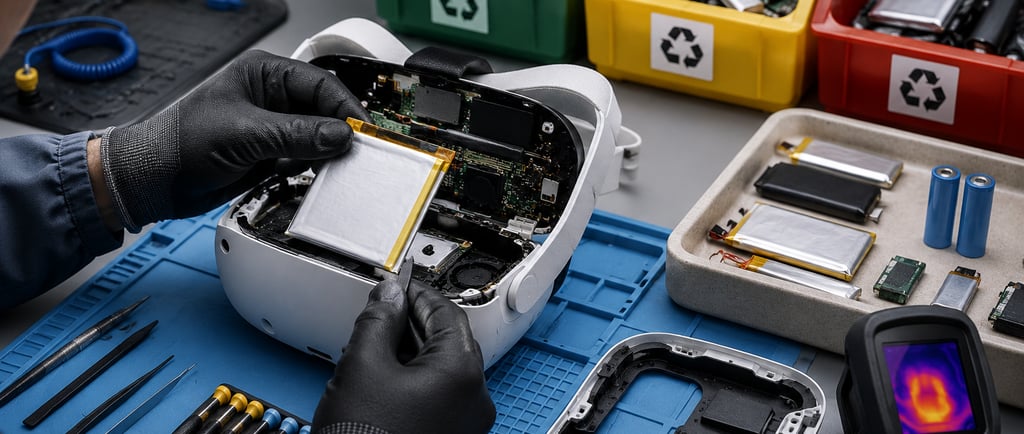
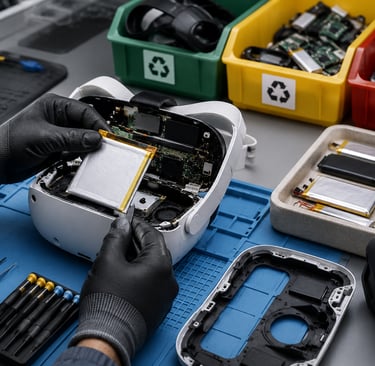
Why Battery Safety Matters for XR Electronics Recycling
The rapid evolution of XR (extended reality) technologies—including AR (augmented reality), VR (virtual reality), and MR (mixed reality) devices—has profoundly reshaped the electronics marketplace. As these small, portable electronics become staples in enterprise and personal ecosystems, their lifecycles raise unique challenges for recyclers, refurbishers, original equipment manufacturers (OEMs), and environmental compliance professionals.
The Growing Risk Landscape
Nearly all XR headsets and wearables utilize advanced lithium-based battery technologies. These batteries are chosen for their high energy density and compact form factor, but that same density also increases the risk profile. According to the U.S. Consumer Product Safety Commission, battery-related incidents have more than doubled for consumer electronics in recent years, with “thermal runaway” events—where the battery cell rapidly overheats—accounting for a growing share of recalls.
Design complexity and miniaturization mean more batteries are glued or fixed close to sensitive circuitry, displays, and sensors. In the context of recycling and refurbishment, improperly handled battery packs can:
Ignite fires during disassembly, sometimes burning at over 1000°C (1832°F).
Release toxic gases harmful to workers and surrounding communities.
Trigger involuntary compliance lapses, incurring severe regulatory fines.
Industry Impact and Consumer Trust
Safety issues reverberate beyond immediate operational hazards. Battery incidents can erode consumer confidence, attract media scrutiny, and undermine brand reputations. For enterprises managing returns or warranty-related refurbishments, a single incident could set back sustainability ambitions and damage trust among users.
Environmental and Regulatory Drivers
Government bodies such as the Environmental Protection Agency (EPA) and regulatory frameworks like UN 38.3 now mandate rigorous controls for lithium-based batteries in end-of-life devices. Battery safety protocols directly drive compliance for ISO 14001-certified recyclers and R2v3-certified refurbishers.
Takeaway:
Battery safety, from pack to cell, is no longer an optional focus—it's a foundational pillar for responsible, scalable XR electronics recycling. Implementing robust safety systems not only prevents accidents but positions companies at the vanguard of sustainable, circular electronics.
2. Defining the Battery Safety Problem in Small Devices
Expanding on the Opportunity:
The XR electronics sector is predicted to expand into a $250 billion global industry by 2027 (Gartner, 2023), fueling massive growth in device returns and upgrades. However, device “design-for-disposal” lags far behind production scale. Here’s why this presents a double-edged sword:
Complex Battery Assemblies: Many new VR and AR headsets use custom cell packs that are difficult—even for skilled technicians—to extract safely. For example, the Oculus Quest 2 contains a polymer cell glued directly to the inner frame, requiring careful work to prevent puncture.
Mixed Chemistries: Devices may contain both lithium-ion and lithium-polymer cells, further complicating safe processing and handling.
Barriers to Disassembly: With rising rates of proprietary screws, tamper-proof adhesives, and internal shielding, safe battery access can be hindered, increasing the likelihood of accidental damage.
Operational Risks at Scale:
Processing thousands of XR devices weekly exposes facilities to complex safety scenarios:
Thermal Events: Even a single cell undergoing thermal runaway can force emergency evacuations and halt operations for hours or days.
Hazardous Waste Crossover: Batteries not properly contained can contaminate e-waste processing lines—mixing chemistries or leaking electrolyte into the waste stream.
Regulatory Non-Compliance: Recycling centers must document safe handling under regulations like R2v3 or risk costly penalties and loss of certifications.
Resource Constraints: Inefficient extraction methods slow device throughput, impacting both yield and profitability of the refurb or recycling operation.
Summary Analysis:
The battery safety bottleneck shapes everything from operational efficiency to company reputation. A scalable, compliant, and risk-aware battery safety framework is mission-critical for every stakeholder in XR device recycling.
3. Key Battery and Electronics Terms Explained
To operate confidently and ensure compliance with safety protocols, it’s crucial to ground your teams in foundational vocabulary. Here’s a richer dive into key terms, with practical context:
Core Battery Entities and Attributes
Pack: The composite battery module built into a device. XR packs often include embedded sensors, management electronics, and multiple parallel or series-connected cells. Packs are specific to form factors—AR glasses vs. VR headsets—and must be addressed as units for warranty or recycling.
Cell: The basic electrochemical unit, such as cylindrical (18650), prismatic, or pouch cells. Each has unique voltage, current, and energy properties. Cells are the end point for disassembly and inspection before recycling or reuse.
Battery Management System (BMS): Integrated electronics prevent overcharge, over-discharge, and short circuits. Some XR devices use “smart” BMS modules with embedded thermal and impact sensors, which must remain intact during disassembly to preserve data and ensure safety.
Thermal Runaway: A dangerous, auto-accelerating heat reaction caused by internal shorts, overcharging, or mechanical damage. Resulting fires can be self-sustaining and extremely hard to extinguish with standard fire suppression.
Dismantling Barrier: Features such as ultra-strong adhesives, custom screws (e.g., tri-point or pentalobe), or welded seams. These increase the likelihood of forced removal or puncture, presenting a direct risk to technician safety.
Design for Repair: Devices engineered for accessible, non-destructive disassembly. Examples include battery doors, modular packs, and standardized screws. Apple, Fairphone, and Framework are reference innovators in this area.
Contextual Importance:
Every refurb, collection, and recycling workflow must incorporate these terms to ensure staff literacy, aid compliance, and streamline battery removal at scale. For more detail, see our [Lithium-Ion Safety Protocols for Refurb Centers] and [Design for Repair in XR Devices] guides.
4. The Pack-to-Cell Safety Framework for Emerging Electronics
Reimagining Safety for High-Growth Device Streams
The acceleration of XR device deployment has called for a new, holistic safety model—one that bridges collection, triage, refurbishment, and cell-level recycling. The “pack-to-cell” safety framework delivers precisely this.
Detailed Step-by-Step Process
Pre-Sorting:
Use machine vision or manual checks to identify high-risk brands or models. For example, certain roll-outs of AR smartglasses from 2022 exhibited an elevated rate of battery swelling—flag these in intake scripts. Store suspect devices in reinforced, mineral-lined containers.Data Logging and Tracking:
Digitally capture device details: serial, battery type, BMS version, intake condition, and any observed anomalies. Implement QR/barcode scanning for seamless tracking. Data supports traceability for compliance audits and recall management.Design Analysis for Risk:
Assess the specific device for battery access and design characteristics. Reference teardown databases like iFixit, or request manufacturer disassembly guides. Note presence of soft pouches, flex connectors, or adhesives that require heat/pry tools.Precision Disassembly SOP:
Deploy ESD mats and ensure all workspaces are certified for battery safety. Select non-conductive implements for prying (plastic spudgers over metal). Document and photograph each removal step, enabling pattern analysis in case of repetitive failures.Cell Isolation and Testing:
After safely extracting the battery pack, decide if further separation is required. For packs with multiple cells, isolate each cell and test voltage, capacity, and impedance using calibrated instruments, ensuring dead or low-voltage cells are identified immediately.Interim Storage and Segregation:
Place batteries and cells in clearly labeled, chemistry-specific storage. Utilize inert gas-blanketed cabinets when handling high-risk (e.g., punctured) pouches. Separate usable cells from those headed directly to hazardous waste processing.Reintegration & Downstream Management:
Direct healthy, high-capacity batteries to refurbishing or remanufacturing lines. Route suspect, degraded, or damaged cells into secure recycling bins with full intake and outbound paperwork, as required for R2 or ISO accreditation.
Framework Application Across Entities
OEM Service Teams: Standardize intake and repair SOPs based on framework principles.
Recycling Centers: Reduce recordable incidents while boosting yield of recoverable materials.
Compliance Teams: Provide documented proof of best-practice adherence for regulators and customers.
5. Step-by-Step Example: Refurbishing a Mixed-Cell AR Headset
Let’s illuminate the framework with a realistic walk-through, complete with troubleshooting and data-driven decision-making.
Scenario:
A refurbishment facility receives a shipment of 50 next-gen AR headsets from an enterprise lease return.
Intake and Initial Screening
On arrival, all units are logged by make, model, and displayed charge state using digital intake platforms. During a first pass:
12 headsets exhibit visible signs of swelling or case damage. Staff immediately place these in ceramic-lined, fireproof caddies—reducing the chance of a chain-reaction incident.
38 units appear undamaged and proceed to the next stage.
Disassembly and Battery Removal
Certified technicians don ESD wrist straps, flame-retardant aprons, and eye protection per SOP. They consult both in-house SOP checklists and the relevant iFixit teardown for their headset model, which details adhesive-backed pouch cells and connector points.
A smartwatch-style heater pad is used at low heat to soften adhesive for safe battery removal, avoiding puncture.
Batteries are gently pried free with plastic spudgers. Technicians document each step and flag two units where resistance signals potential internal damage.
Cell Testing and Decision Points
Extracted batteries are logged and individually tested for:
Voltage (>3.5V preferred)
Capacity (over 80% rated value)
Absence of swelling, odor, or heat
30 cells meet reuse criteria and are routed to a ‘remanufacture/second-life’ bin.
8 cells fall below capacity or voltage requirements and are marked “Recycling Only,” placed in anti-static bags.
Data Capture and Compliance Review
All actions—especially incidents like excessive internal resistance or abnormal odor—are automatically uploaded to the facility compliance dashboard, supporting ISO and R2 process documentation.
Outcome:
No battery punctures, no unplanned heating events, and all adverse findings are captured in compliance logs, enabling both customer reporting and regulatory audits.
6. Implementation Playbook: Building a Pack-to-Cell Battery Safety System
Battery safety in XR electronics recycling starts before a technician touches a headset, controller, wearable, or smart accessory. A safe facility does not treat battery handling as one step inside disassembly. It treats it as a controlled chain: intake, risk scoring, quarantine, documentation, removal, testing, storage, shipment, and downstream proof.
That chain matters because small lithium-ion batteries are now hidden inside more product categories than most waste systems were designed to handle. Phones, tablets, AR glasses, VR controllers, haptic accessories, medical wearables, smart rings, fitness trackers, disposable vapes, power banks, toys, and light-up consumer products can all carry cells that are damaged by heat, pressure, crushing, bending, puncture, or poor charging history. The Global E-waste Monitor 2024 reported that the world generated 62 million tonnes of e-waste in 2022, up 82% from 2010, and projected this figure to reach 82 million tonnes by 2030. Documented collection and recycling are not keeping pace, which means more battery-bearing devices keep entering mixed waste and informal handling routes.
A pack-to-cell safety system should be built in layers.
Start with intake segregation, not disassembly
The first safety decision happens at the receiving dock. Every incoming device stream should be separated into clear categories before it reaches a bench. XR headsets, AR glasses, smart controllers, haptic gloves, wearable batteries, loose packs, and unknown mixed electronics should not be handled as one generic e-waste stream.
At intake, staff should identify visible swelling, cracked housings, heat marks, liquid residue, chemical odor, corrosion, exposed wires, missing screws, impact damage, and signs that the device was previously opened. Any device with one of these signs should move into a suspect battery flow. Suspect units should be placed in fire-resistant, non-conductive containment, away from finished goods, paper, plastics, cardboard, solvents, and mixed scrap.
The goal is simple: prevent one unstable cell from becoming a facility-wide event. Battery fires in waste systems are no longer rare edge cases. A 2026 recycling sector report cited record fire incident data, with 448 reported incidents across North America, and described lithium-ion batteries embedded in everyday consumer products as a leading cause of recycling facility fires.
Build a device risk library
Every facility processing XR and small electronics should maintain a device risk library. This does not need to start as expensive software. A structured spreadsheet, Notion database, Airtable base, or lightweight internal app can work.
Each device profile should include:
Device name and model number.
Battery type, location, shape, and access route.
Known adhesive points.
***** type and tool required.
Required temperature range for adhesive softening.
Connector location.
Known swelling issues, recall history, or field complaints.
Removal time target.
Incident history inside the facility.
Reuse eligibility rules.
Final route: refurb, parts harvest, material recovery, or hazardous waste.
This library turns experience into repeatable safety. If technicians learn that one AR headset model hides a pouch cell behind a glued optical frame, that knowledge should not stay with one employee. It should become part of the facility’s standard process.
Create three handling lanes
A pack-to-cell operation should use three lanes.
The green lane is for devices with no visible battery damage, no swelling, no odor, no corrosion, no impact signs, and known safe disassembly instructions.
The amber lane is for devices with uncertain battery condition, missing records, minor case damage, unknown charging history, or hard-to-access battery packs.
The red lane is for swollen, hot, leaking, punctured, crushed, smoking, sparking, heavily corroded, or recalled devices.
Green-lane devices can move to normal controlled disassembly. Amber-lane devices need senior technician review, lower batch sizes, extra spacing, and slower removal. Red-lane devices should be isolated, documented, and handled only under the site’s damaged battery procedure. These units may require specialist packaging and downstream shipment as damaged or defective lithium batteries.
This matters because discarded lithium-ion batteries can be classified as hazardous waste when they are disposed of. The EPA states that most discarded lithium-ion batteries are likely to be ignitable and reactive hazardous wastes under U.S. hazardous waste codes D001 and D003 because they may catch fire or explode if mishandled.
Train technicians by device type, not only by hazard type
General lithium-ion safety training is useful, but it is not enough for XR recycling. A technician removing a cylindrical cell from a tool battery faces a different risk profile than a technician removing a thin pouch cell glued beneath a curved display, face gasket, speaker module, or optical assembly.
Training should include model-specific teardown simulations, battery puncture recognition, thermal runaway warning signs, ESD control, safe adhesive release, connector removal, quarantine escalation, and emergency response. Staff should know what not to do: no metal pry tools near soft cells, no forced bending, no twisting swollen packs, no stacking loose cells, no taping over vents, no mixing chemistries, and no leaving suspect batteries unattended at a bench.
Training should also explain why small batteries are dangerous. A small pouch cell can still release flammable gas, ignite nearby plastics, contaminate benches, and trigger smoke evacuation. Fire risk is amplified when devices are compacted, crushed, shredded, or stored in bulk.
Standardize the bench setup
Every battery removal bench should be treated as a controlled work zone.
A safe bench should include:
ESD mat and grounding.
Non-conductive pry tools.
Cut-resistant gloves where appropriate.
Eye protection.
Heat-resistant gloves for suspect units.
Ceramic or metal containment tray.
Battery terminal tape.
Sand bucket or approved containment medium based on site policy.
Infrared thermometer or thermal camera for suspect units.
Clear quarantine bin within reach.
No paper, loose plastic, cardboard, solvents, or clutter.
A camera or tablet for step documentation.
The bench layout should support fast escalation. If a battery starts heating, swelling, hissing, venting, or smoking, the technician should not need to walk across the facility to find containment.
Set removal rules for glued pouch cells
Glued pouch cells are one of the highest-risk battery types in small devices. XR headsets and wearables often use them because they are thin, light, and shape-friendly. Those same traits make them vulnerable to bending, puncture, and edge damage.
Safe removal rules should include:
Identify the full cell outline before applying force.
Disconnect power before mechanical work.
Use controlled low heat only where approved by the device profile.
Avoid sharp tools near the cell envelope.
Lift adhesive gradually.
Stop immediately if resistance increases without clear cause.
Do not reuse any cell with crease marks, dents, odor, swelling, puncture risk, or voltage outside the approved range.
Never flatten a swollen cell to fit storage.
The facility should track removal time and damage rate by model. If one headset model has a high puncture risk, the answer is not faster technician work. The answer is better fixtures, better heat control, a revised SOP, or a decision to route that model directly to a higher-control process.
Define reuse thresholds before the battery is tested
A facility should never decide battery reuse case by case at the bench. Reuse thresholds should be documented before testing begins.
For XR and small-device refurbishing, practical reuse rules can include:
No visible swelling, denting, puncture, corrosion, or leakage.
No abnormal heat during rest.
Voltage within approved range.
Capacity above the facility’s threshold, often 80% of rated capacity for consumer-grade reuse decisions.
Internal resistance within model-specific limits.
BMS communication intact where applicable.
No device recall or safety campaign affecting that battery pack.
No unknown third-party replacement pack unless approved.
The EU’s 2025 smartphone and tablet rules show where the market is heading. From 20 June 2025, smartphones and slate tablets placed on the EU market must meet new ecodesign and energy labeling requirements, including durability, repairability, battery endurance, and access to spare parts. These rules do not apply directly to every XR device today, but they set a clear direction for small electronics: batteries must be easier to assess, service, and document.
Control storage by condition and chemistry
Battery storage should never be a backroom pile of loose packs. Batteries and cells should be stored by condition, chemistry, and destination.
Create separate storage zones for:
Reusable tested packs.
Untested extracted packs.
Low-voltage packs.
Damaged or swollen packs.
Recalled packs.
Loose cells.
Outbound recycling loads.
Each container should show the date, device source, battery type, quantity, condition, responsible staff member, and next action. Storage areas should be cool, dry, ventilated, protected from impact, and away from ignition sources. Staff should avoid large accumulations. Smaller, more frequent outbound shipments reduce the size of a potential event.
Transport requirements must also be treated as part of safety. IATA’s 2026 lithium battery guidance states that lithium cells and batteries must have passed the applicable tests in UN Manual of Tests and Criteria Subsection 38.3 to be permitted in transport. That matters for OEMs, refurbishers, recyclers, exporters, and any business moving battery-bearing devices across borders.
Add design feedback loops for OEMs and enterprise buyers
Recyclers and refurbishers see the real end-of-life problems that product teams often miss. If a headset uses excessive adhesive, hidden fasteners, fragile flex cables, or a pouch cell placed beneath a high-force pry point, the facility should record that pattern and send structured feedback to OEMs, leasing partners, and enterprise buyers.
Useful feedback includes:
Average battery removal time by model.
Battery damage rate by model.
Number of units sent to red-lane handling.
Parts broken during access.
Tools required.
Worker safety concerns.
Reuse rate of packs.
Recycling-only rate.
Recommended design changes.
By 2027, the EU Battery Regulation will push product teams harder on removable and replaceable portable batteries. The regulation entered into force on 17 August 2023, and Article 11 requirements on removability and replaceability are scheduled to apply from February 2027. For small electronics brands, this means end-of-life battery access is becoming a compliance, safety, and product design issue.
7. Measurement: Battery Safety KPIs That Actually Prove Control
A pack-to-cell safety system should be measured like an operational system, not like a training slogan. The right metrics show whether the facility is reducing risk, improving reuse yield, protecting workers, and proving compliance.
The most important measure is not how many batteries were processed. It is how many were processed safely, traceably, and without uncontrolled events.
Intake risk metrics
Track the percentage of incoming devices sorted into green, amber, and red lanes. Over time, this tells you how risky your feedstock is becoming.
A facility receiving enterprise XR returns may see a low red-lane rate if devices are managed under controlled lease programs. A municipal e-waste facility receiving mixed consumer devices may see higher risk because devices arrive damaged, crushed, soaked, or mixed with household waste. This distinction matters because feedstock quality affects staffing, storage, pricing, insurance, and downstream routing.
Useful intake metrics include:
Total battery-bearing devices received.
Percentage with visible damage.
Percentage with swelling.
Percentage with unknown model or battery type.
Percentage with recall flags.
Percentage routed to quarantine.
Average time from receipt to risk classification.
The goal is to classify risk before devices enter general storage.
Disassembly safety metrics
Disassembly metrics show whether technicians are removing batteries safely and consistently.
Track:
Battery removal success rate.
Puncture rate.
Near-miss rate.
Abnormal heat events.
Odor or venting events.
Average removal time by model.
Tool-related damage rate.
Percentage of units requiring senior technician escalation.
Number of SOP deviations.
If one model takes 22 minutes for safe removal while another takes 6 minutes, that difference affects pricing, throughput, staffing, and repair viability. If one model has a 4% near-miss rate while the facility average is 0.3%, that model needs a revised process or a different routing decision.
Battery condition and reuse metrics
Battery reuse should be earned through testing, not assumed.
Track:
Percentage of extracted packs eligible for reuse.
Percentage routed to recycling only.
Average remaining capacity.
Average internal resistance.
Percentage below voltage threshold.
BMS communication failure rate.
Post-rest voltage drop rate.
Warranty return rate for reused packs.
A high reuse rate is only good if safety and quality remain stable. If reused packs create higher warranty failures, heat complaints, swelling reports, or customer returns, the threshold is too loose.
For many small electronics, an 80% capacity threshold is a practical starting point because it aligns with common consumer battery health expectations and EU smartphone/tablet durability direction. The EU’s rules for smartphones and tablets include battery endurance expectations and repairability disclosures, signaling that battery performance will be judged more openly in consumer markets.
Storage and incident metrics
Storage is one of the most undermeasured battery risks. Facilities often focus on bench safety, then allow extracted cells to accumulate in containers that are not reviewed often enough.
Track:
Average storage dwell time.
Maximum quantity per container.
Number of damaged batteries in storage.
Temperature checks per day or week.
Container inspection pass rate.
Number of batteries awaiting shipment for more than 30 days.
Emergency response calls.
Fire suppression activations.
Evacuations.
Lost-time incidents.
Property damage cost.
Service disruption hours.
The EPA’s earlier analysis of lithium-ion battery fires in waste management and recycling found 245 fires across 64 U.S. material recovery facilities from 2013 to 2020. A later industry summary of that data reported that 22% of affected facilities had injuries, 39% faced service disruptions, 43% had monetary losses, and 78% called emergency responders at least once.
These numbers make a practical point: the cost of weak battery control is not limited to one damaged container. It can mean injured staff, lost operating days, insurance pressure, customer disruption, and regulator attention.
Compliance and audit metrics
Compliance teams need evidence. Good battery handling should leave a clean record.
Track:
Device serial records.
Battery extraction records.
Technician ID.
SOP version used.
Battery test result.
Final disposition.
Outbound shipment record.
Downstream vendor certificate.
Incident and near-miss reports.
Corrective actions.
Training completion.
Refresher training dates.
R2v3 and ISO systems are built around documented process control, legal compliance, worker safety, environmental management, and downstream accountability. R2v3 requires certified facilities to operate within an environmental, health, and safety management system and address electronics recycling hazards through structured requirements.
A facility should be able to answer one question at any time: where did this battery come from, what condition was it in, who handled it, what test result did it receive, where did it go, and what proof confirms that route?
Financial metrics
Battery safety is often treated as a cost. In reality, it protects revenue.
Track:
Cost per safe extraction.
Revenue per reusable pack.
Avoided disposal cost.
Cost of damaged battery handling.
Insurance claims.
Downtime cost.
Lost labor hours after incidents.
Customer chargeback risk.
Facility cleanup cost.
Regulatory penalty exposure.
When a battery fire closes a facility for a day, the true cost includes staff downtime, emergency response, damaged inventory, delayed shipments, customer confidence, and possible remediation. In April 2026, a battery-linked fire at the Doonan Resource Recovery Centre in Queensland caused the facility to close for an entire day, a reminder that a single improperly discarded battery can disrupt public recycling operations.
8. Case Studies: What Battery Safety Looks Like in the Real World
Case Study 1: Mixed XR lease returns with high reuse value
A global enterprise returns 5,000 XR headsets after a two-year training deployment. The devices were used in manufacturing, onboarding, remote support, and simulation programs. Most units look clean, but the usage history varies. Some sat in charging docks for months. Others were used daily in warm industrial environments. A small number have cracked face frames, swollen rear housings, or failed charging ports.
A poor facility would process these as standard electronics. A better facility would separate them into risk lanes, identify model-specific battery access steps, and test every extracted pack before reuse.
The intake team scans serial numbers and logs the device condition. Green-lane units go to controlled disassembly. Amber-lane units go to senior technicians. Red-lane units move to quarantine. The facility discovers that 7% of units show battery swelling or housing pressure. Another 11% have charging faults. After testing, 61% of extracted packs meet reuse criteria, 27% go to recycling, and 12% require damaged battery handling.
The business result is clear. Reusable packs support lower-cost refurbishing. Damaged packs are isolated before they reach bulk storage. The enterprise customer receives a documented battery safety report, which supports ESG reporting, warranty analysis, and future procurement decisions.
The larger lesson: enterprise XR returns can be a high-value stream, but only when intake, removal, testing, and documentation are treated as one connected process.
Case Study 2: Consumer small devices entering municipal waste
A city recycling operator receives mixed electronics through drop-off points and curbside contamination. The stream includes headphones, vapes, smart watches, toys, phones, tablets, power banks, and small VR accessories. Many devices are unboxed, unlabeled, and already damaged.
This is a higher-risk environment than a controlled refurbishing center. The facility cannot rely on device history. It needs front-end sorting, public education, staff training, and battery-specific containment.
The risk is supported by recent public data. In the UK, fire services responded to 1,760 lithium-ion battery-related fires in 2025, one every five hours, with a 147% increase over three years. Reports linked poor disposal to fires in bin lorries and recycling facilities, with annual costs estimated above £1 billion.
For municipal systems, the best safety gain often comes before the device arrives. Clear drop-off rules, retail take-back, battery bins, public messaging, and visible “do not bin batteries” instructions reduce the number of hidden cells entering compaction and sorting equipment.
The operational lesson: municipal recycling cannot solve battery fires only inside the facility. It needs public sorting behavior, retail collection points, and stricter separation of battery-bearing products.
Case Study 3: Portable charger recall and the small-device risk signal
Small batteries can create large recall events. In 2025, around 429,000 portable chargers were recalled after reports of overheating, expansion, fires, and minor burn injuries. The recall covered 5,000mAh power pods sold over multiple years, with 51 reported incidents and six minor burn injuries.
For recyclers and refurbishers, this case matters because recalled devices do not always return through neat manufacturer channels. Some enter donation streams, thrift stores, repair shops, municipal bins, office cleanouts, and mixed e-waste loads.
A proper intake system should include recall screening for high-volume categories: power banks, headsets, smart glasses, controllers, tablets, laptops, e-bikes, scooters, and vapes. Staff do not need to memorize every recall. They need a searchable recall check inside the device risk library.
The lesson: recall status is not a legal footnote. It is a safety routing trigger.
Case Study 4: EU repair rules changing battery access expectations
Small-device battery safety is being reshaped by European regulation. From 20 June 2025, EU ecodesign and energy labeling rules for smartphones and tablets began applying to products placed on the EU market. These rules cover durability, repairability, energy labeling, spare part access, and battery performance expectations.
The EU Battery Regulation adds another layer. It entered into force on 17 August 2023, and its battery removability and replaceability requirements under Article 11 are scheduled to apply from February 2027 for relevant portable batteries.
This affects XR even where the law does not name every headset category today. Product teams, refurbishers, and recyclers are already moving toward a future where glued-in batteries, hidden packs, and destructive removal are harder to defend. Enterprise buyers will also start asking better questions: Can the battery be removed safely? Can it be replaced without destroying the device? Can the pack be tracked? Can recycling be documented?
The lesson: battery safety is becoming a design requirement, a buyer requirement, and a recycling requirement at the same time.
Case Study 5: Facility shutdown risk from one bad battery
A single battery in the wrong stream can close a facility. In Queensland, Australia, a battery-linked fire at the Doonan Resource Recovery Centre shut the site for a day in 2026. Local officials linked the event to improper disposal and warned that batteries are increasingly causing fires in waste sites and collection systems.
For XR and small-device recyclers, this case reinforces the importance of storage limits, fast sorting, and staff escalation. The risk is not only the battery inside a headset. It is the battery that gets missed, crushed, dropped into metal scrap, or stored near combustibles.
The lesson: every facility needs a “missed battery” prevention system. That includes upstream education, intake checks, technician accountability, and final quality control before shredding or bulk movement.
9. Expert FAQs: Battery Safety in XR and Small Electronics Recycling
What does “pack to cell” mean in battery safety?
Pack to cell means tracking and controlling the battery from the full device or battery pack down to the individual cell level where needed. In XR recycling, a headset may contain a custom battery pack with a pouch cell, protection board, sensor wiring, adhesive, and connector. The facility must decide whether the pack can be reused as a unit, whether it needs further inspection, or whether it must be routed directly to recycling or hazardous handling.
The point is not to dismantle every pack into cells. The point is to know when cell-level assessment is needed and when it creates more risk than value.
Why are XR batteries harder to handle than ordinary laptop batteries?
XR devices are compact, curved, and sensor-dense. Batteries may sit near displays, lenses, speakers, cameras, tracking sensors, flex cables, and heat-sensitive plastics. Many packs are glued into frames to reduce weight and movement. This makes removal harder than opening a traditional battery bay.
A laptop battery is usually larger and may have a more defined access route. An AR glasses battery may be split across temple arms. A VR headset pack may be shaped around the head strap or front housing. A controller battery may sit inside a small cavity with tight wiring. These designs increase puncture and tool-slip risk.
Can a small battery really cause a major fire?
Yes. Small lithium-ion batteries can enter thermal runaway if damaged, crushed, punctured, overcharged, shorted, or exposed to heat. Once that process starts, the cell can vent flammable gases, ignite nearby material, and spread fire to other batteries or plastics.
The risk increases in waste settings because devices can be compacted, shredded, dropped, or mixed with combustibles. Recent fire data from the UK, Australia, and North America shows that hidden lithium-ion batteries remain a growing problem for waste and recycling systems.
Should extracted XR batteries be reused?
Only if they pass documented safety and performance checks. Reuse should never be based on appearance alone.
A reuse-ready battery should have no swelling, no puncture risk, no leakage, no corrosion, stable voltage, acceptable capacity, acceptable internal resistance, and no recall issue. Where the battery has a BMS, communication should be intact. The facility should also check whether the battery’s age, cycle count, or device history makes reuse too risky.
If the facility cannot test the battery properly, reuse is not the safer route.
What battery capacity threshold should refurbishers use?
Many refurbishers use 80% of rated capacity as a practical minimum for consumer-facing reuse, but the exact threshold should depend on device type, warranty promise, buyer expectation, and safety history. A training headset used for short enterprise sessions may tolerate different performance than a consumer headset sold as refurbished.
Capacity alone is not enough. A battery can show acceptable capacity but still be unsafe if it has swelling, high internal resistance, unstable voltage, damaged casing, poor BMS communication, or abnormal heat behavior.
What should happen to swollen batteries?
Swollen batteries should be treated as damaged and high-risk. Staff should not puncture them, compress them, bend them, flatten them, or try to reinstall them. They should be isolated in approved containment, labeled, documented, and routed according to damaged battery handling rules.
Swelling often indicates gas generation inside the cell. That can be caused by age, abuse, internal damage, overcharge, manufacturing defects, or chemical breakdown. A swollen cell is not a candidate for reuse.
What fire extinguisher should be used for lithium-ion battery fires?
Facilities should follow local fire code, insurer requirements, fire service guidance, and their safety consultant’s instructions. Lithium-ion battery incidents can involve electrical hazards, burning plastics, flammable electrolyte, toxic gases, and reignition risk.
The more important point is prevention and containment. Staff should be trained to isolate suspect batteries early, avoid unsafe handling, and escalate quickly. Fire response plans should be reviewed with local emergency responders before an incident happens.
Are lithium-ion batteries hazardous waste?
In the U.S., the EPA states that most lithium-ion batteries are likely to be hazardous waste when discarded because they may catch fire or explode if handled improperly, and they may carry ignitable and reactive hazardous waste codes. Rules differ by jurisdiction, battery condition, and management route, so facilities should verify local requirements and maintain written procedures.
What is UN 38.3 and why does it matter?
UN 38.3 is the lithium battery transport testing section of the UN Manual of Tests and Criteria. It covers safety tests required for lithium cells and batteries transported by air, sea, road, or rail. IATA’s 2026 guidance states that lithium cells and batteries must have passed the applicable UN 38.3 tests to be permitted in transport.
For recyclers and refurbishers, this matters when shipping batteries, devices containing batteries, replacement packs, returned goods, and damaged or defective battery loads.
How should facilities handle unknown battery chemistries?
Unknown batteries should be treated conservatively. Do not mix them with known safe streams. Log them as unknown, isolate them, avoid crushing or shredding, and route them through a controlled identification process. If chemistry cannot be confirmed, use the stricter handling path.
In mixed small electronics, chemistry assumptions are risky. Devices can contain lithium-ion, lithium-polymer, nickel-metal hydride, alkaline, button cells, or proprietary packs. Sorting errors can increase fire, leakage, and contamination risk.
What should OEMs change to make XR recycling safer?
OEMs should design batteries for safe removal. That means accessible fasteners, clear disassembly instructions, reduced adhesive, pull tabs where appropriate, protected cell edges, visible battery labels, QR-linked service documentation, and pack designs that do not require destructive access.
The EU’s repairability and battery rules are already pushing this direction for small electronics. XR brands that act early can reduce downstream risk, improve refurb economics, and make enterprise buyers more confident in device take-back programs.
10. Five-Layer Distribution Toolkit for Battery Safety Content
Battery safety content should not live only inside an internal SOP binder. It should be distributed across five layers: facility operations, employees, customers, downstream partners, and public education. Each layer has a different job.
Layer 1: Facility operations content
This is the internal safety layer. It includes SOPs, device risk profiles, intake scripts, bench checklists, quarantine rules, storage maps, emergency procedures, and corrective action records.
The goal is consistency. Every shift should classify and handle the same device the same way. Every technician should know the difference between green, amber, and red lanes. Every battery should have a record.
Useful assets include:
A one-page intake decision guide.
A damaged battery escalation card.
Model-specific teardown notes.
A battery storage inspection checklist.
A near-miss reporting form.
A monthly battery safety dashboard.
A photo guide showing swelling, punctures, corrosion, venting, and connector damage.
This layer protects workers and gives managers proof that the system is being followed.
Layer 2: Employee training content
Training should be repeated, visual, and practical. A long PDF is not enough.
Create short training modules for:
Lithium-ion battery basics.
Thermal runaway warning signs.
XR battery removal by device type.
Glued pouch cell removal.
Damaged battery quarantine.
Storage and labeling.
Incident response.
Recall screening.
Transport documentation.
Training should include photos, short videos, quizzes, supervised bench practice, and refresher sessions after near misses. New staff should not handle amber or red-lane devices until they have passed practical checks.
The best training content is built from real facility events. If a technician finds a swollen pack in a specific headset model, that example should become part of the next safety briefing.
Layer 3: Customer and enterprise buyer content
Enterprise buyers care about safety, compliance, ESG reporting, data security, and cost. They need clear proof that their returned devices are handled responsibly.
Create buyer-facing content such as:
Battery-safe take-back guides.
XR lease return preparation instructions.
Accepted and non-accepted device condition rules.
Packaging instructions.
Battery damage disclosure forms.
Refurbishment grading criteria.
End-of-life certificates.
Monthly device recovery reports.
Battery reuse and recycling summaries.
This content helps buyers send cleaner streams. Cleaner streams reduce facility risk and improve recovery value.
For XR fleets, this is especially important. Enterprise users may store headsets in charging docks, ship them in bulk, or return devices without noting damage. A simple return kit with photos and checkboxes can prevent unsafe transport and poor intake surprises.
Layer 4: Downstream partner content
Battery safety does not end when the pack leaves your facility. Downstream vendors need clear documentation, and you need proof that they can handle the material correctly.
Create downstream packets that include:
Battery type and condition.
Quantity and weight.
Known damage status.
Packaging method.
Transport classification.
Chain-of-custody record.
Receiving confirmation.
Processing certificate.
Exception reporting process.
For R2v3, downstream control is a major part of responsible electronics recycling. Facilities must manage focus materials and downstream vendors properly through the chain, not only at the first processing step.
Layer 5: Public and search-facing content
Public education reduces bad feedstock. Search-facing content helps customers, municipalities, enterprises, and procurement teams find accurate guidance before they make disposal decisions.
Create public content around:
How to recycle XR headsets safely.
Why VR controllers should not go in household bins.
How to identify a swollen battery.
What to do with damaged smart glasses.
How enterprises should return battery-powered devices.
Why lithium-ion batteries cause recycling fires.
What happens to batteries after device take-back.
How removable battery rules are changing electronics design.
This content should be written in plain language and structured for search engines, AI answer systems, and procurement research. Use direct questions, concise answers, schema markup, internal links, and downloadable checklists.
The public need is real. The UK continues to see millions of battery-bearing small devices discarded weekly, including vapes and pods, despite tighter rules. Reports have linked hidden batteries to frequent fires and major annual damage costs.
A strong public content layer does more than attract traffic. It improves intake quality, reduces fires, supports compliance, and positions the facility as a safer partner.
Conclusion: Battery Safety Is the Gatekeeper for XR Circularity
XR electronics recycling will not scale safely unless battery handling improves from pack to cell. The devices are becoming smaller, denser, more adhesive-heavy, and more common across enterprise and consumer markets. At the same time, global e-waste keeps rising, documented recycling is falling behind, and lithium-ion fires are putting pressure on waste operators, insurers, municipalities, OEMs, and recyclers.
The solution is not one better tool or one training session. It is a complete operating system: risk-based intake, device-specific disassembly, tested reuse thresholds, controlled storage, clear documentation, trained staff, safer product design, and verified downstream routing.
The facilities that build this now will be better prepared for 2026 and beyond. They will reduce fire risk, protect workers, recover more value, satisfy enterprise buyers, support R2v3 and ISO-style audits, and give OEMs the feedback needed to design safer devices. The companies that ignore it will face rising costs, more disruptions, weaker customer trust, and growing regulatory exposure.
Battery safety is now one of the central tests of responsible electronics circularity. If a recycler can track, remove, test, store, and route small-device batteries safely, it can handle the next generation of XR returns with confidence. If it cannot, every headset, controller, wearable, and smart accessory becomes a hidden risk.
Connect
Your trusted partner for scrap metal procurement.
CONTACT
About
haroon@tdcventures.com
+1-307-655-7593
© 2025. All rights reserved.
NEWSLETTER