
Biodiversity Plans for Industrial Sites
Biodiversity is now a critical operational risk. Learn why industrial sites need practical site biodiversity plans to manage permits, water, compliance, and capital—and how to build one that delivers measurable results.
SUSTAINABILITY & GREEN TECHNOLOGY
Why this belongs on your operations agenda now
If you run an industrial site, biodiversity is no longer a “nice to have.” It sits in the same risk bucket as energy, water, permitting, and insurance.
You see the pressure from three directions.
First, nature loss is accelerating. The IPBES global assessment warns that around 1 million animal and plant species are threatened with extinction. That is not a distant scenario, it is a current trend tied to land conversion, pollution, and climate impacts. IPBES+1
Second, the economy depends on nature far more than most risk registers admit. The World Economic Forum estimates about $44 trillion of economic value generation is moderately or highly dependent on nature, which means nature loss becomes business risk at scale. World Economic Forum
Third, disclosure and due diligence expectations are tightening fast. Large companies are being pushed to show their impacts and dependencies on habitats and species, then prove they have a plan, targets, and results. EFRAG+1
For an industrial site, this lands in practical terms:
Permits and license to operate
Stormwater and discharge limits
Water security and drought constraints
Land disturbance rules and rehabilitation duties
Community trust, complaints, and litigation risk
Access to capital, bond terms, and insurance scrutiny
A biodiversity plan is how you bring this under control.
What a site biodiversity plan is, and what it is not
A site biodiversity plan is an operational plan that:
Identifies the habitats and species your site affects
Measures baseline conditions and key risks
Sets targets that match site realities and legal duties
Funds and executes actions on the ground
Monitors results with repeatable methods
Reports outcomes in a way investors, regulators, and communities can verify
It is not:
A generic “tree planting” activity
A one-time consultant report that no one owns
A marketing page with photos and no metrics
If you want it to survive budget cycles, tie it to hard outcomes:
Reduced permitting delays
Fewer shutdown incidents tied to water or discharge non-compliance
Lower remediation liabilities
Fewer community escalations
Clearer pathways to win contracts that screen suppliers on ESG performance
Why industrial sites are a high-impact arena
Industrial footprints concentrate impact. Even when your land area looks small on a map, your influence spreads through:
Stormwater pathways and sediment transport
Noise and light spill into adjacent habitats
Truck traffic, dust, and deposition patterns
Heat islands from paving and roofs
Chemical storage, handling, and accidental releases
Water abstraction and discharge temperature shifts
The biggest global driver of biodiversity loss is land and sea use change, followed by direct exploitation, climate change, pollution, and invasive alien species. Industrial sites intersect directly with several of these drivers, especially land conversion and pollution pathways. IPBES+2UNEP - UN Environment Programme+2
That is the risk case.
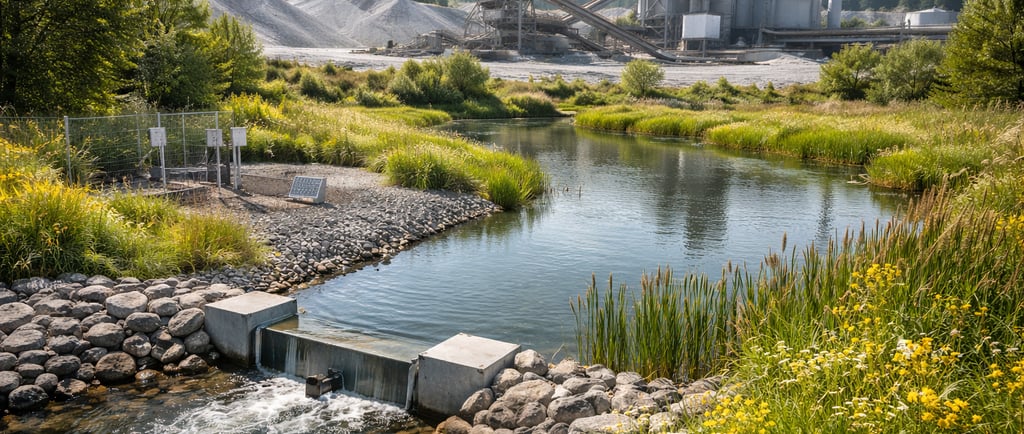
There is also an upside case. Sites can create meaningful habitat value where it matters most, at the edges:
Along waterways, drainage channels, and retention areas
In buffers and setbacks
In low-use corners and safety exclusion zones
During closure, rehabilitation, and redevelopment phases
This is where biodiversity planning becomes a site design and maintenance discipline, not a side project.
Biodiversity and decarbonization belong in one operating plan
Teams often treat carbon and biodiversity as separate workstreams. That creates two common failures:
Climate actions that harm habitats, because siting and land use were not assessed.
Biodiversity actions that backfire on carbon, because water, energy, and maintenance impacts were ignored.
Public commentary has highlighted how poorly planned climate infrastructure can damage nature, which increases backlash and delays. Your plan must screen for these tradeoffs early, during design and procurement. Financial Times
You can also create direct “two-for-one” outcomes when you choose the right actions:
Native, low-water landscaping cuts irrigation demand and mowing frequency, which cuts energy use and fuel burn.
Nature-based stormwater features reduce pumping and treatment loads at some sites, depending on design and local rules.
Rehabilitation plans that stabilize soils reduce dust and particulate emissions, and reduce downstream sediment loads.
The key is simple. Put biodiversity and carbon targets in the same decision path for:
Capex approvals
Site redesigns and expansions
Closure and rehabilitation plans
Contractor scopes of work
Maintenance plans and chemical use
Regulation and disclosure, what you must be ready to show
You are moving into an era where companies must explain “impacts and dependencies” on nature, not just emissions.
If you operate in the EU value chain, CSRD reporting uses ESRS standards. ESRS E4 focuses on biodiversity and habitats, and it is built around clear disclosure expectations on impacts, risks, and how the company manages them. EFRAG
Separately, the TNFD released final recommendations in September 2023, mirroring the familiar structure used in climate disclosure, and it has rapidly gained commitments from organizations planning to adopt it. tnfd.global+1
Even if you do not report directly, your customers, lenders, and insurers may. That pulls your site into their data requests.
Also watch supply-chain due diligence rules tied to land conversion. The EU’s deforestation regulation has faced delays, but the direction is clear: companies will need stronger traceability and proof that products are not linked to deforestation, with implementation now pushed out again according to late-2025 reporting. Reuters+1
One more pressure point is capital allocation. UNEP estimates annual investment in nature-based solutions needs to rise from about $200 billion to $542 billion by 2030 to meet key global nature and climate goals. That scale of financing does not happen without measurement, verification, and credible plans. financefornature.unep.org+1
Translation for your site: expect more due diligence questions, more audits, more requests for evidence.
The anatomy of a site biodiversity plan that works
Use this as the minimum structure. Treat it like an operations document, not a slide deck.
Governance and accountability
Decide who owns the plan.
One accountable site leader, named
One technical owner, internal or external
A budget line with a 12–36 month horizon
Clear decision rights for tradeoffs, especially during expansions
If no one owns it, it becomes a report that expires.
Boundary and influence map
Define what you control and what you influence.
Site boundary, plus buffer areas
Water catchment and discharge pathways
Adjacent land uses, including sensitive areas
Traffic corridors tied to the site
This stops you from missing the biggest off-site impacts, like sediment and stormwater.
Baseline assessment you can repeat
Baseline means “measurable starting point,” not “a list of species once.”
Build it from:
Field surveys across relevant seasons where feasible
Habitat condition mapping
Water sampling, where water risk is material
Photo points and fixed transects for repeat monitoring
Where the site is large, you can combine field work with mapping tools, but keep at least some ground truth.
Impact and dependency register
List the mechanisms of impact.
Common industrial mechanisms include:
Land disturbance, grading, and compaction
Runoff volume changes and peak flow changes
Sediment load, hydrocarbons, heavy metals, nutrient loads
Night lighting and noise
Invasive species introduced via fill, pallets, or transport
Water abstraction volume and discharge temperature
Then list dependencies.
Examples:
Reliable water supply for cooling
Stable slopes and soils
Flood protection and drainage performance
Pollination for on-site landscaping and nearby agriculture, where relevant
Targets that match the site reality
Avoid vague targets.
Use targets with:
A baseline date
A measurement method
A time bound
A responsible owner
Example target types:
Area of habitat improved or created, with condition criteria
Reduced invasive species presence in defined zones
Improved water reuse rate, or reduced abstraction in stress areas
Rehabilitation milestones for disturbed zones
If you are setting broader nature targets, align them with credible target-setting efforts. For example, SBTN reports growing corporate participation in science-based targets for nature. Science Based Targets Network
Action plan built around the mitigation hierarchy
Start with avoiding and reducing impacts.
Then restore.
Use offsets only as a last resort, and only when rules allow.
For many sites, the best “avoid and reduce” actions are unglamorous:
Fix stormwater failures and erosion points
Reduce chemical use in groundskeeping
Replace invasive ornamentals with natives
Adjust lighting to reduce spill and timing impacts
Train contractors on washdown and biosecurity for invasive control
Monitoring, assurance, and reporting
Decide how you will prove results.
Monitoring frequency
Sampling methods
Data storage
Third-party checks, where credibility is needed
You do not need to measure everything.
You must measure the few variables that prove change.
What “good” looks like in the real world
You do not need to invent the playbook. Industrial operators already run serious biodiversity programs.
Holcim has published a quarry rehabilitation and biodiversity directive, including standardized measurement expectations, and it has publicly set measurable targets tied to biodiversity and water at site level. holcim.com+1
Third-party certification also exists for corporate lands. WHC Certification, powered by Tandem Global, is positioned as a voluntary standard for biodiversity enhancement and conservation education on corporate landholdings, with certified programs across many locations. Tandem Global+1
A practical example of scale comes from the waste sector. Waste Management has reported 90 WHC-certified projects across nearly 20,000 acres created, enhanced, or protected for wildlife at its sites. That is what “repeatable across many sites” can look like when the program has ownership and budget. sustainability.wm.com
These examples matter for one reason. They show biodiversity planning can be operationalized like safety or quality.
Common reasons site biodiversity plans fail
Watch for these failure modes.
You treat the plan as an annual report activity, not an operations plan.
You set targets without a baseline or method, then you cannot prove progress.
You outsource ownership, so the plan dies when the consultant leaves.
You choose actions that increase water use, maintenance, or chemical inputs, and you create new problems.
You ignore contractors, even though contractors drive much of the disturbance on site.
How to set yourself up for success before you copy anyone else’s case study
Do these three things first.
Build a site map that shows operational zones, drainage, buffers, and sensitive edges.
Pick 5–10 indicators you can measure every year with the same method.
Put biodiversity and carbon into the same approval flow for expansions and capex.
Once you have that foundation, case studies become useful. You can copy what fits, and skip what does not.
Next comes proof.
The next section walks through real-world case studies of biodiversity plans in action, then moves into advanced strategies, measurement, trends, and a practical implementation checklist.
Real-World Case Studies: Biodiversity Plans in Action
Actions speak louder than words, and nothing underscores the value of combining biodiversity with decarbonization like real-world success stories. Let’s explore how leading industrial players are applying these principles to drive measurable outcomes.
1. LafargeHolcim: Quarry Rehabilitation and Biodiversity Leadership
LafargeHolcim, a titan in building materials, has become a global benchmark for integrating biodiversity into core business. Operating in over 80 countries, their industrial sites often overlap sensitive habitats. In response, the company:
Conducts systematic site biodiversity assessments pre- and post-mining to map baseline species richness and ecosystem functions.
Implements progressive rehabilitation, converting exhausted quarries into wetlands, grasslands, or woodland habitats, depending on local needs.
Tracks biodiversity KPIs using the IUCN Red List and partners with WWF, ensuring interventions are verifiable and externally credible.
Results:
Between 2015 and 2020, over 80% of LafargeHolcim sites had specific biodiversity management plans. Some restored wetlands now support endangered amphibians and migratory birds, demonstrating both ecological and community value.
2. BASF: Circular Water Strategies and Local Engagement
As a global chemical producer, BASF faces intense scrutiny over water and resource impacts. It has responded by innovating in closed-loop water systems and community-centric restoration:
Circular water management at the Ludwigshafen site recycles up to 60 million cubic meters of water per year, slashing both withdrawal and treatment energy footprints.
On-site wetlands and buffer zones offer both pollution abatement and new wildlife corridors.
Outcomes:
Water risk to operations and local ecosystems has fallen sharply, and stakeholder engagement programs resulted in higher employee retention and positive local media coverage.
3. Toyota: Supply Chain Decarbonization Drives Biodiversity Gains
Toyota’s global manufacturing sites prioritize low-carbon and biodiversity-positive supply chains:
Mandates suppliers conduct standardized LCAs and biodiversity assessments.
Prioritizes local, resource-efficient vendors to cut emissions and habitat fragmentation.
Invests in regional tree planting and corridor restoration to support local wildlife.
Impact:
Toyota’s integrated approach helps avoid costly disruptions from resource scarcity and regulatory shifts, while also exceeding many regional compliance thresholds.
Advanced Strategies for Biodiversity and Decarbonization at Scale
While foundational actions (like energy upgrades and habitat restoration) drive quick wins, advanced tactics help industrial sites lead the pack—future-proofing operations and branding the site as a sustainability leader.
1. Nature-Positive Design and Adaptive Infrastructure
Forward-thinking sites move biodiversity and carbon mitigation upstream to the design stage. Examples include:
Flexible green infrastructure: Detention basins double as wildlife habitats and stormwater controls.
Adaptive landscaping: Native, drought-tolerant plant choices minimize maintenance, irrigation, and herbicide use—lowering both emissions and ecosystem impact.
Connected corridors: Linking restored areas with natural habitats allows for greater species migration and resilience to climate change.
2. Digitalization and Data-Driven Eco-Managment
Breakthroughs in environmental monitoring and data analytics empower real-time tracking and predictive planning:
Sensor networks for water, soil, and air quality automate compliance and support early intervention.
GIS mapping and AI-driven land-use modeling forecast biodiversity risk hot spots and optimize restoration investments.
Drone and satellite-based species assessments provide rapid, scalable biodiversity indexing, especially on large or remote sites.
3. Beyond Compliance: Voluntary Certifications and ESG Leadership
Sites often go above legal mandates to win new clients, appease stakeholders, and access green financing:
Pursue certifications such as ISO 14001 (environmental management), LEED (sustainable buildings), or the Wildlife Habitat Council’s Conservation Certification.
Integrate biodiversity performance into ESG (Environmental, Social, and Governance) frameworks, linking executive compensation and investor reporting.
Engage in landscape-level partnerships—working with NGOs and multiple local businesses for larger-scale ecosystem restoration (e.g., watershed projects).
Biodiversity Metrics: Measuring Impact and Delivering Proof
If you can’t measure it, you can’t manage it. Industrial leaders use a range of biodiversity and decarbonization metrics to improve transparency, track ROI, and satisfy both regulators and stakeholders.
Key Performance Indicators for Biodiversity and Carbon
Habitat quality and quantity: Area of restored/created habitat vs. baseline (hectares or % of site)
Species abundance and diversity indices: Use scientifically validated methods such as the Shannon Index or IUCN status assessments
Greenhouse gas emissions reduction: CO₂ equivalent tons avoided or sequestered
Water use efficiency: Cubic meters withdrawn/treated per tonne of product
Pollinator or key species recovery rates
Reporting and Communication Tips
Publish annual biodiversity and carbon progress in sustainability reports, mapped to TNFD or GRI guidelines.
Use infographics and digital dashboards for easily digestible communications to non-technical audiences.
Peer benchmarking: Compare against local and global industry averages to demonstrate leadership.
The Future of Industrial Biodiversity Planning: Trends to Watch
Sustainability is a moving target. The regulatory and market landscape around biodiversity and decarbonization is rapidly evolving. Here’s what’s next:
1. From Net Zero to Nature Positive
“Nature positive” is rising as a strategic goal, complementing or even replacing mere “net zero” rhetoric
Upcoming regulations (like the EU Deforestation Regulation and CSRD biodiversity requirements) will require companies to evidence net nature gains, not just do no harm.
2. Greater Investor and Insurer Scrutiny
Major financial institutions (e.g., BlackRock, AXA) now integrate nature risk into lending and insurability decisions.
Biodiversity-linked financing products such as “green bonds” and insurance discounts are growing, rewarding proactive sites.
3. Technology-Driven Innovation
Digital twins, earth observation satellites, and AI-based biodiversity prediction will shift plans from reactive to predictive—unlocking smarter interventions and new efficiencies.
4. Integrated Value Chains
Companies are moving to system-level approaches: collaborating with suppliers, local authorities, and communities to deliver regional-scale ecological and carbon benefits.
Practical Implementation Checklist: Launch Your Site’s Biodiversity Plan
Baseline analysis:
Conduct a comprehensive LCA and site biodiversity assessment, using both field data and digital tools.Set SMART objectives:
Align biodiversity and decarbonization KPIs with both business and compliance needs.Build your action plan:
Map interventions across energy, land use, water, pollution, and supply chain—budgeting for both quick wins and long-term investments.Engage stakeholders:
Host internal workshops, consult local communities, and partner with trusted NGOs.Monitor and report:
Establish digital tracking systems, conduct annual audits, and benchmark performance.Pursue advanced strategies:
Leverage adaptive infrastructure, digital monitoring, and voluntary standards to stand out.Communicate results:
Publish credible, accessible progress—internally and externally, mapped to respected frameworks.
Final Thoughts: Industrial Sites as Agents of Positive Change
Industrial sites have traditionally been seen as environmental liabilities—but the tide is turning. With holistic biodiversity plans aligned to decarbonization, they can become powerful engines for sustainability, risk reduction, and long-term value creation.
Incorporating these strategies not only strengthens compliance and stakeholder trust but also builds operational and brand resilience. The future belongs to businesses that champion both climate and nature, turning sites from possible eco-risks to nature-positive leaders.
Start your journey now—because the business case for biodiversity, integrated with decarbonization, is stronger than ever.
Connect
Your trusted partner for scrap metal procurement.
CONTACT
About
haroon@tdcventures.com
+1-307-655-7593
© 2025. All rights reserved.
NEWSLETTER