
Ceremonial Protocols for Decommissioning Sites
Discover why ceremonial protocols are moving to the center of decommissioning. Explore IFC standards, Indigenous-led closure criteria, and real-world cases from Ranger to Diavik.
CULTURAL SUSTAINABILITY & INDIGENOUS CIRCULAR PRACTICES
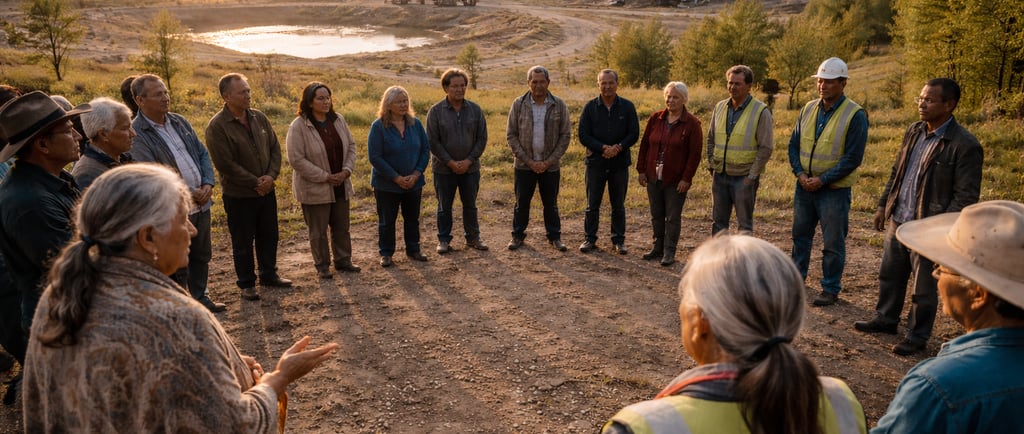
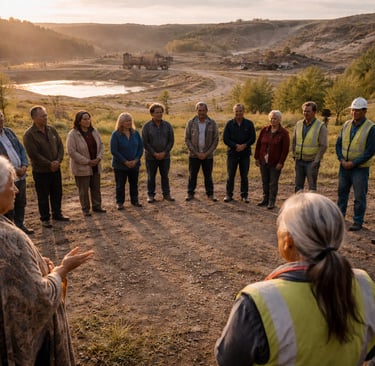
Decommissioning is often described in technical terms. Wells are plugged. Tailings are stabilized. structures are dismantled. contaminated soils are treated. access roads are removed or retained. permits are closed out. monitoring begins. That language captures part of the job, but it misses the part that communities remember longest. A site is never only an engineered footprint. In many places, it is also a lived landscape, a workplace, a sacred geography, a source of grief, a source of income, a memory archive, and a place where the future of land, water, and identity gets argued over in real time. That is why ceremonial protocols are moving from the margins of closure planning to the center of serious decommissioning practice. The current global direction of travel is clear. The IFC’s Performance Standards require projects to identify and protect cultural heritage, consult affected communities who use or have used it within living memory, and build community views into decision-making. ICMM’s updated mine-closure guidance continues to push closure planning across the full life cycle of a project rather than treating closure as an end-stage paperwork exercise. The World Bank’s current just transition work makes the same point in another language: active stakeholder engagement is crucial at every phase of closure and transition.
That shift matters because decommissioning has become larger, more visible, and more politically charged. It is no longer limited to the closing of isolated mines or plants. Around the world, economies are retiring coal assets, restructuring mineral supply chains, reworking tailings governance, modernizing industrial estates, and facing pressure to close or rehabilitate legacy sites in ways that are environmentally sound and socially legitimate. The UN’s 2025 guidance on critical energy transition minerals explicitly includes mine-site closure plans as part of responsible mineral governance. UNEP now frames circularity as a systems shift away from take-make-waste and toward reuse, repair, remanufacture, and recycling, with more than 70 countries already implementing circular economy policies and tens of millions of related jobs projected by 2030. In other words, closure is no longer just the end of extraction. It is increasingly the start of land return, material recovery, social transition, and public judgment about whether a project left behind damage or dignity.
Ceremonial protocols matter in that setting because they deal with what standard closure frameworks usually under-handle: timing, meaning, acknowledgment, permission, mourning, continuity, and collective memory. UNESCO defines intangible cultural heritage as the practices, knowledge, and expressions that communities recognize as part of their cultural identity, including associated objects and spaces, transmitted through generations and adapted over time. That definition is directly relevant to closure. A ceremony at decommissioning is not ornamental. It can be a living expression of law, care, authority, remembrance, gratitude, warning, reclamation, and intergenerational transmission. When closure affects a landscape with ongoing cultural and spiritual connection, the question is not whether ceremony is “symbolic.” The question is whether the closure process is mature enough to recognize that symbols, rituals, and protocols are part of governance, not separate from it.
The leading edge of practice already reflects that reality. In Australia, the 2026 government action on Ranger Uranium Mine explicitly centers returning the site to the Mirarr Traditional Owners, with a new rehabilitation authority and land access agreement developed with the Mirarr, the Gundjeihmi Aboriginal Corporation, and the Northern Land Council. In northern Canada, Rio Tinto states that planning for Diavik’s closure began before the mine itself started production, with closure goals covering not only safety, landforms, water, and biodiversity, but also community capacity and resource development. These are not small details. They show that advanced closure thinking is already moving beyond surface remediation toward relationship-based end-of-life planning. Ceremonial protocols belong inside that shift because they help define how a site is handed back, who speaks for place, what gets acknowledged publicly, and how communities mark the movement from extraction to afterlife.
2. The Core Failure: Why Conventional Decommissioning So Often Falls Short
Traditional decommissioning models are built to satisfy engineering, finance, and compliance first. They focus on physical hazards, liabilities, revegetation targets, water quality, waste management, and cost provisioning. Those things are necessary. None of them are optional. But on their own, they are not enough. The IFC’s standards are explicit that cultural heritage must be identified and protected regardless of whether it has already been legally protected or previously disturbed. They also require consultation with communities who use, or have used within living memory, places or practices tied to that heritage. That is a much higher bar than simply checking whether a formally listed heritage object sits inside a permit boundary. It recognizes something many closure plans still fail to confront: a disturbed site can still be culturally alive, and a “closed” site can still be spiritually open.
This is where many decommissioning efforts break down. They arrive late with engagement, treat ceremony as an optional add-on, reduce cultural recognition to a meeting or acknowledgment statement, and assume that technical rehabilitation automatically produces social legitimacy. It does not. The World Bank’s mine-closure work has long shown that closure reshapes the entire community, not just the operating company’s footprint. Its current just transition framing continues to stress that each stage of mine closure affects workers, families, municipalities, and local economic systems, and that stakeholder engagement has to remain active all the way through. ICMM’s 2025 transition guidance says the same in practical terms, asking whether regional and community-level visioning exists, whether mechanisms for supporting the transition are in place, and whether there are multistakeholder approaches for monitoring the process. These are strong signals that closure failure is rarely just technical failure. It is often social transition failure.
When ceremony is ignored, the harm can be subtle at first and severe later. Communities may feel that the site has been “finished” administratively while nothing meaningful has been resolved relationally. Elders may see spiritual obligations bypassed. Former workers may feel erased rather than honored. Families may see the land being rehabilitated but never properly returned. Youth may inherit a cleaned surface with no narrative bridge explaining what happened there, what was lost, and what responsibilities remain. In that vacuum, resentment hardens. Rumor replaces trust. Closure becomes a legal status rather than a legitimate one. UNESCO’s understanding of living heritage is useful here because it shows why closures that ignore ritual, oral memory, and locally meaningful acts of transition can damage identity even when they improve physical conditions. If a community’s knowledge system says a site must be cleansed, spoken over, named, walked, witnessed, or reintroduced to Country in a particular way, a technically flawless closure that skips those steps can still be experienced as incomplete or disrespectful.
There is also a governance cost to getting this wrong. Financial assurance and post-closure standards exist because governments have repeatedly had to deal with incomplete rehabilitation, unfunded liabilities, and weak post-closure planning. The World Bank’s closure guidance makes clear that financial surety is meant to ensure enough money exists for rehabilitation, monitoring, and maintenance after closure. But even good financial provisioning cannot purchase legitimacy after trust has been lost. Nor can a risk register substitute for a process that communities feel they helped shape. Closure plans need money, yes. They also need moral sequence. People need to know what happens first, who is consulted, which places are protected, who can access the site, how chance finds are handled, how ceremonies are resourced, and what happens if cultural obligations change during the process. When those questions are left vague, conflict is not an outlier. It is the predictable result of treating closure as a one-system problem instead of a multi-system one.
3. What Ceremonial Protocols Actually Mean in a Closure Context
Ceremonial protocols are not a single universal template. They are place-specific, people-specific, and often season-specific arrangements that govern how closure is acknowledged, witnessed, authorized, and carried through in culturally appropriate ways. In one context, that may involve fire, water, smoke, song, processional walking, language, silence, offerings, or the presence of specific elders or custodians. In another, it may involve staged community gatherings, prayer, storytelling, memorial acts, naming practices, harvest restrictions, reburial, site cleansing, or the formal reopening of access to land and water. In some settings, ceremony is public. In others, it is restricted, gendered, lineage-based, or known only to those with standing. A credible closure plan therefore cannot “invent” ceremonial content. It has to create the governance and resourcing conditions in which the relevant community determines what is appropriate, what is confidential, what is non-negotiable, and what should never be documented publicly.
That distinction matters because ceremonial protocols sit at the intersection of several legal and policy concepts that are often discussed separately. One is cultural heritage. IFC Performance Standard 8 covers both tangible heritage and certain intangible forms of heritage, and it requires clients to avoid significant adverse impacts where possible, to use chance-find procedures, and to consult communities whose long-standing cultural uses may be affected. Another is Indigenous rights. IFC Performance Standard 7 and the broader international framework around Free, Prior and Informed Consent make clear that projects affecting Indigenous Peoples must move beyond generic consultation. UNDRIP states that no relocation shall take place without free, prior and informed consent and just and fair compensation where applicable. While FPIC is often discussed in the context of project development, its logic carries directly into decommissioning and land return. Closure decisions can affect access, memory, heritage, livelihoods, and territorial relations just as profoundly as project construction did.
A third concept is just transition. The ILO defines just transition as the move toward environmentally sustainable economies in ways that are fair and inclusive. The World Bank’s just transition work for coal regions frames closure not as a narrow environmental exercise but as a coordinated package of actions for workers, land, municipalities, and communities. Ceremonial protocols belong inside that frame because communities do not transition only economically. They transition socially and emotionally too. A decommissioned site changes how a place understands itself. It changes who remains, what work means, what land is for, and what story children are told about the past. Ritual and protocol help communities metabolize that change. They are part of how a transition becomes socially legible rather than administratively imposed.
A fourth concept is circular legacy. UNEP now describes circularity as a regenerative systems approach that retains value and shifts sectors toward reuse, repair, remanufacture, and recycling. In closure terms, this means decommissioning should not be planned only around removal and rehabilitation. It should also ask what can be returned, reused, reworked, reinterpreted, or repurposed in ways that are culturally acceptable and locally beneficial. Sometimes that means salvaged materials becoming community infrastructure. Sometimes it means archiving tools, signage, or artifacts for local memory institutions. Sometimes it means preserving selected industrial elements as part of a future-use landscape. Sometimes it means leaving nothing visible at all because restoration and cultural return require erasure rather than memorialization. Ceremony helps determine which of those pathways is legitimate. It is often the mechanism by which a community decides what must go, what may remain, and what should be transformed.
4. The Foundation: Community, Governance, Equity, Culture, and Time
Every strong ceremonial closure process rests on five foundations, and each one has to be built early rather than retrofitted late.
The first is community authority. Not every affected person will hold the same standing in relation to the site. Some are rightsholders. Some are stakeholders. Some are former workers. Some are adjacent residents. Some are traditional custodians. Some are youth who inherit the aftermath. A serious protocol process begins by distinguishing these relationships clearly and respectfully. It does not flatten everyone into “the community.” The IFC’s guidance is especially helpful here because it requires engagement with communities that use or have used cultural heritage within living memory. That phrase matters. It recognizes continuity, not just proximity. It asks who has standing because of cultural use, memory, and inherited connection, not simply because they live nearest the gate today.
The second is governance. Ceremony cannot function well inside vague authority structures. Someone has to determine how decisions are made, which matters are confidential, who can convene, what counts as consent, how disputes are handled, and how technical and ceremonial timelines are aligned. ICMM’s closure and transition materials increasingly point toward integrated, multistakeholder approaches because closure now includes environmental, social, land-use, and post-closure development questions that no single actor can resolve alone. Governance is what turns ceremonial respect from a promise into a process. Without it, teams fall back on ad hoc invitations, symbolic events, and last-minute requests for cultural participation after the substantive closure decisions have already been locked in.
The third is equity. Ceremonial protocols fail when they rest on unpaid labor, selective access, or extractive expectations. If elders, knowledge holders, translators, cultural advisers, youth documenters, or community coordinators are essential to the process, then the process needs budget lines, time protections, transport support, food, translation, and administrative backing. Equity also means recognizing that closure burdens are not evenly distributed. Workers may lose income. nearby residents may inherit derelict land. traditional owners may shoulder cultural obligations without institutional resources. municipalities may lose tax base. women often carry hidden care burdens during economic transition. Youth may be expected to “participate” without being offered training or paid roles in stewardship, documentation, restoration, or cultural continuity. A ceremonial protocol is credible only when the people who make it possible are treated as central contributors, not volunteer scenery.
The fourth is culture. This seems obvious, yet it is where projects often become clumsy. Culture is not a decorative layer placed on top of the real work. It is a knowledge system that shapes what the land means, which places are sensitive, how transitions should be marked, and what counts as repair. UNESCO’s living-heritage framework is clear that rituals, festive events, oral traditions, and knowledge concerning nature are part of cultural heritage, not secondary to it. In closure planning, that means the process has to make room for language, seasonal calendars, ceremonial timing, restricted knowledge, and non-Western forms of environmental understanding. The practical implication is simple. If the schedule says one thing and the cultural calendar says another, the schedule is not automatically correct. It may need to move.
The fifth is time. Most project teams think about time in terms of budget cycles, permit deadlines, contractor windows, and reporting dates. Ceremonial closure forces a broader view. There is pre-closure time, mourning time, handover time, monitoring time, and intergenerational time. There is also historical time. Communities may be responding not only to the immediate site but to decades of extraction, exclusion, or broken promises. That is why closure planning done only at the end is so fragile. ICMM’s updated closure guide continues to emphasize integrated planning across the mine life cycle, and Rio Tinto’s public statement on Diavik notes that closure planning began before production started. That is the level of temporal seriousness ceremonial integration requires. You cannot build a meaningful closure protocol in the final weeks of dismantling and expect it to carry the moral weight of decades.
5. A Practical Framework for Embedding Ceremonial Protocols into Decommissioning
A workable framework begins with recognition, but it cannot stop there. It has to move from respect to structure.
The first stage is early cultural scoping. Before closure designs are finalized, teams should identify living heritage, access patterns, sacred or sensitive areas, community expectations for handover, and the likely ceremonial dimensions of decommissioning. This stage should be done with qualified cultural practitioners and community-recognized representatives, not through generic surveys alone. IFC guidance already requires identification and protection of cultural heritage and the use of competent professionals where impacts are possible. That should be read as the floor, not the ceiling. For decommissioning, early scoping should ask not just what must be protected from disturbance, but what must be actively acknowledged, returned, repaired, narrated, or witnessed.
The second stage is protocol co-design. This is where the ceremonial logic of closure is developed. It should include who convenes ceremony, who attends, who does not attend, what is recorded, what stays private, what technical activities must pause, how site access is managed, how cultural objects or materials are handled, how risk controls are adapted without overriding protocol, and how multiple traditions are navigated where more than one group has standing. Co-design should also deal with the uncomfortable issues most teams avoid: what happens when cultural obligations conflict with contractor schedules, what happens when heritage is discovered unexpectedly during dismantling, what happens when different groups disagree, and what happens if a planned ceremony cannot proceed because of weather, safety, or internal community reasons. Strong closure governance plans these contingencies in advance rather than treating them as disruptions.
The third stage is alignment with technical closure. Ceremony should not sit in a separate appendix disconnected from engineering works. It needs to be tied to milestones such as cessation of production, dismantling of major structures, sealing of shafts or wells, relocation of materials, landform completion, water treatment transition, opening or closure of access routes, final revegetation, and post-closure monitoring handover. The World Bank’s toolbox for governments is useful here because it treats closure as a governance framework that includes technical, social, environmental, and cost-estimating aspects rather than a purely engineering schedule. Ceremonial integration becomes much more durable when every major technical milestone is checked for cultural implications before it is approved.
The fourth stage is resourcing and institutionalization. Protocols fail when they are carried entirely by goodwill. There should be a clear budget, named internal accountabilities, paid community roles, documentation rules, language support, transport and safety arrangements, and provisions for ongoing stewardship after the visible closure event is over. This is where financial assurance and closure standards matter. If closure funds are supposed to cover rehabilitation and post-closure monitoring, serious jurisdictions and operators should also be asking whether the governance and community-transition components of closure are adequately financed. Ceremonial work is not free labor. It is part of the infrastructure of legitimate closure.
The fifth stage is post-closure continuity. Ceremonial protocols are often wrongly imagined as one final event. In reality, many sites require a sequence: preparation, acknowledgment, transfer, re-entry, stewardship, remembrance, and periodic return. UNESCO’s work on living heritage and youth transmission is relevant here. Closure should not freeze culture into a single commemorative act. It should support the next generation’s relationship to what happened, what remains, and what responsibilities continue. That may include youth documentation, land-based education, community archives, oral-history programs, cultural mapping, seasonal return visits, or stewardship programs linked to monitoring and restoration. The site is closed operationally, but the cultural relationship may be entering a new phase rather than ending.
6. Implementation Playbook: How to Make the Process Real Before the Case Patterns Begin
The best way to think about implementation is to treat ceremonial protocol as a closure workstream with equal standing beside engineering, environmental management, social transition, and regulatory compliance. It should start with a cultural baseline, continue through scenario planning, and remain active into post-closure monitoring. At minimum, operators and regulators need a cultural heritage and ceremonial-risk register, a rightsholder and stakeholder map, a confidentiality protocol, a chance-finds procedure, a documented engagement calendar, a ceremony logistics plan, a conflict-resolution pathway, and a post-closure continuity plan. None of these tools are exotic. The World Bank, IFC, and ICMM materials already support the underlying logic: closure must be integrated, community-engaged, financially provisioned, and linked to long-term transition outcomes rather than treated as a narrow compliance event.
Implementation also needs measurement, though not all meaningful things can be reduced to numbers. The strongest programs combine qualitative and quantitative evidence. They track whether protocol commitments were met on time, whether the relevant knowledge holders participated on agreed terms, whether access arrangements were honored, whether unexpected heritage finds were handled correctly, whether grievances were resolved, whether local languages were used where needed, whether ceremony-informed schedule changes were respected, and whether post-closure stewardship roles were actually funded and filled. They also track longer-term signals: trust, continuity of site access where appropriate, youth involvement, legacy-use outcomes, and the absence of avoidable conflict. This is where ceremonial protocol stops being treated as sentiment and starts being treated as management quality. If a company can measure water quality, dust, revegetation, and contractor safety, it can also measure whether it kept its cultural commitments.
Common failure modes are now easy to identify. One is late engagement. Another is public ceremony without private consent. Another is documenting things that should never have been filmed or archived. Another is assuming one ceremony resolves all relationships to a site. Another is inviting community members to witness closure after the meaningful decisions have already been taken. Another is ignoring former workers as carriers of memory and local legitimacy. Another is separating cultural heritage teams from closure engineers so completely that each works on a different timeline. Another is believing that regulatory approval automatically means cultural completion. None of these failures are rare. They are exactly what appear when closure systems have process discipline in the technical stream and improvisation in the cultural stream.
A stronger model is now visible internationally. Plan closure early. Treat ceremony as governance, not decoration. Link protocol to technical milestones. Pay the people carrying cultural authority and continuity. Build confidentiality into the system from the start. Make post-closure stewardship real. Design for circular legacy where communities want it. And remember that a site is not fully closed when the last machine leaves. It is closer to closed when the people with the deepest relationship to that place can say, in their own law and language, that the transition was handled properly. With that foundation in place, the case patterns and scenarios that follow make practical sense, because they show what happens when these principles are applied, resisted, negotiated, or ignored in the real world.
7. Case Patterns and Scenarios
Ceremonial protocols are easiest to dismiss in theory and hardest to dismiss in practice. Once a site enters active closure, the limits of purely technical planning become obvious. Questions begin to surface that engineering documents alone cannot answer. Who has the right to speak for the land at the moment of handback? What must be acknowledged publicly before dismantling can proceed? Which places require silence, restricted access, prayer, song, cleansing, witness, or the presence of specific knowledge holders? What can be recorded, and what must remain private? These are not soft issues sitting outside closure. They are closure. IFC Performance Standard 8 requires projects to identify and protect cultural heritage and to consult communities that use, or have used within living memory, that heritage. ICMM’s 2025 closure guidance pushes the industry toward integrated closure planning across the life of the asset, not a last-stage technical exercise. Together, these standards make one thing clear: closure that ignores cultural process is incomplete closure.
One of the strongest real-world patterns comes from Ranger Uranium Mine in Australia. The site sits on Mirarr Country and is surrounded by Kakadu National Park. As rehabilitation advanced, the Mirarr and the Northern Land Council worked to articulate “cultural closure criteria” so that closure would be judged not only by engineering and environmental metrics, but by whether the land could once again support hunting, gathering, recreation, and ceremony. Public reporting from the Northern Land Council makes clear that cultural reconnection was not treated as a ceremonial afterthought. It was positioned as a core part of defining what successful closure would mean in practice. The 2025 Ranger Mine Closure Plan executive summary also states that consultation with Mirarr Traditional Owners continued to further develop cultural closure criteria. In January 2026, the Australian government publicly reaffirmed that rehabilitation is meant to support the land’s return to the Mirarr Traditional Owners. This is exactly the direction stronger closure models are moving in: from closure as compliance, to closure as return, reconnection, and renewed custodianship.
A second important pattern comes from Diavik in Canada’s Northwest Territories. In February 2026, the Tłı̨chǫ Government and Diavik signed a closure agreement in Behchokǫ̀ in front of citizens, Elders, and staff. The event included an opening and closing prayer, a community feast, and a drum dance. That detail matters because it shows ceremonial form being embedded in the governance act itself, not staged separately for optics. The closure agreement followed a relationship that Rio Tinto says dates back to 2000 and was built around Tłı̨chǫ involvement throughout the project life cycle. Public reporting around Diavik’s final shutdown in March 2026 also described a closing ceremony involving employees, government officials, and Indigenous representatives. This is what mature closure looks like in practice: agreement, public witness, cultural protocol, and institutional continuity all operating in the same frame.
A third pattern is emerging from the broader just-transition field, especially in coal and post-mining regions where closure is not only environmental but deeply economic and social. The World Bank’s 2025 mine-closure standards work positions improved post-mining transitions as part of good closure governance, while its Bosnia and Herzegovina transition program links progressive land repurposing, workforce support, and local economic transition directly to mine closure planning. These are not ceremonial case studies in the narrow sense, but they are highly relevant because they confirm the wider point: closure is now being treated as a multidimensional transition process. In that setting, ceremonial protocols become more important, not less. As sites move from production landscapes to post-extractive landscapes, communities need visible, legitimate, collectively understood ways to mark that shift. Where those symbolic and governance needs are ignored, the economic transition is often experienced as abandonment rather than change.
A fourth pattern comes from the social-license literature. Research on “social license for closure” argues that mine closure should be managed through participatory approaches because closure changes the rules under which communities, institutions, and former operators relate to each other. Related 2024 and 2026 literature on mine closure and social impacts makes the same point from different directions: closure can weaken social cohesion, alter cultural practices, and create long-term dependencies or disruptions that standard project-level planning often misses. That is why ceremonial protocols are not peripheral. They help communities process rule change. They give form to closure, create moments of witness and accountability, and allow sites to move from industrial function to social meaning in ways that are publicly legible.
What separates successful scenarios from weak ones is not the existence of a ceremony on paper. It is whether ceremonial protocol is backed by early planning, clear authority, resourcing, confidentiality rules, and post-closure continuity. The Ranger example shows the power of closure criteria shaped by Traditional Owners. Diavik shows ceremonial integration at the point of agreement and public transition. The just-transition cases show that closure is increasingly understood as a regional and community process, not a narrow site event. Across all of them, the lesson is the same: ceremony works when it is part of governance, part of timing, and part of the definition of what “done” actually means.
8. Frequently Asked Questions, Expanded
Q1. What are ceremonial protocols in site decommissioning?
Ceremonial protocols are structured, community-defined processes that guide how a site is acknowledged, transitioned, and returned at closure. They include rituals, governance steps, cultural practices, and timing rules that reflect the values, beliefs, and authority of affected communities. These protocols are not symbolic add-ons. They are part of how closure is made legitimate in social, cultural, and often legal terms.
They can involve activities such as land acknowledgment, cleansing rituals, oral storytelling, restricted access periods, artifact handling, or formal land-return ceremonies. In many Indigenous contexts, these actions are tied to longstanding knowledge systems and responsibilities that extend across generations.
Global standards support this direction indirectly. Frameworks like the International Finance Corporation Performance Standards require protection of cultural heritage and meaningful consultation, which in practice often leads to formalized ceremonial processes at closure.
Q2. Why are ceremonial protocols becoming critical in 2026 and beyond?
Three forces are driving this shift.
First, closure is increasing. Aging mines, industrial assets, and energy-transition pressures are accelerating decommissioning across sectors.
Second, expectations have changed. Communities, regulators, and investors now expect closure to address not only environmental remediation but also social and cultural impact.
Third, risk has become more visible. Projects that ignore cultural protocols face delays, reputational damage, and long-term distrust.
The World Bank has emphasized that closure is no longer a technical endpoint. It is a social transition process affecting workers, land use, and local economies. Ceremonial protocols help manage that transition in a way that communities recognize as legitimate.
Q3. Are ceremonial protocols required by law or just best practice?
They are increasingly moving from best practice toward expectation, depending on jurisdiction.
In many regions:
Cultural heritage protection is legally required
Indigenous consultation is mandatory
Free, Prior and Informed Consent principles apply in certain contexts
Frameworks like the International Council on Mining and Metals guidance and IFC standards push operators toward deeper engagement, which often includes ceremonial elements.
While not always explicitly codified as “ceremonial protocols,” the underlying obligations make them functionally necessary in high-quality closure planning.
Q4. When should ceremonial protocols be introduced in the project lifecycle?
As early as possible.
Best practice is to begin during:
Project development
Early operations
Mid-life planning updates
Not at closure.
Leading operators now plan closure from day one. For example, major sites like Diavik began closure planning before production started. This allows time to:
Build trust
Understand cultural context
Align technical and ceremonial timelines
Late-stage integration leads to conflict, rushed processes, and superficial outcomes.
Q5. Who defines the ceremonial protocols?
The community defines them. Not the company. Not consultants.
Specifically:
Indigenous knowledge holders
Traditional custodians
Elders and cultural leaders
Recognized community authorities
The role of the operator is to:
Facilitate
Resource
Align
Respect confidentiality
The United Nations Educational, Scientific and Cultural Organization defines cultural heritage as community-recognized practice. That principle applies directly here.
Q6. What happens if multiple groups have different ceremonial expectations?
This is common and must be managed through governance, not assumption.
Effective approaches include:
Multi-party protocol mapping
Neutral facilitation
Clear authority structures
Agreed escalation pathways
In complex cases, different ceremonies may be required for different groups, or staged processes may be used.
Ignoring differences or forcing a single approach often leads to disputes, delays, and breakdown in trust.
Q7. How do ceremonial protocols impact project timelines?
They can extend timelines, but they also reduce long-term delays.
Data and case patterns show:
Projects with strong community engagement face fewer stoppages
Conflict-related delays are significantly reduced
Regulatory approvals are often smoother
Short-term scheduling flexibility leads to long-term stability.
Projects that skip ceremonial alignment often face:
Legal disputes
Community resistance
Rework and redesign costs
Q8. Do ceremonial protocols increase closure costs?
Yes, but they reduce overall risk-adjusted costs.
Costs include:
Community engagement
Cultural expertise
Ceremony logistics
Documentation and governance systems
However, these are offset by:
Reduced litigation risk
Faster approvals
Lower reputational damage
Stronger long-term relationships
The World Bank has repeatedly highlighted that poorly managed closure can create long-term liabilities far exceeding initial savings.
Q9. How are ceremonial protocols integrated with technical closure activities?
Through alignment, not separation.
Key integration points include:
Linking ceremonies to closure milestones
Adjusting schedules to cultural calendars
Embedding protocol in site access rules
Aligning environmental restoration with cultural use
For example:
Landform completion may trigger a return ceremony
Final dismantling may require restricted access periods
Water treatment transition may involve ritual acknowledgment
The strongest systems treat ceremony as part of operations, not a parallel track.
Q10. What role do informal or non-Indigenous communities play?
They play a critical role, especially in:
Workforce memory
Local identity
Economic transition
Ceremonial protocols should include:
Former workers
Local residents
Youth groups
Community organizations
Closure is not only about Indigenous rights. It is also about broader community transition.
The International Labour Organization highlights that millions of workers depend on extractive and waste sectors. Their transition must be recognized in closure planning.
Q11. How is success measured in ceremonial protocol integration?
Success is measured through both qualitative and quantitative indicators.
Examples include:
Community-defined closure criteria met
Participation of recognized knowledge holders
Grievances resolved within agreed timelines
Cultural access restored where appropriate
Post-closure stewardship roles established
Long-term indicators matter most:
Continued community use of land
Absence of conflict
Intergenerational knowledge transfer
If a site is technically closed but socially contested, closure is not complete.
Q12. What are the biggest mistakes organizations make?
The most common failures include:
Starting engagement too late
Treating ceremony as symbolic
Ignoring confidentiality requirements
Over-documenting sensitive practices
Excluding key knowledge holders
Separating cultural and technical teams
Assuming one ceremony is enough
These mistakes are predictable and preventable.
They usually stem from treating closure as an engineering task instead of a social process.
Q13. How do international standards address ceremonial protocols?
Standards do not prescribe ceremonies directly, but they create the conditions that require them.
Key frameworks include:
International Finance Corporation Performance Standards
International Council on Mining and Metals Mining Principles
United Nations declarations on Indigenous rights
These frameworks emphasize:
Cultural heritage protection
Stakeholder engagement
Co-designed governance
Ceremonial protocols are how these principles are implemented in practice.
Q14. How are ceremonial protocols audited and verified?
Through structured, culturally appropriate verification.
Methods include:
Community-approved documentation
Witnessed milestone completion
Interviews with knowledge holders
Grievance tracking
Compliance checks against agreed protocols
What should not happen:
Forced disclosure of sacred practices
Over-reliance on visual documentation
Verification should confirm legitimacy, not expose sensitive knowledge.
Q15. What's the role of technology in ceremonial documentation?
Technology supports, but does not control.
Common uses:
Digital storytelling
Archival systems
Controlled documentation platforms
Geospatial mapping
Emerging tools include:
Blockchain for compliance tracking
Immersive media for education and knowledge transfer
Limits are critical:
Not all ceremonies should be recorded
Not all knowledge should be digitized
Technology must follow community rules, not override them.
9. Embedded Five-Layer Toolkit
A useful toolkit for ceremonial decommissioning needs to be practical enough for operators and regulators, but flexible enough for communities whose protocols do not fit a standard corporate template.
The first layer is a stakeholder and rights-holder engagement framework.
This should identify Traditional Owners, Indigenous governments, elders, cultural practitioners, former workers, nearby residents, youth groups, local authorities, faith leaders where relevant, and community organizations with long memory of the site. It should distinguish clearly between parties with legal rights, parties with cultural standing, and parties with broader stakeholder interest. It should also specify how and when they will be engaged, in what language, with what support for transport, accessibility, documentation, and confidentiality. The purpose is not to produce a contact list. It is to create a living governance map of who must be present for closure to be legitimate. IFC and World Bank guidance both support this integrated, multi-actor approach to closure governance.
The second layer is a protocol alignment map.
This is where technical closure milestones are lined up against cultural obligations, seasonal windows, regulatory checkpoints, access restrictions, and community-defined moments that require ceremony or pause. For example, dismantling a specific structure may need to wait until knowledge holders have completed site walkthroughs or cleansing actions. Landform completion may trigger a return-to-Country event. Handback of an area may depend on both ecological metrics and cultural use criteria. The value of this layer is that it forces closure managers to stop treating culture and engineering as separate calendars. It turns protocol into scheduling logic. The Ranger cultural-closure work shows why this matters. Cultural reconnection and future use of land for ceremony, hunting, and gathering are not things that happen after closure is done. They are part of what closure success means.
The third layer is a governance model canvas.
This should define who has authority over which decisions, which matters require consensus, which can be delegated, what happens in case of disagreement, how neutral facilitation is triggered, how sensitive information is handled, and what the escalation pathway looks like if protocol is breached. ICMM’s updated closure guidance and transition materials make clear that multistakeholder governance is increasingly expected in serious closure planning. A governance canvas prevents the familiar failure in which everyone is invited to participate, but no one knows who can actually decide. When ceremony intersects with safety, access, documentation, or land-use transfer, ambiguity creates conflict fast. This layer is where that conflict gets prevented rather than cleaned up later.
The fourth layer is a ceremonial activity library, but it should be used carefully.
Its purpose is not to standardize sacred practice across cultures. Its purpose is to help teams understand the range of possible closure-related actions that communities may choose to develop, such as welcome and return ceremonies, cleansing or smoking practices, water or fire rites, memorial acts for workers, oral-history gatherings, youth knowledge-transfer walks, land return events, artifact handling protocols, and post-closure anniversaries. The library should include only community-approved categories and logistical guidance. It should never become a menu from which project teams select ceremonies on their own. Used properly, this tool helps technical teams understand the operational implications of ceremonial work without trying to control the substance of that work. UNESCO’s framing of living heritage as evolving, community-recognized practice is the right lens here.
The fifth layer is a measurement and learning dashboard.
It should track both hard and soft indicators: whether agreed ceremonies occurred on schedule, whether the right custodians were present, whether restricted areas were respected, whether community-defined closure criteria were met, whether grievances were resolved, whether post-closure stewardship roles were funded, whether youth engagement actually happened, and whether cultural use of the site resumed where that was intended. It should also record what changed because of feedback. Did a dismantling sequence move? Was a road left open longer? Was a site buffer widened? Was documentation reduced because of cultural concerns? A good dashboard is not a performance theater. It is evidence that closure commitments were not treated as symbolic promises. Research on social license for closure and broader mine-closure governance both support this kind of participatory, adaptive monitoring.
10. Competitive Differentiation and Market Gaps
The market gap is now obvious. Closure standards are tightening, public scrutiny is rising, and the energy transition is expanding pressure on extractive and industrial projects to prove they can end responsibly as well as operate responsibly. Yet most organizations still treat ceremonial protocol as informal, discretionary, or too local to build into mainstream closure systems. That leaves a major opening. Companies, consultants, and regulators that can turn cultural respect into auditable closure practice will increasingly stand apart from those still relying on generic community-engagement language. ICMM’s 2025 closure guidance, the World Bank’s 2025 work on closure standards, and the UN’s 2025 guidance on critical energy transition minerals all point toward more integrated, socially credible closure expectations. The direction is not ambiguous. The only open question is which actors adapt early enough to lead.
There is also a strong differentiation angle around risk. Poorly handled closure now carries more than technical and financial consequences. It can trigger prolonged distrust, weaken future permitting prospects, damage employer brand, complicate land repurposing, and undermine relations with governments and communities long after production ends. Research published in 2024 and 2026 on mine-closure social impacts shows that closure disrupts local systems in ways standard impact frameworks often understate. In that context, ceremonial protocols function as risk prevention infrastructure. They help turn a closure from a unilateral shutdown into a negotiated transition. Organizations that understand that will usually face fewer surprises in the final phase of asset life and will be better placed to defend their record publicly.
Another competitive advantage lies in workforce and community continuity. Deloitte’s 2026 mining trends reporting highlights how much the sector’s future is being shaped by cooperation among companies, governments, technology providers, customers, and communities, while broader mining research continues to flag labor and skills shortages across major jurisdictions. In that environment, closure behavior affects more than legacy reputation. It influences whether companies are seen as credible long-term partners and employers. A business that handles closure with visible respect, local participation, and strong legacy planning can retain trust in regions where it may later seek exploration, processing, recycling, or transition-mineral opportunities. Closure is not the end of market positioning. It is often the test of whether earlier social claims were real.
The market is also underprepared for the circular legacy side of closure. UNEP states that more than 70 countries now have circular economy policies, with tens of millions of related jobs projected by 2030. That means decommissioning will increasingly be judged not only on rehabilitation, but on how intelligently assets, materials, land, and community capabilities are transitioned into post-closure use. Ceremonial protocols can become a point of distinction here because they help determine what respectful reuse looks like. They can guide whether salvage materials are repurposed locally, whether industrial remnants become memory sites, whether land is returned without visible infrastructure, or whether former sites support community, ecological, or youth-centered uses. The market gap is not just cultural. It is strategic. Most players still do not know how to join closure, culture, and circular legacy in one coherent system.
The next few years will likely bring three clear trends. First, closure systems will become more integrated and more closely tied to just-transition frameworks, especially in minerals and coal. Second, documentation and verification tools will improve, including more structured use of digital storytelling, heritage records, geospatial data, and controlled digital ledgers for specific compliance functions. Third, ceremonial and cultural protocol thinking will begin spreading beyond mining into infrastructure, energy, and industrial decommissioning as more sectors confront the politics of land return, industrial memory, and post-operational legitimacy. The organizations that act now will not only reduce conflict. They will define what good closure looks like in the next phase of global practice.
Conclusion: Embedding Ceremonial Protocols for Lasting Impact
Ceremonial protocols for decommissioning sites are moving from the edges of practice toward the center because they answer questions that technical closure alone cannot answer. They deal with meaning, witness, authority, transition, memory, and return. They help communities mark the end of extraction and the beginning of something else, whether that is restoration, renewed access, stewardship, mourning, repurposing, or land handback. International standards now provide a strong enough foundation to support this shift. IFC addresses cultural heritage and Indigenous engagement. ICMM is pushing integrated closure across the asset life cycle. The World Bank is tying closure more directly to community transition and post-mining outcomes. Real-world examples like Ranger and Diavik show that culturally grounded closure is already being practiced, not just debated.
The lesson is simple, even if the work is not. Future-facing closure is not only about dismantling safely and rehabilitating effectively. It is about whether the people with the deepest relationship to a place can recognize the process as legitimate. It is about whether closure criteria include cultural use, not just technical completion. It is about whether communities leave the process with stewardship, memory, and dignity intact. It is about whether land is handed back in a way that is lawful in both regulatory and cultural terms. Projects that understand this will not treat ceremony as a performance. They will treat it as part of closure design itself. That is where the field is heading, and it is where the strongest operators, advisors, and regulators need to be headed now.
Connect
Your trusted partner for scrap metal procurement.
CONTACT
About
haroon@tdcventures.com
+1-307-655-7593
© 2025. All rights reserved.
NEWSLETTER