
Circular Contracts: Service-Based Models for Equipment
Discover how circular contracts and equipment-as-a-service models create value by keeping metals circulating longer. Get actionable blueprints, case studies, and digital tools for implementing performance-based agreements.
WASTE-TO-RESOURCE & CIRCULAR ECONOMY SOLUTIONS
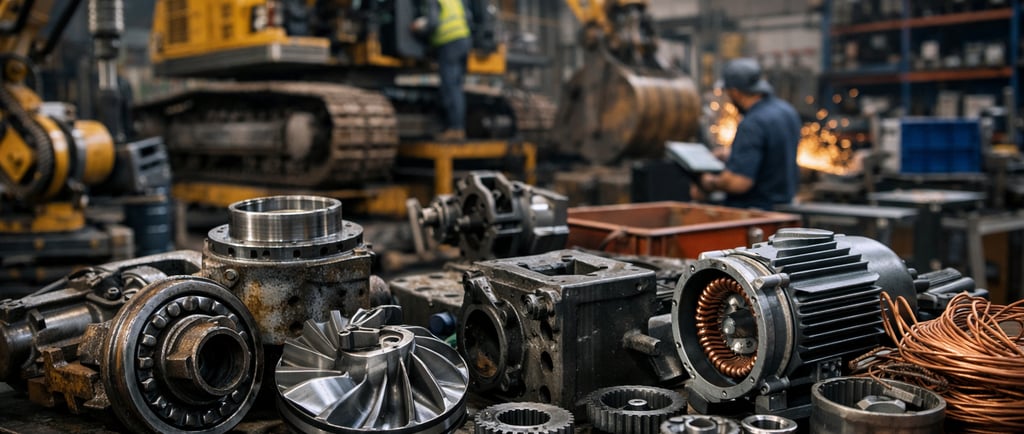
In an era increasingly shaped by resource scarcity, volatile global supply chains, and mounting sustainability demands, the circular economy is rapidly becoming more than just an industry catchphrase—it's becoming a necessity for long-term business viability. Traditional linear economic models (“take, make, dispose”) are being supplanted by regenerative systems that prioritize maximizing resource productivity and lifespan. Within this sweeping transformation, circular contracts and service-based models for equipment stand out as powerful innovations—particularly in sectors where durable, metal-intensive assets are central to operations.
But what are circular contracts in practice? How do equipment-as-a-service and performance-based agreements fundamentally change industry dynamics? Most importantly, how do these approaches create real economic and environmental value by keeping metals and materials in active circulation?
In this comprehensive exploration, we’ll unpack the mechanics and business logic of circular equipment models, providing actionable blueprints, technology enablers, case studies, and future trends for closing the loop on valuable metals. Whether you’re a manufacturing leader, sustainability strategist, or supply chain executive, this guide serves as an essential roadmap for implementing service-based, circular business models that unlock new value streams without sacrificing sustainability.
What Are Circular Contracts?
Circular contracts represent a paradigm shift in commercial agreements, designed not merely around the transfer of goods, but the sustained stewardship of asset value, functionality, and material recovery. Moving away from traditional one-time sales, these contracts recast manufacturers and service providers as ongoing partners responsible for the lifecycle of equipment—even beyond its first use.
Key characteristics of circular contracts include:
Usage-Based Fee Structures: Customers pay for equipment functionality (e.g., hours of uptime, units produced, or service levels) rather than for asset ownership. This fundamentally aligns the interests of the customer and provider.
Manufacturer Stewardship: Original equipment manufacturers (OEMs) retain ownership and assume responsibility for asset maintenance, technology upgrades, and end-of-life recovery, incentivizing them to maximize the utility and longevity of their products.
Recovery Incentives: By holding on to ownership or shared responsibility, manufacturers are highly motivated to recapture and repurpose equipment components—including precious and base metals—through refurbishment or remanufacturing cycles.
This “access over ownership” model resonates strongly across industries like industrial machinery, transportation, healthcare, and consumer electronics—all of which depend on complex, high-value metal components. According to a 2023 Ellen MacArthur Foundation report, circular business models for electronics and equipment could unlock over $700 billion in economic benefits annually by 2030 while reducing global greenhouse gas emissions from metal production by approximately 20%.
Why Circular Contracts Matter for the Circular Economy
The circular economy’s core ambitions—maximizing reuse, promoting remanufacturing, and retaining material value—are particularly relevant in the context of metals. Metals such as steel, aluminum, copper, and rare earth elements are not only vital to modern industry, but are also among the most energy-intensive materials to produce from virgin sources.
Legacy Linear Model Drawbacks
Historically, the industrial approach has been straightforward but highly wasteful:
Resource Extraction: Enormous quantities of raw ores are mined for metal content.
Manufacture & Sale: Equipment is built, purchased, and used until it becomes outdated, damaged, or uneconomical to repair.
Disposal: Old equipment is often discarded, with metals relegated to landfills or, at best, downgraded through low-value recycling.
Lost Value: Valuable engineered materials are lost to the economy, and manufacturers lack incentives to care about what happens after a sale.
This “extract-use-dump” approach has led to skyrocketing raw material costs, mounting electronic and industrial waste (e-waste alone exceeded 50 million tons globally in 2022, per the UN), and missed opportunities for sustainable business growth.
The Promise of Circular Contracts
Circular contracts fundamentally rewrite this narrative, shifting economic and technical incentives to keep metals actively circulating:
Design for Longevity and Circularity: OEMs now have a vested interest in designing products for durability, ease of disassembly, and modularity—because their revenues depend on ongoing performance and refurbishability.
Resource Retention and Efficiency: Metals remain in productive use far longer, through cycles of refurbishment, remanufacturing, and upcycling. This dramatically reduces the consumption of virgin resources and related environmental impacts.
Innovative Revenue Streams: Instead of one-off sales, companies generate recurring income via subscriptions, pay-per-use, or outcome-based contracts, decoupling profits from ever-increasing production and sales volume.
Sustainability and Regulatory Compliance: Circular contracts help companies proactively address stricter global regulations on waste, extended producer responsibility (EPR), and carbon emissions—while responding to public and investor demands for transparency and sustainability.
In essence, circular contracts close the loop on resource flows, creating a virtuous cycle of shared economic and ecological advantage.
Service-Based Models: Shifting from Products to Solutions
At the heart of circular contracts lies product-as-a-service (PaaS)—a business model that treats equipment not as a one-time transaction, but as an ongoing service solution. This strategic shift from selling assets to providing solutions-as-a-service is already reshaping entire markets, with accelerating adoption expected across manufacturing, logistics, and beyond.
Examples of Service-Based Models:
Heavy Equipment Leasing with Lifecycle Guarantees: Construction giants and infrastructure developers increasingly lease heavy machinery with guaranteed service, maintenance, and upgrades included. Providers remain responsible for equipment integrity from delivery to eventual recovery, ensuring high rates of metal and component retention.
Medical Technology-as-a-Service: Medical equipment vendors, like Philips and GE Healthcare, now routinely offer MRI and CT scanners via uptime-based service subscriptions. Hospitals access the latest diagnostic technology without capital outlays, while providers maintain performance, handle repairs, and reclaim assets for upgrade or recycling at contract completion.
Managed Print and IT Services: Enterprises opt for “print by the page” or “compute-as-a-service” models. Service providers supply hardware such as printers or servers, manage consumables and repairs, and systematically recover devices for refurbishment or responsible recycling.
Industrial Tooling on Demand: Major manufacturers rent industrial tools and robotics “as a service,” reducing costs and complexity while ensuring the latest hardware is available and maintained to spec.
Tangible Benefits of Service-Based Models:
Lifecycle Optimization: Providers extend asset life through preventive maintenance, timely part replacements, and technology/software upgrades.
Enhanced Circularity by Design: Products are engineered for modularity, easy disassembly, standardized materials, and more efficient recovery—all of which streamline repair and remanufacturing.
Built-in Reverse Logistics: The process of retrieving obsolete or underutilized assets becomes a core operational pillar rather than an afterthought, systematizing the flow of metals and components back into productive use.
Consider that, according to Accenture, shifting to circular service-based models could improve profitability by up to 20% for equipment makers, while sharply cutting waste and resource consumption.
Blueprints, Digital Tools, Case Studies, Future Trends, and Advanced Tactics for Circular Contracts in Equipment
Circular contracts only work when you treat them like a production system. The commercial terms set the incentives, the digital layer proves performance, and the reverse flow brings assets and metals back on time, in the right condition, and in the right streams. Without those three pieces, “service-based” becomes a nicer invoice format, not a circular loop.
The fastest way to level up Part 1 is to move from concept to contract patterns you can actually ship, then wire those patterns into a toolchain that makes return, repair, rebuild, redeploy, and recycle measurable and enforceable. The numbers also matter, because buyers will not change procurement habits unless you prove total cost, uptime, and risk reduction in hard terms.
Contract blueprints you can reuse in the equipment sector
Availability contract, pay for uptime
Use this when downtime is expensive and performance is easy to define. Think compressors, CNC lines, elevators, imaging systems, critical pumps, and automated material handling.
Structure: a monthly base fee plus an availability KPI, with penalties or service credits when availability drops below the agreed threshold. Your KPI needs clean definitions, including what counts as planned maintenance, what counts as operator misuse, and what counts as site conditions outside the provider’s control.
Circular value: if the provider gets paid for availability, they stop treating maintenance as an optional upsell. They move toward modular design, swap pools, and rebuildable assemblies, because it lowers cost and protects margin over a longer contract. Predictive service becomes economically rational, not a “nice feature,” and the end-of-term return becomes a planned event, not a scramble.
Pay-per-output contract, pay for results
Use this when output is measurable at the point of use. Think compressed air (per cubic metre), processed tonnage (per hour), units produced (per shift), scans completed (per month), or throughput on a sorting line.
Structure: a fixed reservation fee plus a variable fee per output unit. Add price tiers that reward stable volume, then protect the provider with minimums or ramp windows. If you do not define measurement, calibration, and dispute resolution, the model dies in month three.
Real-world proof: KAESER’s SIGMA AIR UTILITY is a clean example of pricing a utility, not a machine. KAESER describes a fixed basic price covering an agreed quantity of compressed air, and a fixed contractual price for additional quantities, with prices held for the contract term. Kaeser Compressors+2KAESER+2
Circular value: output-based pricing pushes the provider to keep the system efficient, maintained, and right-sized. That reduces premature replacement and increases redeploy potential when a site’s demand changes.
Capacity-on-demand contract, pay for flexible capacity
Use this when demand swings and equipment sits idle in the linear model. Think seasonal food lines, packaging, logistics fleets, and construction support gear.
Structure: a reservation fee for capacity plus a smaller usage fee. Write in swap and redeploy rights, because that is where circularity turns into cash. The provider needs the contractual right to move assets between customers to keep utilization high, and the customer needs guaranteed response times for capacity adds and removals.
Circular value: pooling raises utilization. Higher utilization supports refurbishment investment because the provider sees more cycles per year.
Life-extension rider, rebuild as a contractual milestone
Use this for metal-heavy assets with long mechanical life, where the linear default is early replacement driven by maintenance headaches. Think excavators, forklifts, presses, turbines, shredders, and processing lines.
Structure: you add scheduled rebuild triggers based on hours, cycles, or condition thresholds, plus an agreed post-rebuild performance band. The key clause is “core return and module ownership.” Without it, valuable assemblies leak into grey channels and your rebuild economics collapse.
Circular value: you turn mid-life rebuild into a planned event that preserves metal and component value before catastrophic failure and contamination.
Buyback plus minimum residual value, for buyers who insist on ownership
Use this when accounting, financing, or culture blocks subscription models.
Structure: the buyer purchases the asset, but the OEM guarantees buyback at a stated residual value if return conditions are met. Add a return deposit and a condition grading system. This is the simplest way to stop “asset leakage,” which is the main reason OEMs fail to capture metal value.
Circular value: you lock in the return stream, which feeds refurbishment, parts harvesting, and controlled recycling.
The digital tools that turn promises into proof
You do not need exotic tech to make circular contracts work, but you do need a coherent chain of evidence. You are trying to answer five operational questions every day: Where is the asset, what condition is it in, what performance did it deliver, what did you do to it, and where does it go next?
Start with an asset registry as your single source of truth. Give every unit a unique ID, then store configuration, location history, service history, firmware, and major module serials. Add QR plus RFID for fast verification at handoffs. If you cannot verify identity in seconds, you cannot enforce return terms.
Add condition monitoring where it pays back. For rotating equipment, vibration and temperature often beat calendar maintenance. For power electronics, thermal cycling and power quality matter. For mobile equipment, duty cycle and shock events matter. The point is not “more sensors.” The point is fewer catastrophic failures, because catastrophic failures destroy refurbishment value.
Connect service execution to evidence capture. A field service tool should force structured job plans, parts usage, readings, photos, and customer signoff. When disputes happen, you win with logs, not opinions.
Then build reverse logistics like an inbound supply chain. Issue a return authorization, specify packaging, schedule pickup, scan at every custody point, and grade condition on arrival. A missing module is not a small issue, it is often the entire economic margin of the return.
Finally, track material and compliance data in a way that buyers and regulators can use. In the EU, this is moving from voluntary to expected. The Ecodesign for Sustainable Products Regulation (ESPR) entered into force on July 18, 2024, and the European Commission adopted the first ESPR and Energy Labelling Working Plan in April 2025. White & Case+2European Commission+2 That working plan explicitly calls out priority areas like iron and steel and aluminium, which are central to equipment supply chains. EUR-Lex
If you sell equipment into Europe, assume buyers will increasingly ask for repairability, spare parts access, recycled content, and proof of end-of-term handling. A digital product passport approach will not stay limited to consumer goods, it will spill into industrial procurement because the same compliance logic applies.
Case studies with numbers you can use in pitches and term sheets
Rolls-Royce TotalCare, availability economics at scale
Rolls-Royce describes long-term service agreements that keep them connected to products and components through end-of-life, and states that up to 95% of a used aero engine can be recovered and recycled. They also state that around half of recovered materials are high enough quality to be remanufactured for use as new aerospace components. rolls-royce.com The lesson is straightforward: when payment is tied to performance over time, recovery and remanufacture become part of the business model, not a side project.
Caterpillar Reman, take-back as a supply channel
Caterpillar reports 147 million pounds of material taken back for remanufacturing through Cat Reman, and states that remanufacturing produces 65% to 87% less GHG process emissions compared to manufacturing new parts. https://www.caterpillar.com/en.html They also state that remanufacturing uses 80% to 90% less raw materials than making new components in the contexts they describe. https://www.caterpillar.com/en.html+1 This is the clearest pattern in equipment: once you treat used cores as a designed input stream, you can build reliable rebuild capacity and protect both cost and supply risk.
KONE 24/7 Connect, predictive service tied to outcomes
KONE highlights that its predictive maintenance service has delivered a 40% reduction in maintenance callouts and a 50% reduction in elevator entrapments. KONE Corporation The circular angle is not the sensors. It is the avoided damage. Fewer emergency failures means fewer scrapped assemblies and better refurbishment yield.
Hilti Fleet Management, a high-volume circular contract machine
Hilti describes collecting 1 million tools, batteries, and chargers annually for circular usage in its tool fleet model. reports.hilti.group In its circularity reporting, Hilti also states an 83% true material recycling rate overall globally and notes reintroducing over 2,600 tons of material into internal commodity loops, mainly steel, copper, aluminium, and plastic. reports.hilti.group This is what circular contracts look like when executed at volume: standardized returns, centralized triage, parts reuse, and controlled recycling streams.
Xerox, remanufacture economics backed by long-term reporting
Xerox states that since 2009 it has diverted over 600 thousand metric tons of returned equipment, parts, and supplies from landfill through remanufacturing, reuse, or recycling. xerox.com+1 Xerox also states that remanufactured consumables contain an average of 90% reused and recycled parts. xerox.com+1 In a 2025 corporate report announcement, Xerox reports remanufacturing over 1.7 million toner cartridges with 90% reuse by weight, alongside the same landfill diversion figure since 2009. Xerox Newsroom The equipment lesson is simple: long-lived reman programs require tight reverse logistics, shared components, and product design that expects multiple lives.
Signify, “serviceable” products as a revenue strategy
Signify reported circular revenues increasing to 33% in its full-year 2023 results announcement, surpassing its 2025 target of 32%. Signify United Kingdom Even outside heavy equipment, this reinforces a critical point: when products are designed to be serviced and returned, you can measure circularity in revenue terms, not only in waste metrics.
KAESER, compressed air sold like a utility
KAESER’s compressed air utility model shows how a metal-heavy compressor station becomes a service with clear commercial terms. The model emphasizes fixed pricing per cubic metre under contract, and the provider handles the system across the contract period. KAESER+1 This is directly transferable to pumps, chillers, and other utility-like equipment.
Michelin EFFIFUEL, savings-based service contracts that fund themselves
Michelin has described EFFIFUEL delivering average fuel savings of 1.5 liters per 100 kilometers to trucking customers. DG AddCos Prod While this is not an equipment take-back model, it is a useful pattern for equipment contracts because shared savings can fund service fees. It also reduces wear, misuse, and downtime, which raises refurbishment value when assets come back.
Advanced barriers and how to beat them in real deals
Barrier 1: Buyers cannot get internal approval because “opex feels expensive”
Fix it by offering three lanes. Lane one is a full subscription. Lane two is ownership plus guaranteed buyback. Lane three is hybrid, smaller base fee plus usage. You are not changing the product, you are changing the budget narrative. Buyers who hate subscriptions often accept buyback contracts because they resemble familiar depreciation logic while still locking return.
Barrier 2: Outcome risk is unclear and providers overpromise
Fix it with a controllability split. Define what the provider controls, what the buyer controls, and what is shared. Add site readiness requirements for power quality, environment, and operator training. Include duty cycle bands that adjust pricing. If the asset is run harder than the contract assumptions, your economics need a pre-agreed adjustment, not a fight.
Barrier 3: Performance data disputes kill trust
Fix it with measurement governance. Specify meters, calibration frequency, audit rights, and a single arbitration process for disputes. Store event logs with time stamps, and keep raw signals for a defined period. If the contract depends on performance, then measurement is part of the product.
Barrier 4: Assets leak at end-of-term, so circularity never happens
Fix it with enforcement, not slogans. Use return deposits, mandatory pickup windows, and penalties for resale outside approved channels. Tie buyback value to completeness, so missing modules become expensive. Keep serial-level identity controls so buyers cannot swap control units or remove high-value assemblies without detection.
Barrier 5: Reverse logistics and refurbishment capacity are the hidden bottleneck
Fix it with triage hubs and standardized grading. Create a five-step pathway: redeploy as-is, refurbish, remanufacture, harvest parts, recycle. Then build capacity based on expected returns per quarter, not on hope. If you expect returns to rise, invest in test benches, swap pools, and trained technicians early, because a backlog destroys customer trust and destroys asset value.
Barrier 6: Metals lose value through contamination and mixed streams
Fix it by writing material rules into the contract. Define prohibited attachments, contamination thresholds, and separation expectations for high-value streams. In equipment, the money is often in copper-rich modules, motors, and certain alloy parts. If those get mixed or damaged, you lose margin.
How to maximize circular value in metals, with numbers that persuade buyers
Your strongest argument is that circular contracts reduce virgin demand and preserve high-grade material value. You should anchor this in widely accepted figures.
The e-waste problem shows why planned return matters. The Global E-waste Monitor reports a record 62 million tonnes of e-waste generated in 2022, with only 22.3% documented as formally collected and recycled. It also notes about US$62 billion worth of recoverable resources not accounted for, and that only about 1% of rare earth element demand is met by e-waste recycling. ITU+2E-Waste Monitor+2 Equipment contracts attack the same failure mode, which is uncontrolled end-of-use. They raise return rates and keep assets intact long enough for refurbishment and parts harvesting, which is where the value is.
Aluminium makes the energy case clear. The International Aluminium Institute reports primary energy consumption of 186 GJ per tonne for global primary aluminium production in 2019, versus 8.3 GJ per tonne for recycled aluminium, a 95.5% energy saving. International Aluminium Institute+1 When you keep aluminium-rich equipment components in controlled loops, you protect both cost and carbon exposure.
Steel makes the emissions case clear. A World Economic Forum steel net-zero tracker document cites BF-BOF at about 2.3 tonnes of CO2 per tonne of steel, versus scrap-EAF at about 0.7 tonnes. World Economic Forum Reports In practice, this means every extra cycle you squeeze out of steel-heavy equipment before replacement, and every extra ton of clean scrap you return through controlled channels, has real emissions consequences.
To translate that into contract design, do three things. First, map where the high-value metals sit in your equipment, then assign those parts special handling and return rules. Second, set a “core return” economy, with deposits and credits that make full, undamaged returns the default. Third, create a closed outlet for recovered material, because buyers will pay more when alloy control and traceability are credible.
Future trends that will reshape equipment contracts over the next five years
Digital product passports and compliance-linked procurement will spread
The ESPR timeline and working plan show that product-level requirements and prioritized material categories are now being actively planned at EU level, with iron and steel and aluminium explicitly in scope for early work. EUR-Lex+2European Commission+2 For equipment makers, this pushes two shifts: better product data discipline, and contracts that can prove repair, reuse, and end-of-term handling.
Performance contracts will move from “premium option” to default in uptime-sensitive categories
As case studies show, predictive service tied to outcomes can deliver measurable reductions in callouts and incident events, which buyers can feel immediately in downtime and safety. KONE Corporation That makes availability-based contracting easier to sell, especially when labor shortages make in-house maintenance weaker.
Take-back will become a supply risk strategy, not only a sustainability story
Caterpillar’s reported take-back volumes and resource savings show why reclaiming cores is a supply channel, not a waste program. https://www.caterpillar.com/en.html+1 As spare parts lead times and commodity volatility persist, contracts that secure returns become a procurement hedge.
Circularity will be measured in revenue and contract renewal, not only in recycling rates
Signify’s circular revenue reporting points toward how industrial firms will be judged internally. Signify United Kingdom If circular contracts do not show up in recurring revenue, renewal rates, and lower lifecycle cost, they will not survive budget cuts.
Connect
Your trusted partner for scrap metal procurement.
CONTACT
About
haroon@tdcventures.com
+1-307-655-7593
© 2025. All rights reserved.
NEWSLETTER