
Circular Lease Models for Consumer Electronics
Discover how circular lease models for XR devices and consumer electronics are enabling recycling at scale, driving ESG compliance, and unlocking new value through design-for-repair principles.
IMMERSIVE TECH RECYCLING & CIRCULAR ELECTRONICS
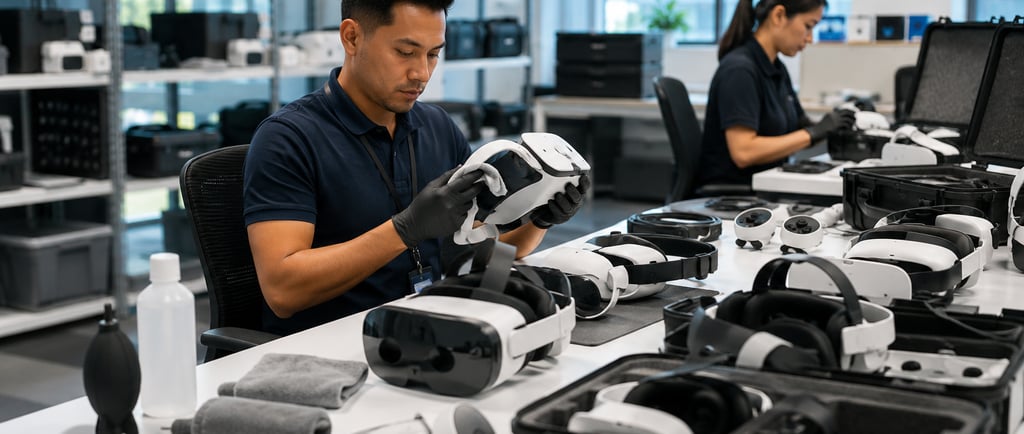

Instant Answer
Circular lease models for consumer electronics—especially XR devices—empower original equipment manufacturers (OEMs), leasing firms, and enterprises to unlock the full potential of sustainability, device lifecycle management, and regulatory compliance. By embedding managed leasing, structured take-back, and design-for-repair principles, organizations can accelerate both environmental and economic value, support global recycling mandates, and future-proof supply chains in a rapidly evolving landscape.
Context: Why Circular Leasing Models Now Matter
Electronic waste (e-waste) stands as one of the fastest-growing waste streams globally, with the UN’s Global E-waste Monitor estimating over 53.6 million metric tons generated in 2019 alone—a figure predicted to reach 74 million metric tons by 2030. Europe is at the epicenter of this crisis, given its dense technology adoption and stringent environmental directives.
XR (extended reality) hardware—including augmented reality (AR) and virtual reality (VR) headsets—along with wearables and smart IoT devices, now increasingly contribute to landfill volume. These devices combine complex materials (optics, sensors, lithium batteries, plastics, metals) in tightly integrated assemblies, rendering traditional recycling and repair challenging.
Crucially, leasing is undergoing a paradigm shift. Historically viewed as only a financial vehicle for enterprise procurement, leasing today is rapidly becoming a strategic lever for circularity. OEMs and lessors are integrating circular economy principles, not just for competitive advantage but as a response to urgent regulatory, environmental, and economic drivers.
Regulatory and Market Drivers
EU Right to Repair: Mandates OEM responsibility for spare parts availability and repairable design, now extending to IT and electronics beyond white goods.
EEE (Electrical and Electronic Equipment) Directive: Imposes extended producer responsibility (EPR) requiring transparent end-of-life device management.
Corporate ESG Pressure: Enterprises face mounting expectations for transparent Environment, Social, and Governance (ESG) reporting, including sustainable procurement and lifecycle tracking.
Shifting Consumer Sentiment: Both enterprises and end-customers now demand repairable, recyclable devices. According to a 2022 Capgemini survey, 79% of consumers say they’re more likely to buy from companies with effective e-waste management policies.
Circular leases allow organizations to operationalize compliance, capture ESG value, and drive innovation—making them a mission-critical model for future-proofing digital transformation programs in sectors from healthcare and retail to education and logistics.
The Problem: Linear Electronics and Unsustainable Waste
The electronics industry’s default “make–use–discard” cycle—that is, a linear economy model—has become unsustainable, particularly as device complexity and refresh cycles accelerate.
How Linear Models Fail XR and Emerging Electronics
In traditional procurement paradigms:
Manufacturers ship finished XR or IoT products.
Buyers consume and use devices for a standard lifecycle (typically 2–3 years for enterprise hardware).
Obsolete products are often discarded or languish unused, rarely being returned, repurposed, or recycled.
This routine results in:
Fragmented Device Ownership: Once a device leaves the OEM or reseller, it becomes challenging to track. For XR deployments across global offices or retail chains, loss rates can exceed 20%.
Incomplete Recycling: Lacking coordinated take-back mechanisms, most end-of-life devices avoid formal recycling channels. The International Telecommunication Union (ITU) reports that only 17.4% of global e-waste was documented as properly recycled in 2019.
Stalled Asset Recovery: Organizations absorb the total cost of lost, non-returned, or non-refurbished hardware—what Gartner calls “stranded asset risk.”
Regulatory Exposure: Businesses face growing liability from environmental non-compliance, with fines under the EU WEEE directive climbing up to €200,000 per violation for improper e-waste management.
Enterprise Customer Risk: From a B2B perspective, outdated, non-circular offers translate into lost contracts, especially when sustainability criteria now influence procurement RFPs.
XR and immersive electronics amplify these problems because:
Devices employ proprietary batteries and bespoke components, making disassembly and recycling cost-prohibitive without design intervention.
Asset fragmentation is magnified by diverse use cases—XR kits in remote learning, AR wearables in field service, and VR headsets in retail are often distributed widely, complicating return logistics.
Quantifying the Impact
It’s estimated that XR and wearable deployments—across sectors such as retail, healthcare, and manufacturing—will represent over $20 billion in annual hardware value by 2025 (IDC). Without circular models, millions of devices could become e-waste within their first lifecycle, risking both financial and reputational damage for enterprises and providers.
The Circular Lease Opportunity
By pivoting from linear to circular lease models, firms can:
Systematize Device Returns: Transform take-back into a contractual standard.
Unlock Residual Value: Refurbish and redeploy devices, capturing multiple lease cycles.
Drive ESG and Regulatory Compliance: Bake in data-driven sustainability metrics, reducing compliance workloads and exposure.
Optimize Total Cost of Ownership (TCO): Reduce capital expenditures by extending device lifespans and recapturing assets.
In summary, circular leases move the needle from ad hoc recycling to full lifecycle management built into every contract—a model fit for both sustainability leadership and long-term profitability.
Key Concepts: Terms and Definitions
To build a robust framework for circular leasing—especially for XR devices and emerging tech—it’s crucial to align on foundational concepts:
Circular Lease: A lease structure embedding obligations and incentives for device return, refurbishment, and certified recycling, with contractual clarity on roles, responsibilities, and value recovery mechanisms.
XR Devices: Hardware supporting extended reality functions (AR, VR, MR), often featuring proprietary processors, sensors, and uniquely integrated components.
Design for Repair: Product engineering approach emphasizing modularity, standardized fasteners, documentation, and spare parts accessibility—aimed at reducing repair time and cost, and boosting refurbishment potential.
PaaS (Product-as-a-Service): Offering devices as a managed service, bundling device access, upgrades, on-demand support, and lifecycle collection into a single subscription fee. According to Accenture, PaaS adoption in electronics could deliver total cost savings upwards of 18% for enterprise customers.
EPR (Extended Producer Responsibility): Regulatory regime placing ultimate responsibility for end-of-life stewardship (collection, processing, recycling) onto manufacturers and importers.
Refurbishment Loop: The repeatable process of device intake, condition assessment, functional/environmental restoration, software update, and qualification for secondary deployment or market.
Asset Tracking: End-to-end visibility mechanisms (e.g., advanced RFID, GPS, digital twin technology) for monitoring the physical status and location of devices throughout their lifecycle—a critical enabler for effective reverse logistics.
Reverse Logistics: Specialized supply chain operations designed to facilitate the collection, transportation, and routing of used or surplus hardware back through the refurbishment or recycling pipeline.
Expanded Circular Lease Model, Implementation Playbook, KPIs, and Conclusion
Circular leasing is no longer a finance-only model. In 2026, it is becoming one of the most practical ways to control electronics waste, recover device value, meet repair rules, and keep XR hardware moving through reuse, refurbishment, parts harvesting, and certified recycling.
This matters because the electronics waste gap is still widening. The Global E-waste Monitor 2024 reported that 62 million tonnes of e-waste were generated in 2022, while only 22.3% was formally documented as collected and recycled. The same report expects documented recycling to fall to about 20% by 2030 if collection and recycling systems fail to keep up with device growth.
For XR, the timing is critical. IDC expects XR shipments to keep shifting from traditional headsets toward display glasses, with glasses gaining meaningful traction by 2027 and eventually overtaking VR and mixed reality headsets in shipment volume. That shift means more lightweight, compact, sensor-rich devices will enter schools, factories, healthcare networks, training centers, warehouses, field service teams, and consumer channels.
The Circular Lease Model: How It Works in Practice
A circular lease model changes the relationship between the device, the user, the OEM, and the recycler. Instead of treating an XR headset, smart wearable, tablet, laptop, or controller as a product sold once and forgotten, the lease keeps the device inside a managed lifecycle.
That lifecycle should cover procurement, deployment, user support, repair, upgrade, return, refurbishment, redeployment, parts recovery, material recovery, and certified recycling. Every stage must be planned before the device reaches the first user.
The best circular lease models are built around five practical pillars.
Ownership stays connected to recovery
The core advantage of leasing is control. When ownership or lifecycle responsibility stays with the OEM, lessor, managed service provider, or enterprise procurement team, the device is less likely to disappear into storage rooms, home drawers, informal resale channels, or landfill-bound waste streams.
This matters for XR because enterprise deployments often scatter devices across many locations. A healthcare network may use VR headsets for therapy and staff training. A retailer may use AR devices for store operations. A school district may deploy wearables and XR headsets across classrooms. A manufacturing company may use smart glasses for remote expert support. In each case, the device is easy to lose if the contract does not define return steps, return timing, user responsibility, and missing-device penalties.
A circular lease should make return the default. The contract should specify who returns the device, where it goes, what condition is acceptable, how missing accessories are handled, and what happens if a device is damaged, locked, or incomplete.
Repair is planned before failure happens
Circular leasing fails when repair is treated as an afterthought. XR devices are difficult to refurbish when they use glued batteries, proprietary screws, fragile sensor modules, sealed optics, non-standard charging parts, locked software, or restricted diagnostics.
Repair planning should begin at product design and procurement. Buyers should ask for modular battery access, spare parts availability, repair manuals, diagnostic access, replaceable face interfaces, replaceable straps, replaceable lenses where practical, serviceable charging ports, and standardized fasteners.
This aligns with the regulatory direction in Europe. The EU Directive on common rules promoting repair was adopted on June 13, 2024, entered into force on July 30, 2024, and must be applied by Member States from July 31, 2026. It pushes manufacturers and sellers toward repair access, repair information, and longer useful product life.
Product data follows the device
Circular leasing needs reliable device data. Without data, operators cannot prove return rates, warranty status, repair history, component replacement, battery condition, refurbishment grade, or recycling outcome.
The EU Ecodesign for Sustainable Products Regulation, Regulation (EU) 2024/1781, was created to improve product circularity, energy performance, and environmental sustainability across products placed on the EU market. It also supports the move toward product-level sustainability data through digital product information.
For leased electronics, this means each device should carry a lifecycle record. At minimum, the record should include:
Device model and serial number.
Lease start date and assigned user or site.
Accessory bundle.
Firmware version.
Repair history.
Battery health.
Sanitization history.
Data wipe status.
Refurbishment grade.
Parts harvested.
Recycling certificate.
Final disposition.
For XR devices, the lifecycle record should also track face interface replacements, hygiene processing, lens condition, sensor calibration, controller pairing, dock compatibility, and battery swelling checks.
Residual value is managed, not guessed
A circular lease only works financially when residual value is measured. The lessor or OEM must know what a device is likely to be worth after 12, 24, or 36 months.
XR hardware can have several value paths after first use:
Redeploy as a full working device.
Refurbish and lease again at a lower price.
Use for training, demo, or internal support.
Harvest controllers, straps, lenses, boards, batteries, speakers, cameras, sensors, or charging docks.
Recover metals, plastics, magnets, copper, aluminum, and circuit board value.
Route hazardous or low-value residues to certified recycling.
Dell’s Asset Recovery Services show how mature IT recovery programs already structure this logic. Dell’s 2025 lifecycle assessment describes services such as resale, recycling, and return-to-lease, all designed to increase recovery, reuse, and recycling while lowering environmental impact.
The same logic should now be adapted for XR and emerging electronics. The goal is simple: keep the highest-value use option open for as long as possible.
Compliance is built into the contract
Circular leasing works best when compliance is contractual, not informal. Every lease should include clear rules for data security, return packaging, wipe certification, repair responsibility, recycling standards, chain of custody, ESG reporting, and end-of-life documentation.
This is important because regulatory pressure is rising across product design, repairability, e-waste, batteries, chargers, and product data. The EU common charger rules, for example, require USB-C for many portable electronics sold in the EU from December 28, 2024, and laptops are covered from April 28, 2026. The policy aims to reduce charger waste and simplify charging across devices.
For circular leases, standardized charging helps reduce accessory loss, lowers replacement cost, improves redeployment speed, and reduces the number of discarded chargers.
Implementation Playbook: How to Build a Circular Lease Program for XR and Consumer Electronics
A strong circular lease program should be designed like an operating system for device recovery. It needs clear roles, clean data, trained users, repair partners, return routes, and measurable outcomes.
Step 1: Choose the right device categories
Do not start with every device. Start with categories that have enough volume, enough value, and enough control.
Good starting categories include:
XR headsets used in training, education, healthcare, industrial operations, retail, field service, and events.
Enterprise smartphones and tablets.
Laptops and detachable devices.
Smartwatches and fitness wearables used in corporate wellness, research, schools, and healthcare.
Controllers, charging docks, and wearable accessories that often get lost or damaged.
The first pilot should focus on devices with a clear return point and a known user group. For example, a hospital training department, a school district technology office, a warehouse AR deployment, or a retail training program.
Step 2: Define lifecycle ownership
Before any device is deployed, assign ownership for each stage.
The OEM may own product design, parts access, firmware support, and repair documentation.
The lessor may own contract structure, billing, device tracking, return enforcement, and residual value planning.
The enterprise customer may own user assignment, site inventory, user training, and return compliance.
The repair partner may own triage, cleaning, diagnostics, component replacement, grading, and redeployment preparation.
The recycler may own certified processing, material recovery, hazardous handling, and recycling documentation.
The data security partner may own data wipe, device unlock, audit logs, and certificates.
Do not leave these roles vague. A circular lease breaks down when everyone assumes someone else is responsible for returns, repair, data wiping, or final recycling.
Step 3: Build the lease contract around return behavior
The lease contract should make return simple and failure expensive.
Practical contract clauses should cover:
Return date and return window.
Return packaging requirements.
Acceptable wear and tear.
Damage categories.
Missing accessory fees.
Lost-device fees.
Early replacement rules.
Battery swelling or safety escalation.
Data wipe obligations.
Locked-device handling.
Repair responsibility.
Refurbishment ownership.
Resale restrictions.
Recycling documentation.
ESG reporting rights.
A strong contract should also reward good behavior. Customers with high return rates, low damage rates, complete accessory returns, and clean data wipe compliance can receive lower renewal pricing, better upgrade terms, or access to newer devices.
Step 4: Design the intake and triage process
Returned devices should not enter a warehouse and sit untouched. They should enter a controlled intake process.
For XR devices, the intake process should include:
Device identification.
Serial number scan.
Visual condition check.
Accessory count.
Battery inspection.
Hygiene check.
Lens and sensor inspection.
Controller and dock pairing check.
Firmware status.
Account lock check.
Data wipe status.
Functional diagnostics.
Repair estimate.
Refurbishment grade.
Routing decision.
The routing decision should place each device into one of several paths:
Redeploy with cleaning only.
Repair and redeploy.
Refurbish for second lease.
Harvest parts.
Recycle materials.
Quarantine for safety or compliance review.
This process should be fast. A device that sits idle for 90 days loses value, especially in fast-moving electronics categories. A circular lease program should aim to complete intake and routing within 5 to 10 business days for standard devices and within 15 business days for repair-heavy returns.
Step 5: Standardize repair grades
Refurbishment programs need simple grading. Without grading, sales, leasing, compliance, and operations teams cannot agree on what a returned device is worth.
A practical XR grading system could look like this:
Grade A: Fully functional, minor cosmetic wear, clean optics, strong battery health, complete accessories, ready for redeployment.
Grade B: Fully functional, visible wear, replaceable hygiene parts required, minor accessory replacement needed, suitable for enterprise redeployment or second lease.
Grade C: Repairable, needs battery, strap, controller, lens housing, charging port, or board-level repair before reuse.
Parts Grade: Not economically repairable, but valuable components can be harvested.
Recycle Grade: No safe or practical reuse path, route to certified recycling.
This grading should be tied to pricing. A Grade A XR headset may support a second lease at a strong discount to new hardware. A Grade B unit may suit schools, training centers, demos, or internal programs. Grade C units may only be worth repairing if parts are available and demand exists.
Step 6: Plan hygiene and safety for shared XR devices
XR leasing has a unique issue: devices touch faces, hands, hair, and skin. Hygiene is not optional.
Lease programs should include cleaning rules for:
Face cushions.
Nose bridges.
Head straps.
Lenses.
Controllers.
Charging docks.
Storage cases.
Shared wearable surfaces.
In healthcare, education, fitness, enterprise training, and public demos, hygiene affects adoption. A headset that feels unsafe or unclean will not be used, even if it works.
Best practice is to use replaceable face interfaces, washable straps where practical, sealed accessory kits, and documented cleaning cycles. For high-use deployments, operators should consider assigning personal face cushions while keeping the main headset in shared use.
Step 7: Solve software locks before return
A working device can become waste if it is locked.
XR and smart electronics often carry account locks, mobile device management profiles, enterprise app restrictions, firmware dependencies, region locks, expired certificates, or cloud-tied licensing. If these locks are not removed before return, the device may be impossible to refurbish.
A circular lease should require:
Remote wipe before shipment.
Admin unlock before return.
MDM removal.
App license release.
Firmware update policy.
Diagnostic access for repair partners.
Proof of wipe.
Exception process for failed wipe.
This issue is not theoretical. Research on device longevity shows that software support and app compatibility can determine whether older hardware remains useful. A 2024 study on older Apple devices found that direct app download access was limited, but many apps could still work when indirect installation paths were available. That shows how software policy can either preserve or destroy device usefulness.
For XR leasing, the same principle applies. A headset with usable optics, battery, sensors, and processor should not be scrapped because of avoidable software barriers.
Step 8: Use circular packaging
Return packaging is part of the system. If devices are shipped back in poor packaging, damage rates rise, repair costs rise, and redeployment speed falls.
Circular lease programs should use reusable transit cases or return kits with compartments for headsets, controllers, cables, docks, hygiene parts, and batteries where applicable.
The return kit should be designed to reduce loss. Each compartment should match the device bundle. The user should immediately see what is missing before shipping the return.
Packaging should avoid printed labels that become outdated. QR codes, reusable sleeves, digital instructions, and return portals can keep the process flexible.
Step 9: Build a partner network before scale
Circular leasing depends on partners. A company should not sell circular outcomes without having the repair, logistics, and recycling network to support them.
The partner network should include:
Regional repair centers.
Certified electronics recyclers.
Battery handling specialists.
Data wipe providers.
Logistics providers.
Parts suppliers.
Refurbishment marketplaces.
Donation or secondary-use partners.
Compliance reporting providers.
For global programs, regionalization matters. Shipping every returned device across continents can erase some environmental gains, delay redeployment, and create customs issues. Repair and recovery should happen as close to the user market as possible.
Step 10: Start with a 90-day pilot
A circular lease pilot should be small enough to control and large enough to reveal real problems.
A useful pilot could include 100 to 500 devices across one enterprise customer, one school network, one healthcare system, or one warehouse group.
The pilot should test:
Return rate.
Damage rate.
Accessory loss.
Data wipe completion.
Average intake time.
Repair time.
Refurbishment yield.
Second-life deployment rate.
Recycling rate.
Customer satisfaction.
Total cost against a normal purchase model.
The pilot should produce a decision: scale, adjust, or stop. Do not scale a circular lease program until the return process works in real conditions.
Scenario 1: Circular Leasing for Enterprise XR Training
A global manufacturer deploys 1,000 XR headsets for safety training across 25 facilities. In a linear purchase model, each facility manages devices differently. Some units are stored in cabinets. Some are damaged. Some are missing controllers. Some remain tied to old accounts after staff turnover.
In a circular lease model, every headset is assigned to a site, tracked by serial number, and covered by a return clause. Devices are inspected every 12 months. Worn face interfaces are replaced. Batteries are tested. Firmware is updated. Damaged units are repaired. At 36 months, devices are returned, graded, and redeployed to lower-intensity training sites or harvested for parts.
The result is better utilization, fewer lost devices, cleaner compliance records, and lower replacement cost.
Scenario 2: Circular Leasing for Schools and Universities
A school district leases XR headsets and wearables for science labs, accessibility support, fitness programs, and vocational training. The key issue is not only device cost. It is loss, hygiene, breakage, student turnover, and summer storage.
A circular lease can include annual collection, summer inspection, cleaning, repair, software reset, and redeployment before the next school year. Devices that are no longer suitable for student use can be moved into demo labs, teacher training, or parts recovery.
This model fits education because schools often lack repair staff. They need predictable costs, clean returns, and simple handling.
Scenario 3: Circular Leasing for Healthcare XR
Hospitals and clinics may use XR devices for pain distraction, mental health therapy, surgical training, rehabilitation, and staff onboarding. Healthcare deployments demand higher standards for hygiene, data security, and documentation.
A circular lease should include medical-grade cleaning protocols where relevant, device assignment logs, strict wipe certification, fast replacement devices, and documented end-of-life handling.
For healthcare buyers, circular leasing can reduce procurement friction because the lease includes support, replacement, cleaning, repair, and compliance evidence.
Scenario 4: Circular Leasing for Retail and Field Service
Retail chains and field service teams use AR devices for guided workflows, inventory support, remote expert help, and training. These devices travel, break, and change hands often.
Circular leasing can reduce operational chaos by linking every device to a worker, store, route, or site. When a worker leaves or a store closes, the device returns to the central program. The return process captures missing parts, damaged straps, battery issues, and account locks before the device becomes stranded.
KPIs and Scorecard: How to Measure Circular Lease Performance
A circular lease program should be measured with a practical scorecard. The goal is to prove that the model works financially, operationally, and environmentally.
Return Rate
Return rate measures how many leased devices are returned at the end of the lease or refresh cycle.
Formula: returned devices divided by devices due for return.
A strong program should aim for 90% or higher return rates in controlled enterprise deployments. For distributed consumer or education programs, the first target may be 75% to 85%, then improved through better reminders, packaging, deposits, and penalties.
Why it matters: No return means no circularity. The device cannot be repaired, reused, harvested, or recycled if it never comes back.
Refurbishment Yield
Refurbishment yield measures how many returned devices can be used again after cleaning, repair, or upgrade.
Formula: redeployable devices divided by returned devices.
A mature circular lease program should track yield by model, site, use case, and customer segment. If one headset model has a 70% refurbishment yield and another has a 35% yield, procurement should favor the better-performing model.
Why it matters: Refurbishment yield is where circular leasing becomes financially attractive. Higher yield means more second-life revenue and fewer new device purchases.
Repair Cost per Returned Device
This KPI measures average repair cost after return.
It should include parts, labor, diagnostics, cleaning, testing, and quality control.
Why it matters: A device can be technically repairable but financially unattractive. If repair cost is too close to replacement cost, the design, lease terms, or user handling process needs improvement.
Average Turnaround Time
Turnaround time measures how long it takes from device return to final routing.
A strong target is 5 to 10 business days for clean returns and 10 to 20 business days for repairable returns.
Why it matters: Slow turnaround reduces residual value. Electronics lose market value quickly, especially when newer models launch.
Accessory Recovery Rate
Accessory recovery rate measures how often controllers, cables, docks, chargers, straps, cases, and inserts are returned with the main device.
This KPI matters heavily in XR. A headset without controllers or a charging dock may be much harder to redeploy.
Best practice is to track each accessory separately. This shows which items are most often lost and whether packaging, user instructions, or lease penalties need to change.
Battery Health Retention
Battery health retention measures whether devices remain safe and useful across lease cycles.
It should include battery capacity, swelling checks, charging stability, cycle count where available, and replacement rate.
Why it matters: Batteries are often the first major barrier to reuse. A circular lease program must know whether battery design supports second and third use cycles.
Data Wipe Completion Rate
This KPI measures the percentage of devices that receive certified data wiping before redeployment, resale, donation, or recycling.
The target should be 100%.
Why it matters: One data failure can damage trust and trigger legal exposure. For enterprise, healthcare, education, and government buyers, data wipe proof is central to circular leasing.
Second-Life Revenue
Second-life revenue measures money generated from renewed leases, refurbished sales, parts harvesting, or material recovery.
Why it matters: Circular leasing is stronger when sustainability and economics reinforce each other. If second-life revenue is tracked clearly, finance teams can support the model.
Avoided New Device Purchases
This KPI measures how many new devices were not purchased because refurbished devices were redeployed.
Why it matters: This is one of the cleanest ways to show business value. It connects circular leasing to procurement savings and lower material demand.
Recycling Documentation Rate
This measures how many non-reusable devices have complete recycling certificates and chain-of-custody records.
The target should be 100%.
Why it matters: Recycling claims without documentation are weak. Enterprises need proof for audits, ESG reports, and compliance reviews.
Carbon and Material Impact
Circular lease reporting should estimate avoided emissions and recovered materials. This can include avoided manufacturing impact, recovered copper, aluminum, plastics, printed circuit boards, batteries, and rare earth-containing components.
Dell’s closed-loop plastics case study found that using recovered plastics in its supply chain produced an 11% lower carbon footprint compared with virgin plastic.
The same principle applies across electronics leasing. Every device that is repaired, reused, or harvested before recycling can reduce the need for virgin material extraction and new manufacturing.
Customer Renewal Rate
Circular leasing should also be measured commercially. If customers renew because the model reduces cost, complexity, and compliance burden, the program is working.
Renewal rate should be tracked alongside service tickets, downtime, replacement speed, and user satisfaction.
The Practical Circular Lease Scorecard
A strong circular lease program should ask these questions every quarter:
Are at least 90% of devices due for return coming back?
Are returned devices being inspected within 5 business days?
Are more than 60% of returned devices suitable for reuse after cleaning or repair?
Are accessory losses falling over time?
Are battery failures tracked by model and use case?
Are data wipes certified before redeployment?
Are recycling certificates complete for all non-reusable devices?
Are second-life devices generating revenue?
Are repair costs lower than replacement costs?
Are customers renewing because the lease reduces operational burden?
Are product design teams receiving repair and failure data?
Are procurement teams using circular performance when choosing future devices?
This scorecard should not sit inside a sustainability report only. It should be used by procurement, finance, product design, operations, logistics, legal, sales, and customer success.
Best Practices for OEMs
OEMs have the greatest influence because design choices decide whether a circular lease can work.
OEMs should:
Design devices with replaceable batteries where practical.
Avoid unnecessary glue and sealed assemblies.
Use standardized screws and ports.
Provide repair manuals and diagnostic tools to approved partners.
Make spare parts available for the expected lease life plus the second-life period.
Support firmware updates long enough for reuse.
Allow secure account unlocking and enterprise wipe processes.
Design packaging for return and redeployment.
Track failure data from returned devices.
Use recycled or recovered materials where quality allows.
Fairphone is one of the strongest consumer electronics examples of repair-led product strategy. Its newer devices emphasize modular design, user-replaceable parts, long software support, and spare part access. Reuters reported in 2025 that Fairphone 6 offered eight years of support, a five-year warranty, and spare parts availability until 2033.
XR OEMs can learn from this. Long support life, modular parts, and available spares make circular leasing more realistic.
Best Practices for Lessors and Managed Service Providers
Lessors should avoid treating circularity as a marketing claim. They need operational control.
They should:
Price leases based on expected residual value.
Require device return and accessory return.
Use deposits or penalties for missing equipment.
Build certified repair and recycling routes.
Provide customers with return kits.
Offer dashboards for asset status.
Track refurbishment yield by device model.
Bundle data wiping and compliance documents.
Offer replacement devices to reduce downtime.
Use second-life inventory for lower-cost lease tiers.
The strongest opportunity is tiered leasing. New devices can go to high-performance use cases. Refurbished devices can go to training, education, demos, non-critical workflows, and budget-sensitive customers. Parts-grade devices can support repair inventory.
Best Practices for Enterprise Buyers
Enterprise buyers should ask better questions before signing a lease.
They should ask:
Who owns the device at end of term?
What happens to returned devices?
What percentage of devices are refurbished?
Are repair parts available?
Are data wipes certified?
Are recycling partners certified?
Can we receive device-level ESG reports?
What happens if devices are locked?
How are batteries handled?
Can refurbished devices be redeployed internally?
What is the missing accessory policy?
How long will firmware and security updates continue?
This is especially important for XR because devices may contain cameras, microphones, biometric-adjacent usage data, location data, user profiles, health-related session data, training records, or enterprise workflow data.
Best Practices for Recyclers and Refurbishers
Recyclers and refurbishers should move upstream. They should not wait for devices to arrive as mixed e-waste.
They should work with OEMs and lessors to define:
Disassembly instructions.
Reusable parts lists.
Material recovery paths.
Battery safety steps.
Grading rules.
Repair thresholds.
Parts resale rules.
Data wipe process.
Chain-of-custody reporting.
Feedback loops for design teams.
A recycler that can tell an OEM which screws slow teardown, which batteries fail early, which clips break, and which adhesives block recovery becomes a design partner, not just a waste handler.
Conclusion: Circular Leasing Is the Operating Model Consumer Electronics Needs Next
Circular leasing gives consumer electronics, XR, wearables, and smart devices a practical path out of the linear waste cycle. It keeps ownership connected to recovery. It makes return behavior contractual. It turns repair into a planned process. It protects residual value. It creates the data needed for ESG reporting, compliance, and better product design.
The timing matters. E-waste generation is rising faster than formal recycling. XR devices are becoming smaller, more distributed, and more complex. Repair rules are tightening. Product data requirements are expanding. Charging standards are changing. Enterprises are under pressure to prove that their technology programs are efficient, secure, and responsible.
The companies that win will not be the ones that simply lease devices. They will be the ones that build full circular operating models around those leases.
That means every device has an owner, a record, a return path, a repair plan, a second-life option, and a certified final destination.
For XR hardware, that shift is urgent. Headsets, smart glasses, controllers, docks, sensors, batteries, straps, optics, and circuit boards cannot be treated as disposable tools. They are high-value assets with recoverable materials, reusable components, and multiple potential lives.
A strong circular lease model turns that potential into a working system. It helps OEMs design better products. It helps lessors protect asset value. It helps enterprises lower lifecycle risk. It helps recyclers recover cleaner material streams. Most importantly, it keeps electronics in productive use longer before they become waste.
That is the real promise of circular leasing in 2026: fewer stranded devices, higher recovery value, better compliance, lower waste, and a device lifecycle that finally matches the scale of modern electronics.
Connect
Your trusted partner for scrap metal procurement.
CONTACT
About
haroon@tdcventures.com
+1-307-655-7593
© 2025. All rights reserved.
NEWSLETTER