
Circular Procurement for Resilient Cities: How Recycled Metals Build Low-Carbon Infrastructure
Discover how circular procurement of recycled metals builds low-carbon, resilient infrastructure. A complete guide for cities on the CIRCUIT framework, case studies, and QA.
CLIMATE-RESILIENT INFRASTRUCTURE & CIRCULAR MATERIALS
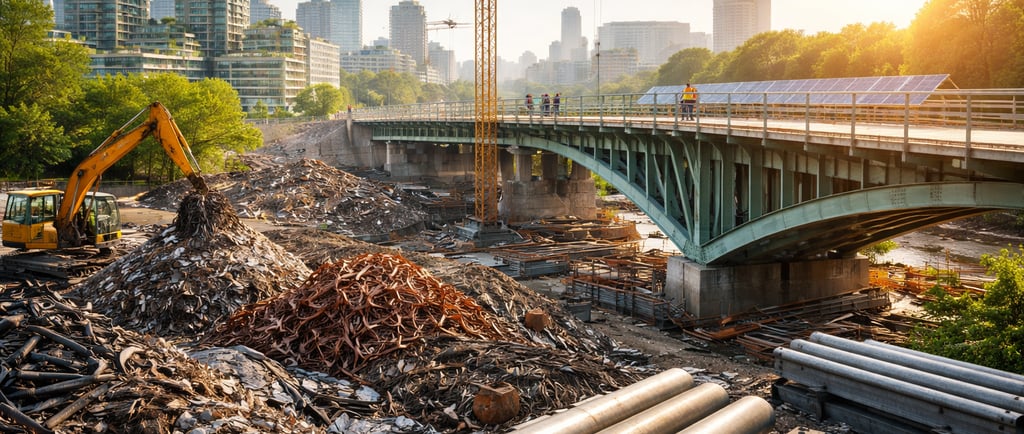

Context: Why Circular Procurement Matters for Infrastructure Owners
Urban infrastructure sits at the core of city functionality, affecting public well-being, economic vitality, safety, and long-term environmental health. For city procurement leaders, asset owners, and infrastructure consultants, the stakes have never been higher—urbanization is surging, while climate-related shocks are more frequent and severe. Floods, wildfires, and extreme storms strain bridges, roads, energy grids, and public buildings, exposing the vulnerability embedded in traditional procurement strategies.
Many legacy procurement models focus on initial capital expenses, often disregarding downstream impacts like repair costs, lifetime emissions, and asset adaptability. This creates a hidden liability for cities, making them susceptible to surprise costs, disruption after disasters, and missed climate commitments. An ingrained preference for virgin materials frequently overlooks significant environmental penalties: the global steel sector alone is responsible for roughly 7–9% of global carbon dioxide emissions (International Energy Agency), with similar figures for primary aluminum and copper mining.
Circular procurement presents a compelling alternative. By setting clear, actionable priorities for recycled metals—such as steel, aluminum, and copper—owners can minimize carbon footprints, contribute directly to achieving net-zero targets, and foster faster post-disaster recovery. In fact, using recycled metals in public infrastructure typically slashes CO₂ emissions by 60–90% versus virgin equivalents, accelerating climate action on a project-by-project basis.
Beyond reducing emissions, circularity in procurement processes creates positive feedback loops for local economies, supporting recyclers, reprocessors, and supply chains. Resilient cities actively manage their asset ecosystems, turning "waste" into a resource and reducing dependency on volatile global raw material markets. For procurement leaders driven by operational continuity, fiscal responsibility, and social value, integrating circular procurement is now a fundamental lever—not just a green tick-box.
Key Takeaway:
Circular procurement transforms infrastructure from a linear liability into a regenerative asset, unlocking faster recovery, lower carbon, and enhanced value for every invested dollar.
2. Defining the Problem: Traditional Procurement vs. Resilient Cities
Traditional Procurement – The Linear Liabilities
The dominant paradigm of public procurement optimizes for lowest upfront price, accelerated timelines, and established specifications. This approach often locks in supply agreements based predominantly on cost, with insufficient consideration of long-term emissions, material recoverability, or adaptability to shifting climate realities.
The consequences of this linear model become starkly apparent during and after shocks. Infrastructure built with carbon-intensive, single-use materials suffers from:
High embodied carbon, undermining municipal emissions goals.
Extended downtimes after disasters due to supply chain inflexibility.
Significant waste at end-of-life—with few pathways for asset reuse or material recovery.
Diminished opportunities for lifecycle savings or adjustments as urban needs evolve.
Resilient Cities – Embracing Systemic Value
Circular procurement reframes asset delivery through the lens of systems thinking and lifecycle impact. By emphasizing regenerative sourcing and recovery, circular procurement amplifies city resilience by:
Lowering embedded carbon per infrastructure project, supporting science-based decarbonization targets.
Unlocking rapid recovery and asset continuity post-disaster, as material flows and supply contingencies are mapped in advance.
Enabling closed material loops—so metals can re-enter the value chain after decades of use, feeding local industry and reducing landfill burdens.
Increasing access to green financing instruments, including sustainability-linked bonds and climate funds, driving competitive advantage.
Hidden and Opportunity Costs
Cities that fail to pivot towards circularity face a growing list of costs:
Reputational risk from public scrutiny or investor pressure regarding sustainability.
Higher infrastructure insurance premiums tied to climate exposure.
Missed economic value—globally, the value of unrecycled metals wasted in construction is estimated at hundreds of billions annually (World Economic Forum).
Eroded eligibility for international grants and green bond certifications.
Operational Lesson:
Shifting procurement from linear to circular directly addresses the primary threats to infrastructure longevity and public value in a warming world.
3. Key Concepts: Circularity, Resilience, and Low-Carbon Procurement
Circular Procurement
Circular procurement is an emerging strategy that revolutionizes how cities purchase goods and services. It places lifecycle value at the core, prioritizing:
Resource efficiency
Waste minimization
Recovery and reuse by design
Circular procurement mandates that materials, such as metals, maintain their highest value throughout use and recovery cycles. This extends beyond recycling—it encompasses circular design, take-back systems, and performance contracting.
Resilient Infrastructure
Urban resilience extends beyond physical robustness. It’s the capacity of infrastructure to absorb disturbance, recover efficiently, and adapt to accelerating uncertainties. Resilient assets are characterized by:
Modularity and ease of repair
Material traceability (e.g., digital material passports)
Flexibility to serve evolving city needs
Embedding circular, low-carbon materials into these assets exponentially increases the city’s ability to respond to—and bounce back from—any crisis.
Low-Carbon Procurement
Low-carbon procurement is a targeted strategy that seeks to minimize both embodied carbon (the greenhouse gas emissions associated with material production, transport, and assembly) and operational carbon (emissions from use). It leverages new procurement policies and smart specifications to:
Set threshold requirements for recycled content (e.g., 75% recycled steel).
Integrate emissions disclosure and tracking into bids and contracts.
Require verifiable third-party certifications (e.g., Environmental Product Declarations, ISO 14021).
Recycled Metals: The Perfect Fit
Steel, aluminum, and copper remain the ideal candidates for circularity. Their structural and conductivity properties are preserved almost indefinitely through recycling. For example, recycled steel retains full tensile strength, making it indistinguishable from primary steel yet offering an average CO₂ footprint reduction of over 70% (Steel Recycling Institute).
Specifying these recycled metals in procurement not only curtails emissions but also ensures rapid material sourcing for repairs—critical for post-crisis recovery.
4. Core Framework: Integrating Recycled Metals for Resilient Outcomes
The CIRCUIT Framework for Circular Procurement in Urban Infrastructure
The CIRCUIT model is an actionable, repeatable approach for embedding circularity and resilience into all infrastructure procurement activities. It guides owners and procurement teams through the essential steps needed to specify, evaluate, and track recycled metal use within city projects.
C – Contextualize Needs
Ground every specification in climate hazard analysis, asset lifecycle assessments, and citywide circularity goals. For example, infrastructure in flood-prone zones should be prioritized for modular, repairable designs using recycled metals.
I – Identify Lifecycle Carbon
Quantify the total embodied and operational carbon of your asset classes. Carbon calculators and EPDs inform accurate baselines, supporting decisions that deliver measurable reductions.
R – Require Recycled Content
Set explicit minimums (e.g., “bridge girders must contain at least 75% recycled steel”) within all RFPs and contracts. This step pushes the market for recycled-content innovation.
C – Classify Suppliers’ Circularity Credentials
Evaluate vendors using multidimensional scoring: chain-of-custody documentation, circular take-back programs, evidence of secondary material flows, and environmental certifications.
U – Update Contract Models
Move beyond price-only evaluations. Structure contracts to reward lifecycle cost reductions, guaranteed repair speed, circular innovation, and demonstrable emissions savings.
I – Implement Material Tracking
Deploy digital tools—material passports and chain-of-custody software—to provide complete visibility on material provenance and recycled content from delivery through to end-of-life.
T – Track Resilience and Recovery Metrics
Include KPIs on recovery speed after disruption, real-world embodied carbon reduction, and closed-loop recycling rates. Feed post-project learning into policy cycles for continuous improvement.
In Practice: CIRCUIT for a City Transit Bridge
Contextualization: The city’s bridge network faces flood and heat stress. Recovery speed is vital for transit continuity.
Spec: New design mandates 75% recycled steel; suppliers must supply material passports detailing content origin.
Supplier Evaluation: Preference for firms with circular take-back and local reprocessing capacity.
Outcome: The bridge achieves a 40% reduction in embodied carbon, and local recyclers are engaged in the supply chain. When a future disaster strikes, rapid replacement parts are readily available using mapped resource flows, minimizing service disruption.
5. Step-by-Step Process: How Cities Put Circular Metal Procurement Into Real Infrastructure Projects
Circular procurement fails when it stays abstract. It succeeds when it is translated into a repeatable project process that procurement officers, engineers, quantity surveyors, legal teams, contractors, and suppliers can all follow without guessing. The practical question is never whether recycled metals are good in theory. The practical question is how a city moves from climate ambition to a compliant tender, a buildable contract, a traceable supply chain, and a measurable project result.
The first step is portfolio triage. Not every asset class offers the same circular opportunity. Cities should start by sorting infrastructure into priority groups based on carbon intensity, criticality, replacement frequency, and exposure to disruption. Bridges, transit structures, street lighting systems, substations, rail components, flood barriers, public buildings, and utility enclosures often rise to the top because they contain high-value steel, aluminum, or copper, and because downtime in these assets carries heavy service and political costs. This matters in a sector where buildings and construction account for 34% of global CO2 emissions and 32% of global energy use, while materials such as cement and steel account for 18% of global emissions. If procurement teams do not target the biggest carbon and continuity levers first, they dilute effort across low-impact categories.
The second step is baseline definition. Before a city can buy better, it has to know what “better” means for that asset class. Baselines should include current embodied carbon, current recycled content, likely end-of-life pathway, expected maintenance profile, and current supplier geography. For metals, this is where the climate case becomes concrete. The steel sector is responsible for roughly 7% to 9% of global greenhouse gas emissions, and the IEA identifies increased scrap recycling as a key lever in lowering those emissions. Recycled aluminum typically saves about 95.5% of the energy required for primary aluminum production. Recycled copper requires about 85% less energy than primary production. Those are not marginal gains. They are the kind of shifts that can materially change the climate profile of public works programs when repeated across hundreds of contracts.
The third step is early market engagement. This is where many public authorities either unlock supply or accidentally suppress it. Circular procurement should begin before the formal tender is issued. Buyers need structured discussions with mills, fabricators, recyclers, stockholders, demolition firms, reprocessors, and contractors to test what is already available, what can be documented, what lead times are realistic, and which requirements would be ambitious but still market-ready. Canadian guidance on circular procurement stresses that the pre-purchase phase is the biggest opportunity for market engagement and for shaping workable circular criteria. In other words, the best circular tender often starts months before the tender document exists.
The fourth step is specification writing. This is the point where intention becomes enforceable. Circular metal requirements should not rely on vague language such as “preference for sustainable materials.” They should set out what the bidder must disclose, what minimums apply, how alternatives will be evaluated, and what evidence is required at award and at delivery. For steel, that may include minimum recycled content, EPD submission, mill route disclosure, fabrication waste management, and end-of-life recovery planning. For aluminum, it may include alloy suitability, recycled-content minimums, and energy or emissions disclosure. For copper, it may include conductor performance, recovery protocols, and traceability requirements for secondary input. The more serious the city is, the more it must shift from general green language to auditable procurement language. U.S. federal Buy Clean programs have done exactly this by setting global warming potential limits and requiring Environmental Product Declarations for key materials.
The fifth step is bid evaluation. A resilient city does not score bids on upfront cost alone. It scores them on delivered public value over time. That means the evaluation method should weigh carbon performance, recycled content, traceability, repairability, take-back arrangements, and local or regional reprocessing capacity alongside price and schedule. Amsterdam is a useful example of what this looks like when applied seriously. In its circular construction work, the city has used a weighting of at least 50% for circular and sustainable construction in relevant land tenders and tied that to auditing of whether commitments were actually delivered. That move changes market behavior because suppliers respond to what wins.
The sixth step is contract conversion. This is where circular goals often die. A bidder may promise recycled metals, traceability, and recovery planning during competition, only for those promises to weaken after award if they are not written into contract obligations, submittal requirements, inspection rights, and payment conditions. The contract should state exactly what documentation is due, when substitutions are allowed, who verifies claims, what happens if material content falls short, and how recovery obligations are handled at project closeout or end-of-life. Circular procurement is not a philosophy at this stage. It is contract administration.
The seventh step is delivery verification. A city should not wait until substantial completion to check whether circular promises were real. Verification needs to happen at submittal, fabrication, delivery, and installation stages. This is where material passports, chain-of-custody files, EPDs, test certificates, and digital asset records matter. FHWA describes EPDs as transparent, standardized, third-party verified reports that help agencies reduce GHG emissions in construction projects and support procurement and asset-management decisions. That makes them more than a reporting exercise. They become the evidence base for better buying and better oversight.
The eighth step is post-project recovery planning. Circular procurement is incomplete if the city only thinks about recycled content at the front end. The stronger model treats every new asset as a future material bank. Design records, joinery choices, component tagging, alloy information, recovery pathways, and dismantling assumptions should be captured while the project is still live, not guessed decades later. This is where resilience and circularity fully meet. Cities that know what is in their assets, where it came from, and how it can be recovered later are far better prepared for budget pressure, climate damage, emergency repair, and raw-material volatility.
6. Implementation Playbook: What Procurement Teams, Engineers, and Suppliers Should Actually Do
A city that wants circular metal procurement to move beyond pilot status needs a working playbook. That playbook should be simple enough to use under deadline pressure and rigorous enough to survive audit, engineering review, and political scrutiny. The strongest way to think about implementation is to divide it into six operating moves: policy, data, market, tender, delivery, and feedback.
Start with policy translation. Many municipalities already have climate plans, net-zero commitments, resilience plans, waste reduction goals, or green-building language. The problem is that these often sit outside the procurement workflow. The first job is to turn broad goals into category-level buying rules. If a city says it wants lower embodied carbon, then bridge steel, handrails, utility cabinets, catenary structures, bollards, poles, roofing systems, and façade metals must each get a procurement rule set. If the city says it wants resilience, then procurement documents must reflect repair speed, local availability, modular replacement, and recovery planning. A policy that cannot be translated into category rules will not change project outcomes.
Next comes data setup. Teams need a clear minimum data stack. At a practical level, that means one material register, one EPD register, one supplier disclosure template, one chain-of-custody checklist, one carbon benchmark sheet, and one post-project closeout record. This does not have to begin as an expensive software program. Many cities can start with a controlled spreadsheet environment and a document management protocol, then move to asset-digitalization tools later. What matters is consistency. If every project requests different data in different formats, buyers create friction for themselves and suppliers alike.
Then comes supplier shaping. Circular procurement works best when a city does not treat the supplier base as fixed. It should actively broaden the field. That means prequalification pathways for reprocessors, clearer onboarding for fabricators using high-scrap-content inputs, guidance for local recyclers on evidence requirements, and supplier education on city goals. Public buyers are powerful market makers. OECD and EU data on procurement scale explain why. When government purchasing accounts for around one-eighth of GDP across the OECD and about 14% of GDP in the EU, public demand can shift supplier investment decisions, documentation habits, and product development.
Tender design comes next. Good circular tenders are precise, proportional, and staged. Precision matters because vague clauses create disputes. Proportionality matters because overreaching clauses can eliminate bidders without improving outcomes. Staging matters because some markets are ready now while others need a glide path. A mature category like structural steel might support stronger disclosure, carbon limits, and recycled-content requirements earlier than a more fragmented category. This is exactly how many Buy Clean programs have developed, starting with disclosure and thresholds in specific materials and then tightening over time as data quality and market readiness improved.
Delivery control is where discipline shows. Cities should not rely only on consultant sign-off. They need defined hold points. For example, no fabrication release until EPDs and recycled-content declarations are approved. No material substitution without fresh carbon and performance evidence. No final payment without closeout records showing what was delivered, what waste was generated, what scrap was recovered, and how the asset should be handled in the future. The message to the market must be clear: circular claims are part of the deliverable, not part of the marketing.
Finally, close the loop through structured feedback. Every major project should answer the same questions after completion. Did the tender attract enough qualified bids. Did suppliers understand the documentation rules. Were carbon claims easy to verify. Did recycled-content requirements affect cost or lead time. Which clauses created confusion. Which material classes showed the best combination of lower carbon, good performance, and strong availability. That learning then feeds the next tender. This is how pilots become policy, and how policy becomes standard practice.
For teams that want a first-90-days action plan, the practical sequence is straightforward. In month one, choose one high-impact asset class and establish baseline documents. In month two, run supplier engagement and draft standard circular clauses. In month three, launch one pilot tender with formal measurement rules and a post-award verification plan. The mistake many cities make is trying to rewrite the whole procurement system at once. The better route is to standardize one category, prove it, then scale.
7. Measurement and Quality Assurance: How to Prove the Materials Are Circular, Low-Carbon, and Fit for Purpose
No serious procurement system can rely on self-declared sustainability claims alone. Circular metal procurement needs a quality-assurance layer that proves five things at the same time: the material does what it is supposed to do, the carbon claim is credible, the recycled-content claim is credible, the chain of custody is real, and the future recovery value of the asset has been protected.
The first QA principle is that engineering performance still comes first. Recycled metals are not a permission slip to weaken structural, durability, conductivity, safety, or code requirements. For city owners, this is a crucial point because resistance to circular procurement often hides behind a false tradeoff. In reality, steel, aluminum, and copper are among the strongest candidates for circular use precisely because their technical properties can remain fit for purpose through repeated recovery and remanufacture when properly processed and certified. The real issue is not whether recycled metal can perform. The real issue is whether the buyer has specified the right grade, route, test, and verification process.
The second QA principle is that carbon data must be standardized. That is the role of Environmental Product Declarations and life-cycle assessment methods. FHWA notes that EPDs communicate GHG emissions in a transparent and standardized manner, are third-party verified, and can support project delivery and asset-management decisions. GSA’s Buy Clean requirements similarly use EPDs and global warming potential limits to set enforceable procurement rules for high-impact materials. This matters because without standardized disclosure, one supplier’s “green steel” can be impossible to compare with another supplier’s claim.
The third QA principle is that recycled-content claims need traceability, not slogans. The city should require chain-of-custody records that show where scrap came from, how it was processed, what the manufacturing route was, and how the reported recycled content was calculated. It should also separate pre-consumer and post-consumer content where possible. That distinction matters because post-consumer recovery usually tells the stronger circular story. Material traceability should be checked against delivery records, mill certificates, fabrication records, and final installed quantities.
The fourth QA principle is that procurement should measure outcomes at both material level and asset level. At material level, useful measures include recycled-content percentage, embodied carbon per tonne, transport distance, EPD completeness, and recovery plan status. At asset level, the city should track project-level embodied carbon reduction, maintenance implications, replaceability of key components, time to restore service after failure, and end-of-life recovery value. Circular procurement earns trust when it can show not only that a project contained more secondary material, but that the project also improved cost certainty, repairability, and service continuity.
The fifth QA principle is that inspection should be staged. One of the most common weaknesses in public procurement is checking too late. Cities should build QA into four checkpoints: bid evaluation, pre-fabrication submittals, delivered materials, and project closeout. Bid evaluation checks the credibility of the supplier’s evidence. Pre-fabrication checks the specific products and routes proposed. Delivered materials checks what actually arrived. Closeout checks whether the documentation set is complete enough for future asset management and recovery. If a city leaves all checking to the end, it loses leverage and increases the risk of greenwashing.
The sixth QA principle is that circularity must include future disassembly and recovery. A product with recycled content is not fully circular if it is then embedded in a way that makes future recovery needlessly expensive or destructive. Quality assurance should therefore ask design questions, not only material questions. Are connections reversible. Are dissimilar metals separated in a way that reduces contamination. Are component locations documented. Is alloy information retained. Have likely recovery routes been identified. These questions matter because the long life of infrastructure can become either a future source of strategic secondary material or a future demolition problem.
A strong city scorecard for circular metal procurement should therefore include at least these indicators: percentage of projects with material disclosures at tender stage, percentage with verified EPDs, average embodied carbon reduction by asset class, average recycled-content percentage by metal type, percentage of projects with material passports or equivalent records, percentage of contracts with take-back or recovery clauses, number of suppliers meeting circular criteria, and time-to-repair performance for critical assets where modular circular design was used. This is the point where climate, resilience, and procurement finally share one language.
8. Case Patterns: What Real Cities and Public Buyers Are Showing the Market
The value of case patterns is not that they give cities a perfect template. The value is that they show what works under real political, legal, and market conditions. Across regions, four patterns are now clear.
The first pattern is that clear procurement targets shift behavior faster than vague sustainability language. Amsterdam is one of the clearest examples. Its circular strategy set interim and long-term targets, including 10% circular procurement by 2022, circular invitations to tender in the built environment by 2023, 50% circular procurement and 50% less use of new raw materials by 2030, and a fully circular city by 2050. In parallel, Amsterdam’s circular construction tenders have applied at least a 50% weighting to circular and sustainable construction in relevant land tender decisions. This combination matters. Targets alone can sit on a shelf. Weighting alone can stay project-specific. Together, they create direction and commercial pressure.
The second pattern is that public procurement can create demand for cleaner industrial materials at national scale. The United States Federal Buy Clean effort is a strong example. GSA first piloted lower embodied carbon procurement requirements across 11 projects with $2.15 billion in low-embodied-carbon materials funding, then expanded to more than 150 federal projects supported by about $2 billion in IRA funding across 39 states, the District of Columbia, and Puerto Rico. The program uses EPDs and GWP limits for materials such as steel. That matters for city readers because it shows that public buyers do not need to wait for perfect markets. They can help build them by setting rules, publishing demand, and giving suppliers a reason to produce verified lower-carbon materials at scale.
The third pattern is that procurement works best when tied to a broader city operating system, not a stand-alone environmental policy. Oslo illustrates this well. The city explicitly uses procurement as a strategic tool to achieve sustainability and climate goals, aligned with its climate budget. Its targets include zero-emission and biogas vehicles for transport in municipal contracts from 2025 and all zero-emission construction sites by 2025. The deeper lesson is not about machinery alone. It is that procurement becomes much stronger when climate goals are linked to budget, contract conditions, and project delivery rules. In practice, Oslo’s public procurement policies have already pushed market behavior. By 2023, 77% of machinery used on municipal construction sites was zero-emission, and from 2025 emission-free construction equipment becomes mandatory for all public projects. On the Sophies Minde redevelopment, the project combined all-electric machinery with material reuse, including preservation and reuse of original brickwork, and achieved a reported 62% reduction in CO2-equivalent emissions compared with conventional new construction.
The fourth pattern is that circular and low-carbon procurement gains strength when it is backed by sector guidance and category-specific limits. In the United Kingdom, National Highways has reported adding maximum carbon-intensity levels for asphalt, steel, and ancillary concrete to a major road reconstruction program. That kind of move is important because it marks a shift from general aspiration to category control. Markets learn from thresholds. Engineers learn from thresholds. Contractors price against thresholds. Cities do not need to copy any one rule set, but they should learn from the logic: category-specific carbon limits are often more powerful than broad declarations of intent.
A fifth pattern is emerging at the international level. Green public procurement is now being treated less as a niche environmental topic and more as an industrial policy tool. The Industrial Deep Decarbonisation Initiative’s green public procurement pledge focuses on low-emission steel, cement, and concrete. The World Bank has also stressed that sustainable procurement uses public spending power to encourage environmentally and socially responsible practices. This matters because city buyers are no longer acting alone. They are part of a wider shift in which public demand is being used to reshape heavy industry, construction inputs, and infrastructure delivery.
What should a city reader take from these case patterns. First, targets matter. Second, evidence rules matter. Third, category-specific criteria matter. Fourth, procurement has more influence when it is tied to budget, resilience planning, and delivery systems. Fifth, cities do not need to invent the movement. They need to adapt it to their own legal and market context.
9. Frequently Asked Questions
One common concern is whether recycled metals are always available at the scale public infrastructure requires. The honest answer is that availability varies by region, product class, fabrication route, and documentation maturity. That is exactly why early market engagement matters so much. The IEA is clear that increased scrap recycling is central to reducing emissions in steel and aluminum, but the path differs by sector and geography. Cities should therefore avoid writing procurement language that assumes every category is equally mature. Start where supply, evidence, and performance are strongest, then scale.
Another common question is whether circular procurement raises cost. Sometimes it can raise unit cost in the short term, especially where documentation, processing, or low-carbon production routes are still scaling. But price-only analysis misses the bigger picture. Circular procurement is often trying to cut lifecycle cost, supply risk, downtime, disposal cost, and future replacement cost. It can also improve access to green finance and reduce exposure to future carbon regulation or procurement reform. In other words, the right comparison is rarely recycled metal versus virgin metal at invoice level. The right comparison is resilient lifecycle value versus linear lifecycle risk.
Many readers also ask whether recycled content alone is enough. It is not. Recycled content is important, but it is only one part of a stronger buying approach. A city should also care about embodied carbon, traceability, durability, repairability, local or regional recovery capacity, and the ability to recover value at the end of service life. A product can contain recycled material and still be poorly designed for long-term circularity. Good procurement therefore asks both, “What is it made from?” and “What will happen to it next?”
A related question is whether EPDs are mandatory everywhere. No. But they are rapidly becoming central to serious low-carbon procurement. FHWA notes that transportation agencies are increasingly requiring and collecting EPDs during project procurement, and GSA’s Buy Clean work uses them as a core evidence tool. Even where law does not require them yet, cities that want cleaner, comparable, auditable bids should expect them wherever the market can provide them.
Another concern is whether circular procurement is only realistic for wealthy global cities. That view is too narrow. Large cities may move first, but the logic applies broadly because the core tools are not inherently expensive. Baseline sheets, disclosure templates, bidder questionnaires, contract clauses, and closeout records can begin in simple formats. The bigger challenge is governance discipline, not software. In many places, the first win will come from one better tender, one better category rule, and one better post-project data set.
Finally, some asset owners worry that circular procurement will slow urgent resilience work. In poorly designed programs, that can happen. In well-designed programs, the opposite is true. Circular procurement strengthens resilience when it improves supplier visibility, shortens replacement pathways, maps secondary material flows, and makes future repair faster and more predictable. The city that knows its material base is usually better prepared than the city that treats infrastructure as a one-way consumption system.
10. Conclusion: Circular Procurement Is Becoming Core City Infrastructure Practice
The old public-works model assumed that infrastructure value came mainly from buying durable assets at an acceptable upfront cost. That model is no longer enough. Climate pressure, carbon limits, insurance pressure, raw-material volatility, tighter public scrutiny, and the need for faster recovery have changed the job. Today, the real question is not just whether a city can afford circular procurement. It is whether it can afford to keep buying infrastructure in a way that locks in carbon, waste, supply fragility, and future demolition costs.
That is why circular procurement deserves to be treated as core infrastructure practice. It allows cities to use one of their strongest powers, purchasing power, to lower embodied emissions, support resilient recovery, reduce dependence on volatile primary raw materials, and build future material value into current assets. This is not a small policy lever. Public procurement is a major share of economic activity, and the buildings and construction sector remains one of the largest sources of emissions worldwide. When cities buy cleaner metals, ask for evidence, and plan for recovery, they do more than improve single projects. They start to change the market that supplies the city itself.
Recycled metals sit at the center of this shift because they combine structural usefulness with real carbon and energy gains. Recycled aluminum can cut energy demand by about 95.5% compared with primary aluminum. Recycled copper can cut energy demand by about 85%. Increased scrap recycling is a major part of the IEA’s pathway for lower-emissions steel and aluminum. These are exactly the kinds of material facts that make circular procurement practical rather than symbolic.
The cities and public buyers moving first are showing a consistent lesson. The winners are not the ones with the most slogans. They are the ones that set targets, write tighter tenders, demand evidence, measure outcomes, and feed project learning back into policy. Amsterdam shows the power of clear circular targets and tender weighting. Oslo shows the power of procurement tied to broader climate delivery. U.S. Buy Clean programs show the power of public demand to move industrial markets. Taken together, they point to the same conclusion: circular procurement is moving from pilot language into mainstream public buying.
For infrastructure owners, the path forward is simple even if the work is not. Pick the highest-impact asset classes first. Build a clear evidence model. Engage the market early. Turn circular goals into contract terms. Verify at delivery, not only at closeout. Capture the recovery value of what you build today. The cities that do this well will not only cut carbon. They will buy infrastructure that is easier to maintain, faster to recover, and harder to strand in a harsher century.
Connect
Your trusted partner for scrap metal procurement.
CONTACT
About
haroon@tdcventures.com
+1-307-655-7593
© 2025. All rights reserved.
NEWSLETTER