
Circular Sanitation: Metal Frames for Modular Toilets in Climate Migration & Circular Infrastructure
Discover how metal frame modular toilets enable circular sanitation for climate migration—reusable, rapidly deployable, and low-carbon. Learn how reused steel, microgrids, and smart design cut costs and waste.
CLIMATE MIGRATION & CIRCULAR INFRASTRUCTURE PLANNING
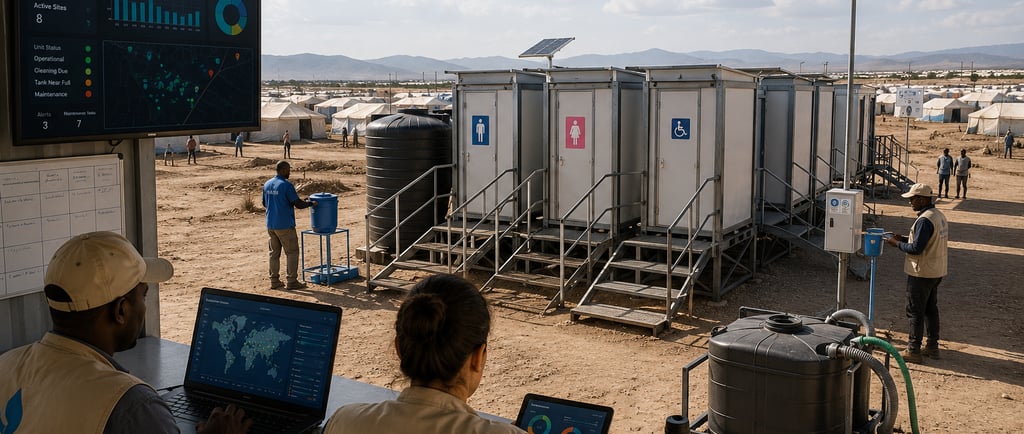
Context: Why Circular Sanitation Matters for Climate Migration
With climate change intensifying, the number of climate migrants is rising dramatically—UN estimates predict up to 200 million people may be displaced by 2050 due to drought, floods, and severe weather. As these populations move, they frequently inhabit spontaneous settlements or emergency camps, placing urgent and dynamic demands on providers of water, sanitation, and hygiene (WASH) services.
Traditional sanitation options—pit latrines, slow-build masonry units, or single-use plastic portables—have proven inadequate on four critical counts: speed of deployment, safety, reusability, and environmental impact. Pit latrines endanger groundwater and are difficult to decommission safely. Concrete toilets require weeks to build and are hardly moveable or adaptable. Generic plastic portables are quick to install but contribute to plastic waste and degrade rapidly under heavy use or harsh climates.
As a result, humanitarian organizations, disaster preparedness agencies, and even government funders are seeking infrastructure that goes beyond temporary stop-gaps. The challenge is formidable: deliver dignified, hygienic sanitation fast—while embedding reusability, circular principles, and reduced carbon into every stage.
Why “Circular” Matters in Sanitation Now
The circular economy model is a game changer for migration contexts. Rather than “build-use-dispose,” circular sanitation aims for systems where modules, such as toilets, are designed for reuse, modular upgrades, and full material recycling. This shift means that when a migration camp is decommissioned or a population moves, sanitation systems migrate, too, instead of leaving waste and pollution behind.
Metal frame modular toilets act as the backbone of this transformation. Reused or recycled steel frames provide durable, stackable, and easy-to-redeploy structures. Integrating with off-grid power (microgrids), remote monitoring, and adaptive waste management, these units directly support circularity and decarbonization in emergency infrastructure—meeting the triple mandate of speed, sustainability, and scalability.
Analyst’s View: Why Stakeholders Are Prioritizing Circular Infrastructure
Donors & funders increasingly require reporting on sustainability and carbon impact (e.g., GHG emission reductions).
WASH NGOs are measured not only on deployment speed but also environmental legacy.
Camp operators demand solutions that minimize end-of-life clean-up and local environmental impact.
Prefab suppliers differentiate by offering modular units with measurable circular attributes.
2. Defining the Opportunity: Modular Toilets with Metal Frames
Modular toilets with metal frames represent a transformation in emergency and migration sanitation. Essentially, these units feature a steel skeleton—fabricated from reused or recycled beams—which forms the load-bearing structure for easily replaceable panels and systems.
Expanding the Value Proposition
Operational Stakes for WASH operations, donors, and on-site users reach well beyond functionality:
Dignity and Privacy: Steel-framed WCs offer privacy locks, elevated structural stability, and weather-proofing. In climate migration contexts, dignity is as essential as hygiene for well-being and security—especially for women, children, and the elderly.
Circular Use: Metal frames’ reusability and panel swap systems shrink plastic pollution and landfill waste. At the end of a deployment, the frame and panels can be flat-packed for redeployment or separated for recycling—fitting circular economy in WASH.
Ultra-Rapid Setup: Frame-based designs allow units to be delivered flat-packed and assembled by small, local teams—often within one working day. This meets the critical urgency of migration flux and rapid disaster response.
Scalable and Adaptive: Units can be added, subtracted, or replaced as site populations shift, with minimal logistical pain.
Off-Grid & Smart-Ready: Metal frames easily integrate with solar lighting, battery-powered fans, rainwater recycling, or sensor systems to monitor usage, tank levels, or cleaning needs.
Market & Industry Insight
According to case studies from EmergencySanitation.org, metal frame modular toilet systems have reduced both setup times by up to 70% and total lifecycle costs by 30% compared to conventional transportable toilets in humanitarian deployments.
Prefab sanitation suppliers—ranging from multinationals to regional fabrication SMEs—now compete to offer certified circular, microgrid-compatible modules, giving operators more choices, flexibility, and sustainability credentials.
3. Key Concepts: Circular Infrastructure, Reused Steel, Microgrids
To fully grasp the strategic value of metal frame modular toilets in migration settings, it’s critical to unpack three core concepts.
Circular Infrastructure in WASH
Circular infrastructure means every component of the sanitation system—frames, panels, waste containers—must be designed from the start for multiple use cycles, adaptability, and easy materials separation at end-of-life. In practical terms:
Longevity: Products are built for many rounds of redeployment, not just one use.
Easy Disassembly: Frames and critical systems can be separated for repairs, upgrades, or material recovery.
Material Traceability: Every module can be tracked for source, use, redeployment, and recycling (supporting compliance and donor transparency).
Reused and Recycled Steel as Structural Backbone
Steel is unsurpassed for its strength-to-weight ratio and resistance to wear in hostile environments. Sourcing reused (salvaged) or recycled steel massively reduces:
Embodied carbon emissions (up to 80% less CO₂ versus virgin steel).
Extraction pressure on global raw materials.
Freight impact, if sourced locally or regionally.
Case studies—such as UNHCR’s “Green Camp” initiative in Jordan—demonstrate modular WCs made from repurposed rebar and shipping container steel maintained structural stability for 5+ years across multiple sites, with minimal corrosion thanks to powder-coating and maintenance.
Microgrids for Independent, Sustainable Utilities
Sanitation units often require lighting, water pumps, or fans—especially in un-electrified or disaster-hit areas. Microgrid integration (solar panels, batteries, low-power IoT) allows toilets to function reliably off the grid:
Resilience: Power outages or fuel shortages don’t compromise sanitation.
Efficiency: IoT sensors monitor use, send alerts for waste removal, and optimize cleaning, reducing downtime.
Water & Energy Circularity: Solar PV-powered pumps supply handwashing or flushing. Rainwater-harvest systems further close the resource loop.
Remote Management: Data dashboards give NGOs and camp managers proactive control and reporting.
4. Modular Sanitation Framework: A Practical Build Method
The Four-Layer Circular Modular Toilet Framework
To help practitioners implement circular, modular toilets effectively, consider the following layered system:
Frame:
Heavy-duty yet lightweight reused steel, treated against rust, forms the skeletal core. Modular sizing—such as a 1000x1500mm base—ensures compatibility with lift equipment and local transport. Design allows both single and multi-stall configurations and easy connection for further expansions (e.g., bolt-together arrays).Panels:
Walls, floors, and ceilings rely on individually removable, washable panels—often made from recyclable polymer, fiber-cement, or coated steel sheets. Damaged panels can be swapped without disassembling the frame, slashing replacement and downtime.Systems:
Depending on scenario, choose from:Waste Systems: Tank, biogas, or composting (for off-grid sustainability—see Composting vs. Tank Systems in Prefab WCs)
Water Supply: Plumbed, waterless, or fitted with gutter-fed rain collectors
Energy: Solar LED for night safety, fans for heat, sensors for use and fill levels
Reusability/Decommissioning:
Critical in circular deployment, the framework allows for:Flat-pack recovery: For next deployment or off-season storage
Material separation: Frames to steel recycling yards; panels and tanks to specialized processors, reducing landfill
In-Field Example: Emergency Camp Setup
Population: 500 displaced individuals
Solution: Install 25 modular steel-frame toilets, 4 shower units
Deployment: Completed in 72 hours by a local team, powered by microgrid
Sustainability: Local scrap provided 90% of frame steel—saving an estimated 9 tons of CO₂ emissions versus new steel.
Adaptability: Toilets redeployed to a flood zone after initial use, with panels replaced in 12% of modules due to rapid wear, showcasing circular reusability.
Engineering Standards: How Many Toilets Are Needed, and What Should Each Unit Deliver?
Modular sanitation only works when it is planned against real population pressure, not against an ideal site plan that disappears the moment a camp fills faster than expected. In climate migration settings, sanitation demand rises in waves. A flood may displace 20,000 people in a weekend. A drought may drive slow movement into peri-urban settlements for months. A cyclone may destroy roads, clinics, water points, and household latrines at the same time. Each pattern creates a different sanitation problem, but the baseline requirement is the same: people need safe, private, usable toilets close enough to use day and night.
Humanitarian WASH standards commonly use one toilet for every 20 people as the medium-term target. In the first emergency phase, teams may begin with one toilet for every 50 people, then move toward one for every 20 as infrastructure stabilizes. This matters because a settlement of 500 people may need 10 toilets during the first rapid response, then 25 toilets once the site moves beyond the first phase. A settlement of 5,000 people may need 100 units immediately and 250 units for a better operating standard. That is where metal-frame modular toilets become practical. They allow a response team to install a first layer fast, then expand, reconfigure, and redeploy units without treating every toilet as a sunk cost.
The unit itself should be designed around four realities: heavy daily use, difficult cleaning, harsh weather, and uneven ground. A toilet that works in a showroom may fail in a camp within weeks if the door hinges bend, the floor flexes, the roof leaks, the frame corrodes, or the waste system cannot be serviced without shutting the unit down. A circular toilet module should therefore be treated as infrastructure, not as a portable product. It needs a tested structural frame, anti-slip flooring, ventilation, washable internal surfaces, safe lighting, privacy locks, gender-sensitive placement, accessibility options, and a waste interface that can work with tanks, sewer tie-ins, container-based systems, composting units, or fecal sludge collection.
The most successful design principle is separation of structure from service parts. The metal frame should last through repeated deployments. Panels, door hardware, tanks, pumps, and fixtures should be replaceable without discarding the full unit. This simple design choice changes the economics. If 10 percent of wall panels are damaged during transport or heavy use, the operator replaces panels, not the whole toilet. If a waste tank cracks, the frame remains in use. If a camp moves, the module is lifted, packed, logged, refurbished, and sent to the next site.
For hot climates, ventilation and heat control are not small details. Toilets that become unbearable in the afternoon will be avoided, which increases open defecation risk. Metal frames can support raised roofs, roof vents, shade canopies, solar-powered fans, and high-reflectance panels. In flood-prone areas, frames can be mounted on raised skids or platforms to prevent water ingress and keep access paths usable. In windy or cyclone-exposed regions, the anchoring system matters as much as the cubicle itself. A module that can be bolted to ground screws, ballast blocks, or reusable steel bases gives responders more options when soil conditions are poor.
The best circular sanitation systems also plan for inclusive use from the start. At least part of the toilet stock should be wheelchair-accessible or designed for people with limited mobility. Units should support handrails, wider doors, ramps, lower latches, child-friendly seats, menstrual hygiene management needs, and safe disposal containers. These details affect whether sanitation is actually used by the people who need it most. In many displacement settings, women and girls face higher safety risks when toilets are poorly lit, too far away, or not separated by sex. A solar-lit, lockable, well-sited unit is a protection tool as much as a sanitation tool.
Waste Pathways: From Toilet Cubicle to Safe Treatment
A modular toilet is only as good as the waste chain behind it. The visible cubicle may attract attention, but the real public health outcome depends on containment, emptying, transport, treatment, and final reuse or disposal. In emergency camps, failure often happens after the toilet is installed. Tanks overflow. Desludging trucks cannot reach the site. Pit latrines contaminate groundwater. Unlined pits collapse in floods. Waste is dumped untreated because treatment capacity was never planned.
Metal-frame modular toilets can reduce these risks because they are easier to pair with different waste pathways. In the first emergency phase, sealed tanks may be the fastest option. They keep fecal waste contained and can be emptied by vacuum trucks or smaller mobile units. In dense camps, container-based sanitation can work when each toilet uses removable sealed cartridges that are collected on a schedule. In dry or water-stressed areas, urine-diverting dry toilets or composting systems can reduce water demand, though they need user training, steady maintenance, and strict pathogen control. In semi-permanent settlements, modular units can connect to decentralized treatment plants, biodigesters, or simplified sewer lines.
The circular opportunity is strongest when waste is treated as a managed resource, not an afterthought. Human waste can produce compost, soil conditioner, biogas, or treated effluent for restricted use, but only when treatment meets safety standards. Poorly managed reuse can spread disease. Well-managed reuse can reduce pressure on water systems, support local agriculture, and cut disposal costs. This is why circular sanitation must be honest about the difference between “waste reuse” as a slogan and safe resource recovery as an engineered system.
For many humanitarian operations, the practical starting point is not advanced reuse. It is safe containment and predictable servicing. A modular toilet program should define the fill rate of each tank, the expected daily use per cubicle, the cleaning frequency, the desludging route, the backup plan during road blockage, and the treatment destination before units arrive on-site. If a 1,000-liter tank fills in three days under heavy use, the site needs scheduled emptying before day three, not an emergency call after overflow. Sensors can help here, but they should support field teams rather than replace inspection. Low-cost fill-level sensors, QR-coded maintenance logs, and cleaning alerts can reduce downtime, but they must be rugged, simple, and repairable.
The frame design should support this servicing reality. Tanks should be accessible without dismantling the cubicle. Hoses should connect safely. Floors should slope toward drains where washdown is used. Handwashing points should be physically linked to toilet exits where possible. Lighting should support night cleaning and user safety. Waste components should be color-coded or mechanically keyed to prevent incorrect assembly during rapid deployment.
The better the waste pathway, the lower the environmental legacy. Traditional emergency sanitation can leave behind contaminated pits, broken superstructures, plastic waste, and unsafe disposal areas. Circular sanitation aims for the opposite: units leave the site, waste is treated, materials are recovered, and the host environment is not treated as a dumping ground.
Microgrids, Sensors, and Off-Grid Utility Design
Climate migration often occurs where public infrastructure is already weak or damaged. Floods knock out electricity. Drought reduces water availability. Conflict or disaster disrupts fuel supply. In these conditions, toilets that depend entirely on grid power, diesel, or continuous water pressure are fragile. Modular sanitation should therefore be designed for off-grid operation from the start.
Solar lighting is the easiest and highest-impact upgrade. A toilet that is safe to use at night reduces protection risks, especially for women, children, older people, and people with disabilities. Solar-powered LED lighting can be integrated into the roof or mounted on nearby poles. Battery packs can also power fans, occupancy indicators, motion sensors, and fill-level monitoring. The energy demand is small compared with clinics or water pumping, which makes sanitation a strong candidate for microgrid integration.
The refugee energy sector already shows why this matters. Large camp-scale solar projects in Jordan, including Zaatari and Azraq, have shown that renewable power can serve tens of thousands of displaced people and reduce dependence on expensive diesel systems. Zaatari’s 12.9 MW solar plant has supplied reliable electricity to about 55,000 Syrian refugees, while Azraq became known as one of the first refugee camps powered by renewable energy. These projects are not toilet projects, but they prove the wider infrastructure point: humanitarian settlements increasingly need durable, low-carbon utility systems that can operate beyond the first emergency window.
For sanitation, the next step is smaller and more distributed. A toilet cluster can be paired with a solar kit, a battery box, LED lighting, low-power sensors, and a small pump if water is needed. In larger settlements, these toilet clusters can connect to a camp microgrid, clinic microgrid, or water-system microgrid. This creates shared power planning instead of isolated gadgets. It also helps operators track performance. Which units are overused? Which tanks are near capacity? Which blocks have poor lighting? Which cubicles need cleaning more often? Data does not solve sanitation by itself, but it gives field teams better timing and better evidence.
The technology should remain practical. Humanitarian infrastructure fails when it becomes too complex for local maintenance teams. A smart modular toilet should use simple wiring, standard batteries, replaceable sensors, protected conduits, and offline-capable logs. It should not require constant cloud access. It should still function as a toilet if the sensor fails. The goal is to improve reliability, not create a fragile system that depends on perfect connectivity.
There is also a reporting advantage. Donors increasingly ask for evidence on sustainability, carbon impact, operating efficiency, and end-of-life handling. A circular sanitation system with asset IDs, maintenance logs, material records, redeployment history, and energy-use data can produce better reporting than one-off procurement of disposable units. Over time, each module becomes part of an infrastructure inventory. It has a source, a service record, a repair history, a carbon profile, and a redeployment value.
Carbon, Cost, and Material Impact: Why Steel Frames Change the Lifecycle Equation
The case for metal-frame modular sanitation is strongest when viewed across the full lifecycle. A cheap disposable toilet can look attractive in a procurement sheet, then become expensive through breakage, replacement, transport waste, landfill disposal, and poor user acceptance. A steel-frame module costs more upfront, but the frame can survive multiple deployments, accept repair, and retain recycling value.
Steel also has a major circular advantage. It is widely recycled, magnetically recoverable, and can be recycled repeatedly without losing its core properties. Using one tonne of steel scrap can avoid about 1.5 tonnes of CO2 emissions, along with large amounts of iron ore, coal, and limestone demand. This matters for humanitarian infrastructure because emergency response often uses large volumes of material under time pressure. If agencies can source verified reused or recycled steel locally, they can cut embodied carbon, reduce freight distance, and support regional fabrication capacity.
The carbon benefit depends on the sourcing route. Reused steel sections normally offer the lowest material impact because the structural member is used again with minimal reprocessing. Recycled steel made through electric arc furnace production is also much lower carbon than coal-heavy blast furnace production, especially when powered by cleaner electricity. New primary steel has the highest footprint. A circular sanitation procurement policy should therefore rank materials in this order: reuse existing steel where safe, use high-recycled-content steel where reuse is not possible, design for future reuse, and only then rely on virgin material.
A simple 500-person deployment shows the difference. If 25 toilet frames each use 80 kilograms of steel, the project requires about 2 tonnes of steel for frames. If that steel is reused or scrap-based, the avoided carbon can be meaningful. If the same module stock is redeployed five times, the frame impact per deployment drops sharply. If panels and fixtures are replaced while frames remain in service, the lifecycle cost improves further. This is the logic that standard emergency procurement often misses. It prices the first deployment but ignores the second, third, and fourth.
The cost benefits also come from logistics. Flat-pack steel-frame units can reduce transport volume compared with fully assembled bulky portable toilets. They can be stored between emergencies. Local teams can assemble them with basic tools. Damaged parts can be repaired or fabricated regionally. In areas with active metal workshops, repairability becomes a major advantage. A bent hinge bracket, broken step, or damaged roof support does not need to end the module’s life. It can be cut, welded, bolted, replaced, or reinforced.
For donors, this changes the procurement question. Instead of asking, “What is the lowest cost per toilet today?” the better question is, “What is the cost per safe toilet-use day across five years?” That calculation includes purchase price, freight, installation, cleaning, repairs, tank servicing, downtime, user acceptance, redeployment, end-of-life value, and environmental remediation. Circular sanitation performs better when the full system is counted.
Case Studies and Field Lessons from Humanitarian Infrastructure
The strongest evidence for circular modular sanitation comes from combining lessons across WASH, shelter, renewable energy, and camp operations. The sanitation sector has long used rapid latrines, raised latrines, desludging systems, and container-based models in difficult ground conditions. The shelter sector has learned how to deploy modular units, steel frames, flat-pack shelters, and reusable components. The energy sector has shown that renewable microgrids can work in refugee camps at real scale. Circular sanitation brings these lessons together.
Jordan’s refugee infrastructure offers a useful reference point. Camps such as Zaatari and Azraq began as emergency responses, then developed into complex settlements with clinics, schools, markets, roads, water systems, solar power, and community services. The lesson is clear: temporary infrastructure often becomes medium-term infrastructure. Toilets designed for a three-month emergency may still be needed years later. Weak materials, poor maintenance access, and non-reusable parts become expensive when displacement lasts longer than expected.
Flood-prone regions provide another lesson. Pit latrines may be fast and familiar, but flooding can spread contamination across living areas and water sources. Raised modular toilets with sealed tanks, reusable access platforms, and serviceable waste connections offer a safer option where groundwater is high or soil is unstable. Pakistan’s 2022 floods, which affected tens of millions of people, showed how quickly water, sanitation, shelter, and disease risks can collide after extreme rainfall. In such contexts, sanitation that can be lifted above floodwater, moved as settlements shift, and serviced without digging new pits becomes a practical adaptation tool.
Drought settings create a different requirement. Water-flush toilets may be inappropriate where water trucking is costly or unreliable. Dry, low-flush, urine-diverting, or container-based models can reduce water demand. Metal frames are useful here because the same structural platform can support different waste technologies. A unit used with a sealed tank in a flood response can later be refurbished for a dry system in a drought-affected settlement. This flexibility is one of the core reasons circular design matters.
Urban displacement adds another layer. Many climate migrants do not live in formal camps. They move into informal settlements, rented rooms, peri-urban neighborhoods, construction edges, and overcrowded urban districts. In these settings, modular toilets may serve as shared community blocks, school sanitation, market sanitation, transit-center sanitation, or temporary sanitation during infrastructure upgrades. Metal frames are useful because they can be installed on constrained sites, moved when land tenure changes, and connected to different service models.
The field lesson is not that one toilet model fits every crisis. The lesson is that a reusable structural platform gives responders options. The frame remains constant while panels, waste systems, water systems, and energy kits change by site.
Procurement and Implementation: What Governments, NGOs, and Suppliers Should Specify
Circular sanitation will not become standard unless procurement changes. Many tenders still focus on unit price, delivery time, and basic dimensions. Those criteria matter, but they do not capture lifecycle performance. A better procurement brief should require proof of durability, repairability, reuse, safe waste integration, user protection, and end-of-life recovery.
Governments and NGOs should ask suppliers to provide the recycled or reused material share of the frame, expected frame life, corrosion protection method, replacement-part list, assembly time, number of workers required, flat-pack dimensions, transport volume, cleaning protocol, tank compatibility, lighting options, accessibility variants, and end-of-life plan. Suppliers should also state whether the module can be disassembled without destroying major components. Bolted connections often support circular use better than permanent bonding when parts need to be separated.
A strong specification should also include operating assumptions. The supplier should define expected daily uses per cubicle, maximum safe tank capacity, service interval, recommended cleaning frequency, ventilation method, wind resistance, flood elevation options, and anchoring requirements. If the toilet is marketed for emergency use, it should be tested for harsh handling, repeated assembly, uneven surfaces, and high-frequency cleaning.
Local fabrication should be part of the model where possible. Imported units can be valuable during major emergencies, but regional production and repair capacity reduce lead times and create local jobs. Metal-frame systems fit this approach because many regions already have workshops capable of cutting, welding, galvanizing, powder-coating, and assembling steel components. A central design standard can be paired with local production, provided quality control is strict.
Implementation should follow a staged model. First, responders assess population size, gender breakdown, accessibility needs, water availability, soil conditions, flood risk, treatment options, and security risks. Then they select the toilet-to-user ratio for the emergency phase and the target ratio for the stabilization phase. Next, they deploy units in clusters with handwashing, lighting, drainage, cleaning access, and waste collection routes. After installation, usage and maintenance data should be reviewed weekly in the early phase. Units can then be added, relocated, repaired, or reassigned as population patterns change.
A circular procurement model also needs asset tracking. Every module should have a durable ID linked to its material profile, deployment history, repair record, and current condition. This allows agencies to know what they own, where it is, how long it has been used, and when it is ready for redeployment. Without asset tracking, reusable infrastructure becomes lost inventory. With tracking, sanitation modules become a managed fleet.
Risks, Limits, and Design Trade-Offs
Circular sanitation is not a magic answer. Metal-frame modular toilets have limits, and ignoring those limits leads to poor field performance. The first issue is cost. A strong reusable unit may cost more upfront than a basic emergency latrine or lightweight portable toilet. This can be difficult for underfunded agencies working under immediate pressure. The answer is not to pretend the upfront cost is low. The answer is to measure cost over time, across repeated deployments, and against avoided waste, lower replacement rates, reduced cleanup, and better service life.
The second issue is weight. Steel is strong, but it can become heavy if overdesigned. A good module should use enough steel for durability, safety, and repeated transport, but not so much that handling becomes difficult. This pushes designers toward light-gauge structural sections, smart bracing, modular skids, and detachable panels. Aluminum can also be used in some components where corrosion resistance and weight reduction matter, though cost and theft risk must be considered.
The third issue is corrosion. Toilets are wet, chemically exposed, and cleaned often. Coastal climates, flood zones, and humid tropical regions can accelerate corrosion. Frames should be galvanized, powder-coated, painted with suitable protective systems, or made from corrosion-resistant alloys where budgets allow. More important, the design should avoid water traps, hidden crevices, and inaccessible joints where corrosion begins unnoticed.
The fourth issue is cultural fit. Toilet design affects use. Squat plates may be preferred in some regions. Seated toilets may be necessary for older users or people with mobility needs. Menstrual hygiene requirements, water use habits, cleaning customs, privacy expectations, and gender separation all vary by context. Circular design should not force one global toilet format into every settlement. It should create a flexible platform that can accept local fixtures and layouts.
The fifth issue is waste treatment. A circular cubicle does not fix a broken fecal sludge system. If no one can empty tanks, transport waste, or treat sludge safely, the sanitation program still fails. The toilet module must be planned as one part of a service chain. The goal is safe sanitation, not attractive hardware.
The sixth issue is theft and vandalism. Metal has scrap value. Fixtures can be removed. Solar parts can disappear if not protected or community-managed. Design should use tamper-resistant fasteners, protected wiring, community oversight, and clear ownership models. In many settings, involving residents in placement, cleaning, maintenance, and reporting improves protection and reduces misuse.
These trade-offs do not weaken the case for metal-frame modular toilets. They make the case for better design, better procurement, and better field planning.
The Future of Circular Sanitation in Climate Migration
By 2026, the direction is clear. Climate migration is no longer a future planning scenario. It is already shaping humanitarian response, urban planning, public health, disaster preparedness, and infrastructure finance. Internal displacement has reached record levels, and disasters continue to push millions of people into temporary, informal, or fragile living conditions. At the same time, billions still lack safely managed sanitation worldwide. These two pressures are converging.
The future of sanitation in climate migration will be modular, low-carbon, repairable, and service-based. Governments will need sanitation stockpiles that can move between flood zones, heat-stressed cities, drought corridors, cyclone shelters, and border reception centers. NGOs will need toilet systems that install quickly but do not create waste mountains after decommissioning. Donors will ask for proof of carbon savings, reuse, local sourcing, and safe disposal. Communities will expect privacy, dignity, lighting, cleanliness, and accessibility.
Metal-frame modular toilets fit this future because they sit at the intersection of several trends. The steel industry is moving toward higher scrap use and lower-carbon production. Humanitarian operations are moving toward renewable energy and better asset tracking. WASH programs are moving from emergency hardware toward full service chains. Cities are preparing for climate-linked population movement. Circular infrastructure is becoming a practical requirement rather than a design preference.
The most advanced sanitation systems will likely operate as fleets. A government or humanitarian agency may own thousands of modular toilet frames, panels, tanks, handwashing stations, solar kits, ramps, and service parts. These assets will be stored regionally, deployed during crises, tracked digitally, cleaned, repaired, and redeployed. Instead of buying disposable units for every emergency, agencies will manage reusable sanitation capacity the way logistics teams manage vehicles, tents, generators, and medical equipment.
This shift will also create opportunities for local industry. Metal fabricators, recyclers, coating companies, sanitation engineers, solar installers, IoT providers, and maintenance contractors can all participate in circular WASH supply chains. In regions exposed to floods, heat, drought, or cyclones, this can become part of climate adaptation planning. A country that builds local capacity for modular sanitation is not only preparing for emergencies. It is building public health infrastructure that can serve schools, markets, temporary housing, construction sites, refugee reception areas, and disaster shelters.
The next generation of circular sanitation should be judged by measurable outcomes. How many people gained safe access within the first 72 hours? How many units remained functional after six months? How many modules were redeployed instead of discarded? How much steel was reused? How much carbon was avoided? How many liters of water were saved? How many tank overflows were prevented? How many women, children, older people, and people with disabilities reported safer access? These are the metrics that will separate serious circular infrastructure from marketing language.
Conclusion: Sanitation Must Move With People
Climate migration changes the basic logic of infrastructure. Fixed systems are still essential, but they are not enough when people are forced to move, return, relocate, or settle in new places under pressure. Sanitation must become faster, cleaner, safer, and more reusable. It must protect public health without leaving pollution behind. It must serve emergency needs without locking agencies into disposable procurement. It must respect dignity while meeting the hard realities of cost, logistics, maintenance, and waste treatment.
Circular sanitation built around metal-frame modular toilets offers a practical path forward. The steel frame gives the system strength, repairability, transportability, and reuse value. Replaceable panels and service parts reduce waste. Off-grid lighting and microgrid compatibility improve safety and resilience. Smart monitoring can support cleaning and desludging. Asset tracking can turn toilets from one-time purchases into managed infrastructure. Safe waste pathways can reduce disease risk and environmental harm.
The most important point is simple: a toilet in a climate migration setting is not a small accessory. It is public health infrastructure. It is protection infrastructure. It is environmental infrastructure. It is dignity infrastructure. When designed for circular use, it can also become climate infrastructure.
The humanitarian sector cannot afford to keep building sanitation systems that are fast but wasteful, cheap but fragile, or temporary but impossible to remove cleanly. The future belongs to systems that can be deployed quickly, maintained locally, adapted to different geographies, and reused across multiple crises. Metal-frame modular toilets are not the whole answer, but they are one of the clearest building blocks for that future.
Connect
Your trusted partner for scrap metal procurement.
CONTACT
About
haroon@tdcventures.com
+1-307-655-7593
© 2025. All rights reserved.
NEWSLETTER