
Circular Startups to Watch: 2025 Edition
Discover the top circular startups of 2025 transforming waste into valuable resources. Learn about the leaders in reuse, remanufacturing, and reverse logistics.
WASTE-TO-RESOURCE & CIRCULAR ECONOMY SOLUTIONS
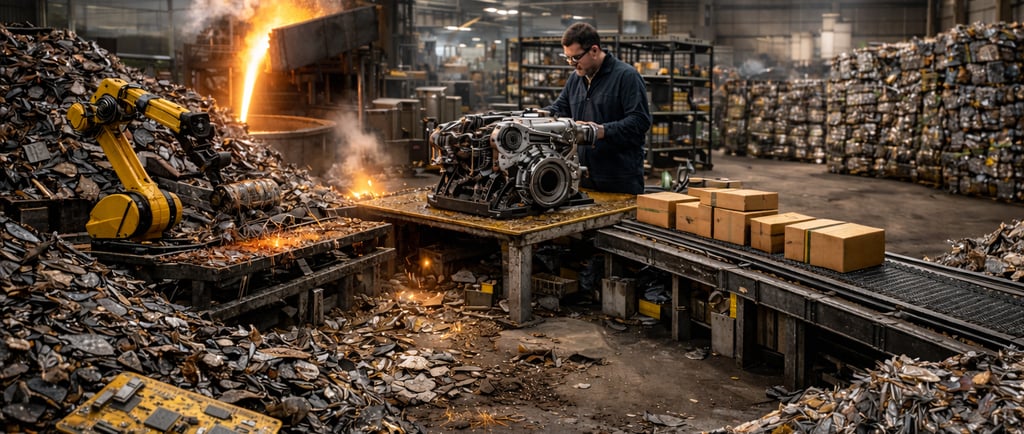
The Circular Economy Leaders Remaking Waste-to-Resource
Instant Answer
Circular startups to watch in 2025 are accelerating the circular economy by transforming waste into valuable resources with cutting-edge reuse, remanufacturing, and reverse logistics models. These innovators extend the lifecycle of metals and materials, offering significant opportunities for investors and corporate leaders focused on sustainability and resource efficiency.
Table of Contents
Context: Why Circular Startups Matter in 2025
The Waste-to-Resource Opportunity (and What’s at Stake)
Key Concepts: Circular Economy, Reuse, Remanufacturing, and Reverse Logistics
Blueprint: Framework for Evaluating Circular Startups
Implementation Playbook
Measurement & QA: Tracking Performance and Impact
Case Patterns: Scenarios from the New Circular Marketplace
Circular Economy FAQs for 2025
Embedded Five-Layer Distribution & Reuse Toolkit
Likely Market Gaps in Existing “Startups to Watch” Lists
1. Context: Why Circular Startups Matter in 2025
In 2025, the circular economy is moving from sustainability concept to cornerstone infrastructure—reshaping how business, government, and consumers view “waste.” Circular startups aren’t just riding the sustainability wave; they’re engineering the next era of resource resilience.
Key Market Drivers
Global supply chain disruptions (2022-2023): Shocks to metals, microchips, and plastics have exposed fragile linear supply models, prompting a rapid pivot to circular material flows.
Investor priorities: Funds are flowing into climate tech, with $70 billion directed to sustainability startups in 2023 (BloombergNEF), and circularity now a top criterion in portfolio construction.
Corporate strategy: Circular integration is a hedge—limiting raw material risks and protecting against regulatory penalties. ESG scores increasingly rise and fall based on waste metrics and closed-loop accomplishments.
Regulatory mandates: Extended producer responsibility programs, landfill taxes, and recycled content legislation are gaining traction in Europe, North America, and Asia, escalating compliance stakes for linear operators.
Why This Matters in 2025
Circular startups are no longer niche—they are the connective tissue between industrial resilience, innovation, and brand leadership in sustainable business. Early adopter advantage is real. Those aligning first with circular champions will unlock preferential access to feedstocks, next-gen branding, and regulatory tailwinds.
2. The Waste-to-Resource Opportunity (and What’s at Stake)
The economic and environmental stakes for waste-to-resource models have never been more pronounced. The global waste management market topped $1 trillion in 2023, yet $100 billion worth of raw materials (notably metals, plastics, & rare earths) were lost to landfills (Circle Economy 2024). Startups now bridge these gaps, circulating “waste” as revenue-generating feedstock.
Key Waste-to-Resource Data Points
Urban Mining and E-Waste: E-waste contains 100x more gold per ton than natural ore, yet only 17% is recycled (per World Economic Forum).
Material Recapture Rates: Leading circular innovators achieve 80-90% recovery rates for select metals and plastics—double the global industrial average.
Operational Savings: Companies piloting closed-loop systems have seen material expense reductions of 15-30%, plus new revenue from resale or “upcycled” offerings.
What’s at Stake for Stakeholders
Leaders and Corporates
Risk of inaction: Failure to adapt to circular strategies exposes firms to material shortages, price spikes, stranded assets, and punitive regulatory action.
Lost partnerships: Slow movers lose prime access to high-growth startups, with competitors securing exclusive supply contracts and positive ESG headlines.
Investors
Capital competition: Venture dollars are chasing scalable circular models—remanufacturing, robotics for scrap sorting, digital chain-of-custody for returned goods, and AI-optimized reverse logistics. These businesses offer sticky network effects and enormous defensibility.
Value unlock: Circular startups present a combination of IP-rich technology, intrinsic environmental/social impact, and revenue streams that scale with every advanced material loop closed.
3. Key Concepts: Circular Economy, Reuse, Remanufacturing, Reverse Logistics
To effectively evaluate or invest in circular startups, it’s crucial to master a few central concepts. Each turbocharges sustainability by keeping valuable materials “in play”—delaying obsolescence and decoupling growth from resource consumption.
Circular Economy: A system where product lifecycles are extended, resource input is minimized, waste is eliminated, and materials circulate perpetually through advanced recovery, reuse, and remanufacturing.
Entity: Circular Economy (Attributes: value retention, lifecycle extension, zero waste)
Reuse: The direct redeployment of products, assemblies, or components—sometimes with minimal repair or cleaning—keeping value high and energy requirements low.
Entity: Reuse (Attributes: product longevity, minimal processing, high value preservation)
Remanufacturing: Comprehensive restoration of products or parts to “like new” status, using advanced inspection, cleaning, and component replacement. Remanufacturing slashes carbon footprints—automotive parts remanufacturing emits up to 88% less CO₂ than new production (Fraunhofer Institute).
Entity: Remanufacturing (Attributes: as-new function, resource efficiency)
Reverse Logistics: Robust supply chain flows that collect, track, and return products from end-users to producers, enabling repair, refurbishment, or material recapture.
Entity: Reverse Logistics (Attributes: closed-loop tracking, customer integration, returns management)
Metals Circularity: Specialized strategies for extracting, refining, and reusing metals through multiple product life cycles, often using minimal extra energy. Stats show metal recovery via circular supply can be 60-95% more efficient than virgin mining.
Entity: Metals Circularity (Attributes: material recovery, closed-cycle metallurgy)
Together, these concepts underpin the practices and success metrics that leading circular startups bring to market.
4. Blueprint: Framework for Evaluating Circular Startups
Choosing the right circular economy startup is both art and science. Investors and innovation managers need to probe beyond the pitch with a structured, entity- and attribute-driven framework for decision clarity.
The 4R Startup Scorecard:
Resource Capture
Are system-level tools (IoT, mobile robotics, digital ID tagging) deployed for superior feedstock collection?
How deep is the startup’s access to post-use material flows—exclusive contracts or open marketplace?
Remanufacturing Rigor
Is the technology patented? Are automation and AI used for consistent restoration quality?
What material recovery rates, purity benchmarks, and process yields are achieved? Is scale built-in, or only pilot-stage?
Reverse Logistics Fit
How seamlessly can the solution integrate with existing B2B/B2C flows? Is there embedded digitization (RFID, blockchain) for superior tracking and accountability?
Can it be “plugged in” to major distribution or after-sales networks with low friction?
Revenue Model
Are circular economics central to the business—real value creation, not just ESG “wrapper”?
Are there clear paths from pilot to operational scale, with recurring revenue and positive unit margins?
Step-By-Step: Practical Startup Scouting
Map Internal Pain Points: Start with your organization’s highest-waste or highest-cost material flows—not just what’s trending.
Longlist Startups: Source from accelerators (e.g., Plug and Play, Urban-X), industry innovation awards, VC deal flows, and sustainability analyst reports.
Score Using 4R Framework: Only shortlist those who meet most of the 4R criteria with proven data, not just vision.
Technical & Logistics Deep Dive: Interview CTOs/founders about IP, process reproducibility, and legacy system integration.
Pilot: Conduct a batch run—track unit costs, time-to-yield, and loss rates with direct performance metrics.
Lifecycle Analysis: Quantify CO₂ savings, water consumption, and percentage material recaptured per pilot.
Scale with Phased Contracts: De-risk scaling through milestones rather than binary launch—each phase linked to technical/financial KPIs.
Ongoing Innovation Sessions: Schedule regular IP updates, tech reviews, and brand alignment meetings to deepen partnership over time.
Worked Example: Metals Circularity in Automotive
A tier-1 supplier (servicing major automakers) targets 40% landfill reduction in its aluminum and steel part supply chain.
Startup 1: Specializes in remanufacturing complex engine components using AI-driven quality controls.
Startup 2: Deploys autonomous robots in scrapyards for precise metals sorting, reducing contamination risk.
Startup 3: Runs a digital reverse logistics platform, coordinating national flows and tracking each part to the source.
Result: The remanufacturing startup wins the pilot—demonstrating 25% cost savings, patent-backed processes, national logistics integration, and strong recurring revenue from OEM refurb contracts. This first-mover position secures both supply chain resilience and ESG awards for the auto supplier.
5. Implementation Playbook: Engaging & Scaling with Circular Leaders
While finding the right startup is challenging, implementation is where most corporates and investors struggle—or shine. A deeply structured playbook, adapted for 2025 realities, bridges vision to actionable outcomes and competitive advantage.
Circular Startup Engagement Checklist (2025 Edition)
Pinpoint Internal Challenges:
Use data, not guesswork. Where are material waste, rising compliance costs, or supply risk the highest?
Define Target Materials:
Are metals, e-waste, plastics, or critical components the biggest opportunity for value capture and emissions reduction?
Cast a Wide Net:
Pull lists from leading accelerators, top venture portfolios, and sustainability innovation ecosystems.
Screen for Fit and Transparency:
Prioritize technical robustness, regional presence, and founder/leadership candor in early conversations.
Secure Data and IP:
Early NDAs and data-sharing agreements set expectations and minimize IP risk down the line.
Tech Validation:
Ask for process demonstrations, virtual or physical “digital twins,” and data on past pilot results.
Legal/ESG Compliance Check:
Vet for regulatory readiness, especially around handling, tracking, and licensing for reverse logistics.
Pilot With Rigor:
Run a one-month, highly monitored trial, capturing every data point on value yield and process friction.
Define Recovery Metrics:
Set specific KPIs: tons of materials recaptured, carbon saved per unit, yield ratios, and cost savings.
Build “Fail Fast” Gates:
Establish clear exit criteria to avoid resource drain on misaligned or underperforming partners.
Handoff to Scale:
Document what triggers the move from pilot to full integration—KPIs, stakeholder approval, and logistics readiness.
Negotiate Exclusivity and Rights:
Early positive results? Secure favorable contracts, branding rights, and first-refusal agreements to maximize strategic value.
Impact Tracking Dashboard:
Live dashboards keep stakeholders aligned and enable proactive course correction.
Internal Stakeholder Education:
Share micro-updates and wins cross-departmentally to drive momentum and build buy-in from the shop floor to the C-suite.
IP and Brand Management:
Nail down legal frameworks for IP co-creation, joint PR, and proprietary process branding from the start.
Revisit for Next Cycle:
Once an initial partnership is stable, prepare to onboard secondary innovation partners for further closed-loop expansion.
Continuous Alignment Review:
Schedule quarterly pulse-checks—priorities and model alignment may shift as business requirements evolve.
Iterate Relentlessly:
The best-in-class circular programs treat each implementation as a living system, course-correcting based on hard data and market evolution.
If This, Then That: Accelerated Decision Tree
Startup can’t integrate with current systems? Seek “bolt-on” solutions or push for middleware integration.
Yield below 15% cost savings? Return to lifecycle ROI calculations; consider pausing or pivoting.
Facing regulatory hurdles? Only progress with startups that proactively prioritize compliance.
Common Failure Patterns
Underestimating solution integration complexity; pilots that don’t scale due to siloed legacy systems.
Overemphasizing PR wins at the expense of day-to-day operational fit.
Poor alignment on resource ownership, data sharing, and attribution of impact/IP.
6. Measurement & QA: Tracking Performance and Impact
If you want a circular startup to survive procurement, finance, and legal scrutiny, you need measurement that stands up to audits, not slides. Circle Economy’s latest analysis underscores why: only 6.9% of global material use is from secondary (recycled) inputs, out of roughly 100+ billion tonnes of materials consumed per year. “We diverted waste” is not enough anymore; you need a measurement system that answers four questions in plain numbers: did you capture it, did you convert it, did you keep quality stable, and did the unit economics hold.
In 2024, the emerging ISO 59000 family—especially ISO 59020 on circularity measurement and ISO 59014 on traceability of secondary materials—started giving global players a common language for circular KPIs. Organizations that align early with these standards can benchmark circular startups across sectors and then plug results straight into ESG, compliance, and procurement systems. At a minimum, serious programs now track four KPI families—material, financial, environmental, and social—on top of a simple mass‑balance spine, with data captured through MFA, LCA, IoT, and core business systems.
6.1 Core Performance Spine and Material KPIs
Start with the mass‑balance spine; everything else hangs off it.
Feedstock capture rate: How much eligible material you actually collect versus what exists in your target stream. This is where most models fail, because access and rights to waste streams usually beat technology.
Conversion yield: Output mass versus input mass, separated by grade, so you cannot hide low‑yield streams in a flattering average.
Purity and contamination: Purity is what gets you paid; contamination is what gets you rejected. Track both by batch and by source so you can fix upstream quality, not just blame the sorter.
Time to value: Days from collection to resale or reuse, which directly influences damage risk and working capital drag.
Loss map: Where material disappears—shrink, theft, moisture, mis‑sorts, breakage, undocumented leakage—so you can quantify and systematically reduce loss.
On top of that spine, material KPIs answer the question, “Are we actually closing loops, or just shuffling waste?” Enterprises increasingly use indicators such as recycled content share, circular material use rate (CMUR), and product‑level circularity indices. Systematic work on circular indicators has cataloged more than 2,700 distinct measures, but high performers pick a manageable subset that they can measure consistently and audit reliably.
For metals and waste‑to‑resource startups, three material KPIs are non‑negotiable:
Recovery and recapture rates: Tons and percentage of target materials retrieved from post‑use streams versus theoretical availability. Circular supply chain case work in technology industries shows that robust circular practices, when fully implemented, can deliver resource utilization efficiency gains of around 40% and cut waste volumes by roughly one third.
Circular material use rate (CMUR): Share of total inputs that come from reused, refurbished, or recycled sources. Large telecom and infrastructure players now track CMUR to understand how much of their network hardware and equipment draws on internal or external circular channels instead of virgin inputs.
Product‑level circularity metrics: Repairability, design‑for‑disassembly, and lifecycle extension factors that quantify how long products and components stay in productive use. Research suggests that product‑level circularity indicators must be life‑cycle oriented and practice‑oriented to be useful for design and procurement decisions.
Urban‑mining and advanced scrap‑sorting operations demonstrate what “good” can look like. Leading systems target metal recovery rates in the 80–90% range for key streams, with high purity thresholds, sometimes achieving roughly double the efficiency of conventional, less‑digitized industrial practice in similar waste categories.
6.2 QA Gates: Keeping Pilots from Collapsing at Scale
Pilots can look excellent on slide decks and still fail once volumes rise, because small data sets hide variability in feedstock, contamination, and process consistency. The solution is to put QA gates in writing before you ramp.
Gate A – Intake verification
Weighbridge or calibrated scales, photo capture at intake, source ID, and a contamination snapshot for every batch. If you cannot tie intake back to a source, you cannot systematically fix supply quality or negotiate fair contracts. Traceable IDs via QR, RFID, or similar tags linked to batch certificates are increasingly expected, especially in metals and batteries.Gate B – Process control
Define the setpoints that matter in your process: shred size, dwell time, sort sensitivity, washing chemistry, temperature bands, or other key parameters. Exceptions, not just averages, should be logged so you can correlate deviations with yield, purity, and failure events.Gate C – Output certification
Issue batch certificates that specify weight, grade, key contaminants, and destination. Buyers want repeatability; compliance and ESG teams want traceability that can be aligned with LCA boundaries and regulatory reporting.Gate D – Dispute handling
Define what happens if a buyer contests contamination or short weight: sampling rules, re‑test protocols, who pays freight, and a resolution clock. Clear protocols here are what let legal and finance approve long‑term offtake arrangements.
Many of the world’s most mature remanufacturing programs in equipment and automotive parts—such as those reported by large OEMs—are built around tightly specified QA systems and gate logic, because quality scandals can erase years of trust and abruptly halt circular adoption.
6.3 Financial, Environmental & Social KPIs That Survive Audit
Circular models die on unit economics, not mission statements. To keep capital onside, you need financial metrics that tie directly to the mass‑balance spine and QA gates:
Gross margin per tonne or per unit, segmented by grade and customer type.
Cost‑to‑collect, including incentives, labor, logistics, returns handling, and storage.
Processing cost per tonne, with fixed and variable components separated so you can model scale.
Revenue concentration risk, to avoid dependence on a single offtake buyer.
Working capital days, because circular operations often carry large amounts of material in inventory; this must be tracked like any other capital‑intensive business.
Empirical work on circular supply chains in technology industries links robust circular practice with roughly 25% profitability improvements on average, driven by better resource utilization, reduced disposal, and value‑added circular services. At the macro level, analyses of the circular economy potential estimate that moving from linear to circular systems could unlock up to USD 4.5 trillion in additional economic output by 2030 and around USD 700 billion in material savings in consumer goods alone.
Impact metrics have to be just as disciplined. For environmental performance, use product‑category LCAs and established emission factors, and always disclose system boundaries. LCA‑based circular performance indicators and recyclability benefit rates help compare the environmental relief of recycling or reuse against manufacturing new products and landfilling or incinerating them. Multiple studies across sectors report 20–80% reductions in greenhouse gas emissions, as well as substantial water and resource savings, when high‑quality closed‑loop systems replace linear models.
In high‑risk streams like e‑waste, batteries, refrigerants, and heavy metals, hazard reduction is a critical KPI. The Global E‑waste Monitor 2024 reports around 62 million tonnes of e‑waste generated in 2022, with only 22.3% properly documented as collected and recycled, and projects a rise to 82 million tonnes by 2030 while documented recycling drops toward 20% if efforts do not accelerate. The same report estimates that roughly USD 62 billion in recoverable resources went unaccounted for in 2022’s e‑waste stream, illustrating both the environmental and financial stakes of better collection, documentation, and treatment.
Social KPIs are harder, but they cannot be an afterthought. Circular‑social enterprises in Europe show that it is possible to combine ecological gains (CO₂ reductions, resource preservation) with meaningful employment for people with disabilities and other vulnerable groups, sometimes making up a large share of the workforce. However, researchers note persistent barriers: limited resources for data collection, lack of standardized social indicators, and sensitivities around publishing detailed information on vulnerable groups. This is why investors increasingly expect circular startups to define a small, realistic set of social indicators—decent work metrics, training hours, inclusion rates—and to integrate them alongside environmental and financial metrics in dashboards and ESG reports.
6.4 Minimum Measurement Stack for Enterprise‑Ready Startups
You do not need complex software to start; you need disciplined records tied to the spine and gates:
Unique batch IDs at intake and output.
A digital chain of custody that records source, date, weight, category, processing step, and destination.
A simple dashboard showing capture, yield, purity, time‑to‑value, margin, and key exceptions.
Quarterly sampling and third‑party checks on your highest‑risk claims.
Combined with alignment to emerging ISO 59020/59014 expectations and the four KPI families, this stack is enough for most enterprise buyers to run a serious pilot and consider multi‑year contracts.
7. Case Patterns: Scenarios from the New Circular Marketplace
Most “startups to watch” lists lump everything together. The market does not. Circular winners are clustering into repeatable patterns—second‑life energy storage, urban mining for electronics and micromobility, circular retail with social impact, and city‑scale initiatives—each with distinctive success conditions and failure modes.
7.1 Second‑Life Batteries and Energy Storage
EV adoption is generating a fast‑growing wave of end‑of‑first‑life lithium‑ion batteries that still retain substantial residual capacity, often around 70–80% of original energy density when they exit automotive use. Research on second‑life EV batteries shows that successful repurposing depends on robust data on battery history, strict adherence to safety and performance standards, and careful economic risk assessment grounded in KPIs.
A common pattern looks like this:
Feedstock: OEMs and fleet operators route retired packs into structured repurposing pipelines once performance drops below automotive thresholds, creating predictable streams of modules for less demanding applications.
Circular startup role: Specialized players test, grade, and reconfigure modules into stationary battery energy storage systems (BESS) for commercial, industrial, and grid‑edge use. Some European and Nordic initiatives target 8–12 years of additional service life from repurposed packs, further amortizing embodied carbon and reducing demand for new cells.
Outcomes: Empirical studies indicate that second‑life systems can reduce lifecycle cost relative to new batteries while delivering large emission reductions, as long as selection, testing, and monitoring follow clear KPI frameworks and QA gates.
The lesson: second‑life batteries are a prime example of circularity at scale, but the moat is not just chemistry—it is traceable data, disciplined QA, and economics that hold under realistic failure and degradation assumptions.
7.2 Urban Mining for Electronics and Micromobility
Urban centers are becoming dense “material mines” of metals and electronics, and circular startups are building the tools to tap them. Analyses of circular supply chains in technology industries suggest that when circular practices are fully digitized and integrated, resource efficiency can improve by roughly 40% and profitability by approximately 25%.
Micromobility shows this in miniature. Even conservative attrition rates across large scooter fleets translate into tens of thousands of end‑of‑life units per year, each containing aluminum frames, steel components, copper wiring, and lithium‑ion batteries—exactly the feedstock circular metals and battery startups want to secure.
Repeated patterns in this space include:
Digital orchestration of end‑of‑life flows through AI platforms that map asset locations, failure modes, and recovery options, and model where to place micro‑factories or specialized recyclers for best economics.
Multi‑startup loop closure, where one player repurposes batteries for stationary storage, another chemically upcycles polymers from housings, and a third uses AI to optimize logistics and routing.
Policy and incentive overlays, such as ride credits for depositing broken scooters at designated points, which can generate double‑digit reductions in landfill disposal when paired with strong reverse logistics and QA.
These dynamics generalize across other dense asset systems, from telecom hardware to consumer electronics and even distributed industrial equipment.
7.3 Circular Retail and Social Inclusion
Circular retail ventures—repair‑first shops, recommerce boutiques, appliance refurbishment hubs—translate circular theory into daily behavior and local jobs. Case work in European cities shows that circular retail startups that align themselves with established indicator frameworks can drive both consumption shifts and upstream industrial circularity by sourcing from local manufacturers and feeding data back into researchers and policymakers.
One documented retail case aligned its operations with multiple circular economy pillars and used KPI‑driven reporting to show how its product mix, sourcing patterns, and customer behavior contributed to regional circular targets. Parallel studies of circular‑social IT refurbishment enterprises show these organizations can deliver ecological value (resource and CO₂ savings) while employing significant numbers of people with disabilities and other marginalized groups, demonstrating the practical link between circularity and inclusive employment.
The pattern: circular retail that connects front‑end customer engagement, community education, and back‑end industrial loops becomes a “translation layer” between households, policymakers, and heavy industry. Success depends on adopting measurement frameworks that capture environmental, economic, and social dimensions rather than treating circularity as a narrow waste diversion metric.
7.4 City and Sector‑Level Transition Projects
Circular startups increasingly plug into larger projects where cities, regions, and sector coalitions co‑create measurement systems and investment roadmaps. In tourism destinations, for instance, participatory projects have built circular measurement systems around multi‑dimensional indicator sets, allowing local stakeholders to track sector‑wide circular transition at destination scale.
Similar approaches are emerging in healthcare and industrial supply chains. Healthcare research has used structured methods to prioritize circular performance indicators around environmental impact, patient safety, cost, and resilience. Technology‑sector reviews highlight digital infrastructure, collaboration, supportive regulation, circular product design, and performance measurement as critical success factors for circular supply chains—conditions that give circular startups real leverage inside these systems.
For startups, these initiatives are both proving ground and springboard: they demand rigorous measurement, strong QA, and governance savvy, but they also provide platforms where validated solutions can scale quickly across multiple regions and sectors.
8. Circular Economy FAQs for 2025
Sophisticated stakeholders aren’t asking “what is circular economy?” anymore; they are asking how it changes risk, P&L, and regulatory exposure. This FAQ focuses on those friction points.
8.1 Which Circular KPIs Actually Matter?
There are thousands of circular indicators in the literature, but operators and investors converge on a concise set. In practice, four clusters matter most when evaluating startups:
Material loop metrics: recovery rates, recycled content, circular material use rates, and product‑level circularity scores. These KPIs sit at the intersection of cost, risk, and compliance and are widely used in circular performance frameworks and corporate dashboards.
Economic metrics: resource productivity, cost savings versus linear baselines, and profitability uplift from circular supply chains. Empirical work in technology industries associates robust circular supply chain management with average profitability improvements around 25%.
Environmental metrics: greenhouse gas reductions, water savings, and avoided virgin extraction measured via LCA‑driven indicators such as circular performance indices and recyclability benefit rates.
Social and governance metrics: decent work, inclusion, and transparency indicators integrated into ESG frameworks, which remain less mature but are increasingly recognized as essential in circular‑social hybrid models.
The key shift is from vanity metrics (“tonnes touched”) to decision‑grade KPIs that can trigger investment, renewals, or redesign.
8.2 How Big Is the Circular Opportunity, Really?
Numbers vary with definitions and boundaries, but several reference points anchor the scale. Analyses of the circular transition estimate that re‑wiring resource flows could unlock up to USD 4.5 trillion in additional economic output by 2030 and roughly USD 700 billion in annual material cost savings in consumer goods alone. At the same time, sector‑level research finds that circular supply chains can materially improve profitability and resource efficiency, turning circularity into a competitiveness strategy, not just an environmental one.
In specific domains like e‑waste, the Global E‑waste Monitor 2024 estimates that increasing e‑waste collection and recycling rates to 60% by 2030 would generate net benefits exceeding USD 38 billion, largely through avoided health damage and environmental harm. Those economics explain why circular startup lists keep growing even as the global circularity rate falls: the opportunity is large, but execution is still rare.
8.3 Why Is Measuring Social Impact in Circular Models So Hard?
Environmental and financial metrics benefit from decades of tools and standards; social impact is behind. Case work on circular‑social enterprises notes recurring barriers: thin measurement capacity, a lack of agreed social KPIs and benchmarks, and ethical concerns around publishing detailed data on vulnerable workers and communities.
The result is that many circular ventures can credibly report CO₂ and cost savings but struggle to report on inclusion, training, community outcomes, or quality of work. Emerging frameworks try to integrate social and circular indicators in unified dashboards, yet regulatory requirements remain vague in most jurisdictions. Practically, founders and investors should pick a small set of meaningful, consent‑based social indicators early and invest modest but consistent effort in tracking them, instead of bolting them on once environmental metrics are fully built out.
8.4 How Do Circular Startups Interact with ESG and Reporting?
Circular performance and ESG reporting are tightly interwoven. ESG standards are increasingly explicit about resource use, waste handling, and supply chain impacts, and many companies are moving beyond carbon‑only metrics to broader circular indicators. At the same time, research emphasizes that indicators must be both systemic (life‑cycle oriented) and practice‑oriented (operationally meaningful), or they become box‑ticking exercises.
Circular startups that can feed verified circular KPIs into their clients’ ESG processes—aligned with frameworks such as ISO 59020 and national or regional indicator sets—help those clients demonstrate “double materiality” and manage regulatory risk. This ability to translate operational data into ESG‑compatible indicators is increasingly a differentiator in procurement and investment decisions.
9. Embedded Five‑Layer Distribution & Reuse Toolkit
Great circular tech fails if distribution and reuse aren’t designed like infrastructure. This five‑layer toolkit assumes a global, multi‑stakeholder context: metals and components crossing borders, digital platforms spanning regions, and regulation tightening year by year.
Layer 1: Signal & Demand Design
Layer 1 designs incentives and signals that pull materials back into circulation. Deposit‑return systems show how powerful this can be: for certain packaging streams, well‑designed deposits routinely produce 80–90% return rates, while pilots extending deposits to non‑beverage metals have delivered strong gains in participation and cost recovery.
Effective Layer 1 portfolios blend:
Price‑based signals such as deposits, buy‑back premiums, and dynamic rebates tuned via simple ROI models that account for return rates, contamination, processing cost, and landfill avoidance. Regional deposit pilots in metals have shown that even modest per‑item deposits can raise return rates by around 30% and reduce public waste costs by seven‑figure amounts annually in large programs.
Non‑price signals like extended warranties, repair guarantees, and “circular by design” labels that reframe reused and remanufactured products as high‑quality options rather than compromises.
Behavioral and reputational levers such as public dashboards that show return rates, contamination, and environmental impact in nearly real time, a practice that city and regional initiatives use to foster participation and accountability.
Startups at this layer build the front‑end interfaces—apps, portals, retailer tools—that make these signals visible and convenient to consumers, fleet operators, and industrial users.
Layer 2: Collection & Reverse Logistics Orchestration
Layer 2 converts intent into actual flows. Research on circular supply chains in technology industries highlights that digital technologies—IoT, cloud platforms, blockchain, and AI—are core enablers of efficient circular logistics and are closely linked to gains in resource efficiency and profitability.
A robust Layer 2 architecture includes:
Multi‑channel collection: curbside programs, in‑store take‑back, B2B pickup routes, and specialized drop‑off hubs for high‑value or hazardous items like batteries and electronics.
Data‑rich reverse logistics: sensorized containers, RFID/QR codes, and route‑optimization engines that adjust pick‑ups based on fill levels, contamination risk, and transport cost.
Traceability layers aligned with emerging secondary‑material standards so that batches can be tracked from collection through processing to final reuse or recycling, which is particularly important in critical mineral and battery value chains.
Circular startups often act as orchestrators here, providing platforms that visualize flows, run “what‑if” scenarios, and allocate materials to the highest‑value use in near real time.
Layer 3: Sorting, Preprocessing & QA Hubs
Layer 3 is where “waste” becomes specification‑ready feedstock. Work on circular indicator frameworks stresses that robust, life‑cycle oriented metrics and QA systems are essential to ensure that circular processes deliver true environmental benefits rather than shifting impacts elsewhere.
High‑performing Layer 3 systems tend to deploy:
Advanced sorting tools (optical sensors, X‑ray fluorescence, hyperspectral imaging, machine vision) and, in some cases, molecular analysis for complex mixtures, which significantly improve recovery rates and reduce contamination.
Micro‑factories and regional hubs that carry out disassembly, component testing, grading, and pre‑processing closer to collection points, cutting transport emissions and letting regions retain more of the value they generate. Real‑world projects have shown that combining such hubs with digital process control can push diversion rates into the high nineties for particular streams, especially when contamination is tightly managed.
Standardized QA protocols tied directly to circular KPIs—sampling frequencies, contamination thresholds, performance tests—so that downstream buyers and regulators can trust inputs and outputs without bespoke negotiations each time.
Startups specializing in this layer provide the invisible infrastructure that lets other circular players—battery repurposers, metals refiners, refurbishers—scale without drowning in feedstock uncertainty.
Layer 4: Reuse, Remanufacturing & Repurposing Channels
Layer 4 is where recovered materials and products go back into productive use, generating revenue and measurable impact. Work on circular business models suggests that success here depends on clear preconditions and KPIs, especially in regulated sectors like mobility and energy.
Effective Layer 4 designs often include:
Dedicated reuse marketplaces that match verified refurbished goods and components with buyers and use scoring to communicate quality, remaining life, and emissions savings.
Sector‑specific remanufacturing lines that apply diagnostics, standardized replacement protocols, process controls, and field‑grade performance tests to deliver “like new” functionality; multiple OEM programs report significant reductions in raw material use and process emissions compared with manufacturing new parts.
Repurposing programs that route components into second‑life uses—EV batteries into stationary storage, industrial electronics into lower‑duty applications, or structural metals into new assemblies—guided by KPIs that weigh technical risk, economic value, and environmental benefits.
Circular startups in this layer win when they tie their operations tightly to Layers 1–3, ensuring steady, high‑quality feedstock and reliable offtake contracts, rather than treating reuse and remanufacturing as opportunistic side projects.
Layer 5: Data, Governance & Market Feedback
Layer 5 makes the whole system adaptive. Recent work on circular measurement and monitoring argues that indicators must sit inside governance systems that continuously adjust policies, design choices, and operational practices as new data arrives.
Core components include:
Unified circular data platforms that merge operational data (flows, yields, QA, costs) with LCA results, ESG metrics, and compliance status. These platforms draw on evolving indicator frameworks for cities and regions to ensure data is comparable and actionable.
Governance frameworks—joint steering groups, sector alliances, city‑region task forces—that use shared data to adjust incentives, standards, and investment priorities over time.
Dynamic feedback loops in which KPIs drive concrete changes: raising deposit levels when return rates lag, adding QA gates where failure clusters, redesigning products based on failure and recovery data, or exiting routes that remain uneconomic despite intervention.
For circular startups, mastering Layer 5 means designing products and platforms as learning systems: able to surface insight that reshapes contracts, logistics, processing choices, and even capital allocation over multiple years.
10. Likely Market Gaps in Existing “Startups to Watch” Lists
Most circular “startups to watch” lists still overweight visible consumer‑facing plays and underweight less glamorous infrastructure, social models, and regionally embedded SMEs. Systematic reviews of circular drivers and success factors, along with sector‑specific studies, point to several recurring blind spots.
10.1 Under‑Indexed Enablers and Middle‑Layer Infrastructure
One major gap is middle‑layer infrastructure: startups whose core products are measurement, verification, traceability, and compliance tooling. Research on circular indicators stresses that standardized, robust measurement is essential to track progress credibly and guide decisions, yet most popular lists do not spotlight ventures that sell circular KPI platforms, LCA engines, or ESG‑aligned reporting tools.
Traceability and secondary materials management tools are similarly under‑represented, even though standards like ISO 59014 make them central to compliant circular metals and battery systems. Investors who focus only on consumer‑visible brands risk missing deep infrastructure plays that may become critical as regulations on secondary materials, reporting, and product stewardship ratchet tighter.
10.2 Social Circularity and Labor‑Intensive Loops
Another blind spot is social circularity. Case work on circular‑social enterprises shows that some organizations achieve strong ecological metrics while delivering direct social benefits—job creation, training, inclusion—for marginalized workers, often in repair and refurbishment roles. At the macro level, circular economies are generally more labor‑intensive than linear extraction‑and‑disposal systems, suggesting significant job‑creation potential in repair, remanufacturing, and reuse.
Yet few lists highlight startups whose primary differentiation is inclusive employment, workforce‑as‑a‑service for circular operations, or specialized training academies for circular skills. As social metrics gain traction within ESG standards and impact investing, those omissions represent both a coverage gap and an investment opportunity.
10.3 Hard‑to‑Measure Sectors and Frontier Materials
Circular transition in healthcare, tourism, and complex industrial systems is still early, and much of the literature focuses on indicator design and pilot projects rather than scaled startups. Consequently, “startups to watch” compilations often under‑represent ventures tackling circularity in these sectors, even though evidence suggests circular strategies can materially enhance resilience, cost control, and environmental performance.
The same applies to frontier materials and processes: nano‑scale recycling, programmable materials, bio‑assisted resource recovery, and other advanced techniques could substantially improve recovery rates and reduce reliance on primary mining over the long term. These ventures often sit in deep‑tech ecosystems, outside mainstream climate or circular startup lists, despite their strategic importance.
10.4 Regional and SME‑Centric Innovation
Finally, there is a geographic and scale bias. Studies of SMEs in resource‑constrained contexts show that appropriate technology and strong knowledge integration can deliver meaningful circular outcomes without expensive equipment, yet these firms rarely appear in global watchlists. Similarly, regional innovation outside the usual hubs often only becomes visible once acquired or partnered by multinationals, even though such firms may play pivotal roles in local circular ecosystems.
For corporates and investors serious about circularity, closing these gaps means looking beyond glossy lists to the underlying system map: measurement and QA enablers, social and labor‑intensive operators, sector‑specific innovators in “difficult” arenas, and regional SMEs that collectively determine whether the circular transition is shallow and fragmented or deep and resilient.
Connect
Your trusted partner for scrap metal procurement.
CONTACT
About
haroon@tdcventures.com
+1-307-655-7593
© 2025. All rights reserved.
NEWSLETTER