
Coastal Defense: Alloy Selection for Salt Spray Zones Resilience
Explore the critical framework for alloy selection in salt spray zones. Learn how recycled duplex stainless steel and circular design principles deliver 50+ year resilience for coastal infrastructure.
CLIMATE-RESILIENT INFRASTRUCTURE & CIRCULAR MATERIALS
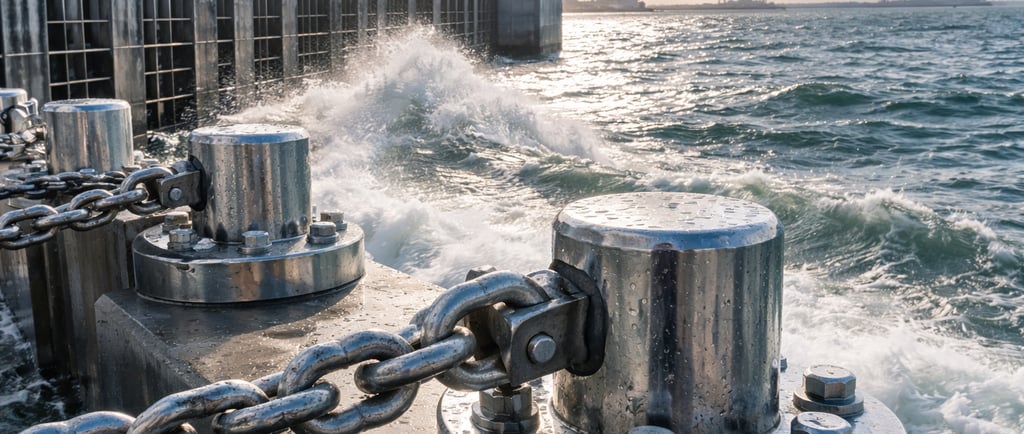
Context: Why Alloy Selection Matters in Coastal Defense
Coastal defense is no longer just a matter of building robust sea walls or reinforced port structures—it’s about future-proofing marine assets against escalating environmental threats. Port authorities, government infrastructure teams, and marine contractors across the world are grappling with the relentless effects of saline exposure, tidal surges, and increasingly corrosive atmospheres accelerated by both pollution and climate change. In the context of coastal defense, improper alloy selection equates to operational risk. Catastrophic material failures not only lead to hazardous conditions and expensive repairs but also disrupt vital supply chains that hinge on the smooth functioning of ports and harbors.
Why does alloy selection matter so much today? The answer lies in the rising bar for resilience, regulatory compliance, and sustainability. Infrastructure must now withstand decades of increasingly severe weather while remaining efficient to maintain, easy to repair, and as low-emission as possible. For decision-makers, carbon budgets, extended asset service life, and the ability to safely deconstruct or recycle materials at the end of life are rapidly overtaking upfront material cost as primary procurement criteria. Authorities in Europe, Asia, North America, and Australia are aligning on this: if you can’t verify your materials’ sustainability and resilience, your projects will face regulatory and funding barriers.
Modern standards require a shift from legacy carbon steel or generic alloys toward highly resilient, well-certified recycled metals. This includes marine-grade aluminum, duplex stainless steel, and even specialty zinc-aluminum galvanized alloys. These materials—when paired with advanced coatings and robust inspection regimes—are setting the benchmark for sustainable, climate-resilient infrastructure. The lesson? Metallurgy is at the core of infrastructure longevity, and well-chosen alloys can reduce total lifecycle cost while safeguarding marine assets for generations.
2. Defining the Challenge: Salt Spray Zones and Material Risks
Salt spray zones—classified as ISO 9223 C5-M or CX exposure environments—are among the most challenging for any engineering material. Structures exposed to salt-laden air, breaking waves, and frequent wetting-drying cycles experience rapid degradation driven by chloride ion penetration. Even the best coatings on mild steel deteriorate quickly under these conditions, while weld seams and fasteners form galvanic couples that can trigger localized corrosion far more aggressive than uniform surface rust.
This isn’t a theoretical risk. Studies from global ports show corrosion rates for unprotected mild steel can reach up to 250 µm/year in extreme coastal splash zones, leading to major section loss and first structural maintenance within 1–5 years of installation. Historical failures, such as the 2007 collapse of a jetty in the UK due to pitting corrosion, underscore the real-world urgency. According to the World Corrosion Organization, annual economic losses from marine corrosion exceed $50 billion globally, with a significant portion attributed to inappropriate material choices in design.
The operational risk multiplies in high-traffic or critical facilities. If a port’s pilings or a flood barrier’s retainers are made of alloys unsuited to C5/CX exposure, unplanned shutdowns and emergency repairs are inevitable. Furthermore, if rare or hard-to-source alloys are chosen, post-storm or seawater impact recovery becomes slow and expensive—potentially putting a facility out of commission for weeks. On the sustainability front, the use of primary (virgin) metals with heavy emissions profiles can jeopardize both green financing eligibility and compliance with environment, social, and governance (ESG) standards.
In contrast, the use of recycled, well-understood alloys paired with proven protective systems demonstrably speeds up repair cycles, reduces total emissions, and improves inspection regularity—paving the way for assets that are both robust and sustainable.
3. Key Concepts: Coastal Resilience, Circular Metals, Exposure Classes
Let’s break down the critical concepts that now shape alloy decision-making for salt spray zones:
Resilience
Resilience in coastal infrastructure refers to the integrated ability to withstand, absorb, and rapidly recover from extreme events—be it hurricanes, storm surges, or severe corrosion episodes. Resilient materials offer not just raw mechanical strength, but also retained function and minimal loss in utility even after repeated exposure to stress. This principle is now integral for infrastructure that must guarantee uptime during and after weather-related disruptions.
Key metrics: Service life exceeding 50 years, minimized unplanned downtime, and rapid recoverability post-event.
Low Carbon
Low-carbon materials deliver the same (or higher) performance as their high-emission counterparts while reducing greenhouse gas emissions associated with extraction, processing, and transport. The drive toward low-carbon alloys is being turbocharged by carbon reporting standards, port authority climate commitments, and the growing availability of Environmental Product Declarations (EPDs).
Key attributes: High recycled content (often 40–70%), closed-loop production, use of renewable energy in smelting, and robust EPD documentation.
Recycled Metals
The circular economy imperative calls for the large-scale adoption of recycled metals. Post-consumer and post-industrial steel, aluminum, and zinc alloys offer mechanical properties equal to virgin materials when quality-controlled. Recycled alloys enable emissions savings up to 70% compared to primary production and provide improved traceability for regulatory compliance.
Named entities: Duplex stainless steel (EN 1.4462), 5xxx/6xxx aluminum (e.g., EN AW-5083, 6082), zinc-aluminum galvanizing.
Exposure Class
Finally, exposure classes—defined under ISO 9223 and EN 12944—guide engineers in categorizing a site’s corrosion risk. C5-M (marine) and CX (extreme) signify high or exceptional salt exposure, dictating the selection of alloys with intrinsic corrosion resistance and compatible coating systems. Lower classes (C2–C4) offer leeway for alternative materials but still demand systematic risk assessment.
Attributes: Corrosion rate, local microclimate, tidal/splash exposure, and atmospheric salinity.
Coating Systems and Circularity are closely linked to these fundamentals. Multilayer epoxy, duplex coatings (zinc plus paint), or metallized barriers are essential to shield metals for the long term. Meanwhile, circular design—modularity, ease of disassembly, and specification of recyclable materials—ensures that assets contribute to a regenerative port economy.
4. The Alloy Selection Framework for Coastal Projects
With these principles, leading engineering consultancies and asset managers use a rigorous, climate-focused, six-step alloy selection framework for coastal defense:
1. Define Exposure Class and Local Corrosion Rate:
Conduct site surveys and use certified exposure data to pinpoint the ISO or EN category. For example, a major North Sea port might chart steel loss rates of 10–15 µm/year at C5/CX zones.
2. Establish Resilience and Carbon Targets:
Define KPIs for both durability and sustainability. Modern targets often include achieving a 50–70 year minimum service life, keeping embodied CO₂ below 1.5 tCO₂e/tonne, and ensuring EPDs are available for all materials. These requirements often unlock access to green bonds or ESG investment capital.
3. Select Optimal Alloy Group:
Shortlist alloys based on recycled content, corrosion resistance, procurement risk, and mechanical properties. For example:
Duplex stainless (1.4462): Superior chloride resistance, very high recycled content.
5xxx/6xxx marine aluminum: Excellent for modular fenders, walkway platforms, and non-loadbearing elements.
Zinc-aluminum galvanized steel: Best for non-critical or C4/C5 shielded structures.
Entities that should be highlighted: steel suppliers compliant with ISO 14021, aluminum smelters with low-carbon certification, and coating system manufacturers with proven marine references.
4. Specify Protective Systems:
Align the alloy’s selection with tested coating stacks. Standards such as ASTM B117 and ISO 12944-6 mandate accelerated salt spray testing to vet coating durability. Options include:
Epoxy glass flake (for highest durability),
Metallizing (arc or flame-sprayed zinc/aluminum),
Duplex systems (hot-dip galvanizing plus high-build paint for double redundancy).
5. Integrate Inspection and Maintenance Needs:
Favor alloys that enable rapid, non-destructive inspection (NDT) and swift repair. The ability to deploy ultrasound, eddy current, or magnetic particle testing directly on marine-grade alloys (without major disassembly) streamlines ongoing stewardship.
6. Design for Circularity and Recovery:
Engineer components for end-of-life reuse. Avoid cast-in-place choices; prefer bolted, demountable sections with standardized fasteners and clear alloy markings. This not only maximizes recycling yields but also expedites recovery after extreme events—a critical trait as operational resilience moves to the forefront of coastal asset design.
Worked Example: Tidal Flood Barrier Piling (Port Authority Estimate)
To concretely illustrate, consider a flood-prone port needing upgrades to its tidal barrier system in a C5-M exposure.
Site conditions: Direct exposure to salt-laden spray, tidal flooding, and waves.
Selected material: Recycled-content duplex stainless steel piles with high-performance, duplex (galvanized + epoxy) coatings.
Connection and inspection: Welds are made with seawater-optimized filler, and robotic-access NDT gates are included in the design.
Performance outcomes: Projected 60+ year asset life, 40% decrease in scheduled maintenance versus prior carbon steel installations, 55% recycled metal content, and full eligibility for green infrastructure financing.
Implementation playbook for coastal defense alloy systems
A coastal alloy choice only pays off when procurement, fabrication, coatings, and maintenance are treated as one system. In salt spray zones, many failures are not “bad metal.” They are avoidable mismatches, wrong fasteners, weak surface prep, rushed cure windows, or inspection plans that never become routine. The implementation goal is simple. Control the interfaces, then prove performance before the asset is locked in place.
Step 1: Turn exposure into a site-specific corrosion brief you can contract against
Start by translating “coastal” into measured exposure conditions. ISO 9223 does this through corrosivity categories based on first-year corrosion rates for standard metals. For carbon steel, ISO 9223 lists first-year corrosion-rate bands of 80 to 200 μm per year for C5, and 200 to 700 μm per year for CX, which ISO calls “extreme” marine and marine industrial environments.
That matters because it forces decisions that look like engineering, not preference.
Define three micro-zones on your drawings and in your specs.
Atmospheric salt spray. Think open air, wind-driven chlorides, and intermittent wetting.
Splash and tidal. Wet-dry cycling, chloride concentration, crevice traps, and fastener vulnerability.
Immersed. Lower oxygen, different biofouling, and different cathodic protection behavior.
Then add local “accelerators” you will see in real ports.
High humidity and long time-of-wetness on sheltered faces where salts sit and stay wet.
Diesel soot and industrial sulfur compounds that change surface chemistry.
Wave overtopping and storm-driven debris that destroys coatings by impact.
Deliverable to include in tender packages. A corrosion brief with:
Exposure category targets and micro-zone map.
Assumed design life, for example 50, 75, or 100 plus years.
Maintenance philosophy, meaning “inspect and repair coatings” versus “minimize touch labor for decades.”
Documentation requirements, including material IDs, heat numbers, coating batch traceability, and inspection records.
Step 2: Decide where the alloy must be inherently resistant, and where coatings carry the load
In CX and severe splash zones, you want fewer single points of failure. That pushes critical components toward alloys that resist chlorides even when coatings are scratched, edges are exposed, or crevices form.
Typical “must be inherently resistant” parts.
Primary load paths in splash and tidal zones, including piles, gate arms, hinge and trunnion regions, and high-consequence brackets.
Fasteners, anchors, and small parts that corrode first and then cascade into bigger failures.
Crevice-prone geometries, like lap joints, clamps, and fender connections.
Typical “coatings can carry the load” parts.
Large carbon steel sections in less aggressive micro-zones where you can reach them for inspection and repair.
Secondary platforms, handrails, and non-critical supports, where modular replacement is planned.
This split is where lifecycle cost is often won. Corrosion is expensive at scale. NACE’s IMPACT study estimates global corrosion cost at about US$2.5 trillion, around 3.4 percent of global GDP, and reports that applying known corrosion control practices can save on the order of 15 to 35 percent of that cost. In coastal assets, this shows up as fewer emergency callouts, fewer closures, and fewer hard-to-schedule dives and heavy lifts.
Step 3: Lock down procurement so “equivalent” does not become “unknown”
For each alloy family, your procurement risk is not just price. It is lead time, certification, and consistency across heats and mills.
Write specs that control what matters most in salt spray zones.
Exact grade and standard. Example, EN 1.4462 for duplex 2205 plate, or EN 1.4362 for lean duplex reinforcement, where appropriate.
Material test certificates for each heat, plus traceable marking that survives fabrication.
Welding consumables and procedures tied to the base alloy family, because corrosion performance often fails first at welds and heat-affected zones.
Fastener policy. Same family where possible. If dissimilar metals are unavoidable, require isolation, sealing, and a galvanic design note.
Add a circularity clause that is practical, not marketing.
Require alloy identification markings on demountable parts.
Specify bolted connections and replaceable sacrificial wear items where abuse is expected.
Plan end-of-life separation so stainless, aluminum, and carbon steel streams are not contaminated.
Step 4: Fabrication and joining rules that prevent hidden corrosion
Coastal corrosion punishes small mistakes. Most early damage begins in places that inspectors cannot easily see.
Design out crevices first.
Avoid overlapping plates in splash zones unless fully sealed and inspected.
Use continuous welds where sealing is needed, but avoid partial welds that create crevice traps.
Add drain paths and slope surfaces to stop ponding.
Control surface finish and contamination on stainless.
Prevent carbon steel tooling contamination on stainless parts.
Require post-fabrication cleaning and passivation steps when needed, especially where grinding and heat tint occur.
Treat galvanic couples as a design item, not a field surprise.
Put dissimilar metal decisions on drawings with isolation details.
Specify gasket materials, sleeves, sealants, and edge protection methods.
Step 5: Coating and barrier systems, specify by performance tests and durability class, not brand preference
If carbon steel remains in the system, coatings become your main life extension tool. ISO 12944 is widely used to align coating systems with corrosivity categories and durability planning, and it frames durability as a planning parameter for maintenance, not a warranty clock.
For C5 and CX work, the implementation focus is not “thick paint.” It is surface prep, stripe coating of edges, controlled environment during application, cure validation, and inspection.
A high-performing coastal coating implementation package usually includes:
Surface preparation standard and verification, with measurable acceptance.
Edge preparation rules and stripe coats on welds, corners, and bolt heads.
Defined dry film thickness targets by layer, and rules for repairs.
Salt contamination testing before coating, because chloride on the surface can break adhesion and cause underfilm corrosion.
Where metallizing is used, include sealing and topcoats and define repair methods after impact damage.
Step 6: Installation planning that protects what you just paid for
Many coatings and alloy systems fail during handling, staging, and installation.
Include handling and storage rules.
No unprotected stacking on coated faces.
No seawater washdown on fresh coatings.
Controlled curing windows before immersion or heavy abrasion.
Require installation inspection gates.
Pre-install baseline photos and readings.
Post-install touch-up map with signoff.
A “closeout pack” that includes as-built alloy list, coating batches, and all inspection records.
Measurement and QA strategy that proves performance and prevents drift
In coastal defense, QA cannot be a single coating inspection report and a binder on a shelf. You need a measurement plan that answers three questions:
Did we build what we specified.
Is it performing in the first year, when early failures appear.
Will we catch degradation before it becomes structural.
A. Pre-commissioning QA, prove the build
Material verification.
Match heat numbers and certificates to installed components.
Verify fastener grades and isolation materials are installed as designed.
Coating verification.
Measure dry film thickness and document it by zone.
Check adhesion and holiday detection where appropriate.
Record repairs with exact locations, because repair density predicts future maintenance load.
Baseline corrosion monitoring setup.
Install corrosion coupons or probes in representative micro-zones.
Set baseline readings for electrical continuity and cathodic protection where used.
B. Early-life performance checks, the first 12 to 24 months
Why early-life matters. This is when application defects, crevice traps, and coating handling damage show up, and when you still have contractor presence and warranty leverage.
Practical early-life metrics.
Coating defect density per square meter and its trend.
Rate of touch-ups required after the first storm season.
Galvanic hotspots, seen as localized corrosion near dissimilar interfaces.
Fastener condition grading, because fasteners often fail first.
Use field exposure evidence as your anchor for stainless decisions.
Recent field exposure work in North Sea marine conditions has compared lean duplex, duplex, and super duplex behavior across splash, tidal, and immersion zones over multi-year exposure, specifically to map pitting and crevice risks by zone. Use this kind of field evidence to justify which grade goes where, instead of over-specifying everywhere.
C. Steady-state inspection and maintenance program, years 3 to 50 plus
A coastal inspection plan should be zone-based and consequence-based.
Zone-based intervals.
Splash and tidal components get the shortest interval.
Atmospheric salt spray faces follow.
Interior sheltered surfaces still matter because salts can accumulate and stay wet, so do not ignore them.
Condition grading.
Use a consistent grading system so trends are visible year over year.
Tie grades to actions, for example clean and monitor, repair coating, replace sacrificial items, or schedule structural intervention.
NDT selection by material and geometry.
Ultrasonic thickness on carbon steel members.
Targeted inspection of weld regions and connections.
For stainless components, focus on crevice locations, deposits, and areas exposed to stagnant seawater and biofilms.
Field case studies that show what “best practice” looks like in different regions
Case study 1: Ultra-long design life in a severe marine bridge splash zone, Hong Kong Zhuhai Macao Bridge
Some projects remove maintenance from the equation for critical areas by changing the reinforcement material strategy. The Hong Kong Zhuhai Macao Bridge specified duplex stainless steel reinforcement in critical areas, mainly in splash zones, to meet a stated lifetime requirement of 120 years without maintenance. The first phase required about 4,000 tonnes of stainless reinforcement, with total demand estimated around 15,000 tonnes. This is a clear signal of how owners treat splash zones when access for maintenance is difficult and design life requirements are high.
What to take from it.
Splash zones are where owners spend the most to reduce long-run risk.
Material selection is tied to access constraints and the cost of future intervention, not only initial capex.
The “critical areas only” approach is often the cost-controlled path, stainless where it matters most, conventional systems elsewhere.
Case study 2: Flood defense gate structures and coating maintenance reality, Thames Barrier
Movable flood barriers combine steel structures, mechanical interfaces, and harsh exposure, which makes coating maintenance a persistent theme. The UK Environment Agency maintains the Thames Barrier, one of the largest movable flood barriers, and historic maintenance literature documents coating solutions chosen for barrier components. The practical lesson is not the brand of coating, it is that barrier assets live or die by disciplined maintenance planning, access design, and repeatable coating repair methods.
What to take from it.
Movable coastal defense assets should be designed for inspection access as a core requirement.
Coatings are not “set and forget.” Implementation needs a maintenance cycle that is realistic and funded.
Case study 3: Coastal and seawater infrastructure materials selection, desalination intake and conveyance
Seawater intake systems expose metals to chlorides, biofouling controls, and disinfectants that can change corrosion behavior. A major US water agency study on desalination intake corrosion and biofouling control notes that duplex 2205 is widely used in seawater applications, with super duplex grades used for more demanding conditions, while also noting sensitivity risks under certain chemical exposures. This reinforces your framework point that alloy choice must be paired with the operational chemistry reality, not just the atmosphere classification.
What to take from it.
The real environment includes treatment chemicals and biofouling controls, not just salt.
Material selection needs operating scenarios, not only design conditions.
Case study 4: Duplex stainless in major North American bridge replacement context
Industry resources document the use of duplex stainless grades in bridge applications where corrosion exposure drives long-life decisions, including major modern bridge projects. This supports your argument that the “marine and de-icing salt” problem is treated similarly in procurement logic, when the target is long service life with reduced intervention.
Conclusion: What “global best referral resource” means in practice
If you want a coastal defense asset to last 50 to 100 plus years, alloy selection is necessary and still not sufficient. The global pattern is consistent across ports, bridges, intakes, and barriers. Owners succeed when they treat corrosion control as a system.
Use ISO 9223 to pin down corrosivity with real rate bands, then write those assumptions into contracts so the build matches the site reality.
Use ISO 12944-aligned coating planning for carbon steel elements, and treat durability as a maintenance planning input that drives inspection intervals, access design, and budget, not as a promise that eliminates upkeep.
Spend where access is hard and consequences are high, which is why splash zones repeatedly attract duplex stainless reinforcement and higher-resistance alloys in long-life projects, including cases explicitly targeting 120-year service life in splash zones.
Measure what you build, then monitor early life performance so defects are caught before they scale into section loss and shutdowns. That is how you convert materials spending into fewer closures and fewer emergency repairs, which is where the biggest financial wins sit, especially in a world where corrosion costs are measured in trillions and best practices can save a material fraction of that total.
Connect
Your trusted partner for scrap metal procurement.
CONTACT
About
haroon@tdcventures.com
+1-307-655-7593
© 2025. All rights reserved.
NEWSLETTER