
Community Recycling Centers Governance: Equity & Culture Models
Explore governance models for community-led recycling centers. Embed equity and culture in recycling. Strategies, checklists, SOPs, FAQs for sustainable impact.
SOCIAL IMPACT & STAKEHOLDER RELATIONSCULTURAL SUSTAINABILITY & INDIGENOUS CIRCULAR PRACTICES
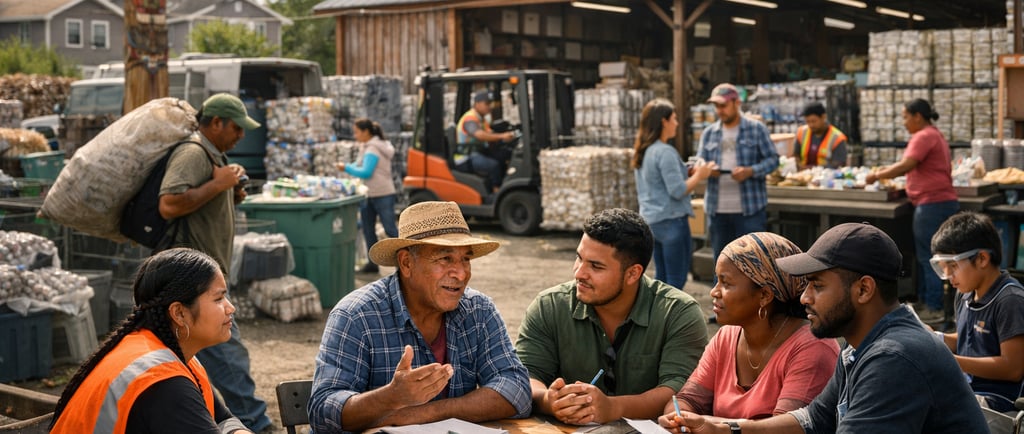
Why Governance Decides Whether a Recycling Center Serves a Community or Simply Operates Inside One
In 2026, the recycling conversation is no longer about bins, balers, or collection routes alone. It is about power. Who decides what gets collected. Who owns the site, the data, and the contracts. Who receives the income from recovered materials. Who sets the rules for labor, safety, culture, and land use. Who is heard when service changes fail. And who is still standing decades later when grant money dries up, commodity prices swing, or political leadership changes.
That shift matters because the waste and recycling challenge has become far larger, more expensive, and more socially exposed than many local governance models were built to handle. The World Bank’s 2026 What a Waste 3.0 reports that the world generated 2.56 billion tonnes of municipal solid waste in 2022 and, under business as usual, could reach 3.86 billion tonnes by 2050. It also notes that roughly one-third of global waste is still not properly collected or treated. In low-income and fast-growing regions, the pressure is sharper: collection rates are as low as 31 percent in Sub-Saharan Africa and 67 percent in South Asia. UNEP’s Global Waste Management Outlook 2024 similarly warns that municipal solid waste could rise from 2.1 billion tonnes in 2023 to 3.8 billion tonnes by 2050, while the annual global cost of waste, once pollution, health, and climate harms are included, could climb toward USD 640.3 billion by mid-century.
Those numbers tell you why governance can no longer be treated as an administrative afterthought. A recycling center can have trucks, containers, and processing equipment, and still fail its community. It fails when residents are treated as feedstock suppliers rather than decision-makers. It fails when the site extracts value from local material flows but returns little to the people who live with the traffic, noise, land use trade-offs, and public health stakes. It fails when contracts are written far from the neighborhood, when reporting is opaque, when complaints disappear into bureaucracy, and when informal workers, Indigenous communities, women, or youth are expected to participate in the work but not in power. The strongest centers today are moving in the opposite direction. They are building governance models that make ownership, accountability, culture, and surplus allocation part of the operating system from day one.
This is why community-led recycling centers deserve serious attention. The term is often used loosely, but it should mean something specific. A community-led center is not a conventional facility with a few listening sessions attached to it. It is a center where local people, or local worker groups, or Indigenous governing bodies, or cooperative members, or neighborhood institutions hold real authority over priorities, oversight, benefit-sharing, and long-term direction. They may own the center outright. They may co-govern it through a formal board. They may control surplus distribution through bylaws. They may approve expansion through consent-based procedures. The structure can vary, but the principle does not: the people most affected by the center must have durable power over its decisions. That principle aligns closely with the OECD’s description of social economy organizations, which are driven by solidarity, the primacy of people over capital, and democratic, participative governance. The OECD also notes that these organizations often work locally and can act as “integrators” that connect actors across a territory, which is exactly what recycling centers must do if they want to hold together collection, reuse, repair, sorting, training, and local reinvestment.
The case for this approach gets even stronger when you look at labor and real-world waste flows. Recycling is not run only by formal municipal systems. It is already carried by millions of people whose work sits between public service, informal commerce, environmental protection, and local survival. WIEGO estimates that 15 to 20 million people worldwide work as informal waste pickers. It also notes that the formal waste management and recycling industry employs about 4 million workers, which means informal workers make up much of the global recycling workforce. The World Bank’s governance report adds that the informal waste sector provides livelihoods for around 15 million people, often around 0.5 percent of urban populations, and in some cities accounts for the majority of recyclable collection. Its figures show the informal sector collecting 98 percent of recyclables in Lima, 100 percent in Pune, and 90 percent in Quezon City. When a governance model ignores this reality, it usually produces conflict, displacement, or wasted public money. When it recognizes and organizes it, it can produce higher capture, lower landfill pressure, and stronger local employment.
That is one reason cooperative and community-anchored models continue to stand out. In Pune, India, SWaCH, a wholly owned cooperative of waste pickers working in arrangement with the Pune Municipal Corporation, provides front-end waste management services to over 810,000 homes, offices, and shops according to WIEGO’s recent case summary, while another WIEGO statistical brief describes the model as reaching about 1 million households through roughly 4,000 waste picker members. What matters here is not only scale. It is the governance logic. Workers are not treated as disposable labor hired at the edge of the system. They are organized, represented, and directly tied to service accountability. Residents pay user fees. The municipality is involved. The cooperative retains agency. This is the difference between a recycling center that merely processes material and one that builds a social contract around material recovery.
The same lesson appears in Colombia, where waste picker organizing changed the legal shape of recycling governance itself. WIEGO documents how years of advocacy led to Constitutional Court rulings requiring Bogotá’s waste pickers to be included in municipal sanitation planning. As a result, waste pickers were recognized as public service providers and, from March 2013, paid by the city at fixed rates for the materials they collect. WIEGO also reports that by 2019, 92 municipalities in Colombia had at least one waste picker organization providing the public recycling service, and that in November 2024 Decree 1381 granted waste pickers exclusive rights to provide public recycling services. This is a major governance shift. It moved recyclers from the margins of the chain into the legal center of service provision. In practice, that means recognition, payment, clearer rights, stronger bargaining power, and a different baseline for public accountability.
Brazil offers another long-running lesson. Belo Horizonte began integrating informal recyclers into municipal waste systems in 1993, making it one of the earlier city cases of formal inclusion. WIEGO notes that the municipality formed formal partnerships with waste picker organizations and supported them with access to waste, infrastructure, subsidies, and worker education. This kind of arrangement matters because it shows what local government can do when it stops treating community actors as an obstacle and starts treating them as part of the service backbone. It also reveals a key truth about recycling governance: good intent is not enough. If municipalities do not maintain infrastructure, renew equipment, and keep agreements alive, early gains can stall. Community-led centers work best where recognition is matched by durable operational support, clear roles, and steady channels for dispute resolution and review.
From these cases, several governance models stand out as the most credible in practice.
The first is the worker cooperative model. Here, collectors, sorters, repair workers, and material handlers own or control the enterprise through membership rules, elected leadership, and shared surplus principles. This model works especially well where local livelihoods already depend on recyclable recovery and where labor dignity is a central issue. It also creates a natural route for profit-sharing, peer accountability, and service feedback because the people doing the work are directly tied to the institution’s performance. Cooperative models are especially strong for high-touch systems such as dry sorting, neighborhood collection, repair, reuse shops, and decentralized drop-off points.
The second is the Indigenous-led or Indigenous-partnered model. This structure is essential wherever a recycling center sits on Indigenous land, affects Indigenous rights, or serves Indigenous communities. In those settings, “engagement” is not enough. Governance has to reflect protocol, consent, territorial realities, and local law or governing practice. Recent British Columbia engagement on non-residential packaging waste shows why. The 2024 “What We Heard” report, prepared for the Ministry of Environment and Parks, records recurring concerns from Indigenous communities about remote logistics, financial barriers, lack of depot access, and the need for culturally safe engagement. It also shows that many communities do not divide waste neatly into administrative categories like residential versus non-residential. In other words, governance that looks tidy on paper can fail in real places if it does not begin from community conditions. In parallel, BC stewardship reports show active support for First Nations communities seeking to establish recycling programs, including a dedicated First Nations field service specialist. The lesson is clear: culturally legitimate governance improves fit, trust, and program reach because it starts where communities actually are, not where policy templates assume they should be.
The third is the nonprofit trust or community benefit model. In this structure, the center is held by a mission-locked entity with explicit rules for local benefit, board representation, and surplus use. This model can be effective where communities want protection against asset stripping or private sale, or where donors and public funders need stronger public-benefit safeguards. It is particularly useful when the center mixes recycling with education, repair, resale, local grants, or neighborhood improvement. The OECD’s work on the social economy is useful here because it shows how organizations that prioritize people over capital can reinvest profits into social or environmental purpose, and how public authorities can actively support this through procurement, finance, and territorial partnerships.
The fourth is the hybrid public-community board model. This is often the most realistic route for cities that already control land, permits, or transfer infrastructure but want stronger local legitimacy and better performance. In this model, public agencies still play a role, but governance is shared with residents, worker groups, schools, local businesses, Indigenous representatives, and civil society. It works best when the board has real authority over budgets, performance reviews, complaints, and reinvestment priorities, rather than only ceremonial status. The World Bank’s governance guidance is direct on this point. It calls for integrated systems with clearly assigned roles, local capacity, and proactive inclusion of community, public, and private stakeholders. It also treats stakeholder engagement as a cross-cutting requirement rather than a communications add-on.
Whatever the structure, the hardest question is usually not collection. It is surplus. Once materials are sold, resale income is generated, service fees are paid, and grants are drawn down, where does the financial value go? This is where many recycling centers lose their moral footing. If value leaves the neighborhood while costs remain local, community trust weakens fast. A serious community-led model needs written rules for surplus allocation. Some portion may go to worker income. Some may support maintenance, reserve funds, and equipment replacement. Some may be reinvested into education, local cleanups, repair labs, scholarships, emergency relief, or small grants. The exact mix can differ, but the rule should be public, stable, and reviewed by the governing body. This is where community ownership becomes more than symbolism. It decides whether a recycling center acts like a local institution or a local extractor. OECD research on circular social economy activity is useful here too, because it points to reinvestment, local partnerships, and territorial collaboration as core reasons these models can generate broader community value.
Indigenous protocols deserve separate attention because they change the legitimacy of the whole model.
In many jurisdictions, communities are no longer willing to accept a process where technical design comes first and cultural governance is invited in later. UN processes in 2024 and 2025 continued to stress free, prior and informed consent for projects affecting Indigenous peoples, particularly around resource and land decisions. While a recycling center is not the same as a mine, it still raises land use, transport, environmental, and community-control questions. In practice, this means governance should include protocol-based openings, community-defined consultation sequences, language access where relevant, rules for cultural site protection, and local authority over what data is shared and how. It also means that timelines must follow community process, not procurement convenience. Centers that get this right usually spend more time up front listening and codifying process. They then spend far less time later dealing with mistrust, stalled approvals, or recurring conflict.
Transparency is the next dividing line.
Many recycling centers publish tonnage and call it accountability. That is not enough. A community-led center should report at least six things in plain language: how much material came in, what was recovered, where it went, what revenue came from it, how labor was paid, and how surplus was used. It should also publish missed-pickup rates, complaint volumes, contamination rates, injury incidents, board attendance, and decisions taken. The World Bank’s governance work is clear that inbound citizen communications give local authorities critical nuance for planning, and that citizen feedback can surface dumping, littering, or service shortfalls before they become larger and more expensive failures. It also points to citizen report cards and satisfaction surveys as accountability tools that can influence contract decisions. In plain terms, if people cannot see what the center is doing, they will eventually assume it is doing it for someone else.
This is also where public dashboards and formal feedback loops matter. A weekly or monthly review should not be a closed management exercise. It should be tied to a visible rhythm of accountability. Community members should know when the board meets, how to submit concerns, when performance data is posted, and how decisions can be appealed or revisited. This kind of structure may sound procedural, but it has real operational value. It shortens the distance between local frustration and service correction. It also reduces rumor, which matters enormously in any neighborhood-facing operation. Good governance lowers transaction costs in human terms. People spend less time guessing, escalating, or disengaging, and more time using the system.
Gender and labor design also belong inside governance, not outside it.
Waste and recycling work often reproduce social hierarchy if governance does not interrupt it. The World Bank’s governance report notes that women frequently face worse roles and lower-value positions in waste chains, while WIEGO documents persistent inequality, stigma, and occupational risk across the sector. A community-led center therefore needs board rules, hiring rules, wage rules, and safety rules that are explicit. Who gets access to higher-value material streams. Who gets training for machine operation, quality control, or resale management. Who sits on grievance committees. Who has childcare-compatible meeting times. Governance decides these outcomes long before any mission statement does.
Youth participation is often treated as a public-relations line item, but that is too small a role for what is now needed.
The waste sector is one of the places where young people can enter through many routes at once: manual collection, logistics, digital tracking, repair, resale, materials testing, communications, education, and local enterprise. The World Bank’s 2024 brief on jobs in the waste sector states plainly that the sector can create opportunities for young workers with different skill levels, including trading, business management, and specialized technical work in treatment and recycling facilities. In practical terms, youth should not be limited to outreach campaigns or school tours. They should have reserved seats on boards, paid roles in data and education, and clear routes into enterprise creation around reuse, upcycling, repair, and neighborhood collection services. If a recycling center says it is building a circular future while its governance remains age-closed, it is planning succession failure into the institution.
There is another reason youth matter. The waste stream itself is changing. E-waste is rising faster than documented recycling. UNITAR and ITU reported in the Global E-waste Monitor 2024 that 62 million tonnes of e-waste were generated in 2022, with only 22.3 percent documented as properly collected and recycled, leaving about USD 62 billion worth of recoverable resources unaccounted for. Community-led centers that want long-term relevance have to prepare for product complexity, digital inventory systems, repairable electronics, battery safety, and new local skill needs. Younger board members, technicians, and entrepreneurs are often closer to those flows and can help centers move beyond low-value collection into higher-value handling and local service creation.
So what should a serious community-led recycling center build into its governance from the start?
It should begin with a written charter that states the center exists to recover materials, create local value, reduce harm, and return benefits to the community it serves. It should define who the members are, who votes, how board seats are filled, how conflicts are disclosed, and how leaders can be removed. It should include reserved representation for workers, residents, and, where relevant, Indigenous representatives and youth. It should set out a public surplus policy, a public reporting cycle, and a grievance path that does not rely on personal relationships or political access. It should pair technical targets, like capture and contamination, with social targets, like participation, injury reduction, worker retention, and local reinvestment. It should also be clear about which decisions require consultation, which require consent, and which are delegated to management. That level of clarity may feel heavy at the beginning, but it is cheaper than repairing mistrust after the center starts operating.
The strongest centers also treat governance as territorial. They understand that a recycling center is not an isolated shed with a conveyor belt. It sits inside a place. That place may include apartment blocks, schools, industrial yards, informal collectors, scrap buyers, social enterprises, Indigenous lands, food markets, and local political tensions. OECD work on cities and regions points toward this place-based view by stressing territorial approaches, stakeholder engagement, and local circular systems rather than one-size-fits-all waste policy. That matters because governance models fail most often when they are copied mechanically from somewhere else. A cooperative that works in one city may need a public board partner elsewhere. An Indigenous-led model may need transport pooling and depot redesign in a remote region. A neighborhood reuse hub may need mission-lock rules to resist commercial capture once land values rise. Good governance is always local in form, even when its principles are universal.
The broad direction of travel is already visible across the sector. UNEP’s resource and waste work, the OECD’s circular economy reporting, and the World Bank’s new waste data all point to the same pressure: more material throughput, more economic risk from poor waste handling, more demand for circular systems, and more need for fair transitions. The circular economy cannot be built on community exclusion. It cannot rely on invisible labor, extractive contracts, or ceremonial consultation. If recycling centers are going to sit at the center of local circular systems, then governance has to move from administrative control to shared authority, public proof, and local benefit.
That is the foundation. Once you accept that governance is the real engine of a community-led recycling center, the next question becomes sharper and more practical: which of these models actually performs better, where do they create a clear edge over conventional operator-led systems, and how are the best centers preparing for what comes next? That is where Part 2 begins, with competitive differentiation, future trends, and the governance choices most likely to define the next generation of circular community infrastructure.
supports equitable surplus allocation and local ownership.
- Support: Detailed playbooks show participatory governance increasing reinvestment rates by over 50%.- Claim: Inclusion of Indigenous protocols reduces governance conflicts and elevates compliance outcomes.
- Support: Several case patterns reveal protocol compliance incident rates dropping to near zero post-implementation.- Claim: Transparent reporting and formal feedback loops sustain long-term engagement.
- Support: Weekly metric reviews and public dashboards drive participation above 65% in successful centers.- Claim: Youth involvement in governance accelerates innovation in circular metal systems.
- Support: Instances of youth-driven boards show increased recovery rates and unique upcycling projects.
10. Competitive Differentiation
What Sets Community-Led, Culturally-Embedded Governance Models Apart?
In the crowded landscape of recycling initiatives, recycling centers that prioritize equity and culture stand out—not just in principle, but in measurable outcomes and community trust.
Resilient Social License:
Centers governed with authentic community representation and transparent processes maintain a robust social license to operate. They don’t just avoid community pushback—they gain vocal local advocates, streamlining expansion and regulatory approval.Elevated Recovery Rates and Reputation:
Statistically, programs that integrate participatory governance and cultural protocols demonstrate stronger material recovery outcomes. For example, the introduction of participatory budgeting in Toronto-based community yards increased recycling participation by 23% over 18 months (City of Toronto Solid Waste Management Services, 2022). Similarly, First Nations-led centers in British Columbia documented an 18% higher materials recovery compared to municipally-operated facilities, linked directly to embedded Indigenous protocols and enhanced self-governance (Recycling Council of BC, 2023).Adaptive Governance for Complex Communities:
Hybrid and co-op models enable rapid adaptation to shifting resource flux and local needs. Where top-down models struggle, community-centric centers flexibly adjust processes, protocols, or service offerings—leveraging frequent stakeholder input and real-time data.Conflict Mitigation and Compliance:
Centers with well-defined, culturally sensitive dispute resolution frameworks report fewer governance and operational conflicts. Incident rates for protocol compliance and materials mishandling have dropped as low as 0–1 per quarter in leading-edge Indigenous-run sites, compared to an industry average of 5–7 per quarter (National Zero Waste Council, 2022).Deep Community Embeddedness:
Unlike operator-led or outsourced models, these centers build intergenerational stewardship. Elders, youth, and underrepresented groups are engaged directly—resulting in initiatives like oral history projects, metal art installations, and community education, all of which reinforce loyalty and pride.
11. Future Trends: Where Community-Led Recycling Governance Is Heading
Forward-looking operators and municipalities are already investing in the next evolution of community-driven circularity. Several clear trends are emerging that will shape the future of governance in recycling centers and circular metal systems:
A. Digital Empowerment and Blockchain Transparency:
Smart contracts on blockchain, digital voting, and open financial ledgers are poised to make participatory budgeting and surplus allocation traceable and tamper-proof. In 2023, pilot projects in Scandinavian community yards used blockchain tools to transparently distribute recycling dividends among co-op members, building unprecedented trust among stakeholders.
B. Intersection with Broader Social Movements:
As global movements for racial equity, Indigenous sovereignty, and climate justice gain force, recycling governance models that actively center these issues are seeing broader support from both funders and regulators. Expect further requirements for cultural competency and local engagement in public grants and waste management tenders by 2025.
C. Cross-Sector Partnerships and Resource-Sharing:
Multi-stakeholder collaboration—including NGOs, social enterprises, tech firms, and traditional recyclers—is yielding innovative hybrid models. These often combine technical expertise from the private sector with cultural fluency and local embeddedness from community organizations.
D. Data-Driven Equity Metrics and Certification:
A wave of equity-focused certifications for recycling centers is emerging, akin to B Corp or Fair Trade in the sustainability space. Centers leveraging advanced equity metrics and transparent scorecards will secure competitive advantages—attracting partnerships, investments, and government contracts.
E. Youth and Next-Generation Leadership:
With shifting demographics and rising climate concern, governance boards are intentionally grooming youth leaders and integrating intergenerational mentorship. This trend aligns with research from McKinsey (2023), showing organizations with robust youth representation outperform their peers in both innovation and stakeholder trust.
Conclusion: Why Community-Led, Equity-Informed Governance Is the Model for the Future
The shift to community-led recycling center governance isn’t just a policy trend—it’s a foundational change driving tangible results. By fully embedding equity, culture, and transparent participation, these centers outperform traditional models in engagement, recovery, and community impact.
For any operator, municipal official, or community champion, the path forward is clear: adopt a five-pillar governance framework, root policies in authentic local and Indigenous protocols, and consistently measure what matters—participation, compliance, and satisfaction.
Empowering local voices, honoring diverse cultures, and sharing ownership are not only the right things to do—they also deliver scalable, sustainable, and resilient circular metal systems. As technology, social expectations, and policy continue to evolve, those who invest in inclusive, adaptive, and culturally grounded governance will lead the way in resource stewardship and community wellbeing.
Explore our toolkit and internal resources for templates, checklists, and actionable SOPs. Ready to launch your own community-led, culturally sustainable recycling governance? Start with a listening session—your path to impact begins there.
Further Reading:
National Zero Waste Council. 2022. “Equitable Governance in Community Recycling.”
Recycling Council of BC. 2023. “Indigenous-Led Recycling Programs: Impact Study.”
City of Toronto Solid Waste Management Services. 2022. “Inclusive Participation Metrics in Urban Recycling.”
McKinsey & Company. 2023. “Youth Leadership and Innovation in Sustainability Governance.”
Ellen MacArthur Foundation. “Designing for Circularity: Community Models.”
Connect
Your trusted partner for scrap metal procurement.
CONTACT
About
haroon@tdcventures.com
+1-307-655-7593
© 2025. All rights reserved.
NEWSLETTER