
Community Repair Clinics: Metals Flow and Education
Discover how community repair clinics drive metals circularity through repair, recycling, and education, reducing waste and boosting local sustainability.
WASTE-TO-RESOURCE & CIRCULAR ECONOMY SOLUTIONS
1. Introduction: Why Metals Matter in the Circular Economy
Metals are at the heart of our everyday lives. They are fundamental to the infrastructure of cities, the efficiency of transport systems, the reliability of information technologies, and the innovation of smarter, more sustainable products. Steel, aluminum, copper, and other metal alloys form the very skeleton of urban economies—embedded in everything from high-rise buildings to home appliances, and from computers to renewable energy grids.
Yet, the way society extracts, uses, and disposes of metals is inherently flawed. Global metal production is projected to reach over 4 billion metric tons annually by 2050 (International Resource Panel, 2023), yet less than 30% of these metals are recycled at the end of their first use. Discarded smartphones and laptops are not just an e-waste problem; they represent an untapped reservoir of valuable metals like gold, silver, copper, and rare earth elements. Mining virgin metals leads to profound environmental impacts—land degradation, water pollution, and skyrocketing carbon emissions. In fact, extracting and refining one ton of primary aluminum emits up to 16.5 tons of CO2, while recycling post-consumer aluminum reduces emissions by over 90% (European Aluminium Association, 2022).
The circular economy champions a bold solution: reimagining the lifecycle of metals by keeping them in use, reintroducing them into the production cycle, and extracting maximum value with minimum waste. Unlike plastics or textiles, most metals retain their quality and structural integrity through repeated use or melting, making them ideal targets for circular interventions. A circular metals flow—where resources loop endlessly between use, reuse, remanufacturing, and recycling—transforms waste into wealth, unlocks job opportunities, and unleashes a wave of local innovation.
Community Repair Clinics are emerging as tactical nodes in this circular revolution, offering immediate, hands-on ways to advance metals recovery and literacy at the neighborhood level. They break down the barriers of linear consumption, foster the circular mindset, and empower communities with the practical skills and knowledge to extend the lifecycle of metal products.
Why Now?
Global urgency: The United Nations’ Sustainable Development Goals highlight responsible consumption and production (Goal 12), emphasizing the need to decouple economic growth from environmental impact.
Economic opportunity: The Ellen MacArthur Foundation estimates that transitioning to a circular economy could generate $4.5 trillion in economic benefits by 2030—with metals representing a major share.
Environmental imperative: If current trends persist, electronic waste (the fastest-growing waste stream, rich in recoverable metals) could exceed 74 million metric tons/year by 2030.
By shifting the paradigm from "take-make-waste" to "repair-remanufacture-reuse," metal-focused repair initiatives help rewrite the narrative of local and global sustainability.
2. Community Repair Clinics: The Blueprint
Community Repair Clinics Defined
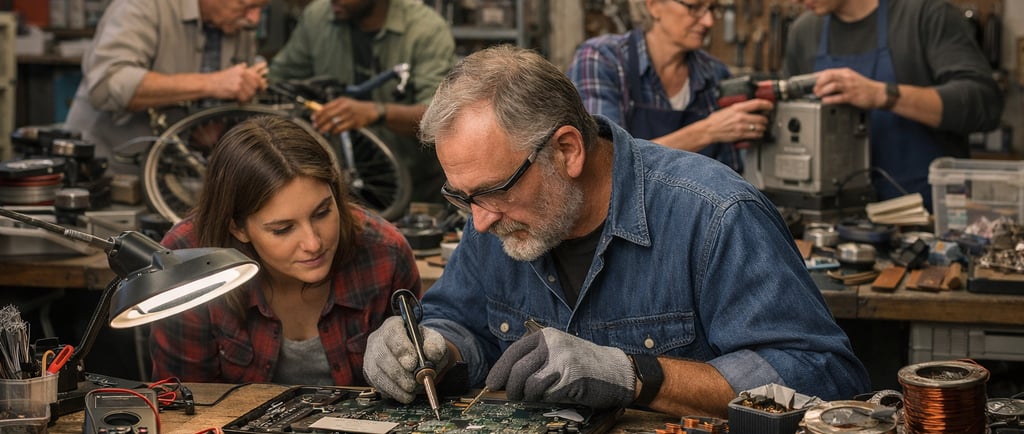
Community Repair Clinics are grassroots hubs where sustainability, social entrepreneurship, and technical problem-solving merge. These volunteer-powered organizations foster collaboration among residents, engineers, hobbyists, and local businesses. While their core mission is simple—fix, don’t throw away—their broader aim is to mainstream circular design thinking and redefine people’s relationship with manufactured goods, particularly metal-intensive products.
Core Structural Elements
Physical Space: Clinics typically operate out of community centers, libraries, makerspaces, or schools—creating a welcoming, accessible environment.
Human Capital: The lifeblood of clinics is their intergenerational teams of technicians, retirees, students, and tinkerers, bringing together diverse repair experience across multiple domains: metalwork, electronics, mechanics.
Equipment Ecosystem: From basic hand tools to advanced welding gear, clinics build out tool libraries that support the diagnosis, disassembly, and repair of metal-rich devices.
Process Protocols: Standardized workflows for intake, troubleshooting, repair, and documentation ensure quality control and data-driven optimization.
Critical Functions and Expanded Impact
1. Diagnosis and Repair
Volunteers provide no- or low-cost troubleshooting and repair—for everything from rusted bikes to malfunctioning washing machines. By extending product life, clinics reduce demand for new metals extraction while simultaneously keeping hazardous e-waste out of landfills and local environments. According to the Global E-Waste Monitor (2022), repairing just 10% of discarded electronics could divert over 5 million metric tons of e-scrap annually for reuse—a clear signal of how high-leverage this touchpoint is for metals flow.
2. Parts Harvesting and Materials Recirculation
When repair isn't feasible, clinics excel at salvage. This involves carefully removing reusable components—like aluminum frames, copper wire, steel fasteners—and cataloguing them for secondary use. These reclaimed materials fuel a local circular loop and feed into a “materials bank” model, where community members draw on previously harvested parts to facilitate further repairs or even creative upcycling projects. Such localized harvesting reduces the carbon footprint associated with global metals transport and aligns with ISO 14001-certified environmental management practices in resource stewardship.
3. Skills Training and Workforce Development
Clinics design and host comprehensive training workshops—teaching hands-on skills in ferrous and non-ferrous metal repair, soldering, circuit diagnostics, and proper tool safety. This pipeline directly contributes to workforce upskilling, addressing chronic shortages of technical labor in repair sectors and fostering a generation of “circular economy champions.” For instance, the Restart Project’s skills bootcamps have enabled over 10,000 learners to gain accreditation in circular repair competencies since 2015.
4. Cultivating a Culture of Careful Consumption
Through regular events, storytelling, and open-door sessions, clinics:
Challenge planned obsolescence by advocating for right-to-repair legislation
Encourage citizens to opt for repair over replacement
Spotlight stories of successful fixes and community innovation
5. Advocacy and Circular Policy Influence
Repair clinics often serve as regional thought leaders, providing data and recommendations to municipalities, influencing the adoption of extended producer responsibility (EPR) policies, incentivizing repair-friendly product design, and pushing for greater transparency in metals supply chains.
The Metals Advantage: Why Prioritize Metal-Based Goods?
Focusing on metals delivers unique leverage. Metals have standardized grading systems, traceable lifecycles, and resilient value even after multiple recycling loops. Products like bikes, hand tools, electronics, and small home appliances enjoy high local demand and high repairability. Additionally, the recovery and reuse of metals support broader decarbonization goals:
Every ton of steel reused avoids using 1.5 tons of iron ore, saving up to 70% of the energy required for primary production.
For copper, secondary production (recycling) requires just 15% of the energy needed for mining virgin ore.
By 2050, recycled metals could meet over 45% of global demand (International Energy Agency, 2023).
Leveraging community repair clinics for these products, therefore, not only conserves natural resources but also accelerates the shift toward clean energy and electrification initiatives.
PART 3. Tools and technologies that make a community repair clinic run like real circular infrastructure
A community repair clinic works when it turns goodwill into repeatable outcomes. That means fast intake, clear triage, safe disassembly, and simple measurement. Without those, you get long queues, scattered parts, inconsistent fixes, and very little metals recovery you can prove.
Start with the reality of what is coming through your door. E-waste hit 62 million tonnes in 2022, and documented formal collection and recycling was 22.3%. The same reporting tracks e-waste rising to 82 million tonnes by 2030. That trend alone explains why repair clinics are shifting from “nice community events” into local capacity that cities and schools can depend on. ITU E-Waste Monitor
Intake and triage systems that increase throughput
The biggest early mistake is treating intake as casual. You need a short, consistent process that any volunteer can run. Use a QR code check-in on a phone, a short form, and a visible ticket number. Capture five fields only: item type, brand, age or approximate year, symptom, and whether the owner consents to parts harvesting if it cannot be repaired. Keep intake under two minutes, or your technicians spend the day doing admin.
Add a triage score so items go to the right bench quickly. You can do this with three labels: quick fix, medium, and complex. Most clinics improve results just by separating “likely under 20 minutes” from “needs deep fault-finding.” That one change increases repaired items per event and reduces accidental damage caused by rushed work.
Digital logging that creates repair memory
Repair clinics learn fast when they log every attempt, not just the wins. The Open Repair Alliance shows what happens when groups record repairs in a shared way. In the 12 months from August 2024 to July 2025, it reports 131,790 repair attempts logged by 968 groups at 9,123 events across 22 countries. That scale matters because it turns scattered local experience into patterns you can act on. Open Repair Alliance
If you want your clinic to feel “industry-grade” without buying expensive software, build a basic stack:
A simple intake form, tied to a spreadsheet or lightweight database.
Photo capture for “before,” “during,” and “after,” mainly for reassembly and part identification.
A failure mode list you keep consistent, so your data stays usable.
A closing note that records what you replaced, what you tightened, and what you could not access.
Diagnostics tools that match modern metal-rich products
Many metal-heavy goods fail at the border between mechanical wear and electronics. A washing machine is bearings, seals, and a control board. A power tool is brushes, gears, and a speed controller. A laptop is hinges, thermal paste, and a power rail fault. That is why a clinic needs two core benches from day one: an electrical bench and a mechanical bench.
On the electrical side, a multimeter is not enough. Add a bench power supply for controlled testing, a clamp meter for motors and power draw, and a basic inspection microscope for ports and solder joints. On the mechanical side, add thread repair kits, a tap and die set, bearing pullers, and precision drivers that stop you from stripping fasteners. These are low-cost tools that prevent high-cost outcomes, like cracked housings and ruined threads that turn a repairable item into scrap.
Disassembly and parts harvesting, designed for metal value
Metals recovery rises when disassembly is orderly. The goal is not “tear it apart,” it is “separate clean streams and keep reusable parts intact.”
Set up teardown with three rules.
First, parts never go into a single mixed bin, because mixed metals lose value and create downstream sorting cost.
Second, fasteners and small metal parts stay in labeled trays, because losing one screw can kill the entire reassembly.
Third, any board, motor, or cable harness you remove gets a quick test label: known good, unknown, or failed. Unknown parts are not “inventory,” they are clutter.
This is where the “materials bank” becomes real. A parts bank works when it is narrow and demand-led. Stock parts you see every month, not rare one-offs. For many clinics, the top movers are simple: power cords, switches, hinges, common fasteners, laptop chargers, fans, belts, and standard bearings. When you keep the bank tight, you increase repair success and reduce the share of items that end up shredded.
Safety tech that protects people and keeps the clinic running
Repair means risk, especially with lithium-ion batteries and mains voltage. Treat safety as a system, not a speech.
Build a small safety station that includes fire-safe battery storage, basic PPE, and isolation bins for damaged packs and swollen cells. Train volunteers on a single rule: if a battery looks damaged or swollen, it does not go back into service at the event. It gets isolated and routed to a safe end point.
Measurement tools that unlock funding and policy impact
Cities fund what they can measure. Schools teach what they can show. Clinics that track outcomes become repeatable programs.
Start with three metrics you can collect without slowing anyone down: repair attempts, repaired items, and estimated diversion weight by category. Once that is stable, add “barriers to repair” as a coded list. Missing parts, locked software, glued construction, unavailable documentation, and time limits are not just frustrations. They are evidence. They guide right-to-repair advocacy and they guide how you train mentors.
PART 4. Innovative models that scale repair, and improve metals flow
Most clinics stall when they rely on donations alone. The strongest clinics blend community energy with incentives, partners, and public systems that already move money.
Repair incentives that turn intent into volume
Repair voucher programs create a direct pull for repair. Austria’s “Reparaturbonus” is a useful example because it is simple and consumer-friendly. Public sources describe vouchers that cover 50% of repair costs, with a maximum subsidy per repair case of up to 200 euros. The European Commission also describes “repair bonus” funding for households in voucher form that covers 50% of the costs for repairing or renewing electric and electronic equipment. European Commission
France’s repair bonus is another example of a national program that pushes demand toward repair. Official public guidance notes increases in the bonus amounts from January 1, 2024, including higher support for several device categories. This matters for clinics because it creates a referral ecosystem. Complex jobs can move from your volunteer bench to professional repair, without the owner giving up due to cost. Service Public
Refurb and resale loops that extend metal life, not just delay disposal
A repair clinic becomes a stronger metals-flow node when it adds a structured refurb pathway. The logic is simple. Every extra year of use delays replacement, which delays new metal production, and avoids emissions tied to manufacturing.
European Commission messaging on green digital policy states that extending the lifetime of all smartphones by one year would save 2.1 Mt CO2 per year by 2030. That is a clean, practical reason to build refurb capacity, especially for laptops and phones that fail for simple reasons like ports, batteries, and thermal issues. Digital Strategy
Corporate and municipal “mentor capacity” sponsorship
Mentors are the bottleneck. One mentor can guide several helpers, but without mentors, repair rates drop and damage rises. A practical model is sponsorship that pays for mentor hours, tools, and consumables, in exchange for public reporting and community training. This is workforce development in plain sight. It also addresses a real labor issue. The International Labour Organization highlights the scale of e-waste and points to the need for safer, more formal systems that can shift activity away from harmful informal handling. International Labour Organization
PART 5. Education impacts, why repair clinics teach metals literacy better than any poster campaign
Repair teaches what most people never see: the material reality inside products. In one session, someone can learn the difference between steel and aluminium fasteners, why copper wiring has value, and how corrosion and mixed alloys create failure. That is metals literacy, learned through touch, not theory.
It also teaches supply and climate facts that stick. Aluminium is a sharp example because the energy gap between primary and recycled production is massive. The International Aluminium Institute cites a comparison where recycled aluminium’s primary energy demand is far lower than primary production, with energy savings of about 95.5% in the cited figures. This helps people understand why keeping metal in circulation is not a niche idea, it is industrial logic. International Aluminium Institute
Education becomes even more relevant as policy shifts toward repair. The European Commission states that the EU directive on common rules promoting the repair of goods entered into force on July 30, 2024, and member states must apply it from July 31, 2026. Clinics can become the local “how-to” layer that turns new rights into real behavior. European Commission
PART 6. Case studies that show what “scale” looks like
Open Repair Alliance, growth through shared logging
The Open Repair Alliance numbers matter because they show repair can be counted across thousands of events. The August 2024 to July 2025 period shows 131,790 repair attempts logged across 9,123 events, run by 968 groups, in 22 countries. If you want your clinic to become a reference resource, align your logging fields early so your data can compare to global trends. Open Repair Alliance
National repair incentives, a demand shock you can ride
Austria and France show a path where repair becomes cheaper for households. When repair becomes cheaper, more people show up with items they would have replaced. Clinics that prepare for this shift tend to do well because they can triage, educate, and refer overflow to local repair businesses. European Commission
PART 7. Practical launch steps you can follow, from idea to a working monthly clinic
Start with a tight scope, then expand. Pick categories that combine high repairability with strong metals value. Small appliances, bikes, laptops, and corded power tools usually work well. Avoid high-risk categories early, especially anything involving gas systems or unknown high-voltage risk.
Choose a venue that supports safe work. You need good lighting, ventilation, stable tables, and enough power circuits to avoid overload. Set up three work zones so the day does not turn into chaos: intake and triage, repair benches, and teardown and parts sorting.
Recruit mentors first. You can scale helpers later. Build a mentor list from retired tradespeople, local repair shops, makerspaces, and technical colleges. Offer clear boundaries so mentors feel safe giving time.
Run a pilot with fixed rules. Keep the event short, keep intake strict, cap time per item, and document outcomes. After three events, use your logs to decide what to add next. If you see repeat failures on ports and batteries, build a focused micro-soldering and battery replacement bench. If you see bikes dominating, add bearing tools and rust removal capability. If you see appliances dominating, partner with a professional for safety-critical checks.
Close the loop with end points. Set up two partners early: a safe battery and hazardous waste route, and a recycler that accepts sorted metal streams. The goal is clean fractions, because clean fractions keep value and reduce downstream loss.
PART 8. Advanced FAQs, the questions that decide whether your clinic lasts
How do you manage liability on electrical repairs?
Use owner-participation as the default. Document what you did and what you did not test. Refuse repairs where safety cannot be verified. Route those cases to certified professionals. Keep your scope clear and written.
What do you do with lithium-ion batteries?
If a pack is swollen, damaged, or unknown, isolate it. Do not reinstall it. Store it in a fire-safe container and move it through a certified collection route.
How do you stop a parts bank from turning into junk?
Only stock parts that match the top items you see repeatedly. Add a time limit for storage, then move slow-moving parts to recycling. Label parts as tested, untested, or failed.
How do you handle software locks and paired parts?
Do not attempt illegal bypasses. Log it as a barrier to repair. Use aggregated barrier data to support right-to-repair efforts and to guide what products you recommend in community education.
How do you prove impact beyond “feel-good repairs”?
Track repair attempts, repair success rate, and estimated diversion weight. Track the top five barriers. Publish a simple monthly summary. Tie your story to credible system numbers, like the Global E-waste Monitor’s 62 million tonnes in 2022 and the 82 million tonnes projected by 2030. ITU E-Waste Monitor
Actionable conclusion, how you make your clinic a reference resource people return to
A strong community repair clinic is a local operating system for circular metals. It keeps metal-rich products in use longer, routes dead items into cleaner recovery streams, and teaches people how materials really behave.
If you want the fastest path to a clinic that grows, do five things. Run monthly, not occasionally. Log every attempt, including failures. Build mentor capacity before you chase scale. Keep your parts bank narrow and useful. Publish your results so funders and partners can see progress. Then, as the EU repair rules approach their July 31, 2026 application date, position your clinic as the practical support layer that helps households and cities turn “right to repair” into repair that actually happens. European Commission
Connect
Your trusted partner for scrap metal procurement.
CONTACT
About
haroon@tdcventures.com
+1-307-655-7593
© 2025. All rights reserved.
NEWSLETTER