
Computer Vision at Drop-Off Points: Auto-Sort Assist
Computer vision at drop-off points enables auto-sort assist to cut contamination, boost recovery, and give users real-time sorting guidance. See metrics, case studies, and a full implementation playbook.
AI & DIGITAL ENGAGEMENT IN SUSTAINABILITY
Context: Why Computer Vision at Drop-Off Points Matters
The evolution of recycling hinges on combining smart automation and proactive digital engagement. As communities intensify focus on sustainability and circular economy practices, the need for smarter collection points is undeniable. At the heart of this transformation is the integration of computer vision (CV) at recycling drop-off locations—a critical technological leap, as stakeholders push to meet environmental targets and optimize waste recovery.
The Legacy Challenge: Plateaued Manual Systems
For decades, drop-off recycling relied heavily on manual processes—educational signs, routine staff oversight, occasional audits, and self-reported compliance. Yet, the reality is sobering: the U.S. Environmental Protection Agency (EPA) estimates recycling contamination rates hover between 15% and 30% at many collection points, with urban areas often reporting even higher figures. This inefficiency ripples throughout the waste stream, increasing operational burden downstream at Material Recovery Facilities (MRFs) and causing missed opportunities for resource recovery.
Digital First, Data-Driven Engagement Expectations
Meanwhile, public expectations have shifted. According to a recent Pew Research survey, more than 65% of adults expect digital tools to be part of their municipal services, including recycling. Residents increasingly want real-time transparency: what happens to their recycling? What is their environmental impact? Digital lag at drop-off points, combined with persistent sorting ambiguity, leads to disengagement, skepticism, and reduced circular action.
The Shift to Computer Vision-Powered Drop-Offs
Computer vision, already mainstream in sectors like retail, healthcare, and smart city infrastructure, is being rapidly adopted in the environmental services domain. Industry projections—from MarketsandMarkets and Waste360, for example—anticipate a 22% compound annual growth rate (CAGR) for AI-powered waste management solutions between 2023 and 2028. This growth is catalyzed by increasing landfill diversion mandates, data-driven grant funding, and the economic penalty of contamination.
Computer vision at drop-off points drives step-change improvements in:
High-accuracy material recognition: Modern CV models, trained on thousands of waste images, outperform humans at real-time item classification.
Digital feedback loops: Integrated apps and on-site technology provide instant, actionable cues to users, creating a seamless, “gamified” recycling journey.
Operational data dashboards: Automated analytics go far beyond clipboard tracking, supporting smarter resource allocation and program optimization.
Why Now? Funding, Policy, and Technology Converge
Global regulations are tightening. The EU Single-Use Plastics Directive and various U.S. states’ extended producer responsibility (EPR) laws are pushing public and private waste operators to demonstrate measurable contamination reduction and citizen engagement.
At the same time, hardware costs for edge AI cameras have dropped by over 50% in the past five years, making it feasible even for mid-sized municipalities to deploy pilot projects. More critically, advances in cloud-based computer vision APIs and mobile app integration lower the technical barriers for customized, scalable solutions.
Bottom line: computer vision drops the friction in recycling, and replaces legacy intuition with high-frequency, high-funnel data. This is fast becoming a core infrastructure investment, not an experimental add-on.
2. The Problem: Inconsistent Sorting, Fragmented Engagement
Despite increasing global awareness around sustainability and recycling, real-world participation and sorting accuracy at civic drop-off points remains stubbornly erratic—posing mounting challenges for municipal operators and MRF managers alike.
Inconsistent Sorting: A Universal Headache
Sorting errors at drop-off bins are rampant—and expensive. Industry data from The Recycling Partnership shows that up to 25% of materials sent to curbside or depot programs are ultimately discarded as trash due to contamination. “Wish-cycling” (placing items in bins in the hope they are recyclable) compounds this, creating frequent disruptions in processing lines and raising overall costs.
Human Error & Confusion: The patchwork of local rules—differing standards for plastics, mixed containers, compostables—confuses even well-intentioned users. A North American survey found that 61% of residents were unsure about at least one major category of recyclables at their local facility.
Low App Utility: Even where recycling apps exist, they often function as little more than static directories, failing to incentivize or correct real-time mistakes or record meaningful action.
Hidden Costs: Manual Checks + Operational Drag
Manual spot-checking is labor-intensive, adding up to 20% to facility payroll in some urban depots (source: SWANA). This approach becomes unsustainable at high-traffic drop-offs—and creates bottlenecks during peak usage times. Furthermore, interventions after errors occur are reactionary, not preventative.
Cost Implications in Numbers:
- Contaminated loads trigger “truckload rejections”—one rejected 10-ton load can cost up to $1,000 in lost value, disposal, and penalties.
- Municipalities face regulatory fines or grant clawbacks if annual contamination rates fail to decline.
- Processing contaminated recyclables through MRFs increases equipment wear, uplifts utility demands, and reduces material resale value.
Fragmented Digital Engagement: Gaps in the Loop
Modern consumer expectations are set by platforms that provide immediate feedback and personalized journeys (think: fitness apps, online banking, ride-sharing). Recycling is typically a black box—users see few results, get little reinforcement, and worry their effort is wasted.
These gaps persist because:
- Digital feedback isn’t tied to actual actions: Without sensors or cameras, most apps can’t “see” if a user sorted correctly.
- No reinforcement for positive behavior: Genuine citizen engagement is hard to sustain without rewards or recognition.
- Data is siloed: Feedback to operators is usually in the form of anonymized, lagging indicators, not actionable, real-time insights.
Measuring Behavior Change Remains Elusive
Surveys claim broad environmental intent, but translating intent into measurable, repeated circular action is rare. Few operators can link specific interventions or campaigns to concrete drops in contamination or rises in accurate sorting—hindering continuous improvement or the justification for further investment.
Taken together, these failures show that the central issue is not public intent alone. The deeper problem is that most drop-off systems still lack the real-time intelligence needed to guide behavior before contamination occurs. Legacy signage, delayed audits, and fragmented apps all operate after the fact. They document mistakes, but they do not prevent them. That is where computer vision-enabled auto-sort assist changes the model. It turns the drop-off point from a passive collection site into an active decision environment, one capable of recognizing materials, guiding users in the moment, and generating the operational data needed to improve the system over time. To understand why this matters, the next section looks at the operating model behind auto-sort assist and how it works at the edge.
3. The Operating Model: How Auto-Sort Assist Works at the Drop-Off Edge
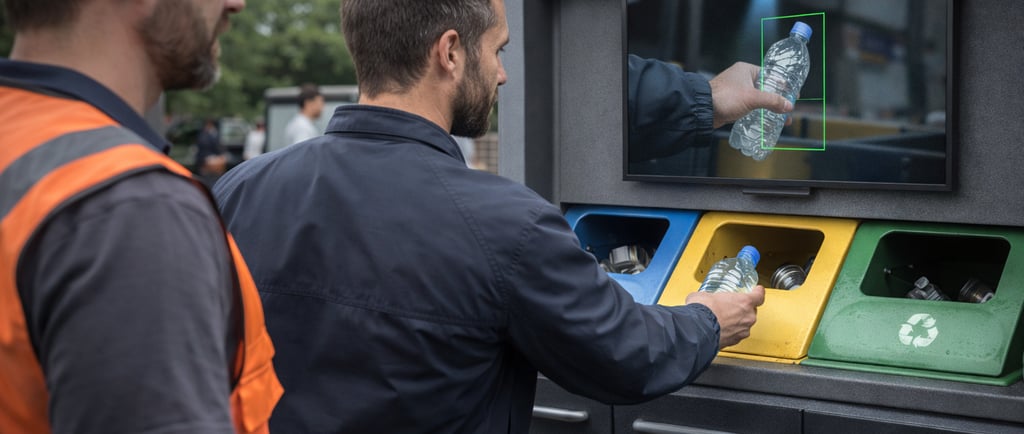
Computer vision at drop-off points works best when it is treated as a live decision layer, not as a passive camera feed. The core job is simple: identify what a person is holding or depositing, compare it against local acceptance rules, and return a clear instruction before contamination spreads downstream. That instruction can appear on a kiosk screen, a mobile interface, a smart bin display, an audio prompt, or a staff dashboard. The value is not just recognition. The value is timing. A sorting correction delivered before the item lands in the wrong stream is far more valuable than a contamination report delivered days later. That logic lines up with the EPA’s current recycling strategy, which puts contamination reduction and better collection infrastructure at the center of progress toward the U.S. goal of a 50% recycling rate by 2030.
In practice, a strong auto-sort assist system has five layers. First, it captures images or short video at the point of disposal. Second, a trained model classifies the object by material, format, and sometimes even pack type. Third, a rules engine checks whether that item belongs in this exact program, at this exact site. Fourth, the system returns an instruction such as “accepted here,” “empty before recycling,” “take to film collection,” or “trash only.” Fifth, it logs the event so operators can see what users are getting wrong, at what times, and at which stations. That final layer matters because it turns every interaction into a measurable signal. Recycleye, for example, reports that its vision layer can identify 28 material classes in real time, including distinctions such as food-grade and non-food-grade plastics, which shows how classification has moved well beyond broad “plastic vs. paper” recognition.
This operating model is especially important because contamination remains stubbornly high. The Recycling Partnership’s national curbside work put average inbound contamination at 17% by weight, and it also found lower contamination in programs that combined inspection and direct feedback methods. That does not mean depot systems behave exactly like curbside programs, but it does show the same principle: specific correction at the point of behavior reduces error more effectively than generic education alone. Computer vision is the logical next step because it can deliver that correction continuously, without waiting for a manual tag, audit, or resident complaint.
The most effective deployments also separate recognition from enforcement. In other words, the camera should first help the user succeed. It should not begin as a punishment device. If people see the system as a way to get the answer right in two seconds, participation rises. If they see it as surveillance, trust drops. This is especially important in public-facing municipal settings where the recycling system already suffers from skepticism. The OECD’s plastics work shows why this trust gap matters. Global plastic waste reached 353 million tonnes in 2019, while only 9% was ultimately recycled after losses in the system. When so much material still leaks out of the circular chain, every avoided sorting error at the front end becomes more important, not less.
A drop-off point with auto-sort assist should also be designed as part of a larger information loop. The user sees a prompt. The operator sees recurring errors. The municipality sees site-level trends. Producers and compliance teams, where laws allow, can see packaging-specific failure patterns. Greyparrot’s 2024 field data, drawn from 55 facilities across 20 countries and 40 billion detected waste objects, shows the scale this kind of intelligence can reach when visual recognition is tied to operational reporting. That matters because better recognition is only half the story. The other half is learning which materials are repeatedly missed, which formats create confusion, and where the economics of better recovery justify further investment.
This is where auto-sort assist becomes more than a sorting tool. It becomes a front-end quality control layer for the whole recycling chain. If a site repeatedly detects film, food residue, black plastic, or multi-material packaging in the wrong stream, operators can respond with tighter signage, better layout, revised accepted-material rules, or targeted public messaging. That approach is far stronger than annual education campaigns because it is based on live observed behavior. The result is a drop-off point that gets smarter over time instead of repeating the same mistakes.
4. Best Practices: What High-Performing Computer Vision Drop-Off Programs Do Differently
The first best practice is narrow-scope deployment. Many failed pilots try to identify too many categories too early. The smarter path is to begin with the materials that create the most cost, the most confusion, or the most resale loss. In many programs, that means PET bottles, HDPE containers, aluminum cans, glass, fiber, film contamination, food-soiled packaging, bagged recyclables, and bagged recyclables. The reason is commercial as much as technical. The IEA Bioenergy review of advanced sorting technologies makes clear that high-value and highly recoverable streams benefit most from strong identification and separation logic, while automated plants such as Sweden’s Site Zero and AMP ONE show how better sorting quality supports higher-value end markets and better overall recovery.
The second best practice is local rule tuning. A vision model may correctly identify an item as polypropylene or thermoform PET, but that is not enough. The system must also know whether that item is accepted in this municipality, at this depot, on this date. That sounds obvious, but it is where many public recycling tools break down. Generic recycling advice creates generic mistakes. The European Commission’s packaging framework reflects this pressure for clearer, more measurable packaging management, with the Packaging and Packaging Waste Regulation entering into force in February 2025 and generally applying from August 2026. As rules tighten, local programs need decision systems that can handle packaging complexity without forcing users to interpret policy language on a signboard.
The third best practice is multimodal guidance. A screen alone is rarely enough. High-traffic drop-off points need visual prompts, short text, icon-based instructions, and where appropriate, audio cues. This matters for multilingual settings, older users, low-light conditions, and quick transactions from drivers who do not want to stop and read a paragraph. The goal is to cut decision time. Two seconds is a good target. If the user has to study the interface, the system has already lost. The best public interfaces reduce choice, state the action clearly, and place the message at the exact moment of disposal. That principle also aligns with what anti-contamination work has shown more broadly: direct, specific correction works better than broad reminders.
The fourth best practice is human fallback. Computer vision should reduce staff burden, not pretend staff are no longer needed. A strong site gives attendants a simple override view, quick issue flags, and a way to mark “unknown item,” “misclassification,” or “rule exception.” These corrections create the training data that improves the system. They also help protect trust when the model is uncertain. This is especially important in public sites that receive damaged items, dirty items, unusual packaging, or locally common products that were underrepresented in the original training set. A model with no operational feedback path becomes stale quickly. A model with staff correction gets better with use.
The fifth best practice is layout before AI. Many operators rush into cameras while ignoring site design. But physical layout often decides whether the vision layer can succeed. Bins should be clearly separated, lighting should be stable, sightlines should be clean, and the point where the item is presented to the camera should be controlled. If people can toss from odd angles, hide items in bags, or dump mixed loads at speed, recognition quality falls. Good design limits ambiguity before software even begins. That is one reason advanced facilities combine mechanical separation, optical tools, and AI instead of relying on a single layer. The IEA Bioenergy review highlights this combination approach in leading plants, where multiple technologies work together to raise quality and recovery.
The sixth best practice is measure what matters. The wrong metric is “number of scans.” The right metrics are contamination rate by stream, correct-sort rate, repeat error categories, recovery uplift, avoided disposal cost, and time-to-decision per user. In mature programs, operators should also track whether repeated CV prompts reduce the frequency of the same mistake over time. That is how a municipality proves that the tool changes behavior rather than simply recording failure. It also helps justify new funding, especially as public agencies face pressure to show measurable progress on contamination and infrastructure. EPA’s recycling strategy is explicit that stronger collection systems and contamination reduction are central system goals, not optional extras.
The seventh best practice is privacy by design. Public-facing computer vision systems should process only what they need, store only what is necessary, and disclose clearly what is being captured. In most drop-off use cases, the priority is the item, not the person. Edge processing, short retention windows, anonymized event logging, and visible public notices help keep the program credible. This matters because recycling is a civic behavior. If residents think the site is monitoring identities rather than materials, adoption can stall even if the model performs well. Strong governance is therefore part of technical performance, not separate from it.
5. Case Studies, Business Proof, and the Future Direction of Auto-Sort Assist
The strongest proof for computer vision in waste systems comes from facilities that tied image recognition to operational decisions and then measured the result. EverestLabs describes a major North American commingled facility processing roughly 1,300 tons per day that used AI on its last-chance line and found that almost 200 tons of valuable material per month were being lost to landfill. After changes informed by the visual data and the addition of robotics, the site identified the potential to recover more than $400,000 of plastics annually, reached payback in three months, and reported 99% uptime. This is a downstream MRF example rather than a public drop-off kiosk, but the lesson is directly relevant: visual intelligence creates financial value when it identifies loss early enough for operators to act.
AMP’s public case material points to the same commercial pattern. Partners reported lower labor costs, higher recovery, more capacity, lower disposal costs, and new income streams after deploying AI-guided sortation systems. The IEA Bioenergy review also highlights AMP ONE outside Cleveland as a showcase for fully automated AI-powered sorting designed to increase recycling rates and recover recyclables economically. Together, those examples matter because they show that computer vision is no longer a fringe experiment. It is moving into core materials infrastructure where performance is judged in throughput, recovery, labor pressure, and revenue, not in demo accuracy alone.
Greyparrot’s field footprint adds another signal about scale and maturity. Its 2024 reporting says Analyzer units detected 40 billion waste objects across 55 facilities in 20 countries in a single year. It also found that PET bottles remained heavily represented in sorting lines while several difficult plastics still showed up strongly in residue, which points to a clear gap between what systems recognize as recyclable and what they actually capture. For drop-off point design, that gap is critical. It means front-end assist should not only focus on obvious items. It should also target the borderline formats that users routinely misplace and facilities routinely lose. That is where the next recovery gains are likely to sit.
There is also a policy reason this front-end layer will matter more from 2026 onward. In the United States, the EPA’s 50% recycling goal remains in place, and contamination reduction is named as a strategic objective. In Europe, the PPWR entered into force in 2025 and generally applies from August 2026, raising pressure around packaging design, recoverability, and waste management performance. When policymakers, municipalities, and producers all need better proof of what is collected, rejected, and mis-sorted, computer vision at drop-off points becomes a practical evidence tool. It helps answer basic but costly questions: Which packaging formats still confuse people? Which sites underperform? Which messages work? Which materials need redesign or separate collection?
The future direction is clear. First, auto-sort assist will move from broad material classes to object-level packaging recognition. That means the system will not just say “plastic tub.” It will increasingly distinguish food tray, thermoform clamshell, flexible pouch, black takeaway tray, coffee cup lid, and refill pack. Second, model logic will become more local. A bin in one city may accept a material that the next city rejects, and the software will need to reflect that without confusing the user. Third, front-end CV will connect more tightly with producer responsibility systems, giving packaging teams direct evidence of where specific formats fail in the real world. Greyparrot’s product-level waste intelligence direction already points in that direction, and the policy climate is pushing the market there faster.
Fourth, edge AI will become more common. That is important for public infrastructure because it reduces latency, lowers bandwidth dependence, and can help with privacy controls. Fifth, systems will move from passive instruction to adaptive instruction. Instead of showing every user the same guidance, the interface will increasingly respond to real site conditions, such as a surge in bagged recyclables, a contamination spike in glass, or a temporary rule change. Sixth, operators will use computer vision not just to improve sorting, but to redesign the service itself. If one stream produces repeated confusion and low value, it may be split, relocated, relabeled, or removed. In other words, CV will shape program design, not just monitor it.
The larger market signals support that direction. MarketsandMarkets projects the AI in computer vision market to grow from $23.42 billion in 2025 to $63.48 billion in 2030, a 22.1% CAGR. Grand View Research similarly projects rapid expansion in AI-enabled waste management through the early 2030s. Market forecasts alone do not prove municipal success, but they do confirm that the supplier base, hardware stack, and software tools will continue to improve. For recycling operators, that means the question is shifting from “Will this category exist?” to “Where does it create the fastest operational gain?”
For drop-off systems, the answer is usually the same. Start where contamination is costly, user confusion is frequent, and recovered value is easiest to protect. Build the visual layer into the physical layout. Tie every recognition event to a rule set and a measurement plan. Use the first months of live data to fix the biggest mistakes, not to chase perfect classification on every item. That is how computer vision at drop-off points moves from a pilot story to a working part of circular infrastructure.
6. Implementation Playbook: How to Deploy Auto-Sort Assist Without Creating a Costly Pilot Trap
The biggest mistake operators make with computer vision at drop-off points is treating deployment as a technology purchase instead of a system redesign. Auto-sort assist works when it is built around a defined operational problem, usually contamination in one or two streams, high user confusion around a few specific materials, or recurring value loss from recoverable packaging that keeps ending up in residue. That focus matters because waste systems are already under pressure. UNEP’s 2024 Global Waste Management Outlook says municipal solid waste is projected to rise from 2.1 billion tonnes in 2023 to 3.8 billion tonnes by 2050, while the annual global cost of waste management could reach $640.3 billion by 2050 without stronger intervention. In that environment, pilots that only produce demo footage and no measurable operating gain are hard to justify.
A strong rollout starts with a baseline audit. Before any camera goes live, the operator should know current contamination by stream, top error categories, average user dwell time at the drop-off point, labor time spent on manual checks, rejected-load frequency, and the revenue impact of lost recoverables. This is the only way to prove whether the vision layer actually improves performance. It also aligns with the EPA’s National Recycling Strategy, which puts contamination reduction and stronger collection infrastructure at the center of improving the recycling system and supporting the national 50% recycling goal by 2030. Grant funding logic increasingly follows the same path. EPA’s Solid Waste Infrastructure for Recycling program is funded at $275 million across fiscal years 2022 through 2026, and recipient demand has far exceeded available dollars, which means future projects need clearer measurement and stronger operating cases to compete well.
The second step is use-case narrowing. Most operators should not begin with “identify everything.” They should begin with the materials that create the highest friction and highest cost. In many depot and civic drop-off systems, that means plastic film in rigid streams, food-soiled packaging, bagged recyclables, black plastic, multilayer packs, cartons, and items that residents repeatedly guess about but local rules reject. The reason to narrow scope is practical. The IEA Bioenergy case compilation on advanced sorting shows that the strongest returns from AI and advanced sortation come when operators target recoverable fractions with real downstream value and quality potential, rather than spreading effort thinly across every possible object class from day one.
The third step is physical design before model training. If the camera angle is poor, the lighting changes wildly, users can dump mixed bags without exposing the item, or the bins are too close together for a clean decision moment, then even a strong model will underperform. The site layout has to create a natural presentation point where the user pauses for one second, the object is visible, and the system can return an instruction before the item is dropped. This is one reason advanced sorting plants pair AI with controlled feed conditions rather than expecting raw disorder to produce clean classification. Site Zero in Sweden and AMP ONE in the United States are large-scale examples of this broader principle: controlled presentation and integrated process design matter as much as model quality.
The fourth step is local rule integration. A technically correct object recognition result is not enough. The system has to know what is accepted at that exact site. That need is growing, not shrinking, because packaging rules are tightening and reporting pressure is increasing. In the EU, the Packaging and Packaging Waste Regulation entered into force in February 2025 and generally applies from 12 August 2026, pushing businesses and waste systems toward clearer packaging accountability, better recyclability outcomes, and more disciplined waste management. A smart drop-off point that cannot distinguish between “recognizable” and “accepted here” will still confuse users.
The fifth step is staged rollout. The right path is usually one site, one or two streams, a defined pilot window, and a clear success threshold. That threshold should not be model accuracy in isolation. It should be operational improvement, such as a 10% to 20% drop in contamination in the target stream, lower manual intervention time, fewer rejected loads, or a measurable gain in captured recoverables. The Recycling Partnership’s AI-assisted contamination pilot in East Lansing is instructive here. The project used camera-based AI to detect contamination and trigger personalized feedback, and contamination fell by 22.5%. That was not a drop-off kiosk pilot, but it proved a key point that directly applies here: when visual detection is linked to timely and specific feedback, sorting behavior improves in measurable ways.
The sixth step is staff integration. Auto-sort assist should reduce avoidable labor, not strip the site of human judgment. Staff need a simple exception workflow for unclear items, local anomalies, damaged packaging, and items outside the model’s training set. They also need a way to flag repeat confusion and mark false positives or false negatives. These corrections are not a side task. They are part of how the system improves. NIST’s AI Risk Management Framework stresses that AI systems should be managed as socio-technical systems across their full lifecycle, with governance, measurement, and ongoing oversight built into deployment rather than added later. For public-facing recycling systems, that means operations teams, procurement, legal, and communications all need a role in the rollout.
The final step is expansion only after proof. Once one stream works, operators can expand by priority: high-volume streams first, then harder materials, then broader packaging recognition. This sequence matters because the waste system itself is not static. OECD data shows that global plastic waste reached 353 million tonnes in 2019 and only 9% was ultimately recycled after losses. That persistent gap between collection and true recovery is exactly why expansion should be driven by where the next gain in quality and capture is most likely, not by the broadest possible software claim.
7. Measurement, Quality Assurance, and Governance: How to Prove the System Works
The most important question after deployment is not whether the model can recognize an item in a lab. It is whether the site performs better in the real world. That means measurement needs to start with operational outcomes. The core metrics should include contamination rate by stream, correct-sort rate, rate of repeated error categories, recovery uplift for target materials, avoided disposal cost, rejected-load reduction, and staff time saved from manual spot-checking. If the operator cannot show movement in those numbers, then the system may be technically interesting but operationally weak. EPA’s recycling strategy and grant logic both reinforce this focus on measurable system performance, especially around contamination reduction and infrastructure effectiveness.
Quality assurance should run on three levels. The first is model QA. This covers precision, recall, class confusion, and edge cases such as crushed items, wet packaging, occlusion, poor lighting, and mixed-material items. The second is site QA. This covers whether the camera view, prompts, latency, and bin layout are producing a usable decision moment. The third is behavioral QA. This is often missed, but it matters most. The operator needs to know whether the same error becomes less common over time after users receive guidance. The East Lansing pilot is useful again here because it did not just detect contamination. It tied detection to personalized communication and documented measurable change, including contamination reduction and better set-out behavior. That is the standard public systems should aim for: not just seeing the problem, but showing that the intervention changes it.
A mature quality framework should also distinguish between three kinds of error. The first is model error, where the system misclassifies the item. The second is rules error, where the system recognizes the object but applies the wrong local guidance. The third is user execution error, where the system gives the correct prompt but the person still discards the item incorrectly. Those three failure modes require different fixes. Model error needs retraining or better image capture. Rules error needs stronger local configuration control. User execution error may need simpler prompts, better bin placement, or stronger reinforcement. Without this breakdown, operators often blame the AI for problems that are actually caused by poor interface design or unclear program rules. NIST’s AI RMF and the OECD AI Principles both stress transparency, accountability, and lifecycle oversight, which are directly relevant here because public trust depends on clear explanations of how the system makes decisions and how errors are corrected.
Governance matters just as much as accuracy because these systems sit in public or semi-public spaces. The safest design principle is to focus on the object, not the individual. In most drop-off applications, the goal is material classification and decision support, not identity tracking. That means operators should prefer edge processing where possible, minimal retention periods, event logging without personal identifiers unless clearly justified, and visible public notices that explain what the system is doing. Trust is not a soft issue here. It directly affects adoption and compliance. The privacy criticism around AI recycling inspections in East Lansing showed that even a program with measurable contamination gains can attract pushback if residents feel the system is intrusive or poorly explained.
The reporting layer should also be designed for different audiences. Operators need a live dashboard showing contamination spikes, target-material misses, staffing implications, and stream-level trends. Municipal leaders need monthly outcome summaries that show whether the site is moving toward budget, diversion, and compliance goals. Producers and packaging teams, where governance permits, need format-level evidence on what packages are still confusing users or failing recovery. This type of intelligence is becoming more valuable as packaging regulation tightens. The PPWR’s application timeline in Europe and broader EPR pressure in multiple markets will push more organizations to ask not just how much material was collected, but how much was correctly sorted, what got rejected, and which packaging formats repeatedly failed in practice.
The best benchmark for this data-centric future is what is already happening downstream. Greyparrot reported more than 40 billion waste objects detected across 55 facilities in 20 countries in 2024, and that data is being used to improve material recovery, packaging insight, and plant performance. EverestLabs has shown that AI vision can reveal large amounts of recoverable value that operators were previously sending to landfill, including case work where a facility identified nearly 200 tons of valuable material per month on a last-chance line and saw a short payback period after acting on the data. For drop-off systems, the implication is clear. Vision is not just an instructional tool. It is a measurement layer that can show where the circular system is leaking value and where the next intervention should happen.
8. Future Outlook: From Item Recognition to Adaptive Circular Infrastructure
The next phase of auto-sort assist will be more specific, more local, and more connected to the economics of recovery. Today, many systems still operate at the level of broad categories such as bottle, can, paper, or film. Over the next few years, the stronger systems will move toward object-level packaging recognition, where the model can distinguish between a PET thermoform, a multilayer pouch, a black takeaway tray, a coffee cup lid, or a refill pack, then connect that recognition to the site’s local rules and downstream market conditions. That shift matters because the biggest losses in recycling are increasingly not caused by obvious materials. They are caused by ambiguous formats, composite packaging, and items that residents believe are recyclable but local systems do not actually process well. OECD’s plastics work and real-world sorting data from Greyparrot both point to the same structural problem: collection alone does not guarantee recovery, and more detailed intelligence is needed to close that gap.
A second shift will be from static guidance to adaptive guidance. Instead of showing the same message to everyone, future drop-off systems will respond to what is happening at the site and in the broader program. If film contamination spikes in the rigid plastics stream, the interface can temporarily emphasize film diversion. If a holiday period causes more food-soiled packaging, the guidance can change accordingly. If a city updates accepted materials, the rules engine can change immediately across all connected sites. This is where edge AI and live data infrastructure become important. They reduce latency, support faster updates, and make the system usable even in settings where connectivity is weak or privacy requirements are tighter. NIST’s AI lifecycle framing supports this kind of continuous monitoring and adjustment, where system performance is managed across deployment, not frozen at launch.
A third shift will be integration with producer responsibility and packaging design. As EPR and packaging regulation mature, producers will face stronger pressure to prove that packaging is not only theoretically recyclable, but recoverable under real operating conditions. Drop-off point vision can become part of that evidence base by showing which formats cause confusion at the point of disposal, which materials are repeatedly rejected, and which messages fail to change behavior. Europe’s PPWR raises the stakes here by tightening the policy environment around packaging and waste performance from August 2026 onward. That will make real-world packaging intelligence more valuable to brands, compliance teams, and waste operators alike.
A fourth shift will be broader system orchestration. In the near term, auto-sort assist is mainly about better decisions at one touchpoint. In the next stage, it will connect to route planning, staffing, maintenance, downstream sorting, and public engagement systems. A site that sees repeated confusion can trigger updated signage, a revised public campaign, a packaging-specific alert, or a change in bin layout. A district with low-quality inbound material can be prioritized for education or inspection. A processor can compare front-end behavior with downstream residue and identify exactly where value is being lost. This is already visible in the broader AI waste market, where computer vision is expanding beyond single devices toward plant intelligence, fleet intelligence, and system-wide waste analytics. The growth trajectory of AI in computer vision, projected by MarketsandMarkets at 22.1% CAGR from 2025 to 2030, supports the view that vendors, models, and hardware will continue to improve quickly.
A fifth shift will be greater pressure for public legitimacy. As more vision systems enter civic infrastructure, public tolerance for opaque AI will drop. Operators will need to explain what the system sees, what it stores, how long it keeps it, and how people can challenge mistakes. OECD’s AI Principles and NIST’s AI RMF both point toward this future, where trustworthy AI depends on transparency, accountability, and clear governance rather than raw accuracy alone. For recycling systems, that means the winners will not simply be those with better detection models. They will be the ones that combine useful guidance, measurable value, and credible public safeguards.
The long-range direction is clear. Computer vision at drop-off points is moving from a narrow assistive feature toward a front-end intelligence layer for circular infrastructure. It will help determine which materials are accepted, which behaviors need correction, which packaging formats are failing, and where the next gain in recovery can be found. As waste volumes rise, packaging systems grow more complex, and public budgets demand harder proof of results, that front-end intelligence will become more valuable. The question for operators is no longer whether digital recognition belongs in the system. The real question is how quickly they can turn it into measurable cleaner streams, better user decisions, and stronger evidence for the next round of system improvement.
9. Market Gaps, Competitive Differentiation, and What Strong Programs Do Better
The next competitive gap in recycling infrastructure is no longer basic access to cameras or image recognition. It is the ability to turn item detection into better public behavior, cleaner material streams, and site-level decisions that can be defended with evidence. Many systems can now identify objects with decent accuracy. Far fewer can connect that recognition to local rules, immediate public guidance, operator reporting, and measurable contamination reduction. That distinction matters because policy and market pressure are moving in the same direction. EPA continues to anchor U.S. system improvement around a 50% recycling goal by 2030, stronger collection systems, and lower contamination, while the EU’s PPWR entered into force on 11 February 2025 and generally applies from 12 August 2026, raising pressure around packaging performance and waste management accountability.
This is where the market begins to separate into three tiers. The first tier is passive monitoring, where cameras record conditions but do little to change behavior in the moment. The second tier is guided sorting, where the system recognizes the item and tells the user what to do. The third tier, which is where the real long-term advantage sits, is adaptive circular infrastructure. In that model, recognition data changes site design, public messaging, accepted-material rules, staffing patterns, and even producer conversations about packaging formats that keep failing in practice. Greyparrot’s reporting from 55 facilities in 20 countries and more than 40 billion detected waste objects in 2024 shows the scale at which visual waste intelligence is already being used to move beyond simple observation toward operational learning.
Strong programs also outperform weaker ones because they focus on the economics of error, not just the technology of recognition. In most civic systems, the most expensive mistakes are not random. They are repeated, predictable, and tied to a short list of materials and packaging types: film in rigid streams, food-soiled packaging, bagged recyclables, composite packs, cartons, and locally confusing plastics. Programs that identify those high-friction categories and build their first phase around them tend to create faster results than programs that try to classify every possible item from day one. That logic is consistent with both the OECD’s plastics findings, which show that only 9% of 353 million tonnes of plastic waste was ultimately recycled in 2019 after system losses, and the broader waste outlook from UNEP, which projects municipal solid waste growth from 2.1 billion tonnes in 2023 to 3.8 billion tonnes by 2050. When losses are that large, the strongest operators are the ones that target the points where recoverable value is most likely to leak out.
Another major gap is between systems that treat public guidance as an afterthought and systems that treat it as the product itself. Residents do not care whether a model has excellent technical performance if the interface is slow, unclear, or disconnected from local rules. What changes behavior is short, specific instruction delivered before the item is discarded. The East Lansing contamination pilot is useful here because it showed that when contamination detection was paired with specific and personalized feedback, contamination fell by 22.5%, and some response types also increased set-out rates. That result came from curbside rather than a public depot kiosk, but the lesson is directly relevant: detection alone is weaker than detection tied to clear intervention.
The same pattern appears in facility economics. EverestLabs describes a large commingled recycling facility processing about 1,300 tons per day that used AI on its last-chance line, found that it was losing nearly 200 tons of valuable material per month, identified the potential to reclaim more than $400,000 of plastics annually, and reached payback in three months. Again, that is a downstream plant case, not a drop-off point case, but it shows what separates serious programs from shallow pilots. The winner is not the operator with the nicest dashboard. It is the operator who turns vision data into recovered value, avoided loss, and site redesign.
A further point of differentiation is governance. Public-facing vision systems that minimize data collection, process locally where possible, and explain clearly what they are doing will hold trust better than systems that feel opaque or punitive. NIST’s AI Risk Management Framework was built to help organizations manage AI risks across the full lifecycle, and that matters here because recycling infrastructure is not judged only on technical performance. It is judged on public legitimacy. If residents feel watched instead of helped, adoption can stall even when the sorting logic is sound.
The strongest programs, then, do a few things differently. They start with the categories that hurt quality and value most. They connect recognition to local rules. They guide the user in plain language at the point of disposal. They measure stream quality and behavior change, not vanity metrics such as scan count. They use the resulting data to revise layout, messaging, and accepted-material rules. That is the gap between a technology demonstration and a serious circular infrastructure program.
10. What Comes Next: Strategic Priorities for Cities, Operators, and Packaging Stakeholders
For municipalities, the next move is not to ask whether computer vision belongs in recycling. The better question is where it solves a measurable front-end problem fastest. In many places, that will mean high-traffic drop-off sites where contamination is costly, signage has limited effect, and staff time is already stretched. The case for action is getting stronger as waste volumes rise and budgets tighten. UNEP’s 2024 outlook projects much higher waste volumes by mid-century and warns that the annual global cost of waste management could reach $640.3 billion by 2050 without stronger action. That does not mean every city should deploy a full smart-depot network tomorrow. It does mean that front-end guidance, better measurement, and targeted contamination control will keep moving up the infrastructure agenda.
For operators, the priority is disciplined deployment. Start with one site or one stream. Build a baseline. Measure contamination, capture rates, staff intervention time, and rejected-load frequency before the system goes live. Then test whether the guidance layer actually changes behavior. EPA’s strategy gives this approach a clear policy frame because it links better infrastructure and lower contamination directly to national recycling progress. Operators that can show clean pre-and-post evidence will be in a better position for grants, internal approvals, and scale-up than operators that can only point to technical claims from vendors.
For packaging producers and compliance teams, the strategic value of drop-off vision is becoming harder to ignore. As the PPWR application date approaches in Europe and producer responsibility pressure continues to grow in many markets, companies will need better evidence of how packaging performs under real disposal conditions. Vision at the drop-off point can show which formats repeatedly confuse users, which items are often mis-sorted, and which materials generate friction even when the packaging is theoretically recyclable. That kind of evidence is more useful than broad recyclability claims because it captures actual behavior at the first point of system entry.
For technology suppliers, the market will likely shift from selling recognition alone to selling measurable site improvement. Buyers will expect shorter implementation cycles, clearer privacy controls, local rules management, and proof that the system changes contamination or recovery outcomes. The wider AI computer vision market is projected by MarketsandMarkets to grow from $23.42 billion in 2025 to $63.48 billion in 2030, a 22.1% CAGR, which suggests the supplier base and tooling will keep improving. But in recycling, growth in the software category will not automatically translate into trust or field performance. Vendors that can show a strong link between recognition, user guidance, and operating results will have the stronger position.
For the sector as a whole, the practical next step is to treat auto-sort assist as part of a broader shift toward adaptive circular infrastructure. Downstream facilities already use visual intelligence to reveal losses, missed recoverables, and quality gaps. The next phase is to connect that intelligence to the front end, where the disposal decision first happens. That is how the sector begins to close the long-standing gap between public intent and actual material quality. It is also how recycling systems begin to learn faster, because every interaction can feed back into layout, education, packaging design, and service rules. Greyparrot’s global dataset, the East Lansing pilot, and downstream recovery cases such as EverestLabs all point in the same direction: the real value of vision is not that it sees. It is that it helps the system respond.
Conclusion
Computer vision at drop-off points matters because it shifts recycling from a passive collection model to an active decision model. That change sounds simple, but it addresses one of the sector’s most persistent failures: people are often willing to recycle, yet the system still loses value because guidance arrives too late, rules are unclear, and contamination is only discovered after the damage is done. EPA’s national strategy, UNEP’s waste outlook, and the tightening packaging policy environment in Europe all point to the same reality. Waste systems need cleaner streams, better data, and more defensible performance, and they need them now.
The strongest case for auto-sort assist is not novelty. It is operational logic. When the system can recognize an item before disposal, match that item to local rules, and deliver a clear instruction in real time, it can prevent mistakes instead of documenting them later. When those interactions are logged and reviewed, operators can learn which materials create confusion, which sites underperform, and which interventions actually change behavior. The East Lansing results on contamination reduction, Greyparrot’s large-scale waste intelligence data, and facility cases showing recovered value from AI-guided insight all reinforce that point from different angles.
That is why the long-term promise of computer vision at drop-off points is larger than sorting help alone. It creates a front-end intelligence layer for the circular economy. It can improve stream quality, protect commodity value, support packaging accountability, and give cities and operators a clearer basis for redesigning service. In a system where global plastic waste and broader waste volumes continue to rise, and where only a small share of plastic waste is ultimately recycled after losses, that kind of faster learning at the point of disposal has real strategic weight.
The practical takeaway is straightforward. The winners in this space will not be the programs that install cameras first. They will be the programs that define the right use case, link recognition to local rules, keep public trust, measure stream quality carefully, and use the data to improve the system over time. That is how auto-sort assist moves from pilot territory into core infrastructure, and that is the logical end point of this blog’s argument.
Connect
Your trusted partner for scrap metal procurement.
CONTACT
About
haroon@tdcventures.com
+1-307-655-7593
© 2025. All rights reserved.
NEWSLETTER