
Corrosion-Under-Insulation: Detect, Prevent, Repair
Learn how to detect, prevent, and repair Corrosion-Under-Insulation (CUI) with a step-by-step framework. Discover low-carbon materials, inspection technologies, and strategies to build climate-resilient infrastructure while reducing downtime and repair costs.
CLIMATE-RESILIENT INFRASTRUCTURE & CIRCULAR MATERIALS
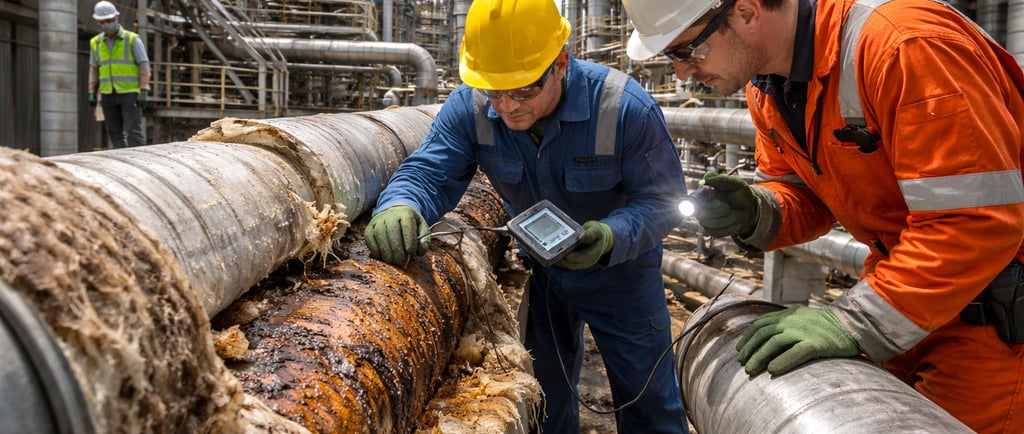
Context: CUI’s Impact on Climate-Resilient Infrastructure
Corrosion-under-insulation (CUI) represents one of the most insidious and costly risks to modern infrastructure focused on resilience and decarbonization. According to NACE International (now AMPP), global corrosion-related losses exceed $2.5 trillion annually, with CUI accounting for up to 10% of this total in sectors such as oil and gas, power generation, and chemicals. For maintenance teams, especially those tasked with meeting ambitious sustainability and low-carbon targets, CUI is not just a technical challenge but a strategic issue tightly linked to operational continuity, capital efficiency, and decarbonization mandates.
Climate-resilient infrastructure depends on meticulous attention to all sources of catastrophic loss or downtime. CUI, often hidden beneath layers of insulation, can progress unchecked in even the best-designed facilities. Its occurrence is especially problematic in regions facing increased precipitation, tropical humidity, or salt-laden environments—trends expected to intensify with climate change. The ability to rapidly detect, mitigate, and repair CUI is crucial to maintaining infrastructure’s functional and environmental integrity, while also achieving organizational ESG (environmental, social, and governance) goals.
Recent advances in both inspection technologies and the availability of recycled, low-carbon metals further distinguish today’s approach to CUI from traditional, often carbon-intensive methods. Now, infrastructure operators have in their toolbox materials and methods designed not just to extend asset life, but also to reduce the embodied carbon and environmental footprint associated with repair cycles.
Statistics:
According to the Energy Institute’s most recent survey, more than 50% of unplanned maintenance outages in refineries are directly linked to CUI events, causing millions in lost revenues and posing severe environmental risks from leaks or containment failures.
Plants prioritizing resilience and circular materials have reported up to 30% reductions in annualized repair costs using rapid-response CUI management models.
Key takeaways:
Addressing CUI is foundational to resilience, sustainability, and operational efficiency. Innovation in material science, inspection digitalization, and circular supply chains has elevated CUI management from a routine maintenance function to a strategic pillar of low-carbon infrastructure planning.
2. Defining CUI: Risks and Opportunities
Corrosion-under-insulation (CUI) manifests when aggressive corrosion develops on metal surfaces concealed by insulation, typically accelerated by trapped moisture, process disturbances, or insulating materials that fail to keep out contaminants like chlorides. What sets CUI apart from other corrosion types is its stealth—plant operators frequently discover it only after a process failure, serious leak, or scheduled insulation removal.
Strategic Risks in Low-Carbon, Resilient Operations
Downtime-avoidance: Modern infrastructure increasingly supports critical services such as district heating, renewable power, or water reuse. An unplanned shutdown caused by CUI doesn’t just affect one facility—downstream users, grid stability, and customer contracts may all be jeopardized. The resilience of the wider network is thus directly threatened by poorly managed CUI.
Repair costs and resource efficiency: Emergency or unscheduled CUI repairs not only cost exponentially more but often require ad-hoc material sourcing, which may not align with carbon reduction goals. Planned use of recycled metals and modular patches can dramatically lower both costs and emissions.
Worker and public safety: Catastrophic CUI failures are often the root cause behind major process accidents. The U.S. Chemical Safety Board (CSB) attributes several refinery and power plant incidents in recent decades to undetected CUI, emphasizing the need for transparent, well-documented inspection regimes.
Environmental footprint: CUI frequently results in leaks of hydrocarbons, refrigerants, or process chemicals—directly increasing a facility's carbon and social license risk. Shifting from carbon-intensive virgin materials to recycled alternatives aligns with broader corporate carbon neutrality targets and the principles of the circular economy.
Emerging Opportunities
Circularity and lifecycle performance: Modern recycled metals not only deliver equivalent (and sometimes superior) corrosion resistance when matched appropriately to service environments, but their use supports a closed-loop supply chain, dramatically lowering embodied carbon and waste.
Rapid, scalable deployment: Prefabricated recycled alloys or modular components can be sourced and installed more rapidly than traditional materials, boosting asset uptime—a critical advantage in sectors where every hour of downtime equals significant financial loss.
Data-driven prioritization: Integration of digital inspection management systems allows teams to continuously monitor, analyze, and prioritize CUI risks, resulting in smarter allocation of repair budget and measurable progress on resilience KPIs (Key Performance Indicators).
Future Trends:
Industry analysts foresee a growing intersection between digital asset management (integrating AI-driven diagnostics) and new insulation or coating systems tailored for circular repair regimes—key areas for facilities seeking a competitive edge in resilience and sustainability.
3. Key Concepts and Technical Definitions
Essential CUI Terms in Modern Infrastructure
Corrosion-Under-Insulation (CUI): Localized metal degradation occurring beneath insulation layers, classically difficult to identify without specialized inspection. Characterized by pitting, crevice corrosion, and under-deposit attacks, CUI frequently targets spots with compromised insulation or within vapor barriers.
Resilience (in industrial context): The capacity of infrastructure to maintain performance, rapidly recover from disruptions (such as CUI events), and adapt as operating environments or regulatory requirements evolve.
Low-Carbon Materials: Alloys or composites produced with processes that minimize greenhouse gas emissions, including electric arc furnace-fabricated steel, recycled aluminum, and nickel alloys with verified green supply chains.
Recycled Metals: Ferrous (iron, steel) and nonferrous (aluminum, copper, nickel) metals recovered and processed from post-industrial or post-consumer sources. When certified, these can substitute for virgin metals in most high-performance CUI repairs, offering lower environmental impact.
Inspection Methods:
Ultrasonic Testing (UT): Industry gold standard for wall-thickness measurement without insulation removal. Modern phased arrays provide high-resolution imaging for precise corrosion mapping.
Radiographic Testing (RT): X-ray or gamma-ray imaging to detect internal flaws, increasingly used when insulation cannot be disturbed.
Advanced Sensors and Robotics: Smart pigging, embedded moisture alerts, and AI-driven pattern recognition are emerging, enabling continuous monitoring and predictive maintenance in risk-prone locations.
Technical Progress
Decades ago, only new, virgin metal was considered suitable for pressure-retaining repairs. Today, certified recycled alloys (sourced with stringent quality assurance) not only match but often exceed minimum code requirements. This shift supports both resilient operations and measurable advances toward net-zero infrastructure targets.
Supporting Case:
BP's Cherry Point Refinery reported an 18% decrease in CUI repair cycle time and a measurable drop in repair-related emissions after switching to a hybrid regime of ultrasonic CUI mapping and recycled stainless steel patching—outcomes validated in their latest ESG report.
Framework: A CUI program that actually finds damage early
A useful CUI framework has one job. It turns a hidden, random-seeming threat into a managed, auditable system. The easiest way to do that is to treat CUI as a repeatable loop with four linked layers: where it happens, how fast it can progress, how you will detect it, and what you will do when you find it. API RP 583 is helpful here because it frames CUI as a combination of susceptibility factors, insulation system details, inspection methods, and risk-based prioritization, not a single technique or coating.
Layer 1: Exposure model, how water and salts get in, and how they stay there
CUI needs an electrolyte on the metal surface. In practice, that means water ingress plus time. Water comes from rain, washdowns, steam leaks, condensation, cooling cycles, deluge systems, and poor sealing around penetrations. Chlorides and other contaminants ride in with coastal air, process leaks, insulation chemistry, or dirty water exposure. Once wet, insulation can hold moisture against steel for long periods. Industry guidance repeatedly points to water ingress control as the first-order variable, because coatings alone do not remove water from a saturated insulation system.
Your framework should force every insulated asset to be tagged with an exposure class such as:
Outdoor, sheltered outdoor, indoor high humidity, indoor dry, coastal or splash zone, frequent washdown, steam-traced, intermittent service, and shutdown or mothball exposure. Shutdown matters because trapped moisture plus stagnant conditions can accelerate attack while nobody is watching.
Layer 2: Susceptibility model, which alloys and temperature windows carry the most risk
CUI is not evenly distributed across temperatures. Too cold and corrosion kinetics can slow, too hot and insulation tends to dry. The risk peaks in intermediate bands where moisture can persist and corrosion reactions run fast. Updated industry discussions commonly use a broad susceptibility guideline of about 10°F to 350°F (about −12°C to 175°C), with severity depending on metal, insulation condition, and contamination.
Within that broad band, your program should separate at least three material families:
Carbon and low-alloy steels. Typically the highest volume, biggest consequence population.
Austenitic stainless steels. Lower general corrosion but vulnerable to chloride stress corrosion cracking under insulation in the wrong conditions, so the failure mode can be sudden.
Duplex stainless steels. Often stronger, but still has operating temperature limits and surface protection considerations in some guidance comparisons.
Do not oversell any single “safe” alloy. CUI is a system failure involving design, sealing, drainage, insulation choice, and maintenance quality. A good framework makes “material selection” one control among several, not the only control.
Layer 3: Damage and consequence model, what failure looks like and why it matters
This layer is where resilience becomes measurable. The same wall loss can be trivial on a low-pressure drain and catastrophic on a toxic, flammable, or high-pressure line. Consequence should combine:
Safety, toxic release, fire, explosion potential.
Environmental harm, spill volume, sensitive receptors, clean-up scope.
Downtime and business interruption, including unit trip propagation.
Regulatory exposure, reporting, and reputation.
Real-world reports show CUI can create severe wall loss and separation at flanges and piping under insulation blankets, enough to contribute to fire and leak scenarios. BSEE documented a platform diesel generator fire investigation where inspectors found discoloration, soot around exhaust flanges, and holes or complete separation of exhaust piping due to excessive corrosion beneath insulation blankets, and it recommended expanding inspection programs for insulated components because similar corrosion was found on other insulated piping, valves, and vessels.
Layer 4: Detection strategy model, how you will find it without tearing everything apart
A detection strategy must be explicit about two tradeoffs: coverage versus cost, and sensitivity versus disruption. API RP 583 lays out inspection practices and non-destructive methods along with their limitations, and it encourages a risk-based approach rather than random removals.
A practical detection model uses three inspection tiers:
Tier A, screening. Fast methods to narrow the search area.
Tier B, confirmation and sizing. Higher resolution to quantify remaining wall and decide repair scope.
Tier C, proof and closeout. Post-repair verification and insulation system QA checks.
Typical method pairing looks like this:
Screening: visual surveys for jacket damage, missing sealant, wet insulation indicators, corrosion staining at terminations, and hot spots or cold spots that suggest wet insulation; infrared can help locate moisture and thermal anomalies, especially when conditions are right.
Confirmation: ultrasonic thickness mapping with spot removal windows, or methods designed for insulated piping where feasible.
S sizing: repeat UT grids, phased array where geometry allows, or radiography when access is limited and insulation disturbance is unacceptable, balanced against safety constraints.
Closeout: UT after repair, holiday testing where coatings were applied, and documented insulation reinstatement checks.
The point is not to list tools. The point is to define how a finding moves through your system, from suspicion to quantified wall loss to a decision.
How the framework becomes audit-ready
If you want this to be a reference resource, you also need the “governance spine.” That means every insulated circuit sits in an inventory, every circuit has a risk rank that can be explained, every inspection produces a record that feeds the next rank, and every repair closes with evidence that water ingress controls were restored. That is the difference between “we inspect CUI” and “we run a CUI program.”
Step-by-step: Detect, prevent, repair, without guessing
Step 1: Build the insulated asset inventory and define circuits
Start with a complete list of insulated piping, vessels, and equipment, then group them into inspection circuits that share:
Material and wall thickness range.
Operating temperature band and cycling profile.
Insulation type, jacketing type, age, and installation standard.
Exposure class, coastal, washdown, sheltered, indoor humidity.
Consequence class, based on service and location.
API RP 583 is explicit that these practices apply across pressure vessels, piping, and tankage, so do not limit the inventory to “process piping only.”
Step 2: Identify CUI “attack points” so inspections are not random
CUI clusters around predictable geometry and construction details, especially where water gets trapped or where insulation is often disturbed:
Insulation terminations, supports, and pipe shoes.
Flanges, valves, instruments, and penetrations.
Low points and deadlegs.
Heat tracing and steam tracing zones.
Areas under damaged jacketing, missing sealant, or patched repairs.
Interfaces with fireproofing and areas with repeated maintenance activity.
This is also where your blog can be more explicit than most standards: you are not hunting for corrosion everywhere. You are hunting for water pathways and retention points.
Step 3: Set screening frequency by exposure and consequence, then adjust by evidence
A defensible starting schedule uses higher frequency screening where water ingress is more likely and consequences are higher. Then you tighten or relax it based on results. This approach matches the logic behind risk-based inspection and helps avoid the two common failures: inspecting too little where risk is high, and wasting money inspecting low-risk circuits with low consequence.
Step 4: Use a “find rate” metric to validate your inspection plan
Track how many circuits inspected yield actionable wall loss. If your find rate is near zero across years, either your plant is unusually perfect or your plan is missing where the damage is. If your find rate is high, you may have a systemic insulation design or maintenance issue that needs prevention work, not just more inspections.
Step 5: When you find CUI, classify severity and decide repair path fast
Make the decision logic clear and consistent:
Minor external corrosion with adequate remaining wall. Clean, treat, recoat if required, and reinstate insulation with upgraded sealing and drainage details.
Localized wall loss approaching minimum thickness. Engineered repair or replacement spool, depending on code, accessibility, and outage window.
Active leak or near-leak, or evidence of cracking risk in stainless circuits. Isolate, remove insulation, inspect wider, repair per applicable code, and expand the inspection scope to sister circuits.
Avoid hand-waving about “recycled metals” at this stage. If you want to include circular materials, state the selection requirements: certified chemistry and mechanical properties, traceability, conformance to the governing code, and compatibility with service temperature and corrosion environment. Otherwise it reads like marketing instead of engineering.
Step 6: Prevent recurrence by fixing the insulation system, not just the pipe
This is where many programs fail. They repair metal and reinstall the same water-trapping insulation details. Prevention is mainly about water ingress control, drainage, and maintainability:
Upgrade jacketing and sealing details at terminations and penetrations.
Remove chronic water traps, add drip edges, slope runs where possible, and improve support details.
Standardize insulation reinstatement QA checks, including sealant condition and fit-up.
Use insulation and jacketing selections appropriate to exposure; industry discussion often focuses on jacketing quality and water ingress minimization as primary controls.
Step 7: Tie the program to measurable business outcomes
Corrosion is expensive at global scale, and proven corrosion control can reduce a significant share of those losses. AMPP has repeatedly highlighted the global corrosion cost estimate at about $2.5 trillion annually and has pointed to major savings potential when corrosion management practices are implemented. Your blog will land harder if you connect that macro view to site-level outcomes that leaders care about: fewer leaks, fewer emergency work orders, fewer insulation rework cycles, and fewer unplanned outages driven by external damage mechanisms.
Implementation Playbook: Build a CUI program in 90 days, then mature it
Weeks 1–2: Program setup and standards alignment
Define scope. Include piping, vessels, and any insulated components that can cause safety or production impact.
Choose the governing references your site will align to. API RP 583 is widely used in oil, gas, chemicals, and power environments for CUI and corrosion under fireproofing program structure. If your organization uses NACE/AMPP systems practice for insulation and fireproofing corrosion control, document that too.
Assign owners. You need an accountable integrity lead, an inspection lead, and a maintenance or insulation execution lead.
Weeks 3–5: Inventory, segmentation, and baseline risk ranking
Build the insulated asset list from P&IDs, isometrics, and field walkdowns. Validate physically, because drawings miss field modifications.
Segment into circuits and tag each with exposure, temperature band, material family, insulation type, jacketing condition, and consequence.
Perform a first-pass rank so you can start with the worst 20% first.
Weeks 6–8: Field screening campaign and targeted NDE
Run a focused field campaign on the highest-ranked circuits. This is where you find the reality gap: jacket damage, missing sealant, wet insulation, repeated patchwork, and neglected supports.
For each “suspect” location, run your confirmation method, usually UT grids after controlled insulation removal windows, or other suitable techniques where insulation removal is constrained.
Document everything. Photos, coordinates, grid maps, thickness readings, and insulation reinstatement notes. If it is not documented, it did not happen.
Weeks 9–12: Repair wave plus prevention upgrades
Bundle repairs into an efficient work pack so you do not create repeated insulation disturbance, which itself increases future ingress risk.
For every repair, include prevention work. Replace failed jacketing, correct terminations, reseal penetrations, and improve support details.
Verify post-repair. Use UT to confirm thickness and integrity, then sign off insulation reinstatement with QA checks.
Operating rhythm after day 90: Continuous improvement and proof
Monthly. Review new findings, update risk ranks, and track inspection find rates.
Quarterly. Review repeat offenders, the circuits where wet insulation keeps coming back, then fix the systemic causes.
Annually. Reassess your temperature and exposure assumptions, especially if climate patterns are shifting toward higher humidity, heavier rainfall, or more coastal aerosol exposure at your site.
Three metrics that keep the program honest
Finding rate. Percent of inspected circuits with actionable wall loss.
Repeat rate. Percent of repaired locations that reappear within 12 to 24 months.
Ingress rate. Percent of surveyed insulation runs showing jacket or sealant defects.
If you publish these internally, you create the feedback loop that drives better design and better maintenance habits.
Common failure modes, and how to avoid them
Random inspections. Replace this with ranked circuits and known attack points.
Metal-only repairs. Always pair repair with water ingress controls.
One-and-done campaigns. CUI is a lifecycle issue, not a turnaround checkbox.
Overreliance on “better coatings.” Coatings help, but wet insulation and poor sealing can defeat even good coating choices, which is why systems guidance emphasizes insulation, jacketing, and installation practices alongside coatings.
A reality check from incident experience
Regulators and investigators keep documenting cases where severe corrosion is found under insulation blankets, sometimes in the context of fires or leaks, and they often recommend expanding inspection programs for insulated components because the issue is not isolated to a single line or piece of equipment. That is exactly why the playbook above focuses on circuits and sister equipment, not a single repair location.
Conclusion: Treat CUI as a resilience system, not a maintenance surprise
CUI sits at the intersection of asset integrity, process safety, downtime risk, and climate exposure. If you rely on chance discoveries, you will keep paying emergency premiums in labor, outages, and risk. If you run a structured program, you convert a hidden threat into a managed portfolio of circuits with clear priorities, repeatable inspection tactics, and repairs that actually last because they fix water ingress pathways.
Connect
Your trusted partner for scrap metal procurement.
CONTACT
About
haroon@tdcventures.com
+1-307-655-7593
© 2025. All rights reserved.
NEWSLETTER