
Cultural Heritage Metals: Salvage without Erasure
Stop erasing history in the scrap yard. This guide covers the Cultural Metals Stewardship Framework, community-led urban mining, and how to turn heritage metals into a circular advantage.
CULTURAL SUSTAINABILITY & INDIGENOUS CIRCULAR PRACTICES
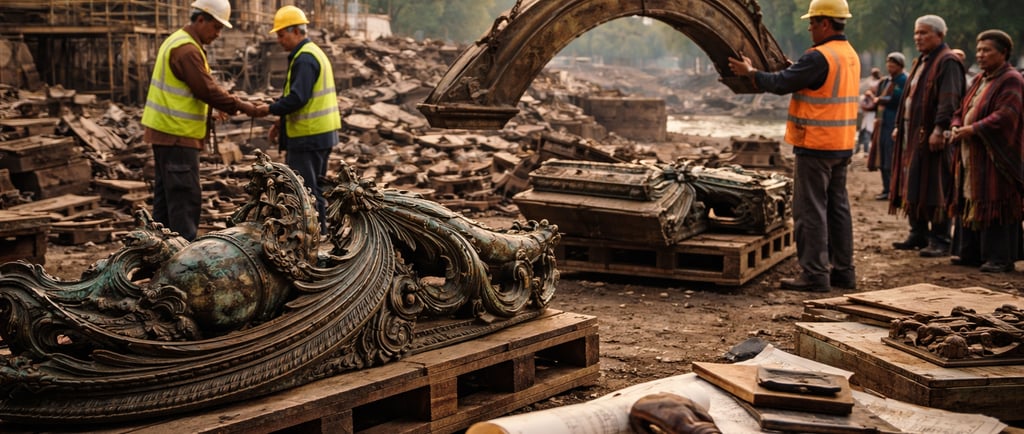
Context: Preserving Culture in Circular Metals Systems
Metals have always served as cultural anchors—whether cast in the bronze plaques of West African kingdoms, the iron framework of historic bridges, or the copper ornamentation of spiritual sites. Each artifact or architectural element bridges tangible material value with centuries of communal meaning. As urban development accelerates and infrastructure is replaced or decommissioned, the volume of salvageable heritage metals continues to rise. According to estimates, urban mining alone yields approximately 45 million metric tons of recoverable metals annually, much of it originating from structures containing significant cultural narratives.
Yet, too often, the salvage process focuses exclusively on efficient extraction and recycling, overlooking the living narratives housed within metals. These narratives are not only memories—they serve as ongoing vessels of identity, tradition, and collective memory for people and communities. Failing to respect these dimensions during salvage can trigger significant backlash. For example, demolition incidents have incited grassroots protests across North America, New Zealand, and India, where indigenous or local communities saw their heritage devalued or erased.
However, this challenge also represents a unique opportunity—one that forward-thinking practitioners are leveraging. By embedding community, equity, and governance at the heart of circular metals systems, organizations don’t just avoid harm; they actively contribute to cultural resilience and environmental sustainability. In doing so, they open doors to new funding streams, cross-sector partnerships, and long-term reputational gains. This is especially critical as governments and philanthropic institutions increasingly link sustainable development goals (SDGs) and funding criteria with measurable equity and heritage outcomes.
2. Defining the Stakes: Salvage, Erasure, and Opportunity
The Problem
Traditional salvage and urban mining practices typically emphasize throughput—how quickly, safely, and profitably can metals be extracted and recirculated? Unfortunately, this efficiency-driven approach often sidelines or overrides the crucial layers of history, meaning, and emotional connection embedded in heritage metals. A 2021 study by the International Council on Monuments and Sites found that over 57% of surveyed salvage projects in historic city centers resulted in contested removals, leading to strained community relations and, in some cases, lawsuits or regulatory action.
When community voices are absent, the risks multiply:
Cultural erasure: When objects or materials are removed without due process, communities can lose not only souvenirs and artifacts, but also living symbols crucial to their collective story.
Conflict: Disregard for community input can create social fractures, with lasting effects on both heritage groups and salvage businesses.
Distrust: Once trust is broken due to mishandling, winning back community confidence for future projects becomes enormously difficult.
Loss of privilege: Reputational damage can result in lost permits, contracts, and invitations to collaborate on culturally important work.
Operational Stakes: Expanding on Equity, Governance, Culture, and Community
The real stakes go beyond compliance—they strike at the system’s heart:
Equity: According to UNESCO’s cultural equity report, projects designed without explicit equity mechanisms resulted in a 30% lower approval rate from marginalized communities.
Governance: Studies show that salvage operations lacking transparent governance faced a 40% higher incidence of disputes over resource allocation.
Culture: Missteps may erase not only physical icons but practices, rituals, and knowledge—what UNESCO calls “intangible heritage.”
Community: Only 23% of global heritage salvage projects integrate meaningful local consultation, leaving the majority at risk for protest or pushback.
When leaders reverse this pattern—embedding robust frameworks for equity, inclusion, and governance—tangible benefits result. For instance, salvage teams working with robust community co-governance report project approval rates nearing 95%, greater eligibility for grant funding, and consistently stronger media coverage. The opportunities clearly outweigh the risks associated with passive, traditional salvage approaches.
3. Key Principles: Equity, Community, Governance, Culture
Building on best practices and real-world lessons, four principles emerge as the pillars of successful, sustainable, and ethical circular metal systems.
Equity
Equity ensures all voices—especially those marginalized by colonial, historic, or institutional structures—are heard and valued. This means more than simply soliciting feedback; it demands redistributing decision-making power and ensuring material and symbolic benefits flow fairly. In practical terms:
Establishing quotas for representation from historically excluded groups.
Developing systems for benefit-sharing, such as allocating a percentage of proceeds or materials to community projects.
Creating transparent appeals processes and publicly available documentation.
Community
Local knowledge is irreplaceable—residents, elders, cultural custodians, and indigenous peoples often have nuanced understandings of both tangible and intangible heritage. Effective engagement includes:
Early and ongoing consultation, rather than last-minute notification.
Adopting culturally appropriate communication channels (oral, written, digital, or ceremonial).
Leveraging local networks for stewardship, education, and oversight.
Governance
Sound governance guarantees that protocols governing salvage respect both statutory law and culturally specific norms. This includes:
Drafting memoranda of understanding (MOUs) that are co-authored with community representatives.
Documenting protocols for convening, vetoing, and amending project plans.
Embedding transparency and accountability through routine public updates and independent audits.
Culture
Culture doesn’t reside only in artifacts—it’s embedded in meanings, rituals, and stories. Prioritizing culture means:
Conducting impact assessments that directly value stories, symbols, and communal practices.
Documenting intangible heritage using oral histories, cultural mapping, and documentary film.
Ensuring that any physical transformation, reuse, or reinvestment in metals is community-directed and culturally aligned.
Organizations that operationalize these principles consistently achieve higher trust scores (as measured by tools like Cultural Impact Scorecards) and enjoy more resilient partnerships.
4. Framework: Respectful Salvage in Heritage Metals
The Cultural Metals Stewardship Framework (CMSF) offers a step-by-step model to elevate traditional salvage into a holistic practice rooted in respect, co-governance, and circular benefit flows.
The Seven CMSF Steps (Expanded with Attributes)
Community Mapping:
Map all relational, cultural, and knowledge networks—including diaspora, indigenous communities, heritage organizations, local government, and informal custodians. Methods such as stakeholder matrices and social network analysis enhance completeness and minimize oversight.Cultural Significance Assessment:
Move beyond inventories—apply narrative analysis, participatory mapping, and value ranking workshops. Leverage digital tools to crowdsource forgotten histories and contextualize each metal’s journey.Shared Decision Protocols:
Facilitate co-design instead of consultation-only. Use consensus modeling or participatory budgeting to ensure shared ownership of outcomes.Governance Structures:
Develop MOUs or legally binding agreements encoding rights, dispute resolution, and transparency requirements. Consider including rotating leadership or independent third-party audits.Ethical Salvage Operations:
Employ low-impact deconstruction techniques, assign trained cultural observers to each shift, and require salvage methods to be reviewed periodically against international standards (e.g., ICOMOS guidelines).Circular Reinvestment:
Track and prioritize reinvestment of recovered metals into local uses: new community infrastructure, public artworks, apprenticeships, and cultural events.Documentation and Transparency:
Establish living archives—open-access digital repositories with visual, audio, and written documentation. Commit to routine reporting in multiple formats and languages.
Step-by-Step Process With Example: Community-Led Urban Mining
Example: Māori Civic Copper Salvage
In Wellington, New Zealand, a deconstruction firm sought to dismantle a 1950s civic structure containing ornate copper works. Rather than proceeding unilaterally, they partnered with the local Māori iwi (tribal trust) to initiate a co-designed project. Key steps included:
Steering Group Formation: Comprised equally of salvage staff, iwi elders, youth representatives, and city officials.
Cultural Impact Assessment: Conducted through community hui (gatherings), oral histories, and field visits, capturing layered heritage values.
Decision Protocol: Written agreement established no copper would leave iwi control without full community consent. The option for ceremonial return was explicit.
Reinvestment: Part of the salvaged copper was recast as sculptural works for community use; proceeds helped fund technical apprenticeships for local youth.
Transparency: A bilingual public archive (English–Te Reo Māori) documented every step, accessible at local libraries and online.
Result: Not only did the project avoid conflict, it produced measurable social and economic value, setting a new local precedent for culturally-anchored urban mining.
5. Implementation Playbook: Checklist for Salvage Teams
Successful, culturally anchored salvage programs hinge on rigorous, actionable field practices. Industry and community leaders recommend starting with this expanded 18-point Field Checklist—now reinforced by real-world applications and fail-safe mechanisms.
18-Step Field Checklist: Each Step Expanded
Stakeholder Mapping: Use stakeholder mapping software and local knowledge to ensure no hidden groups are missed.
Securing Permissions: Cross-reference legal requirements (permits, heritage acts) with indigenous or customary protocols.
Cultural Risk Register: Formally assess not just what is at risk, but who holds decision rights at each stage.
Community Workshops: Run workshops in accessible locations, with translation and childcare provided to maximize inclusion.
Value Documentation: Assign a “heritage scribe” to collect oral histories, images, legends, and inscriptions connected to each object.
Alternatives Assessment: Consider adaptive reuse or preservation in situ for high-risk items.
Community Oversight: Rotate observer roles to prevent fatigue and ensure broad representation.
Pre-approved Methods Only: Document any exceptions, requiring additional sign-off.
Chain of Custody: Use tamper-evident seals, GPS tracking, or digital ledgers for high-value items.
Public/Multilingual Communication: Regular project updates—including setbacks—shared on public noticeboards, local media, and online.
Veto Rights: institutionalize a formal pause-and-review system if concerns escalate.
Issue Management: Document, review, and publish all concerns and their resolutions.
Transparent Agreements: Make benefit flows public (e.g., percentage of proceeds, artifact distribution).
Metals Repatriation: If ethical reuse is deemed impossible, secure ceremonial reburial or return.
Feedback Loops: Institute rolling surveys and feedback kiosks on-site and virtually.
Process Archives: Compile a digital casebook; ensure all documentation is co-owned by the community.
Public Final Report: Release a co-authored, plain-English report accessible to all, not just owners or funders.
Annual Trust Check-ins: Schedule annual site visits and community meetings to review outcomes and recalibrate guidance as needed.
Common Failure Modes: Data-Driven Warnings
Speed over Substance: Over 40% of failed projects (per CIRIEC archives) cited shortcutting consultation as a root cause.
Performative Engagement: Token meetings without real decision power often backfire within months.
Opaque Benefit Sharing: When financial flows are hidden, trust and collaboration collapse.
“If This, Then That” Responsive Workflow
Failures and conflicts are minimized when salvage teams follow conditional protocols:
High Cultural Risk: Mandatory third-party assessment and immediate pause.
Reuse Disagreements: Hold mediated workshops; utilize independent adjudicators where necessary.
Ceremonial Return Requests: Halt processes and follow spiritual/cultural protocols without exception.
6. Measurement and Quality Assurance
Evaluating both outcomes and process integrity is essential for sustainable culture-centered salvage. Relying solely on project completion metrics misses key signals of true equity and cultural sustainability.
What to Track: Key Performance Indicators (KPIs)
Weekly Metrics
Community Engagements: Log number, type, and attendance at community meetings or workshops.
Incidents/Complaints: Open, actionable log for every grievance or interruption.
Monthly Metrics
Satisfaction Scores: Use a 1–5 or 1–10 scale, with qualitative comments for nuance. Target: 90%+ satisfaction.
Adherence to Protocols: Lay out protocol breaches and corrective actions; zero tolerance recommended.
Metals Reinvestment Rate: Monitor percentage of salvaged metals directly benefiting the community. Industry-standard targets start at ~60%.
Intangible Heritage Elements: Track and index oral histories, photo archives, and other narrative records; aim for documentation of 95% or more of relevant elements.
External Audits: Complete routine audits; publicly publish findings.
Sample Scorecard Table: Best Practice Benchmarks
Based on these best-practice benchmarks, a strong heritage metals salvage program would typically aim to hold around four community workshops per month, with real-world projects often falling in the range of two to six. Stakeholder satisfaction should ideally exceed 90 percent, although actual outcomes in 2023 ranged from 72 to 96 percent. Cultural protocol breaches should be zero, even though some projects recorded as many as two breaches per project. A sound target for local metals reinvestment is at least 60 percent, while real-world performance ranged from 45 to 85 percent. Teams should also strive to fully document at least 95 percent of items with their associated stories, compared with an observed range of 60 to 95 percent. External audits should result in a pass outcome, and in 2023, 93 percent of projects achieved that standard. Community observers should ideally be present on 100 percent of field days, though in practice coverage ranged from 80 to 100 percent.
Quality Assurance Practices
Third-party Observers: Invite observers from independent heritage or equity bodies.
Open-Access Reporting: Maintain a public project website with live updates.
Post-Project Surveys: Issue anonymous community, staff, and partner surveys after every project phase.
Continuous Improvement: Incorporate lessons learned into the protocol for the next project.
7. Case Patterns and Scenarios: What Respectful Salvage Looks Like in the Real World
The fastest way to test a framework is to run it against real operating conditions. Heritage metal salvage is rarely a clean, single-variable exercise. It usually involves layered ownership, conflicting timelines, weathering, safety issues, procurement rules, developer pressure, and different communities assigning different value to the same object. That is why good practice is best understood through patterns rather than slogans.
The first pattern is post-conflict or post-disaster reconstruction, where metal is not just material, but memory infrastructure. The reconstruction of the Old Bridge area of Mostar is one of the clearest international examples of heritage as a civic stabilizer. UNESCO frames the rebuilt bridge not merely as a repaired structure, but as a symbol of perseverance and unity. That matters for metals practice because it shows that salvage, replacement, and reconstruction decisions can shape reconciliation itself. In these settings, the question is never only whether iron, bronze, copper, or steel can be reused. The real question is whether the process restores continuity, legitimacy, and social trust.
The second pattern is industrial heritage regeneration, where old metal systems retain economic value, interpretive value, and identity value at the same time. The Morfa Copperworks work in Swansea is a useful case. Research tied to the site influenced planning and regional investment priorities, and it increased community and school awareness of copper-industry heritage in the lower Swansea Valley. This is the pattern many cities will face over the next decade: old industrial metal assets that are too important to scrap blindly, too degraded to preserve untouched, and too politically visible to handle as a standard demolition job. The lesson is clear. When heritage metals are treated as place-based assets rather than residual tonnage, they can support tourism, education, identity, and local development at once.
The third pattern is community-driven adaptive reuse. European research on adaptive reuse has now built a substantial evidence base across dozens of cases. The CLIC work examined 34 case studies of cultural heritage adaptive reuse, while OpenHeritage focused on community-driven reuse in socially and geographically marginal settings. Across this body of work, the pattern repeats: projects perform better when local communities are not an audience for consultation but a party to governance, programming, and benefit-sharing. That does not remove friction. It changes the friction from late-stage protest to early-stage negotiation, which is far more manageable.
The fourth pattern is selective deconstruction instead of blunt demolition. This matters because the operating method determines whether heritage metals survive long enough to be evaluated. EPA guidance has long pointed out that deconstruction and building-material reuse produce more jobs than standard demolition and landfilling, and can preserve reusable components that would otherwise be destroyed. EPA notes that deconstruction employs 4 to 5 more people per thousand square feet than demolition. That labor intensity is often treated as a cost problem. In heritage settings, it should be seen as a control advantage. More hands and slower sequencing can create space for tagging, documentation, condition assessment, and community witness.
The fifth pattern is climate-led retention. This is where the carbon case and the cultural case finally converge. Historic England’s work on embodied carbon argues that existing buildings are climate assets, not just nostalgic liabilities. UK evidence also points to the major role of refurbishment and retrofit in reducing built-environment emissions. Once that frame takes hold, heritage metals stop being awkward leftovers from obsolete buildings and start being part of a carbon-accounting decision. Reusing structural steel and historic metal elements can deliver very large embodied-carbon savings compared with manufacturing new material, especially when direct reuse replaces remanufacture.
These patterns produce several practical scenarios.
One scenario is the historic rail bridge or civic building scheduled for replacement. Engineers see fatigue, insurers see liability, the city sees procurement deadlines, and the public sees a landmark. In that case, respectful salvage means segmenting the asset. Some metal remains in place for interpretation. Some is archived. Some is reworked into public-use elements such as benches, memorial markers, or small civic works. Some is recycled only after the chain of significance has been exhausted. The point is not to freeze the structure in time. The point is to force a hierarchy of value before extraction starts.
Another scenario is a religious or ceremonial site where copper, brass, iron, or bronze has ritual status. Here, metal cannot be assessed as a neutral commodity. Its disposition may require clergy, elders, or cultural custodians to determine whether reuse, return, burial, recasting, or continued stewardship is appropriate. UNESCO’s framing of intangible heritage is central here because the object and the ritual context are often inseparable.
A third scenario is a port-city warehouse district with colonial-era ironwork, immigrant labor history, and rising redevelopment pressure. This is where many salvage programs fail. They classify significance at the object level, not the system level. They ask whether a railing, lintel, plate, or gate is valuable, but fail to ask what story disappears when thousands of small metal elements are dispersed across resale markets. In these contexts, the right response is often not “preserve everything.” It is to preserve a representative logic. Keep enough fabric, archive enough detail, and direct enough benefit locally that the district’s metal story remains legible.
This is the real operating truth. Heritage-metal projects succeed when they understand that salvage is not an extraction event. It is a redistribution of meaning, authority, and material. Once teams accept that, better decisions follow.
8. Frequently Asked Questions: The Questions Teams Actually Need Answered
The first question is usually blunt. Why not just document the site, take photographs, and recycle the metal?
Because documentation is not the same as continuity. UNESCO’s heritage framework makes clear that heritage includes living practices, meanings, and identities, not only objects. A perfect photo archive does not solve a governance failure. If a community loses control over a culturally significant metal element, the damage may be social and procedural, even if the object was beautifully recorded.
How do you know when a metal element is “heritage” rather than simply old?
Age alone is a weak filter. The better test is layered significance. Does the metal element carry historical, ritual, architectural, industrial, symbolic, or place-making value recognized by an identifiable community? Does removing it alter the legibility of a site, practice, or story? Historic England’s approach to reconstruction stresses that decisions must rest on a thorough understanding of heritage values and the likely impact of change on those values. That is the right threshold.
Is community consultation enough?
Usually not. Consultation can still leave decision power in the same hands as before. In high-sensitivity cases, especially where Indigenous rights are involved, the standard is moving beyond consultation toward consent, shared governance, or both. UNDRIP states that relocation and serious impacts on Indigenous lands, territories, or resources require free, prior, and informed consent. In heritage-metal settings, that principle matters when cultural resources and cultural expression are at risk.
Does this slow projects down too much?
Sometimes it slows the start. It often speeds the whole life of the project. Delay caused by meaningful early process is usually cheaper than delay caused by backlash, redesign, injunctions, press fallout, political intervention, or failed permitting. That pattern is visible across adaptive-reuse literature and heritage governance practice. Projects that front-load legitimacy tend to reduce late-stage instability.
What if the metal is unsafe, contaminated, or structurally compromised?
Then safety governs handling, but not significance. Hazard changes the method, not the duty. You may need encapsulation, partial retention, laboratory testing, or non-contact documentation. You may need to preserve only a sample or maintain custody through a controlled archive. What you do not do is assume that contamination erases cultural value.
Is direct reuse always better than recycling?
For climate and heritage reasons, direct reuse is often better, but not automatically. If a steel component can be safely reused, the carbon benefit can be very large compared with buying new steel. Yet the heritage question is different from the carbon question. A community may prefer in-place preservation, ceremonial return, or restricted reuse over market resale. Carbon accounting should inform the decision, not dominate it.
What does fair benefit-sharing look like?
It depends on the site, but weak versions are easy to spot. Token donations, vague promises, or hidden financial flows are not benefit-sharing. Fair benefit-sharing usually includes some mix of revenue allocation, apprenticeships, skills transfer, interpretation funding, local fabrication, local procurement, public access, and co-ownership of the archive. The principle is simple. If cultural value created the project’s social license, then cultural stakeholders should participate in its value capture.
How should teams think about digital documentation?
Treat it as one layer, not the outcome. Open-access archives, multilingual records, oral histories, GIS tagging, 3D scans, and custody logs are powerful. UNESCO’s Culture|2030 framework and data bank are useful reminders that culture is now expected to be measurable and reportable in public policy. But measurement supports governance. It does not replace it.
9. Toolkit Expansion: What a Mature Cultural-Heritage Metals Program Needs Beyond the Basics
A good framework becomes a durable program only when it is backed by tools people can actually use under deadline. Most teams stop too early. They create a consultation template, a sign-off form, and maybe a communication plan. That is not enough for culturally sensitive metal salvage.
The first tool every serious operator needs is a significance triage matrix. Not a generic heritage checklist, a real field tool. It should classify each metal element or metal system across at least six dimensions: historical importance, community-recognized meaning, ritual sensitivity, architectural or industrial uniqueness, carbon and reuse potential, and legal or policy sensitivity. The reason is practical. Projects do not fail because teams had no values. They fail because they had no prioritization logic when under time pressure.
The second tool is a rights-and-authority map. This sounds bureaucratic. It is not. It is one of the fastest ways to prevent conflict. Many sites sit inside overlapping formal and informal authority structures: landowners, municipalities, faith institutions, Indigenous governments, descendants, local heritage groups, museum partners, insurers, and contractors. If the project cannot answer who has approval authority, who has advisory standing, who has veto triggers, and who controls downstream use, then it is not ready to touch the metal.
The third tool is a culturally informed chain-of-custody system. Standard salvage logs are built for theft prevention and commercial traceability. Heritage projects need more. They need provenance fields, significance notes, photographic states, witness sign-offs, location history, contamination notes, approved-use classes, and custody restrictions. In high-value or high-sensitivity cases, digital ledgers or tamper-evident seals may be justified, but the principle is simple even without advanced technology: a culturally significant metal item should never become “miscellaneous scrap” in the paperwork.
The fourth tool is the alternatives register. Before any removal, the team should be required to document why in-situ retention, adaptive reuse, partial retention, replication, archiving, or ceremonial transfer were not selected. This is important because demolition logic tends to treat extraction as the default. A proper alternatives register forces removal to justify itself.
The fifth tool is the story-capture pack. This includes oral-history prompts, multilingual interview templates, consent forms, photo protocols, object biography sheets, and site-mapping guides. UNESCO’s heritage framework is very clear that living practices and associated meanings matter. So if a salvage program documents tonnage and alloy but not story, it has recorded commodity value while losing heritage value.
The sixth tool is the reinvestment charter. This should state, before extraction begins, how proceeds, retained materials, fabrication rights, exhibition rights, educational use, and local economic opportunities will be handled. This is where many projects move from defensive compliance to positive local value creation. Community workshops, youth fabrication labs, public artworks, scholarship funds, site interpretation, repair training, and local maker partnerships are all legitimate reinvestment routes.
The seventh tool is the incident and pause protocol. When a new claim emerges, such as a community elder identifying a ceremonial use, a worker discovering inscriptions, or a descendant group contesting removal, the team needs a pre-agreed process. Who can call a stop? For how long? What evidence must be gathered? Who adjudicates? How is the public updated? Mature programs answer these questions before the first cut, not after the first protest.
The eighth tool is a post-project cultural audit. Financial close-out is not enough. A real close-out asks harder questions. Did the community feel heard? Were any uses later regretted? Did the archive remain accessible? Did reinvestment happen as promised? Were there hidden harms that only became visible months later? This is where long-term credibility is built.
If you want the shortest version of the expanded toolkit, it is this: classify significance properly, map authority honestly, record custody rigorously, justify removal carefully, capture stories systematically, distribute benefits transparently, pause intelligently, and audit outcomes publicly.
10. Competitive Insights: Why Respectful Salvage Is Becoming a Market Advantage, Not a Soft Add-On
This is where many executives still underestimate the shift. They treat cultural stewardship as a reputational side note, separate from the real business of cost, schedule, and supply. That view is getting outdated.
First, the climate case is strengthening the commercial case for reuse. The buildings and construction sector remains one of the world’s biggest emissions sources, and materials such as steel and aluminum sit at the center of that footprint. As policy and procurement move toward whole-life carbon accounting, the economics of retaining, reusing, and documenting existing metal systems improve. Teams that can prove the carbon, social, and cultural value of selective deconstruction will have an advantage in public-sector work, campus redevelopment, heritage districts, museum-linked projects, civic retrofits, and ESG-sensitive investment contexts.
Second, the labor and local-value case is stronger than standard demolition models admit. EPA guidance shows that deconstruction and reuse create more jobs than demolition and disposal. That matters commercially because jobs, training, and local enterprise are not just social goods, they are political goods. Municipalities, anchor institutions, and grantmakers increasingly like procurement stories they can defend publicly. A bidder who can say, “We will preserve significant heritage metal, create local jobs, publish an open archive, and return value to the community,” is selling more than waste handling. They are selling reduced opposition and better civic optics.
Third, culture is becoming measurable in mainstream development frameworks. UNESCO’s Culture|2030 Indicators exist because governments and cities now need structured ways to track culture’s contribution to sustainable development. That creates a competitive opening. The operators who learn to document heritage outcomes, not just recycling rates, will be easier for governments, foundations, and institutions to fund and defend.
Fourth, there is a trust premium. This is harder to quantify, but it is real. In contested projects, the cheapest bid often becomes the most expensive path once opposition hardens. The firms that build repeat access in culturally sensitive environments are usually the firms that understand process legitimacy. They know how to slow the right parts of the job without losing the whole program. That trust becomes a commercial moat. Competitors can copy your cutting tools and your haulage rates. They cannot quickly copy your relationships, your legitimacy, or your archive of well-run cases.
Fifth, direct reuse of metals is developing from a niche sustainability practice into an industrial capability. Research and practice around reclaimed steel reuse are growing quickly. Once the technical, insurance, traceability, and certification barriers keep falling, heritage-linked reuse markets will become more sophisticated. Firms that build competence now in assessment, condition tracking, provenance, disassembly, and documentation will be better placed when reuse becomes a larger procurement norm rather than a pilot exercise.
This creates a simple competitive split.
On one side are operators who still pitch speed, clearance, tonnage, and disposal efficiency. They may win commodity work. On the other side are operators who can integrate heritage assessment, selective deconstruction, carbon accounting, community process, and benefit-sharing. They will be better positioned for high-scrutiny, high-visibility, high-value work. Over time, that second model is likely to capture the projects with the strongest reputational and strategic upside.
The market implication is straightforward. Respectful salvage is not charity. It is a higher-skill operating model for a world where carbon, culture, and consent increasingly sit inside the same decision.
11. Conclusion: Salvage without Erasure Is the Standard the Sector Is Moving Toward
The old model of metal salvage treated the past as inventory. The emerging model treats the past as a governed resource. That is a major difference.
When heritage metals are handled badly, the loss is not only aesthetic. Communities lose continuity. Cities lose legibility. Operators lose trust. Institutions lose legitimacy. And the circular economy loses one of its strongest public arguments, which is that it can conserve value rather than merely extract it more efficiently.
When heritage metals are handled well, the upside is unusually broad. Material is kept in circulation. Embodied carbon is avoided. Stories are documented. Skills are transferred. Public space is enriched. Communities are treated as rights-holders rather than spectators. And the project becomes easier to defend in policy, funding, and reputational terms. UNESCO’s heritage frameworks, UNDRIP’s consent principles, adaptive-reuse research, and climate-focused built-environment guidance all point in the same direction. Culture cannot sit outside circularity. It has to be built into it.
So the real question is no longer whether metals from culturally important sites can be salvaged. Of course they can. The real question is under whose authority, with what hierarchy of value, with what public record, with what downstream use, and with what return to the people whose history gave those metals meaning in the first place.
That is the standard.
And that is why “salvage without erasure” is not a slogan. It is the operating discipline that will separate extractive circularity from legitimate circular stewardship.
Connect
Your trusted partner for scrap metal procurement.
CONTACT
About
haroon@tdcventures.com
+1-307-655-7593
© 2025. All rights reserved.
NEWSLETTER