
Cyclone Belts: Corrosion Maps and Metal Selection for Resilient Infrastructure
Discover how corrosion mapping and advanced metal selection protect coastal infrastructure in cyclone belts. A data-driven guide to resilient, low-carbon asset management.
CLIMATE-RESILIENT INFRASTRUCTURE & CIRCULAR MATERIALS
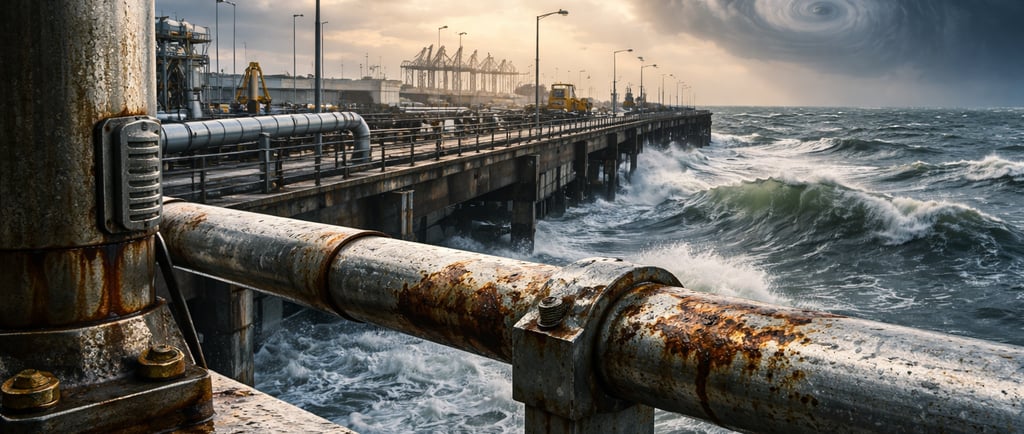
Context: Why Cyclone Belt Resilience Matters for Coastal Operations
The world’s cyclone belts—bands of coastal and island territories that face repeated cyclonic events—represent a focal point for infrastructure operators intent on long-term resilience and operational excellence. In these high-risk environments, utilities, ports, and critical public works act as economic lifelines for communities and industries. Their uninterrupted function directly supports business continuity, supply chain security, and disaster recovery timelines.
Yet, these very assets operate on the frontlines. Environments marked by:
Persistent salt-laden winds
High concentrations of airborne chlorides and sulfates
Heavy rains and flash flooding
Intense wind loads and debris impacts
These bring about extreme corrosion potential and physical deterioration rates. Over the last decade, research by organizations like the International Association for Bridge and Structural Engineering (IABSE) and the American Society of Civil Engineers (ASCE) has found that coastal asset failure rates directly correlate with storm frequency and local climate trends—particularly as climate change intensifies tropical weather events.
Financial Pressures and Insurance Mandates:
Insurance underwriters and government agencies now tie policy rates and disaster coverage to proven evidence of climate resilience and sustainable rebuilding. Carbon accounting, lifecycle emissions, and circular materials are major buying criteria. Utilities and port operators are increasingly evaluated not just on service uptime, but also on their ability to leverage knowledge-driven, low-carbon metals and intelligent exposure mapping.
Resilience as a Competitive Edge:
True operational resilience hinges on more than just “hardening” assets. It demands a systematized approach to corrosion mapping, advanced alloy selection, and rapid post-cyclone renewals. This proactive stance not only reduces maintenance outlays but often speeds regulatory approval for expansion projects, attracts environmentally conscious investors, and satisfies stringent compliance regimes such as ISO 14001 or PAS 2080.
Takeaway: Modern resilience is a function of science-driven metals selection, targeted at site-specific threats documented in detailed exposure maps. For coastal operations, a data-based approach to corrosion and circularity is now a baseline for sustainable, future-proof infrastructure.
2. The Problem: Accelerated Corrosion and Asset Risk
Accelerating Threats:
In cyclone-prone zones, asset failure timelines are collapsing under the combined assault of atmospheric, physical, and chemical factors. Recent industry surveys reveal that over 60% of reported post-cyclone infrastructure failures stem from unaddressed or underestimated corrosion. For example, a 2022 study from the Institution of Civil Engineers (ICE) indicated a median asset lifecycle reduction of up to 55% in tropical belt facilities that ignored advanced exposure assessment.
Top Challenges for Asset Owners and Operators:
Premature Asset Failure: Salt spray, pollutant accumulation, and cyclic wetting/drying processes produce conditions where conventional structural steel or basic coated metals degrade at rates two to four times higher than inland installations. For instance, C5-M class environments (per ISO 9223) can erode 1.5–2.5 times more mass annually than C3-class sites, leading to catastrophic failures within just 8–15 years—a fraction of typical asset design life.
Protracted Downtime and Increased Cost: After a cyclone, damaged or destroyed assets (think wharf bulkheads, towers, conduits, and lighting) force prolonged outages. Emergency repairs incur higher material costs, disrupt supply chains, and often require carbon-intensive “first available” replacements to restore operations swiftly.
Stakeholder Pressure for Climate Action: Sustainability frameworks and government incentives—such as the Global ESG Benchmark for Infrastructure (GRESB) and regional green procurement mandates—require clear CO2 accounting and the use of certified recycled alloy content. Failing to comply can mean higher project insurance premiums, lower investor confidence, and lost public trust.
Root Causes Driving Asset Risk:
Overreliance on generic corrosion assumptions instead of field-validated mapping.
Use of legacy or non-certified “recycled” metal lacking corrosion resistance.
Inspection and maintenance schedules not tailored to real-world exposure intervals, particularly during multi-year surge periods.
Strategic Opportunity:
Organizations adopting advanced corrosion maps, ISO-classed alloy selection, and tightly managed inspection/renewal cycles see measurable gains. These include halved downtime post-event, reduced lifecycle carbon emissions (with up to 60% EPD-certified recycled metal by volume), and asset life extensions that translate directly to improved financial performance.
3. Key Concepts: Exposure Maps, Corrosion Classes, and Low Carbon Alloys
Exposure (Corrosion) Maps:
Leading the toolkit is the exposure map—a digital or physical schematic integrating geographic information system (GIS) data, meteorological trends, and on-site corrosion rate testing (using decay coupons or probes). These maps layer in hyperlocal differences: a single utility’s asset chain might cross three or more corrosion zones depending on proximity to water, wind breaks, or microclimates caused by urban and mangrove landscapes. By assigning numerical corrosion rates, these maps transform “coastal” from a vague descriptor into a targeted engineering input—streamlining risk modeling and spend.
Corrosion Classes (ISO 9223):
Classification systems like ISO 9223 define environments from C1 (very low) to CX (extreme), with descriptors for marine, industrial, or hybrid threats (e.g., C5-M: very high marine; C4-I: high industrial). Each class comes with reference exposure rates (µm loss/year) and drives all downstream selection and maintenance requirements. Organizations such as NACE International and the World Corrosion Organization promote ISO-based standards as the universal language for cross-discipline asset management.
Recycled Metals & Low Carbon Alloys:
The new vanguard in cyclone belt protection is the use of high-performance, verified recycled metals—such as 316L recycled stainless steel, powder-coated aluminum from secondary smelters, or durable copper alloys with low-environmental impact. The difference: EPD-backed (Environmental Product Declaration) materials come with third-party documentation of carbon footprint, corrosion properties, and local supply chain provenance. These aren’t “mixed scrap,” but precision alloys engineered to perform under CX and C5-M classes, often with hybrid coatings (e.g., zinc-aluminum-magnesium) that boost resilience.
Selection Tables:
Comprehensive selection tables synthesize decades of corrosion science, field data, and lifecycle analysis. The best-in-class reference not only aligns ISO class and metal, but also integrates region-specific cyclone frequency data, salt spray deposition rates, and product certifications. Decision-makers quickly cross-reference location, exposure class, asset function, and desired lifecycle to identify the best alloy/coating/protection combination. For example, they can compare the TCO (total cost of ownership) of 316L recycled stainless with an architectural anodized aluminum system for a high-tide utility structure.
Key Takeaway: These concepts—when operationalized—translate abstract climate risk into precise, actionable infrastructure strategies, underpinning a modern framework for cyclone belt asset management and carbon accountability.
4. The Cyclone Belt Corrosion Mapping Framework
A proven, stepwise framework empowers coastal infrastructure leaders to outpace climate threats with agility and science-driven confidence. Here’s a robust process, now widely used by resilient utilities, port operators, and city engineers.
Step 1: Site Exposure Survey
Data-Gathering: Map precise GPS locations of all critical assets. Measure distances to coastline, elevation above mean sea level, prevailing wind directions, and frequency of storm surges. Utilize advanced sensors—such as Time-of-Wetness loggers and corrosion coupons—to capture real-world data over 12 to 36 months.
Climate Layering: Combine on-the-ground readings with satellite-derived salt/wind deposition models, yielding high-granularity maps that account for local weather anomalies (e.g., wind corridor acceleration, urban canyons).
Best Practice Tip: Pilot joint surveys with local meteorological agencies or research universities to fill data gaps inexpensively.
Step 2: Corrosion Class Assignment
ISO Application: Using field and climate data, assign globally recognized ISO 9223 classes to each asset or asset cluster.
Cyclone Customization: Introduce “cyclone belt modifiers”—such as “C5-M+T” indicating very high marine aggressivity plus tidal inundation (important for wharf, bulkheads, and bridge footings). Recording these modifiers in asset databases enables targeted resourcing and reporting.
Documentation: Ensure that exposure classes, assignment criteria, and underlying data are digitally logged for auditing and updating.
Step 3: Material and Protective System Matching
Selection Table Application: Refer to up-to-date tables that match each ISO/modified class to pre-qualified alloys—with a bias for EPD-certified recycled steel, recycled aluminum (with marine-grade anodizing), and hybrid-coated solutions. Include attributes such as through-thickness resistance, anticipated abrasion, and compatibility with existing fixings.
Coating/Barrier Engineering: In the highest classes (e.g., C5-M, CX, or any “+T” modifier), specify hybrid systems—like hot-dip galvanized recycled steel with dual-layer epoxy or advanced zinc-aluminum-magnesium claddings for maximal durability.
Supply Chain Consideration: Pre-identify local or regional recycled alloy producers to minimize logistics emissions and ensure rapid post-event mobilization.
Step 4: Recovery and Replacement Planning
Interval Engineering: Base inspection and renewal intervals directly on aggressivity class—e.g., assets in C5-M+T receive scheduled checks every 2–4 years (down to annual checks after multiple severe cyclone seasons); those in lower-threat C3 zones may see 6–8 year intervals.
Embedded Rapid-Response Kits: Stock site-specific replacement kits with certified recycled alloys and compatible fixings on or near vulnerable locations to curtail downtime.
Supplier Coordination: Maintain standing agreements with regional alloy vendors, including pre-negotiated recovery quantities and delivery timelines post-disruption.
Pro Implementation Tip: Leverage digital twins and GIS-integrated CMMS (Computerized Maintenance Management Systems) to create live dashboards of exposure class, material selection, inspection status, and asset health across your portfolio.
5. Material Selection by Asset Type, Exposure Zone, and Failure Consequence
Once a coastal operator has mapped exposure properly, the next question is simple but expensive if answered poorly: which metal belongs where? In cyclone belts, the right answer depends on three variables at the same time, exposure severity, asset criticality, and the consequence of failure. A handrail and a transmission pole may sit in the same salt-laden air mass, but the business risk of failure is not remotely the same. This is where many projects go wrong. They select by upfront price or by a generic “marine-grade” label, even though two coastal assets a few hundred meters apart can face very different wetting, chloride, abrasion, and maintenance-access conditions. The cost of getting this wrong is large. Globally, corrosion still costs about US$2.5 trillion a year, equal to roughly 3.4% of world GDP, and widely accepted corrosion control practices could save hundreds of billions annually.
For atmospheric coastal assets in high marine or extreme environments, carbon steel with light coating systems is usually where trouble starts. In the splash zone, tidal zone, and areas with repeated wind-driven salt deposition, asset owners need to think in terms of full systems, not standalone metal labels. That means base alloy, coating system, weld details, drainage, crevice control, fastener compatibility, and future inspectability. Waterfront guidance from the U.S. Whole Building Design Guide is clear on the breadth of structures exposed in marine settings, from piers, wharves, dolphins, piles, and tie-backs to utilities and fender systems, and it stresses that corrosion risk in these settings cuts across structural, electrical, environmental, mechanical, coatings, and cathodic protection disciplines.
For primary structural members in severe chloride environments, stainless steels and high-corrosion-resistance steels deserve serious consideration where maintenance access is poor or outage cost is high. FHWA work on corrosion-resistant bridge steels found that for severe corrosion service conditions, maintenance-free corrosion-resistant steel can beat painted conventional steel on lifecycle cost. In one FHWA analysis, the probability that ASTM A1010 steel girders were cheaper than painted conventional steel was already above 90% by year 20, and by year 40 it became certain in the model. That matters far beyond bridges. It tells utilities, ports, and coastal industrial operators that paying more for the right metal at procurement can be financially rational long before the asset reaches old age.
For secondary components, fixings, brackets, cable support systems, louvres, enclosures, walkways, and the like, galvanic compatibility matters as much as the primary alloy choice. Many premature failures do not begin with the major member. They begin at the fastener, cut edge, welded heat-affected zone, or trapped moisture pocket. In cyclone belts, repeated wet-dry cycling accelerates these weak points. That is why “value engineering” that swaps a specified fastener grade, coating thickness, or washer isolation detail often becomes false economy. One corroding connection can seed a wider failure path through staining, crevice attack, section loss, or water ingress into adjacent systems.
Aluminium has a strong place in this discussion, especially where weight reduction, corrosion resistance, and low-carbon procurement matter. It is especially relevant for rooftop systems, louvers, cable management, cladding, equipment housings, and modular recovery assemblies. Recycled aluminium is compelling from an energy and emissions standpoint. The International Aluminium Institute reports that recycled aluminium requires about 8.3 GJ per tonne versus 186 GJ per tonne for primary aluminium, a 95.5% energy saving. It also reports a large emissions gap, with global primary aluminium at 15.1 tonnes of CO2e per tonne in 2022 versus 0.52 tonnes of CO2e per tonne for recycled aluminium on a gate-to-gate basis. That does not mean aluminium is the answer everywhere. In highly alkaline contact zones, poorly detailed bimetallic joints, or high-abrasion impact areas, its performance depends heavily on design and finish quality. But in the right applications, it gives owners a serious mix of corrosion resistance, lighter logistics burden, and lower embodied emissions.
Copper and copper alloys also deserve more deliberate use than they often receive in broad infrastructure writing. For electrical continuity, grounding integrity, and certain heat-transfer and specialist service applications, copper’s long-term reliability still matters. The Copper Development Association notes that copper is 100% recyclable without loss of properties, and about 30% of annual global copper demand is met through recycled copper and copper-alloy scrap. In cyclone belts, that matters for two reasons. One is circularity and procurement transparency. The other is service continuity in systems where conductivity and stable performance under harsh exposure have direct safety and downtime implications.
For coated steel systems, zinc-aluminium-magnesium families are drawing growing interest because they perform better than many older metallic coating systems in marine exposure, especially where cut-edge behavior and sacrificial performance matter. Recent published work continues to show strong marine-atmosphere corrosion resistance for zinc-aluminium-magnesium coated steels, which is why they are appearing more often in enclosure systems, cable support structures, lightweight framing, and modular utility components. Their place is real, but they should still be specified carefully. They are not a free pass for every chloride-heavy use case, especially where standing moisture, debris entrapment, heavy abrasion, or immersion are present.
The real rule is this: the harsher the exposure and the higher the outage cost, the more the buyer should shift from “cheapest acceptable metal” to “lowest expected failure cost over service life.” In cyclone belts, material selection is a business continuity decision wearing an engineering label.
6. Lifecycle Cost, Carbon, Procurement Discipline, and the Insurance Case
The financial case for better metal selection in cyclone belts has become much stronger over the past few years because climate shocks are increasing, downtime is more expensive, and insurers now scrutinize exposure and resilience evidence more closely. Tropical cyclones have accounted for 17% of weather, climate, and water-related disasters over the past 50 years, but they were responsible for 38% of deaths and 38% of economic losses in that period, according to WMO. In 2024 alone, the Atlantic basin saw 18 named storms, 11 hurricanes, and 5 major hurricanes, making it the ninth straight above-average Atlantic season. This matters because owners are no longer pricing isolated storm events. They are pricing repeated hazard exposure over the life of the asset.
That shift is why lifecycle cost has to move to the center of procurement. The old habit of comparing only upfront material quotes is no longer defensible for critical coastal assets. The World Bank has argued for years that resilient infrastructure pays back strongly. Its Lifelines work found that in low and middle-income countries, the net benefit of more resilient infrastructure would be about US$4.2 trillion, with roughly US$4 in benefit for each US$1 invested. UNDRR adds another important point: building resilience into infrastructure often adds only about 3% to total investment costs, while reducing future losses and service interruptions. Those are not abstract public-policy numbers. They provide cover for project sponsors who need to justify better alloys, better coatings, spare strategy, and better inspection plans at the capital approval stage.
Procurement is where intent usually lives or dies. An owner may approve 316L stainless in concept, or specify a marine anodized aluminium system, or require compatible isolated fixings and controlled weld procedures, but the tender may still allow substitutions that quietly degrade performance. This is common in ports, water assets, substations, and municipal coastal works. The cure is disciplined specification language. The tender must define exposure class, target service life, acceptable alloy families, coating standards, test evidence, recycled-content documentation where relevant, EPD or equivalent disclosure requirements, and clear rules on galvanic compatibility. It should also define what cannot be substituted without engineering review. Cyclone-belt procurement needs fewer vague product labels and more performance clauses.
Carbon has become part of this procurement logic because buyers, lenders, and public agencies increasingly ask for both resilience and emissions evidence. Steel remains critical because scale matters, availability matters, and circularity is strong. World Steel states that around 680 million tonnes of steel were recycled in 2021, avoiding over one billion tonnes of CO2 emissions compared with virgin production. It also notes that each tonne of scrap used for steel production avoids about 1.5 tonnes of CO2 and saves raw materials such as iron ore, coal, and limestone. For coastal infrastructure owners, that means lower-carbon steel pathways are real, especially when matched to the right exposure class and detailing practice. But the carbon case only holds if the selected steel system can survive the local chloride and wetting conditions for the intended life. Low carbon with early replacement is a poor trade.
This is where lenders and insurers have become more exacting. They increasingly want proof that the resilience story is real, site-specific, and maintained over time. A project that says “marine-grade materials will be used” is weak. A project that presents mapped corrosivity zones, storm-surge logic, alloy schedules by zone, whole-life inspection planning, replacement stock strategy, and embodied-carbon declarations is much stronger. It shows that the owner understands both operational risk and transition risk. In practical terms, it can support faster approvals, tighter underwriting narratives, and more defensible asset valuations.
Owners should also take whole-life costing seriously at the portfolio level, not only at the single-asset level. PIANC’s work on life-cycle management of port structures has long argued for planning maintenance from the beginning and using whole-life cost as an early planning discipline. For ports and coastal industrial estates, that is critical. Assets do not fail one by one in tidy isolation. When one corroded berth element, cable gallery, or service corridor goes down after a cyclone, it can trigger delays, vessel congestion, contractor bottlenecks, and longer outage chains across the whole site.
The best buyers in 2026 are therefore asking four questions at once. Will this metal survive this exposure? What is the cost of maintaining it? What is the cost if it fails after a cyclone? What is the carbon and disclosure position of the chosen system? That is the level at which procurement becomes resilience strategy rather than purchasing administration.
7. Inspection, Maintenance, Cathodic Protection, and Post-Cyclone Recovery
Even the right metal will disappoint if the inspection system is weak. In cyclone belts, inspection intervals cannot be based on old inland assumptions or generic annual routines. They need to be tied to exposure class, failure mode, access difficulty, and the most recent storm history. This is especially true for port and waterfront assets, where splash zones, tidal zones, buried interfaces, and hidden utility runs can deteriorate very differently from the more visible atmospheric steel above them. WBDG guidance and U.S. military corrosion knowledge for waterfront structures both stress that coastal facilities face simultaneous structural, mechanical, electrical, coatings, and cathodic protection issues, which means inspection cannot stay trapped in one discipline.
The first rule is to inspect by zone, not by asset name alone. A berth pile, for example, should be considered as several corrosion environments in one object. The atmospheric section, splash zone, tidal section, immersion zone, and mudline zone do not corrode in the same way, and they do not deserve the same maintenance treatment. The same logic applies to coastal bridges, utility poles, sign gantries, pump stations, switchyards, and rooftop plant in storm corridors. The most failure-prone area is often not the broad exposed face. It is the water trap, the cut edge, the joint, the clamp, the anchor zone, or the partially shielded cavity where salts accumulate and drying is delayed.
The second rule is to prioritize hidden corrosion and compatibility failures. Coastal operators often miss the small causes that become major outages, dissimilar metals in a constantly damp joint, damaged coating edges at bolts, gasket failure that allows saline ingress into electrical housings, or replacement fasteners that do not match the original corrosion class. After a cyclone, these weak links become more dangerous because debris impact, vibration, and inundation can break whatever fragile equilibrium existed before the storm. That is why post-event inspection should never stop at visible deformation. It must include corrosion-trigger points, water ingress paths, fixings, and electrical continuity.
Cathodic protection remains central for many waterfront, submerged, and buried systems, but it needs competent design, testing, and monitoring. U.S. Army Corps of Engineers corrosion guidance underscores that cathodic protection design and testing require specialist expertise. In practical terms, that means operators should not treat CP as a one-time installation line item. They need clear criteria for protection levels, monitoring frequency, rectifier and anode checks where relevant, and post-storm revalidation. A damaged CP system can create a false sense of security if its failure goes unnoticed.
Recovery planning should also be physically built into the site. This is where many otherwise sophisticated operators are still underprepared. They may have a hazard plan and a contractor call list, but they do not have pre-positioned compatible spares, prequalified local fabricators, preapproved repair details, or digital location records of high-risk components. In a cyclone belt, the first seventy-two hours after the event are often about controlled improvisation. The owner that has pre-bundled replacement fixings, coated steel members, cable supports, gasket sets, sealed enclosures, and repair coating systems matched to the actual installed metals will recover faster than the owner that is trying to source “equivalents” in a disrupted market.
Inspection after a major storm should therefore follow a clear sequence. First, restore safety and isolate hazards. Second, inspect structural continuity, access routes, and utilities. Third, assess chloride contamination, coating breaches, joint damage, standing water, and debris abrasion. Fourth, test electrical and grounding integrity. Fifth, classify each issue by service impact and deterioration speed. Sixth, document what changed in the corrosion map because the storm may have altered drainage, sediment, sheltering, or salt deposition patterns. That last point is often ignored. A severe cyclone can permanently change the exposure character of a site.
This is also why lifecycle management matters so much. PIANC’s guidance on port structures has for years emphasized inspection, maintenance, repair, and whole-life planning as connected tasks rather than separate maintenance paperwork. In cyclone belts, owners should treat post-event repair data as new design input. Every storm reveals where water sits, where coatings fail first, where access is poor, where mechanical damage concentrates, and which details were too fragile for the local reality. That learning loop is one of the cheapest ways to improve future resilience.
8. Case Patterns and What Real-World Evidence Shows
Across sectors and geographies, the strongest case for better metal selection in cyclone belts comes from repeated patterns in the field. One pattern is simple. Severe chloride environments punish deferred thinking. When owners wait until visible corrosion is widespread, the eventual cost multiplies because they are no longer replacing a detail. They are replacing outage hours, contractor mobilizations, access systems, service disruption, and public trust.
Transport infrastructure offers one of the clearest examples. FHWA research on corrosion-resistant bridge steels found that in severe corrosion conditions, maintenance-free corrosion-resistant steel can overtake painted conventional steel on cost much earlier than many procurement teams assume. By year 20, the chance that ASTM A1010 steel girders are cheaper than painted conventional steel is already above 90% in the cited FHWA work. This is a strong reminder that lifecycle economics in harsh coastal environments are not theoretical. They move within the span of real capital planning cycles.
Ports show a second pattern. Climate risk is now being screened more explicitly, and that screening is pushing asset owners toward site-specific measures. The recent climate risk screening case work around the Port of Mombasa identified flooding, erosion, extreme heat, sea-level rise, and operational exposure as serious threats to long-term port resilience. The lesson here is not that every port should copy one port’s answer. The lesson is that climate screening and corrosion planning are converging. Port resilience can no longer be separated into a “storm” track and a “materials” track. They are part of the same continuity problem.
There is also a wider macro pattern. Maritime transport carries over 90% of global merchandise trade, according to the World Bank and IAPH. That means every cyclone-hit port, coastal access road, utility corridor, and storage yard has significance beyond its fence line. When a storm damages metal-intensive coastal systems, the damage does not stay local. It ripples into vessel delays, cargo backlog, commodity price effects, and supply chain stress. This is why port operators are increasingly linking physical resilience with digital resilience, better maintenance data, and stronger asset transparency.
Recent climate reporting reinforces how urgent this is. WMO notes that over the past 50 years tropical cyclones have caused US$1.4 trillion in economic losses and killed 779,324 people. It also states that climate change is linked to a higher likelihood of major hurricanes and direct increases in their destructive power. In 2024, the Atlantic had 18 named storms and 5 major hurricanes, again showing that high-activity seasons are no longer unusual events to be treated as planning outliers.
A fourth case pattern concerns recycled metals. The evidence no longer supports the old idea that circular sourcing must mean weaker engineering outcomes. Recycled steel, aluminium, and copper each have strong circular credentials, and in the case of steel and aluminium the carbon savings are large when compared with virgin routes. The better question in 2026 is no longer “should recycled metal be used?” It is “which certified recycled alloy, with what chemistry, finish, fabrication quality, and exposure fit, should be used here?” That is a much more mature conversation, and it is where the market is heading.
What the best case studies all point to is a hard truth. Resilience in cyclone belts is won in specification, detailing, stocking strategy, and disciplined inspection long before the wind starts rising.
9. Future Trends Shaping Cyclone-Belt Metal Selection Through 2030
The next five years will change this field in three major ways. The first change is that corrosion mapping will become more live and less static. Owners are moving from one-off site surveys to sensor-backed condition data, time-of-wetness monitoring, chloride deposition tracking, and digitally updated asset records. NIST defines a digital twin as a high-accuracy computer model of a physical system that can support simulation, monitoring, and decision support by forecasting future states and behaviors. For cyclone-belt infrastructure, that matters because corrosion is time-based, location-based, and event-sensitive. A digital model that ties inspection data, storm history, drainage behavior, and material inventory together can help owners decide where to inspect next, when to intervene, and what to stock for recovery.
The second change is that maritime and infrastructure resilience will become more data-linked across organizations. The World Bank and IAPH have argued that broader digitalization in the maritime chain would produce efficiency gains, safer and more resilient supply chains, and lower emissions. In practical terms, this means ports, utilities, cargo handlers, municipalities, and logistics partners will increasingly share operational data or at least align around digital reporting standards. For metal selection, that will sharpen the business case for systems that reduce outage risk and are easier to inspect, verify, and replace under pressure.
The third change is that climate-adjusted financing will get stricter. Investors and underwriters are steadily moving toward evidence-based resilience claims. A project that cannot show mapped hazard exposure, material logic, maintenance intervals, and replacement readiness will look weaker than one that can. That shift is already supported by resilience economics. The World Bank’s work on resilient infrastructure and UNDRR’s cost evidence both strengthen the position of owners who want better metals, better detailing, and earlier intervention.
At the material level, expect wider use of better metallic coating systems, more disciplined use of stainless in high-consequence nodes, more modular aluminium and hybrid assemblies where weight and deployment speed matter, and tougher scrutiny on traceability. Suppliers will increasingly be asked for EPDs, recycled-content documentation, fabrication controls, and evidence that the delivered product actually matches the specified coastal exposure use case. The era of vague “marine-grade” claims is fading.
Expect codes and guidance to keep moving toward climate-aware design assumptions as well. Coastal hazard planning already reflects rising concern over stronger storms, rainfall intensity, and sea-level pressures. WMO notes that every degree of global warming is projected to increase extreme daily rainfall by around 7%. For cyclone-belt infrastructure, that means the corrosion story is not only about airborne salts. It is also about longer wetness periods, trapped moisture, flood residue, and more frequent saturation-drying cycles, all of which shape deterioration.
One more shift deserves attention. Circularity and resilience will increasingly be bought together rather than separately. Steel, aluminium, and copper all offer strong recycling credentials. But the winning suppliers will be those who can prove both low carbon and high survival in mapped coastal exposure. The market is moving away from symbolic sustainability claims and toward evidence that an asset can stay in service longer with less replacement demand.
10. Final Thoughts: What Serious Coastal Asset Owners Should Do Now
Cyclone-belt resilience has moved beyond broad statements about hardening infrastructure. The real work is more exact. It begins with exposure mapping that reflects how chlorides, wetness, storm surge, rainfall, heat, and maintenance access actually behave across a site. It continues with disciplined selection of metals, coatings, and compatible fixings by asset type and failure consequence. It becomes financially credible through whole-life costing, carbon disclosure, and procurement language that does not allow weak substitutions. It stays credible through inspection plans tied to exposure reality, not office routine. And it proves its value after a storm, when the site either recovers quickly or does not.
The stakes are rising. Tropical cyclones continue to impose outsized human and economic losses worldwide. Corrosion still destroys value at global scale. Maritime systems remain central to trade. At the same time, the financial case for resilient infrastructure is strong, the carbon case for certified recycled metals is stronger than ever, and digital tools now allow owners to track condition in far more useful ways than before.
For ports, utilities, municipalities, industrial operators, and public works teams, the message is clear. Stop treating coastal corrosion as a maintenance afterthought. Treat it as a design, procurement, finance, and continuity issue from day one. The owners who do that will spend less on emergency replacement, keep services running longer, present a stronger case to insurers and investors, and build assets that still make sense in the harsher climate conditions already unfolding.
Section 11: Frequently Asked Questions About Corrosion Maps, Metal Choice, and Coastal Resilience
Q1. Do coastal projects really need a site-specific corrosion map?
A1. For critical coastal assets, yes. A generic “coastal” label is too broad. Corrosion severity depends on local chloride deposition, humidity, time of wetness, temperature, pollution, wind direction, splash exposure, and drainage behavior. Two assets on the same site can face very different conditions. A site-specific corrosion map turns that variability into a usable design input.
Q2. Is distance from the sea enough to judge corrosion risk?
A2. No. Distance helps, but it is only one factor. Localized exposure zones such as splash areas, tidal influence, salt-spray corridors, trapped-moisture zones, and poorly ventilated cavities can drive faster deterioration than inland assumptions would suggest.
Q3. Is “marine-grade” a good enough specification?
A3. No. “Marine-grade” is too vague for serious procurement. A proper specification should define the exposure class, intended service life, acceptable alloy or coating system, fastener compatibility, galvanic isolation needs, and inspection logic. Marketing labels are not a substitute for engineering criteria.
Q4. Are recycled metals weaker or less reliable in cyclone-belt infrastructure?
A4. Not inherently. Performance depends on the final alloy chemistry, finish, fabrication quality, coating system, and suitability for the actual exposure. Recycled content alone does not make a metal weaker. The real question is whether the finished product is fit for the mapped environment and design life. Steel, aluminium, and copper all have strong circularity cases when properly specified.
Q5. Can coatings alone solve the corrosion problem?
A5. Usually not. In marine environments, coatings are important in atmospheric, splash, and tidal zones, but they are part of a larger corrosion-control system. In submerged zones, cathodic protection can be especially effective, particularly when combined with coatings. Good design, drainage, material choice, and maintenance still matter.
Q6. When is cathodic protection necessary?
A6. It should be strongly considered for submerged and buried steel in waterfront environments, and in many cases it is essential. Its value is highest when the asset is continuously exposed to water or aggressive soil and when long service life matters. Cathodic protection must also be monitored and maintained. Installing it once is not enough.
Q7. Is paying more for better metal systems financially justified?
A7. Often, yes. The global cost of corrosion is estimated at US$2.5 trillion, about 3.4% of global GDP. At the infrastructure level, the World Bank estimates that investing in resilience can deliver about US$4 in benefit for every US$1 invested, with net benefits around US$4.2 trillion in low- and middle-income countries. That supports paying more where failure consequences, outage risk, and maintenance burdens are high.
Q8. Are cyclone-belt risks large enough now to justify more conservative design?
A8. Yes. WMO reports that over the past 50 years, tropical cyclones caused 1,945 disasters, killed 779,324 people, and caused US$1.4 trillion in economic losses. That makes cyclone exposure a recurring asset-management condition, not a rare planning exception.
Q9. How often should coastal assets be inspected?
A9. There is no universal interval. Inspection frequency should depend on corrosivity, asset criticality, accessibility, failure consequence, and recent storm history. High-risk marine zones need tighter inspection cycles than low-risk inland-support zones. A good rule is to tie inspection intervals to mapped exposure, then update them after severe storm seasons.
Q10. Why does this matter beyond engineering?
A10. Because coastal corrosion affects operations, recovery speed, insurance, supply chains, and public safety. Corrosion in cyclone belts is not only a maintenance issue. It is also a business continuity and resilience issue. That is why material selection should be treated as part of risk management, not only procurement.
12. Buyer Checklist: What Serious Coastal Asset Owners Should Require Before Approving a Metal System
Before any owner, operator, consultant, or procurement team signs off on metal selection in a cyclone belt, there are several questions that should be answered in writing.
First, the project should define the actual exposure, not just the geography. That means identifying whether the asset sits in a general marine atmosphere, a severe marine atmosphere, a splash or tidal influence zone, a flood-prone enclosure, a debris-impact corridor, or a combined salt-and-industrial pollutant environment. If that is not clear, the material decision is not ready.
Second, the corrosion classification basis should be documented. A serious file should show how the site was classified, what field evidence or environmental data were used, and whether the owner is relying on ISO 9223 logic, direct measurements, local corrosion coupons, time-of-wetness records, or a combination of these. Without that, the design is partly guesswork.
Third, the asset consequence should be explicit. Is this a noncritical fence panel, a high-value rooftop plant frame, a berth utility run, a substation support, a cable ladder, or a structural node whose failure would stop operations? The answer changes what level of material conservatism is appropriate.
Fourth, the full system should be specified, not only the headline metal. The base alloy is only part of the answer. The finish, coating thickness, pretreatment, weld procedure, cut-edge treatment, drainage detail, isolation detail, gasket quality, and fastener compatibility must all be locked down. Many coastal failures start where the specification gets vague.
Fifth, galvanic compatibility should be checked at every junction. In cyclone belts, wet-dry cycling and salt deposition turn minor compatibility mistakes into recurring maintenance and premature section loss. A strong specification should clearly identify acceptable contact pairings, required isolators, and prohibited substitutions.
Sixth, the procurement file should require proof, not claims. That means mill certificates where relevant, coating test evidence, alloy designation confirmation, EPDs or equivalent environmental declarations if low-carbon procurement is part of the brief, and clear recycled-content documentation where the project has sustainability targets. Steel, copper, and aluminium all have strong circularity stories, but buyers should still demand product-specific evidence, not generic sector marketing.
Seventh, inspection and maintenance logic should be in place before installation, not invented later. The owner should know who will inspect the system, what the trigger points are, how often the asset will be checked, what spare parts are needed, and what the repair protocol is after a cyclone.
Eighth, coastal assets with submerged or buried steel exposure should be screened for cathodic protection needs by qualified specialists. If CP is required, the project should define design responsibility, testing, commissioning, monitoring, and fault response. USACE guidance makes clear that design and operation of cathodic protection systems require specialized attention, not generic electrical installation.
Ninth, lifecycle cost should be part of the approval file. If the selected system is cheaper upfront but is expected to corrode faster, need more frequent access work, or increase outage risk after a cyclone, that cost should be visible before the purchase order is signed. FHWA and World Bank resilience economics both support the logic of paying more where harsh exposure and failure consequence justify it.
Tenth, the owner should ask one final question that cuts through the rest. If this asset is hit by the next major storm season, will the chosen material system help recovery, or make recovery harder? That single question often exposes weak procurement decisions faster than any spreadsheet.
13. Suggested Procurement and Specification Language for Cyclone-Belt Projects
A large share of infrastructure underperformance in coastal regions does not come from wrong intent. It comes from weak wording. The concept design may be sound, but the tender language is too loose, the approval workflow allows inappropriate substitutions, and the contractor is left too much room to interpret “equivalent” materials. In cyclone-belt infrastructure, specification language should be written to prevent that drift.
A strong starting point is to state that all exposed metal systems shall be selected based on site-specific atmospheric corrosivity and service conditions, with classification aligned to ISO 9223 or documented equivalent engineering assessment. That immediately raises the standard from generic coastal assumptions to evidence-based selection.
The next clause should define service-life intent. For example, the tender can require that each specified metal and protective system be suitable for the intended exposure zone and target design life, with a stated minimum performance expectation under local chloride, humidity, rainfall, and wetting conditions. This matters because many substitution attempts focus only on nominal material equivalence while ignoring whole-life durability.
After that, the specification should require full-system compatibility. In plain terms, it should say that brackets, fasteners, washers, anchors, isolation pads, cut-edge treatments, field repairs, sealants, and coatings must be compatible with the base metal and the local exposure zone, and that substitutions must not create galvanic incompatibility or reduce the durability of the assembly. This is one of the simplest and most important sentences an owner can include.
Where submerged or tidal steel is involved, the specification should require that corrosion protection for those zones be addressed through an integrated design combining coating strategy, section allowance where relevant, and cathodic protection assessment by qualified specialists. WBDG and USACE guidance both support this integrated approach for waterfront assets.
Where resilience and emissions matter, the procurement language should also require environmental documentation. That can include EPDs, recycled-content evidence, chain-of-custody or provenance documentation where applicable, and a declaration of the manufacturing route if the project has carbon thresholds. This does not mean choosing the lowest-carbon product at any performance cost. It means making carbon visible while preserving exposure fit. For aluminium, steel, and copper, the circularity and emissions case is increasingly well supported, so requiring documentation is reasonable and practical.
The tender should also state that “marine-grade,” “coastal grade,” or similar marketing labels are not, by themselves, acceptable proof of suitability. Suitability must be demonstrated through material designation, finish details, test evidence where relevant, and compatibility with the stated exposure class and service-life requirement. That one sentence eliminates a large amount of ambiguity.
For post-installation assurance, the owner should require as-built material records. That means a final schedule listing installed alloys, coatings, protective systems, fastener grades, and locations, linked to inspection and maintenance planning. If a cyclone strikes two years later, that record becomes one of the most valuable recovery documents on the site.
Finally, a serious cyclone-belt specification should control substitutions tightly. It should say that any proposed substitution affecting metal type, alloy family, coating system, anodizing class, fastener material, cathodic protection design, or galvanic interface must be supported by an engineering equivalency review demonstrating equal or better performance for the stated exposure class, service life, maintenance burden, and recovery requirements. Without that sentence, many coastal projects drift toward short-term savings and long-term regret.
14. Global Reference Notes and Closing Perspective
The strongest coastal resilience decisions in 2026 sit at the intersection of corrosion science, climate adaptation, lifecycle cost, and circular procurement. ISO 9223 remains foundational because it gives engineers a structured way to classify atmospheric corrosivity using measurable environmental factors. PIANC remains important because port and waterfront assets live or die by whole-life management, not one-time capital decisions. WBDG and USACE remain highly practical because they treat coastal corrosion as a systems problem involving coatings, immersion, tidal effects, cathodic protection, and maintainability.
The economic case is also clear. The cost of corrosion remains enormous at about US$2.5 trillion globally, around 3.4% of world GDP. Resilient infrastructure investment continues to show strong returns, with World Bank analysis pointing to around four dollars in benefit for each dollar invested. And in sectors tied to trade, ports and coastal logistics matter far beyond their site boundaries because maritime transport still carries more than 80% of world trade volume and over 90% of global merchandise trade by some World Bank references depending on framing and dataset. When cyclone belts disrupt coastal assets, the effects can move quickly through commodity chains, shipping schedules, and critical services.
The climate case is getting sharper as well. WMO’s long-run reporting shows that tropical cyclones have imposed a disproportionate share of weather-related economic losses over the past half century. That means design teams should stop treating cyclone seasons as periodic exceptions and start treating them as recurring asset-management conditions. In those conditions, corrosion mapping is not paperwork. It is part of continuity planning.
The circularity case is now mature enough to support serious procurement decisions. Recycled aluminium can deliver drastic energy and emissions savings, recycled copper already supplies a meaningful share of global demand, and recycled steel continues to play a central role in reducing embodied emissions. But the real lesson of this entire blog is that circularity only creates durable value when it is paired with exposure-fit engineering. Low-carbon material that fails too early is not resilient. High-performance material with no carbon transparency is becoming harder to justify. The future belongs to systems that can do both.
That is where the market is heading. Owners are moving toward better mapping, stronger documentation, tighter procurement language, more whole-life thinking, and more digital condition tracking. NIST’s recent digital twin work points toward a future where infrastructure condition, environment, and maintenance decisions are modeled more continuously and more intelligently. For cyclone-belt assets, that shift can turn corrosion management from a slow paperwork cycle into a live operational discipline.
Section 15: Expanded FAQ, 20 LLM-Friendly Questions and Answers
Q1. What is a corrosion map in simple terms?
A1. A corrosion map is a site-specific exposure model that shows where corrosion risk is low, moderate, high, or severe across an asset portfolio or facility. It uses local environmental conditions such as salt deposition, humidity, time of wetness, splash exposure, tidal influence, and pollution to guide material selection, coating strategy, and inspection planning.
Q2. Why is a corrosion map better than calling a site “coastal”?
A2. Because “coastal” is too broad. A corrosion map captures the fact that one area may face intense salt spray and repeated wetting while another nearby area stays relatively sheltered and dries quickly. Those differences affect service life, coating needs, and replacement timing.
Q3. What are the main drivers of corrosion in cyclone belts?
A3. The main drivers are airborne chlorides, salt-laden winds, high humidity, long time-of-wetness periods, tidal or splash exposure, poor drainage, storm surge, pollutant deposition, and physical damage from debris or abrasion. Cyclones worsen several of these at the same time.
Q4. What is the splash zone, and why is it so important?
A4. The splash zone is the area repeatedly hit by waves, spray, and wet-dry cycling. It is one of the most aggressive corrosion zones in marine infrastructure because oxygen, salts, and moisture are constantly present. This makes steel and coatings degrade faster there than in many other parts of the same structure.
Q5. What is the tidal zone, and how is it different from the submerged zone?
A5. The tidal zone is regularly covered and uncovered by tidal movement, while the submerged zone stays underwater. Corrosion behavior differs between them. Tidal and splash zones are especially harsh because of repeated wetting and oxygen access. Submerged zones often benefit significantly from cathodic protection, especially when coatings are also used.
Q6. Why do fasteners fail so often in coastal systems?
A6. Fasteners are common weak points because they sit at interfaces where water can collect, coatings can be damaged during installation, and dissimilar metals can create galvanic problems. If the fastener grade, washer, anchor, or isolator is wrong, corrosion can start there even when the primary member is still in decent condition.
Q7. What is galvanic corrosion?
A7. Galvanic corrosion happens when two dissimilar metals are electrically connected in the presence of an electrolyte such as saltwater. One metal becomes more likely to corrode. In cyclone belts, salt moisture makes this problem more frequent and more severe.
Q8. Can a brand-new coastal asset fail early?
A8. Yes. New assets can fail early if specifications are vague, detailing is poor, drainage traps moisture, incompatible metals are joined, coatings are damaged, or substitutions weaken the intended system. Newness does not protect against bad coastal detailing.
Q9. Is corrosion mainly a structural issue?
A9. No. It affects structural steel, electrical systems, utilities, fixings, enclosures, docks, pipelines, equipment housings, and public safety systems. Corrosion can trigger service outages, leakage, contamination, reduced electrical reliability, and delayed recovery after storms.
Q10. How expensive is corrosion globally?
A10. The global cost of corrosion is estimated at US$2.5 trillion, which is about 3.4% of global GDP. That is why corrosion control is treated as a major economic issue, not only a maintenance concern.
Q11. Why does cyclone-belt corrosion matter to ports and trade?
A11. Because maritime infrastructure is central to global commerce. UNCTAD reports that over 80% of world trade volume is carried by sea. When cyclone-prone ports or coastal logistics systems fail, the effects reach cargo movement, supply chains, and national economies.
Q12. Does investing in resilience actually pay back?
A12. Yes, in many cases. The World Bank found that more resilient infrastructure in low- and middle-income countries can deliver about US$4 in benefit for every US$1 invested, with net benefits around US$4.2 trillion. It also notes that the extra cost of resilience can be relatively modest compared with the avoided disruption and losses.
Q13. How much extra does resilient infrastructure usually cost?
A13. The World Bank’s Lifelines work states that the extra cost of building resilience into infrastructure systems is about 3% of overall investment needs in its assessed scenarios. That figure will vary by project, but it shows that resilience is often cheaper than owners assume.
Q14. Are tropical cyclones really causing losses at this scale?
A14. Yes. WMO reports that over the past 50 years, tropical cyclones caused 1,945 disasters, killed 779,324 people, and caused US$1.4 trillion in economic losses.
Q15. Are coatings enough for every marine zone?
A15. No. Coatings are necessary in many atmospheric, splash, and tidal applications, but they are not a full answer on their own. Submerged and buried systems may need cathodic protection. High-risk details also need good design, drainage, maintenance access, and compatible fixings.
Q16. Are recycled metals a good fit for resilient infrastructure?
A16. Yes, when properly specified. Recycled steel, aluminium, and copper can support circular procurement and lower embodied emissions. The main requirement is that the finished product must still meet the corrosion resistance and service-life demands of the actual site.
Q17. Why is recycled aluminium talked about so much in low-carbon procurement?
A17. Because the energy savings are very large. The International Aluminium Institute reports that recycled aluminium uses about 95.5% less energy than primary aluminium production. That makes it attractive where weight, corrosion resistance, and carbon reduction all matter.
Q18. What role does digital monitoring play in corrosion control?
A18. Digital monitoring helps owners track exposure zones, inspection results, material history, and post-storm condition changes in one system. This supports better timing for inspections, repairs, and replacements. It is especially useful for large coastal portfolios with many distributed assets.
Q19. Should corrosion control sit only with the maintenance team?
A19. No. In cyclone belts, corrosion control should involve design, procurement, operations, finance, sustainability, and risk teams. The scale of the costs and the recovery implications are too large to leave it as a maintenance-only issue.
Q20. What is the single best way to improve coastal asset resilience right now?
A20. Start with exposure-based decision-making. Map the real conditions, classify the risk, choose metals and protection systems for that exact exposure, control substitutions tightly, and tie inspection intervals to actual corrosivity. That is the most reliable path to longer asset life and faster post-cyclone recovery.
16. Consultant-Grade Implementation Playbook
The most useful way to implement cyclone-belt corrosion strategy is not as a standalone engineering report, but as a staged operating program. The first stage is portfolio definition. The owner must identify which assets are business-critical, which are safety-critical, which are public-service-critical, and which are deferrable. This matters because the same exposure class does not justify the same spend across all assets. An electrical enclosure supporting a port gate system, a wharf lighting mast, and a corrosion-prone decorative fence may sit in similar marine air, but the failure consequences are very different. That is why serious resilience programs start with consequence mapping before they start with metal procurement. This is consistent with whole-life asset thinking found in port and waterfront guidance.
The second stage is exposure intelligence. Owners should map distance to coast, prevailing wind direction, storm-surge reach, elevation, drainage behavior, flood recurrence, splash exposure, and known chloride accumulation areas. That desktop work should then be checked against site observation. WBDG guidance on waterfront corrosion makes clear that corrosion severity varies strongly by zone, especially between atmospheric, splash, tidal, and submerged conditions. The same project should therefore distinguish not just between sites, but between exposure bands within the same asset.
The third stage is data capture. For major assets, especially ports, utilities, and public works, the best practice is to use a combination of historic climate data, direct field observation, inspection records, and where practical, coupon testing or sensor-backed measurements. The goal is not perfect scientific purity. The goal is a defensible classification basis that can drive material decisions and future audits. This approach aligns with ISO-style corrosivity thinking and the broader corrosion-control logic in waterfront guidance.
The fourth stage is corrosivity zoning. At this point, each asset or asset segment should be assigned to a corrosivity class or equivalent internal severity band. For owners who want a more operational model, it often helps to convert formal ISO thinking into a portfolio-friendly rule set. For example, Zone A can mean severe atmospheric marine exposure, Zone B can mean splash and tidal influence, Zone C can mean intermittent saline wetting with sheltered drying, and Zone D can mean inland-support or lower coastal exposure. This translation helps procurement teams and maintenance planners act faster without losing technical rigor. That translation is an operational choice built on the source frameworks, not a quoted standard.
The fifth stage is critical-asset pairing. At this point, owners should link each zone to asset type and failure consequence. High-consequence assets in severe exposure should get more conservative systems, stronger compatibility control, tighter inspection intervals, and stocked spare strategy. Lower-consequence assets in the same zone may still receive good materials, but with different whole-life assumptions. This is where lifecycle cost logic becomes useful. World Bank and UNDRR resilience evidence helps justify why owners should not default to cheapest-first decisions for high-impact assets.
The sixth stage is specification development. This is where many programs fail. Owners need project clauses that define exposure-fit requirements, accepted material families, protective systems, field repair methods, fastener rules, galvanic isolation rules, documentation requirements, and substitution controls. “Equivalent approved” language should never be open-ended in cyclone-belt work. If the contractor wants to substitute alloy, coating, or fixing grade, they should prove equal or better performance under the mapped exposure, intended service life, and maintenance burden. That is a best-practice inference from coastal corrosion control guidance and lifecycle evidence.
The seventh stage is carbon and circularity integration. Projects that care about embodied carbon should ask for EPDs or equivalent product-level declarations where available, along with recycled-content evidence and manufacturing-route disclosure where relevant. The point is not to force one metal everywhere. The point is to make carbon and circularity visible while keeping technical fitness primary. The sector evidence for steel, aluminium, and copper clearly supports including this layer in procurement.
The eighth stage is maintenance planning before handover. The inspection matrix should already exist when the asset is commissioned. It should define what gets checked, how often, by whom, and what the action triggers are. PIANC’s port life-cycle guidance strongly supports this approach by placing inspection, maintenance, and repair inside the original life-cycle planning model rather than treating them as later operational improvisation.
The ninth stage is post-cyclone response design. That means prequalified repair methods, stocked compatible spares, fast access to approved coatings and fixings, and a digital record of what is installed where. WBDG and USACE materials support the importance of zone-based protection and CP management, but the operational translation is that owners recover faster when the replacement logic is already decided before the storm. This is a practical inference drawn from the sources and from resilience economics.
The tenth stage is digitalization. NIST’s digital twin work and the World Bank-IAPH work on maritime digitalization both point toward a future in which resilience decisions are increasingly data-linked. For a coastal asset owner, that means one live system showing exposure class, installed materials, inspection dates, CP status where applicable, and storm impacts. That kind of visibility can reduce missed interventions and speed post-event decisions.
Taken together, this playbook moves cyclone-belt corrosion strategy out of the narrow maintenance silo and into portfolio governance. That is where it belongs.
17. Procurement Appendix: Sample Clauses by Asset Type
For structural steel in coastal atmospheric exposure, the specification should require that all exposed structural steel systems be selected and detailed based on documented marine corrosivity conditions and intended service life. It should state that coatings, section allowances where justified, joint detailing, drainage, and fastener compatibility must be treated as one performance system. WBDG waterfront guidance supports this integrated approach by making clear that coatings are critical in atmospheric, splash, and tidal zones and that carbon steel corrodes across waterfront exposure zones.
For splash-zone and tidal-zone steel, the clause should be stronger. It should require that all steel within splash, tidal, or frequent saline wetting zones be protected by a marine-suitable multi-layer corrosion-control system and be assessed for cathodic protection or equivalent advanced protection strategy where relevant to function and exposure. The reason is simple. WBDG states that the most severe corrosion occurs in the splash zone and just below mean low water, and that cathodic protection is especially effective in submerged zones when paired with coatings.
For submerged or buried metallic systems, the specification should require corrosion-control design by qualified specialists and define commissioning, monitoring, and verification responsibilities for cathodic protection where used. USACE and WBDG sources both support the need for active management rather than passive installation.
For aluminium systems, the clause should require that aluminium alloy, finish, fasteners, and adjoining metals be specified as a full compatibility package, with surface finish appropriate to the mapped marine environment and with measures to prevent galvanic attack at joints and connections. The sustainability appendix may note that recycled aluminium offers very large energy and emissions savings relative to primary production, but only when final performance remains fit for the site. That climate claim is supported by International Aluminium Institute data.
For copper and copper-alloy systems, the clause should focus on conductivity-critical, grounding, and specialty service applications where long-term stability and service continuity matter. It should require clear confirmation of alloy, connection method, and compatibility with surrounding materials and environmental conditions. A sustainability note may state that recycled copper already meets more than 30% of global demand, supporting circular procurement where technical suitability is confirmed.
For fasteners, a standalone clause is essential. It should state that fasteners, washers, anchors, sleeves, and isolation elements are part of the corrosion-control system and may not be substituted without proof of compatibility and equal or better durability in the stated exposure class. This matters because hidden corrosion often begins at fixings and interfaces rather than the main structural members. That conclusion is strongly supported by the system-based emphasis in waterfront corrosion guidance, even when the sources do not isolate fasteners as a standalone headline topic.
For substitutions, the clause should say that no substitution affecting alloy family, metallic coating type, coating thickness, anodized finish, CP design, or fastening system shall be accepted unless the supplier submits an engineering equivalency review showing equal or better performance for exposure severity, intended service life, inspection burden, and recovery needs after extreme weather events. This is not direct quote language from a standard. It is recommended procurement wording drawn from the combined logic of lifecycle management, waterfront corrosion control, and resilience economics.
For documentation, the clause should require an as-built corrosion register at project handover. That register should list installed metals, coating systems, CP equipment where applicable, fastener types, exposed zones, inspection intervals, and product-level evidence such as certificates or declarations. This is the bridge between design intent and future maintenance performance. PIANC life-cycle principles strongly support this kind of structured continuity across the life of the asset.
For carbon disclosure, public or ESG-driven projects may add a clause requiring EPDs or equivalent environmental declarations and recycled-content evidence for nominated material packages where such documentation is available. World Steel, the International Aluminium Institute, and global copper bodies all provide strong basis for why this is now reasonable in advanced procurement.
For ports and trade-critical assets, a final clause should state that material selection and corrosion-protection systems shall be evaluated not only for structural adequacy but for contribution to business continuity, recovery speed, and service restoration following extreme coastal weather. Given the scale of trade carried by maritime infrastructure, that framing is justified.
18. References and Source Notes for Publication
A serious blog in this category benefits from a visible source backbone because the audience includes engineers, asset managers, sustainability leads, procurement teams, insurers, and infrastructure planners. The most important references supporting this article are the ISO corrosivity framework, port life-cycle management guidance, waterfront corrosion-control guidance, global corrosion-cost research, resilience economics, tropical cyclone risk reporting, and circularity data for steel, aluminium, and copper.
For corrosion fundamentals and cost framing, the NACE and AMPP economic-impact materials remain widely used reference points. They anchor the scale of the issue by estimating corrosion at about US$2.5 trillion annually, around 3.4% of global GDP, with major savings possible through better control practices.
For waterfront asset design and zone-based protection, WBDG coastal corrosion guidance is highly practical because it breaks down how steel behaves in atmospheric, splash, tidal, and submerged zones and explains the role of coatings and cathodic protection. The 2026 waterfront facilities guidance retrieved through WBDG reinforces the same point and is especially useful for current specification work.
For long-life asset planning in ports and marine facilities, PIANC’s life-cycle management publications remain core reading. They frame inspection, maintenance, repair, and degradation as planned life-cycle disciplines rather than reactive maintenance tasks.
For the climate and hazard case, WMO tropical cyclone reporting is central because it quantifies the long-run loss burden of cyclones. UNDRR and World Bank resilience materials are central because they show that resilience spending is usually a modest addition relative to the avoided losses and improved continuity.
For the trade and systems case, UNCTAD and the World Bank-IAPH maritime digitalization work show why port and coastal infrastructure resilience matters far beyond one site or city. When over 80% of world trade volume and over 90% of merchandise trade are linked to maritime transport, corrosion and cyclone resilience stop being narrow engineering concerns.
For the circular materials case, World Steel, the International Aluminium Institute, and international copper bodies provide the strongest baseline numbers for recycled content, avoided emissions, and energy savings. These sources are useful because they help buyers link climate goals to technically serious material strategy rather than generic sustainability claims.
For digital condition management and future practice, NIST’s digital twin work matters because it shows where infrastructure monitoring, forecasting, and system-level decision support are heading. That direction is especially relevant for large coastal portfolios with distributed assets, repeated storm exposure, and high consequence of downtime.
Connect
Your trusted partner for scrap metal procurement.
CONTACT
About
haroon@tdcventures.com
+1-307-655-7593
© 2025. All rights reserved.
NEWSLETTER