
Dangerous Goods in E-Scrap: UN Codes & Labels
Master Dangerous Goods in E-Scrap: UN codes, labels, shipping rules & Basel 2025 updates. Avoid costly rejections, pass audits, and build a compliant export operation. Essential guide for e‑waste processors and logistics teams.
COMPLIANCE & REGULATORY OPERATIONS IN RECYCLING
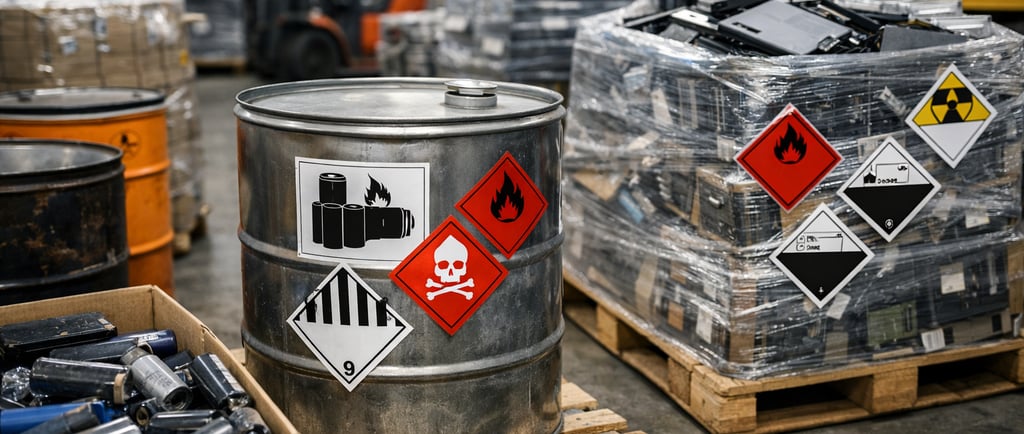
Introduction
E-scrap sits at the intersection of two fast-moving realities. First, e-waste is growing faster than most recycling systems can keep up. The Global E-waste Monitor reports 62 million metric tons generated in 2022, with only 22.3 percent documented as formally collected and recycled, and projections rising to 82 million metric tons by 2030. Second, a growing share of that stream contains energy-dense batteries and legacy toxic components, so transport risk is no longer theoretical. Airlines and regulators have tracked an uptick in lithium battery overheating incidents, and carriers have tightened policies in response.
That combination changes what “good operations” looks like for processors, brokers, refurbishers, exporters, and logistics partners. You cannot treat dangerous goods as a paperwork step done at the end of the dock. Dangerous goods classification, UN numbers, marks, labels, packing instructions, and training need to be built into intake, dismantling, sorting, storage, and outbound staging.
This guide is written to be global by design. It uses the UN system as the backbone, then shows how air, sea, and road rules typically inherit or mirror that backbone, with stricter requirements layered on top depending on mode and jurisdiction. It also reflects the biggest regulatory shift hitting e-scrap movements right now. Basel Convention amendments that expand controls on both hazardous and non-hazardous e-waste take effect on January 1, 2025, which raises the compliance bar for international shipments and increases scrutiny on documentation quality.
If you run e-scrap operations, your goal is simple. Every shipment should leave your site with the correct classification, the correct UN number and proper shipping name, the correct markings and labels, and a documentation trail that survives a spot check at a border crossing or carrier terminal.
Section 1. Why dangerous goods controls matter in e-scrap
Dangerous goods compliance is about preventing two outcomes that are both expensive. The first is a safety event, like a battery thermal runaway during handling, storage, or transport. The second is a compliance event, like a shipment refusal, detention, or enforcement action because the UN number, marks, or paperwork does not match the actual risk profile of the load.
In e-scrap, the risk drivers are predictable. Modern devices concentrate lithium-ion cells, power banks, battery packs, and embedded batteries in high volumes. Older streams can carry mercury components, PCB-containing parts, and CRT-related hazards that are often mischaracterized during sorting. Your exposure rises when you ship mixed lots, use multiple subcontractors, or export, because every handoff adds a failure point.
The business impact is not limited to a single rejected container. It shows up as carrier restrictions, insurance friction, higher claims frequency, and customer audits that go beyond the shipment itself into your training records and storage controls. The more your customers are exposed to EPR and downstream due diligence, the more they will demand proof that you can run safe, compliant movements, not just recycling output. Basel’s expanded e-waste controls and the direction of travel in major markets are reinforcing that demand.
Section 2. The global rule stack you must align to
Most operators get tripped up because they treat each rulebook as separate. In practice, the UN Recommendations on the Transport of Dangerous Goods, usually called the UN Model Regulations, form the core vocabulary. They define hazard classes, UN numbers, proper shipping names, packing groups, marking and labeling principles, and the structure that other modal codes align to.
From there, your shipment inherits requirements based on transport mode.
Air
Air transport follows ICAO Technical Instructions and is commonly implemented by carriers through the IATA Dangerous Goods Regulations and associated guidance. Air rules are often the strictest on lithium batteries, state of charge, packing instructions, and training expectations. For example, IATA guidance for 2026 highlights state-of-charge limits and new requirements around batteries packed with equipment, plus detailed classification flowcharts and training clarifications.
Sea
Sea transport follows the International Maritime Dangerous Goods Code, which continues to evolve with new entries and amendments. Amendment 42-24 becomes mandatory from January 1, 2026 and includes updates such as sodium-ion battery entries and new UN numbers, which matters if your outbound includes emerging chemistries or equipment powered by them.
Road and rail
Road and rail rules differ by region, but typically harmonize heavily with the UN model. In Canada, the Transportation of Dangerous Goods framework includes clear marking expectations such as displaying the UN number and shipping name in common containment scenarios, including overpacks. In the US, DOT regularly updates harmonization with international standards, and recent Federal Register activity shows this is an ongoing process, not a one-time alignment.
Basel and environmental controls
Separate from transport rules, Basel controls determine whether a movement is treated as controlled waste and what paperwork and permissions you need across borders. Basel’s e-waste related changes effective January 1, 2025 increase the operational need for clear segregation, clear classification, and clean documentation.
Section 3. What counts as dangerous goods in e-scrap
Dangerous goods in e-scrap is not limited to “a pallet of batteries.” It includes any configuration where a regulated hazard is present and the rules treat it as dangerous goods based on classification and quantity thresholds.
Common high-risk categories in real e-scrap operations include:
Lithium batteries in multiple states
Loose lithium-ion batteries, lithium batteries packed with equipment, lithium batteries contained in equipment, and damaged or recalled batteries, which are often treated very differently by rules and carriers.
Lead-acid and other wet batteries
These can bring corrosive hazards, leak risks, and different marking and packaging expectations compared to lithium streams.
Devices with embedded power sources
Laptops, tablets, telecom equipment, industrial controls, and IoT gear often contain embedded batteries that are missed during intake screening, especially in mixed refurb and scrap streams.
Legacy toxic components
Mercury-containing devices, certain capacitors, and PCB-containing components can create hazardous classification outcomes even when the rest of the load appears benign.
You also need to treat “used” versus “waste” distinctions as operationally relevant. Basel technical guidance exists largely because shipments are often misrepresented as reusable equipment when they functionally behave as waste. This is a known enforcement focus area, and it interacts with how you describe and document loads in the supply chain.
Section 4. UN numbers, proper shipping names, and hazard classes
UN numbers are four-digit identifiers assigned to dangerous goods entries. They are paired with a proper shipping name and hazard class, and often special provisions and packing instructions. In practice, you do not choose a UN number because it “seems close.” You select it because the item and configuration match the entry definition.
In battery-driven e-scrap, a practical way to avoid misclassification is to start from configuration, not chemistry.
Batteries by themselves
For lithium-ion batteries shipped alone, UN 3480 is a common entry, and air transport rules apply strict packing instruction controls.
Batteries packed with equipment or contained in equipment
UN 3481 and UN 3091 are commonly used in these configurations, and air guidance increasingly pushes state-of-charge controls and clear training expectations even where some shipments fall under simplified provisions.
Emerging chemistries
Sodium-ion is now explicitly addressed with entries such as UN 3551 and UN 3552 in aviation guidance, and maritime updates also incorporate sodium-ion changes.
Vehicles and large equipment powered by batteries
Newer entries, including UN numbers for battery-powered vehicles and specific battery chemistries, appear in guidance used by shippers and carriers, which matters if you handle e-mobility streams or large battery systems.
A key operational detail that many sites miss is the battery test summary requirement. IATA guidance references the UN Manual of Tests and Criteria 38.3 testing framework and the requirement to make a test summary available for cells and batteries manufactured after a certain date, with limited exceptions. That requirement can affect what you can legally tender to carriers and what you can defend during an audit.
Section 5. Labels, marks, and packaging basics that prevent refusals
Marks and labels are where good classification turns into defensible shipping. They also act as a fast proxy for compliance during spot checks because inspectors and carriers often look at the outside first.
At a minimum, you need to treat three layers as distinct.
Package marks
These include the UN number and proper shipping name related marks, plus orientation marks when required, and any required overpack markings when marks are not visible through the overpack.
Hazard labels
These show the hazard class or subsidiary risks that apply. In mixed e-scrap movements, mislabeling often happens when teams assume “everything is Class 9.” That can be wrong depending on chemistry, configuration, or specific hazards.
Packaging instructions
The packaging requirement is not just “use a strong box.” It includes inner packaging rules, separation rules, short-circuit protection, net weight limitations for air, and mode-specific prohibitions.
A concrete example that helps teams internalize this is how air guidance treats lithium battery shipments. The IATA lithium and sodium-ion guidance includes flowcharts and packing instruction references that change the allowed quantities, packaging types, and even whether passenger aircraft carriage is forbidden. This is why battery movements are so frequently rejected when the shipper follows a generic warehouse packing standard instead of a dangerous goods packing instruction.
For road movements, regulators also provide clear examples of what must be displayed in containment and overpack scenarios. Transport Canada, for example, explains the requirement to display the primary class label, shipping name, and UN number when marks are not visible through an overpack.
Section 6. Documentation, what must match, and what auditors check
Documentation is where most e-scrap sites lose time, because a small mismatch can break the entire chain of custody. Dangerous goods paperwork is also where environmental rules and transport rules collide. Your shipment description, classification, packaging details, and emergency response information must be consistent across all documents used by the shipper, consolidator, carrier, and broker.
In air shipments, documentation expectations escalate quickly when you are outside simplified provisions. IATA guidance also makes an important point about training, even shipments prepared under certain sections still require adequate instruction, and other sections require full dangerous goods training.
On the Basel side, documentation needs can change based on whether the movement is controlled waste, and Basel’s e-waste amendments effective January 1, 2025 expand the scope of controls. That raises the likelihood that documentation will be checked for correct classification and waste versus non-waste distinctions.
A practical documentation rule you can enforce internally is this. If the UN number on the package, the proper shipping name in your system, and the entry on the transport document do not match, treat it as a stop shipment event until resolved. It sounds strict, but it prevents the operational spiral of rework at the carrier terminal.
Section 7. Intake to outbound workflow, where sites usually fail
Most dangerous goods failures originate upstream of shipping, not at shipping. They start at intake.
Step one is triage at receiving.
You need to identify battery presence, battery condition, and embedded batteries that will remain in equipment. You also need to separate damaged, defective, or recalled batteries immediately because they often fall under different prohibitions and approval requirements in air and sometimes sea contexts.
Step two is segregation and storage.
You need physical controls that prevent short-circuit risk, thermal exposure, and mixing of incompatible items. This is not just safety. It is also evidence during an audit that you manage hazards intentionally.
Step three is packaging and labeling as a controlled process.
Treat packaging and labeling like a production step with checks, not like a warehouse task. If you rely on memory, you will get inconsistent labels and missed marks, especially with turnover.
Step four is outbound staging.
Outbound staging should include a final compliance gate where the physical package is checked against the system record and documents. This is where you catch the common failure, the package reflects one UN number but the paperwork reflects another.
Section 8. Training and competence, the part regulators and carriers remember
Training is not a once-a-year checkbox. In dangerous goods, training is part of your ability to ship at all. Carriers can and do refuse loads if they do not trust the shipper’s training controls, and auditors often look for evidence that training is role-based, current, and tied to the rule set that applies to your modes and lanes.
The IATA lithium and sodium-ion guidance spells out that dangerous goods training is required for certain lithium battery shipment categories, and that even where formal training is not required under a simplified section, adequate instruction is still required. This distinction is important because many e-scrap teams assume “small batteries, small rules,” and that is where mis-prepared shipments begin.
A training system that holds up under scrutiny has four properties.
It is role-based, packers and shippers need different depth than intake sorters, but both need hazard recognition.
It is lane-aware, air rules can change what you can tender even when the first leg is road.
It is documented, with refresh cycles and recorded updates.
It is tied to incident learning, every near miss updates the training content.
Section 9. Audit readiness, KPIs, and what “good” looks like
Audit readiness is not about producing a binder. It is about being able to prove repeatable control in minutes.
There are a few KPIs that correlate strongly with fewer shipment failures.
Classification accuracy rate
Track the percent of shipments that pass internal classification review without correction.
Label and mark conformity
Track the percent of packages that match the required markings and hazard labels on first pass.
Documentation match rate
Track matches between package marks, system records, and transport documents.
Exception rate by stream
Battery-heavy streams should show lower variance over time if controls are working. If variance spikes, your intake triage is failing or your training is slipping.
Incident and near-miss closure time
If you cannot close a near miss quickly with corrective action, the same error will show up again at the border.
You also need to watch the external environment, because rules change. Basel e-waste controls expand in 2025, maritime rules change with amendments becoming mandatory in 2026, and aviation guidance continues to evolve around lithium battery risk, including state-of-charge controls that are now explicitly called out for 2026.
This is the point where mature operators stop treating dangerous goods as a compliance cost and start treating it as an operating system. With that foundation in place, the next step is to build distribution and reuse mechanisms that keep controls intact as volume scales across lanes, carriers, and sites.
10. Embedded Five-Layer Toolkit: Distribution & Reuse (Continued)
Future-Proof Your Compliance Strategy
Leveraging Process Automation and Digital Tracking
Modern e-scrap processors are moving to digital-first compliance platforms. According to a 2023 ISRI industry survey, 61% of e-waste exporters plan to invest in compliance automation or mobile tracking by 2025. These tools dynamically update with regulatory changes, provide real-time checklists, and maintain digital audit logs—a critical advantage as authorities increase spot-checking frequency across international borders. For instance, AI-powered platforms can now scan incoming shipments, auto-classify hazardous materials using image recognition, and flag missing UN codes, drastically reducing manual error rates.
Integrated Staff Training Modules
Continuous, documented staff training mitigates the risk of non-compliance. Online learning portals tailored to UN regulatory updates—such as those offered by the Basel Action Network (BAN) or NAID—help organizations ensure every employee understands their responsibilities. Staff are certified, their knowledge tracked digitally, and refresher modules prompt retraining upon significant regulatory changes—resulting in improved audit outcomes and reducing fines.
Chain-of-Custody Blockchain Solutions
Several progressive processors are piloting blockchain-based chain-of-custody tools for the e-scrap supply chain. These systems create immutable records for every handoff, inventory movement, and label application. Immutable ledgers enhance regulatory trust and facilitate incident forensics in the event of compliance disputes. In 2024, 12% of OECD-certified e-scrap exporters had integrated blockchain or similar distributed ledgers to strengthen external stakeholder confidence.
Third-Party Permit Management
Navigating multi-jurisdictional export permits requires dedicated expertise. Some large e-scrap facilities now utilize external regulatory consultants to pre-vet each shipment—a cost that pays for itself by minimizing customs delays and prevented shipment rejections (which can cost $15,000–$50,000 per export incident). Subscription-based permit management services are expected to double in market adoption by 2027 as regulators increase documentation complexity for international e-scrap flows.
Analytics and Predictive QA
Leveraging analytics to identify bottlenecks or forecast risk events is another frontier. Systems now provide dashboards tracking code assignment timeliness, near-miss incidents, and carrier infractions. Companies employing predictive analytics in their compliance workflow report a 30% reduction in non-compliance events and a 35% improvement in audit pass rates, according to the Electronics TakeBack Coalition’s 2023 compliance study.
11. Competitive Differentiation: Market Gaps & Upgrades
Identifying Gaps in Dangerous Goods Compliance
Manual Processes & Legacy Paperwork
Many processors still rely on manual logbooks and printed checklists, a practice that is both time-consuming and highly prone to error. According to ComplianceWeek data, 70% of e-scrap compliance incidents stem from manual paperwork errors or incomplete documentation at export. Upgrading to integrated digital platforms not only streamlines day-to-day operations but also builds a defensible audit trail.
Reactive vs. Proactive Compliance Culture
Best-in-class organizations foster a proactive “compliance-first” culture—where staff anticipate regulatory changes and prepare ahead of enforcement cycles. By contrast, less mature operations often scramble in response to failed audits or last-minute legislative shifts, resulting in penalties and loss of customer trust. Training, frequent fire drills, and simulation audits help build resilience and transform compliance from a bottleneck to a source of operational agility.
Value-Added Services: Sustainability and Transparency
Leading e-scrap processors now leverage robust compliance systems as a market differentiator. Transparent documentation, real-time tracking, and environmental stewardship certifications (such as e-Stewards or R2v3) enable them to command premium pricing and attract enterprise contracts. Forward-thinking clients increasingly require vendors to demonstrate not just legal compliance, but carbon impact measurement and ethical supply chain traceability—a trend reinforced by new EU and US state-level directives.
Tech Integration: AI, ML, and IoT Sensors
Using AI/ML technology to identify hazardous components, predict code assignments, and auto-populate digital shipping manifests stands to dramatically reduce labor overhead and error risk. IoT-enabled bins and sensor-equipped packaging ensure transporters are immediately alerted to abnormal temperature/pressure—critical advances for lithium battery safety. According to Gartner's 2024 landscape analysis, AI-driven compliance features can cut workflow times by up to 50% compared to manual or rule-based processes.
Upgrade Pathways for Processors
Adopt digital compliance suites that integrate inventory, labeling, and document control.
Pilot blockchain for chain-of-custody to ensure transparent shipment histories.
Provide quarterly staff training automatically linked to regulatory update feeds.
Outsource multi-jurisdictional permitting to guarantee uninterrupted international flow.
Market compliance as a value proposition: Share audit success rates, incident-free records, and sustainability data with clients.
12. The Road Ahead: Trends, Pitfalls, and Expert Recommendations
Regulatory Landscape—2024 and Beyond
Dynamic Standards
E-scrap hazardous goods requirements are evolving rapidly. The UN Model Regulations (21st Edition) and the 2025 IATA DGR both introduce updates for battery testing, new hazard pictograms, and tracking requirements for mixed shipments. Regional authorities—like the US DOT and Europe’s ADR—are preparing harmonization clauses to reduce cross-border confusion, but this will raise expectations for systems-based proof of compliance.
Extended Producer Responsibility (EPR)
By 2027, Extended Producer Responsibility frameworks in North America and the EU will require original electronics manufacturers and first-handlers to demonstrate downstream compliance, including proper hazardous labeling and export permitting for e-waste. This change shifts more responsibility up the chain and will force closer integration between producers, processors, and logistics operators.
Common Pitfalls Still Hindering Compliance
Neglecting Real-Time Updates: Regulatory tables and UN numbers can change mid-year; missing an update exposes shippers to audit risk.
Overlooking Small Components: Button-cell batteries, mercury switches in legacy equipment, and PCBs are often overlooked and cross-contaminated into non-hazardous flows.
Underestimating Training Gaps: High staff turnover in e-scrap sites directly correlates with an increase in non-compliance events; onboarding and ongoing reinforcement are critical.
Expert Recommendations for E-Scrap Processors
Establish a regulatory intelligence lead: Designate a staff member or team to monitor standards bodies, regulatory feeds, and permitted shipping lists.
Integrate compliance at every operational stage: Build UN code checks, packaging verifications, and digital logs into the default workflow.
Engage with industry groups: Networking through ISRI, BAN, or ERA provides early warning of upcoming rules and instant benchmarking against leaders.
Invest in continuous improvement: Conduct semi-annual “mock audits” to stress-test systems, uncover weak points, and drive incremental upgrade cycles.
Showcase compliance externally: Share KPIs, pass rates, and digital process stats with your logistics partners and clients to build trust and win contracts.
13. Additional Case Studies & Outcomes
Case Study: North American E-Scrap Exporter
Facing increased audits from both Canadian and US authorities, this organization invested in a cloud-based compliance management system linked to on-site barcode scanners. The result: document error rates dropped from 6% to under 1%, and regulatory audit pass rates improved from 85% to 100% year-over-year. The client was able to expand exports to 14 new countries after third-party certification.
Case Study: EU Battery Recycler
A leading European battery recycler, using AI-driven inventory cameras and real-time labeling checks, eliminated mislabels across 50,000+ shipments in a single year. The company saved over €250,000 in potential penalties and reduced insurance premiums by nearly 20% by substantiating their risk mitigation through credible QA data.
14. Conclusion: Unlocking Safer, Smarter E-Scrap Flows
E-scrap processors and exporters operate in an environment of zero tolerance for dangerous goods mistakes. The intersection of UN codes, accurate labeling, robust documentation, and agile compliance systems is not just a regulatory necessity but a business edge. By harnessing digital tools, rigorous training, and transparent processes, organizations can confidently meet global e-scrap safety requirements, minimize risk, and secure competitive advantage—present and future.
FAQ
What are UN codes, and why are they required for e-scrap shipments?
UN codes are four-digit identifiers assigned to hazardous materials. For e-scrap, using the correct UN code is essential for regulatory compliance, proper labeling, and safe transport. They help keep the shipment legal, reduce the risk of rejection, and protect workers and the environment.
Which e-scrap dangerous goods require UN labeling?
Lithium and lead-acid batteries, mercury switches, select capacitors, certain CRTs, and PCB-containing parts require UN labeling. The exact requirement depends on local, national, and international rules, so you must verify it for each shipment.
What happens if I use the wrong UN code or label?
Wrong UN codes or labels can trigger shipment delays, regulatory fines, and refusals by carriers or customs. Accurate documentation is mandatory if you want to avoid avoidable compliance and operational problems.
How often should staff be trained on UN code and labeling rules?
Train staff at least once per year on current regulations. If your site ships high volumes, do quarterly refreshers. Training should include new codes, packaging instructions, and labeling standards.
Are digital tools available for UN code tracking and compliance?
Yes. Compliance platforms can automate code assignment, packaging documentation, permit management, and audit trails. This reduces errors and makes audits easier for e-scrap processors.
Final Thoughts
The future of e-scrap compliance demands more than basic box-ticking. With digitalization, constant learning, and a commitment to transparent, defensible systems, hazardous goods handling becomes a strength, not a liability—fueling business growth and regulatory peace of mind.
For deeper dives on lithium battery shipping, regulatory audit checklists, and staff training programs, explore our related guides linked throughout this article. Stay ahead of compliance—subscribe to our blog!
Connect
Your trusted partner for scrap metal procurement.
CONTACT
About
haroon@tdcventures.com
+1-307-655-7593
© 2025. All rights reserved.
NEWSLETTER