
Data Center Resilience: Metal Choices for Cooling
Cooling failures are a top cause of data center outages. Discover how choosing climate-resilient, recycled metals like 316L stainless steel can slash downtime, cut embodied carbon by up to 80%, and future-proof your infrastructure against rising climate risks.
CLIMATE-RESILIENT INFRASTRUCTURE & CIRCULAR MATERIALS
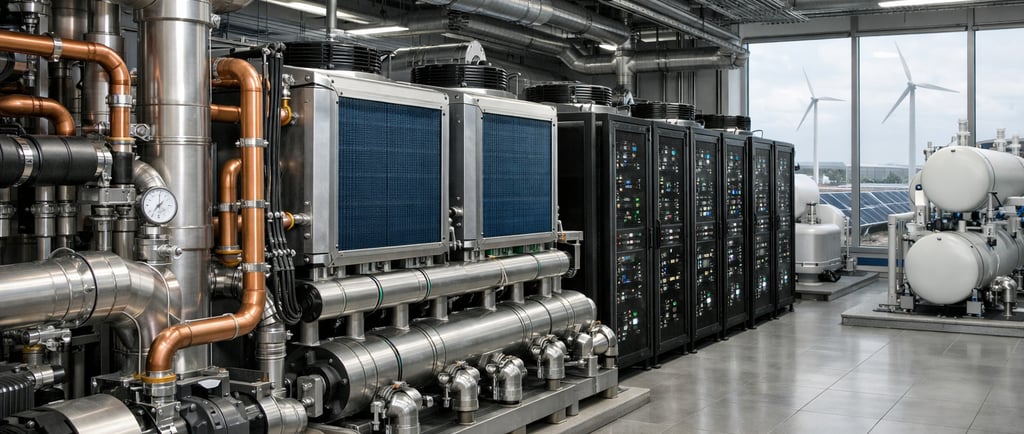
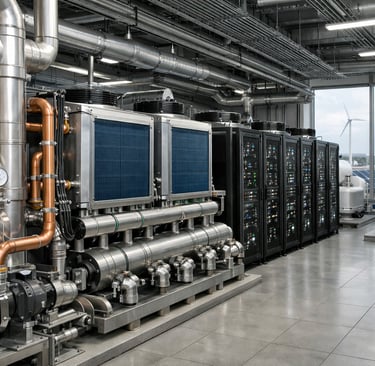
Introduction: The Stakes of Metal Selection in Data Center Cooling
Metal selection for data center cooling is far more than a background specification—it has become a boardroom-level conversation in 2024. The resilience of a data center, defined as its ability to withstand disruptions, recover quickly, and maintain 24/7 uptime, fundamentally hinges on the strength, integrity, and sustainability of its cooling system materials. The cooling infrastructure is no longer judged simply by BTUs removed per hour, but by how seamlessly it operates through climate extremes, rapid load growth, and regulatory shakeups.
Given that today’s hyperscale and edge data centers are expanding into regions exposed to record-breaking heat waves, unpredictable flooding, and severe storms, the durability of cooling system metals directly influences service continuity and brand trust. Colocation operators, mission-critical facility managers, and mechanical-electrical-plumbing (MEP) engineers face a new reality: A suboptimal metal choice in cooling infrastructure can accelerate corrosion, increase unscheduled outages, and inflate both carbon and financial costs.
Why is all this happening now? The digital economy’s hunger for low-latency, high-density compute has pushed data centers into environments with harsh water chemistry and corrosive airborne contaminants. With global data center energy use projected to double by 2030 (per International Energy Agency estimates), both clients and regulators demand sustainable infrastructure that can scale without contributing to climate risk or resource depletion.
Enter recycled and circular metals. Well-chosen, these materials massively reduce both lifecycle emissions and operational risks. Not only do they offer superior performance in corrosive environments, but they align with investor ESG priorities and emerging climate-resilient standards—transforming cooling systems from a hidden vulnerability into a competitive differentiator.
2. Defining the Problem: Metals, Cooling, and Climate Resilience
Data center downtime is costly: Uptime Institute’s 2023 survey found the average cost of a critical infrastructure outage approaches $700,000, with cooling system failures ranking among the top three causes. In this context, the legacy approach to metal selection—guided mainly by capital cost or textbook corrosion rankings—is dangerously outdated.
Key Failure Patterns and Risks
Corrosion and Scaling: Traditional choices (e.g., standard carbon steels) break down rapidly when exposed to humid air, high-chloride water, or extreme temperature cycles. Leaks, pitting, and scale formation not only lower system thermal efficiency but can cause catastrophic bursts during high load.
Slow Post-Failure Recovery: Some facilities experience MTTRs of 72–120 hours during unplanned cooling outages, primarily driven by sourcing delays for niche or imported alloys. This downtime can shatter service-level agreements and tarnish customer relationships.
High Embodied Carbon: Embodied embodied carbon (the sum of greenhouse gas emissions produced in raw material extraction, processing, and transport) in primary metals clashes with modern low-carbon design mandates. Each ton of virgin stainless steel, for example, emits about 4-6 tons of CO2e if not sourced from recycled inputs.
Traceability Gaps: Without verified material provenance and recyclability credentials, operators cannot guarantee closed-loop recovery or avoid compliance penalties for waste or carbon reporting.
Operational Stakes at a Glance:
Even a 1% efficiency loss due to internal scaling can raise rack inlet temperatures by 5°C, pushing hardware toward thermal throttling or failure.
In coastal or highly humid climates, corrosion accounts for nearly one-third of all unexpected cooling equipment failures, according to the American Society of Mechanical Engineers (ASME).
The absence of a clear metals recovery plan at end-of-life can result in 30–50% of high-value metals being lost to landfill rather than re-entering the circular economy.
As data centers proliferate in emerging markets and edge locations, these risks multiply—demanding a new, holistic view of metal choice built for resilience, repairability, and regulatory alignment.
3. Key Concepts: Resilience, Circularity, and Low-Carbon Metals
To address the technical and environmental demands of 21st-century infrastructure, teams must prioritize three intertwined qualities in their metal selection process:
A. Resilience
Data center resilience is not a static property—it’s a dynamic ability to anticipate, withstand, quickly recover from, and adapt to disruptions. For cooling systems, resilience emerges from:
Metals engineered for decades-long service lives under severe environmental conditions.
Proof of resistance to corrosion, thermal fatigue, and frequent maintenance without degrading.
Rapid availability for replacement or upgrade, supported by regional supply chains and modular designs.
B. Circularity
Circularity in metals means adopting a ‘design for recovery’ mindset—so cooling materials are not just used, but re-used, repaired, reused, and recycled with maximum economic and environmental value. Circular, closed-loop sourcing minimizes waste, creates rapid repair pathways, and enables compliance with emerging right-to-repair regulations.
Concrete benefits:
Use of recycled metals has been shown to reduce greenhouse gas emissions by up to 80% compared to virgin material production, based on International Resource Panel data.
Circular procurement increases system resilience by ensuring that spare parts and replacement stock are both locally available and compatible with EOL (end-of-life) recycling streams.
C. Low-Carbon Metals
Beyond durability, the carbon footprint of each kilogram of metal matters. Investors and large clients expect data center projects to meet Science-Based Targets (SBTs) for embodied carbon. Recycled-content metals are not just more sustainable—they signal climate leadership and regulatory foresight.
Metal typeCorrosion resistanceEmbodied carbon (kg CO2e/ton)Recycled content (typical max)RecyclabilityStainless steel 316LVery high~3,000–4,000>85%Excellent (fully recyclable, high recovery)Aluminum alloy 6061High~1,300–2,500>90%Excellent (recycling uses ~5% of primary energy)Copper-nickel alloysHigh (marine/demanding)~3,800–5,000>70%Good (high circular value)
Note: Values based on 2023 global averages (World Steel Association, European Aluminium Association)
When combined, these attributes deliver a future-proof cooling platform—built to survive evolving climate and compliance shocks.
4. Framework: Building Next-Gen Cooling Systems with Recycled Metals
Designing for resilience with recycled metals is not a ‘bolt-on’ activity, but a systematic approach that transforms every phase of project delivery.
Core Steps for Resilient, Circular Cooling Design
Environmental Assessment: Map exposure severity—humidity, salinity, temperature swings, urban pollutants.
Requirements Definition: Capture all technical, operational, and regulatory requirements (e.g., allowable chloride levels, pressure ratings, maintenance preferences).
Material Prequalification: Assemble a metals shortlist using datasheets, EPDs (Environmental Product Declarations), and regional recycled-content availability.
Corrosion and Galvanic Analysis: Use site-specific water and air chemistry to simulate long-term corrosion behavior, especially at junctions of mixed metals.
Lifecycle Assessment (LCA): Model embodied carbon, service life projections, maintenance needs, and end-of-life recycling pathways.
Supplier Due Diligence: Vet traceability, audited recycled content, local recycling infrastructure, and third-party certifications (e.g., Cradle to Cradle, REACH).
Detailed Design & Specification: Codify choices in construction/BIM documents, outlining installation, handling, and preventive maintenance protocols.
Prototyping and Testing: Pilot critical system stretches under accelerated environmental exposures or via digital twins.
Operations and Maintenance Planning: Program maintenance checks, part replacement intervals, and train teams on recognizing early signs of wear and corrosion.
End-of-Life and Circular Recovery: Design for disassembly; lock-in take-back agreements with local recyclers and track realized recovery rates.
Real-World Example: Coastal Data Center Retrofit
Facility Profile: 10MW, multi-tenant colocation, operating in a salt-laden marine climate.
Trigger: Unexpected corrosion shut down two cooling loops within five years of launch (using standard carbon steel).
Steps Taken:
Switched to recycled 316L stainless steel for piping and plate heat exchangers.
Secured 85% recycled content from a local steel mill, minimizing transport emissions.
Modified flange and bracket designs to enable tool-less disassembly for future upgrades.
Annualized corrosion inspections flagged a 96% reduction in incidents after retrofit.
Bottom-Line Impact: Lifecycle cost over 20 years fell by 22%, with avoided outages translating to an estimated $450,000 in protected revenue. Embodied carbon was halved compared to the original spec. Circular recovery was contractually guaranteed at end-of-life.
5. Step-by-Step Guide: Applying the Metal Selection Framework
Ready to transform cooling system resilience? Follow this practitioner’s workflow, verified by top colocation and edge facility operators:
Environmental Mapping: Trace site-specific climate and chemical loads—from prevailing wind-driven salts to urban ozone and airborne nitrates.
Full System Inventory: Document every metallic component touching cooling fluids—pipes, fittings, pumps, exchangers, valves, and spares.
Specs and Codes Collection: Gather all engineering requirements (operating pressures, peak versus steady-state temps, regulatory mandates on recycled content).
Recycled Metal Vetting: Acquire technical datasheets highlighting recycled content, corrosion ratings, mechanical strength, and manufacturing origin.
Comparative Scoring: Systematically rate metals for corrosion resistance, carbon footprint, recyclability, supply chain security, and price stability.
Site-Specific Corrosion Simulation: Model how candidate metals behave under local water chemistry using corrosion curves and real-world failure databases.
Supplier Traceability Checks: Request full chain-of-custody documentation, third-party audits, and real-time tracking of recycled content.
Top Candidates Downselect: Identify the 2–3 alloys with best fit, and validate their performance history from similar climate/data center cases.
Accelerated Piloting: Where possible, subject samples or pilot sections of pipe/exchanger to intensive cycles in the lab, or digitally stress test via CFD and LCA models.
Specification Finalization: Lock in all design, installation, and maintenance notes in technical documentation and 3D/BIM models for as-built/permanent record.
Operator Training: Deliver tailored learning modules for ops teams—covering material-specific handling, leak detection, and early warning sign identification.
Traceability Logging: Institute continuous digital logs tracking materials, locations, replacement frequency, and maintenance interventions for audit-readiness.
Maintenance Interval Setting: Combine supplier datasheets with pilot outcomes to tune inspection and replacement intervals for each metal/component.
Circularity Contracts: Ensure take-back, refurbish, and recycling agreements are in place for all metals, with penalties for landfill loss.
Quarterly Performance Verification: Review all field metrics quarterly, feeding findings into design/operations refinements.
Annual Documentation Audit: Validate traceability, recovery, and recycling rates via internal or third-party review to protect ESG reputations.
Pro Tip: The best-performing teams treat metal lifecycle management as a core pillar of overall data center asset performance—not just an engineering afterthought.
Measurement and Quality Assurance: How to Prove Your Metal Choices Are Actually Working
A resilient cooling system is not proven at handover. It is proven in year one, in year three, during the first heat wave, after the first water chemistry upset, and when a replacement valve or plate pack is needed in a hurry. That is why measurement and quality assurance must sit at the center of any serious metal-selection strategy for data centers.
The biggest mistake operators make is assuming that a premium alloy automatically solves risk. It does not. A good metal can still fail early if the weld quality is weak, if mixed-metal interfaces were poorly detailed, if water treatment drifts, or if maintenance teams inherit incomplete records. In practice, data center resilience comes from the marriage of material choice, installation quality, fluid chemistry control, and disciplined verification.
Start with the metrics that actually matter. Availability remains the north star. Uptime Institute’s 2025 outage analysis reported that more than half of respondents said their most recent significant outage cost more than $100,000, and about one in five said it cost more than $1 million. That matters because cooling failures do not need to be catastrophic to become financially painful. A short-lived leak, a fouled heat exchanger, or a burst section of poorly selected pipe can trigger thermal alarms, throttling, customer complaints, emergency service calls, and long procurement delays. In a market already strained by rising power constraints, AI buildouts, and supply chain friction, material mistakes are no longer small engineering errors. They are business events.
The first measurement layer is physical integrity. Every operator should track corrosion rate, scale accumulation, leak incidence, weld defect rate, and unplanned replacement frequency at the component level. This sounds basic, but few sites maintain a clean, searchable history linking each failure event to a material grade, supplier lot, water profile, and operating condition. Without that chain, organizations keep buying the same trouble in new packaging.
The second layer is thermal performance. A cooling loop may stay “operational” while quietly degrading. Plate heat exchangers can foul. Internal surfaces can scale. Flow restriction can rise. Even before a visible failure, the system may require higher pumping energy, tighter temperature control, and more maintenance labor just to hold the same rack inlet conditions. This is why thermal approach temperature, pressure drop drift, and heat-transfer performance should be trended alongside basic uptime metrics. If your materials strategy is sound, those lines stay stable for longer, inspection intervals can be extended with confidence, and maintenance stops become planned rather than reactive.
The third layer is water and chemistry control. As liquid cooling grows, material compatibility with water quality becomes more important, not less. ASHRAE’s guidance on water-cooled servers stresses that corrosion and scaling can accelerate when wetted materials are chemically incompatible with the waterborne constituents in the loop, and that material selection should be tied directly to water quality standards and loop conditions. In other words, the alloy decision cannot be separated from the fluid decision. A site that buys excellent stainless or copper-nickel components but runs unstable chemistry is still building risk into the system.
The fourth layer is sustainability proof. This is where many glossy ESG claims collapse. If a project claims “low-carbon metals,” it should be able to show Environmental Product Declarations, recycled-content evidence, traceability records, and end-of-life recovery arrangements. World Stainless states that around 95% of end-of-life stainless steels are collected and recycled into new stainless steels, while worldsteel emphasizes that steel scrap’s intrinsic value makes recovery economically viable across many waste streams. The International Aluminium Institute reports that recycled aluminium uses about 95.5% less primary energy than primary production, and the Copper Alliance states that copper recycling can use up to 85% less energy than primary production. Those are powerful advantages, but they only count strategically when owners can document what they bought, from whom, with what recycled content, and what happens to it at end of life.
That brings us to quality assurance in procurement. The best operators now require a material dossier for every critical metallic component. That dossier should include the exact alloy and grade, weld procedures, pressure rating, corrosion data, recycled-content declaration, country of melt or fabrication where relevant, and spare-part lead time. For stainless, this often means moving beyond a generic “316L” note and capturing actual fabrication and finishing requirements, because performance in chloride-bearing or deposit-prone conditions depends heavily on execution quality as well as nominal chemistry. The Nickel Institute notes that 316L is a more conservative choice than 304L in more aggressive water conditions and has improved corrosion resistance where higher residual chlorine and deposits are present.
Data centers should also bring sustainability metrics into operational dashboards. The Green Grid’s Water Usage Effectiveness, or WUE, remains one of the most useful facility-level measures because it makes water intensity visible rather than invisible. DOE’s 2024 best-practice guide for energy-efficient data center design includes WUE among key data center metrics, and DOE’s cooling tower management guidance notes that increasing cycles of concentration from three to six can reduce cooling tower makeup water by 20% and blowdown by 50%. Those are not abstract gains. They directly affect corrosion chemistry, blowdown frequency, chemical use, and local water-risk exposure.
If you want a simple way to check whether your metal strategy is working, ask six questions every quarter. Are leak events falling? Is thermal performance stable? Are corrosion findings getting milder, not worse? Are emergency part orders declining? Is embodied-carbon documentation complete for new work? And can the operations team identify, from a digital log, exactly what metal is installed where? If the answer to any of those questions is no, the project is not finished. It is still mid-correction.
Real-World Patterns and Mini-Cases: What the Field Keeps Teaching Us
Material decisions become clearer when you stop treating every data center as the same. They are not. Climate, water chemistry, cooling topology, density, supply chain access, and local regulation all change the answer. What matters is pattern recognition.
The first pattern is the coastal penalty. Marine air and chloride exposure punish casual specifications. In coastal regions, facilities that rely on basic carbon steel for parts of the cooling chain often discover the cost of “saving money” later through external corrosion, flange degradation, staining, leaks, and higher inspection frequency. The lesson is not that every component must be an expensive alloy. The lesson is that the corrosivity map should drive zoning. Critical wetted sections, exposed supports, exchanger components, and fasteners in chloride-prone environments need far more disciplined selection and detailing than those in sheltered inland sites. Stainless grades with stronger chloride resistance or copper-nickel solutions in seawater-adjacent services keep appearing in long-life marine applications because they resist both corrosion and operational instability. Copper.org notes that copper-nickel alloys are widely used in seawater piping and water boxes because of their corrosion resistance and thermal stability.
The second pattern is the water-side lesson from liquid cooling. As rack densities rise, air-only strategies face economic and technical pressure. The IEA now projects that global electricity consumption from data centers will more than double to around 945 TWh by 2030, with AI as the biggest driver, and electricity demand from AI-optimized data centers is projected to more than quadruple by 2030. At the same time, Uptime Institute’s 2025 cooling survey found that direct liquid cooling adoption is still gradual, even though high rack densities are the leading driver for it. That combination matters. The industry is moving into a period where more sites will use mixed cooling modes. They will still operate air systems in many spaces, but more high-density zones will depend on liquid loops, CDUs, cold plates, and heat rejection systems that place much more scrutiny on wetted materials and fluid compatibility. In that world, materials are not passive hardware. They become part of the control strategy for reliability.
A useful mini-case here is the hyperscale retrofit problem. Imagine a facility built in the late 2010s for modest rack densities and traditional chilled-water assumptions. It now needs to host AI clusters with much higher heat flux. The operators do not want a full rebuild. They phase in direct-to-chip cooling for selected rows and connect those systems to existing plant infrastructure through new distribution skids and heat exchangers. This is where poor material choices show up fast. If the original piping inventory is incomplete, if mixed metals are introduced without galvanic review, or if old water treatment assumptions are copied into the new loop, the retrofit creates a hidden failure path. The best retrofits handle this by splitting loop responsibilities clearly, documenting fluid quality limits, narrowing approved materials, and requiring commissioning tests that focus on wetted compatibility as much as thermal performance. ASHRAE’s 2026 programming and TC 9.9 materials reflect how central these issues have become in real projects, with strong emphasis on fluid quality requirements, liquid-cooling design characteristics, and resiliency under direct-to-chip scenarios.
The third pattern is the heat-and-water tradeoff in hot inland regions. In these markets, owners may lean toward evaporative or water-intensive rejection strategies because they help energy performance. But if the water source has high mineral content, or if drought and municipal water pressure are rising risks, metal performance becomes tied to water treatment discipline and blowdown economics. The DOE’s cooling tower management guidance makes clear that cycles of concentration, leak control, and compatible use of alternative water streams materially affect water use and system behavior. A site that pushes cycles aggressively without matching metallurgy and chemistry control may save water on paper while shortening component life in practice.
The fourth pattern is edge and remote deployment. Hyperscale campuses can absorb specialty materials and keep larger spare inventories. Small edge sites, remote sites, and emerging-market deployments often cannot. For them, supply chain timing is part of resilience. A theoretically excellent alloy that takes sixteen weeks to source is not always the most resilient answer. A slightly less exotic material with better local availability, proven repair familiarity, and clearer take-back channels may protect uptime better over ten years. This is especially true where skilled labor is limited and component replacement depends on regional distributors rather than global service contracts.
The fifth pattern is the quiet strength of circular procurement. The blog’s first half already framed circularity well. The field confirms it. When operators standardize on recoverable metals, document them well, and line up local recovery partners, they cut disposal friction, reduce emergency sourcing chaos, and improve asset visibility.
Stainless steel and copper remain attractive partly because the recovery market recognizes them, values them, and handles them with fewer ambiguities than many mixed-material assemblies. worldstainless says about 95% of end-of-life stainless steels are recycled, and USGS reports that copper recovered from scrap contributed about 30% of U.S. copper supply in 2025. Those are not just sustainability facts. They are supply facts.
The sixth pattern is the documentation gap. Some of the worst failures come from good materials installed in bad information environments. Operators inherit plants where no one can say which sections are 304L, which are 316L, where dissimilar metal transitions sit, which valves were replaced after an emergency event, or whether a exchanger bundle came from the same source as the approved unit. When you cannot see your materials clearly, you cannot manage risk clearly. A resilient cooling strategy is therefore also a records strategy.
Future Trends Through 2030: How Metal Choices for Cooling Are Changing Fast
The future of data center cooling is not one technology replacing another overnight. It is a layered transition. Air cooling will remain important across a large share of the market for years. DOE presentation material shown at the 2025 Better Buildings Summit noted that air cooling still dominates, around 90%, even as next-generation workloads push facilities toward new architectures. At the same time, higher-density computing is steadily shifting the decision criteria for cooling materials.
The first major trend is the move from “energy-first” cooling decisions to “energy-plus-material-risk” decisions. For years, many teams treated material selection as a support issue behind energy performance. That is becoming less workable. As AI workloads increase heat density and electricity demand rises, the penalty for a cooling failure grows. The IEA’s latest analysis makes clear that data center electricity use is climbing sharply, and that AI is a central driver of the increase. In that environment, facilities cannot afford cooling material strategies that look cheap at bid stage but bring more corrosion, more maintenance, or longer recovery times later.
The second trend is the rise of warm-water and liquid-cooled system thinking. NREL’s Energy Systems Integration Facility highlighted years ago how warm-water direct liquid cooling can move heat efficiently because water carries vastly more heat per unit volume than air, and current ASHRAE work shows how quickly industry guidance is evolving around liquid-cooling classes, fluid quality, and resiliency questions. As more facilities adopt direct-to-chip cooling, immersion systems, or hybrid designs, the conversation shifts from generic HVAC metals to loop-specific material science. Operators will need tighter control of pitting resistance, particulate shedding, brazing compatibility, gasket behavior, and serviceability.
The third trend is traceability becoming mandatory, not optional. This is happening because carbon disclosure, circular procurement, and supply chain scrutiny are moving into the same room. worldsteel released updated chain-of-custody guidelines in February 2026 to improve transparency and accountability in company schemes relating to greenhouse gas reduction claims. That direction matters for data center projects because material declarations are becoming more contested. Buyers, investors, and customers increasingly want evidence behind recycled-content and emissions claims. For cooling systems, this means metal specifications will carry more documentary weight. “Low-carbon steel” or “recycled stainless” will need proof attached, not just marketing language.
The fourth trend is regional sourcing becoming part of resilience strategy. Supply chain shocks over the last several years changed how operators think about uptime risk. The most resilient procurement model is often not the one with the absolute lowest material price. It is the one that combines acceptable corrosion performance, known fabrication quality, credible sustainability data, and reachable replacement stock. Facilities with regional supply relationships for standard high-performance alloys will recover faster than those dependent on long-distance custom imports for every critical part.
The fifth trend is water stress moving closer to the center of design. The Green Grid’s WUE framework has existed for years, but water risk is becoming harder to ignore as more facilities face permitting pressure, public scrutiny, and climate-related supply volatility. That changes material choice because hot, water-stressed regions often push owners toward harder tradeoffs between evaporative savings, treatment intensity, blowdown, reuse streams, and component life. Metals that tolerate a wider range of real-world water conditions without dramatic life loss become strategically more attractive.
The sixth trend is stronger interest in recycled and low-emissions metals. Aluminium recycling’s roughly 95.5% primary energy saving, copper recycling’s up to 85% lower energy use, and stainless steel’s high end-of-life recovery rates make these materials more appealing in projects under pressure to cut embodied carbon. That does not mean all recycled metal is equal. It means owners now have a stronger business case to ask sharper questions about scrap content, melt route, EPD quality, and regional electricity mix used in fabrication.
The seventh trend is digital twins and materials intelligence. More operators will use digital models not only for airflow and energy use, but for corrosion exposure, maintenance planning, and spare-part prediction. The long-term winners will likely be the firms that can connect material metadata to operating telemetry. When a loop starts drifting, they will know not just that performance changed, but which alloy is in the affected section, what its service history is, and what replacement path is fastest.
By 2030, the question will not be “Which metal is best?” It will be “Which metal system, with which documentation, under which fluid regime, in which climate, gives me the lowest lifetime risk?” That is a far better question, and it is where the market is heading.
The Practitioner’s Toolkit: A Full Playbook for Owners, Engineers, Procurement Teams, and Operators
A strong article should leave the reader with something they can use Monday morning. So here is the practical toolkit.
First, at the strategy level, define the cooling material brief before design gets too far. That brief should answer six things clearly. What densities are expected today and in the next five years? What climate and water stressors are present? What is the acceptable outage and maintenance risk? What embodied-carbon and recycled-content goals apply? What local spare-part and recovery ecosystem exists? And what standards of traceability will be required from suppliers?
Second, build a climate-and-chemistry risk map. Separate the site into zones. Wet interior loop. Heat rejection interface. Outdoor exposed metalwork. Coastal or salt-laden exposure. Chemical treatment contact points. Drainage and condensate contact areas. For each zone, list the likely corrosive drivers. Chlorides. residual oxidants. temperature cycling. deposits. humid air. industrial pollutants. mixed-metal contact. Then match materials to the zone rather than pretending one alloy solves everything.
Third, tighten your approved-material schedule. Many projects stay too vague. Instead of broad labels, specify exact grades, acceptable alternates, finish requirements, weld expectations, gasket compatibility, and no-go pairings for dissimilar metals unless separately reviewed. For any stainless selection in challenging waters, require a site-specific rationale, not habit. For any aluminium or copper component in contact with other metals, require galvanic review and joint detailing. For any vendor proposing substitutions, require fresh corrosion, carbon, and traceability evidence.
Fourth, make procurement smarter. Every bidder for critical cooling metals should be asked for five items. A recycled-content declaration. An environmental product declaration or equivalent emissions data. Lead times for standard and emergency replacement. Chain-of-custody or traceability records. End-of-life recovery options. If a bidder cannot provide these for major components, they are not selling resilience. They are selling uncertainty.
Fifth, commission the system like you expect it to fail one day. Too much commissioning proves the system works on day one and stops there. A better approach asks: what happens if chemistry drifts? what happens if a plate starts fouling? what happens if a mixed-metal section sees unexpected condensate? what happens if one loop runs hotter than intended? Stress the system intellectually before it is stressed physically.
Sixth, train operators on materials, not just controls. Most operations teams know alarms and setpoints. Fewer are taught what early pitting looks like, why one valve body should not be swapped casually for another, or how a treatment change might interact with metallurgy. Material awareness should become part of normal cooling operations training.
Seventh, create a live materials register. Every critical metallic asset should be digitally logged with location, alloy, supplier, installation date, replacement history, water chemistry notes, and recovery path. This is not paperwork for paperwork’s sake. It is what turns future repairs from detective work into routine work.
Eighth, connect sustainability to maintenance. If you track PUE but not WUE, if you discuss emissions but not replacement frequency, or if you claim circularity but landfill failed metal, your reporting is incomplete. A mature cooling program ties metal life, water use, energy use, and recovery outcomes together.
Ninth, rehearse end-of-life recovery before end of life arrives. Stainless, aluminium, and copper all have strong circular stories, but only if someone has already decided how recovery will happen. Recovery vendors, separation steps, contamination controls, and documentation routes should be identified during design and procurement, not after demolition starts.
Tenth, set executive-level review triggers. Material strategy should be reviewed when any of the following happen: the site moves into higher rack densities, the water source or chemistry regime changes, new climate risk data appears, repeated leaks occur in the same material family, or a major supplier changes melt route or fabrication location.
This toolkit sounds detailed because it is. Cooling resilience is detailed work. The market no longer rewards vague confidence.
Frequently Asked Questions
One question comes up constantly: is stainless steel always the safest choice for cooling systems? No. It is often a strong choice, especially where corrosion resistance, service life, and recoverability matter, but it is not automatically correct everywhere. Local water chemistry, chloride levels, deposit risk, fabrication quality, cost, and availability all matter. Type 316L is often preferred over 304L in more aggressive conditions, but even 316L needs correct detailing and operating conditions to deliver the life people assume it will.
Another common question is whether recycled metal means worse performance. For these major engineering metals, the answer is generally no when the material meets the required specification and quality controls. The Copper Alliance notes that recycled copper can be used without loss of performance, and worldstainless describes stainless steel as fully recyclable with high recovery rates. Recycling affects environmental profile and sourcing route. It does not excuse weak QA, but it does not inherently mean weaker material either.
A third question is whether embodied carbon should matter if uptime is the main goal. Yes, because in 2026 the two are increasingly linked. Customers, investors, and regulators are all asking harder questions about data center growth, electricity demand, water use, and climate impact. Materials with lower embodied emissions and clearer recovery paths can reduce reporting risk, strengthen client positioning, and often improve regional sourcing resilience at the same time. The IEA’s latest work on energy and AI makes it plain that data center growth is now a major energy-system issue, not a niche facilities topic.
A fourth question is how to choose between copper and aluminium in heat-transfer applications. The answer depends on thermal performance targets, corrosion environment, weight, joining methods, cost, and galvanic pairing. Copper brings excellent thermal conductivity and a mature recovery market. Aluminium offers lower weight and major recycling energy savings. The right answer is often not one metal across the entire system, but a carefully managed combination with clear separation, coatings, or joint design where needed.
Another question is whether liquid cooling makes material selection more important. Very much so. As more heat moves through liquid loops close to chips, the consequences of chemistry errors, poor compatibility, particulate contamination, and material degradation rise. ASHRAE’s current technical focus and Uptime’s survey results both point in the same direction. Liquid cooling is growing, and with it, the importance of better wetted-material decisions.
The last major question is what a good first step looks like for an existing facility. It is not necessarily a full plant retrofit. It is usually a materials audit. Identify what is installed, where the weak points are, how often they fail, what chemistry the loops see, and which replacements take too long. Once you have that map, your next decision becomes much clearer.
Conclusion: The Cooling Metal Decision Is Now a Resilience Decision
The era when metal selection in data center cooling could be treated as a back-page engineering note is over. The stakes are higher now. AI-driven compute growth is lifting power density. Climate stress is getting harsher. Water scrutiny is growing. Customers are less tolerant of outages. Investors want clearer carbon answers. Regulators want better reporting. In that world, cooling materials sit directly on the line between uptime and failure, between manageable maintenance and repeated disruption, between credible sustainability claims and empty ones.
That is why the best operators are changing the question. They are no longer asking which metal is cheapest or most familiar. They are asking which material system will survive their climate, fit their cooling architecture, match their water chemistry, remain replaceable under pressure, and still make sense in carbon and circularity terms five or ten years from now.
The strongest answers keep repeating. Use resilience as the first filter, not the last. Match materials to actual exposure zones. Treat water chemistry and metallurgy as one system. Demand traceability. Build for disassembly and recovery. Keep a live materials register. Train operators to spot early degradation. And never confuse a premium alloy with a finished strategy.
Data center growth through 2030 will be shaped by electricity constraints, AI rack density, water pressure, and public scrutiny. The facilities that handle that future best will not just have more cooling capacity. They will have better cooling judgment. And a large part of that judgment starts with metal.
Connect
Your trusted partner for scrap metal procurement.
CONTACT
About
haroon@tdcventures.com
+1-307-655-7593
© 2025. All rights reserved.
NEWSLETTER