
Data Standards for Tracking Reused Components
Discover how standardized data for reused components can accelerate climate-resilient infrastructure, cut costs, and build donor trust in a world facing record displacement.
CLIMATE MIGRATION & CIRCULAR INFRASTRUCTURE PLANNING
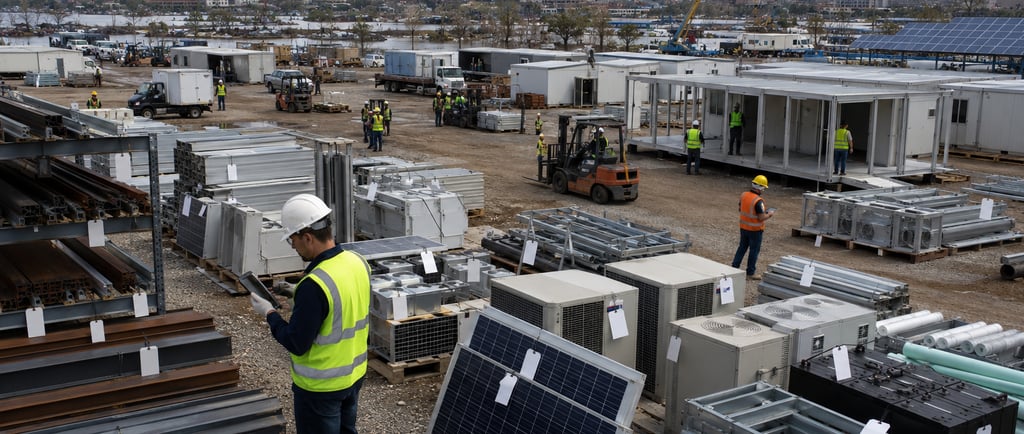

Context and Why It Matters
The rapid pace of climate migration globally places immense strain on cities and regional governments. According to the Institute for Economics & Peace, over 1.2 billion people could be displaced by 2050 due to environmental change and extreme weather. As cities become safe havens and transition corridors for these populations, the demand for infrastructure that is agile, rapid to deploy, and resource-resilient reaches unprecedented heights.
Circular infrastructure—where materials and components like reused steel beams, modular microgrids, and HVAC systems are cycled back into new builds—has shifted from an aspirational sustainability goal to a critical operational necessity. The cost savings alone are compelling: the Ellen MacArthur Foundation estimates that circular construction practices could deliver up to $700 billion in economic benefits globally by 2040, while also reducing construction waste by as much as 30%.
Yet, none of these benefits are possible without robust mechanisms for tracking and documenting every reused component’s journey. In the absence of standardized data regimes, asset histories fragment across disconnected spreadsheets, PDFs, and siloed systems. Builders spend 30% more time reconciling records for reused components, according to a 2022 McKinsey study, and cities face delays or even legal liabilities when records are incomplete or unverifiable.
For communities managing climate-driven population changes, these issues are not just technical—they are existential. Consistent and transparent data standards underpin the procurement, reporting, and resilience frameworks needed to deliver humane outcomes at scale, building public and donor trust while enabling cities to optimize material flows and carbon impacts. Without such consistency, cities are forced into ad hoc and fragmented interventions that cannot scale as migration accelerates.
2. Problem Definition and Opportunity
When seismic shifts like climate migration occur, the twin imperatives of speed and sustainability define modern infrastructure delivery. The inability to rapidly relocate, repurpose, or expand infrastructure systems can result in humanitarian crises and missed opportunities for regional development. At the same time, circular infrastructure—optimizing for the highest-value component reuse—offers quantifiable reductions in cost, emissions, and time-to-occupancy.
However, the operational and strategic stakes are unmistakable. The absence of standardized component tracking triggers a cascade of pain points:
Builders are often compelled to invest extra man-hours in piecing together incomplete documentation, increasing project costs and the risk of errors or delays.
Donors hesitate to invest further when they cannot verify claims about reused components and their compliance with ESG or grant terms.
Asset Owners worry about legal and insurance ramifications if provenance is unclear, particularly for safety-critical elements like reused steel or electrical equipment.
Standards Bodies jeopardize their credibility if their frameworks are inconsistently applied and disconnected from real operational needs.
City Planners lose access to rich data streams that could inform strategic material management, deconstruction planning, and emissions tracking for entire neighborhoods or districts.
Studies from the World Green Building Council reinforce the impact: standardized data capture and reporting on reused materials can generate 20–40% improvements in compliance turnaround and donor reporting accuracy. More broadly, the growing pressure for ESG disclosures—now codified in regulation by entities like the EU and SEC—makes robust asset tracking mandatory for cities and developers seeking sustainable finance.
Thus, establishing a shared digital language—a data standard—for specifying, validating, and maintaining reused components is not just best practice but a non-negotiable enabler for scalable, humane, circular solutions in climate migration contexts.
3. Key Concepts and Definitions
In order to build a common foundation, let’s clarify the critical terms and entities driving this emerging field:
Component-Level Tracking: This refers to the granular documentation of each significant reused or repurposed element within a project (such as steel I-beams, solar microgrid batteries, or sectioned façade systems). It includes tracking detailed specs, installation history, previous use cases, and all changes in custody or state.
Circular Infrastructure: Infrastructure that is inherently engineered for deconstruction, reuse, and recycling, rather than the traditional linear “make-use-dispose” model. This approach enables vital resources like metals, electronics, and prefabricated units to retain value and utility over multiple lifecycles—critical for scaling infrastructure in the face of ongoing migration patterns.
Climate Migration: The mass movement of people caused by acute or chronic climate hazards—flood, drought, sea-level rise—that mandate adaptive, mobile, and rapidly deployable infrastructure solutions.
Data Standard: A vetted and consensus-driven technical specification that governs how asset data (including specifications, maintenance, and compliance records) should be structured, exchanged, and validated across different systems and stakeholders.
Audit Trail: A mandatory, chronological log capturing every event in the life of a reused component—from extraction to re-installation to inspection—enabling transparent, tamper-proof verification for regulators, insurers, and donors.
Unique Component ID (UCID): A persistent, machine-readable identifier, such as a QR code or RFID, assigned to each component at extraction or deconstruction, acting as the linchpin linking all data records, inspections, and transfer events across project boundaries.
Additionally, terms like BIM Integration (Building Information Modeling) and GIS (Geospatial Information Systems) are increasingly referenced in standards-driven tracking, ensuring reused components remain visible within both spatial designs and asset registries.
4. The Core Framework: Standards-Driven Component Tracking
Overview
Implementing circular infrastructure in response to climate migration is only as viable as the framework used to track every major reused or redeployed component. Standards-driven tracking not only delivers immediate efficiency and compliance improvements but paves the way for smarter asset management, adaptive reuse, and net-zero operations across cities.
Step-by-Step Framework
Here’s a granular look at the pivotal steps for operationalizing robust data standards in tracking reused components:
Asset Categorization
Start by mapping out all asset types likely to be reused or repurposed—think steel structures from deconstructed warehouses, modular microgrid systems from outdated facilities, or MEP (Mechanical, Electrical, Plumbing) components from commercial retrofits.Unique Identification
At the extraction or deconstruction point, assign each qualifying component a Unique Component ID (UCID). This could leverage globally accepted digital ID systems to ensure interoperability, supporting barcoding, RFID, or blockchain-backed identifiers as applicable.Data Capture
Mandate a minimum viable set of data fields for every component: original location, material and engineering specs, date and conditions of manufacture, prior use cycles, exposure to environmental stresses, and any existing compliance documentation—built on open schemas such as IFC or ISO 19650 when possible.Verification
Each component’s digital record incorporates third-party quality checks, certifications (such as weld, load, or electrical safety certificates), and all inspection data. These artifacts are layered onto the UCID, creating a comprehensive provenance chain.System Integration
Integrate tracking records into core platforms: BIM for model-based design and as-built status, GIS for geolocation and spatial analytics, donor compliance dashboards for reporting, and asset management tools for ongoing operations.Transfer Protocols
Codify and automate workflow ”triggers” for when a component changes hands—between owners, sites, or inventories. These triggers ensure data handoff is seamless, with all compliance and reporting obligations preserved.Audit Trail Enforcement
Enforce policy that every event (such as repairs, movements, or inspections) tied to a component is instantly and immutably logged against its UCID. This step transforms static records into living audit trails, supporting real-time reporting and risk mitigation.Reporting
Automate the generation of on-demand and scheduled reports showing lifecycle carbon impacts, compliance fulfillment, provenance, and transfer history—tailored for donor, regulatory, and internal operational needs.
Worked Example: Urban Microgrid Deployment
Let’s see the framework in action.
Imagine a coastal city adapting its largest secondary school as a transition site for climate migrants. To rapidly provide reliable, renewable power, the city’s utilities division sources decommissioned solar panels and microgrid modules donated from an industrial site. At the donation site, each panel is catalogued with its own UCID, capturing original installation date, manufacturer data, maintenance and repair logs, and all relevant compliance certificates.
Upon arrival at the school, a facilities asset manager scans the UCID—a single scan instantly pulls not only the asset’s full history but also donor chain-of-custody documents, load test verification, and warranty data. BIM and donor dashboards reflect the new location, and automated transfer protocols issue fresh compliance certificates and carbon accounting for the project’s ESG reporting. The asset’s audit trail is both tamper-proof and linked directly to regulatory and donor frameworks, supporting everything from insurance claims to future redeployment.
Advanced Case Analysis
Applying this framework city-wide has unlocked significant results. In Singapore, the Housing & Development Board piloted similar standards for modular MEP units in residential retrofits, achieving a 26% reduction in project time and a 19% decrease in embodied carbon for new housing aimed at resettled families (source: HDB Annual Circularity Report 2023).
Key Takeaway:
Robust, standards-driven tracking is the linchpin of reusable, low-carbon infrastructure that can match the pace and fluidity of climate migration—driving down project risks, ensuring rapid compliance, and building trust with donors and communities.
5. Implementation Paths for Standards-Based Tracking of Reused Components
Tracking reused components becomes practical only when the system is designed around real project pressure: limited time, incomplete records, multiple contractors, donor reporting, insurance checks, and urgent deployment needs. In climate migration and disaster recovery settings, the goal is not to create a perfect digital archive after the project is complete. The goal is to make every reusable component traceable before it is removed, transported, stored, inspected, installed, maintained, and redeployed.
This matters because the construction sector is one of the largest material users and emissions sources in the global economy. The 2024/25 Global Status Report for Buildings and Construction states that buildings and construction consume 32% of global energy and contribute 34% of global CO₂ emissions. The same report notes that cement and steel alone are responsible for 18% of global emissions and remain major sources of construction waste. Any serious reuse system must therefore focus on high-impact components first: structural steel, façade systems, roofing sheets, modular wall panels, MEP units, solar panels, batteries, switchgear, doors, windows, sanitary modules, and prefabricated shelter parts. These are the items with the highest value, highest inspection need, and highest risk if documentation is weak.
A strong implementation path begins with a simple rule: track the component before it leaves its first site. Once a steel beam, modular toilet frame, solar inverter, or roof panel is pulled from a building and placed in a mixed pile, the cost of reconstructing its history rises sharply. The best time to assign a Unique Component ID is during pre-demolition audit or selective deconstruction. This is when surveyors can still connect each component to its building location, drawings, previous maintenance records, exposure conditions, structural role, and removal method.
A city or project owner should start by defining which components qualify for full tracking. Not every screw, bracket, or short pipe section needs a full digital record. A practical standard should create tiers. Tier 1 should cover safety-critical and high-value assets, such as structural steel, load-bearing timber, electrical equipment, batteries, façade panels, HVAC units, and water treatment modules. Tier 2 should cover repeatable modular items, such as doors, windows, partitions, metal frames, sanitary units, and cable trays. Tier 3 should cover bulk material streams, such as aggregate, bricks, pavers, sheet metal offcuts, and non-structural salvage.
Emergency Deployment Path
The first implementation path is the emergency deployment path. This applies when a city, NGO, utility, or relief agency must move components into shelters, clinics, schools, sanitation blocks, power hubs, or water points within days or weeks. The data model in this case must be lean. It should capture the component ID, material type, dimensions, weight, quantity, origin site, removal date, inspection status, hazard status, current location, owner, custody holder, and approved use. The system does not need every historic document on day one, but it must flag what is missing. A solar panel with incomplete warranty history can still be useful for non-critical loads after testing. A reused steel column with missing grade data cannot be used structurally until testing confirms its properties.
Municipal Material Bank Path
The second implementation path is the municipal material bank path. This applies to cities that want to store reusable components for multiple future projects. Here, the data record must support inventory planning. It should show how many components are available, where they are stored, what condition they are in, what projects they are suitable for, when inspections expire, what embodied carbon has been preserved, and what replacement value has been retained. This is where GIS becomes important. A material bank serving flood relocation, heat-resilient shelter upgrades, and modular sanitation sites needs to know whether usable components are close enough to deployment zones to beat new procurement timelines.
Development and Housing Path
The third implementation path is the development and housing path. This applies to public housing, affordable housing, schools, hospitals, and community infrastructure. Here, data standards need deeper connection with BIM, engineering approvals, procurement, and lifecycle asset management. ISO 19650 is useful because it provides a structured approach to managing built asset information across the asset lifecycle using BIM processes. For reused components, that means the project team should not treat reuse data as a side folder. It should sit inside the project’s information management process, with clear responsibilities for who creates, checks, approves, updates, and hands over the data.
Donor and ESG Reporting Path
The fourth implementation path is the donor and ESG reporting path. Climate migration infrastructure often depends on public funds, humanitarian budgets, climate finance, philanthropic grants, or development bank support. Funders need proof that reused components were actually reused, safely installed, and connected to measurable outcomes. In this path, the data standard should connect each component to avoided waste, avoided embodied carbon, procurement savings, local jobs, deployment speed, and service capacity. For example, a sanitation hub built with reused steel frames should be able to report how many frames were reused, their total weight, their prior source, their inspection results, their new location, and their estimated avoided emissions compared with new steel.
Regulated Product Path
The fifth implementation path is the regulated product path. This is becoming more important in 2026 because product-level traceability is moving from voluntary sustainability practice to regulatory infrastructure. The EU’s Ecodesign for Sustainable Products Regulation introduced Digital Product Passports as a way to store and share product sustainability, durability, and environmental data. The European Commission has also stated that Digital Product Passports under the new Construction Products Regulation will provide key information for construction products, including performance and conformity declarations, safety information, and instructions for use. For cities and builders outside Europe, this shift still matters because EU rules often influence global supplier behavior, software design, certification models, and procurement expectations.
A practical implementation plan should start small but be designed to grow. A 90-day pilot can be enough to test the system. Choose one material family, one site, one receiving project, and one reporting use case. For example, a city could track 300 reused steel frames from a decommissioned warehouse into modular classrooms for displaced families. During the pilot, the project team should test whether QR codes survive handling, whether field teams can scan components without network access, whether inspectors can upload photos and test results quickly, whether the BIM team can connect the component record to the model, and whether procurement teams can compare reuse against new purchase cost.
By month three, the city should know the real answer to the only question that matters: does the data standard make reuse faster, safer, cheaper, and easier to prove? If the answer is yes, the next phase should expand to more component families, more storage sites, more contractors, and more donor reporting lines.
6. Quality Assurance Methodologies for Reused Component Data
Quality assurance in reused component tracking has two jobs. The first is to prove that the physical component is safe and fit for its next use. The second is to prove that the digital record is complete, accurate, current, and connected to the right component. One without the other fails. A perfect QR code attached to an unsafe steel member is useless. A safe steel member with no traceable record may still be rejected by engineers, insurers, donors, or regulators.
Component Acceptance Protocol
The most effective quality assurance process starts with a component acceptance protocol. This protocol should define what can be reused, what must be downgraded, what must be repaired, what must be recycled, and what must be rejected. Structural items should be assessed for grade, dimensions, corrosion, deformation, fatigue risk, fire exposure, coating condition, weld condition, hole patterns, and past load history. Electrical and energy assets should be checked for age, rated output, insulation condition, battery health, firmware status, thermal damage, water ingress, and manufacturer safety notices. Plumbing and sanitation components should be checked for contamination, pressure rating, corrosion, seal integrity, prior use, and cleaning records.
Documentation QA
The second layer is documentation QA. Every component record should pass a minimum completeness check before it is released for procurement or installation. The required fields should include component ID, category, material, dimensions, quantity, condition grade, source site, removal method, inspection date, inspector identity, photos, test results, hazard status, custody holder, approved use category, and current location. For higher-risk components, the record should also include engineering certificates, load testing, chemical or material testing, installation instructions, maintenance records, and insurance notes.
Identity QA
The third layer is identity QA. A component ID only works if the physical tag and digital record remain connected. QR codes are cheap and easy to deploy, but they can be scratched, painted over, removed, or duplicated. RFID tags work better for bulk scanning and storage yards, but they cost more and may need specific readers. Laser etching can work for metal components, but it must be placed where it does not affect performance or inspection. For critical assets, the strongest approach is dual identity: one visible QR code and one secondary identifier, such as stamped serial, RFID, or etched code. The digital record should store photos of the tag location so field teams can verify that the tag belongs to the right component.
Chain-of-Custody QA
The fourth layer is chain-of-custody QA. Reused components often pass through many hands: building owner, demolition contractor, salvage operator, material bank, transporter, testing lab, fabricator, project contractor, final asset owner, and maintenance team. Each transfer creates risk. A proper audit trail should record who held the component, when custody changed, where it moved, what condition it was in, and whether any documents were added, edited, or invalidated. In high-risk projects, transfers should require digital sign-off from both sender and receiver. If a component arrives damaged, wet, incomplete, or mixed with untagged items, the receiving party should be able to freeze its status immediately.
Inspection QA
The fifth layer is inspection QA. Inspection cannot be a one-time event. A component may pass at deconstruction but fail after storage or transport. A reused steel frame stored outdoors for six months may need a new corrosion check. A battery bank moved through a flood-prone area may need electrical retesting. A modular toilet frame installed in a coastal relocation site may need faster coating inspections because salt exposure accelerates corrosion. The data standard should include inspection expiry dates, not just inspection results. This prevents outdated approvals from being treated as current.
Data Change Control
The sixth layer is data change control. Reused component data should be editable, but every edit should be traceable. Field teams need to correct dimensions, upload better photos, update condition ratings, or attach missing certificates. The system should record who made the change, what changed, when it changed, and why. Critical fields, such as material grade, safety status, owner, approved use, or test result, should require reviewer approval. This protects the record from accidental changes and deliberate misrepresentation.
Sampling and Audit QA
The seventh layer is sampling and audit QA. Large projects cannot test every item with the same intensity. A practical method is risk-based sampling. For example, 100% of structural steel used in load-bearing roles should be verified for grade and condition. A smaller sample of identical non-structural partitions may be enough if they come from the same building, same batch, same removal method, and same condition class. Bulk materials should be checked by lot, weight, contamination risk, and source. Audit samples should include both data records and physical components. Auditors should be able to scan a random component in storage and match it to its full digital history within minutes.
Carbon and Circularity QA
The eighth layer is carbon and circularity QA. Reuse claims can become weak if the numbers are unclear. A component record should separate measured data from estimated data. Measured data includes weight, distance transported, quantity, installation date, and inspection result. Estimated data includes avoided carbon, avoided disposal, replacement value, and future reuse potential. This distinction protects credibility. It also prevents exaggerated ESG claims, which are coming under tighter scrutiny as sustainability reporting rules mature.
European policy is moving in this direction. Digital Product Passports under EU rules are intended to store product sustainability, durability, and environmental information, and construction product passports are expected to support reliable calculation of building carbon footprints. That means QA for reused components must be built for evidence, not marketing. The winning systems will be those that can show what was reused, where it came from, what condition it was in, how it was tested, where it went, and what impact it produced.
7. Expanded Case Studies: What the Industry Is Already Teaching Us
The reused components sector is still fragmented, but several real-world initiatives already show how data standards, material passports, and reuse metrics can shift construction from one-off salvage to planned circular infrastructure.
Madaster Platform
One of the clearest examples is Madaster, a materials passport platform that registers building materials and components so owners can understand their composition, circular value, and reuse potential. The platform grew rapidly in its early years. A European Commission CORDIS case profile reported that Madaster’s database expanded from just over 300 square metres of registered materials at the end of 2017 to more than 2.5 million square metres by 2019. That growth showed early market demand for treating buildings as material repositories rather than future waste streams.
The practical lesson from Madaster is that material identity changes decision-making. When building owners know what materials exist inside an asset, in what quantities, and with what likely residual value, demolition becomes less attractive. Selective deconstruction becomes easier to justify. Insurance, financing, sale, and redevelopment decisions become more evidence-based. In climate migration settings, that same principle can help cities identify what can be redeployed quickly after a flood, heatwave, fire, or relocation event.
FCRBE Project
A second case is the FCRBE project, which focused on increasing the circulation of reclaimed building elements in north-west Europe. The project identified a major structural problem: only about 1% of building elements in the region were being reused after their first application, even though many were technically reusable. The project set an ambition to increase the amount of reclaimed building elements in circulation by 50% by 2032. It also produced practical guides for procurement, reuse targets, reclamation rates, and project reporting.
FCRBE is important because it did not treat reuse as a design trend. It treated reuse as a market circulation problem. A component cannot be reused if nobody knows it exists, nobody knows its condition, nobody knows whether it meets project requirements, and nobody can report the reuse rate in a consistent way. The project’s work on reuse rates is especially relevant for public procurement. If a city wants a contractor to use reclaimed materials in modular shelters, schools, or public housing, it must define how reuse will be measured. Is the reuse target based on mass, cost, carbon, number of components, or functional role? Without that clarity, bidders cannot price the work fairly and auditors cannot judge performance.
Digital Product Passports in Europe
A third case is the rise of Digital Product Passports in Europe. Although DPPs are not limited to construction, they are changing expectations across product markets. The European Commission describes the DPP as a key tool under the Ecodesign for Sustainable Products Regulation for storing and sharing information about sustainability, durability, and environmental aspects. The new Construction Products Regulation goes further for the built environment by connecting digital product information to performance, conformity, safety, use instructions, and building carbon calculations.
The lesson for reused component tracking is clear. Future construction systems will expect product data to travel with the product. Reuse programs that still depend on PDFs, emails, WhatsApp photos, and disconnected spreadsheets will face rising friction. A steel member, façade cassette, battery module, door set, pipe section, or HVAC unit will need a readable identity and a trusted record. The market is moving toward components that carry their own proof.
Buildings and Construction Emissions Data
A fourth case comes from the wider buildings and construction emissions picture. UNEP’s 2024/25 Global Status Report shows why reused components cannot remain a niche practice. Buildings and construction still account for a massive share of energy use and CO₂ emissions. Cement and steel are central to the problem because they carry high embodied carbon and are consumed at huge scale. This makes reuse one of the few strategies that can cut embodied carbon immediately, especially when components are reused in their existing form rather than melted, crushed, or remanufactured.
This distinction matters. Recycling steel is valuable, but direct reuse can preserve more of the component’s embedded value. A reused steel beam that remains a beam avoids part of the need for new steel production, avoids some demolition waste, and avoids some remelting energy. The same logic applies to modular frames, façade units, raised flooring, cable trays, toilets, doors, and equipment skids. The higher the component remains in the value chain, the stronger the circular result.
Displacement Data from IDMC and World Bank
A fifth case comes from displacement data itself. The Internal Displacement Monitoring Centre’s 2026 Global Report states that 82.2 million people were living in internal displacement at the end of 2025. It also reports that storms, floods, and other hazards triggered 29.9 million internal displacements in 2025. These figures show why infrastructure systems must be prepared before disaster happens. Cities cannot wait until displacement peaks to start identifying reusable materials, testing them, tagging them, and connecting them to deployment plans.
The World Bank’s Groundswell report adds a longer horizon: climate change could force 216 million people to move within their own countries by 2050 across six regions, while decisive climate and development action could reduce that movement by as much as 80%. This does not mean every movement will require emergency shelters. It means that regions need adaptable infrastructure capacity across housing, sanitation, schools, clinics, transport, drainage, power, and water systems. Reused component tracking is one of the data foundations that can make that capacity cheaper, faster, and more accountable.
The combined lesson from these cases is direct. Reuse works best when it is planned before removal, priced before procurement, verified before installation, and reported after handover. Data standards turn reuse from a hopeful claim into a managed infrastructure method.
8. Future Outlook: Where Reused Component Tracking Is Going in 2026 and Beyond
By 2026, reused component tracking is moving from a sustainability add-on to a core part of infrastructure risk management. The shift is being pushed by four forces: displacement pressure, construction emissions, regulation, and digital construction maturity.
Driving Forces Behind the Shift
The first force is displacement pressure. Climate and disaster-linked displacement is no longer a rare shock. It is a recurring planning condition. IDMC reported 29.9 million internal displacements from storms, floods, and other hazards in 2025, while 13.6 million people were living in internal displacement due to disasters at the end of that year. For cities, this means temporary infrastructure is becoming semi-permanent. Schools become shelters. Parking lots become service hubs. Clinics move into modular units. Sanitation blocks must be relocated as settlements shift. Power and water assets must be moved, repaired, and reused across multiple phases.
The second force is construction emissions. As operational building emissions slowly improve through electrification and efficiency, embodied carbon is gaining more attention. Steel, cement, aluminium, glass, insulation, plastics, and mechanical systems all carry carbon before a building opens. Reused components can cut the need for new production, but only if the component’s identity, condition, and use history can be trusted. This is why the future of circular construction will depend less on inspirational reuse projects and more on verifiable reuse records.
The third force is regulation. The EU is already building the policy architecture for product-level traceability through Digital Product Passports and the new Construction Products Regulation. The European Commission has said construction product passports will include performance and conformity declarations, safety information, and instructions for use, while also helping calculate whole-building carbon footprints. Even where these exact rules do not apply, suppliers, software vendors, certifiers, and international contractors will begin aligning to them because the EU market is too large to ignore.
The fourth force is digital construction maturity. BIM, GIS, digital twins, field apps, sensors, drones, computer vision, RFID, QR tags, and asset management platforms are becoming more common. The problem is that many still operate in separate channels. The next phase will focus on connecting them. A reused steel frame should appear in the BIM model, the material bank inventory, the GIS map, the inspection log, the procurement record, the carbon report, and the maintenance system. The same component should not have six different names in six different systems.
The Role of AI
Artificial intelligence will also change component tracking, but it will not replace field evidence. AI can help classify components from site photos, extract data from old drawings, detect duplicate records, estimate dimensions, flag missing certificates, and match available inventory with upcoming project needs. Computer vision can help identify beams, panels, pipes, doors, windows, and equipment at deconstruction sites. But AI outputs must still be checked by trained people, especially for safety-critical components. In reused infrastructure, AI should reduce search time and admin load. It should not be the final authority on structural safety.
Mobile Phone Data for Planning
Mobile phone and mobility data may also influence planning. Recent research on context-aware displacement estimation from mobile phone data argues that traditional post-disaster surveys can be slow, while privacy-preserving mobility data can support faster humanitarian decision-making. The study’s 2025 Philippines typhoon case shows how displacement estimation methods can distinguish regular movement from likely displacement. This type of population movement data could help cities position material banks, storage yards, modular shelter kits, and repair hubs closer to likely demand.
GIS and Hazard Maps
The next major trend will be reusable infrastructure inventories linked to hazard maps. Cities will not only ask, “What materials do we have?” They will ask, “Which materials can be redeployed after a flood in this district, after a heat emergency in that district, or after coastal erosion forces relocation in this zone?” GIS will connect reused component data to flood plains, heat islands, landslide zones, evacuation routes, ports, warehouses, rail links, clinics, schools, and settlement growth.
Reuse-Linked Finance
Another trend will be reuse-linked finance. Donors, insurers, lenders, and climate funds will increasingly reward projects that can prove material savings, carbon savings, and deployment speed. A city that can show audited reuse records may be able to access better funding terms, faster grant approvals, or stronger public trust. A developer that can prove the circular value of its building components may protect asset value and reduce future demolition risk. A relief agency that can show where every modular sanitation unit went, when it was inspected, and how many people it served can defend its spending with evidence.
Multi-Life Asset Records
The future will also require better standards for end-of-life and next-life decisions. A reused component should not disappear from the record after installation. Its next inspection, repair, removal, resale, redeployment, or recycling should be captured. This creates a multi-life asset record. Over time, the record becomes more valuable than the first passport. It shows how the component performed across climates, locations, users, and maintenance cycles. For climate migration infrastructure, that knowledge is essential because assets may move between emergency response, temporary settlement, public service, and permanent community use.
Reusable Components as Strategic Reserve
By 2030, leading cities and agencies will likely treat reusable components as a strategic reserve. Steel frames, modular roofing, solar kits, battery banks, pumps, toilets, clinic modules, temporary bridges, water tanks, and cable systems will be managed with the same seriousness as emergency food, medical stock, or fuel. The difference will be that these assets are heavier, longer-lived, higher-value, and more regulated. They will need better data.
9. Toolkit Integration: How to Connect Standards With Real Systems
A reused component tracking system should not become another disconnected database. It should connect to the tools that project teams already use: BIM, GIS, procurement systems, asset management software, inspection apps, donor dashboards, document repositories, LCA tools, and material marketplaces. The more the system reduces repeated data entry, the more likely field teams will use it.
Field Capture
The first tool layer is field capture. This is where the component record begins. A mobile app should allow deconstruction crews, inspectors, and warehouse teams to create or update component records on site. It should work offline because disaster zones, demolition sites, storage yards, and rural relocation areas often have weak connectivity. Field capture should support QR scanning, RFID reading where available, photo uploads, GPS location, voice notes, condition grading, dimensions, hazards, and custody transfer signatures. Every record should be time-stamped and tied to the person or organization that entered it.
Document Control
The second tool layer is document control. Reused components often carry documents from several sources: original drawings, invoices, material certificates, test reports, maintenance logs, warranties, manuals, photos, inspection sheets, customs documents, transport notes, and installation approvals. These should not sit in random folders. The component ID should link directly to the document set. When a certificate expires or a new test overrides an old result, the record should show that change clearly.
BIM Integration
The third tool layer is BIM. BIM integration helps designers see reused components during planning, not after procurement. If a project needs 120 steel beams of a certain length range, grade, and condition class, the BIM process should be able to check available inventory. If a modular clinic uses reused façade panels, the model should identify those panels and carry their records into handover. ISO 19650 supports this by giving teams a structured way to manage built asset information through delivery and operation.
GIS
The fourth tool layer is GIS. GIS turns component data into spatial intelligence. It shows where materials are available, where they are needed, where transport routes are blocked, where storage yards sit relative to risk zones, and where relocated communities are growing. For climate migration, this matters because demand is geographic. A material bank 300 kilometres away may be useless for a rapid shelter response if roads are damaged. A smaller inventory 20 kilometres away may save days.
Procurement
The fifth tool layer is procurement. Reuse must be visible at the buying stage. Procurement systems should let project teams specify reused components, pre-approved suppliers, condition classes, documentation requirements, inspection rules, and reporting duties. Public tenders should define how reuse is measured and how bidders prove compliance. FCRBE’s work on procurement strategies and reuse reporting is useful here because it shows that reuse needs clear targets, definitions, and monitoring methods before contractors price the job.
Quality and Inspection
The sixth tool layer is quality and inspection. Inspection apps should connect directly to the component record. A field inspector should be able to scan a component, see its required checks, upload test results, mark it approved or rejected, and set the next inspection date. If the component is later moved or installed, the inspection status should move with it. If it is damaged, the system should change its status and prevent accidental reuse in critical roles.
LCA and Carbon Reporting
The seventh tool layer is LCA and carbon reporting. Lifecycle assessment tools need accurate quantities, materials, weights, transport distances, and replacement assumptions. Reused component tracking can provide that data. The system should clearly separate measured facts from estimates. For example, the actual weight and transport distance can be measured. Avoided carbon compared with a new component depends on the selected method and assumptions. A credible reporting system should show both.
Asset Management
The eighth tool layer is asset management. Once a reused component is installed, it becomes part of the operating asset. It should enter maintenance schedules, warranty management, inspection plans, and future deconstruction records. A reused pump in a relocation water system should not be treated as an anonymous asset. Its prior use, refurbishment history, spares, and inspection status should remain available to maintenance teams.
Donor and Public Reporting
The ninth tool layer is donor and public reporting. Donors and public agencies need different reporting views. A donor may want carbon savings, cost savings, deployment speed, population served, and compliance proof. A city planner may want inventory, location, readiness status, and future reuse potential. A regulator may want safety approvals, conformity documents, and audit trails. A public dashboard may show high-level results without exposing sensitive site, supplier, or security data.
Marketplaces and Material Banks
The tenth tool layer is marketplaces and material banks. A reused component record should make materials easier to trade, donate, reserve, insure, and redeploy. Marketplaces need trust. Buyers need to know what they are buying. Sellers need to prove quality. Cities need to avoid unsafe informal reuse. A strong data standard gives each component enough identity to move through formal channels.
The best toolkit design is simple at the front and strict at the back. Field teams should see short forms, scan buttons, photos, and clear pass-fail statuses. Project managers, engineers, auditors, and donors should see the deeper record. This prevents the system from collapsing under its own complexity.
10. Differentiation Analysis and Conclusion
The difference between basic reuse and standards-driven reuse is proof. Basic reuse says, “This material was used before.” Standards-driven reuse says, “This exact component came from this place, was removed on this date, passed these checks, moved through these hands, was approved for this use, was installed here, and produced these measured outcomes.”
That difference changes everything.
For builders, standards-driven tracking reduces uncertainty. It helps teams decide which reused components can safely enter design, which need testing, which should be downgraded, and which should be rejected. It also reduces time wasted searching through old emails, photos, spreadsheets, and paper files. In a rapid rebuild or relocation project, that time can decide whether shelters, clinics, toilets, power systems, or classrooms open on schedule.
For asset owners, it protects value. A building with a material passport and traceable components is easier to audit, refurbish, insure, finance, and deconstruct. The owner can show what is inside the asset and what it may be worth at the next intervention. This is especially important for public agencies managing schools, hospitals, housing estates, transport hubs, and emergency facilities.
For donors, it creates confidence. Climate migration infrastructure often carries intense public scrutiny. Funders need to know whether money was spent responsibly, whether circularity claims are real, whether safety was protected, and whether communities received the promised service. Component-level records give donors a stronger evidence trail than project narratives alone.
For insurers and regulators, it reduces blind spots. Reused components can be safe, but they must be documented and assessed. A data standard helps separate responsible reuse from risky salvage. It creates a common language for inspection, approval, transfer, installation, maintenance, and future redeployment.
For city planners, it creates infrastructure intelligence. Over time, tracked components become a map of material capacity. Cities can see what they have, where it is, what condition it is in, what it can be used for, and how fast it can move. This is vital in a world where displacement, disaster recovery, and public infrastructure demand are all increasing.
The strongest differentiation comes from connecting reused component tracking to climate migration planning. Many circular construction tools were designed for commercial buildings, real estate portfolios, or green procurement. Climate migration adds harder conditions: speed, uncertainty, damaged infrastructure, donor pressure, vulnerable populations, limited budgets, shifting settlement patterns, and urgent safety requirements. A data standard built for this context must work in warehouses, ports, flood zones, camps, schools, clinics, and informal transition sites. It must support both engineering rigor and field simplicity.
The global need is clear. IDMC’s 2026 reporting shows tens of millions of disaster-triggered internal displacements in a single year, while the World Bank warns that climate change could drive 216 million people to move within their own countries by 2050. At the same time, buildings and construction remain responsible for a huge share of global energy use, CO₂ emissions, material demand, and waste. These pressures are converging. Cities will need to build more, rebuild faster, waste less, spend better, and prove more.
Data standards for tracking reused components are therefore not a software detail. They are a core part of circular infrastructure readiness. They decide whether reusable steel becomes trusted structure or scrap. Whether a solar module becomes emergency power or warehouse clutter. Whether a modular toilet frame becomes safe sanitation or an undocumented liability. Whether a city can turn demolition into supply. Whether a donor can fund reuse with confidence. Whether a displaced community receives infrastructure that is fast, safe, accountable, and durable.
The next generation of circular infrastructure will be built from components with memory. Every beam, frame, panel, battery, pump, door, and module will need a usable record. That record will show where the component came from, what it can do, how it was tested, who handled it, where it is now, and where it can go next.
For climate migration, that record is more than documentation. It is the bridge between urgency and trust.
Connect
Your trusted partner for scrap metal procurement.
CONTACT
About
haroon@tdcventures.com
+1-307-655-7593
© 2025. All rights reserved.
NEWSLETTER