
Deconstruction over Demolition: Metals Recovery Boosters
Discover why deconstruction is outperforming demolition for higher-value metals recovery. Learn the innovative strategies, technologies, and business models driving the circular economy in construction.
SUSTAINABLE METALS & RECYCLING INNOVATIONS
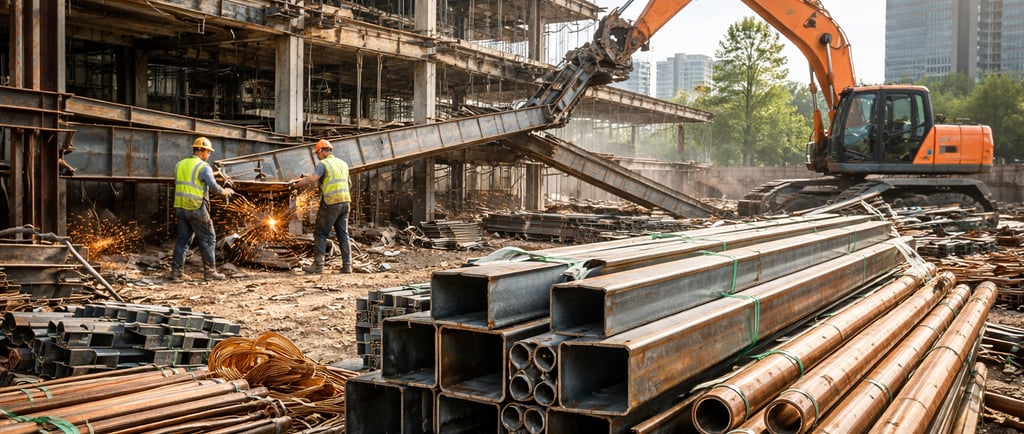

The world is in the midst of an unprecedented resource transition, reshaping how society perceives waste, value, and long-term sustainability. As environmental pressures mount and businesses seek competitive advantage through sustainable innovation, the construction industry faces a crucial fork in the road: deconstruction vs. demolition. This choice is accelerating a new frontier in metals recovery—one that’s enabling companies to capture lasting value and align with the global shift toward the circular economy.
But why is deconstruction rapidly displacing demolition in leading markets? Which frameworks, technologies, and business models enable this shift—and how are progressive organizations operationalizing these strategies for tangible impact? Let’s dissect the playbook industry leaders use to maximize metals recovery and explore how your organization can plug into this value cycle.
Why Deconstruction Beats Demolition for Metals Recovery
Traditional demolition—the rapid razing and removal of structures—has long been the norm for end-of-life buildings. This process creates mixed debris streams, usually involving enormous machinery that crushes, shreds, and commingles structural and non-structural materials. The result? Substantial material downcycling, landfill usage, and lost economic opportunity.
Deconstruction, by contrast, is a selective, methodical process that prioritizes the careful removal of building components, especially high-value metals. Let’s break down why this matters so much for resource efficiency and economic return:
Quality retention: When metals like steel, copper, and aluminum are removed in intact lengths or forms, their physical properties—such as tensile strength and conductivity—remain uncompromised. This high-quality recovery unlocks their continued use in structural applications or precision manufacturing, supporting higher price points and less need for primary ore extraction.
Contaminant reduction: Typical demolition practices cover metals with concrete dust, insulation fibers, paints, and adhesives. Cleaning or reprocessing these contaminated metals reduces their value, increases energy usage, and restricts their reuse potential. In contrast, manual or robotic deconstruction extracts metals cleanly for direct reuse or high-grade recycling.
Value recovery: According to the U.S. Environmental Protection Agency, steel recovered from deconstruction can be sold for up to 95% higher value compared to similar metals extracted from mixed demolition waste. Deconstruction directly supports circular metals markets by supplying “like-new” quality materials, establishing profitable reverse flows for contractors and manufacturers.
Environmental benefits: Each tonne of reused structural steel cuts up to 1.8 tonnes of CO₂ emissions compared to producing new steel—according to the World Steel Association. Deconstruction, therefore, stands as a powerful weapon in achieving net-zero carbon commitments across real estate portfolios and supply chains.
The Circular Economy Context: Keeping Metals in Play
The circular economy is more than just a sustainability buzzword: it’s a systems-level approach where resources retain their maximum utility and value for as long as possible. The metal economy is especially suited to this model:
Durability and recyclability: Unlike polymers or composites, metals can be recycled an unlimited number of times without loss of property, making them “permanent materials.”
Criticality and finite supply: Essential metals like copper and rare earth elements face supply vulnerabilities. Recent research by the U.S. Geological Survey and the European Commission highlights increasing risks of supply chain disruptions, underscoring the imperative to maximize secondary, urban-sourced metals.
Economy-wide impact: Steel, aluminum, and copper account for over 50% of the embodied carbon in modern buildings and infrastructure. Their circular management pays direct dividends for both the planet and the bottom line.
However, unlocking this potential requires organizational, technological, and policy innovation. The following sections outline how forward-thinking enterprises are making circular metals recovery standard practice.
Blueprints for a Circular Metals Recovery System
1. Design for Deconstruction (DfD)
The journey to high-yield metals recovery begins long before demolition crews arrive—it starts at the architectural design table. Designing for Deconstruction is a key DfD strategy, ensuring components can be efficiently separated and reclaimed in the future.
Key principles:
Modular construction: Buildings made from prefabricated steel frames, aluminum curtain walls, or copper piping modules enable swift disassembly. For example, the Edge building in Amsterdam uses demountable metal structures, facilitating 91% material reusability after disassembly.
Use of mechanical fasteners: By prioritizing bolts, screws, and clips instead of welding or adhesives, deconstruction teams can rapidly separate and salvage large, intact metal components, preserving maximum value across multiple use cycles.
Standardization: The adoption of universal building component sizes (e.g., I-beam profiles, steel studs) streamlines future reverse logistics, enabling components’ reuse across different projects or geographies. This is now a core requirement in several green building certifications (such as BREEAM and LEED).
2. Material Passports and Digital Twin Technologies
Transparency and traceability are non-negotiables in a viable circular metals system. Enter material passports and digital twins:
Material passports provide digital, blockchain-secured records for every significant metal element in a building—listing material type, supplier, treatments, and recovery recommendations. This ensures that when the building is deconstructed, every beam or conduit is traceable and readily reusable.
Digital twins replicate all assets virtually, giving real-time visibility into metal inventory, condition, and location. For instance, Siemens’ MindSphere platform integrates IoT sensors and BIM data to maintain comprehensive digital twins of commercial buildings, enabling optimal metals extraction and reuse logistics.
3. Reverse Logistics Networks
Streamlining the movement of reclaimed metals from point-of-recovery to point-of-reuse is essential. Advanced reverse logistics networks are being designed around three integrated functions:
Manufacturer take-back schemes: Leading steel and aluminum producers now offer end-of-life buybacks, guaranteeing building owners a lower total cost of ownership and a near-certain recovery pathway for high-value metals.
Urban mining and sorting hubs: Cities like Tokyo and Paris have established centralized hubs equipped with advanced separation and testing infrastructure to process metals from deconstructed buildings. These sites act as regional supply bases, enabling just-in-time delivery of high-grade secondary metals to local manufacturers.
Collaborative digital marketplaces: Online B2B platforms now connect developers with recyclers and remanufacturers directly, listing available reclaimed metal batches by grade, length, and certification status.
4. Remanufacturing and Reuse Ecosystems
Instead of melting metals for recycling, deconstruction emphasizes remanufacturing and direct reuse:
Remanufacturing steel beams, columns, or façade panels eliminates the energy and emissions of smelting and recasting. The Ellen MacArthur Foundation case study demonstrates that remanufacturing can cut environmental impact by up to 87% compared to conventional recycling.
Component leasing models—whereby building developers lease, not purchase, steel or aluminum frames—are gaining ground. This incentivizes manufacturers to design for easy recovery, high durability, and multiple life cycles, as their revenue depends on long-term component circulation.
Traceability and certification: Verified schemes like the Cradle to Cradle Certified™ standard now include provisions specifically for reclaimed metals, ensuring supply chain accountability and boosting market trust.
Essential Tools Advancing Metals Recovery Through Deconstruction
1. Selective Dismantling Technologies
Cutting-edge tools include:
Robotic deconstruction units: Autonomous machines can carefully extract steel and copper elements, reducing injury risk and increasing speed. Japanese robotics firm Kajima has piloted fully automated deconstruction robots in high-rise towers, recovering 30% more metals than manual teams.
High-precision saws and cranes: These allow for safe separation of long-span metal structures without deformation, safeguarding their reuse potential.
2. Advanced Sorting and Sensing
Efficient sortation ensures only the highest purity metals enter reuse channels:
X-ray fluorescence (XRF) analyzers instantly identify alloy compositions, making it possible to sort structural steel from rebar, or copper from aluminum, at lightning speed.
Near-infrared (NIR) spectroscopy scans can detect surface treatments or contaminants, further refining separation.
3. Lifecycle Assessment (LCA) Software
Industry-specific lifecycle assessment platforms like SimaPro or Tally for Revit model the exact emissions, costs, and material flows involved in deconstruction. Project teams can quantitatively forecast and document the environmental and financial ROI of recovering steel versus scrapping it.
4. Digital Marketplaces and Traceability Apps
Blockchain-based supply chain solutions—such as Everledger’s digital traceability for metals—ensure full provenance from deconstruction through resale, deterring fraud and enhancing buyer confidence in reclaimed materials.
Business Models That Make Deconstruction Profitable
Deconstruction’s ascent is underpinned by commercially savvy, circular economy business models:
Material-as-a-Service (MaaS): Hardware companies, such as Tata Steel, now offer steel leasing for modular construction projects, bundling maintenance and end-of-life take-back into a single predictable fee.
Component Buyback Programs: US-based reuse firm Harvest Table guarantees upfront buyback values for deconstructed elements, reducing project risk for building owners.
Deconstruction-as-a-Service: European firms like New Horizon provide comprehensive building assessments, selective dismantling, and downstream logistics, often achieving revenue generation greater than the incremental deconstruction cost through optimized metals resale.
Collaborative Partnerships: The London Circular Construction Coalition brings together developers, demolition contractors, metal traders, and municipal agencies, coordinating skills and resources to maximize recovery efficiency and ensure value remains within local economies.
Real-World Examples: Circular Metals Success Stories
ArcelorMittal’s Steligence® platform integrates modular, prefabricated steel elements into new European buildings designed for full disassembly and future reincarnation. In the Netherlands, their deconstruction pilots report up to 95% material recovery, drastically surpassing traditional demolition rates.
Rotor Deconstruction—a Belgian pioneer—runs dedicated facilities certifying and grading extracted building metals. By focusing on high-quality salvage and transparent documentation, Rotor has redistributed over 3,000 tonnes of building metals, directly preventing nearly 3,600 tonnes of CO₂ emissions.
DIRTT Environmental Solutions leverages digital mapping and modular design to guarantee that every installed aluminum frame is easily recoverable and certifiable for subsequent projects, enabling circular supply contracts with major North American real estate owners.
Case in focus: Sydney’s Barangaroo South project employed design for deconstruction principles, using steel modules tagged with QR codes for lifecycle tracking. This system ensured that 97% of the steel used on-site is traceable for future removal and resale—dramatically lowering lifecycle costs and environmental impacts.
The Critical Role of Reverse Logistics in a Circular Economy
Reverse logistics is the backbone of effective metals circulation:
Strategic city-based collection points minimize emissions and time-lag in returning metals from deconstruction sites to regional processing hubs.
Dynamic logistics software allows real-time pickup routing, reducing idle time and ensuring that recovered metals remain “fresh” for direct integration into new construction or manufacturing flows.
Complete data integration (e.g., linking trucks and facilities to building material passports) closes the information gap, protecting value along the whole supply chain.
Overcoming Challenges: Shifting Mindsets and Policy Levers
Despite a compelling business case, obstacles remain:
Cost myths: While deconstruction is often viewed as more expensive upfront, a PricewaterhouseCoopers study found that after accounting for material resale and avoided landfill charges, many projects achieve net positive returns.
Skills development: Building a workforce adept at material recovery, digital documentation, and advanced sorting requires targeted investment in training, certifications, and apprenticeship programs. The UK’s Construction Industry Training Board now includes deconstruction skills in its national curriculum.
Policy interventions: Public procurement increasingly requires lifecycle carbon reporting and minimum reuse content. Cities like Vancouver and San Francisco enforce deconstruction ordinances on pre-World War II buildings, supporting reclaimed metals markets and local jobs.
Incentivization: Tax credits, fast-tracked permitting, and “green” building bonuses for developers integrating reclaimed metals are now proven levers for market growth.
Conclusion: Deconstruction Powers the Metals-Sharing Economy
Choosing deconstruction over demolition is a transformative strategy for any organization seeking to thrive in a zero-waste, circular economy. Integrated blueprints—from design for deconstruction to digital material passports—are already enabling superior metals recovery and superior environmental performance.
Successful projects prove that with digital, mechanical, and business model innovation, metals can circulate productively for generations—delivering major value, resilience, and brand leadership to first-movers. By evolving beyond the take-make-waste paradigm, businesses become active stewards in a metals-sharing economy poised to define the sustainable cities and industries of tomorrow.
Ready to future-proof your assets? Start with deconstruction best practices, forge circular partnerships, and reimagine value in a world where metals never become waste. The future is circular—be a forerunner, not a follower.
Connect
Your trusted partner for scrap metal procurement.
CONTACT
About
haroon@tdcventures.com
+1-307-655-7593
© 2025. All rights reserved.
NEWSLETTER