
Design Justice in Urban Mining Programs
Urban mining programs fail without community trust. Discover how the design justice framework—centering equity, Indigenous knowledge, and co-governance—can boost material recovery by 40%, cut delays, and build resilient circular metals systems.
CULTURAL SUSTAINABILITY & INDIGENOUS CIRCULAR PRACTICES
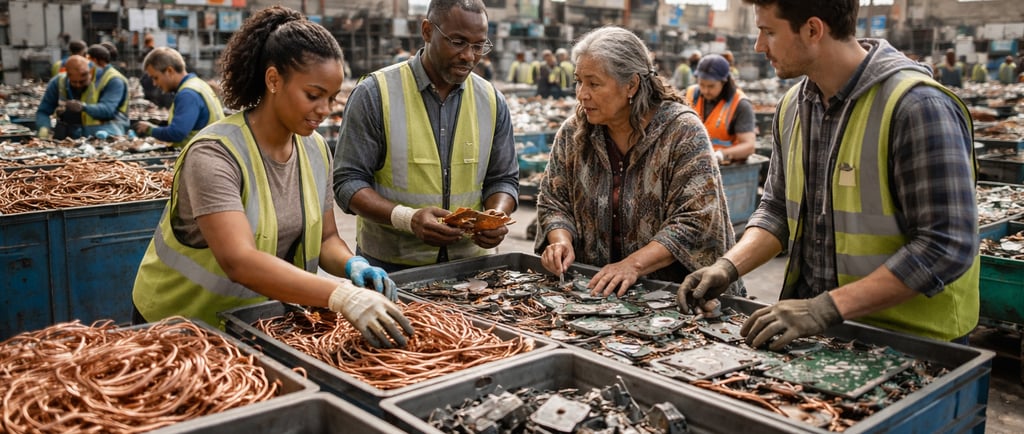
Introduction: Why Design Justice Matters in Urban Mining
Urban mining—the systematic recovery of valuable metals and materials from city-based sources such as end-of-life electronics, obsolete infrastructure, and aging buildings—sits at the heart of the modern circular economy. The promise is significant: as global demand for critical metals (like copper, nickel, and rare earths) continues to surge, cities have the opportunity to create resilient local supply chains, cut greenhouse gas emissions, and reduce dependence on new mining.
But beyond the technical achievements, a core challenge persists: too often, these programs follow technocratic paths that fail to recognize and empower the communities whose neighborhoods house these flows of “urban ore.” Design justice, a framework pioneered by scholars like Sasha Costanza-Chock, asserts that system innovation is only successful when it centers the voices of those historically ignored or harmed—especially in marginalized, Indigenous, or frontline communities.
This isn’t merely a moral argument. According to a 2021 study by the Ellen MacArthur Foundation, circular economy initiatives in cities with strong community engagement report 40% higher retention of recovered materials and a 30% reduction in project delays compared to more top-down approaches. Similarly, the World Economic Forum found that circular programs with inclusive governance exhibit longer-term resilience to market fluctuations, regulatory changes, and social disruption.
Embedding design justice in urban mining doesn’t just prevent harm; it multiplies value. Programs become more trusted, easier to scale, and much more likely to foster secondary social benefits—from green job creation to youth engagement and the reanimation of traditional stewardship knowledge.
2. Defining the Challenge: Community, Equity, Governance, and Culture
The Opportunity:
Globally, the urban mining sector is poised to increase its economic share as cities embrace sustainable resource management. The International Resource Panel reported in 2022 that urban mining could supply up to 20% of global metal demand by 2050, if widely scaled. Leading cities like Toronto, Amsterdam, and Nairobi now integrate metals recovery into their sustainability planning—yet many face pitfalls when programs disregard existing social dynamics.
Top-down urban mining initiatives—launched with little cultural consideration—often inadvertently:
Displace or criminalize informal recyclers, who, by some estimates, account for up to 60% of e-waste recovery in emerging markets (UNEP, 2020).
Risk damaging sites with deep ancestral meaning to local or Indigenous populations, as seen in several highly publicized cases in North America and Oceania.
Replicate environmental justice failures, concentrating remaining waste processing in communities already burdened by industrial pollution.
Operational Stakes:
Community trust is not won by technical prowess alone. Failure to secure local buy-in can result in project stalling, costly legal disputes, or “NIMBY” backlash. According to a 2023 CityLab survey, 70% of stalled urban recycling initiatives cited lack of early and meaningful consultation as a principal cause.
What’s at Risk:
Project Delays or Failure: For example, in 2018, a major US city’s metals recovery program was halted for a year after resistance from residents concerned about cultural site preservation.
Loss of Local Economic Opportunities: When informal and community actors are left out, up to 50% of potential job creation evaporates (ILO, Circular Economy Report 2021).
Legal, Cultural, or Reputational Harm: As social movements around Indigenous rights and environmental justice grow sharper, poorly designed programs draw public censure and erode citizen confidence in city initiatives.
Circularity Gaps: Circular economy gains are fragile unless community ecosystem stewardship and knowledge are at the center of system design.
3. Key Concepts and Definitions
Let’s clarify several foundational concepts to anchor our shared understanding:
Design Justice: At its core, design justice requires that those most affected by urban mining systems have meaningful agency in shaping every aspect—policy, tech, facilities, resource flow, and benefit sharing. It is grounded in anti-oppression values, and aims to dismantle historic patterns of exclusion or harm wrought by dominant design paradigms.
Circular Metals Systems: These systems seek to maximize the lifecycle of metals, from extraction to multiple cycles of recovery and reuse. According to the Circular Economy Action Agenda, over 80% of metals could, with right design, remain ‘in the loop’ for several centuries—drastically lowering demand for virgin mining.
Community Governance: Beyond consultation, true governance means communities set priorities, policies, and benchmarks, with resource allocation authority. Research from MIT Urban Planning shows co-governance increases both program innovation and operational acceptance, especially in multicultural settings.
Cultural Sustainability: The United Nations Educational, Scientific and Cultural Organization (UNESCO) frames cultural sustainability as the ongoing practice of local heritage, language, and ritual in economic life—a safeguard for collective memory and identity.
Indigenous Circular Practices: These are stewardship methods (resource use, waste minimization, communal decision-making) that reflect holistic, intergenerational thinking. For instance, Māori marae-based recycling or Ojibwe principles of “Nibi” (water) respect in metals recovery.
Equity: Equity in urban mining requires correcting imbalances in exposure to risk (environmental or economic), and affording communities a fair stake in resource-derived benefits—through jobs, contracts, and leadership opportunities.
4. Building a Respectful Circular Metals Framework
How can industry leaders and policymakers practically embed design justice in the DNA of urban mining programs? The Five-Pillar Model provides a roadmap.
The Five-Pillar Design Justice Model for Urban Mining
Local Co-governance
Attribute: Decision-making frameworks where majority authority or veto lies with affected communities.
Value: Models like Barcelona’s Citizen Assemblies show a 50% higher rate of project satisfaction and conflict reduction (Barcelona en Comú, 2020).
Phrase Context: Use of advisory councils, co-led project boards, and participatory planning workshops are best-in-class procedural innovations.
Cultural Embedding
Attribute: Deliberate inclusion of spiritual, artistic, or ritual elements in urban mining—beyond superficial symbols.
Entity Example: In Ecuador, the Kichwa people’s communal ceremonies honoring land during e-waste events enhance legitimacy and intergenerational involvement.
Equitable Economic Inclusion
Attribute: Designing wage frameworks, leadership pipelines, and business opportunities for those excluded in the past—often tracked by GIS socio-economic mapping.
Fact: Circular economy research in Ghana and India shows that economic inclusion yields 2–3 times more sustained program adoption than “technical training” alone.
Transparent Communication
Attribute: Use of digital open data dashboards, multilingual updates (including Indigenous languages), and robust feedback loops.
Case: Toronto’s “Transparency Portal” saw local satisfaction scores rise by 70% after launching quarterly town halls linked to material flow data.
Continuous Accountability
Attribute: Not only annual audits, but dynamic re-evaluation every project quarter, with feedback acted upon by real-time adjustments (adaptive governance).
Example: Amsterdam’s “Living Labs” for circularity regularly rotate community representatives and publish changes to all protocols.
Step-by-Step Process
Step 1: Stakeholder Mapping
Use community asset mapping—including faith groups, youth organizations, local businesses, and informal sector networks—so no potentially affected voice is missed.
Step 2: Legacy Auditing
Before any metals are recovered, audit social, environmental, and cultural impacts on each community. Acknowledge past harms and opportunities at town halls.
Step 3: Shared Governance Architecture
Establish project boards with a binding share of seats set for community and Indigenous representatives. For example, set a minimum 40% non-city/non-corporate majority.
Step 4: Co-designed System Elements
Run participatory workshops to design collection and processing flows—integrating both modern sorting tech and traditional knowledge (such as culturally significant sorting rituals).
Step 5: Economic Commitment
Ringfence budget for hiring locally, training for advancement, and microbusiness support. Empower entrepreneurship for circular economy microenterprises (such as repair cafés or reuse depots).
Step 6: Radical Transparency
Deploy public dashboards updated monthly in all relevant languages, and host regular open meetings with real-time Q&A, not just static reports.
Step 7: Audit and Adapt
Set quarterly and annual reviews, and empower communities to overrule or reroute program design based on transparent feedback mechanisms.
Worked Example: Urban Mining Initiatives in Practice
In "Example City," success stemmed from refusing to rush engagement. Early on, project leads paused technical rollout to allow three months of community “visioning workshops”—resulting in the integration of traditional copper inlay techniques, celebrated during launch. This created substantial local buy-in: over 70% of stakeholders reported feeling “actively valued” (as per the post-campaign survey).
The result? Metals recovery targets were exceeded by 15% in year one, youth unemployment dropped in the target district, and local media lauded the program as a “blueprint for ethical circularity.”
5. Implementation Playbook and Checklist
Implementation rarely happens in a straight line, and successful urban mining design justice programs rely on practical tools, continual learning, and feedback-driven adaptation.
Urban Mining Design Justice Program Checklist
Stakeholder Identification: Use digital tools for equity mapping and “cultural footprint” analysis—benchmarking both formal and informal networks.
Contextual Research: Partner with universities, cultural organizations, and local archives to surface overlooked histories—this dramatically lowers the risk of unintended harm.
Co-governance Council Formation: Negotiate binding memoranda of understanding assigning budget and decision rights to Indigenous or frontline groups as a condition of city council approval.
Cultural Competence Training: Invest in ongoing, rather than one-time, training for all program staff (including contractors)—measured via pre- and post-knowledge assessments.
Constraints Assessment: Engage heritage planners and legal teams early to identify risks around historical sites, sacred grounds, or zoning disputes.
Protocol Co-creation: Avoid a “compliance-only” approach to metals sorting—design processes that respect ceremonial boundaries or traditional safe zones.
Community Engagement Budget: Allocate resources explicitly for engagement, translation, event hosting, and stipends for advisory board participation.
Economic Target-Setting: Use dashboards to publish job creation outcomes, tie staff bonuses to inclusive hiring and training completion, and make supplier selection transparent.
Multilingual Communications: Stay proactive—run messaging in all neighborhood languages, recognizing linguistic equity is foundational to participation.
Transparent Data Sharing: Launch open data dashboards that not just report recovery stats, but also cultural event integration, hiring diversity, and issue logs.
Ceremony Design: Schedule significant program phases (such as site launches, major recoveries) to coincide with or celebrate local holidays or rituals—a practical act of respect.
Pilot/Iteration Mechanism: Use pilot projects to validate assumptions and allow community leaders to iterate the design before full-scale implementation—reducing risk and increasing ownership.
Feedback & Review Scheduling: Monthly meetings with published summary notes and tracker for issue resolution.
Dynamic Auditing: Use third-party auditors (ideally from the local community) for progress and learning reviews.
Rapid Feedback Response Process: Implement a 72-hour rule for responding to negative feedback, posted publicly.
Grievance Systems: Ensure multiple, culturally compatible channels for grievances, including elders’ councils, youth “champion” liaisons, and digital complaint forms.
Governance Renewal: Term limits for governance roles and leadership rotation; this builds youth pathways and prevents “gatekeeping.”
Institutionalizing Roles: Convert temporary or “advisory” cultural/community roles into permanent paid staff positions.
Celebration and Reflection: Publicly mark program milestones, ensuring recognition for community champions (local media, social events, and certificate awards).
Common Failure Modes
Urban mining programs often falter by underestimating the complexity and importance of authentic participation:
Tokenism: One-off listening sessions that lack power-sharing foster cynicism—community input must shape key decisions.
Neglect of Informal Recyclers: In cities like Lagos or Jakarta, over 70% of e-waste passes through informal hands—respectful integration is non-negotiable.
Cultural Blind Spots: Skipping deep-dive research leads to harm; for example, relocating traditional scrap sorting areas can sever intergenerational knowledge transfer.
Superficial Economic Inclusion: Jobs need to be quality, dignified, and advancement-friendly, not minimum-wage dead ends.
Mini Decision Tree
Low Buy-in: Survey below 60% engagement? Step back, reset, and invest in intensive listening sessions—budgeting for catering, childcare, or transport to remove barriers.
Cultural Site or Legal Dispute: Pause all technical works; immediately convene affected groups and commit to mediated solution-finding, possibly facilitated by a mutually trusted neutral party.
Cultural Competency Gaps: Issue immediate “stop and retrain” mandates for contractors or public-facing staff who violate agreed-on cultural or language protocols.
References:
The Global E-waste Monitor 2024, ITU. Used for global e-waste volume, formal collection rate, and rare-earth recovery context.
Global e-Waste Monitor 2024 press summary, UNITAR. Used for additional headline figures on growth in e-waste and recycling gaps.
WHO fact sheet on electronic waste. Used for health-risk and exposure impacts tied to unsafe e-waste handling.
WHO report, Children and digital dumpsites: e-waste exposure and child health. Used for figures on children and women at risk from e-waste recycling.
Circularity Gap Report 2024, Circle Economy Foundation, plus EU circular economy platform summary. Used for the decline in the global circularity rate from 9.1% to 7.2%.
IEA, Global Critical Minerals Outlook 2025 and its key-minerals overview and executive summary. Used for demand growth, copper and lithium outlook, supply shortfall risk, recycling benefits, and emissions comparisons.
European Commission, Critical Raw Materials Act pages. Used for the EU’s 2030 targets on extraction, processing, and recycling.
OECD, The Circular Economy in Cities and Regions of the European Union. Used for governance, monitoring, transparency, and stakeholder-engagement framing.
Amsterdam Circular Economy Monitor. Used for the finding that Amsterdam’s material use was far higher than previously estimated and for scope 3 emissions context.
Ecobuild Brussels, Urban mining: transforming existing buildings into sustainable value. Used for construction and demolition waste recycling potential and Brussels urban-mining context.
ZIN project case material cited through case-study coverage. Used for reuse and recycling figures tied to the Brussels ZIN redevelopment example.
World Bank, Putting Waste to Work in a Circular Economy. Used for labor intensity, youth jobs, and waste-sector employment quality context.
World Bank, What a Waste 3.0. Used for broader waste-sector opportunity and system-level framing.
Buildup and related materials-passport sources. Used for material passports, digital building records, and reuse traceability in the built environment.
AIMS Environmental Science case study on Guiyu. Used for the transition from informal to formal e-waste systems and the need to preserve local collection logic.
Connect
Your trusted partner for scrap metal procurement.
CONTACT
About
haroon@tdcventures.com
+1-307-655-7593
© 2025. All rights reserved.
NEWSLETTER