
Digital Marketplaces for Secondary Parts
Unlock the value trapped in unused inventory. Our guide explains how a digital secondary parts marketplace reduces downtime, cuts costs, and drives circular economy results for industrial MRO and OEM operations.
WASTE-TO-RESOURCE & CIRCULAR ECONOMY SOLUTIONS

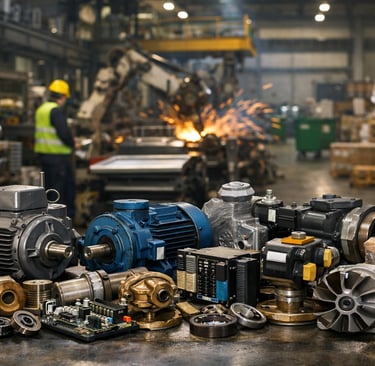
1. Context and Why It Matters for the Target Niche
Industrial operations exist in perpetual motion—downtime is the sworn enemy of productivity and profit. For asset-intensive sectors such as manufacturing, utilities, energy, and processing, even a single unplanned shutdown can trigger catastrophic financial losses and operational disruptions. MRO (maintenance, repair, and operations) teams and OEM (original equipment manufacturer) spare parts buyers sit at the heart of this critical ecosystem, tasked with the near-impossible: reducing downtime, containing costs, and managing risk—all while adapting to the increasing demand for sustainability.
The legacy supply model—linear, siloed, and reactive—results in ballooning surplus inventories and the quiet, insidious depreciation of high-value components. Items purchased as insurance against long lead times often languish forgotten on shelves. Meanwhile, missing or obsolete parts can halt production lines, jeopardizing both daily targets and long-term equipment effectiveness.
This old approach runs headlong into emerging sustainability mandates and growing pressure from customers and regulators to adopt circular economy principles. There’s both corporate and social capital at stake. Buyers, investors, and regulators increasingly favor brands demonstrating concrete action toward responsible resource stewardship and low-waste operations.
Digital secondary parts marketplaces are fast emerging as a game-changer within this industrial landscape. These platforms address both practical and strategic objectives by enabling the transparent, efficient trading and recirculation of valuable parts and materials. The result? Teams can extract maximum value from existing resources, cut procurement cycle times, and visibly participate in the circular economy.
Why It Matters: Strategic and Operational Advantages
Resilience: Digital platforms mitigate supply chain shocks by unlocking dormant inventory and offering real-time access to rare and legacy parts.
Efficiency: Properly implemented, marketplaces help teams avoid emergency buys, reduce “just-in-case” stockpiling, free up warehouse capacity, and release working capital trapped in surplus.
Regulatory Readiness: Industrial leaders face mounting pressure to comply with environmental, social, and governance (ESG) standards. Active marketplace participation demonstrates measurable progress—reducing landfill waste, optimizing lifecycle management, and supporting transparent reporting.
Competitive Differentiation: The ability to source parts quickly, support sustainable practices, and offer lower-cost solutions bolsters brand loyalty and differentiates OEMs and MRO suppliers in an increasingly circular world.
In sum: Adopting secondary parts marketplaces is not merely a “nice to have”—it’s an essential leap forward for efficient, modern, sustainable operations.
2. Defining the Problem and Operational Stakes
The Problem: Value Loss in Linear Supply Chains
Traditional supply chains in industrial maintenance are riddled with inefficiencies and hidden costs:
Static Inventory: A significant portion of purchased spares remain unused; according to Aberdeen Group, as much as 40% of MRO inventory can be classified as inactive or obsolete at any given time.
Obsolescence Risk: For OEMs, supporting equipment through its entire service life becomes increasingly complex as product lines evolve and technology changes, placing immense pressure on aftersales and support divisions.
Long Lead Times and Price Spikes: When a critical part becomes unavailable via traditional channels, buyers must often accept higher prices or endure production delays—each hour of downtime costing from $2,500 (for smaller plants) to over $100,000 (for large-scale manufacturing and energy operations), per Deloitte industry estimates.
Environment-Waste Disconnect: Linear “take-make-waste” models push perfectly viable metals and components into the waste stream, contributing to landfill build-up and resource depletion.
Operational Stakes: What’s on the Line
Procurement Risk and Lost Uptime: Being unable to locate or acquire a needed part during a maintenance window puts asset uptime at risk—sometimes with severe operational consequences.
Financial Impact: Unused inventory ages, tying up capital that could be redeployed elsewhere. According to ARC Advisory Group, idle MRO assets can represent 15–20% of total spare parts spending.
Regulatory and Customer Pressure: Modern buyers, auditors, and government agencies expect OEMs, parts distributors, and asset owners to track, report, and optimize end-of-life management—penalizing those who fall short on sustainability reporting or circular practices.
Evolving Buyer Expectations: Industrial buyers have grown to expect consumer-grade transparency, rapid sourcing, and evidence of sustainable practices. Failing to deliver can erode trust and market share.
Digital marketplaces for secondary parts deliver a direct solution to these pain points by turning the traditional waste stream into a source of value, improving resource efficiency, and helping organizations comply with the new circular economy imperative.
3. Key Concepts and Definitions
Let’s clarify the foundational concepts at play—these power the design and execution of any successful industrial parts marketplace in the circular economy.
Circular Economy:
A production and consumption ecosystem that emphasizes extending product life, maximizing value retention, and closing resource loops. It replaces single-use linear models with systems that prioritize reuse, remanufacturing, and recycling, driving down raw material dependency and landfill waste.
Secondary Parts:
Parts that have completed their first use-cycle but retain functional or recoverable value. Categories include: surplus new inventory, lightly used spares, decommissioned assemblies, and components that can be remanufactured. Eligibility depends on the part’s condition, technological relevance, and regulatory compliance.
Remanufacturing:
A process in which end-of-life or used components are restored to original (or better) performance standards, often with updated warranties. This goes beyond conventional repair or refurbishment by meeting—or exceeding—OEM quality and reliability benchmarks.
Reverse Logistics:
The end-to-end system for moving products or materials backward through the supply chain. In digital secondary markets, this includes pick-up, transport, inspection, certification, and redistribution of spare parts and assemblies, using robust tracking to guarantee compliance and provenance.
Digital Marketplace:
A secure, web-based platform where sellers and buyers of secondary industrial parts register, list, and transact spares—with embedded tools for documentation, certification, dispute resolution, and analytics. Effective marketplaces integrate directly with asset management software (like EAM or CMMS platforms), automating the flow of information and inventory.
Related Entities:
OEM Spare Parts: The original components manufactured to precise specifications, which form the backbone of the secondary parts ecosystem.
MRO Inventory: The full spectrum of maintenance, repair, and operational supplies held by asset-intensive organizations, often spanning thousands of SKUs and substantial surplus.
Certification Bodies: Third-party or OEM organizations tasked with validating the quality, safety, and compliance of used, refurbished, or remanufactured items—building trust in every transaction.
Entity Relationships:
Secondary parts (entities) are characterized by condition (attribute) and can be traceable via digital certification (attribute: provenance/documentation).
Digital marketplaces (entities) enable listing, transaction, and integration (attributes: platform functionality).
Remanufacturing processes (entities) assign warranties and quality standards (attributes: compliance, performance, warranty duration).
4. The Core Framework: Keeping Metals Circulating Longer
Five Pillars of Industrial Circularity
1. Inventory Transparency
Success starts with visibility. Digital marketplaces excel by providing all stakeholders—asset owners, OEMs, MRO buyers—with a real-time window into the inventory landscape. Networked databases display both in-house stocks and available options from across the marketplace ecosystem. According to McKinsey, companies capturing real-time MRO inventory data see up to 25% reduction in carrying costs.
What sets top platforms apart: Deep, searchable part catalogs, advanced filtering, and smart suggestions based on usage history and criticality.
2. Certification & Traceability
Trust is the currency of the circular parts marketplace. Reliable certification programs, digital “birth certificates,” and transparent documentation ensure every part’s status, service history, compliance records, and warranty terms are immediately accessible. This reduces risk for buyers and protects sellers’ reputations.
Key features include: Blockchain-based records, OEM-authenticated certifications, and automated compliance checks for each transaction.
3. Automated Matching
Artificial intelligence and machine learning algorithms power the automated “supply meets demand” engine. By analyzing historical demand, active search queries, and asset management triggers, platforms can surface highly relevant secondary listings to buyers right when needs arise. Dynamic pricing tools also optimize deals for both sides.
Industry insight: According to BCG, AI-powered industrial marketplaces can cut sourcing lead times by 30% and reduce emergency buy scenarios by over 20%.
4. Reverse Logistics Integration
Reverse logistics is the engine room of the industrial circular economy. Top-performing marketplaces partner with specialist logistics providers—or build in-house capability—to ensure frictionless pick-up, certified shipping, regulatory compliance (such as hazardous material regulations), and efficient routing for refurbishment, recycling, or redistribution.
5. Marketplace Governance
Scale and reliability depend on robust governance. Marketplaces must establish clear dispute resolution pathways, standard operating procedures for quality assurance, privacy controls, transaction security, and ongoing participant monitoring.
Best-in-class platforms: Employ escrow payment structures, enforce standardized listing protocols, and regularly review participant performance.
Step-by-Step Framework for Marketplace Adoption
1. Map Your Inventory
Conduct a thorough asset census, leveraging CMMS or EAM systems to identify every spare, obsolete, surplus, or under-utilized item. Capture metadata—part number, condition, usage history, technical specs, compliance status. Digital tools and physical audits often uncover hidden value worth tens or even hundreds of thousands per site.
2. Segment by Reusability
Classify parts into categories:
Direct-Reuse: Like new, low-wear, or new-old stock
Refurbishment Required: Used, repairable, needs minor overhaul
Remanufacturing-Eligible: High wear, but suitable for re-man by certified partners
Each category should follow a defined assessment and documentation protocol.
3. Digitize Listings
Upload part data, high-resolution images, condition reports, and supporting documents to the marketplace. If possible, integrate asset data feeds to automate updates. Standardize descriptions and leverage data validation to prevent listing mismatches or errors.
4. Set QA Protocols
Define the operational quality testing and certification steps for every category. For example, electrical components require dielectric strength testing, while rotating machinery might need run-out measurements and bearing assessment.
5. Integrate with Asset Management
Plug your EAM/CMMS or other MRO asset management tools directly into the marketplace platform. This not only automates demand signals (triggering part listings or removal) but enables predictive sourcing.
6. Enable Reverse Logistics Flows
Work with logistics providers specializing in regulated goods movement, heavy items, or hazardous materials. Your program should include return authorizations, drop-off point management, and automated tracking from pickup to final disposition.
7. Launch and Monitor
Start with a pilot, focusing on a specific parts category or business unit. Collect transaction data, buyer and seller feedback, and iterate rapidly on workflow or platform usability. Reinvest early wins (cost recovered, downtime prevented) into broadening the effort enterprise-wide.
Industry Snapshot: Refurbished Pumps Case
Industrial leaders already leveraging these steps see outsized returns:
Company ABC, a top-tier chemical processor, conducted a comprehensive MRO audit and discovered 2,100 surplus industrial pumps, idle across six global manufacturing sites. Through a digital secondary parts marketplace, they listed, certified, and coordinated sale and shipping of nearly 800 pumps within a single quarter. The effort unlocked $600,000 of value from dormant assets, reduced urgent procurement by 15%, and delivered an independently verified carbon saving by ensuring pumps were recirculated, not scrapped. Centralized certification and logistics partners were critical for speed and risk management.
Trust, safety, and compliance, the layer that decides whether the market works
Secondary parts fail for one reason more than any other: buyers do not trust the unit enough to put it into production. Price matters, but confidence matters more.
If you want a marketplace that serious operators adopt, you need to treat trust as an engineered outcome. That means building controls that reduce uncertainty at each point where risk spikes.
The risk categories you must design for
Safety-critical and regulated applications. Think pressure systems, lifting, rotating equipment, electrical protection devices, and hazardous-area components. Your marketplace must make it easy to say “no” when the risk is not acceptable, and easy to say “yes” when the evidence is strong.
Counterfeit and gray-market exposure. Counterfeit industrial components are not only a financial risk. They create operator risk and plant liability. A VDMA study on product piracy reports that 36% of companies say counterfeits pose a danger to operators or users. This is why your marketplace needs provenance rules that a buyer’s QA team can defend.
Warranty reality. Many secondary parts will not carry the OEM warranty, even when they are legitimate. For example, Radwell states that surplus items may not be covered by the original manufacturer’s warranty, but they are covered by Radwell’s own warranty terms. Buyers need that clarity upfront, not after a failure.
A practical trust stack that works in real plants
Identity and provenance for every listing. Serial number capture where applicable, photos that prove condition, and documentation that ties the unit to a real origin. If you cannot show origin, you price it as higher risk and you restrict the use case.
Condition grading with test evidence. Not “used, good.” You need category-specific proof, with test method, test date, test equipment, and technician identity. Secondary does not mean undocumented.
Clear eligibility rules. Some categories should never be listed without certification. Others can be listed with disclosure and limited use-case labels. Make “intended use” a mandatory field, not a suggestion.
Escrow or controlled release. For higher-risk components, payment release should depend on receipt and verification. This is how you keep disputes from poisoning the market.
Dispute and return path that respects downtime. A normal e-commerce return window is not enough. You need a “plant-critical failure” path that triggers immediate replacement sourcing, rapid logistics, and a documented root cause record.
Data, integration, and how marketplaces connect to EAM and CMMS systems
A secondary marketplace becomes truly valuable when it stops being a separate website and starts behaving like an extension of maintenance planning.
The reason is simple. Demand for spares is event-driven. A work order gets created. A failure code appears. A shutdown window is scheduled. If the marketplace is not connected to those signals, buyers arrive late, buy in panic, and trust the market less.
What you integrate and why it matters
EAM and CMMS triggers. The marketplace should ingest planned work orders, BOMs, equipment criticality, and failure history, then surface matching listings as early as possible. This prevents emergency buying, which is where cost and risk explode.
ERP and procurement controls. You need consistent vendor onboarding, tax handling, approval flows, and invoice logic. Without it, procurement blocks the program.
Master data cleanup. This is the hidden work that decides success. If part numbers are inconsistent, descriptions are vague, and synonyms are uncontrolled, your matching will fail even with good search.
How to structure listing data so buyers trust it
Make every listing answer these questions without back-and-forth:
What is it. OEM part number, manufacturer, model, revision, compatibility notes.
What condition is it in. New surplus, unused but aged, used tested, repaired, refurbished, remanufactured.
What proof exists. Test report, photos, service history, certification, and warranty terms.
What risk remains. Known limitations, missing documentation, storage conditions, and allowed applications.
How fast can it be installed. Lead time, packaging, shipping constraints, and return conditions.
Where digital product passports start to matter
If you sell into the EU, the direction of travel is clear. The EU’s Ecodesign for Sustainable Products Regulation introduces a Digital Product Passport concept, which is intended to store and share product sustainability and compliance information. Even when your category is not the first wave, the operating expectation is moving toward structured product identity and traceability. Secondary parts markets that build strong product identity now will be ahead of the curve.
Economics, ROI, and why finance teams approve secondary programs
A marketplace program survives when finance can see the cash and can audit the controls. You should be able to walk into a CFO review with three numbers and a clean method behind each one.
The cost drivers that make secondary parts financially obvious
Downtime cost. Siemens’ “True Cost of Downtime” report highlights that large automotive manufacturers can lose $2.3 million per hour of downtime. Even if your sector is lower, the point is that a single avoided stoppage can pay for an entire program.
Inventory carrying cost and obsolescence. IBM’s material on MRO spare parts highlights patterns many plants recognize: only 8–10% of MRO spare parts inventory is used annually, holding costs can run 20–30% of inventory value, and 20–30% of inventory can be obsolete at any given time. This is why secondary marketplaces are not only “procurement.” They are working capital release.
Surplus liquidation value. Platforms such as Automa.Net position themselves around helping firms buy, sell, and manage industrial automation spare parts, and they report scale indicators like 36 million SKUs listed and 14.8 million products in stock, supported by hundreds of suppliers. You do not need those exact numbers to win internally, but it shows there is meaningful market liquidity in certain categories.
A simple ROI model leaders can use
Step one, quantify the trapped value.
Inventory value in-scope. Pick categories you can safely transact.
Excess and obsolete estimate. Use your own movement data. If you do not have it, start with a conservative internal baseline and tighten it during the pilot.
Annual holding cost. Use your finance standard, many organizations land in the 20–30% band when they include space, handling, insurance, taxes, and shrink.
Step two, quantify the avoided cost.
Avoided emergency buys. Track every event you sourced faster or cheaper than normal channels.
Avoided downtime. Track “maintenance window saved” events and estimate the downtime value using your internal standard.
Step three, quantify program cost.
Platform fees and integration cost.
QA and inspection cost.
Logistics cost and returns.
Net result equals credibility. The finance team does not need perfection. They need repeatable logic that stands up in audit.
Reverse logistics and quality, the operating playbook buyers will judge you on
Secondary parts are a logistics and QA business disguised as a digital product.
If you want repeat usage, your reverse logistics needs predictable cycle times, reliable packaging, and a clear chain of custody. The moment a part arrives late or arrives undocumented, buyer confidence drops, and your market volume follows.
What “good” looks like in practice
Fast repair and exchange windows. Siemens describes repair turnaround windows in the 12 to 72 hour range for certain circular repair approaches. Even if your program cannot hit that on day one, it sets the benchmark mindset: cycle time is the product.
Quality assurance that matches the category. Electrical and automation parts need functional testing that a technician would trust. Rotating assets need vibration, alignment checks, bearing condition, and clear limits. Pressure-related components need inspection evidence appropriate to the risk.
Packaging as risk control. Electrostatic protection, shock protection, moisture control, and tamper evidence should be standard for high-risk categories.
A category-based QA ladder you can adopt
Tier 1, low-risk commodity spares. Visual inspection, basic verification, clear disclosure, and returns.
Tier 2, moderate-risk components. Functional test evidence, documented storage conditions, and limited warranty.
Tier 3, plant-critical or safety-critical. Certification path, controlled release, traceability, and stricter listing eligibility.
How to handle failure events without destroying trust
When a unit fails on arrival or fails immediately after install, buyers do not want debate. They want resolution.
Your program should pre-define:
Failure classification and evidence requirements.
Replacement sourcing protocol, including cross-sourcing from new channels.
Credit and returns rules.
A root cause capture step, so you learn and reduce repeats.
ESG, circular reporting, and how to prove impact without hand-waving
Many companies talk about circularity. Few can measure it in a way auditors respect.
A secondary parts marketplace can become one of the most measurable circular programs inside an industrial business, because transactions are discrete, traceable events.
What to measure and report
Value retention. Share of demand served by reuse, repair, refurbishment, or remanufacture.
Waste avoided. Units recirculated versus scrapped.
Carbon impact estimates. Use category-specific factors where possible, and document assumptions.
A credible example from remanufacturing
Caterpillar reports that, compared to manufacturing new parts, its remanufacturing can deliver 65–87% less GHG process emissions, 80–90% less new materials used, and 65–87% less process energy use.
You do not need to claim the same numbers for every part category. You do need a method that allows you to estimate impact based on a defensible source, a part category, and a documented substitution event.
Why regulation pressure is not going away
The EU’s right-to-repair direction is clear, and the rules adopted in 2024 apply from July 31, 2026 after national transposition. Even though much of the early scope focuses on consumer goods, the broader market expectation moves in the same direction: longer product life, available parts, and fewer barriers to repair.
Where this is heading, and how leaders stay ahead
The next phase of secondary parts marketplaces will be shaped by three forces.
First, structured traceability becomes normal. Digital product passports, standardized identifiers, and machine-readable product data will move from “pilot idea” to “business requirement,” especially in EU-linked supply chains.
Second, circular service offerings expand inside OEMs. Siemens’ launch of Circular Repair Services is a signal that OEMs are building formal circular service lines for automation products, with an emphasis on predictable lifecycle cost and plant availability. This changes the marketplace landscape because OEMs can become both participants and standard setters.
Third, risk controls will differentiate winners. Counterfeit exposure, documentation weakness, and unclear warranty terms will push buyers toward programs that feel governed and safe.
Embedded SEO toolkit for this topic
Primary search intent you should target
Your reader is usually searching under pressure. Build pages that match those moments.
High-intent topics to publish as standalone sections inside this guide
Digital marketplace for industrial spare parts
Buy used PLC parts with warranty
Surplus MRO inventory liquidation
Obsolete spare parts sourcing
Refurbished vs remanufactured spare parts differences
How to reduce downtime with spare parts availability
MRO inventory carrying cost percentage
How to prevent counterfeit industrial components
On-page structure that ranks and converts
A short “direct answer” near the top for the main query, then expand.
A glossary that repeats and standardizes entity terms: CMMS, EAM, RMA, escrow, traceability, remanufacture, refurbished, exchange.
A “program checklist” section that a manager can copy into a project plan.
Internal link targets you should create around this guide
MRO inventory audit procedure
Spare parts criticality classification
Reverse logistics SOP for industrial returns
Certification and testing templates by category
ESG measurement method for circular spares
Embedded AEO toolkit for assistants and answer engines
If you want this guide to be pulled into AI answers, you need tight, quotable blocks that resolve a question cleanly.
Use these ready-to-place “instant answers” inside your post
What is a secondary parts marketplace in industry?
It is a controlled platform where companies buy and sell surplus, used, repaired, refurbished, or remanufactured industrial parts with documentation, warranty terms, and a dispute path. The goal is to reduce downtime risk, cut procurement lead times, and recover value from idle inventory while meeting internal QA and compliance requirements.
What is the difference between refurbished and remanufactured?
Refurbished usually means the unit is restored to working condition, often with limited replacement of worn elements. Remanufactured means the unit is restored to a defined standard that targets original performance, with standardized processes, test evidence, and warranty terms.
What makes buyers trust secondary parts?
Clear provenance, category-appropriate test evidence, transparent warranty terms, and a predictable return and dispute process. Trust rises when the platform restricts high-risk categories unless certification rules are met.
Embedded GEO toolkit for AI search surfaces and generative results
Write with consistent entities. Do not rotate terms. Pick one term per concept and stick to it.
Repeat definitional anchors. Every long section should restate the key term once, in plain language, before adding detail.
Add “proof hooks.” When you mention a number, attach the source and the context. Examples you can cite include downtime cost reports, MRO inventory usage patterns, and remanufacturing impact figures.
Include decision logic. AI systems surface content that explains choices. Add “when to use secondary,” “when to refuse secondary,” and “how to choose certification level.”
Actionable recommendations for implementation and performance improvement
A 30–60–90 day rollout plan that works in real organizations
Days 1–30, pick the pilot that will not get blocked
Choose 2–3 part categories with strong demand and lower safety risk, such as industrial automation spares, non-critical motors, pumps in non-hazard zones, or common instrumentation components. Define what is out of scope on day one.
Stand up the minimum trust stack: required fields, photos, warranty disclosure, and a basic test evidence template. Mirror the approach used by established resellers that publish explicit warranty policies.
Build your internal approval lane. Legal, QA, and procurement need a simple policy they can sign.
Days 31–60, connect to maintenance planning
Integrate with your CMMS or EAM export first if full API integration is not ready. Your objective is simple: when a work order is scheduled, the planner can see marketplace options without leaving the planning flow.
Add a criticality flag that changes the rules. Critical parts require higher evidence and stricter seller requirements.
Set logistics SLAs by category. If you cannot control lead time, you cannot claim downtime reduction.
Days 61–90, prove value with measured wins
Track the three headline metrics: cash recovered from surplus, avoided emergency spend, and avoided downtime events.
Add ESG reporting fields where you can, using conservative assumptions and documented sources for remanufacturing impact where applicable.
Run a post-mortem on every dispute and every failure-on-arrival. Improve the listing rules and test evidence templates after each incident.
Practical do’s and don’ts that prevent failure
Do require test evidence on anything that could shut down a line.
Do make warranty terms impossible to miss.
Do restrict categories that are too risky until you have certification partners.
Do not allow vague condition labels without proof.
Do not run secondary sourcing as a side project. It touches uptime, safety, compliance, and working capital. It needs an owner.
The operating manual, SOP pack, KPI system, and scale playbook
If Part 2 explained why secondary parts marketplaces win, Part 3 shows you how to run one without losing trust, breaking compliance, or creating extra work for maintenance.
The operating model that survives real-world pressure
A secondary parts marketplace is not a procurement side project. It sits at the intersection of uptime, safety, compliance, finance, and sustainability reporting. If you do not assign clear ownership, it becomes “everyone’s job,” which means it becomes no one’s job.
Core roles you need, even in a lean setup
Program Owner (usually Reliability, MRO, or Supply Chain). Owns policy, scope, results, and escalation. Chairs the weekly review and signs off on category rules.
Quality and Certification Lead (QA or Engineering). Owns condition grading, acceptance tests, certification partners, and listing eligibility rules by category.
Marketplace Operations Lead (Supply Chain Ops). Owns listing intake, documentation completeness, dispute handling, and seller performance monitoring.
Logistics and Chain-of-Custody Lead (Logistics or EHS). Owns packaging standards, hazardous movement rules, tracking, and chain-of-custody evidence.
Finance Partner (FP&A or Controller). Owns value recovery logic, inventory write-down alignment, and audit readiness.
Legal and Compliance Partner. Owns terms, liability boundaries, and high-risk category restrictions.
The decision you must make early: centralized, federated, or hybrid
Centralized works best for multi-site enterprises that want consistent QA, consistent terms, and stronger negotiating power with logistics partners. It also helps prevent “random local selling” that can create audit problems.
Federated can work when sites run very different equipment stacks and have distinct risk profiles, but it demands strong minimum standards.
Hybrid is often the practical answer. Centralized policy and QA templates, local execution for intake and packaging, centralized dispute path and reporting.
The minimum viable policy that unlocks adoption
Most programs stall because policy is vague. Buyers do not know what is allowed. Sellers do not know what proof is required. Procurement does not know how to approve.
Your policy must answer five questions in plain language
What is in scope. Define categories, brands, and risk classes you accept in Phase 1.
What is out of scope. List safety-critical and regulated categories that require a higher gate.
What proof is required. Define the document set and test evidence by risk tier.
What warranty rules apply. Make it impossible to miss. This is one of the biggest trust drivers in secondary channels, because many surplus items will not carry OEM warranty and will instead rely on reseller or program warranty terms.
What happens when something fails. Define return windows, failure-on-arrival process, and plant-critical escalation.
A simple, defensible risk-tier system
Tier A, low risk. Fast-moving, non-safety-critical spares where a failure does not create a safety incident and does not create catastrophic downtime. Example: non-critical sensors, certain HMIs, general consumable modules where redundancy exists.
Tier B, medium risk. Failure can cause downtime, but can be verified with tests and controlled installation. Example: many automation components, certain drives and control modules with documented testing.
Tier C, high risk. Safety-critical, regulated, hazardous-area, pressure systems, lifting, and anything where provenance gaps or hidden defects can cause harm. These should require certification and strict eligibility rules, or be excluded until you have the right partners.
Counterfeit risk must be explicitly covered. Industrial counterfeits remain a safety issue, with VDMA studies reporting substantial shares of companies encountering counterfeits that pose risk to operators or users.
SOP pack, listing intake to publication
This is the day-to-day system that prevents chaos. You can copy this section into your internal documentation.
SOP 1, Listing Intake and Evidence Checklist
Purpose
Ensure every listing is complete, comparable, and defendable before it goes live.
Trigger
A site requests to sell surplus, used, refurbished, or remanufactured parts.
Inputs required
Seller identity, location, internal asset reference, and category risk tier.
Steps
Identity and eligibility gate
Confirm seller is approved, confirm category is allowed, confirm no sanctions or restricted compliance issues.
Mandatory listing fields
Manufacturer, OEM part number, model, revision, serial number if applicable, compatibility notes, quantity, storage location, and available date.
Condition declaration
Select one: New surplus, new old stock, used tested, repaired, refurbished, remanufactured. Do not allow free-text-only condition.
Evidence pack upload
High-resolution photos, nameplate photo, packaging photo, and documentation relevant to the tier.
Storage and handling declaration
Temperature exposure, moisture exposure, ESD controls where relevant, and any known handling events.
Warranty and returns declaration
Program warranty terms, return window, and exclusions. Keep it explicit because buyers will assume OEM warranty unless you state otherwise, and secondary channels often rely on program warranty structures.
QA hold or release
Tier A can be released after completeness check. Tier B and Tier C require QA review and test evidence verification.
Outputs
Published listing with evidence, or rejected listing with reasons and required fixes.
SOP 2, Condition Grading Standard
Purpose
Make condition comparable across sellers and sites.
Condition grades
Grade 1, New surplus. Unused, current generation, documentation available.
Grade 2, New old stock. Unused, but aged, verify storage conditions.
Grade 3, Used tested. Used, tested with documented method and pass results.
Grade 4, Repaired or refurbished. Work performed documented, test evidence required.
Grade 5, Remanufactured. Standard process, full test evidence, warranty terms defined.
Required disclosures
Missing documents, missing serials, unknown storage history, and any prior failure mode known.
QA and certification templates you can run tomorrow
Quality is where secondary marketplaces win or fail. Buyers will forgive a slow interface. They will not forgive a part that arrives undocumented, untestable, or unsafe.
Template A, Test Evidence Summary (attach to every Tier B and Tier C listing)
Header
Part number:
Manufacturer:
Model and revision:
Serial number:
Test location:
Test date:
Technician or lab:
Test equipment ID and calibration date:
Functional test results
Test 1 name:
Method:
Pass criteria:
Result: Pass or Fail
Notes:Test 2 name:
Method:
Pass criteria:
Result: Pass or Fail
Notes:
Environmental and handling checks
ESD handling used: Yes or No
Packaging method:
Moisture protection:
Shock protection:
Tamper evidence:
Final declaration
I confirm these results reflect the unit shipped, and evidence files are attached.
Template B, Incoming Inspection Checklist for Buyers
On receipt
Confirm packaging intact and tamper evidence unbroken.
Photograph the box, label, and unit before opening.
Confirm nameplate matches listing.
Confirm serial and revision match listing.
Basic checks
Visual damage, corrosion, missing components.
Connector and terminal condition.
Seal condition where applicable.
Evidence match
Confirm test summary present.
Confirm warranty terms present.
Decision
Accept and release to stores, or quarantine and trigger dispute path.
Reverse logistics SOPs that protect uptime
Logistics is not only shipping. It is risk control and cycle time control. If you want repeat buyers, you must be predictable.
SOP 3, Chain of Custody and Tracking
Purpose
Maintain traceability from seller shelf to buyer receiving dock, including custody changes.
Steps
Pick authorization issued with listing ID and serial reference.
Packaging applied to standard by tier, include ESD and shock control where needed.
Custody handoff recorded with timestamp and handler identity.
Tracking number linked to listing ID.
Delivery receipt captured with photos and buyer sign-off.
If quarantine occurs, record reason codes and evidence.
Why this matters
It is one of the strongest defenses against disputes and counterfeit exposure, and counterfeits remain a real safety concern in industrial supply chains.
SOP 4, Plant-Critical Escalation Path
Trigger
Buyer reports failure-on-arrival, wrong revision, or nonconformance during a shutdown window.
Response rules
Within 2 hours: acknowledge, open case, request minimal evidence set.
Within 8 hours: confirm replacement or refund decision path.
Within 24 hours: ship replacement if available, or source alternate channel and credit difference if policy allows.
The benchmark mindset
OEM service organizations are explicitly building circular repair offers around cycle time and availability, including rapid repair windows stated in the 12 to 72 hour range in Siemens circular spares and repairs materials. Your marketplace should treat cycle time as a core product feature, not an afterthought.
Pricing and commercial rules that prevent bad behavior
Secondary marketplaces become unhealthy when sellers overprice and buyers do not trust fairness, or when buyers expect unrealistic bargains and sellers stop listing.
Pricing rules that work
Use a reference anchor. New OEM price when known, or a verified reseller baseline.
Apply a condition multiplier. New surplus highest, used tested lower, repaired lower unless warranty is strong, reman high if evidence and warranty match.
Price speed. If you can ship in 24 to 48 hours with evidence, you can price above a slow listing.
Reward completeness. Listings with full evidence packs should rank higher and sell faster.
Discourage low-trust listings. If evidence is missing, force a lower price and label the risk clearly.
Commercial controls you should include
Escrow or conditional release for Tier B and Tier C.
Clear Incoterms and responsibility for damage.
A returns policy aligned to maintenance reality, including a special case for failure-on-arrival.
KPIs that prove value and reveal problems early
You need KPIs that matter to maintenance leaders, finance, and compliance. The best KPI sets are small, strict, and reviewed on a cadence.
Uptime and maintenance KPIs
Avoided downtime events. Count events where secondary sourcing prevented a delay in a scheduled maintenance window.
Mean time to source. Time from request to confirmed shipment.
Mean time to receive. Time from confirmed shipment to dock receipt.
Emergency buys avoided. Count and value.
Financial KPIs
Cash recovered from surplus. Actual realized value.
Inventory reduction. Value removed from stores and written off, tied to movement.
Carrying cost reduction estimate. Use your finance standard, track the method.
Cost avoidance. Difference between secondary cost and fastest available alternative in that moment.
Trust and quality KPIs
Dispute rate per 100 transactions.
Failure-on-arrival rate per 100 shipments.
Listing completeness rate. Share of listings that pass intake on first submission.
Seller scorecard. On-time shipping, evidence quality, dispute rate, buyer feedback.
Circular and reporting KPIs
Reuse share. Percent of fulfilled demand served by reuse, repair, refurbishment, or remanufacture.
Waste avoided. Units recirculated versus scrapped.
Estimated emissions benefit. Only where you have defensible factors and documented substitution.
A credible reference point for impact discussions could be that Caterpillar reports that remanufacturing can produce 65–87% less GHG process emissions and use 80–90% less new materials compared with manufacturing new parts, in the specific scope they define. Use these as examples of the kind of quantified impact leading manufacturers publish, then build your own category factors conservatively.
Audit readiness and future regulation, build now so you do not scramble later
Industrial buyers are increasingly asked to prove traceability and compliance, not only for finished products but for components and materials that flow through operations.
Digital product passports are moving from concept to requirement in the EU policy direction. The European Commission describes the Digital Product Passport under the Ecodesign for Sustainable Products Regulation as a digital identity card for products, components, and materials intended to support sustainability and circularity and strengthen compliance.
What to do now, even if you are not in the EU
Adopt consistent identifiers. Tie listings to unique IDs and serials when possible.
Store evidence in a structured way. Documents, tests, custody, warranty terms.
Make data exportable. Audits and customer requests will demand it.
Treat traceability as a product feature. Buyers will choose the program that makes their own reporting easier.
Scale playbook, from pilot to global program without losing control
Phase 1, prove trust and cycle time
Pick categories with liquidity and manageable risk, then deliver predictable receiving quality. Your win condition is not “marketplace launched.” Your win condition is “maintenance planners choose it again.”
Phase 2, expand category depth
Add higher-value categories only when your QA and dispute performance is stable. Add certification partners before you open a riskier category.
Phase 3, integrate demand signals
Connect work orders, BOMs, and criticality to reduce panic buying. The earlier you surface options, the less buyers pay and the more they trust.
Phase 4, build supplier and buyer network effects
Once buyers trust outcomes, sellers list more. Once listings are high quality, buyers return. Governance keeps this loop healthy.
Common failure modes, and the fix for each
Failure mode: listings are incomplete and buyers waste time
Fix: enforce mandatory fields and evidence gate, reject listings that do not meet the standard.Failure mode: disputes poison trust
Fix: escrow for higher tiers, chain-of-custody evidence, clear failure-on-arrival process.Failure mode: procurement blocks the program
Fix: align vendor onboarding, terms, and invoice flow early, keep policy simple and strict.Failure mode: QA becomes a bottleneck
Fix: tier-based rules, templates, and a small number of approved test partners.Failure mode: leadership loses interest after launch
Fix: weekly KPI review, monthly financial impact summary, quarterly risk review.
Connect
Your trusted partner for scrap metal procurement.
CONTACT
About
haroon@tdcventures.com
+1-307-655-7593
© 2025. All rights reserved.
NEWSLETTER