
Drone Repair & Refurb: A Circular Pathway
Discover how circular drone repair and refurbishment reduces e-waste, cuts costs, and ensures compliance. Learn the strategies to turn drone fleets into recoverable assets.
WASTE-TO-RESOURCE & CIRCULAR ECONOMY SOLUTIONS
Why Drone Repair and Refurbishment Matters in 2026
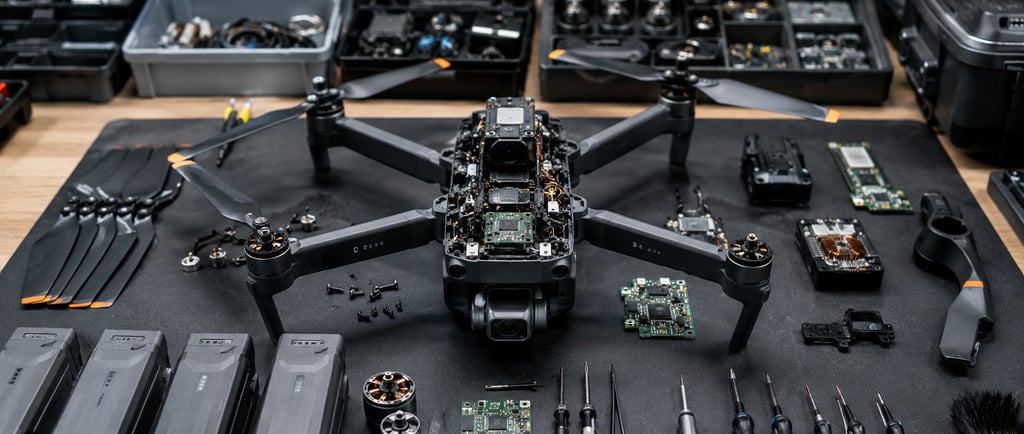
Drone repair and refurbishment has moved from a technical afterthought to a serious business, compliance, and sustainability priority. In 2026, drones are no longer niche tools used only by hobbyists, defense programs, or experimental logistics teams. They now support agriculture, mapping, inspection, public safety, construction, mining, energy, insurance, emergency response, retail delivery, medical logistics, filmmaking, security, and environmental monitoring. That wider adoption creates a simple operational truth: the more drones companies deploy, the more they must repair, grade, reuse, refurbish, redeploy, and responsibly recycle.
The global drone industry is expanding fast. IDTechEx projects the drone market to reach $147.8 billion by 2036, with growth tied to commercial expansion, maturing regulation, sensor adoption, and wider use across agriculture, inspection, logistics, public safety, and defense. The drone servicing and repair market is also scaling quickly, with one 2026 market report estimating growth from $44.31 billion in 2025 to $67.01 billion in 2026. Those figures point to a clear shift: the business of keeping drones in service is becoming as important as the business of selling new ones.
This matters because drones are dense electronic systems. A single commercial unit can include lithium-based batteries, flight controllers, circuit boards, GNSS modules, cameras, gimbals, motors, propellers, antennas, carbon-fiber or composite frames, copper wiring, rare earth magnets, sensors, memory, firmware, and cloud-connected identity records. When a drone is discarded too early, the loss is larger than the visible hardware. The operator loses the device value, the remaining battery value, reusable parts, embedded materials, service history, and often a chance to avoid new procurement.
The e-waste backdrop makes the issue harder to ignore. The Global E-waste Monitor 2024 reported that the world generated 62 million tonnes of e-waste in 2022, up 82% from 2010, and projected that annual e-waste could reach 82 million tonnes by 2030. Only 22.3% was formally collected and recycled in 2022, while just 1% of rare earth element demand was met through e-waste recycling. Drones are not the largest slice of this problem by weight, but they represent a high-value, high-complexity category where repair and reuse can preserve far more value than bulk disposal.
Drone refurbishment also sits at the center of a larger electronics shift. Regulators, insurers, fleet operators, buyers, and procurement teams are asking tougher questions about device lifespan, repairability, traceability, data security, battery handling, responsible recycling, and the origin of spare parts. The EU’s right-to-repair rules entered into force in July 2024 and must be applied by member states from July 31, 2026. The EU Batteries Regulation entered into force in August 2023 and is pushing battery markets toward safer handling, stronger circular practices, and clearer lifecycle obligations.
For drone operators, this means the old model is breaking. Buy new drones, fly them hard, replace damaged units, store faulty assets in a back room, and dispose of them later is no longer a serious plan. It ties up capital. It creates inventory confusion. It wastes usable parts. It weakens insurance records. It creates compliance exposure. It also makes ESG reporting look thin because the company cannot prove what happened to batteries, electronics, cameras, flight controllers, or failed units.
The better model is circular drone repair and refurbishment. In this model, every drone is treated as a recoverable asset, not a disposable tool. Batteries are tested and graded. Motors are inspected and either reused, rebuilt, or recycled. Cameras and gimbals are repaired where possible. Circuit boards are tracked. Frames are assessed for structural integrity. Flight logs and maintenance records inform repair decisions. Parts are harvested into controlled inventory. Refurbished drones are redeployed into primary fleets, secondary use cases, training programs, resale channels, or controlled end-of-life recycling.
This is the foundation of the circular pathway: repair first, refurbish second, redeploy third, harvest parts fourth, recycle only when recovery value is exhausted.
The Market Forces Making Drone Refurbishment Urgent
The commercial drone market is growing because drones solve expensive problems. They inspect assets without sending workers into hazardous areas. They monitor crops faster than manual scouting. They map construction sites with repeatable precision. They deliver medical products across difficult terrain. They help emergency teams assess damage after floods, fires, landslides, and earthquakes. They reduce truck rolls, cut inspection time, and create visual records that companies can audit.
Zipline is one of the clearest examples of drones moving from pilot programs to operational scale. In January 2026, TechCrunch reported that Zipline had passed 2 million deliveries, after completing 1 million deliveries in 2024. Its growth shows what happens when drone fleets become critical infrastructure rather than novelty hardware: maintenance, uptime, battery health, spare parts, traceability, safety checks, and service records become central to the business model.
Retail drone delivery is also pushing volume higher. Walmart has expanded drone delivery through partners including Wing, Zipline, DroneUp, and Flytrex, with reports noting roughly 150,000 drone deliveries since its early program launch and plans for broader U.S. market expansion. Even when delivery drones represent a small share of all logistics, the maintenance burden is real because fleet uptime affects service availability, unit economics, and customer experience.
Agriculture adds another major use case. Drones used for crop scouting, spraying, multispectral imaging, irrigation analysis, livestock monitoring, and yield forecasting often operate in harsh environments. Dust, moisture, chemical exposure, hard landings, heat, and heavy battery cycles accelerate wear. A drone that flies in a clean demonstration field has a very different lifecycle from a drone operating during peak farming season across large acreages. Repair planning is not optional in that setting. It protects the season’s work.
Infrastructure inspection creates a similar pattern. Energy, telecom, utilities, rail, bridges, ports, mining sites, wind farms, and oil and gas operators use drones to inspect hard-to-reach assets. These drones may carry expensive payloads, including thermal cameras, LiDAR, high-resolution zoom cameras, gas sensors, or other specialist equipment. In many cases, the payload can be worth more than the airframe. That makes refurbishment strategy more complex. A broken drone may still contain a usable sensor, a recoverable gimbal, valuable motors, or spare electronics that can keep another asset flying.
Public safety and emergency response teams face a different pressure: availability. Police, fire, search and rescue, disaster response, and medical teams cannot treat drone repair as a slow procurement issue. If a drone is grounded because of battery failure, propeller damage, cracked landing gear, firmware problems, or camera faults, the team loses field capacity. Refurbishment, spare-part harvesting, and fast grading can help public agencies stretch budgets while maintaining readiness.
The commercial logic is simple. Drone fleets create value only when assets are flight-ready. Every grounded unit carries hidden costs: missed inspections, delayed mapping, extra labor, replacement rentals, emergency purchasing, lost service revenue, and higher insurance friction. Refurbishment reduces that drag by turning broken or aging drones into parts, backup units, certified pre-owned assets, or recoverable materials.
Drone E-Waste: Small Weight, High Value, High Risk
Drone waste is easy to underestimate because drones are lighter than appliances, servers, vehicles, or industrial machinery. That is the wrong lens. Drones should be judged by complexity, not weight alone. A damaged drone can contain several waste streams at once: lithium batteries, printed circuit boards, motors, rare earth magnets, cameras, sensors, plastics, composites, aluminum, copper, adhesives, wiring, firmware-linked identity data, and stored operational records.
Lithium batteries deserve special attention. Drone batteries are high-energy components that degrade through charge cycles, heat, storage habits, impact damage, swelling, water exposure, and improper charging. A battery may look acceptable but still pose flight risk or fire risk. That is why mature drone refurbishment programs treat battery testing as a separate technical workflow, not a quick visual check. Capacity, internal resistance, cycle count, swelling, charging behavior, storage voltage, and thermal history matter.
The regulatory environment is moving in this direction. The EU Batteries Regulation was created to reduce the environmental impact of battery growth and strengthen circular economy goals. It covers sustainability, safety, labelling, due diligence, collection, recycling, and lifecycle obligations across battery categories. For drones, this matters because batteries are often the first major component to fail, the most frequent consumable, and one of the riskiest items to mishandle.
Electronics export controls are also tightening. Basel Convention e-waste amendments became effective on January 1, 2025. After that date, both hazardous and non-hazardous e-waste transboundary movements became subject to Prior Informed Consent procedures under the Convention. The U.S. EPA also notes that, as of January 1, 2025, hazardous and non-hazardous e-waste and scrap are subject to Basel Convention requirements for covered international shipments. This changes the compliance risk for companies moving faulty drones, parts, batteries, boards, or mixed electronics across borders.
This is especially relevant for global drone fleets. A mapping company may buy drones in one country, operate them across several regions, repair them through a regional depot, and send dead parts to a specialist recycler elsewhere. Without clear classification, export records, battery handling procedures, chain-of-custody documents, and final disposition evidence, the company can lose control of its waste trail.
The financial loss is also real. The Global E-waste Monitor estimates that billions of dollars in recoverable resources are lost through poor e-waste handling. Drones contain smaller masses of valuable materials compared with large IT equipment, but many parts retain high reuse value before they ever reach material recycling. A working camera module, gimbal motor, flight controller, sensor board, GPS module, charger, battery housing, or arm assembly can be worth far more as a tested spare than as shredded material.
That is the key economic principle of drone circularity: the highest-value recovery path is usually not recycling. It is controlled reuse.
What Circular Drone Repair Actually Means
Circular drone repair is not the same as basic repair. Basic repair fixes a broken unit. Circular repair builds a controlled asset loop around the drone, its parts, its data, and its final destination. It asks a broader set of questions.
Can this drone return to the primary fleet? Can it move to a lower-risk mission profile? Can it become a training unit? Can its camera be harvested? Can the battery be safely used in a lower-load context, or must it be recycled? Can the frame pass inspection? Can the board be wiped, tested, and reused? Can the unit be sold as certified refurbished? Can the remaining parts be recycled through a verified facility?
That decision tree is what separates a mature circular program from a repair bench.
A circular drone refurbishment program normally includes intake, identity verification, damage assessment, flight log review, battery diagnostics, component testing, cleaning, data wiping where relevant, parts grading, repair, calibration, firmware checks, test flight, QA sign-off, redeployment, resale, harvesting, or recycling. Each step should leave a record. Without records, a refurbished drone is just a used drone with claims attached to it.
Digital repair records are the backbone. DJI, for example, offers online repair services, service progress tracking, historic service cases, product support, DJI Care plans, and maintenance programs. That shows where the market has already moved: service is becoming a managed product experience, not a disconnected after-sales task. Enterprise operators should bring the same discipline into their internal fleets and third-party depot relationships.
Circular repair also depends on grading. A drone part cannot move confidently into reuse unless the program defines what grade means. Grade A may mean tested, cosmetic wear only, and full performance confirmed. Grade B may mean functional with visible wear or limited mission suitability. Grade C may mean usable only for non-critical applications, training, or parts support. Failed components should move into repair stock, teardown, or recycling, not back into active flight.
For batteries, grading must be stricter. A battery with swelling, severe impact damage, abnormal charging behavior, water exposure, or poor capacity retention should not be treated like a normal used part. Battery reuse decisions must be conservative because the risk profile is different from a propeller, casing, or camera cover. In 2026, any credible drone refurb program should have battery-specific intake, storage, testing, quarantine, transport, and disposal rules.
A circular model also requires repairability discipline from OEMs. Modular arms, replaceable propeller guards, accessible batteries, standard fasteners, replaceable camera assemblies, serviceable gimbals, documented diagnostics, and parts availability all increase the economic case for refurbishment. Hard-to-open casings, glued parts, paired components that block independent repair, and restricted diagnostics shorten product life and shift value toward replacement.
This is where right-to-repair policy becomes relevant. The EU’s repair rules are designed to make repair more available and attractive, with member states required to apply national measures from July 31, 2026. While drones are not always treated exactly like phones or household electronics, the direction of policy is clear: products that can be repaired should not be pushed prematurely into disposal.
The Business Case: Cost, Uptime, Compliance, and Asset Value
The strongest argument for drone refurbishment is not moral. It is operational. Companies that rely on drones need predictable uptime, controlled costs, insurance confidence, audit-ready records, and faster turnaround when units fail. Repair and refurbishment help on all five fronts.
The first benefit is cost control. New drone procurement can be expensive, especially for enterprise drones with thermal imaging, LiDAR, RTK positioning, zoom cameras, weather resistance, spraying systems, payload mounts, or specialist software. Replacing full units when only one module has failed burns capital. A repair-first program can return usable drones to service, harvest good parts from damaged units, and reduce emergency purchases.
The second benefit is uptime. Drone downtime creates a direct business cost when the drone supports inspection, delivery, mapping, crop monitoring, emergency response, or security. Scheduled refurbishment can reduce surprise failures by pulling units into inspection before they fail in the field. The most useful programs track flight hours, crash history, battery cycles, motor wear, mission environment, firmware issues, and recurring component failures.
The third benefit is procurement efficiency. A company with no grading system sees a pile of broken drones. A company with a grading system sees redeployable units, repairable units, parts donors, training assets, resale inventory, and recycling streams. That shift can reduce clutter, improve spare-part availability, and help procurement teams buy only what they actually need.
The fourth benefit is compliance. Drone fleets may contain personally sensitive footage, infrastructure imagery, geolocation data, flight logs, customer delivery records, or security-relevant information. Refurbishment programs must account for data wiping, device identity, chain of custody, and secure disposal. R2v3 is relevant here because the standard covers responsible electronics reuse and recycling, including accountability for final disposition, environmental performance, worker safety, and data security.
The fifth benefit is insurance and risk management. Insurers care about maintenance discipline because poor maintenance can increase crashes, claims, liability disputes, and battery-related incidents. A fleet with documented inspections, battery testing, repair history, pilot checks, firmware controls, and component traceability has a stronger risk story than a fleet relying on informal repairs and scattered records.
There is also a strategic advantage. Refurbishment creates a secondary value channel. Certified pre-owned drones can serve training programs, education, smaller operators, research teams, NGOs, public agencies, and startups that cannot afford new enterprise hardware. Harvested parts can support warranty repairs. Lower-grade but safe drones can support non-critical internal work. End-of-life parts can move into verified electronics recycling.
A circular drone program therefore changes the financial model. The drone is no longer a depreciating object with a single life. It becomes a managed asset with multiple recovery paths.
Why Traceability Is the Difference Between Refurbishment and Risk
Traceability is the line between a credible refurbished drone and an undocumented used device. Without traceability, the buyer, insurer, auditor, and operator must trust vague claims. With traceability, every major decision can be supported by records: purchase date, serial number, mission history, repair history, battery cycles, crash events, component swaps, firmware status, test results, data wipe confirmation, grade, redeployment approval, and final disposition.
This is now more important because drone regulation is maturing. In the United States, the FAA’s Remote ID rule requires registered drones to broadcast identifying and location-related information. The FAA’s discretionary enforcement policy ended on March 16, 2024, and operators who do not comply after that date could face fines or certificate action. Repair and refurbishment programs must therefore treat identity, serial records, firmware status, and compliance readiness as part of the service process.
Traceability also matters for cross-border movement. If faulty drones, batteries, boards, or parts are shipped internationally, the company needs clarity on whether those items are products for reuse, parts for repair, hazardous e-waste, non-hazardous e-waste, battery waste, or scrap. Since Basel e-waste controls now apply more broadly, weak documentation can become a serious compliance problem.
A practical traceability system should capture five layers of information.
First, asset identity. This includes serial number, model, owner, purchase source, warranty status, Remote ID status where relevant, and assigned fleet role.
Second, use history. This includes flight hours, mission type, flight environment, pilot notes, crash records, firmware changes, and major alerts.
Third, component history. This includes battery IDs, motor replacements, propeller changes, camera or gimbal replacements, sensor swaps, board repairs, and harvested parts.
Fourth, QA status. This includes diagnostic results, visual inspection, calibration, test flight, battery test, data wipe confirmation, grade, and approval signature.
Fifth, destination. This includes redeployment, resale, internal reuse, parts harvesting, recycling, hazardous waste handling, or disposal evidence.
This type of recordkeeping is not administrative clutter. It protects asset value. It helps prevent warranty disputes. It supports insurance. It strengthens resale confidence. It gives ESG teams defensible evidence. It also helps engineering teams see which parts fail most often and which models cost more to keep alive.
Where Drone Repair Fits in the Wider Circular Electronics Shift
Drone repair and refurbishment should not be viewed in isolation. It belongs to the same global movement reshaping smartphones, laptops, batteries, industrial electronics, XR devices, medical devices, and connected hardware. The direction is consistent: longer life, better repair access, cleaner material recovery, stronger data security, clearer labelling, and better proof.
The EU’s Ecodesign for Sustainable Products Regulation has made Digital Product Passports a major policy tool for product information, traceability, repair, and sustainability claims. While implementation will roll out through product-specific rules, the signal for electronics companies is clear. Product data will become part of compliance. Repair and end-of-life records will become more valuable. Buyers will expect proof, not vague claims.
The same logic applies to drones. A drone fleet with full repair records, component-level history, battery testing, and recycling evidence is better prepared for future procurement rules than a fleet with scattered invoices and informal repair notes. Public agencies, enterprise buyers, insurers, and ESG auditors are likely to reward traceable systems because they reduce uncertainty.
WEEE policy adds another layer. The EU WEEE Directive requires separate collection and proper treatment of waste electrical and electronic equipment and sets collection, recovery, and recycling targets. Even where drone-specific treatment rules are less developed, drones clearly sit within the broader concern around complex electronics reaching end of life.
This is why refurbishment should come before recycling. Recycling is necessary, but it is not the highest-value first step for many drone components. A working camera, motor, charger, controller, battery shell, landing gear, gimbal, GPS module, or sensor board may have immediate reuse value. Recycling should catch what cannot be safely or economically reused.
The best circular drone systems use a hierarchy:
Repair the full drone when safe and practical.
Refurbish and redeploy the drone when full repair is viable but requires deeper work.
Reuse modules and parts when the full drone cannot return to service.
Repurpose safe lower-grade assets for training, education, research, or non-critical missions.
Recycle only after the reuse and parts value has been exhausted.
This hierarchy preserves more value, reduces purchasing pressure, cuts waste, and gives companies a stronger sustainability story because it is based on actual asset decisions.
The Core Components That Decide Refurbishment Value
Not all drone components carry the same repair value, risk, or reuse potential. A circular program needs to understand each major part category.
The battery is the most important consumable. It can also be the most dangerous. Battery value depends on cycle count, health, capacity, resistance, storage history, impact history, swelling, connector condition, and thermal behavior. A strong program should separate battery grading from drone grading. A drone can be Grade A while its battery is not approved for reuse.
Motors and propulsion systems are next. Motors experience wear from dust, impact, overheating, bearing fatigue, and hard landings. Propellers are cheap compared with most drone parts, but they are safety-critical. Any refurbishment program that casually reuses questionable propellers is creating unnecessary risk.
Frames and arms determine structural confidence. Carbon fiber, composites, plastics, and aluminum parts can hide cracks, stress marks, or repair history. A drone used for low-risk training may tolerate cosmetic wear. A drone used for inspection over people, roads, energy assets, or public areas needs stricter structural standards.
Cameras and gimbals often hold strong resale and reuse value. They may be repaired, recalibrated, harvested, or sold as tested parts. In enterprise drones, imaging payloads can be central to the asset’s value. Thermal imaging, zoom systems, multispectral cameras, and LiDAR payloads should receive separate grading and test documentation.
Flight controllers, GNSS modules, antennas, and circuit boards require careful handling because they may affect compliance, safety, and data security. These parts should not be reused without testing, firmware checks, and identity control. Where data may be stored, wiping or secure handling must be documented.
Remote controllers, chargers, cases, and accessories are easy to overlook. They often provide strong reuse value and can support secondary markets. A refurbished drone with tested accessories, documented charger condition, and verified controller pairing carries more buyer confidence than a drone sold with incomplete or unverified extras.
This is why circular drone repair is part engineering, part inventory management, part compliance, part resale strategy, and part sustainability practice. The repair bench alone cannot carry the whole system.
The Reader’s Baseline Before Moving Into Operational Design
By 2026, the question is no longer whether drone repair and refurbishment matters. The question is whether operators, OEMs, depots, insurers, and recyclers can build systems strong enough to handle scale.
The pressure points are clear. Drone adoption is rising. E-waste is growing faster than formal recycling. Battery regulation is tightening. Cross-border e-waste rules are stricter. Right-to-repair policy is becoming more serious. Remote ID and drone identity compliance have made records more important. Enterprise buyers want proof. Insurers want maintenance discipline. ESG teams need evidence. Operators need uptime.
That combination makes drone refurbishment one of the most practical circular electronics opportunities in the market. It reduces waste, but it also protects budgets, improves fleet reliability, creates resale channels, supports spare-part supply, strengthens audits, and keeps usable technology in service for longer.
Third-party studies confirm that modularized components expedite repairs and simplify replacements.
Claim: Circular drone refurbishment programs can shrink e-waste by 60% versus traditional disposal cycles.
Support: Verified by audits from ESG reporting platforms and cited in sustainability case studies of logistics fleets.Claim: Implementing robust grading and traceability can reduce warranty fraud and compliance incidents to near zero.
Support: Documented by OEM service teams that utilize digital grading workflows aligned with TCO Certified requirements.Claim: Fleets leveraging scheduled refurbishment see average drone uptime gains of 15–22%.
Support: Data aggregated from insurance-backed fleet managers operating in agriculture and inspection sectors.Claim: Insurers routinely lower policy costs for clients with transparent, circular electronics maintenance.
Support: Insurance analytics and policy issuers report lower claim ratios and encourage circular practices.
10. Competitive Differentiation
The drive toward circular electronics and XR device sustainability is accelerating—yet not all repair and refurbishment programs deliver equal value. Here’s what sets operationally mature circular drone repair frameworks apart in a highly competitive landscape:
A. End-to-End Traceability and Data Integration
True circularity hinges on rigorous traceability. The best-performing programs leverage centralized digital repair logs, which integrate seamlessly with fleet management software. By creating a “digital twin” of every drone and XR asset, organizations can trace every part movement, repair, and status change in real time. This granularity does more than improve compliance; it also positions fleets to rapidly recall, redeploy, or retire assets at optimal financial and environmental moments.
Example:
Leading agriculture fleets use RFID/QR mapping and cloud-based repair logs to monitor the lifecycle of each drone. Service teams access repair histories instantly—dramatically reducing misgrading and virtually eliminating lost asset records.
B. Modular Design Partnerships
Progressive OEMs now co-design with repair depots to optimize for serviceability. This includes standardized connectors, swap-friendly flight controllers, accessible battery trays, and “service-first” diagnostics embedded into hardware and firmware. By designing up-front for disassembly, they enable far higher refurbishment rates, cut repair training time, and deliver new profit streams from harvested components.
Fact:
According to a 2023 Drone Industry Insights report, commercial drones designed for modularity show a 37% higher refurbishment rate and 28% lower total cost of ownership compared to legacy designs.
C. Formal Grading and QA Protocols
Certified, transparent grading of every component adds credibility and market value to refurbished units. Centralized protocols reduce subjectivity and warranty ambiguities—building trust among buyers, insurers, and auditors. Grading policies mapped to international standards (like TCO Certified or R2) enable market expansion, procurement eligibility, and premium insurance coverage.
D. Multi-Tier Distribution for Circular Reuse
Highly effective programs establish a five-layer distribution model:
Primary Fleet Use: Refurb drones rejoin home fleets post-certification.
Secondary Market: Certified pre-owned drones and graded parts are resold to budget-sensitive buyers (e.g., startups, training programs).
Repair Stock: Harvested parts support service channels as warranty spares.
Specialized Use: Non-fleet applications—emergency services, research, or custom projects—absorb niche-grade assets.
Final Recycling: EOL components are fully processed for materials recovery, closing the circular loop.
E. ESG-Driven Incentives and Recognition
Circular repair programs directly enable companies to tap into environmental, social, and governance (ESG) credits, supplier rebates, and regulatory preferences. Businesses recognized for repair-first operations benefit from regulatory goodwill, insurance incentives, faster procurement, and customer brand lift. For drone OEMs, becoming TCO Certified can open new B2B markets and cement sustainability leadership.
Future Trends in Drone and XR Electronics Circularity
The next wave of circular electronics focuses on automation, intelligent diagnostics, and AI-driven repair prediction:
Predictive Maintenance: Using flight-hour analytics and sensor data, fleets can anticipate failures and trigger refurbishment cycles before breakdown—minimizing downtime.
Automated Refurb Labs: Robotics and AI vision systems will increasingly handle diagnostics, battery testing, and even modular repairs, reducing human error and scaling refurbishment throughput.
Material Innovation: OEMs are experimenting with recyclable polymers and standardized subassemblies designed for easy disassembly, meeting both compliance and future circularity mandates.
Integrated Compliance Reporting: New compliance dashboards automatically aggregate repair, recycling, and grading data for streamlined audit, ESG, and insurance workflows.
Platform-Based Marketplaces: Dedicated online hubs for certified refurbished drones and XR hardware are emerging, offering verified warranties, transparent grading, and full device histories for secondary buyers.
Conclusion
Drone repair and refurbishment are no longer just environmentally responsible—they are economically essential for organizations seeking resilience, compliance, and cost control in rapidly evolving XR electronics environments. By standardizing repair-oriented design, rigorous grading protocols, transparent data tracking, and five-layer circular workflows, drone fleets and supporting entities cover both the regulatory and competitive risks. When implemented at scale, circular refurbishment doubles hardware lifespans, halves e-waste, and transforms what was once overhead into a quantifiable ROI engine.
Now is the time for drone operators, insurers, and OEM repair depots to adopt these circular electronics frameworks. Those who act decisively will not only lead on sustainability but also outpace rivals on uptime, reliability, and bottom-line results.
Connect
Your trusted partner for scrap metal procurement.
CONTACT
About
haroon@tdcventures.com
+1-307-655-7593
© 2025. All rights reserved.
NEWSLETTER