
E-Textiles with Conductive Threads: Metals Recovery
Explore how recovering silver, copper, and nickel from conductive threads in XR wearables is reshaping e-waste. Learn design-for-repair strategies, scalable recycling frameworks, and the metrics that make circular e-textiles commercially viable.
IMMERSIVE TECH RECYCLING & CIRCULAR ELECTRONICS
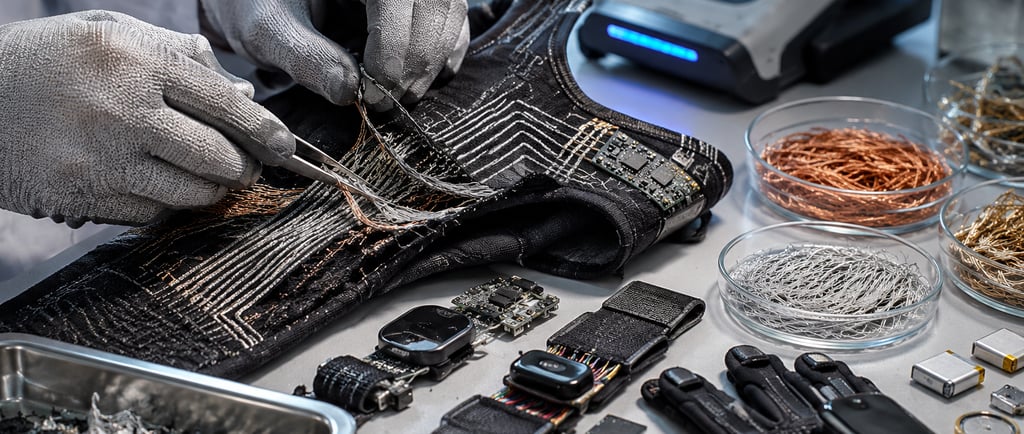
Introduction: Context and Why It Matters for XR, Wearables, and Recycling
E-textiles—also known as electronic textiles or smart textiles—are quickly reshaping the landscape of wearable technology. By embedding conductive threads directly into fabrics, manufacturers unlock new forms of interaction, data collection, and biometric monitoring, especially in XR (extended reality) electronics. From smart fitness shirts monitoring heart rates to augmented reality gloves with embedded sensors, the seamless integration of electronics into textiles is fueling a new wave of innovation for both consumers and enterprises.
But this rapid evolution leads to a formidable challenge: What happens to these smart fabrics at the end of their life cycle?
Traditional e-waste management techniques often falter when faced with e-textiles, which blend metal threads, polymers, microcontrollers, and traditional fabrics into tightly bound composites. The metals vital for function—silver, copper, nickel—are present in much lower concentrations compared to conventional circuit boards. The disruptive material complexity makes it difficult to separate, sort, and extract valuable resources efficiently.
Here's why this matters so much now:
Supply Chain and Scarcity: The price and availability of precious and base metals are volatile, exacerbated by geo-political events and surging demand for electronics.
Regulatory Pressure: The EU and parts of Asia are enforcing rigorous Extended Producer Responsibility (EPR) and Circular Economy rules, expecting manufacturers to reclaim, refurbish, or recycle their products.
Consumer Sentiment: Today's eco-conscious buyers expect brands to design devices that last, can be repaired, and are responsibly managed at end of life.
Systemic Risk: Without scalable solutions for XR e-textiles, brands and recyclers face unsustainable e-waste accumulation and missed opportunities for resource recovery.
Unlocking metals recovery from e-textiles is no longer a niche sustainability concern; it is essential for meeting operational, regulatory, and market-driven objectives in the circular electronics economy.
Defining the Problem and Operational Stakes in E-Textile Metals Recovery
The rise of XR-enabled wearables packed with conductive threads disrupts existing recycling paradigms in profound ways. Here are three core challenges:
Complex Layering and Bonding: Conductive threads—commonly composed of silver, copper, or nickel coatings—are tightly bound with textile fibers and often affixed using adhesives or polymer matrices for durability and washability. This multilayer construction complicates the physical and chemical separation processes required for traditional metals recovery.
Low Metal Concentration per Garment: Unlike circuit boards, where metals are present in concentrated amounts, the total weight of recoverable metal in a single smart shirt, for example, might be a fraction of a gram. Profitable recovery thus hinges on batching and process efficiency at scale.
Scarcity of Mature, Scalable Solutions: Most post-consumer e-textile recovery initiatives are still at the laboratory, pilot, or demonstration stage. Commercial infrastructure lags far behind what is needed for the anticipated market flood of XR wearables.
Operationally, these issues translate into four high-stakes concerns:
Cost Efficiency: Without streamlined processes, the cost of extracting each gram of metal can outweigh its market value, challenging business cases for recycling.
Regulatory Compliance: Failing to meet metals recovery targets can expose brands to regulatory fines and public scrutiny under EPR and eco-design mandates.
Operational Intelligence: A lack of reliable product design data complicates intake sorting and extraction, increasing error rates and batch contamination.
Brand Trust: As sustainability becomes a table stake, inability to demonstrate responsible end-of-life management can erode competitive differentiation.
Key Concepts and Definitions
XR Electronics: Devices used in extended reality (VR, AR, MR) environments, often including wearables with embedded electronics, actuators, and sensors.
E-Textiles: Smart fabrics created by integrating conductive threads or yarns for functionalities like sensor data, haptic feedback, or power transmission.
Conductive Threads: Specialized filaments containing or coated with metals such as silver, copper, nickel, or gold; these threads form the backbone of data paths within e-textiles.
Metals Recovery: Targeted extraction and reclamation of valuable metals—including silver, copper, nickel, and occasionally gold—from e-textile waste, using mechanical, chemical, or hybrid methods.
Design for Repair: Engineering philosophy prioritizing product architectures that allow for straightforward access, component replacement, and end-of-life disassembly.
Recycling Streams: Dedicated pathways for collecting, preprocessing, and treating e-textiles distinct from both standard clothing and conventional electronics to maximize batch purity and recovery yield.
Digital Product Passport: An embedded or digital record—via QR, NFC, RFID, or blockchain—detailing a product's composition, design, and recycling instructions, crucial for efficient downstream processing.
The Core Framework: Designing, Collecting, Refurbishing, and Recycling E-Textiles
Adopting a closed-loop vision for e-textiles recycling, the industry is converging on a four-phase framework that integrates design, operational excellence, and compliance:
Phase 1: Design for Disassembly and Materials Transparency
Brands should prioritize:
Modular Electronics: Snap-on sensors, zippable modules, and detachable batteries ease disassembly and support upgrades.
Minimized and Reversible Binding: Reversible attachments (e.g., thermoplastic adhesives or stitching) versus permanent glue facilitate future separation without contaminating metal threads.
Material Passports: Digital passports with granular breakdowns of thread type, metal content, and connection points streamline intake assessment and sorter automation.
Standardized Marking: Consistent color-coding or physical tags on conductive pathways reduce error during sorting and separation.
Phase 2: Collection and Intake Sorting
Effective collection schemes hinge on:
Branded Take-Back Initiatives: Alliances with retailers and logistics providers for collection bins, mail-back, and in-store returns, often under EPR frameworks.
Smart Tracking: Use of barcodes, QR codes, or RFID for chain-of-custody and provenance data collection.
Segregation by Category: Intake teams sorting e-textiles by application, dominant thread metal, and contamination risk ensure batches ready for efficient processing.
Safe Handling: Early removal of batteries and detachable electronics minimizes safety hazards and risk to subsequent processing equipment.
Phase 3: Refurbishment and Component Recovery
Triage processes determine the path:
Assessment for Repair: Testing and visual inspection identify devices eligible for repair or component salvage, supporting reuse and circularity.
Module Recovery: Extraction of functional parts—ICs, sensors, connectors—not only saves materials but also reduces downstream shredding complexity.
Preprocessing: Mechanical (shearing, shredding) or solvent-based separation isolates XY-coordinate thread paths without damaging metal integrity.
Yield Optimization: Early removal of high-value modules increases project ROI—studies show refurbishment can extend up to 50% of returns' useful lives.
Phase 4: End-of-Life Metals Extraction
Optimized for both yield and compliance:
Thread Grouping: Spectroscopy (e.g., XRF) sorts threads by metal type for targeted recovery processes—essential for purity and regulatory reporting.
Selective Processing: Application of low-energy pyrometallurgical or hydrometallurgical treatments tuned for the specific metal composition and microstructure of e-textile threads.
Supply Loop Closure: Recovered metals are trafficked back to thread manufacturers or electronics fabricators, completing a circular value chain.
Implementation Playbook: Step-by-Step Process and Decision Points
To operationalize the circular recovery of metals from XR e-textiles, a detailed, stage-gated playbook ensures each stakeholder—from brand design teams to recycling operators—executes best practices at every step:
Bill of Materials Mapping: Document all metals, polymers, and electronic components as part of the design cycle.
Digital Passport Embedding: Assign a unique ID and encode material, construction, and recycling instructions.
Intake Team Training: Regularly upskill staff on e-textile sorting, recognizing thread markings, and safe extraction protocols.
Pre-Processing Disassembly: Remove batteries, Bluetooth modules, and removable electronics before initiating textile-specific recovery.
Repair Assessment: Evaluate garments for repair, using assessment checklists and simple diagnostic tools (e.g., circuit continuity testing).
Component Salvage: If beyond repair, harvest functional modules for resale or reuse; residual value can range from $2–$30 per item depending on function and size.
Textile Layer Separation: Use mechanical techniques or specialized solvents to peel apart textiles and isolate conductive threads.
Thread Identification: Deploy visual inspection and machine learning-enhanced spectroscopy for accurate sorting by metal type and contamination risk.
Process Selection: Choose between water-based extraction, low-temperature melting, or advanced hydrometallurgical methods based on thread type and batch composition.
Purity Analysis: Routinely test recovered metals to ensure purity meets industrial reuse standards (commonly 98%+ for silver and copper).
Traceability and Reporting: Use digital ledgers for tracking materials flow, enabling transparent compliance reporting.
Eco-Disposal of Base Textiles: Route textile scrap to registered recyclers or downcycling partners, reducing landfill impact.
Compliance Reporting: Submit detailed reports to regulatory authorities under local or regional EPR laws.
Continuous Feedback Loop: Operational data feeds back to design and intake for ongoing improvement.
Decision Tree Mini-Guide:
Accessible modules, clear thread markings → Prioritize disassembly and repair.
Inaccessible threads, mixed metals → Proceed to batch mechanical separation.
Batch purity below threshold → Divert to lower-tier metals processing, classify for downcycling or energy recovery.
Case Studies: What E-Textile Recovery Looks Like in the Real World
The e-textile recycling challenge is still early, but enough evidence now exists to show where the industry is heading. The most useful case studies do not come from one perfect commercial model. They come from adjacent sectors that are already solving parts of the same problem: printed electronics recovery, smart textile design, digital product passports, automated textile sorting, modular wearable design, and closed-loop material tracking.
One of the clearest technical examples comes from silver-printed electronic textiles. Research on silver ink printed onto textile substrates shows why recovery is both important and difficult. Silver is widely used in conductive inks because of its high conductivity, stability, and performance in flexible circuits. In printed e-textiles, however, the silver is often spread across thin traces instead of concentrated in a removable circuit board. That means recyclers must recover small amounts of high-value metal from large amounts of fabric, coating, binder, and polymer. The recovery logic is clear: if a recycler can group similar silver-printed textiles into clean batches, remove detachable electronics first, and apply selective processing, the recovered silver can become a meaningful secondary raw material rather than a hidden loss in landfill, incineration, or low-grade textile downcycling.
A second case comes from recyclable soft electronics. Recent work on recyclable thin-film circuits used silver flakes and water-based polyurethane to create flexible electronic systems that could be broken down and recovered with only a small conductivity loss after recovery. The reported conductivity drop of 2.4% after recovery is important because it points toward a future where conductive layers are designed from the start for material return, not only for product performance. For XR gloves, posture-tracking garments, haptic sleeves, medical monitoring wearables, and smart compression textiles, this is the design lesson: recyclability must be built into the material stack before the first production run. If the conductive layer, adhesive system, encapsulant, and textile base are selected without end-of-life planning, the recycler inherits a mixed-material problem that is expensive to solve.
A third case comes from smart textile architecture itself. Smart e-textiles usually combine a base fabric, conductive interconnects, sensors, actuators, power sources, and processing units. This means they sit between two industries that were never designed to process them together: the textile industry and the electronics recycling industry. A conventional textile sorter may see the item as a garment, while an electronics recycler may see too much fabric and too little concentrated metal. That mismatch is the reason e-textiles need their own intake rules, product identifiers, and pre-processing logic. The product should be inspected first for batteries, detachable modules, rigid electronics, RF components, and conductive pathways. Only after that triage should the textile fraction move toward thread recovery, fiber recovery, or lower-grade disposal.
A fourth case comes from the textile recycling sector, where disassembly is becoming one of the biggest operational barriers. Garments are often difficult to recycle because buttons, zippers, labels, coatings, trims, elastic components, and blended fibers must be removed or separated. E-textiles add another layer: embedded conductive yarns, sensor zones, encapsulated traces, small batteries, and communication modules. Newer automated textile sorting systems using near-infrared sorting, metal detection, and AI-assisted classification are starting to address the broader textile disassembly problem. For e-textiles, these same tools will need to be tuned for conductive thread detection, battery risk, and metal identification.
A fifth case comes from digital product passport pilots in fashion and textiles. Product passport work in Europe has already shown that traceability depends on three practical building blocks: accurate product data, a unique product identifier, and an interoperable system that downstream users can access. A passport for an e-textile cannot stop at brand story, origin, and care instructions. It must include the conductive thread type, metal coating, battery chemistry, sensor locations, detachable module instructions, safe disassembly steps, and preferred recycling route. Without this information, every recycler starts from guesswork. With it, intake teams can sort faster, reduce contamination, protect workers, and recover higher-value materials.
The strongest lesson across these cases is simple. E-textile recovery cannot be treated as a waste problem that starts at disposal. It is a design, data, collection, sorting, and recovery problem that starts at product development.
Metrics That Matter for E-Textile Metals Recovery
The global e-waste baseline is already severe. The Global E-waste Monitor 2024 reported that the world generated 62 million tonnes of e-waste in 2022, up 82% from 2010, and projected that annual e-waste generation will reach 82 million tonnes by 2030. Documented formal collection and recycling reached only 22.3% in 2022, and under a business-as-usual scenario, that rate could decline to 20% by 2030. This matters for e-textiles because XR wearables, smart garments, haptic accessories, and sensor-embedded fabrics will enter a system that is already struggling to collect and process conventional electronics.
For recyclers, the most important e-textile metric is not item count. It is recoverable value per kilogram. A smart shirt, haptic glove, or biometric sleeve may contain only fractions of a gram of silver, copper, nickel, or gold in its thread network. A rigid electronics module attached to the same product may contain more concentrated value than the fabric itself. This creates a two-part recovery model. First, recover the high-value detachable electronics, batteries, connectors, and sensors. Second, batch the textile fraction by dominant conductive material so the metal-bearing threads can be processed with enough scale to justify the cost.
The next metric is batch purity. A mixed load of silver-coated nylon, copper yarn, stainless steel thread, nickel-coated fibers, elastane blends, adhesives, laminated films, and battery residue is difficult to process profitably. A cleaner batch creates better yields, fewer chemical conflicts, and stronger reporting. For commercial operators, the target should be to classify incoming e-textiles by at least five attributes: product category, battery presence, detachable electronics, dominant conductive metal, and textile substrate. More advanced facilities should also record coating type, adhesive type, washability treatment, and flame-retardant risk.
Another key metric is disassembly time per item. This will decide whether repair, reuse, module recovery, or shredding makes sense. If a smart compression sleeve takes 90 seconds to remove a module, inspect a battery, and isolate the conductive fabric, recovery may be viable at scale. If the same product takes 12 minutes because the electronics are glued, laminated, or hidden, the economics collapse. Design teams should track disassembly time during product development, not after launch. A practical target for many wearable e-textile products should be battery and module access in under two minutes using common tools, with no fabric cutting required unless the item is already beyond repair.
Repair yield is another high-value metric. Many e-textile products will fail because of connection breaks, module faults, battery degradation, sweat damage, wash damage, or broken snaps rather than complete material failure. If 20% to 40% of returned products can be repaired, cleaned, recertified, or harvested for reusable modules, the circular value is usually higher than immediate materials recovery. For XR and medical-adjacent wearables, repair and reuse must also include hygiene validation, data deletion, electrical safety testing, and performance checks.
Metal recovery yield should be tracked separately by metal. Silver recovery from printed or coated conductive textiles will need different processing than copper yarn, stainless steel fibers, or nickel-coated thread. A single blended recovery percentage hides too much. Operators should report mass balance by input batch, recovered metal weight, purity, residue, textile fraction destination, and process loss. For industrial reuse, recovered metal purity matters as much as recovered weight. The original draft used 98%+ as a reference point for silver and copper. That is a useful benchmark, but commercial requirements will vary by buyer, application, and refining partner.
Compliance metrics are becoming equally important. The EU is moving toward stronger rules for sustainable products, circular textiles, and product information. The Ecodesign for Sustainable Products Regulation entered into force on July 18, 2024, and digital product passports are a central part of the regulatory direction. The EU textile strategy also pushes separate textile waste collection and stronger reuse and recycling systems. For e-textile brands selling into Europe, the compliance question will shift from "can this be recycled?" to "can you prove what is in it, how it should be handled, and where it went?"
A strong e-textile recovery program should therefore track these operating metrics every month: intake volume by product type, percentage with readable product IDs, battery removal rate, average disassembly time, repair yield, module salvage value, batch purity, recovered metal mass, recovered metal purity, textile residue route, processing cost per kilogram, revenue per kilogram, carbon impact estimate, and compliance documentation completeness.
Future Trends: Where E-Textile Recovery Is Heading in 2026 and Beyond
The first major trend is the shift from hidden electronics to traceable electronics. Smart textiles can no longer depend on invisible material complexity. Brands will need QR codes, NFC tags, RFID, or other identifiers that connect the physical item to a product record. This record should tell a recycler where the battery is, what metal is in the thread, how the conductive pathways are routed, which modules can be removed, and whether any coatings or chemicals require special handling. In 2026, this is no longer a future-facing compliance concept. It is becoming the practical foundation for repair, resale, recycling, and producer responsibility.
The second trend is modularity. Luxury wearable tech, smart accessories, AI eyewear, smart rings, health wearables, and sensor-enabled garments are moving closer to fashion and daily life. As wearables become more style-sensitive, product life will depend on the ability to replace straps, textile shells, sensors, batteries, and compute modules without discarding the full item. This is especially relevant for XR wearables, where the textile component may wear out faster than the electronics, or the electronics may become outdated while the textile structure remains usable. Modular design lets the brand recover value from both sides.
The third trend is automated sorting for mixed textile and electronics streams. Near-infrared sorting can identify textile fibers, while XRF can identify metals. Metal detection can flag conductive pathways and hidden hardware. Computer vision can identify product types, labels, battery compartments, connector locations, and contamination risk. The best future facilities will not treat e-textiles as random fabric waste. They will run staged sorting: visual classification, product ID scan, battery risk check, metal detection, fiber scan, conductive material verification, and route assignment.
The fourth trend is lower-impact conductive materials. Silver will remain important because it performs well, but cost and recovery challenges will push research and production toward hybrid inks, graphene-silver composites, carbon-based conductors, stainless steel yarns, copper alternatives, and recyclable conductive coatings. The goal will not be to eliminate metals completely. The better goal is to reduce unnecessary precious metal loading, use recoverable material systems, and design conductive networks that can be separated without destroying the whole textile. Research into graphene-silver composite inks and newer recyclable conductive materials shows how performance, cost, and end-of-life planning are starting to converge.
The fifth trend is self-powered and lower-battery smart textiles. A major recycling risk in small wearables is the battery. Batteries create fire risk, handling cost, shipping restrictions, and disassembly needs. Smart textile research is exploring body heat, movement, friction, light, moisture, and other energy sources to reduce dependence on disposable or hard-to-remove batteries. This will not remove batteries from all XR and medical wearables, but it can reduce battery size, extend product life, and simplify end-of-life handling in some use cases.
The sixth trend is repair-first procurement. Enterprise buyers of XR uniforms, training gloves, medical monitoring garments, industrial safety wearables, and smart PPE will begin asking sharper questions before purchase. They will ask whether batteries are replaceable, whether modules can be upgraded, whether textile shells can be washed separately, whether product passports are available, whether spare parts exist, and whether end-of-life routing is documented. This will affect tenders, insurance, ESG reporting, and vendor selection. A product that cannot be repaired or traced may lose enterprise buyers even if the upfront price is lower.
The seventh trend is the rise of recycler feedback into product design. Today, recyclers often receive finished products with no influence over design. That will change. Brands that want credible circularity will need to involve recyclers, refurbishers, repair technicians, and materials specialists before products go to market. The feedback should be direct: move the battery access point, avoid permanent adhesives, mark conductive pathways, reduce mixed-metal thread networks, keep modules removable, use fewer textile blends, publish disassembly instructions, and design batches that can be processed commercially.
The eighth trend is better separation between reuse, refurbishment, and recycling. Too many programs treat returns as a single waste stream. E-textiles need a triage model. Some products should be repaired and resold. Some should be harvested for modules. Some should be stripped for batteries and electronics. Some should be sent to textile recycling after conductive elements are removed. Some will need specialist metals recovery. Some may only qualify for safe disposal. The value is in choosing the right route early.
The ninth trend is stronger regulation around proof. Claims such as "recyclable," "circular," "repairable," or "sustainable" will need documentation. For e-textiles, proof means bill of materials data, component traceability, repair records, material recovery records, and verified downstream partners. Digital product passports will make this easier, but only if the data is accurate and maintained across the product's life.
Conclusion: The Future of E-Textiles Depends on Repairable Design and Recoverable Materials
E-textiles with conductive threads sit at the intersection of fashion, electronics, healthcare, XR, sports performance, defense, industrial safety, and circular materials. That is what makes them powerful. It is also what makes them difficult to recover. They are not normal garments, and they are not normal electronics. They are mixed systems with embedded value, hidden risk, and rising regulatory exposure.
The metals inside these products may be small by weight, but they are important by function, cost, and supply risk. Silver, copper, nickel, stainless steel, gold-plated contacts, sensors, batteries, and microcontrollers all carry recovery value when products are designed and collected correctly. When they are glued, hidden, unlabeled, and mixed into general textile waste, that value disappears.
The practical path forward is clear. Brands must design e-textiles for disassembly. Product teams must reduce permanent bonding, keep batteries and modules accessible, identify conductive pathways, and avoid unnecessary material mixing. Operations teams must build dedicated collection and intake processes. Recyclers must develop separate sorting rules for e-textiles, supported by metal detection, XRF, near-infrared sorting, and product passport data. Regulators must push for proof, not vague claims. Buyers must ask for repair, recovery, and end-of-life documentation before they place large orders.
The winning model in 2026 is not simple recycling at the end of life. It is a full product-life strategy: design the item clearly, track it digitally, collect it separately, repair it when possible, recover modules first, extract metals from clean batches, document every route, and send feedback back into the next product generation.
E-textiles will keep growing because they solve real problems in XR interaction, health monitoring, training, mobility, safety, and human-machine interfaces. Their growth will only be responsible if the industry treats conductive threads as recoverable infrastructure, not disposable decoration. The brands that act now will have better compliance, stronger buyer trust, lower material risk, and a more credible circular story. The brands that wait will inherit a harder problem: complex products, scattered waste, rising rules, and valuable metals trapped in fabric that nobody can process profitably.
Connect
Your trusted partner for scrap metal procurement.
CONTACT
About
haroon@tdcventures.com
+1-307-655-7593
© 2025. All rights reserved.
NEWSLETTER