
Emergency Response ICS for Scrap Facilities: Compliance Systems That Work
With scrap facility fires rising 25% above average, discover an ICS emergency response framework that turns compliance into a repeatable, provable system. Reduce risk and protect your operations.
COMPLIANCE & REGULATORY OPERATIONS IN RECYCLING
Instant Answer
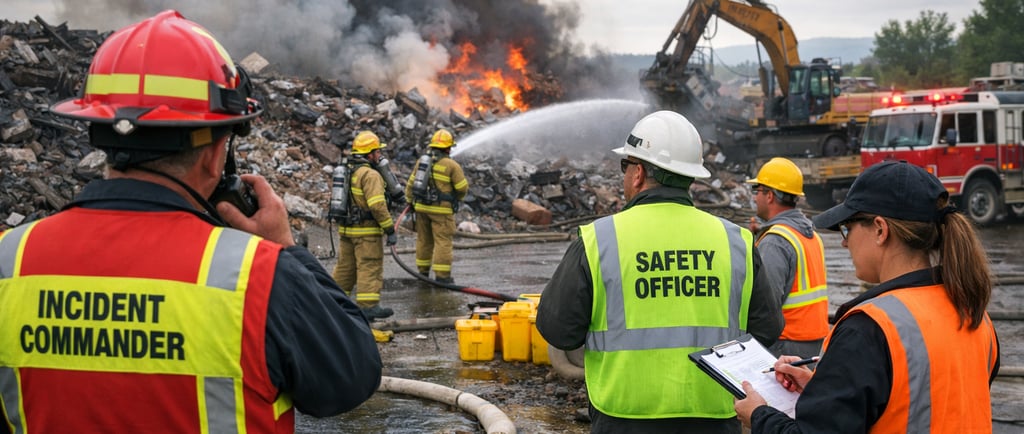
Scrap facilities need a tailored Incident Command System (ICS) for emergency response if you want compliance you can prove and response you can repeat. The goal is simple. Assign clear roles before an incident happens, run standardized playbooks that match your yard’s real hazards, and drill often enough that the first 10 minutes look the same every time. That combination reduces confusion, protects people, shortens downtime, and strengthens your position with regulators, insurers, and customers.
Table of Contents
Context and Relevance for Scrap Facilities
Defining the Problem: Compliance and Emergency Response Gaps
Key Concepts: ICS, Compliance, and Regulatory Demands
Core Method: ICS-Based Compliance Framework
Step-by-Step Example: ICS in a Scrap Yard Spill
Implementation Playbook
Measurement and QA: Scorecard and Tracking
Case Patterns and Scenarios
FAQs
Five-Layer Distribution and Reuse Toolkit
Likely Market Gaps and Differentiators
Context and Relevance for Scrap Facilities
Scrap and recycling sites sit at the intersection of heavy industrial work and fast-changing risk. You run mobile equipment near stockpiles. You store fuels, oils, gases, solvents, and sometimes regulated wastes. You handle unknown inbound material that can hide ignition sources. That mix is why emergency response readiness is no longer a “safety program” detail. It has become an operating requirement that affects permits, insurance renewals, and customer qualification.
The best available public incident tracking shows the trend clearly. Publicly reported waste and recycling facility fires in the U.S. and Canada rose from 373 in 2023 to 430 in 2024, a 15% year-over-year jump. The same tracking then closed 2025 as the worst year on record since tracking began in 2016, finishing at 448 publicly reported fires, which is nearly 25% above the annual average of 360. That is only the publicly visible layer. Even the researchers publishing these figures stress that there is no comprehensive database, and that many events never reach public reporting.
Industry bodies and risk researchers argue the true annual fire burden is materially higher. A widely cited estimate from National Waste & Recycling Association puts the total at more than 5,000 fires per year at recycling facilities, with lithium-ion batteries frequently implicated. When your risk landscape looks like that, emergency response quality stops being an internal preference. It becomes a business survival variable.
The cost side has also tightened. A joint analysis by Resource Recycling Systems and NWRA describes catastrophic loss frequency increasing 41% over five years, while insurance pricing for insured property value has moved from less than $0.20 per $100 of insured value to as much as $10 per $100 in extreme cases. Their report also notes that MRF fires can range from a few thousand dollars to more than $50 million for catastrophic events. This directly changes what insurers expect during underwriting. They are asking for evidence that your response is trained, repeatable, and documented in real time, not just “planned.”
Defining the Problem: Compliance and Emergency Response Gaps
Most compliance failures during incidents do not come from malicious intent. They come from predictable breakdowns under stress. The same gaps show up across jurisdictions, even when the rulebooks differ.
Generic, template-based plans are still common. They often fail because they do not match your yard’s layout, your inbound streams, your equipment, or your staffing realities. During an event, people do what they remember, not what a binder says.
Role confusion is another frequent cause of avoidable errors. If nobody is clearly assigned to make external calls, to log the timeline, or to manage isolation and ignition control, you can end up with a technically decent containment response paired with a weak compliance record. That is the combination that creates exposure in investigations, permit reviews, and insurance claims.
Drills are also often too shallow. Many facilities rehearse evacuation and basic extinguisher use, but they do not test the hard decisions: When do you escalate? Who calls whom? What do you say, and what evidence do you capture to support that decision? In a world where publicly reported incidents rose 15% from 2023 to 2024 and then set a new record again in 2025, “checkbox drilling” is not a stable approach.
Documentation lapses remain a major weak point because they happen during the same window where containment actions are underway. If documentation is treated as a post-event reconstruction, you lose timestamps, you lose clarity, and you lose credibility. ICS fixes this by making documentation a live role, not an afterthought.
Key Concepts: ICS, Compliance, and Regulatory Demands
Incident Command System (ICS)
ICS was built for high-pressure response where coordination and clarity matter more than hierarchy. The value is not bureaucracy. The value is speed and order when the environment is chaotic.
ICS works because it enforces a small number of behaviors:
You name an Incident Commander quickly.
You control safety and isolation through a designated Safety Officer role.
You assign operations direction, so field actions do not fragment.
You ensure communications and external coordination run through a Liaison function.
You log actions in real time through a Scribe or Documentation role.
The reason this is now urgent for scrap and recycling is that the major ignition driver is changing. Fire Rover’s tracking and industry guidance describe lithium-ion batteries as the leading cause of fires at waste and recycling facilities across North America, driven by batteries embedded in everyday products. That means your response cannot assume a “normal” fire. It has to anticipate thermal runaway behavior, fast spread to combustibles, and recurring ignition risks during overhaul.
Compliance
Your compliance exposure depends on where you operate and what you handle, but the core demands look similar globally:
Documented readiness.
Trained roles.
Demonstrable drills.
Proven notification and escalation processes.
Evidence that response practices match the hazards on site.
In the U.S., emergency response and hazardous waste operations requirements are anchored through Occupational Safety and Health Administration rules such as 29 CFR 1910.120 and related provisions, while spill planning and notification obligations intersect with United States Environmental Protection Agency frameworks such as SPCC and federal reporting pathways. In Canada, environmental emergency planning obligations can arise under federal Environmental Emergency Regulations depending on substance thresholds and site conditions. In the UK and EU, emergency readiness expectations often show up through a mix of major accident controls, environmental permitting, and fire authority requirements, even when a facility is not classified as a major hazard site.
The common operational truth is this. Regulators and insurers judge you on actions and records, not intentions. ICS gives you both in a format that scales.
Core Method: ICS-Based Compliance Framework
ICS Compliance System for Scrap Facilities
This method stays the same, but the statistics and risk context around it have moved fast in the last two years. The structure below is still the right backbone.
Predefine Roles and Authority Levels
Post an ICS org chart that matches your yard reality. Keep it small, but complete. At minimum, pre-assign:
Incident Commander (IC)
Safety Officer
Operations Lead
Liaison Officer
Scribe or Documentation Lead
Update assignments by shift, not by year. The fire trend data shows why. Publicly reported incidents hit 448 in 2025, and that level of frequency means your readiness has to survive turnover, vacations, and staffing gaps without improvisation.
Develop Site-Specific Incident Action Plans (IAPs)
Your first three playbooks should match your highest-frequency, highest-loss scenarios:
Fire and thermal events, including battery-driven ignition
Spills and releases from drums, totes, vehicles, and equipment
Serious injury or entrapment involving mobile equipment and processing lines
Battery-driven risk deserves explicit treatment because the numbers support it. The latest public reporting frames batteries, including disposable vapes and small embedded cells, as a key driver of rising incidents.
Set Realistic Drill and Review Schedules
Quarterly drills on your top three risks are still a baseline. What changes in 2026 is the need to test battery-relevant decisions, not just evacuation. Fire Rover’s reporting calls out growing “systemic” risk and stresses layered protection, including employee training, early identification and isolation, safe handling, and response planning that accounts for lithium-ion fire behavior.
Standardize Documentation
You want one simple incident record that captures:
Start time and discovery time
Location and material involved
Named roles and handoffs
Key actions and timestamps
Notification decisions and contact outcomes
Photos that show containment, isolation, and recovery status
This is not paperwork for its own sake. It is what protects you when the incident turns into an inspection, a permit review, or an insurance claim discussion where the loss numbers can be enormous.
Integrate Permits and Compliance Checks into Response
During an event, do not make people hunt for permit conditions. Store the active permit set in one place, then tie response checklists to those conditions. If an incident affects load integrity, contamination potential, stormwater pathways, or waste characterization, your documentation becomes part of your defensibility in downstream disputes.
Continuous Training and Review
Keep training role-based and decision-focused. In a rising-incident environment, you are training for frequency, not for a rare disaster. In the first quarter of 2025 alone, Fire Rover reported 104 publicly reported incidents, showing that “event velocity” is high even before you reach annual totals.
Step-by-Step Example: ICS in a Scrap Yard Spill
Scenario: Forklift Causes Drum Spill
This scenario remains realistic and common. The key update is not the mechanics of absorbents. It is the expectation that your response record will be examined with the same seriousness as a fire record because regulators and insurers are reacting to rising loss frequency and scale.
Detection and Activation
Forklift ruptures a 55-gallon drum of solvent. Operator radios for help and stops traffic in the immediate area.
Role Activation
IC arrives and assumes command.
Safety Officer assesses vapor risk, ignition sources, and PPE requirements, then establishes an exclusion zone.
Liaison Officer initiates the external call tree if thresholds or off-site pathways are plausible.
Scribe logs actions live with timestamps and photos.
Operations
Operations Lead deploys the correct spill kit, controls spread, and blocks drains or stormwater routes if relevant. Security or traffic control support limits access and reduces secondary incident risk.
Documentation
Scribe captures:
Exact time of discovery
Estimated quantity released
Containment steps
Waste disposition path for contaminated absorbents
Notification rationale, including why you did or did not call external agencies
Post-Incident
IC runs a short debrief, assigns corrective actions, and closes the documentation loop. This is where you convert an incident into improved controls, which is exactly what insurers look for when catastrophic losses are rising and premiums are tightening.
Implementation Playbook
Most yards fail here because they treat ICS as a binder. ICS only works when it becomes a habit that fits your shift rhythm, your layout, and your top incident types. That “tailored ICS” is the difference between audit comfort and real-world control.
Start with a right-sized, two-speed ICS
ICS is meant to scale. Your yard does not need a complex structure for a minor spill, but it does need role clarity the moment something threatens life safety, creates off-site impact risk, or triggers a plausible reporting pathway.
Speed 1, initial control, first 5 minutes
For most incidents, start with three people:Incident Commander, usually the shift lead
Safety Officer, the person empowered to stop work and enforce isolation and PPE
Scribe, a trained documenter logging actions and timestamps
Speed 2, expanded ICS, after 5 minutes
If the incident has any chance of external reporting, fire service involvement, injury escalation, or media visibility, expand into five functions:Incident Commander
Safety Officer
Operations Lead
Liaison Officer
Planning and Logistics support, even if one person covers both
Make “shift-ready” role assignment your default
ICS fails when names are assigned once a year. Your staffing changes by shift, by turnover, and by contractors. A practical approach is a daily role board plus a short shift-start confirmation of where kits, suppression tools, isolation gear, and responder access points are staged.
The reason to treat this as daily discipline is frequency. Fire Rover’s public tracking ended 2025 at 448 incidents, and it also reported that its systems identified and responded to more than 3,500 confirmed fire or hot spot incidents during 2025, suppressing about 450 fire events. Even if your yard never experiences a major event, the industry baseline shows you are operating inside a system where ignition risk is constant.
Build your ICS around top loss drivers, not generic hazards
Your first playbooks should match what is driving the newest loss patterns:
Battery-driven thermal events
Forklift puncture and container releases
Stormwater and runoff risk after any spill or fire water use
Serious injury with production pressure to resume
Battery risk is not niche anymore. Fire Rover’s reporting frames lithium-ion batteries as the leading cause of fires across the sector, and it highlights the rising role of products like disposable vapes entering the waste stream in unstable conditions.
Tie the playbook to what external stakeholders accept as credible
You want a system that integrates cleanly when firefighters and regulators arrive. Your goal is not to outsmart them. Your goal is compatibility. A well-implemented ICS structure reduces handoff friction and shortens the time it takes external responders to understand your scene, your hazards, and your decision trail.
Measurement and QA: Scorecard and Tracking
If you cannot measure readiness, you cannot defend it. Measurement is also what turns ICS from a cost into downtime prevention.
Build a scorecard that tracks speed, quality, and learning
Speed measures
Time to name an Incident Commander, target under 2 minutes
Time to isolate and control access, target under 5 minutes
Time to first internal leadership notification, target under 10 minutes
Compliance control measures
Incident log completeness, target 95% field completion with timestamps and named roles
Notification decision accuracy, target zero missed required notifications as confirmed in post-incident review
Correct equipment deployment, target “matched to material,” not “whatever is closest”
Learning measures
Corrective actions closed within 30 days, target 90% closure
Repeat incident trend by category, target down quarter over quarter
Drill trend improvement, target faster isolation and higher log quality each quarter
This matters because the loss range is extreme. NWRA-linked research describes MRF fire costs ranging up to more than $50 million for catastrophic events, and it ties a 41% rise in catastrophic losses over five years to lithium-ion battery risk.
Run after-action reviews like an operator
Keep the format short and decisive. Capture what happened, what worked, what failed, what changes by next shift, and what changes by next month. Assign owners and due dates. This is how you show insurers and regulators that you do not just respond, you improve.
Case Patterns and Scenarios
Pattern 1: Battery ignition during processing
A battery hidden in inbound material gets punctured, then enters thermal runaway and spreads to nearby combustibles. The updated data makes this pattern central, not occasional. Batteries are described as a leading cause of fires, and incident counts have continued climbing through 2025.
ICS decisions that prevent escalation
Immediate isolation and exclusion zone
Early fire service support when battery involvement is suspected
Exposure control, pulling combustibles back
Real-time documentation of inbound load context and timeline
Pattern 2: Forklift puncture of a drum or tote
This remains common. The failure mode is usually not absorbent use. It is vapor risk control, ignition source control, delayed call-tree decisions, and weak documentation.
Pattern 3: Stormwater and runoff after an incident
Spills become environmental incidents when precipitation spreads them or when fire water carries contaminants. Your ICS needs a clear “drains and containment” step, including who knows shutoffs and where runoff collects.
Pattern 4: Injury plus operational pressure
ICS prevents the classic error where the scene changes before facts are captured. Secure the scene, provide care, document immediately, then resume work in a controlled way once Safety agrees.
FAQs
Do I need full ICS for a small yard?
You need ICS behavior, not bureaucracy. A small yard can run the three-role model for most events, then expand when triggers demand it. That approach still aligns with how the system is meant to scale, and it matches how responders expect to interface.
How do I avoid turning this into paperwork?
Keep it to three records unless your permits demand more:
An incident log with timestamps and photos
A notification record
An after-action record with corrective actions
The system fails when documentation competes with response. The system succeeds when documentation is a live role that runs in parallel with response.
What is the fastest way to improve compliance in 30 days?
Assign shift-ready roles daily, run one serious drill on your top risk, and implement live logging with photos. If your first 10 minutes become consistent, your compliance record gets stronger even before you redesign the whole program.
How does this connect to insurance and business continuity?
Insurance pricing is reacting to rising catastrophic loss rates. The NWRA and RRS research describes a 41% rise in catastrophic losses over five years and a sharp increase in insurance costs per insured value in some cases. Your best defense is evidence of repeatable response, controlled escalation, and documented improvement.
Five-Layer Distribution and Reuse Toolkit
If you want this to be a resource people reuse, ship it as assets that supervisors can deploy without rewriting.
Layer 1, Shift tools
Role cards for IC, Safety, Liaison, Scribe
One-page call tree
One-page top-three incident checklist
Layer 2, Drill kit
Three drill scripts with start condition, injects, pass criteria
After-action template with owner and due date fields
Layer 3, Audit pack
Monthly readiness checklist
Drill records and corrective action log
Inspection records tied to response equipment locations
Layer 4, Training micro-lessons
Five short lessons: assume command, isolate and control access, notification decisions, live documentation, recover and return to work
Layer 5, External responder alignment
One-page responder interface guide that explains your site map, hazard areas, and how your command role will hand off to arriving responders
Likely Market Gaps and Differentiators
Where most facilities still fall short
They do not run shift-ready command, so the Incident Commander is decided mid-event.
They do not train scribes, so documentation becomes reconstruction.
They do not treat battery-driven ignition as a primary risk driver, despite record incident counts in 2025 and the broader estimate of more than 5,000 annual facility fires.
They do not connect response to stormwater and secondary containment pathways.
They drill actions, but they do not drill notification decisions and documentation quality.
Differentiators that make ICS actually work
Two-speed activation with clear expansion triggers
A real Scribe role on every shift
A notification decision tree tied to substances, quantities, and pathways
Battery-specific readiness that assumes embedded cells will show up in inbound loads
Insurance-ready evidence of drills, corrective action closure, and control improvements
Conclusion
A scrap facility does not get judged on how polished the plan looks. You get judged on what happens when something goes wrong and on what you can prove afterward. The latest incident data makes that standard non-negotiable. Publicly reported waste and recycling fires in the U.S. and Canada reached 448 in 2025, surpassing the 2024 record of 430 and running far above the annual average of 360. Industry estimates also suggest the true number of facility fires is much higher, exceeding 5,000 annually, which helps explain why insurers and regulators are tightening expectations.
That is why a yard-ready ICS matters. It turns the first 10 minutes into a repeatable set of actions, handoffs, and records. It removes the most common failure mode in real incidents, confusion about who is in charge and who is documenting, notifying, and controlling hazards. It also produces the evidence trail that protects you when the conversation shifts from response to accountability, especially in a loss landscape where catastrophic fire losses have risen 41% over five years and individual events can climb into the tens of millions.
Connect
Your trusted partner for scrap metal procurement.
CONTACT
About
haroon@tdcventures.com
+1-307-655-7593
© 2025. All rights reserved.
NEWSLETTER