
Emergency Shelters: Flat-Pack Metal Systems for Resilience and Low-Carbon Infrastructure
Discover how flat-pack metal emergency shelters made from recycled materials enable rapid deployment, climate resilience, and low-carbon infrastructure for NGOs and disaster response teams facing increasing global crises.
CLIMATE-RESILIENT INFRASTRUCTURE & CIRCULAR MATERIALS
Instant Answer
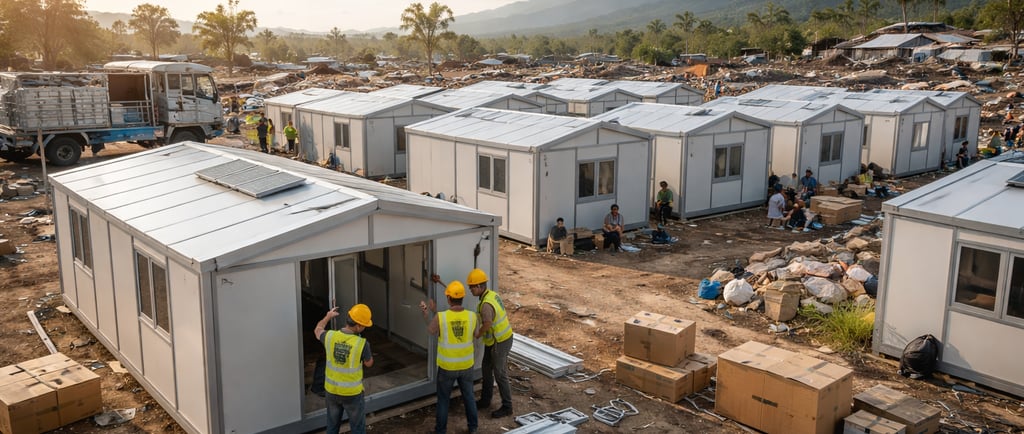
Flat-pack metal emergency shelters made from recycled metals offer rapid deployment, climate resilience, and long-term sustainability. These shelters help disaster-affected communities recover in days rather than weeks, keeping carbon footprints low while facilitating material reuse. Agencies from NGOs to national emergency response teams now rely on these flat-pack solutions for fast, circular, and robust sheltering in crisis zones.
Table of Contents
Context and Why It Matters for Emergency Response Teams
Defining the Challenge: Speed, Survivability, Sustainability
Key Concepts: Flat-Pack, Resilience, Recycled Metal
Core Framework: Rapid-Deploy, Long-Life, Low-Carbon
Implementation Playbook: From Logistics to Assembly
Measurement and Quality Assurance
Case Patterns and Scenario Examples
FAQs: Practical Questions Answered
Embedded Five-Layer Toolkit
Competitive Differentiation / Market Gaps
Conclusion
1. Context and Why It Matters for Emergency Response Teams
In disaster response, every hour lost equates to lives put at further risk, escalating human suffering and resource strain. Traditional emergency shelter infrastructure—tents, temporary wood structures, or ad-hoc huts—often fail crucial performance checks: they’re slow to deploy, provide limited protection in extreme weather, and create significant waste. As disasters become increasingly frequent and intense due to climate change, humanitarian organizations, NGOs, and municipal teams are under pressure to identify resilient, scalable, and sustainable shelter solutions.
The flat-pack metal emergency shelter model stands at the intersection of modern humanitarian logistics, climate adaptation, and circular infrastructure. Unlike tents—prone to rapid deterioration and disposal—flat-pack metal shelters are engineered for both crisis response and prolonged habitation. Their design allows transport in high density (reducing shipments and associated emissions), rapid on-site assembly, and reuse spanning multiple missions or reconstruction projects after the fact.
The Rising Stakes in Emergency Shelter
According to the United Nations Office for the Coordination of Humanitarian Affairs (UNOCHA), over 350 natural disasters affecting 100+ million people occurred in 2023 alone. Recovery gaps persist: In the aftermath of Typhoon Rai (Philippines, 2021), it took over 10 days for many families to secure even basic shelter due to slow logistics and short-lived solutions.
For response agencies—governed now by ESG (Environmental, Social, Governance) standards, donor oversight, and measurable impact—pivoting to flat-pack, low-carbon solutions is more than a trend. It’s an operational imperative aligned with the sector’s evolving values: resilience, speed, and a commitment to reducing the environmental footprint of aid operations.
Key Takeaway: Flat-pack metal shelters—designed for efficiency, circularity, and climate resilience—are redefining what emergency infrastructure looks like in the era of rapid disaster cycles and growing climate risk.
2. Defining the Challenge: Speed, Survivability, Sustainability
Solving shelter in emergencies means optimizing across three interconnected axes: the speed of deployment, the shelter’s survivability, and its sustainability—both environmental and economic.
Speed:
Every additional day without shelter amplifies vulnerability, from exposure to the elements to increased risk of disease. The International Federation of Red Cross and Red Crescent Societies (IFRC) calculates that moving from traditional tents to rapid-assembly flat-pack units reduces median time-to-habitation from 7 days to under 48 hours per 100 families—a critical efficiency during surge events.
Survivability:
Climate volatility brings multifaceted hazards: hurricanes, monsoon floods, earthquakes, and prolonged heatwaves. Lightweight or single-use shelters often fail under the compounding pressures of severe wind or water ingress, putting lives and property in jeopardy. In contrast, flat-pack metal emergency shelters are engineered for longevity and safety—some rated for wind loads exceeding 150 kph, and able to withstand substantial rain and moderate seismic shocks. Thermal properties of insulated metal panels further reduce heat stress and offer more dignified living conditions in both tropical and temperate climates.
Sustainability:
The global humanitarian sector is accountable for over 6% of all humanitarian relief emissions—much from the transport, use, and disposal of single-use tarps and timber. Flat-pack metal systems, constructed from 75% or more recycled content and designed for circularity, lower embodied carbon by upwards of 40% compared to conventional builds. They are easier to transport (requiring fewer convoys or flights), withstand repeated deployment cycles, and contribute to a significant reduction in post-mission landfill.
Operational Stakes—A Closer Look
Safety: Shelters must withstand disaster aftershocks—floods, heavy winds, temperature swings—without rapid deterioration or collapse.
Logistics: Flat-pack allows loading dozens of units onto a single truck or aircraft, enabling reach into urban peripheries as well as isolated villages.
Lifecycle Management: Modular design means shelters can be reconfigured, repaired, or even sold to local institutions after the crisis, closing the loop on waste and maximizing aid investment.
Analysis: The core challenge is not just a question of “where to house people fast,” but “how to provide resilient infrastructure that protects, adapts, and endures with the least environmental impact.” Modern crisis management calls for a paradigm shift—from short-term fixes to long-term, circular, and climate-smart shelter strategies.
3. Key Concepts: Flat-Pack, Resilience, Recycled Metal
Understanding the terminology is key to aligning stakeholders and accelerating procurement, training, and deployment. Let’s break down the essential concepts shaping this new generation of emergency shelters:
Flat-Pack
The “flat-pack” approach is inspired by modern manufacturing and global furniture logistics (think IKEA). Shelters ship in densely packed, standardized kits—typically under 1 cubic meter per unit—enabling bulk transport, easier warehousing, and fast on-site assembly. By minimizing empty space and palletizing components, carriers can triple shipment density compared to volumetric tents or timber materials, directly reducing both costs and emissions.
Resilience
In shelter design, resilience is multidimensional:
Structural: Engineered profiles, galvanized coatings, and modular panels ensure the shelter withstands dynamic loads, high winds, and driving rain.
Thermal: Double-walled, insulated metal sheets (often utilizing aerogel or recycled PET cores) help regulate interior temperatures, protecting occupants from heat waves or cold snaps.
Lifecycle: Robust metal frameworks permit repeated disassembly, storage, and redeployment without degradation, far surpassing the lifecycle of single-use alternatives.
Recent advances in resilience have incorporated smart design upgrades—quick-release fasteners, rainwater management features, and modular extensions—to ensure that shelters maintain integrity season after season.
Recycled Metals
Sourcing aluminum or steel from post-industrial or post-consumer streams slashes the carbon footprint. Compared to virgin steel, recycled steel production generates 75% less greenhouse gas emissions and uses 80% less water (World Steel Association data). Leading suppliers now offer Environmental Product Declarations (EPDs), so procurement teams can verify recycled content and CO₂ impact.
Low-Carbon Circularity
The full shelter system is designed for circularity: all major components (frames, panels, fasteners) can be disassembled and reused or recycled. This approach incentivizes product stewardship—suppliers and agencies alike track kit deployment, maintenance, and end-of-life recycling. The aim: eliminate single-use materials, shrink operational carbon, and extend the working asset life-cycle.
Infrastructure, Not Waste
Flat-pack metal shelters function as temporary homes, schools, clinics, and recovery hubs. Their long life means they can transition seamlessly from crisis response to semi-permanent community infrastructure, drastically reducing material waste and the environmental burden left behind by older shelter strategies.
Key Fact: According to Shelter Cluster analysis (2022), shelters with a minimum 10-year lifecycle deliver a 350% improvement in cost-per-use and reduce annualized emissions by 60% versus tent solutions in multi-year crises.
4. Core Framework: Rapid-Deploy, Long-Life, Low-Carbon
From Emergency to End-of-Life—A Framework for Shelter Success
Flat-pack metal emergency shelters thrive at the intersection of three strategic pillars: speed, durability, and climate-conscious design. To maximize impact, leading NGOs and municipal response teams increasingly rely on the following structured approach.
1. Pre-Event Planning
A proactive stance is critical. Teams must estimate populations at risk, overlay hazard and access maps, and pre-position stock at strategic hubs—national airports, port facilities, or designated “green corridor” warehouses. Pre-crisis drills, assembly walk-throughs, and digital inventory management ensure that response is both coordinated and swift.
Future Trend: The use of AI-powered simulation is enabling agencies to anticipate shelter demand with greater accuracy, optimizing pre-positioning and stock turnover.
2. Procurement
Procure only from vendors with independently verified recycled metal content—80%+ is now an achievable benchmark. Demand modularity: universal panel sizes, standard bolt patterns, and compatibility with sanitation or solar add-ons. Many agencies now include carbon intensity as a core procurement metric, alongside structural ratings and warranty period.
3. Deployment Trigger
Upon event trigger (e.g., earthquake notification, floods, or cyclone landfall), warehouses activate pre-packed kits for shipment. Designated teams coordinate real-time transport via digital dashboards, syncing with local authorities to expedite customs and site transfer.
4. Transport
Efficient, multi-modal transport is key. Flat-pack kits fit a range of carriers:
Trucks: Up to 40 shelters in a single 40ft trailer (typical)
C-130 Aircraft: 18 kits with basic field prepping
Helicopter Sling Loads: Individual units for isolated regions
The compact design sharply reduces logistical bottlenecks, freeing resources for additional relief supplies.
5. Site Selection
Selection criteria must balance accessibility, safety from secondary hazards (e.g., landslides, flash floods), and future service integration (water, power, sanitation). Modern GIS tools and drone reconnaissance supplement traditional site scouts for accurate, rapid mapping.
6. Assembly
Assembly is engineered for speed and simplicity: a 4–6 person team, working with hand tools or basic drills, can construct each unit in under two hours. Kits include all hardware, pre-cut insulation, and clear pictogram manuals in local languages. Structure verification (roof, anchoring, door/window fitment) ensures each unit meets specified safety and climate performance standards.
Stat: In Pakistan’s 2022 super flood relief, a coalition of NGOs deployed over 500 flat-pack metal shelters—averaging under 90 minutes per shelter, with completion of a 2,500-person camp in three days (UNHCR field report).
7. Commissioning & Handover
Commissioning involves live waterproofing tests (visual plus hose-down), user orientation, and digital registration (barcoded shelter ID linked to beneficiary and logistics records). This process documents readiness for both on-ground teams and remote command centers.
8. Upgrades / Reuse
Flat-pack metal shelter systems are modular. Need grows? Expansion modules can link shelters for family clusters, clinics, or classrooms. As the emergency subsides, shelters either remain for rebuilding as semi-permanent dwellings, or are decommissioned, cleaned, and stored for future redeployment. Studies show a well-maintained shelter can be redeployed five to ten cycles before significant refurbishment is required.
Worked Example: Flood Response in Southeast Asia
Scenario Recap:
Massive flood displaces 3,000 people; 9-month shelter required.
75 pre-stocked shelters shipped in 2 trucks straight from a regional hub.
48 hours from arrival to full set-up, with simultaneous team assembly lines.
Shelters not only withstand two additional storms, but two are repurposed as temporary health clinics, demonstrating asset flexibility and resource optimization.
5. Implementation Playbook: From Logistics to Assembly
A flat-pack metal emergency shelter program succeeds or fails long before the first unit is opened on site. The field image people often imagine is a team unloading panels and bolting together a structure after a flood, earthquake, cyclone, or conflict displacement event. That moment matters, but it is only the visible tip of the system. The real work starts in pre-crisis planning, specification discipline, stock strategy, route design, customs readiness, site governance, community engagement, and post-occupancy maintenance planning. When those pieces are weak, even a technically strong shelter kit underperforms. When those pieces are strong, a shelter becomes more than an emergency object. It becomes a repeatable operational asset.
The first rule is to treat the shelter as infrastructure, not aid packaging. That changes procurement behavior immediately. Instead of buying on headline unit price alone, response teams should buy against a field-ready specification: minimum covered living space, minimum height, structural resistance, leakage performance, ventilation, fire behavior, anchoring method, shelf life, repairability, and the ability to disassemble and redeploy. UNHCR’s emergency shelter standards continue to use a minimum of 3.5 square metres of covered living space per person in tropical or warm climates, with a minimum height of 2 metres at the highest point, and Sphere remains the common humanitarian baseline for covered living space, privacy, thermal comfort, and protection. Any shelter that cannot reliably meet those fundamentals may move quickly through procurement but will create problems in occupancy, health, dignity, and donor accountability.
Pre-positioning is where speed is actually won. If your shelter system sits in a faraway warehouse, waits for export paperwork, and relies on ad hoc routing after the event, you have already lost the first 72 hours. The better model is regional buffering. Position stock near airports, seaports, rail corridors, or high-risk inland hubs, then map likely deployment corridors by hazard type. Floods need different last-mile planning than earthquakes. Conflict displacement needs different site logic than cyclone evacuation. Mountain regions may need smaller pack formats or helicopter-compatible loads. Coastal areas may need corrosion-aware hardware and more aggressive anchoring assumptions. In every case, the shelter program should live inside an incident logistics plan, not beside it.
The packaging format deserves more attention than it usually gets. Flat-pack systems work because volume efficiency changes the economics of movement. Better Shelter’s Relief Housing Unit, for example, ships in flat packs, can be assembled by a team of four in roughly 4 to 6 hours, and fits 48 units in a 40-foot high-cube container or 52 units on a truck, while still meeting Sphere minimum standards. That density matters in real operations because freight bottlenecks are rarely theoretical. They are often the main constraint. When airport slots are tight, roads are damaged, or fuel is scarce, each cubic metre saved is operational time recovered for food, WASH, medicines, or additional shelter coverage.
Vendor selection should move beyond product brochures. Ask for a bill of materials, recycled-content declaration where available, coating details, corrosion resistance data, fire classification, expected lifespan by component, spare-part architecture, decommissioning guidance, and evidence of prior humanitarian deployment. Ask whether the frame can accept local cladding later. Ask whether the system can become a clinic, classroom, protection point, or storage facility once peak emergency demand subsides. Ask whether parts are standardized across product generations or whether every model change creates a spare-parts headache. In practice, the best systems are not always the cheapest at purchase. They are the least troublesome over three to ten years of intermittent use. Better Shelter’s current published guidance is useful here because it separates frame life from panel life, notes a minimum three-year lifespan for panels and a longer life for the frame, and explicitly prioritizes repair, refit, reuse, and eventual recycling over disposal.
Customs and import readiness are a quiet source of delay. Emergency teams often focus on transport mode but overlook import classification, temporary import rules, local certification needs, or tax treatment. A strong implementation playbook includes pre-cleared HS classifications where possible, pre-agreed donor paperwork, translated packing lists, and a local legal contact who can troubleshoot in real time. This sounds administrative, but in many operations a shelter delayed in customs is just as unavailable as a shelter that was never bought. The most resilient shelter programs build legal and administrative speed into the same response doctrine as transport speed.
Site selection is where humanitarian urgency must meet engineering discipline. Not every open parcel is a shelter site. Teams must avoid flood paths, unstable slopes, erosion corridors, contaminated land, conflict exposure, and locations that isolate residents from water, health services, schools, and protection mechanisms. GIS, drone reconnaissance, and local community mapping all help, but none of them replace local knowledge. Residents often know where water pools, where winds funnel, where security risks rise after dark, and where drainage fails. In that sense, community participation is not a soft add-on. It is part of risk reduction.
Assembly planning should assume variable labor skill, stressful conditions, and incomplete tools. Good shelter systems are built for this reality. The ideal field package includes pictogram-based instructions, color-coded parts, minimal unique fasteners, spares, anchoring guidance for different soil conditions, and a simple quality-control sequence that a non-engineer can follow. One reason Better Shelter and similar modular systems have gained traction is that they reduce dependence on specialized crews. Better Shelter publishes assembly times of 4 to 6 hours for a team of four for a full RHU, and a faster frame-only structure version assembled by four people in about an hour without extra tools. That range is important because it reminds buyers to distinguish between a frame system and a fully enclosed, occupancy-ready shelter. Field plans that confuse those two will overpromise speed.
Assembly lines outperform one-by-one installation in larger responses. Once the first few units are built and a local team is trained, the next productivity jump comes from specialization. One crew lays out and inventories parts. Another sets anchors and foundations. Another assembles frames. Another installs wall and roof panels. Another handles fit-out, lighting, registration, and snagging. This is how shelter programs move from demonstration speed to camp-scale throughput. Better Shelter states that up to 140 units can be assembled per day under organized conditions. Actual field rates will often be lower because terrain, weather, labor availability, and beneficiary participation vary, but the broader lesson holds: productivity comes from system design, not heroic labor.
Commissioning should never be skipped. In emergency settings, there is a temptation to count a shelter as delivered once it stands upright. That is too early. A shelter should only be counted as ready when it passes a short commissioning checklist: anchorage complete, door and window function verified, roof and wall interfaces checked, leakage test completed where feasible, internal ventilation confirmed, hazard clearance documented, occupancy registration completed, and basic user orientation delivered. This matters for safety and for auditability. It also matters for dignity. People do not just need something overhead. They need a secure, usable place to live. UNHCR has emphasized features such as lockable doors, lighting, sturdier walls, and improved fire safety and ventilation precisely because these affect daily security, especially for women, children, older persons, and survivors of violence.
Maintenance planning should begin on day one. Too many shelter programs are designed around deployment, not duration. But many crises become protracted. Shelters that were procured as temporary assets remain in use for years. That means every implementation playbook should include spare-part kits, routine inspection intervals, a simple defect reporting system, and a repair doctrine that can be taught locally. Better Shelter’s own decommissioning guidance is clear that the most effective way to reduce environmental footprint is to extend lifespan, repair broken parts, and refit the frame with local materials when panels degrade. That is a useful principle well beyond one supplier. The shelter with the lowest lifecycle impact is often the one you do not have to replace.
A final implementation point is often overlooked: handover does not mean abandonment. Shelter teams should schedule post-occupancy checks at 7 days, 30 days, and 90 days. Early defects, misuse patterns, thermal discomfort, drainage failures, and security issues usually show up fast. Catching them early turns a shelter program into a learning system. Missing them turns it into a photo opportunity followed by field frustration.
6. Measurement and Quality Assurance
If you cannot measure a shelter system well, you cannot defend it to donors, improve it in the field, or compare it honestly with tents, timber systems, containers, or local build approaches. Measurement is where flat-pack metal shelters either move from promising concept to proven operating model, or get exposed as expensive hardware with weak field fit. The answer is not one heroic KPI. It is a disciplined framework that tracks speed, safety, human outcomes, cost, durability, and environmental performance together.
The first measurement family is speed. Most shelter reports still track shipment and distribution, but not time-to-safe-occupancy. That is a mistake. The metric that matters is the interval from deployment trigger to shelter readiness for habitation. Break that into stages: warehouse release, line-haul transit, customs clearance, site transfer, assembly start, assembly completion, commissioning pass, occupancy. That sequence tells you where time is actually being lost. A shelter that assembles in four hours but waits four days in customs is not a four-hour shelter in operational terms. Teams should also record output per crew per day, training time to proficiency, and the percentage of units assembled without supervisor intervention after day three of operations. Those are the real indicators of surge capacity. Better Shelter’s published assembly time and shipping density give a useful benchmark for what is technically possible, but field measurement should always report the local reality, not brochure speed.
The second family is standards compliance. Here the baseline is straightforward. Does the unit provide minimum covered living space? Does it maintain basic weather protection? Does it provide privacy, ventilation, and a minimum acceptable internal environment? Sphere has long defined covered living space as more than a roof area number. It is about thermal comfort, fresh air, privacy, safety, health, and the ability to carry out essential household and livelihood activities. The commonly cited 3.5 square metres per person is a signal, not a complete standard. Good QA therefore checks usable area, head height, ventilation effectiveness, internal moisture behavior, and occupant density in practice, not just in design drawings.
The third family is structural and weather performance. A metal shelter should be tested or verified against the hazard profile it is entering. That includes wind, rain ingress, anchoring pullout, corrosion risk, snow load where relevant, and heat performance. Better Shelter publishes 101 km/h wind resistance for its RHU, artificial rain test performance with no leakage, and a minimum two-minute escape time under fire-related conditions. Those are useful examples of measurable claims. Procurement teams should require equivalent published or certified data from all vendors and then validate a sample of units in the field. A shelter program that cannot show how its units perform under rain, wind, and heat should not claim resilience.
The fourth family is human outcomes. A shelter is not successful because steel stayed straight. It is successful because people were safer, drier, less exposed, and better able to recover. This is where many programs under-measure. Teams should collect occupant-reported data on sleep quality, thermal comfort, sense of security, privacy, ability to store possessions, and willingness to remain in the unit through bad weather. UNHCR’s reporting on Refugee Housing Units highlights exactly why these softer measures matter. Lockable doors, lighting, sturdier walls, and more durable weather protection materially affect how safe people feel, especially at night and especially for women and girls facing heightened protection risks. Those are not cosmetic benefits. They are part of shelter performance.
The fifth family is lifecycle durability. This is where flat-pack metal systems should outperform disposable shelter classes. Track defect rates at 30, 90, 180, and 365 days. Track panel damage, corrosion, fastener loss, door failures, leakage complaints, anchor failures, and repair frequency. Track how many units remain serviceable after disassembly and redeployment. Track whether the shelter frame can be repurposed with local materials. Better Shelter’s decommissioning guidance is especially useful because it frames repair and refit as first-line sustainability strategies and notes that the modular design enables disassembly and reuse in different combinations. That gives agencies a model for measuring true asset value, rather than treating all shelter stock as near-disposable inventory.
The sixth family is financial efficiency. Unit price is only the start. Serious programs need cost per person sheltered, cost per sheltered person-day, cost per redeployment cycle, cost per square metre delivered to site, and cost per shelter still serviceable after one year. This is where cheap products often become expensive. If a lower-cost shelter needs early replacement, creates more leakage complaints, or requires more freight because it packs poorly, the headline saving disappears. Lifecycle cost thinking is increasingly aligned with sustainable procurement practice more broadly, because decisions that reduce waste, fuel use, and replacement cycles often improve long-run value too.
The seventh family is environmental performance. This is where the sector is improving, but still not measuring enough. The IASC guidance notes that the humanitarian shelter sector has been developing LCA tools because procurement decisions have major environmental implications. UNHCR and Shelter Cluster sustainability guidance also make clear that shelter responses can have some of the highest negative environmental impacts in humanitarian operations if materials, sourcing, transport, and end-of-life are poorly managed. For flat-pack metal shelters, the core metrics should include recycled content by mass, transport emissions per unit delivered, emissions per sheltered person-day, expected useful life, repairability, share of mass recyclable at end of life, and actual disposal route. Better Shelter’s decommissioning guidance states that 61% of the shelter’s weight can be directly recycled to raw material with proper processes, and worldsteel notes that around 680 million tonnes of steel were recycled in 2021, avoiding more than one billion tonnes of CO2 emissions. Those are the right kinds of numbers to build into a measurement framework, but each project still needs its own local carbon and end-of-life accounting.
A robust QA workflow should therefore include four layers. Factory QA checks the kit before dispatch. Arrival QA checks completeness and transit damage. Assembly QA checks compliance with field installation steps. Post-occupancy QA checks whether the shelter actually performs for residents. That sounds basic, but many failed shelter programs can be traced to the absence of one of those layers. The best programs document every shelter with a unique ID, installation date, crew lead, location, defect log, and occupant record. Once you do that consistently, pattern recognition becomes possible. You can identify which soils cause anchor failures, which routes drive damage, which crews need retraining, and which shelter models hold up best in specific climates.
Measurement should also be comparative. Do not only ask whether the metal shelter worked. Ask whether it worked better than your next-best alternative for that context. In sudden-onset mass displacement, the comparison may be a tent. In flood recovery, it may be an improved local-material shelter. In cold climates, it may be a different insulated modular system. A shelter system earns its place when it beats alternatives on the dimensions that matter in that setting, not when it wins a generic design argument.
7. Case Patterns and Scenario Examples
The strongest case for flat-pack metal emergency shelters is not that they are perfect. It is that across multiple settings they solve a cluster of recurring problems better than many legacy options. The pattern that repeats is simple: when displacement is large, time is tight, weather is hostile, and long-term uncertainty is high, modular flat-pack systems often provide a better balance of speed, dignity, and reuse than tents or improvised structures.
One important case pattern comes from refugee settings where “temporary” conditions last years. UNHCR’s Refugee Housing Unit program, developed with Better Shelter and the IKEA Foundation, was designed for exactly this gap. UNHCR has described the RHU as a sturdier shelter with a steel frame, lockable door, lighting, and everyday features that restore a measure of normal life. In 2019, UNHCR Canada reported that more than 1,800 RHUs had been installed that year in Brazil, Chad, and Tanzania, and that distribution prioritized highly vulnerable groups including children, women, older people, those with serious medical conditions, and survivors of sexual and gender-based violence. In Tanzania, UNHCR reported that more than 4,000 refugees were already benefiting from the shelter solution. This matters because it shows the shelter being used not as a flashy prototype, but as part of vulnerability-targeted field programming.
A second pattern appears in protracted accommodation responses linked to conflict displacement in higher-income host contexts. Ireland’s rapid-build housing program for people fleeing Ukraine is not the same product class as lightweight humanitarian kits, but it reinforces the strategic point. The project was launched to provide short-term accommodation to around 2,000 Ukrainians, especially women and children, through modular homes delivered much faster than conventional housing. By August 2023, five modular home sites had been completed. This case matters because it shows that modular, faster-build shelter logic is not confined to camps or low-income settings. It has become a mainstream emergency housing pathway when conventional construction timelines are too slow.
A third pattern is multi-use conversion. Better Shelter’s own published material highlights RHUs being used not only for shelter, but also for health, education, protection, and communal infrastructure. Its annual review points to uses ranging from schools in northwestern Syria to homelessness support in Austin, to emergency shelters after disasters in India, to vaccination kiosks, and to family shelter on a Colombian island where a hurricane destroyed most infrastructure. The lesson here is commercial and operational. A good shelter asset should not become dead stock once one emergency phase ends. It should convert into another public-use function. That improves utilization rates and helps justify stronger upfront specifications.
A fourth pattern is border, transit, and return settings. Better Shelter notes recent deployments with the International Rescue Committee at the Afghanistan border and earthquake response with IOM in Türkiye. Those contexts demand speed, modularity, and basic service continuity under pressure. The shelter may not stay in one place or serve one use case for long. That is exactly why disassembly, transportability, and repeat installation matter. A shelter system that performs only in static camp conditions is too narrow for the modern displacement landscape.
A fifth pattern is where the shelter serves as a bridge between emergency and recovery. This is arguably the most important strategic advantage of flat-pack metal systems. In many crises, tents are procured because they are fast, then a second round of spending is needed because they deteriorate, leak, overheat, tear, or become socially unacceptable. A better shelter model reduces that double-spend. Better Shelter’s decommissioning guidance explicitly encourages extending frame life, replacing or repairing damaged parts, and refitting with local materials. That means the shelter can evolve rather than being discarded at the first point of wear. From a donor and procurement standpoint, this is one of the clearest arguments for metal modular systems: they allow the response to move from emergency to transitional use without restarting from zero.
Now consider three realistic scenario examples.
In a delta flood response, road access is intermittent, land is soft, and standing water may persist for weeks. In that context, the shelter system should prioritize compact pack-out, corrosion-aware components, raised foundation details, strong rainproofing, and simple repairability. A metal flat-pack unit can work well if anchoring is adapted to soft ground and the floor strategy is handled carefully. The main failure point is not usually the frame. It is drainage, access, and underfloor moisture management. The best-performing program in that setting is the one that integrates the shelter with site drainage, WASH, and mosquito control from the start.
In a cold-weather displacement setting, the key issue shifts from basic coverage to thermal retention, energy burden, and condensation. A metal frame can still be a strong base, but insulation, vapor control, safe heating interfaces, and ventilation become non-negotiable. Here, the right comparison may not be tent versus metal shelter, but poor modularity versus well-insulated modularity. The shelter system must prove that it is habitable, not merely upright. Sphere and UNHCR standards do not let agencies ignore thermal comfort. They make it part of the definition of adequate covered living space.
In a cyclone or high-wind coastal setting, the shelter must be judged on anchorage, uplift resistance, corrosion resistance, and maintenance regime. Better Shelter’s published wind resistance figure of 101 km/h is useful, but many coastal events exceed that. So the implementation question becomes whether the shelter is suitable for the exposure class, and if not, whether it is being used only as an interim shelter in safer inland zones. This is why responsible shelter programming never treats one shelter type as universal. The right shelter is the one matched honestly to the hazard profile and duration of use.
The broader point from these cases is clear. Flat-pack metal shelters win when agencies need repeatable logistics, fast assembly, stronger protection than fabric-only solutions, and a pathway to reuse. They lose when they are bought without climate matching, installed without site planning, or judged only on procurement price.
8. FAQs: Practical Questions Answered
Are flat-pack metal emergency shelters always better than tents?
No. They are often better when displacement lasts beyond the very short term, when weather exposure is serious, when security and privacy matter, and when agencies want assets that can be repaired and reused. Tents can still make sense for immediate surge coverage, ultra-light deployment, or very short occupancy windows. The real decision is contextual. A shelter should be chosen against hazard, duration, population needs, logistics, and lifecycle cost. Sphere and UNHCR standards give the floor, but the right product depends on what comes after the first 48 hours.
Do metal shelters overheat?
They can, if they are badly designed or poorly sited. Metal does not automatically mean thermal failure, just as fabric does not automatically mean comfort. Heat performance depends on insulation, ventilation, roof detailing, shading, orientation, and local climate. This is why thermal comfort is part of humanitarian shelter standards and why buyer specifications must ask for actual thermal strategy, not just structural claims.
Are they really low carbon if they use steel?
They can be materially lower carbon than less durable alternatives when recycled content is high, freight efficiency is good, and the shelter is reused or repurposed over multiple cycles. Worldsteel states that recycled-steel production can generate 78% fewer greenhouse-gas emissions than steel made from virgin material, and around 680 million tonnes of steel were recycled in 2021, avoiding more than one billion tonnes of CO2. But low carbon is not automatic. A metal shelter flown long distances, used once, and dumped badly can lose much of its advantage. Lifecycle use is what makes the climate case strong.
How long do these shelters last?
It depends on product design, climate, maintenance, and how hard they are used. Better Shelter’s RHU publishes a minimum three-year panel lifespan and a minimum ten-year frame life, with a five-year shelf life. Its guidance also notes that actual life is often longer, especially when parts are repaired and the frame is refitted with local materials as needed. That makes lifespan a managed outcome, not just a factory claim.
How many people can one unit house?
That depends on unit size and the applicable humanitarian space standard. The RHU example is 17.5 square metres. UNHCR’s current emergency standard and long-standing Sphere guidance use a minimum of 3.5 square metres per person in warm climates, which means a unit of that size can meet the minimum for about five people. That does not mean five is always ideal. Household composition, storage needs, privacy, disability inclusion, and climate may justify more generous space planning.
Can local communities assemble and maintain them?
Often yes, and that is one of their main strengths. Better Shelter’s published assembly guidance assumes a team of four and limited tools. More broadly, the best systems are the ones that reduce specialized labor dependency, use simple instructions, and support local repair. That matters for both cost and dignity because people gain more control over their own living conditions.
What happens at end of life?
The best answer is that end of life should come late and in stages. Repair first. Refit second. Reuse third. Recycle after that. Better Shelter’s decommissioning hierarchy explicitly follows that logic and states that 61% of the shelter’s weight can be directly recycled with proper processes. The sector is moving in this direction because humanitarian shelter responses can carry large environmental impacts if disposal is ignored.
Can they be used for more than housing?
Yes. That is one of the strongest operational arguments in their favor. Better Shelter and UNHCR materials both reference use cases across shelter, education, health, protection, storage, and communal infrastructure. A shelter asset that can become a clinic room, classroom, registration point, or protection space has more strategic value than one locked to a single phase of response.
9. Embedded Five-Layer Toolkit
To make flat-pack metal shelter programs work in the field, agencies need more than a product. They need a toolkit. The most useful way to think about that toolkit is in five layers.
Layer one is the specification toolkit. This is your buyer’s shield against vague claims and flashy marketing. It should define minimum covered living space, minimum internal height, structural resistance, rainproofing, fire safety behavior, ventilation requirements, shelf life, repairability, spare-parts policy, component standardization, end-of-life pathway, and documentation requirements such as EPDs or recycled-content declarations where available. If a vendor cannot answer those items clearly, the product is not procurement-ready for serious emergency use.
Layer two is the logistics toolkit. This includes regional stock maps, pack-out density records, route plans, customs templates, deployment triggers, transport mode rules, handling instructions, and a last-mile access matrix. Build it before the emergency. Include which products fit which truck classes, what lifting equipment is needed, what route limitations exist in wet season, and which buffer stocks should be rotated first. The whole point of flat-pack is that movement becomes more efficient. That advantage only becomes real when logistics planning is equally disciplined.
Layer three is the field assembly toolkit. This should contain pictogram manuals, translated quick guides, crew role definitions, foundation options by soil type, anchoring details, snagging checklists, commissioning forms, and training modules for local teams. Keep it simple enough that a first-time crew can learn it fast, but detailed enough that quality does not collapse under pressure. Include a red-flag page showing the five mistakes that most often create later defects. In practice those are usually incomplete anchoring, poor sealing, bad panel alignment, missing fasteners, and weak drainage treatment around the site.
Layer four is the measurement toolkit. Every shelter should have a unique ID and a minimal digital record. Record dispatch date, install date, commissioning status, occupant count, defect history, repair actions, and eventual reuse or decommissioning pathway. Then aggregate those records into program metrics: time-to-safe-occupancy, defects per 100 units, repair cost per unit-year, occupant satisfaction, sheltered person-days delivered, and emissions or material recovery metrics where possible. This is how agencies turn hardware deployment into institutional learning. It is also how they defend budgets in donor reviews.
Layer five is the circularity toolkit. This is where low-carbon ambition becomes practice. Map which components can be reused directly, which can be repaired, which can be refitted with local materials, which can enter local recycling streams, and which require controlled disposal. Better Shelter’s decommissioning guidance is useful because it operationalizes this logic with a waste hierarchy and notes that all steel and aluminium articles are recyclable while encouraging reuse and repurposing before recycling. Combine that with global steel recycling facts and you have a practical roadmap for circular shelter operations rather than a generic sustainability statement.
The reason this five-layer model matters is simple. Most shelter failures do not come from one catastrophic design flaw. They come from missing system layers. A good product without a logistics toolkit arrives late. A good logistics plan without a field assembly toolkit produces poor installation. A strong installation without a measurement toolkit creates no learning. A program with no circularity toolkit eventually turns resilience into waste.
10. Competitive Differentiation and Market Gaps
The market for emergency shelter still has a major gap between what responders say they want and what many procurement systems still reward. Responders say they want speed, dignity, durability, climate fit, and lower environmental harm. Procurement too often still rewards low upfront price, generic compliance language, and vendor claims that are hard to compare. That gap is one reason flat-pack metal shelter systems remain both promising and underused.
The first market gap is lifecycle blindness. Too many tenders still compare products on unit cost and immediate delivery only. That misses freight density, repairability, reuse cycles, thermal performance, and end-of-life burden. In a world where disasters are frequent and budgets are tight, lifecycle blindness is expensive. A shelter that lasts longer, packs tighter, and converts into secondary uses can beat a cheaper option decisively over time. The commercial winners in the next shelter market phase will be the suppliers that can prove lifecycle value with data, not just promise it in prose.
The second gap is weak climate matching. Many products are sold as general-purpose emergency shelters even though heat, humidity, wind, corrosion, and occupancy duration vary enormously by context. This creates disappointment in the field and distrust among buyers. The next competitive step is not a universal shelter. It is a modular family with honest performance envelopes, upgrade paths, and localized adaptation options. Better Shelter’s more recent public materials move in that direction by emphasizing adaptability, incremental upgrading, and the use of locally available materials with the frame. That is a better answer than pretending one sealed box solves every shelter problem.
The third gap is poor end-of-life planning. The Global Shelter Cluster and UNHCR sustainability work have repeatedly highlighted the environmental footprint of shelter operations, yet many procurements still barely ask what happens after use. This is a serious weakness. The suppliers that differentiate from here onward will be the ones that provide decommissioning protocols, material marking, recyclable component mapping, spare-parts support, and realistic repair guidance. In short, they will sell not just a shelter, but a managed asset.
The fourth gap is evidence. Humanitarian shelter still needs more published, comparable data on thermal performance, field failure rates, redeployment rates, user satisfaction, and carbon per person sheltered. The IASC guidance notes the importance of LCA tools for the sector, but the market still lacks enough shared benchmarks. This is a competitive opening. The supplier or agency that publishes strong comparative evidence, across climates and use durations, will shape procurement standards.
The fifth gap is dignity-focused design. Too many shelter decisions still get framed as a race between speed and comfort, as though privacy, locking, lighting, and weatherproofing are luxuries. UNHCR’s own messaging on RHUs shows why that is wrong. Features that support privacy and security are central, especially for vulnerable groups. The market gap is therefore not only technical. It is moral and programmatic. The shelters that will matter most in the next decade are the ones that treat human dignity as a core performance metric.
This is where flat-pack metal systems can stand out. Their best competitive case is not that they are futuristic. It is that they are measurable. They can show pack density. They can show assembly time. They can show structural testing. They can show component life. They can show reuse pathways. In a donor environment increasingly shaped by accountability, ESG pressure, and climate scrutiny, measurability is a real advantage.
11. Conclusion
Emergency shelter is no longer a narrow question of how to get something over people’s heads fast. It is now a systems question. How quickly can you move? How safely can you house? How well can the shelter hold up to wind, rain, heat, and time? How much waste will the response create? Can the asset be repaired, upgraded, reused, and finally recycled? Can you prove all of that with data?
That is why flat-pack metal emergency shelters matter. They sit at the intersection of humanitarian speed, engineering discipline, and lower-carbon infrastructure logic. They are not automatically the right answer in every emergency. But where displacement is large, climate stress is high, logistics are tight, and occupancy may stretch far beyond the “temporary” label, they often provide a stronger operating model than short-life alternatives. The wider data only reinforces the urgency. In 2024, EM-DAT recorded 393 natural hazard-related disasters affecting 167.2 million people. IDMC reported 75.9 million people living in internal displacement at the end of 2023. At the same time, the shelter sector is under growing pressure to reduce environmental harm, and the steel sector offers real circularity and emissions-reduction potential when recycled content and reuse are built in properly.
The real lesson is this. The best shelter programs are no longer buying products. They are building shelter systems. They specify hard. They pre-position smart. They commission properly. They measure honestly. They repair early. They reuse aggressively. They decommission responsibly. When flat-pack metal emergency shelters are deployed inside that kind of system, they stop being temporary boxes. They become resilient, reusable infrastructure for a harder century.
Global Outlook, Procurement Outlook, and Final Synthesis
Why This Topic Is Moving From Niche Shelter Design to Mainstream Infrastructure Strategy
Emergency shelter is no longer a narrow humanitarian subtopic. It is now part of a much larger global conversation about climate adaptation, supply-chain resilience, circular construction, public procurement, and long-duration displacement. The numbers alone explain why. EM-DAT recorded 393 natural hazard-related disasters in 2024, affecting 167.2 million people and causing nearly US$242 billion in economic losses. At the same time, IDMC reported 75.9 million people living in internal displacement at the end of 2023, including 7.7 million displaced by disasters and 68.3 million by conflict and violence. That is the backdrop against which shelter systems now have to perform. They are no longer being judged only on how quickly they can be delivered. They are being judged on how well they work when crises overlap, when housing shortages stretch on for months or years, and when donors and governments want stronger evidence of value, safety, and lower environmental impact.
That shift matters because older shelter logic was built around a shorter emergency arc. A tent, tarp, or improvised temporary unit could still make operational sense when the crisis window was measured in days or a few weeks. Today, that is often not the reality. Displacement is increasingly protracted. Recovery is slower. Climate events are more frequent. Public authorities and aid agencies are expected to justify not only response speed, but also durability, dignity, embodied impact, reuse potential, and lifecycle cost. Guidance from UNHCR, Sphere-linked standards, and humanitarian sustainability work all point in the same direction: shelter is not just about minimum coverage. It is about thermal comfort, privacy, protection, habitability, safe siting, and environmental responsibility across the whole response cycle.
This is where flat-pack metal shelter systems have a serious opening. They fit the operational reality of modern response better than many single-use alternatives because they combine compact shipping, repeat assembly, stronger structural integrity, and a clearer pathway to repair, repurposing, and recycling. Better Shelter’s published specifications are a useful benchmark for what that looks like in practice: 48 units in a 40-foot high-cube container, a team-of-four assembly time of roughly 4 to 6 hours for the full RHU, a minimum 10-year frame life, and a layout designed to meet Sphere minimum standards. That does not make every flat-pack metal shelter automatically good. It does show why this shelter class is increasingly taken seriously.
The Procurement Outlook: What Buyers Will Demand Next
The next phase of this market will be defined by procurement discipline. For years, many shelter tenders have still leaned too heavily on unit price, immediate availability, and broad technical claims. That approach is breaking down. Buyers now need shelter systems that can withstand closer scrutiny. They need proof of shipping density, field assembly rates, usable living area, structural resistance, repair pathways, spare-parts availability, expected service life, and environmental recovery potential. In other words, the shelter market is moving from product marketing to evidence-based procurement.
You can already see the shape of that transition in the standards landscape. UNHCR’s emergency shelter standards make explicit reference to minimum covered living space and minimum height. Sphere-linked guidance frames shelter adequacy in wider terms, including privacy, safety, thermal comfort, ventilation, and the ability to support basic household activity. The IASC environmental responsibility guidance goes further by noting the development of life cycle assessment tools for the humanitarian shelter sector, because procurement choices drive large downstream impacts. This means future buyers will not just ask whether a shelter can be delivered. They will ask what kind of emissions profile, maintenance burden, and waste footprint comes with that delivery.
That has real commercial consequences. Suppliers that can provide transparent data will have an advantage. Suppliers that only offer generic language about resilience or sustainability will be easier to filter out. The strongest future shelter bids are likely to include at least six hard evidence areas: validated structural performance, installation rate under realistic conditions, lifecycle component map, repair and spare-parts plan, packaging and freight efficiency data, and end-of-life recovery pathway. Better Shelter’s public documentation is notable here because it provides numbers many vendors still do not publish clearly, including unit density in containers, lifespan by component, wind performance, and decommissioning hierarchy. That level of specificity is likely to become less exceptional over time because buyers will increasingly expect it.
Where the Biggest Market Gaps Still Exist
Despite the progress, the market still has several obvious weaknesses.
The first is climate mismatch. Too many shelter products are still marketed as broadly suitable across contexts where the hazard profile is radically different. A shelter that works in a dry inland camp may perform poorly in a humid coastal zone or a cold-weather setting. Wind, heat, condensation, corrosion, and anchoring conditions all change the real-world outcome. The more mature suppliers will be the ones that define operating envelopes clearly rather than pretending one system fits everything. UNHCR and Sphere-based standards help establish the minimum floor, but they do not eliminate the need for climate-specific engineering and site-specific adaptation.
The second gap is weak lifecycle accounting. A shelter that looks cheap on paper can become expensive once freight inefficiency, early damage, poor repairability, or single-use disposal are factored in. This is especially important now that environmental responsibility is moving closer to the center of humanitarian operations. The Global Shelter Cluster has explicitly highlighted the need to reduce negative environmental outcomes from shelter responses, and the IASC guidance points to growing use of LCA thinking in the sector. That means programs that still buy on upfront price alone are likely undercounting the real cost of shelter.
The third gap is incomplete end-of-life planning. One of the strongest claims made on behalf of metal shelter systems is circularity, but that claim only holds if decommissioning is actually planned. Better Shelter’s decommissioning guidance is useful because it does not treat recycling as the first answer. It prioritizes extending service life, then repair, then refit, then repurposing, and only after that recycling and disposal. That is exactly the right hierarchy. It also states that 61% of the shelter’s weight can be directly recycled into raw material when handled correctly. This kind of documentation should become standard across the category. Without it, “low-carbon” becomes a weak marketing line instead of a controlled operational practice.
The fourth gap is published field performance data. There are still not enough open, comparable datasets showing how different shelter systems perform over time across climates, soil conditions, occupancy patterns, and reuse cycles. The vendor that helps close that gap will shape the market. A shelter system that can show defect rates after 90 days, 1 year, and redeployment cycle 2 or 3 will be more credible than one that only shares assembly speed from an ideal demonstration setting. This is why the future leaders in this category are likely to be those who act more like infrastructure providers than hardware sellers.
What a Best-in-Class Flat-Pack Shelter Program Looks Like
A strong flat-pack shelter program in 2026 and beyond will look different from older shelter responses. It will start with pre-positioning and route logic rather than last-minute buying. It will use a specification package that defines not just footprint and frame, but also living-space adequacy, ventilation, fire performance, anchoring method, panel strategy, maintenance expectations, and end-of-life options. It will include customs readiness, field assembly training, defect logging, and post-occupancy review. It will treat the shelter as a managed asset with a digital record, not as a one-time distribution item.
It will also track meaningful performance. That includes time-to-safe-occupancy, not just time-to-arrival. It includes sheltered person-days delivered, not just units distributed. It includes repair frequency, user-reported safety, thermal comfort, leakage incidents, and the percentage of components reused or recycled. These are the kinds of metrics that actually show whether a shelter model is working. Anything less creates the illusion of accountability while missing the reality on the ground.
Most importantly, a best-in-class program will allow the shelter to change role over time. One of the clearest strengths of modular systems is that they can bridge emergency and recovery phases. Better Shelter and related UNHCR use cases show these units serving not only as family shelter but also as clinics, schools, community spaces, and other essential facilities. That flexibility is not a side benefit. It is one of the strongest economic and operational reasons to choose a modular metal system in the first place.
The Strategic Case for Recycled Metal in Shelter Systems
The case for recycled metal is strongest when it is discussed honestly. Steel and aluminium are not impact-free materials. The point is not that they are magically green. The point is that they become substantially more defensible when high recycled content, long service life, compact freight, repairability, and strong end-of-life recovery are built into the program. Worldsteel’s 2021 LCI work states that steel production using recycled steel generates 78% fewer greenhouse-gas emissions than production from virgin steel. Worldsteel also notes that using one tonne of scrap in steel production avoids about 1.5 tonnes of CO2 emissions, along with major savings in iron ore, coal, and limestone use. Those are significant gains, but they only become meaningful in shelter terms when the product is designed for repeated use and responsible recovery.
This is why metal shelters deserve a more serious place in the low-carbon infrastructure conversation. They sit in a category where operational resilience and circular material logic can reinforce each other. A shelter frame that lasts a decade or more, is redeployed across multiple missions, and can be refitted locally as panels age is a fundamentally different proposition from a shelter that becomes waste after one crisis season. The climate argument gets stronger the more the shelter behaves like reusable infrastructure and weaker the more it behaves like disposable aid stock.
Final Synthesis
Flat-pack metal emergency shelters are not the answer to every shelter challenge. They are not a substitute for local participation, careful site planning, protection-aware settlement design, or long-term housing policy. They do not remove the need for climate-specific engineering or honest cost analysis. What they do offer is a shelter format that is unusually well suited to the realities of modern crisis response: dense shipping, repeat assembly, stronger physical protection, clearer quality control, and a real pathway toward lower-waste operations.
That matters because the world they are being deployed into is getting harder. Disaster exposure remains high. Displacement remains historically elevated. Public and donor expectations are rising. Procurement is moving toward more evidence and more accountability. The shelter sector is under growing pressure to reduce its own environmental harm while still moving fast under extreme conditions. In that environment, flat-pack metal systems are no longer a niche product idea. They are part of a broader transition from emergency shelter as short-life consumable to emergency shelter as resilient, measurable, reusable infrastructure.
The strongest conclusion is also the simplest. The future of emergency shelter belongs to systems that can do five things at once: move fast, protect well, last longer, prove their value, and leave behind less waste. Flat-pack metal shelter systems are not yet perfect. But when specified properly, measured honestly, and managed across the full lifecycle, they are one of the clearest examples of where the shelter sector is heading next.
Connect
Your trusted partner for scrap metal procurement.
CONTACT
About
haroon@tdcventures.com
+1-307-655-7593
© 2025. All rights reserved.
NEWSLETTER