
EPR Targets for XR & Wearables: What’s Coming
EPR is reshaping market access for XR devices and wearables by 2026. Learn the core EPR targets, design pressures, take-back requirements, and digital traceability strategies producers need to turn compliance into competitive advantage.
IMMERSIVE TECH RECYCLING & CIRCULAR ELECTRONICS
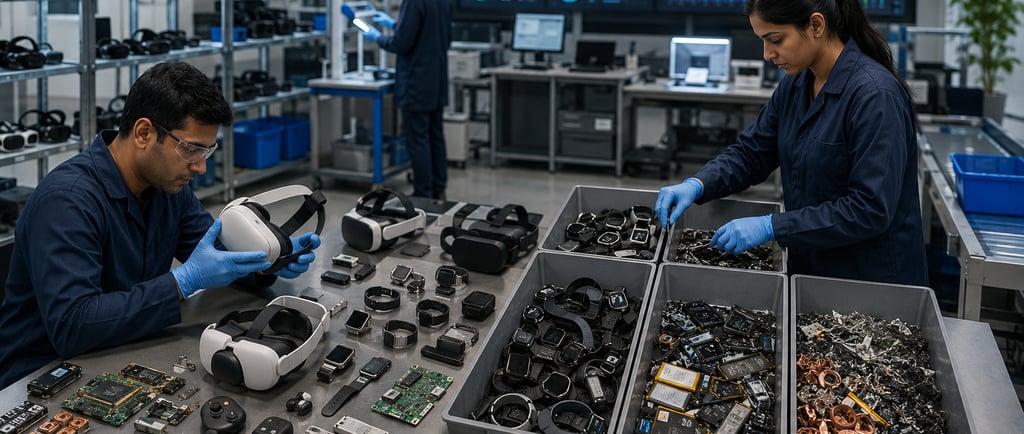
Instant Answer
Extended Producer Responsibility, or EPR, is moving from a broad electronics recycling obligation into a sharper market-access requirement for XR devices, smartwatches, fitness trackers, smart glasses, connected earbuds, health wearables, smart textiles, and other battery-powered devices. By 2026, producers can no longer treat take-back, repairability, recycled content, battery recovery, spare parts, and end-of-life reporting as optional sustainability work. These requirements are becoming part of product design, sales eligibility, retail access, public procurement, ESG reporting, and customer trust.
The shift is happening because the global e-waste problem is outpacing formal recycling systems. The world generated 62 million tonnes of e-waste in 2022, while only 22.3% was formally collected and recycled. The same global monitor projects e-waste could reach 82 million tonnes by 2030 if current growth continues. For XR and wearables brands, that gap creates a direct compliance risk. These products are small, material-dense, hard to repair, battery-dependent, and often replaced quickly. That combination makes them exactly the type of electronics regulators are beginning to scrutinize.
Table of Contents
Context: Why EPR Targets for XR and Wearables Matter Now
What EPR Means for XR, Wearables, and Connected Electronics
Why XR and Wearables Are Becoming a Regulatory Priority
Global EPR Direction in 2026
Core EPR Targets Producers Should Expect
Product Design Pressure: Repairability, Batteries, Materials, and Modularity
Collection and Take-Back: The Weak Link in Small Device Circularity
Reporting, Traceability, and Digital Product Passports
Strategic Readiness Roadmap for OEMs, Brands, Retailers, and Compliance Teams
Embedded Five-Layer Toolkit
Competitive Differentiation
Future Trends in EPR for XR and Wearables
Conclusion: Make EPR Compliance Your Growth Catalyst
1. Context: Why EPR Targets for XR and Wearables Matter Now
EPR was once treated as a back-office compliance function. A producer registered in a market, paid into a scheme, submitted periodic reports, and moved on. That version of EPR is no longer enough for the next generation of electronics. XR devices and wearables are changing the shape of e-waste because they pack batteries, sensors, circuit boards, displays, magnets, lenses, adhesives, plastics, metals, biometric features, and wireless modules into compact products that often move through fast replacement cycles.
The global e-waste system is already under pressure. The Global E-waste Monitor 2024 reported 62 million tonnes of e-waste generated in 2022, equal to 7.8 kg per person. Only 22.3% was documented as formally collected and recycled. The report also warns that formal collection and recycling could fall to 20% by 2030 because recycling growth is not keeping pace with device growth. That matters for XR and wearables because small connected devices are among the easiest products for consumers to keep in drawers, discard in household waste, resell informally, or lose in unmanaged return streams.
The category is also expanding beyond entertainment. XR headsets and smart glasses are now used in workforce training, remote assistance, healthcare simulation, design review, education, warehouse workflows, manufacturing, defense training, and field service. Wearables have expanded from watches and fitness bands into health monitors, smart rings, hearables, smart clothing, workplace safety sensors, and connected medical-adjacent devices. Each new use case adds more devices, more replacement units, more accessories, more batteries, and more responsibility for producers.
The regulatory question is no longer whether these devices are electronic waste. They clearly are. The new question is how precisely producers will be expected to prove that they designed, sold, collected, repaired, refurbished, reused, and recycled them responsibly.
That is where EPR targets become critical. Targets turn broad responsibility into measurable performance. Instead of asking whether a producer has a recycling program, regulators increasingly ask: how many units were placed on the market, how many were collected, how many were repaired, how many were refurbished, how much material was recovered, how much recycled content was used, how much battery material was recovered, and how much proof exists behind the numbers.
For XR and wearables companies, this changes compliance from a legal checkbox into a product strategy issue. Product teams must understand materials and repairability. Supply chain teams must collect supplier data. Retail teams must support returns. Customer service teams must redirect failed units into recovery channels. ESG teams must report accurate numbers. Finance teams must forecast EPR fees, repair costs, take-back incentives, and resale value. Legal teams must track market-by-market obligations.
This is why 2026 is a turning point. EPR is no longer only about waste. It is becoming about market access, data quality, product design, and circular value.
2. What EPR Means for XR, Wearables, and Connected Electronics
Extended Producer Responsibility means producers remain responsible for products after sale, including collection, treatment, reuse, recycling, and responsible disposal at end of life. In electronics, this usually applies to electrical and electronic equipment, batteries, packaging, and sometimes related accessories. For XR and wearables, the scope can touch almost every part of the product system.
An XR headset is not only a headset. It can include controllers, straps, face cushions, prescription inserts, docking stations, cables, adapters, batteries, sensors, cameras, speakers, microphones, printed circuit boards, magnesium or aluminum structures, plastic shells, glass, adhesives, and textiles. A wearable is not only a watch. It can include a battery, casing, screen, sensor stack, strap, charger, packaging, firmware, spare parts, and health or activity data functions. EPR forces producers to treat the full physical product chain as a compliance asset.
This matters because electronics EPR is typically based on producer obligations such as registration, product category reporting, weight reporting, financing collection and treatment, meeting recycling or recovery targets, labeling devices, informing consumers, joining compliance schemes, and keeping documentation for audits. In the EU, the WEEE Directive sets collection targets that can be measured as 65% of the average weight of electrical and electronic equipment placed on the market in the previous three years or 85% of WEEE generated, depending on the calculation route used.
For XR and wearables, these weight-based models can be awkward. The devices are small, but they are high in value and complexity. A kilogram of discarded smartwatches may contain more compliance complexity than a kilogram of simpler electronics because each unit may include a lithium-ion battery, adhesives, software locks, sensor modules, magnets, displays, and high-value metals. Traditional EPR systems often count tonnes, but circular electronics strategy must also count units, parts, batteries, refurbished yield, and material recovery quality.
A strong EPR approach for XR and wearables should therefore track both regulatory metrics and operational metrics. Regulatory metrics satisfy scheme and authority requirements. Operational metrics show whether the system actually works. A producer may meet a basic reporting obligation while still losing usable returned devices, failing to collect chargers, destroying reusable parts, or missing resale opportunities. That gap is where next-stage EPR targets are likely to become more detailed.
EPR also overlaps with right-to-repair and ecodesign policy. The EU repair directive entered into force in July 2024, with Member States required to apply national rules from July 31, 2026. It aims to make repair more available to consumers and reduce premature replacement. This is highly relevant for wearables and XR because repair barriers can directly reduce take-back value. If a product is glued shut, battery replacement is difficult, spare parts are unavailable, or firmware blocks reuse, then EPR costs rise because more returned units become waste instead of refurbishable inventory.
The practical definition of EPR for XR and wearables in 2026 is simple: producers must be ready to prove what they placed on the market, where it went, how it can be repaired, how it can be collected, what happens when it returns, and what evidence supports the claim.
3. Why XR and Wearables Are Becoming a Regulatory Priority
XR and wearables sit at the intersection of several pressure points regulators care about: small device waste, lithium battery safety, critical raw materials, rapid product cycles, repair restrictions, data-bearing hardware, and consumer confusion about disposal.
The first pressure point is small-device loss. Small electronics are less likely to enter formal collection channels because users store them, misplace them, sell them informally, or throw them away with general waste. Smartwatches, fitness bands, smart rings, earbuds, controllers, charging docks, sensors, and XR accessories are exactly the types of products that disappear from formal recovery systems. This creates a problem for EPR programs because collection targets become harder to hit when products are lightweight, widely distributed, and not returned through predictable channels.
The second pressure point is battery risk. Many wearables and XR accessories use rechargeable lithium-ion batteries. When these batteries enter household waste, mixed recycling, or poorly managed scrap streams, they can create fire risk and handling hazards. The EU Batteries Regulation has already moved battery policy toward tighter collection, removability, recycled content, due diligence, carbon footprint rules, and information requirements. Portable battery collection targets under the regulation rise over time, including 63% by the end of 2027 and 73% by the end of 2030. For wearables, this means battery design and recovery will sit closer to EPR compliance than ever before.
The third pressure point is critical material loss. XR and wearables can contain copper, aluminum, cobalt, lithium, nickel, tin, gold, rare earth elements, stainless steel, magnets, printed circuit boards, and specialty plastics. When devices are not collected, those materials are lost. The global e-waste problem is not only a waste issue. It is also a resource security issue. The European Commission's raw materials information system notes that e-waste generated in 2022 reached 62 million tonnes and that poor recycling practices lead to an estimated US$62 billion worth of recoverable natural resources lost each year.
The fourth pressure point is design complexity. XR devices and wearables are often hard to open. They rely on compact builds, adhesive bonding, water resistance, miniaturized electronics, proprietary fasteners, and sealed batteries. This can be good for user experience, but it creates recovery problems. If a recycler cannot remove the battery safely, separate circuit boards efficiently, or access valuable parts without damage, then recovery costs rise. If a refurbisher cannot replace straps, lenses, face pads, batteries, speakers, or sensors, then reuse rates fall.
The fifth pressure point is data and software control. XR devices and wearables often contain personal data, biometric data, enterprise credentials, device locks, pairing restrictions, and firmware dependencies. A returned headset from a school, hospital, factory, or office is not the same as a returned toaster. The device may require secure data wiping, chain-of-custody records, firmware reset procedures, account unlocks, and documented reuse eligibility. These steps now belong inside the EPR conversation because they determine whether a returned device can re-enter the market.
The sixth pressure point is category expansion. Wearables are no longer a narrow consumer accessory category. They now include devices with health monitoring, workplace safety, sports performance, sleep tracking, industrial alerts, smart textiles, and medical-adjacent use cases. XR hardware is also moving into enterprise operations. As soon as products become more embedded in business, healthcare, education, and public-sector purchasing, buyers begin asking for proof of responsible end-of-life management.
Regulators respond to these pressure points by expanding definitions, tightening producer obligations, and demanding better data. The result is clear. XR and wearables are unlikely to remain hidden inside broad electronics categories forever. Producers should expect more specific reporting, higher collection expectations, repairability scrutiny, battery removal requirements, and stronger proof of responsible recovery.
4. Global EPR Direction in 2026
The global direction of EPR is not uniform, but the pattern is consistent. More markets are asking producers to finance collection and treatment. More regulators are tightening reporting quality. More product categories are being pulled into extended responsibility rules. More public buyers are using sustainability criteria in procurement. More consumers expect take-back and trade-in options.
Europe remains the most influential regulatory reference point for electronics EPR. The WEEE Directive already provides the foundation for electrical and electronic equipment obligations. The Ecodesign for Sustainable Products Regulation, known as ESPR, adds a broader product design and information layer. Under ESPR, the EU is moving toward product requirements linked to durability, repairability, energy and resource efficiency, recycled content, carbon and environmental footprint, and information requirements. Digital Product Passports are one of the central tools in that system because they can carry product data needed for repair, reuse, and recycling. Research on DPP systems notes that ESPR uses these passports to provide product information that supports reuse, repair, and recycling.
The EU repair directive adds another layer. It was adopted in June 2024, entered into force in July 2024, and must be applied by Member States from July 31, 2026. This timing is important. By 2026, producers selling into Europe need to understand repair access as part of compliance readiness, especially for devices that may later be covered through product-specific rules.
The UK is also reforming its WEEE system. The UK government response to its electrical waste reform consultation stated that regulations would be amended in 2025 to require online marketplaces to join an approved WEEE compliance scheme, pay registration fees, and report data on equipment placed on the UK market by overseas sellers. This matters for XR and wearables because many small electronics enter markets through online platforms, cross-border sellers, marketplace stores, and direct-to-consumer channels. EPR enforcement is moving closer to those routes.
Battery policy is moving in the same direction. The EU Batteries Regulation creates obligations across the battery life cycle, including collection targets, information, recycled content, and due diligence. For wearables and XR accessories, this affects product design, service networks, battery removal, replacement planning, and end-of-life routing.
North America is more fragmented, but the trend is still clear. Canada has long used provincial EPR systems for electronics, with programs that cover many consumer electronics categories. The United States remains state-led, with electronics recycling laws varying by state. This makes compliance more complex for producers because obligations can differ by product category, sales channel, covered entity, reporting period, and recycling program structure. For XR and wearable brands selling nationally, state-by-state compliance mapping is no longer optional.
Asia-Pacific is also moving. Japan, South Korea, Taiwan, India, Australia, and several Southeast Asian markets have electronics waste rules, producer responsibility programs, or fast-developing circular economy policies. India's e-waste system has become especially relevant because of the country's electronics growth, formal recycling push, and producer responsibility certificate structure. For global XR and wearable producers, APAC is not only a manufacturing base. It is also a compliance region.
The global direction can be summarized in five shifts.
First, EPR is expanding from end-of-life payment to full product accountability. Second, product data is becoming as important as product weight. Third, small electronics are getting more attention because they leak out of formal collection. Fourth, batteries are becoming a separate compliance trigger inside connected devices. Fifth, online marketplaces and cross-border sales are being pulled into enforcement.
For XR and wearables, this means 2026 is not a year to wait for category-specific rules. It is a year to build the system before those rules arrive.
5. Core EPR Targets Producers Should Expect
Future EPR targets for XR and wearables will likely combine familiar electronics recycling measures with new circularity indicators. Producers should prepare for a mix of collection, reuse, refurbishment, repair, recycling, recycled content, battery recovery, reporting accuracy, and consumer participation targets.
The most established target type is collection. Under the EU WEEE system, collection targets can be calculated against equipment placed on the market or WEEE generated. The common reference point is 65% of the average weight placed on the market in the three preceding years, or 85% of WEEE generated. For XR and wearables, weight-based collection targets may not capture the full value of returned products, so producers should also track unit-based collection. A company may collect a small total weight but recover thousands of valuable devices, batteries, and circuit boards.
The second target type is recycling and recovery. This measures how much collected material is processed into recoverable outputs. For XR and wearables, this should include printed circuit boards, batteries, copper, aluminum, stainless steel, plastics, rare earth magnets, displays, straps, lenses, textiles, and packaging. The challenge is that mixed small electronics can be expensive to process. Producers that design for disassembly will usually have a cost advantage because recyclers can separate batteries and high-value parts faster.
The third target type is reuse and refurbishment. This is especially important for XR hardware because returned headsets, controllers, and accessories may retain high functional value. Enterprise headsets used in training programs, for example, may be returned after a contract ends, a hardware refresh, or a failed component. If the product can be cleaned, reset, repaired, tested, and redeployed, the producer can reduce waste and capture resale value. This is where EPR becomes commercially useful. A refurbishable device is not only a compliance burden. It is recovered inventory.
The fourth target type is repairability. Regulators are increasingly linking waste reduction to repair access. Repairability targets may include spare parts availability, battery replacement, fastener standardization, access to diagnostic tools, repair instructions, firmware reset support, and reasonable repair pricing. The EU repair directive's 2026 application deadline increases the urgency for producers to prepare repair systems.
The fifth target type is recycled content. This is already visible in leading electronics companies. Apple announced in April 2026 that 30% of the material across products shipped in 2025 came from recycled content. Apple has also stated that its long-term goal is to use only recycled or renewable materials in products and packaging, with examples including recycled cobalt in batteries. XR and wearable producers should expect buyers and regulators to ask similar questions: how much recycled aluminum, cobalt, tin, rare earth material, gold, plastic, and fiber-based packaging is present in the product?
The sixth target type is battery collection and recovery. Portable battery collection targets in Europe increase over time, including 63% by the end of 2027 and 73% by the end of 2030. This creates direct pressure on products with embedded batteries. If a battery cannot be removed safely or economically, the producer's end-of-life costs rise.
The seventh target type is traceability and reporting accuracy. Regulators are moving away from self-declared, weakly supported claims. Future EPR programs will require better documentation of units placed on market, weights, product categories, returns, treatment partners, export routes, refurbishment rates, and recycling outputs. For XR and wearables, serialization and digital records will be critical because devices are high-value, data-bearing, and often managed through warranty, retail, enterprise, and resale channels.
The eighth target type is consumer participation. Collection rates depend on user behavior. For small devices, producers may be expected to use take-back prompts, trade-in offers, retail drop-offs, prepaid mailers, in-app reminders, QR-based return instructions, and collection partnerships. The device cannot be recovered if the user does not know where to send it.
The companies that prepare for all eight target types will be better positioned than companies that only prepare for annual compliance reporting.
6. Product Design Pressure: Repairability, Batteries, Materials, and Modularity
EPR targets become expensive when products are hard to repair, hard to open, hard to identify, or hard to recycle. That is why the next phase of EPR for XR and wearables will affect product design much earlier in the development process.
The first design pressure is battery access. Wearables and XR accessories often use sealed rechargeable batteries. Compact design and water resistance are valuable, but if the battery cannot be removed without damaging the product or creating risk, the device becomes harder to repair and recycle. Battery removability is becoming a major policy direction in Europe. Recent battery rules have pushed the market toward greater replaceability and stronger battery information requirements. For producers, the practical task is to design batteries that can be removed by trained repairers, and where required, by users with accessible tools.
The second design pressure is adhesive reduction. Adhesives can make products thinner, lighter, and more water-resistant, but they slow repair and disassembly. In XR headsets, adhesives may appear around lenses, foam, sensors, display assemblies, and batteries. In wearables, adhesives often appear around screens, backs, seals, and batteries. Every adhesive point adds labor time. In an EPR cost model, labor time becomes money.
The third design pressure is fastener standardization. Tiny proprietary screws, mixed fastener types, hidden clips, and single-use parts create problems for repairers and recyclers. Standardized fasteners and clear disassembly paths improve repair yield and reduce damage during opening. This matters for XR because headsets include multiple materials and part layers. A poorly designed teardown process can turn a repairable headset into scrap.
The fourth design pressure is modularity. Modular design allows high-failure or high-wear components to be replaced without destroying the whole product. For XR and wearables, modularity can apply to face cushions, straps, lenses, batteries, speakers, headbands, controllers, charging ports, sensor modules, and display assemblies. Modularity also supports refurbishment. A device with a scratched lens, worn strap, weak battery, or damaged cushion does not need to become waste if the affected part can be replaced.
The fifth design pressure is material labeling and separation. Producers should know which plastics, metals, coatings, flame retardants, adhesives, and laminates are used. Recyclers need this data to process devices safely and efficiently. Digital Product Passports may become a key route for carrying this information. ESPR-related DPP research points to product information supporting reuse, repair, and recycling as a central reason for the passport model.
The sixth design pressure is firmware and account reset. XR and wearables often require accounts, pairing, firmware locks, cloud services, app support, or enterprise device management. If a device cannot be reset, unlocked, wiped, or reactivated, the physical hardware may be usable but commercially dead. That is a circularity failure. Producers need documented processes for secure wiping, ownership transfer, firmware restoration, and reuse eligibility.
The seventh design pressure is recycled material integration. Recycled content is becoming a visible performance signal. Apple's 2026 disclosure that 30% of material across 2025-shipped products came from recycled content shows where the electronics market is heading. XR and wearable producers will need supplier data, material verification, chain-of-custody proof, and product-level reporting to make credible recycled content claims.
The best design question for 2026 is not "Can we recycle this someday?" The better question is "Can this product be identified, opened, cleaned, repaired, wiped, reused, disassembled, and reported without excessive cost?"
7. Collection and Take-Back: The Weak Link in Small Device Circularity
Collection is the hardest part of EPR for XR and wearables because the product is often too small to feel urgent and too valuable to discard immediately. Users store old smartwatches, fitness trackers, earbuds, controllers, and headsets in drawers. Enterprises keep retired devices in IT storage rooms. Schools hold old classroom devices in cabinets. Clinics and warehouses may keep non-working units because they are unsure how to wipe, return, or dispose of them.
This "drawer effect" weakens EPR performance. A product cannot be repaired, refurbished, or recycled until it comes back. The global e-waste data shows the scale of the challenge. Formal collection and recycling covered only 22.3% of global e-waste in 2022. Small connected devices are likely to be even harder to capture because they do not always enter bulky waste channels.
For XR and wearable producers, take-back must become part of the customer journey, not a hidden footer link. The best programs place return options at the points where users already make decisions: purchase, warranty claim, app notification, battery degradation warning, device refresh, subscription renewal, trade-in, retail visit, enterprise contract closeout, school technology refresh, and service ticket closure.
Consumer take-back needs convenience. Prepaid mailers, QR-based return setup, retail drop-off, courier pickup, app reminders, trade-in value, and instant store credit can all increase participation. For wearables, trade-in and upgrade moments are especially useful because consumers already understand the device has residual value. For XR, enterprise refresh cycles create a strong return opportunity because devices are often purchased in batches and managed centrally.
B2B take-back needs documentation. A corporate XR program may require asset tags, wipe certificates, chain-of-custody records, refurbishment reports, serial-level status, and proof of recycling. Healthcare, education, and industrial clients may need more than a shipping label. They need confidence that data, safety, and compliance risks are controlled.
Retail take-back needs staff training. If a store sells smartwatches, fitness bands, smart glasses, XR accessories, controllers, and chargers, staff need simple instructions for accepting returns. They need to know what can be accepted, how batteries should be handled, where items should be stored, and how to avoid mixing damaged lithium batteries with general returns.
Marketplace take-back needs producer clarity. The UK's WEEE reform direction shows that online marketplaces are being pulled into reporting and compliance obligations for equipment placed on the market by overseas sellers. This is a major signal for XR and wearables because many devices and accessories are sold through marketplaces. Producers cannot rely on unclear seller structures forever.
The strongest take-back programs will treat collection as a revenue recovery channel. A returned XR headset may be refurbished. A returned smartwatch may provide reusable parts. A returned controller may contain recoverable boards, batteries, and metals. A returned charger may prevent contamination in household waste. A returned strap may inform design changes. Every collected item is data, material, and potential value.
The weakest programs will wait until regulators demand higher collection. By then, the infrastructure, customer behavior, and data systems will be harder to build.
8. Reporting, Traceability, and Digital Product Passports
EPR reporting is becoming more detailed because regulators no longer want broad claims. They want proof. For XR and wearable producers, proof must connect product design, sales, collection, repair, refurbishment, recycling, battery handling, and material recovery.
Traditional EPR reporting often starts with product weight and category. A producer reports how much electrical and electronic equipment it placed on the market, pays fees, and submits data through a scheme. That remains important, but it is not enough for high-value connected devices. XR and wearables require serial-level or batch-level visibility because the same product can move through many paths: consumer sale, enterprise deployment, warranty return, repair, refurbishment, resale, parts recovery, recycling, or disposal.
Traceability starts with product identity. Producers should know SKU, model, serial number, battery type, material composition, launch date, market, sales channel, and warranty status. They should also know whether a unit has been returned, repaired, refurbished, harvested for parts, recycled, or written off. This allows teams to calculate real circularity performance rather than guess.
Digital Product Passports are likely to become a major part of this system. Under ESPR, DPPs are designed to carry product information that can support reuse, repair, and recycling. For XR and wearables, a passport could eventually include material data, battery information, repair instructions, spare parts data, disassembly guidance, firmware reset status, recycled content, and end-of-life instructions.
The value of DPPs is not only regulatory. A repair technician can use product data to identify the right battery or part. A recycler can use it to understand material hazards and disassembly steps. A refurbisher can use it to validate a product's repair history. A buyer can use it to compare sustainability claims. A regulator can use it to audit EPR reporting.
Good traceability also helps prevent fraud. EPR systems can be vulnerable to weak reporting, double-counting, unclear export routes, and unsupported recycling claims. XR and wearables are high-value enough to attract gray-market flows. A device may be reported as collected, resold informally, exported, stripped, or recycled without adequate proof. Serial-level tracking and verified treatment records reduce that risk.
Reporting should also connect to ESG disclosures. Investors, enterprise buyers, and public procurement teams increasingly ask for sustainability proof. A producer that can report collection rates, repair rates, refurbishment yield, recycled content, battery recovery, and verified recycling partners has a stronger position than a producer offering broad claims without evidence.
For 2026, producers should build reporting systems around five questions.
What did we place on the market?
What came back?
What happened to it?
What material or product value was recovered?
Can we prove it?
If the answer to any of these questions depends on manual spreadsheets, incomplete partner emails, or assumptions, the EPR system is not ready for the next phase.
9. Strategic Readiness Roadmap for OEMs, Brands, Retailers, and Compliance Teams
EPR readiness for XR and wearables requires more than legal registration. It requires an operating model that connects product design, data, take-back, repair, recycling, customer experience, and reporting. The companies that start early will reduce compliance risk and find more value in returned products.
The first step is product scope mapping. Every device, accessory, spare part, charger, battery, strap, dock, controller, sensor, and bundled item should be mapped by market and regulatory category. This includes direct sales, retail, distributors, marketplace sales, enterprise contracts, warranty replacements, refurbished units, and promotional bundles. Many compliance failures begin because companies only map the main device and forget accessories.
The second step is market obligation mapping. Producers need to identify where they are legally considered the producer, importer, distributor, seller, or marketplace participant. This varies by jurisdiction. A company selling XR headsets in the EU, UK, Canada, United States, and APAC may face different obligations in each region. Some markets require producer registration. Some require scheme membership. Some require reporting by weight. Some include batteries separately. Some apply obligations to online sellers. Some require labels and consumer information.
The third step is product data readiness. Compliance teams need accurate weights, battery chemistry, material composition, packaging data, spare parts data, repair instructions, recycled content claims, and supplier documentation. This data should not be gathered after launch. It should be part of product development and supplier onboarding.
The fourth step is design-for-return review. Before a product launches, teams should test how it will return. Can the battery be removed safely? Can the device be wiped? Can parts be replaced? Can the product be opened without destroying it? Can recyclers identify materials? Can refurbishers access diagnostics? Can customer support direct users to take-back options? A teardown review should be part of EPR readiness.
The fifth step is take-back infrastructure. Producers should build return routes for consumers, enterprises, retailers, schools, clinics, and service partners. The system should include shipping instructions, damaged battery handling, device wipe guidance, packaging guidance, customer incentives, and partner routing. For enterprise XR deployments, end-of-contract return planning should be built into the sales agreement.
The sixth step is refurbishment and triage planning. Returned devices should not go straight to recycling unless necessary. A triage process should sort units into repair, refurbishment, parts harvesting, battery recovery, material recycling, and responsible disposal. This improves value recovery and reduces waste.
The seventh step is compliance partner qualification. Not every recycler or refurbisher is suitable for XR and wearable devices. Producers should evaluate partners based on certifications, battery handling, data destruction, chain-of-custody, reporting accuracy, downstream transparency, material recovery capability, and ability to process small complex electronics.
The eighth step is reporting system design. The system should track units and weights placed on market, returns, repair outcomes, refurbishment yield, recycled material outputs, battery recovery, and audit evidence. It should be built for both internal decision-making and external compliance.
The ninth step is internal ownership. EPR should not sit only with legal or sustainability teams. Product, engineering, procurement, supply chain, logistics, customer service, retail, IT security, finance, and sales all affect EPR outcomes. A headset that cannot be reset is a circularity issue. A supplier that cannot provide material data is a compliance issue. A retailer that cannot accept returns is a collection issue. A warranty system that sends devices to disposal by default is a value-loss issue.
The tenth step is scenario planning. Producers should model what happens if collection targets rise, batteries face stricter removability rules, digital product passports become mandatory for the category, spare parts rules expand, online marketplace reporting tightens, or public buyers require verified circularity data. The goal is to avoid rushed compliance when rules change.
This roadmap sets the foundation for the next stage: an embedded five-layer toolkit that turns EPR readiness into a working system across lifecycle mapping, traceability, collection, refurbishment, and reporting.
10. Embedded Five-Layer Toolkit
To accelerate compliance and maximize readiness for EPR obligations in the electronics recycling space, an actionable, five-layer toolkit is now essential for XR and wearables producers. Here's how leading compliance teams and OEMs are approaching the challenge with best-in-class tools, mapped to the realities of immersive tech:
Layer 1: Product Lifecycle Mapping & EPR Risk Assessment
Understanding every touchpoint and environmental impact starts with rigorous lifecycle mapping. This process reveals "leakage points" for used devices and highlights SKUs at highest risk for non-compliance. Teams leverage AI-powered product mapping platforms and supply chain analytics to visualize device flows from design and sale to take-back and recycling. According to a 2023 Accenture report, manufacturers using digital lifecycle analytics improved compliance gap identification by 43% compared to manual methods.
Layer 2: Digital Data Traceability Solutions
Modern EPR targets are data-driven and regulators expect robust device tracking. Leading OEMs implement cloud-based platforms for real-time serialization and chain-of-custody. Blockchain pilots—seen with multinational wearables brands—are enhancing device traceability, reducing fraud in EPR reporting, and enabling automated audits. For instance, a major European smartwatch brand cut administrative compliance costs by 20% after adopting end-to-end digital item tracking.
Layer 3: Collection Channel Orchestration Tools
Best-in-class programs integrate omnichannel device return workflows. This may include plug-and-play collection kiosks, e-commerce portals for mail-in shipping labels, and mobile apps prompting consumers on EOL returns. Adding gamification and customer incentives boosts participation: studies from WRAP UK indicate that visible rewards and digital reminder systems improve small device collection rates by up to 35%.
Layer 4: Automated Refurbishment & Triage Systems
Refurb flows require speed and quality. Major players employ IoT-enabled diagnostics, AI-driven grading, and digital SOPs to maximize time-to-refurb and output quality. For example, a global AR headset OEM scaled refurb yield by integrating AI diagnostics to pre-screen batches, resulting in a 52% increase in the proportion of devices meeting "like new" standards.
Layer 5: Compliance Reporting and Audit Analytics
Finally, integrating all streams into a centralized dashboard is critical. Real-time dashboards track collection metrics, refurbishment yields, recycling outcomes, and regulatory submissions. Enhanced reporting boosts compliance accuracy and can cut audit preparation times from weeks to days. As regulators move toward open EPR data, these dashboards also support public sustainability disclosures and ESG scoring.
Toolkit Integration Pro Tip:
Don't wait for mandatory audits—run quarterly mock drill audits with your toolkit, benchmarking against upcoming standards such as the EU's Digital Product Passport and WEEE 2.0 protocols for electronics recycling.
11. Competitive Differentiation
Complying with EPR regulations is no longer simply a risk management exercise; it's a prime opportunity for creating strategic differentiation in the immersive tech and wearables market.
EPR as a Value Driver
Forward-thinking XR and wearables brands are actively using EPR leadership to access locked-in value across B2B and B2C channels. According to the World Economic Forum, 75% of institutional buyers prioritize eco-certified suppliers, and almost all governments in the EU and APAC now mandate EPR or sustainability standards in their procurement processes. This means that early movers gain a clear sales advantage, especially as new private and public contracts increasingly require eco-labels or demonstrable EPR compliance.
Winning Customer Trust and Loyalty
As eco-consciousness surges among consumers, being seen as an "e-waste responsible" producer actively influences purchasing decisions. A GreenPrint survey found that 77% of buyers are more likely to purchase from companies with transparent recycling and take-back programs. Transparent reporting, visible collection bins, and "certified refurbished" product lines all build customer loyalty and reduce churn.
Unlocking New Revenue Streams
Embracing circularity enables innovative revenue models—think certified pre-owned XR headsets, subscription models with built-in device refresh/return cycles, and partnerships with secondary market refurbishers. Samsung's Galaxy Upcycling and Apple's refurbishment programs illustrate how brands generate profit from returned devices, reducing net compliance costs.
Driving Sustainability Leadership and Brand Advocacy
Brands at the forefront of EPR compliance in wearables and immersive tech are receiving recognition (and free PR) for their commitment to sustainable electronics recycling and responsible design for repair. Awards and third-party testimonials matter: Gartner reports that tech brands with documented sustainability leadership see a 20–30% higher share of voice across major industry media.
Mitigating Future Regulatory Risk
Finally, advanced EPR compliance platforms enable rapid adaptation as regulations tighten through 2026 and beyond. Companies that invest now can pivot quickly to changing collection quotas, new device definitions, or more detailed reporting requirements—outpacing slow competitors and avoiding costly market withdrawals or fines.
Future Trends in EPR for XR and Wearables
Looking ahead to 2025–2028, the electronics recycling landscape for XR and wearables is set for rapid evolution:
Expansion of EPR Categories: Expect stricter categorization, including wearables with medical functions, smart textiles, and even embedded IoT apparel.
Digital Product Passports: The EU Digital Product Passport becomes mandatory, requiring a scannable digital record for every XR/wearable device, covering all material, repair, and recycling info.
Tighter Right-to-Repair Laws: Legislatures worldwide are mandating longer spare parts availability, open repair documentation, and modular design—especially for immersive tech.
AI-Powered EPR Analytics: Automated QA and compliance tracking platforms will leverage AI and computer vision for batch inspections, streamlining regulatory submissions with greater precision.
Consumer Take-back Innovation: Expect more integrated recycling touchpoints—such as trade-in offers at major retail, drop-off points at gyms/health clubs, and on-demand courier pickups for used devices.
Increased Transparency and Public Reporting: NGOs and governments will require more granular, public-facing EPR disclosures, with real-time dashboards accessible to regulators and consumers alike.
By aligning early with these trends, XR and wearables OEMs not only mitigate compliance risk but also establish themselves as sustainability vanguards in electronics recycling—accelerating growth in both new and existing markets.
Conclusion: Make EPR Compliance Your Growth Catalyst
EPR for XR and wearables is no longer just a regulatory hurdle—it is the new minimum for market access in electronics recycling and an accelerator for circular innovation. Brands that act now—integrating digital traceability, modular design, and highly orchestrated take-back workflows—will not only meet compliance but unlock cost savings, customer loyalty, and brand leadership.
Invest in robust toolkits, connect your teams with the right data-driven processes, and treat EPR not as a checkbox, but as a platform for sustainable competitive growth in the immersive tech era. The future of electronics recycling and responsible producer responsibility is here. Are you prepared to lead?
Connect
Your trusted partner for scrap metal procurement.
CONTACT
About
haroon@tdcventures.com
+1-307-655-7593
© 2025. All rights reserved.
NEWSLETTER