
Ethical Sourcing Charters Co-Written with Elders
Co-write ethical sourcing charters with Indigenous elders to transform metals procurement, reduce community conflict, and build cultural governance that investors trust.
CULTURAL SUSTAINABILITY & INDIGENOUS CIRCULAR PRACTICES
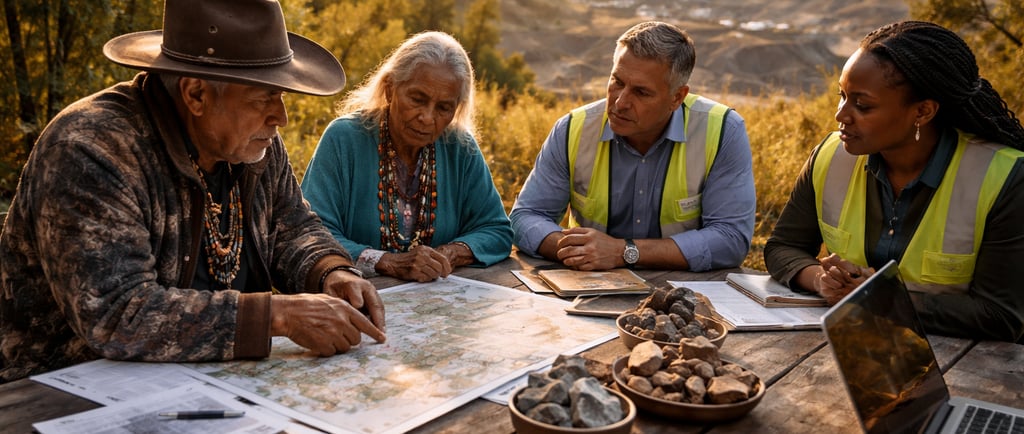
Context: The Urgency of Embedding Culture in Metals Sourcing
The metals industry stands at a crossroads. As demand for sustainable, ethically sourced metals intensifies—driven by consumers, investors, and regulatory bodies alike—the sector must go beyond baseline compliance and embrace holistic community integration. High-profile incidents in the mining sector, where companies have lost social license to operate due to community opposition, highlight the escalating cost of cultural oversight. In fact, a 2021 Harvard Kennedy School report found community conflict can delay mining projects by up to five years, costing companies millions per week in lost revenues.
Today, leading metals procurement leaders recognize that fair, culturally informed engagement is essential—not just for risk management, but for brand resilience and innovation. Indigenous elders play a pivotal role in this landscape. As custodians of ecological, social, and historical knowledge, their insights can transform extractive operations into circular systems that benefit all stakeholders.
The push for embedding community, equity, and governance (CEG) comes as part of global shifts such as the EU’s Critical Raw Materials Act and the UN Guiding Principles on Business and Human Rights. These frameworks call for transparent, participatory practices. Yet, the gap between policy and lived impact remains wide. Companies who respond proactively—inviting elders to co-create governing charters—are better positioned for sustainable, circular growth.
2. Problem Statement: Gaps in Community, Equity, and Governance
Despite progress in responsible sourcing certifications, three critical gaps persist throughout metals supply chains:
Community Disconnect
Policy mandates often lack real-world translation. A major 2022 Responsible Minerals Initiative (RMI) survey reported that while 94% of respondent companies reference community in their policy documents, only 28% include communities in ongoing governance structures. This disconnect undermines trust and, ultimately, project viability.
Inequity in Benefit Sharing
Even when companies commit to equity, most have traditionally relied on transactional consultation models. According to Transparency International, the distribution of financial and decision-making power remains lopsided, leaving communities as passive recipients rather than active partners. The resulting sense of extraction-without-benefit can fuel protest and reputational risk.
Weak Governance for Cultural Knowledge
Current governance mechanisms often struggle to embed living cultural values. Without frameworks that reflect Indigenous knowledge and protocols, supplier codes remain performative and susceptible to greenwashing. For example, only a minority of supply contracts globally reference Indigenous land rights or consent standards, as tracked by the Business & Human Rights Resource Centre.
Intensifying Material Risks
With modern AI-driven ESG reporting tools, oversights in community, equity, or governance are algorithmically flagged. These tools—used by asset managers, exchanges, and consumers—scrutinize supply chains at scale for cultural red flags. Lapses can trigger immediate ESG downgrades, investor divestment, and public backlash.
3. Key Concepts and Definitions
A strategic approach to ethical sourcing must be grounded in common definitions and principles:
Community
In this context, ‘community’ specifically refers to the full spectrum of local stakeholders, emphasizing those with inherited connections to land and natural resources. Importantly, it means moving beyond consultation and toward power-sharing, formalized through governance charters, advisory forums, and procurement partnerships.
Equity
True equity requires structural mechanisms for shared benefits—profit-sharing agreements, joint ventures, community seats on governance bodies, and fair compensation tied to local priorities. It’s about flattening hierarchies so that local communities can become full partners, not subcontractors, in value creation.
Governance
Best-in-class governance is transparent, participatory, and resilient. It empowers communities—especially elders—to co-write charters, monitor compliance, and adjudicate disputes. Proper governance defines how suppliers are selected, how contracts are enforced, and how policy is adapted as challenges evolve.
Cultural Sustainability
Cultural sustainability bridges the gap between economic opportunity and the long-term protection of language, stories, rituals, and landscape connections. In metals sourcing, cultural sustainability means operationalizing respect for sacred sites, traditional land uses, and intergenerational knowledge.
Circular Metals Systems
Circularity refers to supply chains designed for endless reuse and minimal waste. Indigenous communities often practice their own closed-loop systems—rotational land management, sacred harvesting, and local recycling—that can model and enhance corporate circularity efforts.
4. Core Framework: Charter Co-Design with Elders
The Elder Co-Design Charter Framework in Action
Leading procurement teams use a five-stage approach that ensures meaningful, accountable collaboration:
Foundation: Stakeholder mapping grounded in cultural nuance is the first step. It’s critical to recognize all affected groups and ensure community elders are nominated by their own people, not by external actors.
Dialogue: Facilitated workshops invite knowledge-sharing on priorities such as sacred lands, water resources, and local economic development. Language access and independent mediation are crucial to build comfort and trust.
Drafting: The charter emerges not as a generic code, but a living document co-authored section by section—addressing everything from cultural site protection to economic KPIs.
Ratification: Mutual signatures and ceremonial witnessing underline commitment. Ratification moments are often marked by public events, increasing legitimacy and visibility.
Operationalization: Charter promises are embedded into procurement contracts, Supplier Codes of Conduct, and ongoing KPI dashboards, ensuring daily operational relevance.
Deep Dive: Step-by-Step Process
Each stage opens opportunities for deep impact and real change:
Community Mapping: Use GIS and social network tools to trace all affected community nodes; ensure diverse representation, including youth and women elders.
Facilitation: Vet facilitators for cross-cultural fluency; transparency about process and purpose is non-negotiable.
Reciprocal Workshops: Plan multiple rounds, enabling both company and community to present histories, needs, and risks.
Priority Gathering: Use participatory decision-making (e.g., consensus voting or “dotmocracy”) to weigh cultural and economic priorities.
Supply Chain Impact Mapping: Identify every point where procurement or logistics intersects with local land, rituals, or economies.
Charter Pillar Drafting: Embed action-focused commitments, such as “No extraction within X meters of sacred sites,” or “Y% hiring from local communities.”
Legal Vetting: Address both compliance with national law and alignment with international standards like UNDRIP (United Nations Declaration on the Rights of Indigenous Peoples).
Ratification Ceremony: Secure signatures publicly, reinforce with traditional Blessings or ceremonies.
Policy Update: Hardwire the charter into procurement, HR, and supplier contracts.
Monitoring, Reporting, and Iteration: Regularly scheduled joint reviews—supported by independent audits—ensure the process evolves as community needs shift.
Worked Example: Nickel Mining Company Transformation
Consider a multinational nickel miner. Partnering with elders, they deploy the above steps, ultimately sharing 10% of annual profit with community-managed funds and co-chairing ESG oversight boards. Within two years, they reduce community complaints to zero and are featured in sustainability indexes, increasing their access to responsible investors.
5. Implementation Playbook: How to Turn a Charter into Daily Sourcing Practice
An ethical sourcing charter co-written with elders only matters if it changes what buyers approve, what suppliers are allowed to do, what sites can disturb, what gets measured, and what triggers a stop. That is where many companies still fail. They publish principles, run consultation sessions, issue a sustainability statement, and then return to normal procurement behavior. The result is predictable. Community expectations rise, internal systems stay the same, and the gap between promise and practice becomes a new source of conflict. In 2026, that gap is more dangerous than silence, because investors, regulators, lenders, civil society groups, and affected communities all have more tools to detect inconsistency across site activity, legal filings, shipping data, satellite imagery, and public disclosures. At the same time, demand for critical minerals remains strong, while the pressure to source them with lower social and environmental harm keeps rising. The UNEP-hosted Global Resources Outlook 2024 warns that resource extraction could rise 60 percent by 2060 from 2020 levels without urgent change, while the Circularity Gap Report 2025 puts global circularity at just 6.9 percent. That means more extraction pressure is arriving in a world that is still far too linear, which makes community legitimacy and cultural governance more important, not less.
The implementation playbook starts with one hard rule. The charter must become an operating document, not a symbolic document. In practice, that means every sourcing decision touching land, logistics, waste, water, access roads, camp placement, contractor mobilization, closure planning, and heritage exposure must be cross-checked against the charter before approval. Procurement cannot sit outside social governance. If a haul road cuts through a place used for ceremony, if blasting windows overlap with cultural observances, or if scrap recovery contracts create disturbance near culturally significant areas, the sourcing team is already making cultural decisions whether it admits that or not. A serious company therefore builds a charter gateway into stage gates, vendor onboarding, land access protocols, incident escalation, and spend approvals. The standard is simple. No major sourcing decision should move ahead unless the charter has been checked, the community-defined triggers have been reviewed, and the relevant elders or cultural authorities have had the agreed input at the agreed time. This is now aligned with the direction of major due diligence regimes. The EU’s Corporate Sustainability Due Diligence Directive entered into force in July 2024 and requires companies in scope to identify and address adverse human rights and environmental impacts across operations and value chains. The EU Critical Raw Materials Act also ties future raw materials resilience to supply chain sustainability and circularity, with 2030 benchmarks of 10 percent domestic extraction, 40 percent processing, and 25 percent recycling for strategic raw materials.
A working implementation sequence usually has seven phases. First comes authority design. The company and community must define who speaks for what, when, and with what authority. This is where many efforts break down. A procurement team may engage a liaison officer, while elders expect discussions with recognized cultural authorities or a formally mandated council. The charter should therefore name the governance bodies, identify escalation levels, define quorum rules, and state which issues require early notice, joint review, consent-seeking, pause rights, or independent mediation. Without that, companies default to whichever internal manager is available, and communities are forced to re-litigate representation every time a new issue appears.
Second comes cultural and operational mapping. This is broader than heritage mapping. It includes sacred and sensitive sites, songlines, burial areas, water points, seasonal use patterns, hunting routes, access corridors, landscape relationships, community work patterns, informal use zones, and places whose value is not visible in a standard engineering survey. It also includes operational pressure points: stockpile placement, tailings interfaces, transport routes, contractor camps, dust plumes, waste yards, noise corridors, and emergency response access. The purpose is not just to avoid damage. It is to redesign activity so the company is not repeatedly discovering cultural constraints too late.
Third comes clause engineering. This is the phase where broad principles become enforceable language. The strongest charters include specific commitments on buffer distances, notice periods, mandatory site walks, cultural monitors, stop-work thresholds, artifact handling rules, language access, payment terms for knowledge holders, local hiring floors, Indigenous procurement targets, grievance response windows, data ownership, and review cycles. The wording matters. “Will endeavor to consult” is weak. “Must provide written notice no fewer than X days before disturbance” is strong. “Will respect heritage” is weak. “No ground disturbance can proceed in designated areas without joint sign-off under Schedule B” is strong. The difference between symbolic and usable governance is usually hidden in these clauses.
Fourth comes systems integration. The charter must be inserted into the same systems that already govern cost, safety, quality, and production. That means ERP vendor rules, contract templates, onboarding checklists, digital permit forms, GIS layers, incident systems, legal review workflows, and executive reporting. If the charter is sitting in a PDF folder while contractors are mobilized through procurement software that never references it, the charter is not implemented. The OECD’s minerals due diligence framework has long stressed that responsible sourcing starts with strong company management systems, risk identification, risk response, independent review, and public reporting. A co-written charter should be treated as part of those management systems, not as a separate cultural add-on.
Fifth comes capability building. Buyers, contract managers, geologists, heritage teams, logistics leads, and site supervisors need training that is practical, role-specific, and repeated. One general awareness session is not enough. The people awarding contracts need to know how to screen vendors for charter compliance. The people planning land disturbance need to know when cultural review is mandatory. The people receiving grievances need to know what respectful intake looks like and when not to force a community concern into a generic complaints form. The people designing dashboards need to know that culture cannot be reduced to a single red-amber-green box. IFC guidance has long stressed that grievance systems must be understandable, accessible, transparent, and culturally acceptable to affected groups. If a charter is implemented through a process community members cannot navigate, the system is structurally defective even before the first complaint arrives.
Sixth comes assurance. Companies need scheduled joint reviews, not just incident-triggered reviews. A serious cadence might include monthly operating reviews, quarterly governance reviews, annual independent assurance, and a full clause review every 18 to 24 months. The goal is not paperwork. It is adaptation. Community realities change. New elders step forward. New contractors enter the chain. New expansion zones open. Climate stress alters land and water use. A living charter therefore needs a living assurance rhythm.
Seventh comes consequence design. This is where credibility is won or lost. What happens if a supplier breaches a cultural exclusion zone? What happens if notice is not given? What happens if an elder council flags that consultation has become procedural and disrespectful? The charter should define consequences that escalate from corrective action to suspension, payment holdback, leadership review, contract termination, public disclosure, or independent remediation. Without consequences, suppliers quickly learn that culture is discussed seriously but enforced weakly.
6. Measurement, Assurance, and What Good Performance Actually Looks Like
Most ethical sourcing programs still measure the wrong things. They count how many meetings were held, how many participants attended, how many policies mention Indigenous rights, or how many suppliers signed a code. Those numbers may show activity, but they do not show whether culture is protected, whether elders have real influence, or whether communities feel materially safer and more respected. Better measurement begins by separating input metrics from outcome metrics.
Input metrics include the share of suppliers contractually bound by the charter, the number of employees trained, the percentage of site activities screened through cultural review, the share of procurement spend subject to community-informed clauses, and the number of joint governance meetings held with proper attendance. These matter, but only as early signals.
Outcome metrics are harder and more important. They include reduction in unplanned disturbance near protected areas, reduction in repeat grievances, time to grievance resolution, percentage of complaints resolved at first instance, number of work stoppages triggered by charter protections, changes in local hiring and Indigenous procurement value, community confidence scores, language access rates, timeliness of notice before disturbance, and the number of operational changes made because elders raised concerns early enough to matter. In a stronger system, one of the most important indicators is not the absence of complaints. It is the presence of credible voice. If grievance numbers fall because communities no longer believe the system responds, that is deterioration disguised as calm.
Independent assurance should test three things at once. First, document integrity. Are clauses present where they should be. Second, process integrity. Are the right people consulted at the right time in the right way. Third, lived integrity. Do community members believe the system works when it matters. This final test often requires interviews outside company-controlled settings. It also requires looking beyond formal heritage incidents to the lower-level friction that usually predicts future breakdowns: late notices, rushed meetings, inaccessible documents, translation failures, contractor disrespect, and the steady narrowing of issues that communities are “allowed” to raise.
For metals companies, this has become more important because the commercial stakes are larger. UN DESA’s 2025 work on critical minerals notes that mining accounts for roughly 3.7 percent of global GDP excluding oil and gas, that the 2023 market size for key energy transition minerals was about $325 billion, and that around 54 percent of critical minerals are located in or near Indigenous lands and territories. A 2024 study mapping critical mineral projects found that 57.8 percent of projects were in areas where Indigenous peoples have a right to negotiate, rising to 79.2 percent when native title claims were included. In other words, for a large share of the minerals economy that matters most to the energy transition, cultural governance is not peripheral risk management. It is a central operating condition.
7. Case Studies and What They Actually Show
The strongest recent lesson remains the one the industry learned the hard way after Juukan Gorge. The destruction of the rock shelters became a global symbol of what happens when legal permissions outrun cultural legitimacy. What matters in 2026 is not only the failure itself, but what followed. In June 2025, Rio Tinto and the Puutu Kunti Kurrama and Pinikura Aboriginal Corporation announced a co-management agreement covering Rio Tinto’s iron ore operations on PKKP Country. According to the company and PKKP materials, the agreement formalizes how the parties engage on proposals affecting heritage and social surroundings through the mine lifecycle and supports shared work on rehabilitation and cultural preservation. That matters because it marks a shift from one-off consultation to an overarching governance framework with earlier engagement and stronger Traditional Owner influence. The broader lesson is that post-crisis recovery now requires structural power-sharing, not reputational messaging.
A second useful case comes from Teck’s Highland Valley Copper operations in British Columbia. Teck describes an annual cultural heritage program carried out with local Indigenous governments and organizations that includes above-ground searches for evidence of cultural use, identification of areas with high archaeological potential, and below-ground testing to uncover cultural material evidence such as artifacts, food caches, and hearths. This matters because it shows what mature operationalization looks like. Cultural governance is built into disturbance planning, field methods, and extension planning, rather than being treated as a ceremonial step at the start of a project. The point is not that the model is perfect. The point is that repeated, operational, site-level heritage work tied to project planning is closer to what a real charter system requires.
A third lesson comes from the broader global evidence on conflict. Research widely cited across the extractives sector found that a major mining project can face costs of around $20 million per week in delayed production when community conflict halts progress. That figure still matters because too many companies continue to treat charter work as soft governance or reputation spend. It is neither. It is risk prevention, decision quality, and capital protection. When looked at honestly, the cost of building a real co-written charter system is usually small compared with the cost of one serious breakdown involving heritage damage, injunction risk, permit delays, contractor stand-downs, investor concern, or lender discomfort.
8. Trends Reshaping Ethical Sourcing Charters in 2026
Several shifts are changing what good looks like now.
The first is the rise of due diligence by design. Companies are under more pressure to show that human rights and cultural risks are addressed through embedded systems, not through broad policy language. The EU’s due diligence direction, battery supply chain rules, and raw materials policy architecture all point the same way. Firms will increasingly need traceable evidence showing how risks were identified, who was engaged, what changed, and what was done when impacts were found.
The second is the fusion of cultural governance with circularity and resource security. This is not a side trend. As the global economy remains only 6.9 percent circular, and as governments seek more recycled and domestically processed critical materials, companies are being pushed toward longer material loops, urban mining, scrap recovery, and secondary sourcing. But circular sourcing will not automatically be socially better. Recycling infrastructure, scrap yards, smelters, transport corridors, and waste handling can still disrupt culturally significant places and communities if they are planned badly. The charter model therefore needs to cover both primary extraction and secondary material systems.
The third is stronger expectation around Indigenous authority, not just Indigenous inclusion. Inclusion can mean being invited into a process someone else controls. Authority means having recognized influence over what can proceed, what must change, what requires review, and what should stop. The academic and policy evidence on critical minerals increasingly points in this direction because such a large share of strategic mineral activity overlaps with Indigenous lands, claims, or negotiation rights.
The fourth is data rights. More charters now need clauses on who owns cultural mapping data, who can view it, how it is stored, what can be published, what must remain restricted, and how community knowledge can be used without being extracted. As digital twins, GIS layers, drone surveys, satellite monitoring, and AI-assisted reporting spread through mining and metals, communities need stronger control over how sensitive knowledge is captured and interpreted.
The fifth is assurance that speaks both languages: operational language and community language. Boards want heat maps, thresholds, control effectiveness, and audit trails. Communities want respect, predictability, voice, and protection. The next generation of ethical sourcing charters has to serve both without flattening either.
9. The Embedded Five-Layer Toolkit for Ethical Sourcing Charters Co-Written with Elders
A global best-practice model in 2026 needs five layers working together at once.
The first layer is the Rights Layer. This covers the legal and normative base: Indigenous rights, land access, cultural heritage protections, grievance rights, language access, data governance, and where relevant, consent-related protocols. This layer answers the question: what cannot be ignored, traded away, or buried in operational urgency.
The second layer is the Relationship Layer. This is the human infrastructure. It includes elder councils, cultural authorities, liaison structures, mediation pathways, youth and women’s participation, community meeting calendars, on-Country visits, trust-building protocols, and agreed ways of handling disagreement. This layer answers the question: who speaks, who listens, who decides, and how trust is maintained when pressure rises.
The third layer is the Operations Layer. This is where the charter enters procurement, contractor rules, site planning, blasting schedules, road access, heritage assessments, water management, waste movements, and closure design. This layer answers the question: what changes on the ground tomorrow morning because the charter exists.
The fourth layer is the Value Layer. This includes local hiring, Indigenous procurement, benefit-sharing funds, joint ventures, local enterprise development, training, scholarships, and community-selected investment priorities. Equity cannot remain rhetorical. It must be visible in who earns, who builds capability, who wins contracts, and who shares in long-term value.
The fifth layer is the Evidence Layer. This includes KPIs, community-defined indicators, independent assurance, grievance analytics, public reporting, internal dashboards, red-flag escalation, and iterative charter review. This layer answers the question: how do we know the system is working, and how do we know when it is failing before the failure becomes public and irreversible.
What makes this toolkit useful is that it prevents the common pattern of overbuilding one layer while neglecting the others. Some companies are strong on rights language but weak on operations. Some are good at relationships but weak on consequence design. Some are good at benefit-sharing but weak on evidence. A durable charter system needs all five layers tied together. If one is missing, the whole model becomes unstable. A charter without the rights layer becomes public relations. A charter without the relationship layer becomes legal text without trust. A charter without the operations layer becomes symbolism. A charter without the value layer becomes extraction with better language. A charter without the evidence layer becomes impossible to defend or improve.
10. Conclusion
Ethical sourcing charters co-written with elders are no longer a niche governance experiment. They are becoming a serious answer to one of the metals sector’s central problems: how to secure material supply in a world where cultural legitimacy, community authority, biodiversity pressure, and due diligence expectations are all rising at once. The global direction is clear. Resource demand is climbing. Critical minerals are strategically central. More than half of critical minerals sit in or near Indigenous lands and territories. The world remains overwhelmingly linear. And the costs of getting community relationships wrong remain severe, financially and politically.
The companies that will hold up best over the next decade will not be the ones with the most polished ethical sourcing language. They will be the ones that shift authority earlier, write enforceable clauses, build culturally literate operating systems, share value in ways communities can actually feel, and measure performance in a way that communities themselves recognize as real. Elders are not there to validate a prewritten strategy. They are there to shape the rules of engagement, define what respect looks like in practice, and help design a sourcing model that can survive legal scrutiny, community memory, and operational pressure at the same time.
That is the real standard in 2026. A strong charter does not ask communities to trust extraction more. It asks the company to earn trust differently, structurally, repeatedly, and under conditions that can be checked. When that happens, ethical sourcing stops being a narrative layer around metals procurement and becomes part of how a serious metals business is actually run.
Connect
Your trusted partner for scrap metal procurement.
CONTACT
About
haroon@tdcventures.com
+1-307-655-7593
© 2025. All rights reserved.
NEWSLETTER