
Firmware Locks and Circularity: Overcoming Barriers
Firmware locks are silently blocking XR device reuse and recycling. Learn the strategies top refurbishers use to unlock value, slash e-waste, and stay compliant in 2026.
IMMERSIVE TECH RECYCLING & CIRCULAR ELECTRONICS
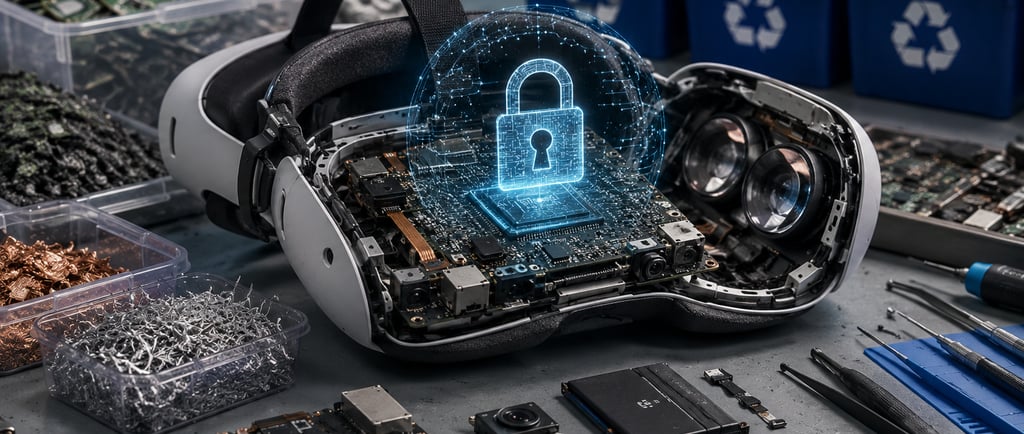
Context: Why Firmware Locks Matter to Circularity in XR Electronics
The exponential growth of XR (Extended Reality) devices is transforming entertainment, education, manufacturing, and healthcare. According to IDC, annual shipments of AR/VR headsets surpassed 14 million units globally in 2023, with forecasts pointing to double-digit growth through 2027. As these devices saturate both commercial and consumer landscapes, the environmental and business challenges of electronic waste (e-waste) multiply.
Sustainability has become non-negotiable. For today’s hardware teams, product managers, compliance professionals, and sustainability officers, circularity is no longer a theoretical goal—it's a performance benchmark. The landmark European Green Deal and US Right-to-Repair laws exemplify sweeping regulatory shifts, pressuring tech OEMs and their partners to rethink device end-of-life management. Circular electronics—products purposely designed for repair, refurbishment, and material recovery—are foundational to meeting both legal requirements and rising consumer expectations for sustainability.
However, the proliferation of firmware locks, originally intended to secure devices, prevent theft, or control warranty adherence, now threatens genuine progress towards a circular economy in electronics. In XR hardware, these digital locks can render once-valuable devices functionally obsolete regardless of their physical condition, creating an artificial ceiling on recycling and reuse.
Industry Stake: Companies that proactively align their design and supply chain strategies with circularity not only avoid legal penalties but also unlock market advantages—such as increased brand trust, cost savings through component recovery, and new revenue channels in refurbishment. Conversely, failure to address firmware barriers adds direct risk: lower recovery yields, increased compliance costs, reputational impact, and loss of global competitiveness.
The Bottom Line: Addressing firmware locks is now at the forefront of any robust XR electronics recycling and circularity strategy.
2. Defining the Problem: Barriers to Electronic Recycling and Repair
Firmware Locks affect the circularity of electronics at multiple operational layers, manifesting as a technical and legal bottleneck. These barriers have only intensified as devices become “smarter” and more interconnected.
Breakdown of Firmware Lock Types
Activation Locks: Prevent device reactivation without original user credentials, common in consumer AR/VR gear.
Secure Bootloaders: Only allow OEM-signed firmware updates, blocking legitimate third-party repairs or refreshes.
Component Pairing Technology: Ties critical hardware (such as batteries, cameras, displays) to specific device serials by way of embedded encryption, making parts swapping nearly impossible.
Remote Disablement: Enables OEMs to deactivate devices post-warranty, lease, or upon certain triggers, complicating secondary market access.
Tangible Market Impact
Refurbishment Rates Slashed: International Data Corporation (IDC) estimates that up to 20% of returned or decommissioned XR devices are prematurely shredded or warehoused due to irreversible software locks.
Repair Shop Revenue Loss: According to the Repair Association, local shops report up to 40% of potentially serviceable units being rendered inoperable by component-matching locks.
OEM Liability: European Environmental Bureau data shows 52% of electronics brands surveyed risk non-compliance with emerging repairability requirements due to restrictive firmware practices.
Regulatory Pressure
With the European Union enacting the Ecodesign Directive and multiple U.S. states passing Right-to-Repair bills, stringent legal demands are emerging. Companies failing to provide authorized firmware unlocks or documentation now face significant fines, product bans, or forced recalls.
The "Circularity Ceiling" in XR Devices
The convergence of these technical and legal walls results in a so-called “circularity ceiling.” When hardware cannot be functionally accessed, wiped, repaired, or its valuable materials harvested, the environmental and financial costs rise dramatically—undermining the entire premise of circular electronics.
3. Key Concepts: Firmware Locks, Circular Electronics, and Design for Repair
Firmware Lock
A firmware lock is a deeply embedded software mechanism at the chip or bootloader level, controlling access for diagnostics, resets, updates, and hardware changes. Unlike simple passwords, firmware locks persist through resets and often require privileged OEM codes or cloud authentication for removal.
Attributes:
Persistence: Survives user resets and factory wipes.
Scope: Can affect single components or the entire device.
Security Intent: Originated to deter theft and ensure authorized repair—but often at the expense of legitimate refurbishment or recycling.
Circular Electronics
Circular electronics represent devices purposely designed for continuity: every unit should be serviceable, upgradable, and ultimately recoverable for parts or material value. In contrast to traditional “linear” electronics (produce-sell-use-discard), circular electronics enable:
Efficient Resource Utilization: Maximizing material recovery, reducing extraction and processing of raw materials.
Extended Product Lifespan: Through easy repairs and multiple resales.
Minimized E-Waste: By closing the loop from product launch to responsible end-of-life.
Report Highlight: The Ellen MacArthur Foundation projects that circular design across electronics could reduce global e-waste flows by up to 50 million tons annually by 2030.
Design for Repair
Design for repair involves integrating physical and digital features that allow for safe, affordable servicing throughout a product's life. Key tenets include:
Accessible Internals: Tool-less entry or fastener-based openings rather than adhesives.
Standardized Connectors: Swappable components—such as batteries, lenses, sensors, or circuit boards.
Documentation and Firmware Support: Publicly available or authorized access methods for firmware unlock and part re-pairing.
XR (Extended Reality)
Extended Reality (XR) is an umbrella term (embracing AR, VR, and MR) that describes devices blending digital content with the real world. Most XR hardware has high-churn design cycles and short shelf lives—making efficient circularity practices paramount.
Industry Entities:
OEMs: XR headset makers (Meta, HTC, Magic Leap, Apple)
Refurbishing Specialists: Global and regional players
Policy Bodies: European Commission, US FTC
Repair Networks: Independent and chain-based repairers
4. Core Framework: Unlocking Circularity in XR Device Lifecycles
A robust approach for overcoming firmware-induced circularity barriers in XR hardware hinges on four integrated pillars, each supporting a sustainable electronics landscape.
The Four-Stage Circularity Enablement Framework
Stage 1: Open Firmware Protocols
Urges industry-wide adoption of transparent, secure, and (where feasible) open-source unlock procedures.
Ensures end-of-life and authorized repair unlocks can be safely executed by vetted partners.
Statistical Note: Markets that enforce open firmware standards (e.g., France) have achieved up to 25% higher refurbishment throughput, per 2023 OECD data.
Stage 2: Traceable Component Networks
Emphasizes granular serialization and digital provenance for every major part.
Employs cloud-based databases and advanced digital twins, allowing authentication of parts during replacement or downstream reuse.
Industry Example: Microsoft’s Circular Center program employs such traceable systems across its device recycling streams, boosting part recovery rates by over 30%.
Stage 3: Modular Design for Repair
Advocates for product architectures prioritizing easy disassembly, minimized use of adhesives, and standardized connectors.
Enables faster repair and higher yield in both professional and DIY settings.
Best Practice: Framework laptops and Fairphone devices stand as category leaders, showing greater than 9/10 iFixit repairability scores.
Stage 4: Circular Chain Integration
Leverages smart contracts, blockchain ledgers, and API-driven platforms to maintain chain-of-custody from collection to final recycling.
Guarantees that device history, refurbishment status, and parts authenticity are tracked and verifiable—a crucial attribute for compliance and reporting.
Step-by-Step Process
Identify Device Families: Start with high-impact XR models prone to volume return and upgrade cycles.
Audit Firmware Barriers: Conduct forensic reviews (using specialist tooling/apps) to enumerate all present lock types.
Policy Mapping: Cross-reference legal obligations by region and product category—Leverage up-to-date compliance matrices.
Negotiate Unlock Protocols: Engage OEMs via industry working groups or directly; in some cases, leverage collective advocacy through alliances (like R2R Europe).
Document Serialized Components: Implement automated scanning upon intake to record provenance and unlock eligibility.
Redesign for Modularity: Share detailed unlock and repair incident data with product planning, closing the feedback loop on what blocks circularity most.
Integrate Circular Chain Tech: Beta test blockchain or distributed ledgers for chain-of-custody proofs—minimize manual hand-offs.
Test, Certify, Pilot: Run controlled, small-batch pilots to ensure all unlock and tracking workflows perform as expected.
Deploy at Scale: Expand successful processes, offering co-marketing with OEMs or sustainability labeling for recycled/refurbished stock.
Continuously Monitor: Use real-time analytics dashboards to spot bottlenecks, regulatory shifts, or recurring unlock-related failures.
Worked Example:
Take the case of a mid-size US refurbisher processing 4,000 firmware-locked XR headsets. Previously, 3 in 4 units were classified as e-waste due to inaccessible firmware. By adopting an industry-standard unlock platform integrated with OEM APIs, this refurbisher achieved:
Unlock rate of 85% across inventory
Traceability: Each salvaged part logged on-chain, linking back to original production lot (vital for warranty and recall management)
Economic Upside: Margins on refurbished units increased by 30% through higher resale value and lower e-waste disposal costs
Regulatory Reporting: Automated compliance dashboards strengthened transparency for both local authorities and circular supply partners
This closed the loop economically and environmentally—creating measurable and repeatable business value.
5. Implementation Playbook: Turning Firmware-Locked XR Devices Into Repairable, Resalable, and Recoverable Assets
A circular XR strategy only works when it survives the real operating floor. It cannot sit inside a sustainability report. It has to guide intake staff, ITAD teams, refurbishers, repair partners, compliance teams, procurement teams, and product engineers through the same repeatable process. Firmware locks create value loss because they interrupt that process at the worst possible moment: after the hardware has already been collected, transported, sorted, inspected, and assigned a possible second-life path.
By 2026, this issue has become more urgent because the electronics waste curve is moving faster than formal recovery systems. The Global E-waste Monitor 2024 reported that the world generated 62 million tonnes of e-waste in 2022, equal to 7.8 kg per person, and only 22.3% was formally collected and recycled through documented channels. The same report projects global e-waste to reach 82 million tonnes by 2030 if current trends continue. This means electronics circularity is not being limited by good intentions. It is being limited by collection gaps, poor repair access, weak material recovery, short product cycles, and digital barriers that prevent working devices from being reused. Firmware locks sit directly inside that bottleneck. (ITU)
For XR devices, the implementation challenge is more complex than it is for many traditional electronics. A headset is not simply a screen and a battery. It may include high-resolution displays, eye-tracking cameras, depth sensors, microphones, speakers, Wi-Fi and Bluetooth radios, lithium-ion batteries, custom chipsets, external controllers, inside-out tracking arrays, facial interface materials, straps, lenses, microphones, speakers, charging docks, and software tied to accounts, cloud services, app stores, and device management platforms. Each layer can become a failure point for reuse. A headset may be physically clean, electrically sound, and materially valuable, yet still unsellable because it cannot be activated, reset, updated, paired with replacement parts, or certified for safe resale.
The first step is to treat firmware status as an intake category, not a late-stage repair issue. Every XR device entering a refurbishment or recycling operation should be classified by its lock condition before labor is spent on cosmetic work or component harvesting. A practical intake flow should separate units into at least five groups: fully accessible devices, account-locked devices, mobile device management locked devices, secure boot or firmware update blocked devices, and component-pairing restricted devices. This classification allows the operator to decide whether the unit belongs in resale, parts recovery, warranty claim, OEM return, data destruction, or final material recovery.
The second step is to record firmware barriers at the model level. A single locked unit is an operational problem. A repeated pattern across hundreds or thousands of units is a product design signal. Refurbishers should maintain model-specific lock profiles that capture the type of lock, the failure screen or error code, required tool, unlock method, average time to unlock, success rate, parts affected, resale impact, and final disposition. Over time, this creates a practical evidence base that can be shared with OEMs, industry bodies, procurement teams, and policy stakeholders.
The third step is to define authorized unlock pathways before large volumes arrive. Many circularity programs fail because they collect devices before they know whether those devices can legally and technically be reactivated. Enterprises retiring XR fleets should require clear unlock terms in procurement agreements, especially when devices are used in training, healthcare, manufacturing, field service, education, retail, or defense-adjacent environments. A buyer should not wait until end-of-life to learn that a device cannot be reset without an original admin account, cloud tenant, or OEM-only service process.
This matters because enterprise XR deployments often involve managed accounts, fleet controls, security policies, and device management tools. A headset used in a factory training room may be tied to an employer’s identity system. A headset used in a hospital may contain sensitive usage data. A headset used in a school may be tied to a classroom management account. If the decommissioning process does not include admin release, data wipe verification, firmware reset, and asset transfer authorization, the device may become stranded even if the owner intended to send it for reuse.
The fourth step is to separate data security from reuse blocking. Strong security is essential. XR devices can hold sensitive data such as spatial maps, user profiles, voice inputs, biometric-related signals, eye-tracking data, location history, app usage, training records, saved media, and enterprise credentials. Circularity does not require weaker security. It requires secure release procedures. A well-designed XR circularity model should allow verified data erasure, proof of ownership, account removal, firmware reset, and component reauthorization without handing open access to bad actors.
This is where chain-of-custody becomes critical. A proper process should document device serial number, asset tag, owner, wipe method, wipe result, lock status, unlock authorization, technician ID, parts removed, parts replaced, firmware version, resale grade, and final destination. For higher-risk devices, operators should add photo evidence, timestamped inspection records, tamper checks, and certificate generation. The goal is to create a defensible record that proves the device was handled securely while still preserving its second-life value.
The fifth step is to build a controlled unlock station inside the refurbishment line. This station should be treated like a secure workbench, not an informal troubleshooting corner. It should include approved firmware tools, isolated networks where needed, documented reset procedures, device management release checks, battery health testing, update validation, and quality assurance logs. Technicians should not be expected to improvise. They should follow model-specific work instructions with clear pass, fail, and escalation rules.
The sixth step is to use firmware findings to redesign procurement. Buyers hold more power than they often realize. Large enterprises, schools, hospitals, training providers, and public agencies should add circularity clauses to XR purchase agreements. These clauses should require end-of-life admin release, spare parts access, repair documentation, reset tools, minimum software support windows, battery replacement pathways, and clear procedures for transferring lawful ownership to refurbishers or recyclers. These terms convert circularity from a voluntary promise into a commercial requirement.
The seventh step is to link refurbishment outcomes back to product design. If 35% of a headset model fails reuse because of account locks, that is not only an ITAD issue. It is a design issue, a customer experience issue, and a future compliance issue. If display modules cannot be replaced because they require OEM-only pairing, the product is not truly repair-ready. If batteries are glued in place and firmware reports errors after replacement, the product has a circularity ceiling built into it. These lessons should feed into engineering requirements for future XR generations.
The policy direction is already moving toward this type of thinking. In the European Union, repair rules are no longer limited to vague sustainability language. The Directive on common rules promoting the repair of goods was adopted on June 13, 2024, entered into force on July 30, 2024, and Member States must transpose it into national law by July 31, 2026. For electronics companies operating in or selling into Europe, 2026 is therefore not a distant planning horizon. It is a live compliance year. (European Commission)
Smartphones and tablets also show where electronics policy is heading. From June 20, 2025, EU ecodesign and energy labelling requirements began applying to smartphones, feature phones, cordless phones, and slate tablets placed on the EU market. The rules include durability, battery, repairability, and spare-parts expectations. XR headsets are not identical to smartphones, but they share enough design traits, including compact batteries, sensors, displays, cameras, software support, and account-based activation, that the direction is clear. Regulators are moving toward measurable repairability, longer product life, and more transparent post-sale support. (Energy Efficient Products)
A mature implementation playbook should therefore cover both the current device stream and future product planning. For devices already in circulation, operators need unlock classification, secure wipe, account release, testing, parts harvesting, resale grading, and material recovery. For future devices, OEMs and buyers need repairable architecture, documented unlock protocols, replaceable wear parts, software support commitments, and a lawful transfer process. The companies that connect both sides will recover more value, reduce waste, and face fewer surprises as right-to-repair rules expand.
6. Metrics and Measurement: How to Prove Firmware Circularity Is Working
Circularity cannot be managed with broad claims. It needs measurable signals. Firmware locks are especially dangerous because their damage can remain hidden inside general e-waste figures. A recycler may report tonnes processed. A refurbisher may report units received. An OEM may report take-back participation. None of these numbers, by themselves, show how many devices were unnecessarily destroyed because software blocked reuse.
The first metric is the firmware unlock rate. This measures the percentage of locked devices that can be lawfully reset, reactivated, updated, or reauthorized for reuse. A high unlock rate means the circular channel is functional. A low unlock rate means value is being trapped. The unlock rate should be tracked by model, batch, source, lock type, and firmware version. A general unlock rate is helpful, but model-level tracking is where the real value appears. One headset family may unlock cleanly after admin release. Another may fail because replacement cameras or batteries cannot be accepted by the device. These patterns tell operators where to focus negotiations, engineering feedback, and purchasing decisions.
The second metric is reuse yield. This measures the percentage of collected devices that return to use as complete units. Reuse yield should sit above recycling yield in the value hierarchy because a working headset usually preserves more embedded value than shredded material. XR devices contain displays, optics, processors, sensors, circuit boards, speakers, plastics, straps, batteries, and packaging value. Recycling recovers only part of that value. Reuse extends the life of the whole product and delays the need to manufacture a replacement.
The third metric is parts recovery yield. Not every XR unit can return as a complete headset. Some will have cracked lenses, worn straps, damaged housings, swollen batteries, failed cameras, missing controllers, or dead displays. That does not make them worthless. A good circular process should recover usable components and route them into repair stock. Parts recovery yield should track batteries, straps, facial interfaces, controllers, lenses, cameras, speakers, sensors, displays, boards, and charging accessories. It should also track how many parts are blocked by pairing restrictions. A camera module that physically works but fails because the firmware rejects it should be counted as lost circular value.
The fourth metric is firmware-related scrap rate. This is one of the most important numbers for circular electronics. It measures the share of devices or components that were physically serviceable but still moved to scrap because of digital restrictions. This number makes the hidden cost of firmware locks visible. It gives sustainability teams, compliance teams, and procurement teams a number they can act on. It also helps OEMs distinguish between genuine hardware failures and preventable digital barriers.
The fifth metric is time-to-clear lock. Labor time can make or break refurbishment economics. If a technician spends 45 minutes trying to release a low-value unit, the economics may fail even if the unlock is technically possible. A practical process should measure average time to identify lock type, average time to complete unlock, average escalation time, and percentage of units requiring senior technician review. The target is not only a higher success rate. It is a predictable process that fits commercial repair economics.
The sixth metric is resale value recovery. A firmware-unlocked, tested, cleaned, and certified XR headset may sell for a meaningful share of its original price depending on model, condition, age, accessories, and market demand. A locked headset may fall to parts value or scrap value. Tracking the value gap between unlocked resale, parts resale, and commodity recycling helps show the business case for proper firmware release. It also gives procurement teams a financial argument for choosing repairable devices in future buying cycles.
The seventh metric is avoided e-waste mass. This measures the total weight of devices or parts diverted from shredding or disposal through reuse and parts recovery. It should be calculated carefully. A headset reused as a full device should be counted differently from a headset stripped for one usable controller and then recycled. The strongest reporting separates full-unit reuse, parts reuse, battery recycling, board recovery, plastics recovery, and final residual waste.
The eighth metric is avoided emissions. Manufacturing electronics carries embodied carbon. When a working XR device is reused, part of the environmental benefit comes from delaying new production. The exact carbon benefit varies by device type, manufacturing process, energy mix, logistics route, and replacement behavior. However, the principle is clear: extending the life of electronics usually creates environmental value because manufacturing, materials extraction, and upstream processing are energy-intensive. For enterprise reporting, avoided emissions should be calculated with conservative assumptions and clearly stated boundaries.
The ninth metric is compliance readiness. By 2026, repairability is becoming a regulatory, procurement, and reputational issue. Companies should track whether each XR device family has spare parts access, software support documentation, reset procedures, battery replacement guidance, repair manuals, and lawful ownership transfer steps. This is especially relevant for businesses selling into Europe because EU repair policy and ecodesign requirements are becoming more specific and measurable. (European Commission)
The tenth metric is customer trust. This is harder to quantify, but it matters. Buyers of refurbished XR devices need confidence that the product is safe, clean, reset, data-free, functionally tested, and not at risk of future disablement. A strong circular XR program should report warranty return rates, defect rates after resale, customer complaints tied to activation issues, and repeat buyer rates. If refurbished devices fail because of firmware or pairing problems after sale, the market loses confidence quickly.
Measurement should also reflect market timing. XR has not grown in a smooth line. The sector has seen hype, pullbacks, product delays, and category shifts. IDC reported in March 2026 that the XR market expanded 44.4% in 2025 as smart glasses gained momentum, while Meta remained a leading player despite Quest shipment pressure. Other market reporting has shown uneven demand for premium headsets and stronger interest in lighter smart glasses and AI-assisted wearables. This matters because circularity programs need to prepare for uneven return waves. When a product is discontinued, replaced, delayed, or sold into a niche enterprise segment, the return profile changes. (IDC)
The VR market also shows why circular metrics should be tied to product cycles. Counterpoint reported that global VR headset shipments declined 12% year over year in 2024, the third straight year of decline, while AR plus AI smart glasses were expected to gain attention in 2025. This kind of shift can leave refurbishers with mixed inventory: older VR headsets, newer mixed-reality devices, enterprise units, smart glasses, controllers, and accessories. Without clear metrics, operators may undercount the value trapped in non-current models. (Counterpoint Research)
A strong XR circularity dashboard should therefore answer practical questions. How many devices came in? How many were locked? Which lock types appeared most often? Which models had the highest unlock success rate? Which models had the highest firmware-related scrap rate? How long did unlocks take? Which parts were reusable? Which parts were blocked by pairing? How much resale value was recovered? How much material moved into recycling? How much residual waste remained? Which OEMs or product families performed best?
The final metric is design feedback closure. It is not enough to measure failure. The organization must prove that failure data changed future decisions. This means tracking whether firmware-lock findings influenced procurement rules, vendor negotiations, service manuals, repair tools, product design, spare-parts planning, or policy engagement. A circularity system that only records problems becomes an archive. A system that changes future buying and design behavior becomes a real business advantage.
7. Case Patterns: What Real-World Electronics Repair Battles Teach XR Companies
Firmware locks in XR are part of a wider electronics repair pattern. The details vary by product category, but the conflict is familiar: manufacturers want security, quality control, brand protection, warranty discipline, and revenue control; repairers and recyclers need access, documentation, parts, diagnostics, and lawful reset tools. Circularity depends on finding a balance that protects users without destroying the second-life market.
The smartphone sector offers the clearest warning. Component pairing has become one of the most contested repair issues because it can make a physically compatible part behave like an unauthorized part. A replaced screen, battery, camera, or sensor may trigger warnings, disable functions, or require manufacturer-controlled calibration. Supporters argue that pairing protects device integrity and security. Critics argue that it blocks independent repair and pushes consumers toward replacement. XR devices are likely to repeat this conflict because they contain more sensors, cameras, and calibration-sensitive parts than many phones.
The U.S. Federal Trade Commission identified repair restrictions as a competition and consumer protection concern in its 2021 “Nixing the Fix” report to Congress. The report examined manufacturer practices that can restrict repair, including product designs that make repair difficult, limited access to parts and manuals, software locks, and restrictions on diagnostic tools. Although the report is not XR-specific, its logic applies directly to XR hardware because headsets combine compact physical design with software-controlled access. (Federal Trade Commission)
The laptop sector provides a more positive pattern. Framework built its brand around modular laptops, replaceable parts, repair documentation, and upgradeable components. Fairphone did the same in smartphones, focusing on repair access, spare parts, and longer product life. These companies prove that repair-friendly design can be part of product identity, not a hidden compliance burden. XR companies can apply the same principle by designing head straps, facial interfaces, batteries, controllers, lenses, and selected sensor assemblies for replacement without destroying the device or requiring opaque firmware intervention.
Enterprise ITAD provides another useful pattern. In corporate laptops and phones, mature asset disposition programs already track serial numbers, ownership, data wiping, resale grade, repair cost, parts value, and recycling disposition. XR fleets should be added to the same discipline. A headset used for employee training or remote collaboration should not be treated like a novelty gadget at end-of-life. It should be treated as a managed endpoint with residual value, data risk, firmware status, and recoverable materials.
The gaming console sector shows how closed systems can complicate circularity. Consoles are often built around secure boot, account services, proprietary accessories, digital stores, and controlled repair channels. These controls can reduce piracy and fraud, but they can also make repair and parts reuse more difficult. XR devices share many of these traits. They are entertainment platforms, computing devices, biometric interfaces, and cloud-connected endpoints at the same time. If circularity is not designed in from the beginning, the product can become locked into a manufacturer-only service path that breaks down once warranties expire or product lines change.
A practical case pattern appears when enterprises retire large XR fleets. Consider a training provider that purchased 2,000 headsets for safety simulations across multiple locations. After three years, the headsets are replaced with newer mixed-reality units. Physically, many of the old devices still work. Some need new straps, batteries, facial interfaces, controllers, or storage resets. However, the devices were enrolled in a managed account system, some local admins have left the company, several units have outdated firmware, and a portion cannot be reactivated without original account credentials. If the company planned ahead, the devices can be released, wiped, tested, and resold into education or light enterprise use. If it did not, hundreds of working devices may be downgraded to parts or scrap.
Another case pattern appears in healthcare and research. XR devices used in clinical training, therapy, rehabilitation, surgical planning, or medical education may carry sensitive user data and stricter internal controls. In these settings, security teams may prefer destruction over reuse because destruction feels safer. The better path is not to weaken security. It is to prove secure erasure and lawful release through documented workflows. If a device can be wiped, verified, unlocked, and certified, the organization can protect patient or user data while still preserving circular value.
Education is another important pattern. Schools and universities often buy devices in batches, use them heavily for a few years, and then face budget pressure when products age. Firmware locks can hurt this segment because schools may lack dedicated IT staff to manage end-of-life release. A school may own the hardware but lose access to the admin structure needed to reset it. OEMs that want long-term education adoption should provide simple ownership transfer, bulk reset, and refurbishment pathways. Otherwise, education buyers may face hidden disposal costs and lower residual value.
The premium XR market adds a different risk. High-end headsets with advanced displays, sensors, custom chips, and dense assemblies may contain more recoverable value per unit, but they can also be harder to repair. Apple Vision Pro is a useful market signal because it showed that consumers and developers will pay attention to high-fidelity spatial computing, but market reports also point to demand constraints around price, weight, app supply, battery life, and production scale. When expensive devices have uncertain demand, circularity becomes even more important. A premium headset that cannot be repaired or resold creates a larger value loss than a low-cost accessory. (The Verge)
Smart glasses create another emerging pattern. Lighter devices may sell into broader consumer markets, but they also raise repair and privacy questions. Smart glasses can include cameras, microphones, batteries, speakers, touch controls, wireless chips, and AI features in a compact body. Their small form factor may make repair harder than headset repair. If the category grows as expected, the industry needs to avoid repeating the pattern of sealed, glued, account-bound devices that become hard to repair after only a few years.
The most useful lesson across all these cases is that firmware circularity must be designed before the return wave arrives. Once thousands of devices are already locked in warehouses, the economics become harder. Labor costs rise. Storage costs rise. Market value falls as models age. Batteries degrade. Accessories go missing. Firmware support windows close. The best time to solve firmware circularity is during procurement and product design. The second-best time is before fleet retirement begins.
The companies that handle this well will follow a consistent pattern. They will map firmware barriers by model. They will require clear reset and release rights in purchase contracts. They will maintain secure wipe and unlock procedures. They will preserve parts value through documentation and serialization. They will train repair partners. They will report unlock rates and firmware-related scrap rates. They will send lock failure data back into design teams. They will treat repairability as a measurable product feature.
The companies that fail will follow another pattern. They will collect devices without release rights. They will discover lock issues late. They will spend technician hours on avoidable troubleshooting. They will warehouse units while waiting for unclear OEM responses. They will shred working hardware because it cannot be reactivated. They will report recycling activity while missing the higher-value reuse opportunity. Over time, this will become harder to defend as right-to-repair rules, procurement standards, and customer expectations become more specific.
Conclusion: Firmware Access Is Now a Core Circularity Requirement
Firmware locks began as security tools, but in circular electronics they have become a defining test of whether a device can truly live beyond its first owner. For XR hardware, this test is especially important because the devices are complex, sensor-rich, data-sensitive, and expensive to manufacture. A headset can no longer be judged only by display quality, processor speed, comfort, or app support. It must also be judged by whether it can be wiped, unlocked, repaired, updated, transferred, harvested for parts, and responsibly recycled.
The global e-waste numbers make the stakes clear. The world is already generating tens of millions of tonnes of e-waste each year, and documented recycling is not keeping pace. Every working device that is destroyed because of a preventable digital barrier adds pressure to a system that is already under strain. Every repairable device that returns to use reduces waste, preserves material value, and gives buyers a lower-cost path into XR adoption.
The regulatory direction is also clear. Europe’s right-to-repair rules, smartphone and tablet ecodesign requirements, and wider repairability expectations are creating a new baseline for electronics. The United States has also increased scrutiny of repair restrictions through competition and consumer protection channels. XR may not yet be regulated in every detail, but the direction of travel is obvious. Products that block lawful repair and reuse will face increasing pressure from regulators, enterprise buyers, repair advocates, and sustainability teams.
The business case is just as strong as the compliance case. Firmware-ready circularity can increase resale yield, reduce disposal costs, improve parts recovery, lower warranty waste, support brand trust, and create a more reliable secondary market. For OEMs, it can turn end-of-life from a liability into a managed value stream. For refurbishers, it can raise margins and reduce uncertainty. For enterprises, it can lower total cost of ownership. For recyclers, it can create cleaner sorting and better material recovery. For users, it can make XR more affordable and less wasteful.
The practical path is not to remove security. It is to design secure release. The industry needs verified ownership transfer, certified data wiping, documented unlock procedures, replaceable components, serviceable batteries, repair manuals, parts access, software support windows, and transparent reporting. These measures protect users while allowing lawful reuse and recovery.
Firmware access is no longer a technical footnote. It is a circularity requirement. In 2026 and beyond, the XR companies that understand this will build devices that hold value after first use. The companies that ignore it will create locked hardware, stranded inventory, avoidable waste, and rising compliance risk. The future of XR circularity will belong to products that are secure by design, repairable in practice, and recoverable at end-of-life.
Connect
Your trusted partner for scrap metal procurement.
CONTACT
About
haroon@tdcventures.com
+1-307-655-7593
© 2025. All rights reserved.
NEWSLETTER