
Flood-Resilient Bridges: Corrosion-Resistant Recycled Steel Choices
Discover how corrosion-resistant recycled steel grades (A709 50CR, A588) and EAF production enable flood-resilient bridges with lower embodied carbon, faster post-disaster recovery, and reduced lifecycle costs.
CLIMATE-RESILIENT INFRASTRUCTURE & CIRCULAR MATERIALS
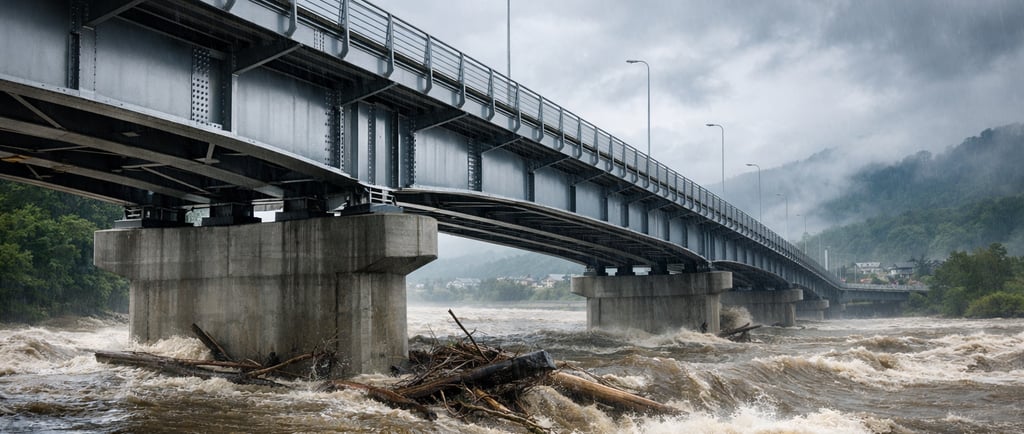
Flood-resilient bridges are transforming infrastructure by adopting corrosion-resistant, recycled steel alloys. These materials ensure bridges endure extreme weather and high-magnitude flood events, enable faster post-flood recovery, and drastically reduce embodied carbon emissions. Selecting the right recycled steel grades and protective coatings is now mission-critical for civil engineers and DOTs determined to build safer, longer-lasting, climate-adaptive bridges for the 21st century.
Table of Contents
1. Context and Why It Matters for Civil Infrastructure
2. Defining Corrosion, Resilience, and the Low-Carbon Mandate
3. Core Framework: Selecting Corrosion-Resistant Recycled Steels for Flood Resilience
4. Implementation Playbook: From Procurement to Inspection
5. Measurement and Quality Assurance
6. Case Patterns and Deployment Scenarios
7. FAQs: Bridge Resilience, Recycled Steel, and Specification
8. Embedded Five-Layer Distribution & Reuse Toolkit
9. Competitive Differentiation (Market Gap Analysis)
10. Conclusion
1. Context and Why It Matters for Civil Infrastructure
Flooding & Bridge Vulnerability: The Modern Challenge
Extreme weather events are becoming commonplace. Since 2010, FEMA has reported a 38% increase in the frequency of major U.S. flood events, resulting in more bridge outages and failures than ever before. Much of America’s bridge infrastructure predates modern material science: in 2023, the Federal Highway Administration (FHWA) found that nearly 42% of U.S. bridges were built before 1980. These structures weren’t designed for the repeated, high-velocity flooding and chronic wet-dry cycling that defines today’s climate-driven risks.
The Compound Risk Equation
Flood-induced hydraulic forces already challenge bridge foundations and superstructures with scour, debris, and intense load reversals. But it’s the hidden enemy of corrosion—accelerated by wet-dry cycling, increased salinity (from de-icing or sea level rise), and pollutants—that silently undermines steel bridges, attacking welds, deck plates, and joints.
The Modern Mandate: Resilience + Sustainability
Today’s project owners and public agencies face intensified pressure in two strategic areas:
1. Resilience Mandate: Bridges must withstand frequent flooding without suffering critical failures or long downtime. Average closure times after flood events cost cities up to $1 million per day in traffic, economic, and emergency response disruptions (source: TRB, 2022).
2. Carbon Mandate: With infrastructure representing 11% of all U.S. greenhouse gas emissions (EPA, 2022), there’s a clear imperative to use low-carbon materials—driven by state/federal procurement rules and public reporting standards.
Why Recycled, Corrosion-Resistant Steel Is the New Gold Standard
Corrosion-resistant recycled steel addresses both mandates—delivering longevity, lowering carbon footprint, and enabling faster, less expensive post-flood recovery. Advanced grades like ASTM A709 50CR and A588 offer multi-decade durability with much less maintenance, while modern EAF processes enable recycled content upwards of 85%, drastically lowering environmental impact. From highway overpasses battered by spring melts to floodplain rural spans tested by catastrophic storms, this new steel paradigm is revolutionizing not just how bridges are built, but how their long-term value is measured.
2. Defining Corrosion, Resilience, and the Low-Carbon Mandate
What Is Corrosion in Bridges?
Corrosion is the electrochemical deterioration of steel. In simple terms, when steel bridge components are exposed to water, oxygen, and (especially) salts, they react and form rust. Over time, this leads to:
- Section loss (thinning of steel sections)
- Decreased load-carrying capacity
- Structural instability and, ultimately, failure
Statistics: According to NACE International, corrosion costs U.S. infrastructure over $22 billion per year, with a significant share tied to bridges and highways.
What Do We Mean by ‘Resilience’?
Bridge resilience measures the ability to maintain or rapidly restore function after a flood. For local governments and DOTs, this boils down to:
- Shorter outage times: Fast post-flood inspection and recovery
- Fewer emergency repairs: Lower operational costs and less risk for repair crews
- Safer travel: Minimizing safety incidents after extreme weather
In the context of bridges, resilience starts with using materials that can ‘take a hit’—resisting both the brute force of floodwaters and the chemical assault of high-moisture, high-chloride environments.
Defining the Low-Carbon Mandate
With global attention on climate change, infrastructure projects are now required to:
- Report embodied carbon: The sum of CO₂ emitted to manufacture, transport, and construct all materials.
- Lower operational emissions: Through less frequent repairs/rehab and longer bridge service life.
Fact: EAF-produced recycled steel cuts embodied carbon by 50–70%, compared with blast-furnace steel (source: World Steel Association, 2022).
Key Material Definitions
Circular Materials: Products and inputs designed for reuse, recycling, and the lowest-possible lifetime carbon impact.
Corrosion-Resistant Recycled Steels: Modern grades such as ASTM A588, A709 50W, and A709 50CR. Made primarily via electric arc furnace (EAF) steelmaking using recycled scrap.
Protective Coatings: Zinc-rich galvanizing, metalizing, advanced fluoropolymers, and duplex/triplex systems that seal steel from corrosive agents—especially useful for bridges hit by recurring floods.
Bringing the Concepts Together: Flood-resilient, corrosion-resistant, recycled steel is not just good for the environment—it’s crucial for building “future-proof” bridges that save time, money, and carbon for years to come.
3. Core Framework: Selecting Corrosion-Resistant Recycled Steels for Flood Resilience
The 4S Model for Resilient Bridge Steel Selection
To make the right choices, leading infrastructure teams use a repeatable, data-driven framework:
1. Source
Require recycled steel content (≥75% EAF preferred).
Demand full chain-of-custody documentation, including mill certificates and Environmental Product Declarations (EPDs).
2. Select
Cross-reference local flood and corrosion risk maps (AASHTO, FHWA, regional climate models).
Match exposure class to the correct steel grade and protective coating (e.g., A588 for rural inland, A709 50CR for high chloride).
3. Specify
Go beyond prescriptive recipes—integrate performance-based requirements (number of years of minimum corrosion resistance at defined exposure).
Embed requirements for both alloy and coating in the bid package using AISC, ASTM, and FHWA templates.
4. Sustain
Develop a proactive, data-informed inspection and maintenance plan.
Use bridge asset management systems (NBI logic) to link inspection records with lifecycle replacement triggers.
Expanded: Step-by-Step Selection Process
1. Flood/Corrosion Risk Assessment
Collect high-resolution flood risk data: recurrence intervals, flow velocity, likelihood of overtopping.
Analyze site water chemistry, including chlorides from road salt or natural sources, organic contaminants, dissolved oxygen.
Consult AASHTO’s atmospheric corrosion maps and FHWA’s Extreme Weather Events risk data.
2. Recycled Content Verification
Mandate a minimum recycled content (75–80%, EAF route).
Require EPDs—third-party verified for low-carbon impact, increasingly standard for public procurement under Buy Clean and state decarbonization policies.
3. Steel and Coating System Selection
Use risk-based logic:
Low-salt, rural: ASTM A588 weathering steel (forms protective oxide layer in most environments, minimizing need for coatings).
High chloride, urban/coastal or heavy salt: A709 50CR (a low-nickel, high-CR stainless grade) or 316L stainless, preferably with a duplex coating (zinc primer + polyurethane/epoxy top).
Chronic immersion, urban/industrial: EAF carbon steel ≥80% recycled, with state-of-the-art metalizing or fluoropolymer systems.
4. Clear Specifications for Performance
Write durability clauses based on projected years of corrosion resistance under site-specific exposure.
Reference ASTM, AASHTO, and FHWA model language where possible.
Require mock-up panels or test coupons for verification before fabrication.
5. Life-Cycle Inspection Planning
Load all bridge data—steel grade, coating type, flood/corrosion risk, inspection photos—into a digital NBIS-compliant registry.
Set predictive, linked triggers (e.g., after major flood events, use baseline plus event-based inspection cycles).
Quick Reference: Alloy and Coating Selection Table
Exposure ClassSteel GradeCoating/SystemExample Use CaseRural, low saltASTM A588/A709 50WNone (self-passivating)Floodplain rural bridgeHighway, road saltASTM A709 50CR (stainless)Duplex (zinc + topcoat)Urban freeway overpassCoastal/tidal zones316L stainless (recycled)Micro-epoxy powder, triplexCoastal bridges, frequent wettingIndustrial urbanEAF carbon steel (≥80% scrap)Metalizing or fluoropolymerRail bridges, high industrial exposure
Expert Analysis: Why Specifications Must Match Exposure
Under-specification can lead to rapid corrosion, costly repairs, and compromised safety.
Over-specification (e.g., always using full stainless, regardless of salt risk) can inflate costs unnecessarily.
Precision matters—properly matched material and coating choices deliver both value and resilience.
Future Trend: ‘Performance-Based Procurement’
With digital twin and IoT asset management, DOTs are moving towards performance-based contracts—requiring not just compliance at handover, but ongoing measured outcomes (corrosion rates, inspection photos, rapid post-flood reopening times). This shift favors low-carbon, corrosion-resistant recycled alloys with independently certified EPDs.
4. Implementation Playbook: From Procurement to Inspection
Best-Practice Checklist for Bridge Teams
Flood/Corrosion Zoning: Use AASHTO/FHWA maps to determine precise risk profile.
Mandatory Recycled Content: Embed ≥75% EAF steel in specs.
Evidence Gathering: Require mill certs and EPDs for every steel shipment.
Alloy Vetting: Pre-screen for site-specific corrosion, load-bearing, and constructibility.
Smart Coating Selection: Reference risk—duplex/triplex for salt or immersion risk, avoid “one size fits all.”
Lifecycle Modeling: Run durability and LCC (life-cycle cost) analyses with FHWA’s Bridge Preservation Guide.
Digital Registry Integration: Sync all data into asset management software (preferably NBI-compliant for federal reporting).
Physical Mock-Ups & Test Coupons: Approve sample panels before fabrication to spot coating/steel mismatches early.
Batch QA: Test delivered steel for chemistry (XRF), mechanicals, and cross-verify with EPDs.
Coating Thickness Verification: Use UT and magnetic gauges (factory and field).
Post-Fabrication Weld QA: Inspect welds/joints for missed spots or coating holidays.
On-Site Assembly: Check field bolted/jointed areas for coating continuity.
Baseline Inspection: Commission a digital baseline, with drone or ground imagery, upon bridge opening.
Rapid-Response Plan: Pre-script flood response—access, jacking points, spare parts—so outages are short.
Asset Linking: Tag bridge sections with segment IDs linked to maintenance registry.
Inspector Training: Educate teams on rapid identification of flood-driven corrosion patterns.
Proactive Inspection Cycle: Use annual + post-event inspection schedules tied to flood risk.
Feedback Loop: Post-mortem after major events, cycling lessons into future specs.
Analysis: Common Failure Modes
Flood chemistry shifts misunderstood—rising chloride or acidity can outpace legacy assumptions.
Incomplete recycled traceability—missing or falsified EPDs lead to non-compliance risk.
Coating system shortcuts—especially at welds/joints, leading to early pitting.
Neglected inspection triggers—mild floods skipped, allowing hidden damage to accumulate.
Decision Tree [Expanded]:
High chloride, recurrent floods? Only use A709 50CR, duplex system.
Low-chloride, rural, moderate flooding? Go with A588; invest in wash-down/inspection access.
No EPD? Disqualify—prioritize suppliers meeting full transparency.
Anticipate overtopping? Shift to sacrificial/repair-friendly coatings and more aggressive inspection.
5. Measurement and Quality Assurance
If you want flood-resilient steel bridges to perform the way your spec promises, you need measurement that survives procurement, fabrication, erection, and the first few flood seasons. The goal is simple. Reduce uncertainty. Catch failures early, before they become section loss, pack rust, frozen bearings, or emergency closures.
Start by measuring what matters to performance.
You can group it into five buckets.
Material identity and traceability.
You want to prove that the steel delivered matches the heat, chemistry, and mechanical properties you specified, and that the recycled route and documentation align with your procurement rules.
For bridge steels, mill test reports are the non-negotiable baseline, and modern procurement is increasingly stacking environmental documentation on top. AISC has pushed the industry toward Environmental Product Declarations as the standard way to document environmental impacts of structural steel products.
At a practical level, your QA plan should treat traceability like a chain, not a file. Heat number to plate. Plate to member mark. Member mark to location on plans. Location to inspection record. If any link is broken, you have a maintenance risk later because you cannot tie observed corrosion behavior to a known alloy and coating system.
Recycled content and carbon reporting.
If your project uses Buy Clean rules, owner carbon dashboards, or public reporting, you need consistent carbon accounting. The point is not perfection, it is comparability across bids and submittals.
Industry references help you set realistic expectations. Worldsteel notes that the electric arc furnace route uses primarily recycled steel and that some steel products can contain up to 100 percent recycled content, depending on product and feedstock.
For practical benchmarks, some large EAF producers report high scrap usage, around the mid-80 percent range, with disclosed emissions intensity around 0.94 tons CO2 per ton of steel in one cited example.
You can also cite the structural reality of EAF: it is widely used for recycled feedstocks and represents a significant share of global steel production, and technical briefs describe it as predominantly scrap-based.
Mechanical and fracture-critical verification.
Flood resilience is not only corrosion. Flood debris impact, load reversals, and post-event fatigue demand confidence in toughness, weldability, and fracture performance.
Your acceptance tests should reflect the structure’s risk class.
Charpy V-notch toughness where required by governing bridge codes and temperature regime.
Weld procedure qualification and welder qualification, aligned to the steel grade and thickness range.
Fracture-critical member controls, if applicable, with tighter NDE requirements and traceability.
Corrosion performance and detailing verification.
Corrosion is not only chemistry. It is also geometry. The same steel performs very differently depending on whether it can dry, whether salts wash off, and whether trapped moisture sits on a horizontal surface.
One of the most repeatable corrosion lessons for weathering steel is not theoretical, it is detailing and drainage. TRB guidance documents long ago flagged that salt-laden runoff through leaking deck joints and splash zones is a common driver of corrosion problems in weathering steel bridges.
FHWA guidance also warns against uncoated weathering steel where deicing salt exposure is significant, and marine coastal areas can be problematic due to salt-laden air.
So your QA plan has to treat deck joints, scuppers, bearings, diaphragms, and stiffeners as high-risk zones. You do not wait for rust streaks. You inspect the details that create them.
Coating system quality, because most failures start as small defects.
For coated carbon steel bridges, your biggest early-life risks are coating holidays, under-cured coatings, poor surface prep, and field damage at bolted splices and weld zones.
A field-ready QA checklist includes:
Surface preparation verification, with documented cleanliness and profile.
Wet film and dry film thickness checks at a defined sampling frequency.
Holiday detection where specified, especially in immersion-prone zones.
Adhesion testing on representative areas when risk is high.
Field repair protocol that matches the original system, not a random touch-up paint.
Your flood exposure changes the sampling logic.
If the bridge sees frequent wetting, overtopping risk, or high chlorides, increase inspection density at low points, backwalls, bearings, and crevices. Floodwater carries fine abrasives and pollutants. That combination can turn a small coating defect into a pit cluster quickly.
Measurement after a flood event needs to be scripted.
Most agencies already do post-event checks for scour and debris. You should add a corrosion-focused module. Keep it rapid. Make it repeatable.
A good post-flood corrosion module includes:
A standard photo set from fixed vantage points.
A checklist for salt residue, mud lines, trapped debris, and joint leakage evidence.
Targeted checks at bearings, splice plates, and low-drain zones.
A trigger rule for follow-up NDE if corrosion shows up at fracture-critical locations or weld toes.
6. Case Patterns and Deployment Scenarios
Readers come back to a resource when it helps them recognize patterns and pick a proven approach. Here are deployment scenarios that recur globally, and how corrosion-resistant recycled steel choices tend to shake out in practice.
Scenario A: Inland rural floodplain bridge, low deicing salt, high wet-dry cycling.
Typical failure pattern.
General corrosion is slow, but crevice corrosion and pack rust show up where water sits. After floods, sediment packs into stiffeners, diaphragms, and bearing seats. That packed material holds moisture for weeks.
Material strategy.
Weathering steel can work well when detailing supports drying and salt exposure is low, but it fails when you let runoff leak through deck joints and keep components wet for long periods. The literature on weathering steel use highlights joint leakage and salt-laden runoff as major drivers of corrosion issues.
What “good” looks like.
Simple geometries.
Open details that shed water.
Protected bearings.
Deck joint strategy that actually stays watertight over time, or that directs runoff away from steel.
Scenario B: Urban highway bridge with heavy deicing salt, frequent splash and spray.
Typical failure pattern.
Chloride-driven corrosion accelerates at joints, beam ends, bearings, and lower flanges. You see early coating breakdown where traffic spray and runoff concentrate.
Material strategy.
Treat uncoated weathering steel as high risk here. FHWA guidance explicitly warns against it where deicing salt exposure is significant.
You generally move toward coated systems, stainless options in critical zones, or higher corrosion-resistant alloys where life-cycle cost justifies it. FHWA research has explored improved corrosion-resistant steels for severe service conditions, including stainless-like alloys that outperform traditional weathering steel in chloride environments.
What “good” looks like.
A coating system that is proven for salt exposure.
A detailing package that avoids crevices.
A wash-down plan where feasible, because removing salts matters.
Scenario C: Coastal bridge, tidal splash, salt-laden air, storm surge flooding.
Typical failure pattern.
Chloride deposition is constant. Drying does not remove salts, it concentrates them. Corrosion becomes a life-cycle certainty unless the system is designed to resist it.
Material strategy.
You move to stainless or highly corrosion-resistant alloys in primary exposure zones, sometimes selectively, not everywhere. The goal is to reduce the amount of “highest-cost” material while protecting the most vulnerable details.
What “good” looks like.
Zone-based material use.
Highest resistance at connections, bearings, and splash zones.
Inspection access that is built in, because you will inspect more often.
Scenario D: Industrial waterway bridge, chemical pollutants, variable pH, immersion potential.
Typical failure pattern.
Corrosion can become localized and aggressive, and coatings can degrade faster due to chemical exposure.
Material strategy.
Treat the water chemistry as a design input, not a maintenance surprise. You bias toward coated systems with chemical resistance and toward alloys that tolerate the environment, validated through submittal testing.
What “good” looks like.
Chemistry sampling.
Material coupons or mock-ups where uncertainty is high.
Fast repair pathways for predictable damage zones.
Scenario E: Rapid replacement bridge after a disaster, speed is the constraint.
Typical failure pattern.
Projects rush, and QA suffers. Shortcuts show up later as premature coating failures, inconsistent documentation, and unplanned rehab.
Material strategy.
Pre-approved material families and coating systems.
Standing supplier qualification.
Digital documentation templates for mill certs, EPDs, and inspection photos.
Why recycled steel fits disaster recovery well.
Scrap-based steelmaking is a mature supply chain, and it can support high recycled content. Worldsteel documents that the EAF route uses primarily recycled steels and that steel is heavily recycled at scale. That helps agencies meet recovery speed goals while meeting carbon reporting requirements.
7. FAQs: Bridge Resilience, Recycled Steel, and Specification
Does recycled steel mean lower quality?
No, not inherently. Quality comes from process control, chemistry control, and testing. Your spec should focus on measurable properties, documented traceability, and fabrication QA. Recycled feedstock is common in EAF steelmaking and is widely used for structural applications.
How do you verify recycled content?
You do not “test” recycled content in the field the way you test yield strength. You verify it through supply chain documentation and third-party declarations when required, paired with mill certification and heat traceability. EPDs are commonly used to document environmental impacts in a standardized way for structural steel products.
When does uncoated weathering steel make sense?
When the environment supports a stable patina and the detailing supports drying, and salt exposure is low. It becomes risky where deicing salts or marine salts are present, or where water leaks and keeps members wet. This is explicitly called out in FHWA guidance and in TRB guidance documents that discuss salt runoff and leaking deck joints as major corrosion drivers.
Why do bridge corrosion problems concentrate at joints?
Because joints create crevices and leakage paths. Water and salts collect. Oxygen differentials form. Protective coatings get damaged. TRB guidance highlights joint leakage and salt-laden runoff as common sources of corrosion problems, especially for weathering steel bridges.
How big is the corrosion problem in bridges, in dollars?
AMPP estimates the annual direct cost of corrosion for highway bridges in the United States at about $13.6 billion.
At the global scale, the NACE IMPACT study estimated corrosion at about US$2.5 trillion annually, about 3.4 percent of global GDP, and suggests a meaningful share can be avoided using known practices.
How does flood risk change inspection strategy?
Floods do two things that matter for corrosion. They deposit debris and sediment that holds moisture, and they can introduce chlorides and pollutants that change corrosion rates. UNDRR data shows flood disasters have risen sharply since 2000, meaning post-event inspection is becoming a routine operational requirement, not a rare event.
8. Embedded Five-Layer Distribution and Reuse Toolkit
If your goal is a reference that people reuse, you need packaging that fits how DOTs, consultants, and contractors work. Here is a five-layer toolkit that makes the guidance reusable across planning, design, procurement, construction, and operations.
Layer 1. One-page spec insert, for bid packages.
Purpose.
Drop-in language that raises the floor without rewriting the whole spec.
Include:
Recycled steel documentation requirements, including mill certs and EPDs when required.
Exposure zoning language that ties material and coating to chloride and wetting risk.
Detailing requirements for drainage, joint leakage control, and inspection access.
Acceptance plan summary, including coating inspection and traceability.
Layer 2. Submittal checklist, for contractor and fabricator workflows.
Purpose.
Reduce back-and-forth and prevent missing documents.
Include:
Mill test reports tied to heat numbers and member marks.
EPDs or equivalent environmental declarations where required.
WPS, PQR, welder qualifications.
Coating system product data sheets, cure schedules, and QA records.
Repair protocol for field damage and bolted splice touch-ups.
Layer 3. Construction QA field book, for inspectors.
Purpose.
Make inspection consistent across crews and shifts.
Include:
Sampling plan for thickness checks and visual defects.
Photo standards for baseline documentation.
A map of high-risk corrosion zones to target.
A defined punch list format with deadlines and reinspection rules.
Layer 4. Post-flood rapid assessment script, for operations teams.
Purpose.
Speed reopening while reducing hidden corrosion risk.
Include:
Go or no-go triggers for immediate restrictions.
A short photo set checklist.
A debris and sediment removal plan for known traps.
A trigger list for follow-up NDE and coating repairs.
Layer 5. Owner dashboard metrics, for asset management.
Purpose.
Tie material choices to outcomes and budget.
Include:
Time-to-reopen after flood events.
Count and cost of corrosion repairs per year.
Percent of bridge elements with verified documentation.
Coating condition trend by bridge zone.
Carbon reporting from EPDs where applicable.
Why this toolkit matters now.
Floods are a dominant disaster type in many datasets, and their frequency has increased in the modern era.
At the same time, corrosion is a multi-trillion-dollar global drag and a multi-billion-dollar bridge cost in the US alone.
When those forces combine, the winning agencies are the ones that systematize documentation and inspection, not the ones that pick a premium alloy and hope for the best.
9. Competitive Differentiation (Market Gap Analysis)
If you are a DOT, a consultant, or a steel bridge fabricator, “differentiation” here means fewer surprises, faster recovery, and lower life-cycle cost with defensible documentation.
Gap 1. Many specs still treat corrosion as paint selection, not as a systems problem.
Reality.
Corrosion outcomes come from material plus detailing plus drainage plus inspection. Guidance documents stress there is no universal corrosion solution for steel bridges, and the correct approach depends on environment and design details.
Differentiator.
Agencies that require exposure zoning and detail-driven controls avoid repeating the same failure modes.
Gap 2. Climate and disaster data is not being translated into inspection rules fast enough.
Reality.
Flood disasters have increased sharply since 2000.
Yet many inspection cycles are still calendar-driven only.
Differentiator.
A scripted post-event inspection protocol, tied to flood triggers, reduces downtime and reduces the risk of hidden corrosion compounding between cycles.
Gap 3. Documentation is inconsistent, which creates both compliance risk and maintenance uncertainty.
Reality.
More owners want EPDs and traceable environmental reporting, and industry bodies have normalized EPD use for structural steel impacts.
Differentiator.
If you standardize traceability and environmental documentation, you cut bid friction and reduce disputes, especially on publicly visible projects.
Gap 4. Misuse of weathering steel in salt and leakage environments still happens.
Reality.
FHWA guidance cautions against uncoated weathering steel where deicing salts are significant, and TRB guidance calls out deck joint leakage and salt runoff as recurring drivers of corrosion damage.
Differentiator.
Teams that treat joint leakage control as part of corrosion control, not a separate deck issue, get better outcomes with lower spend.
Gap 5. Carbon reporting is becoming a selection factor, and steel supply chains already have the tools.
Reality.
EAF steelmaking is commonly scrap-based, and the steel industry documents high recycling flows and the EAF route’s reliance on recycled steel.
Differentiator.
Bid packages that require standardized EPDs and define acceptable documentation remove ambiguity and let low-emission supply chains compete fairly, instead of being judged on marketing claims.
Conclusion
Flood-resilient bridge performance is not won by a single steel grade. It is won by alignment. Exposure zoning that matches material and coating choices to chlorides and wetting. Detailing that supports drying and blocks joint leakage pathways. Documentation that ties every member to its heat, its test results, and its environmental declarations. Inspection rules that treat flood events as routine, because the data says they are.
The business case is already obvious in the numbers. Flood-related disasters have risen sharply in the modern record. Corrosion costs sit at global-trillion scale, with credible studies arguing a meaningful share is avoidable through known controls, and bridge corrosion alone carries multi-billion-dollar annual costs in the US.
Connect
Your trusted partner for scrap metal procurement.
CONTACT
About
haroon@tdcventures.com
+1-307-655-7593
© 2025. All rights reserved.
NEWSLETTER