
Free, Prior and Informed Consent (FPIC) in Metals Projects
A comprehensive guide to FPIC in metals projects. Learn how to move beyond superficial consultation to build genuine community equity, de-risk project timelines, and meet global ESG standards with this step-by-step implementation framework.
SOCIAL IMPACT & STAKEHOLDER RELATIONS

Instant Answer
Free, Prior, and Informed Consent (FPIC) is a foundational principle for mining and metals projects, requiring the voluntary agreement of Indigenous and local communities before any work impacting their land, society, or cultural governance commences. Well-executed FPIC brings community equity, legal security, and resilient governance to the heart of responsible, circular metals ventures.
Table of Contents
1. Context: FPIC and Its Importance in Metals Projects
2. Defining the Problem: Risks and Opportunities for Project Stakeholders
3. Key Concepts and Definitions: FPIC and Community Governance
4. The Respectful FPIC Framework for Metals Projects
5. Step-by-Step FPIC Process with Example
6. Implementation Playbook: FPIC in Practice
7. Measurement and Quality Assurance
8. Case Patterns and Scenarios
9. Frequently Asked Questions (FAQs)
10. Embedded Five-Layer Toolkit for FPIC in Metals Projects
1. Context: FPIC and Its Importance in Metals Projects
The global push for a low-carbon future and the expanding adoption of circular economy principles have driven surging demand for metals—such as lithium, nickel, copper, and rare earth elements. Extraction and processing, however, increasingly overlap with Indigenous territories and long-established local communities. In this context, FPIC has moved from a soft recommendation to a hard requirement across international finance, national law, and the best practice guidelines of industry associations.
The Strategic Value of FPIC
Companies and stakeholders leveraging FPIC are not simply appeasing local demands; they are futureproofing their projects. When communities and Indigenous groups feel they are respected partners—rather than afterthoughts—projects can cultivate allies rather than adversaries. This results in faster approvals, smoother operations, and sustainable reputational capital.
According to the World Bank, mining companies lose up to $20 million per week due to social conflict delays. Furthermore, analysis by the International Council on Mining and Metals (ICMM) shows that projects with high-quality FPIC engagement experience fewer legal stoppages and maintain project schedules more consistently. Achieving and maintaining social license is no longer negotiable: over 73% of major institutional investors name Indigenous consent and community governance as critical ESG investment criteria (Source: PRI Survey on Responsible Mining Investment, 2023).
Regulatory Drivers and Global Standards
UN Declaration on the Rights of Indigenous Peoples (UNDRIP): Codifies FPIC as an Indigenous right.
International Finance Corporation (IFC): Performance Standard 7 makes FPIC a precondition for project finance.
OECD Guidelines, Equator Principles, ILO 169: Embed explicit FPIC commitments for lenders and operators.
Local Legislation: Countries like Canada, Australia, Brazil, and the Philippines require some form of Indigenous consultation—often interpreted as FPIC by courts and regulators.
In summary: FPIC is now a cornerstone of sustainable metals projects. Ignoring it is costly, both financially and socially.
2. Defining the Problem: Risks and Opportunities for Project Stakeholders
The Core Problem
Despite the prominence of FPIC in legal and policy infrastructures, many metals projects misread its requirements. They often equate superficial consultations, information meetings, or one-off briefings with genuine consent. This “check-the-box” approach neglects the free, prior, and informed aspects, failing to meaningfully involve communities as co-governors of their territory and future.
Key Risks Include:
Community resistance and protest, sometimes escalating to media standoffs or physical blockades.
Costly permit delays due to unresolved disputes or legal challenges.
Penalties and project halts if processes violate human rights standards.
Investor and insurer withdrawal, as leading ESG benchmarks adopt zero-tolerance for inadequate FPIC.
AI-powered risk auditing: Public, governmental, and AI information systems increasingly flag companies with poor FPIC track records, affecting reputation and even algorithmic credibility scoring.
Transforming Risk into Opportunity
Conversely, authentic FPIC processes become launchpads for operational excellence and strategic advantage. Companies engaging communities as partners benefit from:
Enhanced social license: Sustained community acceptance lowers protest risk and elevates project legitimacy.
Risk mitigation: Companies can identify red flags early, adapt designs, and avoid expensive rework.
Project acceleration: Time upfront in building trust equates to fewer midstream disruptions.
Investment access: Satisfying investors’ ESG due diligence and enabling lower insurance premiums.
Community-driven innovation: Unlocking local expertise in environmental stewardship and circular resource use.
The Bottom Line
Failing on FPIC is a gamble with multi-million-dollar consequences; excelling at it is a competitive differentiator for metals companies determined to lead in the era of stakeholder capitalism and the circular economy.
3. Key Concepts and Definitions: FPIC and Community Governance
Dissecting FPIC
Free: Consent given voluntarily, with no intimidation, bribery, undue influence, or manipulation. The process must foster genuine autonomy for community decision-makers.
Prior: Communities must be engaged before key project approvals or legal agreements are finalized. This allows time for knowledge transfer and independent decision-making on their schedule, not the company’s.
Informed: Technical, legal, and social information must be comprehensive, understandable, and accessible—in native languages and culturally appropriate formats.
Consent: Much more than a signature. Consent is an ongoing, living agreement, renewable as the project evolves. It can be revisited, withdrawn, or renegotiated if circumstances change.
Expanding Concepts for Modern Metals Projects
Community Equity: Goes beyond traditional benefit-sharing (such as compensation or jobs). Community equity refers to sharing ownership, decision rights, and cultural stewardship in all phases of the project. It asks: How do our operations build wealth, knowledge, and resilience for all stakeholders—not just shareholders?
Community Governance: Embodies formal and informal decision-making structures—elders, clan leaders, women’s groups, and youth councils are included, not just official organizations.
Cultural Sustainability: Integration of traditional knowledge systems and sacred or spiritual practices into environmental management and design.
4. The Respectful FPIC Framework for Metals Projects
Strategic Overview
The Respectful FPIC Framework represents a holistic approach, embedding equity, inclusive governance, and cultural protocols throughout the metals project lifecycle. This framework is grounded in iterative, multi-party engagement and transparency.
Core Principles, Deep Dive
Inclusivity: All community voices—women, elders, youth, spiritual leaders, and marginalized segments—are meaningfully included from start to finish. This mitigates “elite capture,” where only a select few benefit or decide.
Transparency: Full disclosure in accessible, digestible formats. For instance, interactive maps, radio broadcasts, and infographics supplement legal documents.
Iterative Consent: Consent is not static—it’s renewed at each major project milestone: exploration, feasibility, construction, operation, closure, and reclamation.
Benefit-Sharing: Tangible, enforceable sharing of project value. This can be profit-sharing, joint ventures, local hiring quotas, training programs, or cultural heritage support funds.
The Stakeholder Value Proposition
Projects leveraging this framework create mutually beneficial systems where:
Communities gain true co-governance and shared prosperity.
Companies reduce project friction, attract responsible capital, and strengthen ESG profiles.
Ecosystems benefit as traditional stewardship knowledge informs environmental planning.
5. Step-by-Step FPIC Process with Example
The FPIC Process, Expanded and Analyzed
1. Early Scoping and Stakeholder Mapping
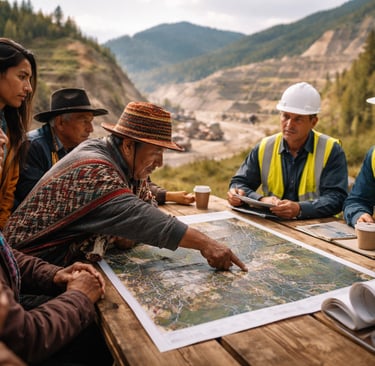
Map all potentially impacted communities, cultural landscapes, and governance structures with precision. Leverage participatory digital tools, such as GIS-based mapping, to involve locals in identifying sacred sites, access routes, and ecological hotspots.
2. Initial Contact and Trust Building
Begin introductions—often using respected local intermediaries or facilitators. Transparent agenda-setting, open invitations, and acknowledgment of past grievances foster trust.
3. Social Baseline and Impact Assessment
Collaborate on comprehensive environmental and social baseline studies. Include community-led participatory mapping, oral history interviews, and traditional ecological surveys.
4. Information Sharing Across Formats
Present project details through multiple channels: town halls, radio shows, visual guides, and mobile apps. Ensure all information is available in Indigenous languages and adapts to various literacy levels.
5. Dialogue and Deliberation
Space is granted for repeated dialogue. The engagement approach mirrors traditional decision-making cycles, respecting the need for private internal discussion and consensus-building.
6. Negotiation and Co-Creation
Consent agreements are co-developed, specifying:
The scope of project activities
Environmental and social safeguards
Benefit-sharing commitments
Dispute and grievance resolution processes
Rights and processes for possible consent withdrawal
7. Documentation
All consent-related communications and agreements are comprehensively documented: minutes, audio/visual records, and signed protocols, distributed in local languages.
8. Monitoring, Feedback, and Renewal
Joint monitoring teams (often including youth and elders) are established. Regular meetings, transparent reporting, and public logs reinforce accountability.
9. Consent Renewal and Adaptive Management
Consent is viewed as dynamic. Scheduled reviews take place at every project phase, allowing for adaptation as circumstances and community perspectives evolve.
Worked Example: FPIC in Action
Case Example:
Situation: A mid-tier metals company proposes a lithium processing plant in an area traditionally managed by three Indigenous nations.
Application of FPIC Process:
Early Engagement: The company partners with local universities and Indigenous interpreters to hold introductory workshops in each community.
Participatory Baseline: Community elders and youth help lead water and biodiversity surveys, charting seasonal flows and sacred areas.
Information Session: Animated video walk-throughs and interactive Q&A sessions dispel misconceptions and highlight potential impacts.
Deliberation and Consent: Communities take two months to consult internally, after which they negotiate benefit-sharing arrangements including local apprenticeships, a cultural heritage trust fund, and a consent renewal process allowing for biannual renegotiation.
Outcome: Consent is provided in writing, with all sessions recorded, and a joint governance board is established to monitor compliance and adapt practices collaboratively.
Analysis:
This example demonstrates how robust FPIC builds trust, leverages local wisdom, reduces social risks, and positions the project for ESG leadership in the circular metals economy.
6. Implementation Playbook: FPIC in Practice
Strong FPIC in metals projects is built in the field, not in a policy binder. The practical test is simple. Can a community understand what is proposed, deliberate through its own institutions, say yes, no, or not yet, and keep shaping the project as conditions change? That is the real threshold. International standards increasingly point in that direction. IFC Performance Standard 7 requires an ongoing relationship through the project life cycle, sufficient time for Indigenous decision-making, good-faith negotiation, documentation of the agreed process, and consent in specific high-impact situations such as impacts on customary lands, relocation, critical cultural heritage, and use of Indigenous knowledge for commercial purposes. Equator Principles 4 mirrors that structure for project finance, making FPIC a live financing issue rather than a side topic for community relations teams.
In practice, the best implementation sequence starts before engineering is locked. The operator should begin with rightsholder mapping, not just stakeholder mapping. That means identifying Indigenous governments, hereditary systems where relevant, elders, women’s leadership, youth voices, harvesters, land users, and people affected seasonally rather than permanently. Recent IRMA guidance is explicit that inclusive and participatory rightsholder mapping is a front-end requirement for judging whether FPIC obligations are engaged. That matters because one of the oldest failures in mining has been misidentifying who actually holds authority, or collapsing complex governance into one committee, one chief, or one memorandum.
The second step is to fund informed participation properly. “Informed” does not happen because a company uploads a 600-page impact assessment to a website. It happens when communities can review project information in their own language, on their own timeline, with their own advisers. Australia’s 2025 government guidance on FPIC is useful here because it treats the four words, free, prior, informed, consent, as principles that must be applied continuously and collectively, not as a one-time event. It also stresses honesty about what can and cannot be agreed, the need for escalation routes when expectations diverge, and the importance of First Nations participation in decision-making rather than passive consultation.
The third step is co-designing the process before debating the outcome. This is where serious projects separate themselves from performative ones. The parties should agree early on the rules of engagement: who represents whom, how meetings are called, what quorum means, how technical evidence will be reviewed, who pays for independent experts, how minutes will be validated, what confidentiality rules apply, and what happens if information changes midstream. IFC PS7 is clear that the client must document both the mutually accepted process and the evidence of agreement that results from negotiations. That procedural record is not bureaucracy for its own sake. It is often the difference between a durable consent path and a future legal dispute over whether consent was ever real.
The fourth step is to treat alternatives analysis as part of FPIC, not as a technical exercise done elsewhere. Communities do not need a polished project dropped in front of them with only minor tweaks left to discuss. They need the chance to shape core decisions such as site layout, access roads, water use, tailings design, blasting windows, shipping routes, worker accommodation, closure design, and culturally restricted areas. OECD’s 2026 minerals due diligence note underlines that mining can create land-use change, habitat fragmentation, water pollution, and community health risks, and that these effects can be irreversible in sensitive ecosystems. A consent process that does not allow communities to influence these core risk drivers is weak by design.
The fifth step is to move from benefits to equity. Traditional benefit packages, jobs, contracts, scholarships, and community funds, still matter. But by 2026, the stronger model is community equity in governance as well as economics. That can include co-management boards, Indigenous environmental monitors with stop-work escalation rights, revenue-sharing formulas, protected area stewardship arrangements, procurement set-asides, culturally grounded training pipelines, and closure trust structures that survive turnover in both company and community leadership. IFC PS7 also points to culturally appropriate and sustainable development benefits and equitable delivery of agreed measures, which means benefit-sharing has to be structured, timely, and traceable.
The sixth step is to build renewal points into the project calendar. Consent should be revisited at exploration, advanced exploration, feasibility, construction, operational ramp-up, major expansion, closure, and post-closure transition. This is not a legal flourish. It reflects operational reality. Ore bodies change. Waste volumes change. water models change. Haul routes change. Ownership changes. So do community priorities. Australia’s 2025 guidance and IFC’s life-cycle framing both support the view that FPIC is not exhausted by one signature at one moment in time.
For operators that want a practical internal rule, the playbook can be reduced to seven operating disciplines: map the rightsholders correctly, fund community capacity, agree the process first, open alternatives for genuine influence, negotiate enforceable safeguards, track commitments publicly, and renew consent whenever project risk changes materially. That is the version that survives audits, lender review, leadership turnover, and public scrutiny.
7. Measurement and Quality Assurance
FPIC fails when it is described only in moral language and never translated into operating evidence. The right way to measure it is to combine process quality, decision quality, implementation quality, and outcome quality. Global standards are moving toward exactly that. IFC requires documentation of the accepted process and evidence of agreement. Equator Principles require structured stakeholder engagement and disclosure early in assessment and before construction. IRMA goes further. For new mines, it does not allow IRMA certification, now framed as achieving IRMA 100, unless FPIC has been obtained from potentially affected Indigenous Peoples. Copper Mark’s 2025 guidance also makes Criterion 23 on Indigenous Peoples’ rights central for mining and co-located metal processing, and ties conformance to risk identification, meaningful engagement, action plans, and respect for FPIC.
A serious measurement system starts with process indicators. These answer whether the company engaged in a manner that could plausibly produce valid consent. Useful indicators include the percentage of affected communities mapped with community validation, the share of meetings held in local language, the number of days communities had documents before deliberation, the percentage of meetings attended by women, youth, and land users, the number of independent experts funded by the project but selected by the community, and the percentage of consent-stage materials translated into culturally appropriate formats. These are not vanity measures. They show whether participation was structurally possible.
The next layer is decision-quality indicators. Here, the question is whether communities had real influence over the project. Track how many material project elements changed due to community input, how many culturally sensitive areas were excluded from development, how many alternatives were evaluated jointly, and whether agreements clearly define triggers for renegotiation, grievance escalation, benefit-sharing distribution, and independent monitoring. If the answer to all of those is zero, the project may have consultation records, but it does not have strong FPIC.
Then come implementation indicators. These matter most after the press release. Measure the percentage of commitments delivered on time, the share of monitoring visits conducted jointly, the percentage of procurement spend reaching Indigenous businesses, grievance closure time, number of unresolved high-severity grievances, number of permit deviations reported to the governance board, and the proportion of environmental data disclosed in community-facing formats. IFC requires timely and equitable delivery of agreed measures. Copper Mark guidance also stresses risk assessment, baseline formation, tailored engagement, and action plans to prevent harm and create benefits. Those are measurable.
Outcome indicators are harder, but they matter more. They should track whether FPIC is actually reducing project risk and strengthening community governance. Good examples include the number of protests, blockades, injunctions, work stoppages, and rights-based complaints; community perceptions of trust and procedural fairness; continuity of traditional land use; water quality and biodiversity indicators tied to culturally important species; household income diversity; and the long-term durability of co-governance structures after management turnover. The cost case for getting this right is still strong. Research widely used across the extractives field found that for a major mining project with capital expenditure of US$3 billion to US$5 billion, conflict-driven delay can cost roughly US$20 million per week in lost value. More recent tracking by Global Witness found 334 incidents of violence or protest linked to copper, cobalt, lithium, and nickel mining in top producing countries between 2021 and 2023, or about 111 incidents a year on average.
Quality assurance should be layered. Start with internal controls, then community verification, then independent review. Internally, the legal, permitting, environment, finance, and operations teams should all sign off that no irreversible step has occurred before the agreed consent gate. Community verification should include approved minutes, plain-language dashboards, and a standing right to challenge inaccurate records. Independent review can come from lender consultants, IRMA-style assurance, or another trusted third party chosen with the community. What matters is that evidence can be checked from outside the company.
A useful discipline is to classify every FPIC indicator as red, amber, or green. Red means a right, safeguard, or agreed process has been breached. Amber means a delay, data gap, or dispute is emerging. Green means the commitment is delivered and verified. No executive team should be allowed to present a project as “socially supported” unless the red issues are disclosed beside the green ones. That single habit prevents more self-deception than most community-relations strategies ever will.
8. Case Patterns and Scenarios
The strongest positive pattern in 2026 is not a perfect case. It is a case where consent is being tied directly to shared decision-making in law and in process. British Columbia’s January 2026 decision on the Eskay Creek project is important for that reason. The Province and Tahltan Central Government used a consent-based decision-making agreement under section 7 of the Declaration on the Rights of Indigenous Peoples Act, and Tahltan gave notice of consent as part of the environmental assessment decision path. The public material around the decision describes it as a collaborative process grounded in Tahltan decision-making authority and provincial coordination. For metals projects globally, the significance is clear. FPIC is moving out of the “relationship management” box and into the core architecture of approvals and governance.
A second positive pattern is the shift from litigation to consent-based redesign. In June 2025, British Columbia, Taseko, and the Tŝilhqot’in Nation announced a tripartite agreement concerning the New Prosperity tenure area. The history matters. The project faced years of opposition, federal denial, court conflict, and a landmark Aboriginal title context. The 2025 agreement did not erase that history. It did something more useful. It created a consent-based model for any future mine development in the area and opened a land-use planning path outside endless litigation. That is a valuable lesson. Good FPIC does not always mean immediate project approval. Sometimes the success case is a framework that replaces forced timelines with legitimate future pathways.
The Mary River story in Nunavut shows the cost of weak social acceptability and contested consent. Academic analysis published in 2024 describes how distrust deepened around the project and notes criticism that the 2013 Inuit Impact and Benefit Agreement was concluded without prior information sessions or referendums across affected communities. In 2021, hunters blockaded the mine airstrip and tote road. In 2022, the federal government accepted the Nunavut Impact Review Board’s recommendation that Phase 2, in its current form, should not proceed. Even where formal agreements exist, FPIC can still fail in practice if representativeness, transparency, internal legitimacy, and community-wide confidence are not strong enough.
The Juukan Gorge disaster remains one of the clearest cautionary cases in mining governance. In 2020, Rio Tinto destroyed 46,000-year-old rock shelters at Juukan Gorge in Western Australia, triggering a parliamentary inquiry and a broad reckoning over cultural heritage, legal compliance, and the gap between formal approvals and substantive respect for Indigenous rights. The lesson for FPIC is blunt. A legally valid permit is not the same thing as a socially or morally valid process. Any FPIC system that lets a company say, “we had approval,” after a site of this importance is destroyed, is not a mature system. It is a weak system with better paperwork.
There is also a broader transition-minerals pattern that no metals company can ignore. Global Witness documented 334 incidents of violence or protest linked to copper, cobalt, lithium, and nickel mining between 2021 and 2023 in top producing countries. That should end the fiction that faster critical minerals supply can be built on old social models. The energy transition does not reduce FPIC risk. It intensifies it, because the pressure to approve projects faster tends to collide with lands, waters, and governance systems that communities are under no duty to surrender.
Put together, these cases reveal four recurring patterns. First, early co-governance outperforms late-stage mitigation. Second, formal agreements without broad legitimacy are unstable. Third, legal compliance without cultural legitimacy is dangerous. Fourth, projects that respect Indigenous jurisdiction are more likely to reach durable decisions, even if those decisions take longer at the front end. For executives, the message is clear. FPIC is not a delay variable to manage. It is a design condition for whether the project deserves to proceed.
9. Frequently Asked Questions (FAQs)
Does FPIC give communities an absolute veto?
One of the most common questions is whether FPIC gives communities an absolute veto. The most accurate answer is that different legal and assurance systems describe consent differently, but none of the serious systems treat it as a shallow information exercise. IFC PS7 frames FPIC as good-faith negotiation, documentation of a mutually accepted process, and evidence of agreement, while also noting that there is no universally accepted definition and that unanimity is not always required. Copper Mark’s 2025 guidance openly recognizes the global debate, ranging from stronger views that FPIC includes a right to say no, to narrower interpretations that stress negotiation and efforts to obtain agreement. In practice, companies should work on the stronger assumption: a project affecting Indigenous lands, livelihoods, or cultural heritage should not advance on the theory that communities were merely “heard.”
Does FPIC apply only to new mines?
Another frequent question is whether FPIC applies only to new mines. No. It plainly applies to major changes in existing operations when the change creates new or expanded impacts on Indigenous rights or interests. IFC PS7 ties FPIC to project design, implementation, and expected outcomes in specified high-impact circumstances. That logic extends to expansions, relocations, new transport corridors, tailings changes, closures, post-closure land transfers, and commercial use of Indigenous knowledge.
Can consultation substitute for consent?
A third question is whether consultation can substitute for consent. The answer is no where the applicable framework requires FPIC, and dangerous even where the law uses softer language. Equator Principles 4 and IFC PS7 both distinguish structured consultation from the specific need for FPIC in defined circumstances. Operators that collapse the two usually end up with the worst of both worlds: they invest heavily in engagement but still fail lender, court, or community expectations.
Can consent be revisited after it is given?
People also ask whether consent, once given, can ever be revisited. Operationally, it should be. The better view in 2026 is that consent is durable when the process includes renewal triggers, adaptive management, and transparent grievance pathways. Australia’s 2025 guidance treats FPIC principles as continuous and collective. IFC PS7 requires an ongoing relationship through the project life cycle. That means a company should expect review if material project assumptions change, if promised safeguards are not delivered, or if new harms emerge.
Does FPIC only concern Indigenous communities and not other nearby local communities?
Another question is whether FPIC only concerns Indigenous communities and not other nearby local communities. FPIC is specific to Indigenous rights under frameworks such as UNDRIP, IFC PS7, ILO-based approaches, and mining assurance systems. But that does not mean other local communities are irrelevant. They still require robust engagement, impact assessment, remedy, and where applicable consent-related processes under domestic law or lender rules. The key mistake is to use engagement with non-Indigenous stakeholders as a substitute for Indigenous consent. Those are different obligations and should never be merged for convenience.
What do lenders and buyers now expect regarding FPIC?
Finally, executives often ask what lenders and buyers now expect. The answer is stricter than it was a decade ago. Equator Principles 4 embeds FPIC in project finance for certain projects. IRMA’s standard makes FPIC decisive for new mine assurance. Copper Mark’s 2025 guidance places Indigenous rights, including FPIC, inside responsible production assessment for mining and co-located processing. OECD’s 2026 due diligence note also treats Indigenous rights and FPIC as a core risk area in responsible minerals supply chains. In plain terms, FPIC now affects capital access, offtake credibility, audit readiness, and long-term market trust.
10. Embedded Five-Layer Toolkit for FPIC in Metals Projects
To make FPIC usable inside a real metals business, it helps to break it into five connected layers. Each layer answers a different operational question, and projects usually fail where one layer is treated as optional.
Layer 1: Rights and legal trigger mapping.
This layer asks where FPIC is engaged and under which rules. Start with UNDRIP, domestic law, treaty context, lender standards, and assurance systems. UNDRIP anchors the rights basis, including FPIC in situations such as relocation. IFC PS7 and Equator Principles define high-impact project contexts where consent is required. IRMA and Copper Mark translate those expectations into assurance and performance language. If a project team cannot state clearly which triggers apply, it is not ready to engage on consent.
Layer 2: Governance and representation design.
This layer asks who has standing, who participates, and how legitimacy is recognized. It requires rightsholder mapping, recognition of community-specific institutions, and safeguards against elite capture. Copper Mark’s 2025 guidance is especially useful here because it requires sites to identify Indigenous Peoples through more than desk research, including engagement with Indigenous organizations, experts, and communities, and to document findings even where the operator believes no impacts are in scope. In practice, this layer should produce a governance map, a representation protocol, and a validated meeting architecture.
Layer 3: Information, capacity, and alternatives.
This layer asks whether the community can actually make an informed decision. It includes translation, plain-language materials, technical funding, site visits, community-led baseline studies, and genuine alternatives analysis. OECD’s 2026 minerals due diligence publication makes clear why this is essential. Mining can affect land use, water, biodiversity, health, and livelihoods in ways that are severe and sometimes irreversible. A community cannot consent meaningfully if it is asked to react to conclusions it did not help test.
Layer 4: Agreement architecture and value sharing.
This layer asks what the parties are actually agreeing to. It should cover impact avoidance, mitigation, benefit-sharing, cultural heritage protection, emergency response, grievance handling, monitoring rights, change-control rules, and closure commitments. IFC PS7 calls for culturally appropriate mitigation and sustainable development benefits with timely and equitable delivery. In stronger models, this layer also covers decision rights, not just compensation. That can include approval gates for expansions, Indigenous monitor programs, data access, and co-management boards.
Layer 5: Monitoring, remedy, and renewal.
This layer asks how consent stays valid over time. It should include joint dashboards, independent review, grievance escalation, non-compliance consequences, and scheduled renewal points. The reason is simple. Most FPIC failure happens after signing, not before. Community trust collapses when water data stops flowing, employment promises drift, heritage incidents are minimized, or ownership changes without re-engagement. This layer is where the project proves that FPIC is a governance system, not a launch document. IRMA, Copper Mark, IFC, and Equator Principles all point toward ongoing engagement, documented action, and reviewable performance.
Used together, the five layers create a practical discipline. Layer 1 tells you whether consent is legally and commercially unavoidable. Layer 2 tells you who must shape the process. Layer 3 makes consent informed. Layer 4 turns discussion into enforceable terms. Layer 5 keeps the agreement alive under real project conditions. A company that cannot show evidence in all five layers does not have a mature FPIC system, no matter how polished its ESG report looks.
Conclusion
FPIC in metals projects is no longer a peripheral social issue. It sits at the junction of rights, finance, permitting, project design, and long-term operating legitimacy. The standards that matter most, UNDRIP, IFC PS7, Equator Principles 4, IRMA, OECD due diligence guidance, and the latest responsible production criteria, all point in the same direction: communities must be able to participate through their own institutions, on a prior basis, with usable information, and with real power over outcomes that affect their lands, livelihoods, culture, and future.
The cases now shaping the field show both sides of the ledger. Tahltan and Tŝilhqot’in processes show how consent-based models can create more durable pathways. Mary River and Juukan Gorge show what happens when legitimacy is thin, representativeness is contested, or law outruns respect. Meanwhile, conflict data tied to transition minerals shows that the old model of pushing first and repairing later is not getting safer under energy-transition pressure. It is getting more expensive, more visible, and more fragile.
For operators, the practical conclusion is clear. Build FPIC into the earliest design stage. Treat it as a governance condition, not a communications task. Measure it with the same discipline used for grade, recovery, safety, and capital controls. Fund community capacity as a core project cost. Renew consent when risk changes. Share power where power is due. That is how metals projects earn legitimacy that lasts longer than one permit cycle, one CEO, or one commodity boom.
Connect
Your trusted partner for scrap metal procurement.
CONTACT
About
haroon@tdcventures.com
+1-307-655-7593
© 2025. All rights reserved.
NEWSLETTER