
From Totems to Towers: Symbolism in Metal Reuse for Community and Culture
Metal reuse isn’t just carbon savings — it’s memory, identity, and consent. This guide shows how to preserve cultural meaning while cutting emissions, with playbooks, metrics, and case studies from the High Line to Indigenous-led design.
CULTURAL SUSTAINABILITY & INDIGENOUS CIRCULAR PRACTICES
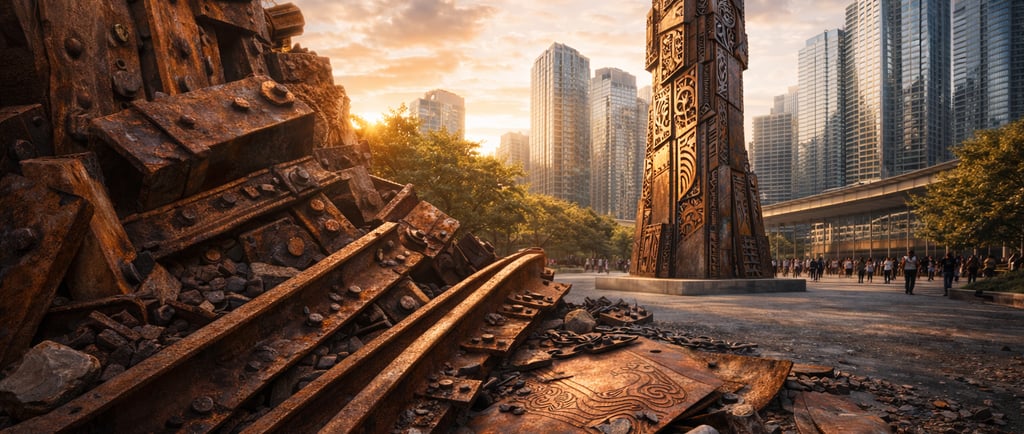

Table of Contents
1. Why Symbolism Now Sits at the Center of Metal Reuse
2. The Problem and the Opening
3. Why Cultural Signals Change Project Risk
4. The Core Ideas: Community, Equity, Governance, Culture, and Provenance
5. A Practical System for Culturally Grounded Metal Reuse
6. A Step-by-Step Delivery Process
7. Implementation Playbook
8. Measurement: What to Track and How to Prove It Works
9. Case Patterns from Around the World
10. What Strong Projects Do Differently
11. Future Outlook: What Changes Between 2026 and 2030
12. Conclusion
1. Why Symbolism Now Sits at the Center of Metal Reuse
Metal reuse is no longer only a carbon story. In 2026, it is also a story about memory, identity, legitimacy, and who gets to define what a place means. That shift matters because the world is still consuming far more raw material than planetary limits can absorb. UNEP’s Global Resources Outlook 2024 warns that, without major change, global resource extraction could rise by 60 percent by 2060 compared with 2020. At the same time, the 2025 Circularity Gap Report found that only 6.9 percent of materials entering the global economy come from secondary sources. In plain terms, the world is using more material, building more physical stock, and still failing to keep enough of it in circulation. 
The built environment sits directly inside that problem. UNEP and GlobalABC report that the buildings and construction sector accounts for 34 percent of global CO2 emissions, while construction materials such as cement and steel alone are responsible for 18 percent of global emissions. The same 2025 report estimates that construction and demolition waste now reaches about 2 billion tonnes each year worldwide. That makes every decision about whether to demolish, salvage, reuse, recast, or reinterpret metal a climate decision. It also makes every decision about whether to preserve meaning or erase it a cultural decision. 
Steel and aluminum show why this matters. World Steel notes that the industry has recycled more than 25 billion tonnes of steel since 1900, while the International Aluminium Institute reports that recycled aluminum uses about 95.5 percent less energy than primary production. A 2025 study on reclaimed steel components found that direct reuse of steel, rather than recycling it back through remelting, can cut CO2 emissions by an average of 87 percent. The lesson is simple. Recycling matters, but keeping metal in recognizable form, with its surface, history, and public meaning still legible, can do more than save carbon. It can save story. 
That is where symbolism enters. A beam is not always just a beam. A rail is not always just a rail. A copper sheet removed from a civic roof, a steel plate cut from an old bridge, or forged iron taken from a decommissioned plant can carry industrial memory, labor history, Indigenous land history, neighborhood struggle, migration, grief, celebration, and pride. When those meanings are ignored, reuse becomes extraction in softer language. When those meanings are carried forward with care, reuse becomes public memory made durable. 
2. The Problem and the Opening
Most metal recovery systems still treat material as interchangeable stock. They are built to move tonnage quickly, sort by grade, and return value through speed, purity, and throughput. That logic works for commodity recovery. It does not work for culturally significant material. Once a historically loaded object is stripped of provenance and melted into anonymous feedstock, the environmental value may survive, but the public meaning is gone. 
This is the core failure in many circular economy discussions. They talk about loops, but not about authorship. They talk about recovery rates, but not about whose memory is being recovered. They talk about design for disassembly, but not about design for continuity. Yet adaptive reuse research keeps reaching the same conclusion from different angles. Projects work better when they retain historical and cultural features while introducing new use, rather than wiping the slate clean and starting again. That is one reason adaptive reuse is increasingly treated as a serious urban and heritage strategy rather than a niche conservation tactic. 
The opening is larger than many teams realize. Repurposing an existing building can emit 50 to 75 percent less embodied carbon than constructing an equivalent new one. When metal elements are retained in ways that keep their previous identity visible, the project does more than lower emissions. It gains interpretive depth, stronger local recognition, and a clearer public reason for why this material, in this place, matters. For cities under pressure to cut carbon while rebuilding civic trust, that is a major advantage. 
There is also a market and governance opening. Around the world, institutions are under greater pressure to show where materials come from, who benefits, and whether community knowledge changed the outcome. In many Indigenous contexts, consultation is not a decorative step. UNDRIP Articles 19 and 32 state that governments should consult and cooperate in good faith through Indigenous peoples’ own representative institutions to obtain free, prior, and informed consent before adopting measures or approving projects that affect them or their lands and resources. In Canada, the UN Declaration Act has pushed this standard further into public and legal practice. In short, culturally blind reuse is becoming harder to defend. 
3. Why Cultural Signals Change Project Risk
The cost of ignoring cultural meaning is not abstract. Research by Harvard Kennedy School and the University of Queensland found that for a major mining project with capital expenditure of US$3 billion to US$5 billion, delayed production linked to company-community conflict can cost roughly US$20 million per week in net present value terms. Those findings came from extractives, but the lesson travels well into land use, public works, and heritage-related construction. Regulatory permission is not the same as public legitimacy. 
The same pattern appears in participation practice. The IAP2 Spectrum has become a widely used global tool precisely because public involvement has levels, and the level chosen shapes outcomes. Informing people after design decisions are mostly settled is very different from involving them early, collaborating on key choices, or placing decision power partly in community hands. Projects that treat symbolism as a finishing layer usually stay stuck at the lower end of participation. Projects that treat symbolism as part of material decision-making move closer to collaboration and shared authorship. 
That difference affects risk in at least five ways. First, it changes approvals because communities are more likely to back projects they can recognize as truthful. Second, it changes design quality because local knowledge often improves siting, language, symbolism, and use. Third, it changes operational resilience because a cared-for civic asset is less likely to become a source of backlash. Fourth, it changes educational value because visitors can understand what was preserved and why. Fifth, it changes long-term identity because reused metal can become a marker of continuity instead of a marker of displacement. 
This is also why symbolism cannot be reduced to motifs pasted onto finished steel. Symbolism in reuse is not decoration. It is a chain of decisions about provenance, consent, interpretation, design language, ownership, credit, maintenance, ceremony, and return of value. If any of those links are weak, the symbolic claim starts to look performative. 
4. The Core Ideas: Community, Equity, Governance, Culture, and Provenance
Community does not mean a general public that appears at a launch event. It means people with a lived relationship to the land, the structure, the labor history, the material source, the neighborhood, or the tradition being referenced. In practice, this can include Indigenous nations, former workers, local artists, neighborhood associations, descendants of displaced communities, schools, historians, youth groups, disability advocates, and civic users. The first serious mistake many projects make is drawing the circle too narrowly. 
Equity means more than representation in a room. It means that cultural contribution changes who gets paid, credited, trained, commissioned, and remembered. If a local artist or knowledge holder contributes the symbolic language that gives a project its public identity, that contribution should show up in contracts, IP terms, royalties where relevant, fabrication opportunities, and future commissions. Equity in this field is material, not rhetorical. 
Governance is the operating system behind trust. It determines who approves symbolic use of salvaged material, who can stop the process, how disputes are handled, what level of consent is needed, and how agreements are recorded. IFC guidance on Indigenous Peoples makes clear that informed consultation and participation are core requirements, and that free, prior, and informed consent may be required in certain circumstances. A project without governance rules can still look beautiful. It just cannot reliably defend itself. 
Culture is not a visual style bank. It is a living system of meaning carried through language, memory, use, ceremony, practice, and relationship to place. That means culturally grounded metal reuse may involve preserving a scar, retaining an old maker’s mark, naming the original source, maintaining an unfinished surface, holding a blessing before relocation, or deciding not to reuse a material at all because its previous role should not be abstracted into public spectacle. In many cases, the most respectful move is selective non-use. 
Provenance is the bridge between climate and culture. Carbon accounting asks what material was saved. Provenance asks where it came from, whose lives touched it, what histories it holds, and what duties follow from that knowledge. Without provenance, symbolic claims remain weak. With provenance, reused metal can become documentary evidence in built form. 
5. A Practical System for Culturally Grounded Metal Reuse
A strong project needs more than good intentions. It needs a repeatable system. One workable model has seven connected stages.
The first stage is source identification and screening. Before salvage begins, the team should identify whether a metal source has industrial, civic, spiritual, labor, colonial, migration, conflict, or neighborhood significance. The question is not just whether the metal can be reused, but whether it should be reused in visible form, hidden form, or not at all. This is where early mistakes can still be avoided at low cost. 
The second stage is authority mapping. This identifies who has standing to speak on the material and the site. In Indigenous contexts, this must follow representative institutions recognized by the people concerned, not a shortcut list made by the project team. In non-Indigenous contexts, it may include labor unions, worker families, local archives, community historians, and civic groups whose relationship to the source material is substantive rather than symbolic. 
The third stage is narrative harvesting. This involves oral history, archival work, imagery collection, previous use mapping, and community workshops. The goal is not to manufacture a neat story. The goal is to identify which meanings are strong enough to carry into design and which meanings should remain protected, private, or context-bound. Often the most valuable output is not a slogan but a map of tensions. 
The fourth stage is symbolic translation. Here the team turns cultural input into built choices. This can shape what metal elements remain intact, what surface finishes are retained, how old and new material meet, where interpretive text sits, which forms are repeated, what languages appear, and whether digital layers such as QR-linked oral histories accompany the object. This stage only works when artists, fabricators, and community knowledge holders are in the room together. 
The fifth stage is benefit design. This sets training targets, procurement rules, fabrication participation, artist credit, educational programming, and economic return. If a project uses community knowledge to raise civic value, then value has to flow back, not just outward. 
The sixth stage is review and consent. This includes design sign-offs, fabrication checkpoints, plain-language documentation, and grievance paths. The key is that review happens before irreversible steps. Consultation after cutting, polishing, or installation is too late. 
The seventh stage is stewardship. Reused symbolic metal does not stop being cultural material once the ribbon is cut. It needs maintenance rules, interpretation updates, school use, archive links, and a plan for future repair or relocation. Stewardship is what keeps the symbolic claim alive beyond the launch cycle. 
6. A Step-by-Step Delivery Process
A real project usually begins with a trigger. A bridge is coming down. A rail line is being converted. A factory is being decommissioned. A civic roof is being replaced. At that moment, most teams ask technical questions about tonnage, contamination, metallurgy, storage, and resale. A culturally competent team adds five more questions immediately. What did this metal mean? To whom? What histories make it sensitive? Which elements must stay legible? What permissions are required before design begins? 
Once the trigger is identified, the team should create a provenance dossier. This should include source photographs, archival references, original function, dates, known community relationships, environmental condition, and possible symbolic issues. If there is uncertainty, that uncertainty should be stated early rather than buried later. Provenance work is not bureaucracy. It is the basis for every later claim about continuity and respect. 
Next comes the cultural working group. This group should exist before concept design is locked. It should include technical staff, client decision-makers, affected community voices, and at least one person responsible for documenting decisions in plain language. If the project touches Indigenous lands, rights, or narratives, this group must align with the people’s own representative pathways, not an ad hoc advisory theater. 
Then come narrative sessions and material tests in parallel. One stream gathers story, memory, language, and significance. The other tests strength, contamination, section size, finish condition, and workable reuse pathways. Running these in parallel matters because symbolism without feasibility becomes sentiment, and feasibility without symbolism becomes extraction. 
Concept design should then show, clearly, where memory lives in the object. The strongest schemes usually make this visible through retained marks, partial preservation, juxtaposition of old and new, or direct naming of source. They do not bury all the salvaged metal inside concealed assemblies and then claim public storytelling afterward. When symbolism matters, legibility matters. 
Fabrication should include review points before irreversible alterations. This is especially important where symbolic cuts, inscriptions, coatings, or combinations with new material may change cultural reading. Teams should plan at least three checkpoints: before major cutting, before final finish, and before installation. 
The final stage is public activation. This should include on-site interpretation, digital access to source history, school materials where suitable, and a clear acknowledgment of who shaped the outcome. A culturally strong project does not leave visitors guessing whether meaning was researched or invented. It shows its work. 
7. Implementation Playbook
If you are a city, museum, developer, transit agency, university, or cultural institution trying to do this well, the most useful starting point is a one-year playbook.
In the first 30 days, identify potential metal sources and classify them by cultural sensitivity, public visibility, and reuse potential. Do not wait until demolition is underway. At this stage, build a short source register with three labels for each item: commodity material, heritage material, and culturally sensitive material. Some pieces may sit in more than one category. That overlap is exactly why early sorting matters. 
From day 30 to day 60, appoint a small cross-functional team with clear authority. One person should own provenance and archive work. One should own community process. One should own technical reuse. One should own contracts and benefit-sharing terms. One should own interpretation and public education. Projects fail when these roles are blurred or pushed to consultants without a central decision spine. 
From day 60 to day 120, run structured engagement before design direction hardens. Use the IAP2 logic honestly. Decide whether the public is being informed, consulted, involved, collaborated with, or given real decision power in defined areas. State that level clearly. If you are only consulting, do not market the process as co-creation. If a project needs consent, build the schedule around that reality. 
From day 120 to day 180, create a symbolic use brief. This is different from a design brief. It should state what the material may represent, what it must not represent, what parts of its history should remain visible, whether language translation is needed, what ceremonial steps may apply, who must review artistic interpretation, and how credit will be assigned. This document becomes the guardrail against later drift. 
From day 180 to day 240, align design and contracts. Procurement documents should include requirements for provenance retention, artist and knowledge-holder participation, documentation standards, sign-off points, archival handover, and public interpretation. If you leave these issues outside the contract, they tend to vanish under time pressure. 
From day 240 to day 300, prepare fabrication and learning pathways together. That means apprentice slots, community fabrication tours where safe, school partnerships, and content capture for future educational use. The project should produce more than an object. It should produce capability. 
From day 300 to day 365, launch with stewardship already funded. Too many projects spend on unveiling and underfund interpretation, maintenance, and follow-up programming. If the reused metal is meant to carry community meaning, then the budget must support that meaning after opening day. 
For organizations scaling multiple projects, the best move is to adopt a standing cultural provenance policy. This policy should define thresholds for enhanced review, minimum documentation, consent triggers, public credit rules, and benefit-sharing expectations. The goal is to stop treating culturally significant reuse as a special exception and start treating it as normal responsible practice. 
8. Measurement: What to Track and How to Prove It Works
Most reuse metrics are still too narrow. They count tonnes diverted, recycled content, embodied carbon saved, and sometimes waste disposal avoided. Those matter, but they do not prove whether a project preserved public meaning. A serious measurement approach needs four layers.
The first layer is material performance. Track tonnes of metal salvaged, tonnes reused in original or near-original form, percentage retained with visible provenance, embodied carbon avoided, and percentage of salvaged material that stayed in-region. Because reuse of steel can deliver much deeper carbon cuts than remelting alone, it is useful to separate direct reuse from recycling in reporting. 
The second layer is process integrity. Track when community engagement began, the number of decision points influenced by community input, the percentage of design changes traceable to that input, the number of review rounds before irreversible fabrication, and the average turnaround time for grievance response. These indicators show whether the symbolic story was built through process or written after the fact. 
The third layer is cultural continuity. Track provenance completeness, number of source histories documented, languages used in interpretation, participation of artists and knowledge holders, retention of original marks or features, and the percentage of visitors who can correctly identify the source and significance of the reused metal after engaging with the site. This last metric matters because if the public cannot read the symbolism, the project may be culturally sincere but communicatively weak. 
The fourth layer is local return. Track paid roles for community members, apprentice hours, commissions to local artists, school partnerships, repeat visits, public program attendance, and follow-on commissions generated for contributors. Equity has to be measurable in labor, money, and future access. 
A good reporting cycle combines baseline, opening-year, and year-three reviews. Baseline captures what would have happened under a standard salvage path. Opening-year review captures delivery quality and public reception. Year-three review shows whether the object still holds value after novelty fades. Post-occupancy and post-reuse evaluation is increasingly important in heritage work because many problems only surface after the building or site is in real use. 
The strongest public reports do one more thing. They publish both wins and unresolved tensions. They state what was reused, what was not reused, why those choices were made, and what disagreements shaped the outcome. That level of candor creates trust because it treats community knowledge as part of decision-making, not part of project marketing. 
9. Case Patterns from Around the World
The High Line in New York is often discussed as a park story, but it is also a powerful symbolism-in-reuse story. The project turned a former elevated freight rail line into a public landscape while keeping the line’s industrial identity legible. That mattered because the site was not wiped clean and renamed into abstraction. It was transformed while still reading as rail infrastructure. The result is a place that drew around 8 million visitors a year before the pandemic and became one of the most influential adaptive reuse projects in the world. Its real lesson is not that every city needs a High Line. Its lesson is that old metal systems can retain memory while serving new public life. 
Landschaftspark Duisburg-Nord shows a second pattern. Instead of demolishing a decommissioned ironworks and replacing it with a blank recreational landscape, the project preserved the steelworks as the heart of the park. Old furnaces, bunkers, pipes, and industrial structures remained readable, while new uses such as climbing, diving, walking, and events were layered into the site. Today the park attracts about 1 million visitors a year. The deeper point is that the retained metal does not function there as debris. It functions as witness. It lets industrial labor, regional identity, and ecological recovery sit in one place without pretending the past never happened. 
A third pattern appears in current public art. In 2026, San Francisco’s India Basin Waterfront Park installed “Whispers of Waste,” a 13-foot sculpture made from 5,000 pounds of recycled industrial scrap and designed to resonate with the local Bayview-Hunters Point community. The city process emphasized that the artist should be rooted in the neighborhood and that the work should reflect the community. This matters because it shows what happens when reclaimed metal is tied not only to sustainability but to local authorship and neighborhood recognition. The scrap is not just reused. It is socially re-sited. 
A fourth pattern comes from Indigenous engagement practice in contemporary architecture. HGA’s 2026 case studies show repeated themes across projects: early and ongoing engagement, design as cultural storytelling, long-term stewardship, respect for land and history, and trust built through real partnership. Projects such as the La Quinta Cultural Campus, Davidson Park, and Water Works Park Pavilion show that culturally grounded design becomes stronger when community voices shape symbolic elements from the start rather than reviewing them after the concept is formed. Even when the retained material is not always metal-specific, the lesson transfers directly to metal reuse. Early partnership produces better symbolism than late decoration. 
Across these examples, the pattern is consistent. Successful symbolic reuse does not hide the source, flatten the history, or treat culture as an accent layer. It keeps the relationship between material and memory visible. 
10. What Strong Projects Do Differently
Strong projects begin with meaning before form. They do not wait for a finished design and then ask what story can be attached to it. They ask, at the outset, what histories the material already carries and what new civic role it should play. This sounds simple, but it changes everything from schedule to procurement. 
Strong projects keep old and new in visible dialogue. They do not polish every trace away. They allow the reused metal to remain legible through marks, edges, geometry, patina, or siting. In symbolic reuse, too much visual smoothing can become a form of erasure. 
Strong projects separate cultural consultation from public relations. They compensate contributors, define review authority, and document how input changed the work. They do not use community voices as atmosphere around decisions made elsewhere. 
Strong projects also prepare for disagreement. Not every community voice will want the same outcome. Some will want preservation in place. Some will support visible reuse elsewhere. Some will oppose any symbolic abstraction of certain materials. That is normal. The goal is not friction-free consensus. The goal is a process people can recognize as honest, competent, and fair. 
Finally, strong projects fund interpretation and stewardship as core scope, not add-ons. Without this, even a well-made object can lose its social meaning within a few years. The material survives. The memory thins out. 
11. Future Outlook: What Changes Between 2026 and 2030
Between now and 2030, three shifts are likely to shape this field.
First, provenance expectations will rise. As circular economy claims face more scrutiny, cities, institutions, and funders will ask not only how much metal was reused, but where it came from and who approved its reuse. The era of generic “reclaimed metal feature” language is fading. Traceability will become standard practice. 
Second, direct reuse of structural steel is likely to expand as carbon pressure grows. Research is moving from proof-of-concept to practical deployment, and the carbon case is now hard to ignore. As reuse systems mature, cultural and provenance questions will become more important because more projects will be working with recognizable whole elements rather than anonymous recycled feedstock. 
Third, Indigenous and community-led design standards will keep gaining ground. The 2026 design discourse is already moving toward shared authorship, long-term stewardship, and early engagement. That shift will likely make symbolic metal reuse less about heroic designers and more about negotiated public meaning. That is a healthier direction because it places authority closer to the people who bear the history. 
The strategic opening is clear. Organizations that build credible systems now will be ahead on carbon, public trust, and cultural legitimacy at the same time. Those that continue to treat symbolism as surface treatment will face growing resistance from communities, funders, and regulators. 
12. Conclusion
Metal reuse is often presented as a technical response to waste, emissions, and scarcity. That is true, but incomplete. Reused metal also asks a harder question. When a material leaves one life and enters another, what else moves with it besides mass and value? Sometimes the answer is labor memory. Sometimes it is Indigenous relationship to land. Sometimes it is grief, resistance, civic pride, migration, or neighborhood identity. If those meanings are stripped out, the project may still be efficient. It will not be whole. 
The best work in this field shows a better path. Keep carbon in view. Keep provenance intact. Build consent and participation early. Pay and credit the people whose knowledge gives the material meaning. Preserve legibility. Publish the reasoning. Fund stewardship. When teams do that, reused metal stops being an anonymous sustainability gesture and becomes a durable public record of how a community chose to remember, repair, and build forward. 
That is the real promise of moving from totems to towers. It is not simply that old metal can serve a new function. It is that matter can carry memory without being trapped by the past. In a time of resource pressure, public distrust, and cultural contest, that is not a soft benefit. It is part of what makes reuse worth doing well. 
Connect
Your trusted partner for scrap metal procurement.
CONTACT
About
haroon@tdcventures.com
+1-307-655-7593
© 2025. All rights reserved.
NEWSLETTER