
Geo-Fenced Prompts that Boost Returns: AI Engagement for Digital Behavior Change in Recycling Apps
Discover how geo-fenced AI prompts in recycling apps turn user intent into measurable circular action, boosting take-back rates and sustainability ROI.
AI & DIGITAL ENGAGEMENT IN SUSTAINABILITY
Context: Why Geo-fenced Prompts Matter for Digital Engagement in Sustainability
Cities, retailers, and brands now operate in an environment where sustainability is not only a regulatory expectation but a competitive advantage. The divide between awareness and meaningful action is especially glaring in recycling and circularity programs. Traditional digital content—think email newsletters or generic app banners—often fails to move the needle. The big question: How can organizations orchestrate real-world, sustainable behavior at scale, and prove it?
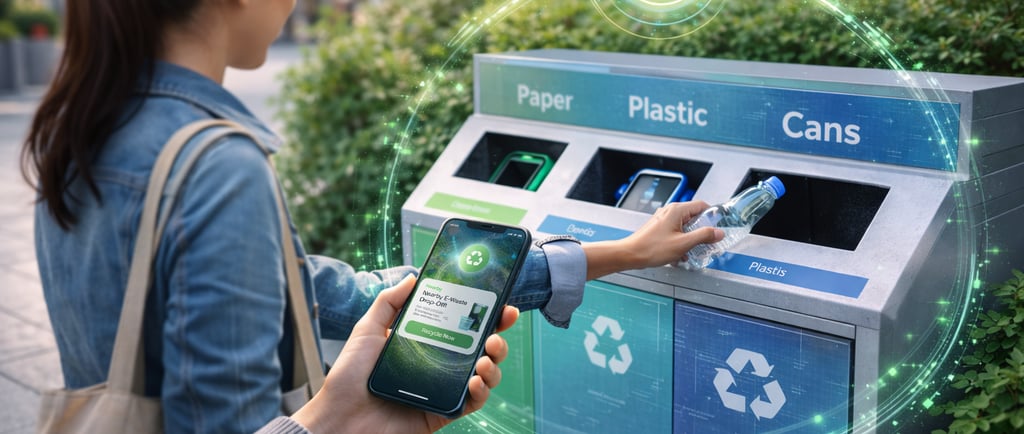
Geo-fenced prompts, leveraging AI engagement, provide a radical shift in approach for recycling apps and take-back programs. When digital nudges are tightly coupled to a user’s physical context—such as being near a recycling bin, retailer drop-off, or local event—they transform passive awareness into immediate, measurable action. Here’s why this matters:
Resource Optimization: Municipalities and brands can target investments—collection staff, marketing, logistics—at zones of highest engagement, reducing wasted effort.
Real-time Conversion: AI-driven nudges prompt action when interest and intent peak, such as when a user is standing outside a partner retailer or municipal depot.
Closed Loop Proof: Instant reporting of recycling or reuse activity helps organizations close the loop for both compliance (e.g., ESG) and reputation management.
Recent studies demonstrate that location-triggered digital prompts activate action at rates up to 3X those of untargeted campaigns (source: Behavioral Insights Team, 2023). As governments and retailers chase ambitious circularity targets, geo-fenced prompts are becoming an essential toolkit for digital sustainability engagement.
The Problem: Bridging Awareness and Circular Action
Awareness does not guarantee action. Even audiences who have downloaded recycling apps—indicating a willingness to engage—often don’t act when it matters most. Statistics from North American take-back programs illustrate the challenge: average return rates frequently languish between 8–18%, even among ‘engaged’ app users.
The real challenge is crossing the last mile:
Digital Engagement Plateau: App downloads and session data can look strong, but actual recycling or reuse is not keeping pace.
Measuring True Impact: Brands and municipalities struggle to capture real-world data that verifies environment-friendly behaviors for accurate reporting, whether for ESG compliance or customer trust.
Sustaining User Motivation: Without timely reminders or tangible rewards, engagement dips after initial curiosity, making it hard to sustain repeated behavior.
Behavioral Science Friction: Users intending to recycle may simply forget or face minor friction at the critical moment of action. Classic digital channels often miss this time-sensitive window.
As competitive benchmarks and regulatory frameworks such as the EU Circular Economy Action Plan intensify, organizations are seeking smart, data-driven ways to move the needle from intent to impact.
Key Concepts: Geo-fencing, AI Engagement, and Circularity in Municipal and Retail Networks
Geo-fencing
Geo-fencing is the foundational technology here. It’s more than just location tracking; it’s the creation of virtual perimeters—or “fences”—around defined locations using GPS. When a user with the app crosses into or dwells within these digital boundaries, a pre-defined action, such as delivering an in-app prompt or reward, fires. Market research estimates that by 2025, over 60% of location-based marketing campaigns will leverage geo-fencing to drive real-world outcomes, from retail to urban sustainability.
AI Engagement
AI engagement activates data-driven personalization. Rather than sending generic notifications, machine learning algorithms analyze user profiles, recycling history, and real-time behavior to craft prompts that speak to individual motivations. For example:
A novice recycler near a bin might see, “Ready for your first return? Earn bonus points!”
A seasoned user might be challenged: “You’re close to beating your monthly record—drop off now to unlock a new badge.”
This AI-driven layer ensures that each prompt is timely, relevant, and drives higher conversion.
Behavioral Nudging within Circularity
Behavioral nudges leverage “choice architecture,” a key behavioral economics principle, by making the desired sustainable action the simplest or most rewarding option precisely when the user can act. This adjustment—prompting action at the exact right moment in the exact right place—can increase behavior change rates by up to 150% compared with untargeted messaging, according to field experiments by MIT’s Center for Social Innovation (2022).
Circularity in Ecosystem Context
Retailers and municipal players are increasingly responsible for demonstrating circularity—the ability for products to reenter the supply chain or be recycled efficiently. Digital recycling apps with geo-fenced, AI-powered prompts form the connective tissue between consumer convenience, operational accountability, and regulatory transparency.
Framework: The Geo-fenced Prompt Action Loop
Effective digital engagement for sustainability requires structure, sequencing, and iteration. Let’s dissect how high-impact geo-fenced prompts are orchestrated in a continuous improvement loop:
Trigger: When a user enters a geo-fenced area (e.g., near a recycling hub, retailer’s electronics take-back counter), the app senses proximity.
AI Analysis: The system analyzes the user’s recycling behavior, location, and preferences to tailor the content and timing of the prompt.
Nudge Delivery: Via push notification, in-app message, or SMS, the user receives a context-sensitive nudge—customized for where they are and what they’re likely to recycle.
Action Opportunity: The prompt enables frictionless action such as scanning a QR code at the site, registering a return, or unlocking a location-based reward.
Confirm & Credit: The app verifies the action (using photo uploads, code scan, or staff confirmation), then credits the user’s account and updates engagement stats.
Iterate: Engagement data flows back into the AI engine, continuously optimizing prompt cadence, messaging, and targeting.
Industry Example
In the UK, a major electronics retailer integrated geo-fenced prompts into its take-back scheme. When users approached any of over 300 national drop-off points, the app delivered motivational nudges tailored by device type and past engagement. The system tripled take-back rates versus regions without AI-powered prompts.
Why This Loop Matters
This structured loop does more than drive action—it creates a virtuous cycle of data, improvement, and transparency, strengthening both user loyalty and compliance reporting.
Step-by-Step Example: Drop-off Activation in a Retailer Take-Back App
Scenario: Anna, an urban professional, has an old smartphone gathering dust. She’s aware of her favorite retailer’s take-back program but hasn’t found time to recycle.
Step 1: Anna walks past a retailer location with an active take-back bin. Her recycling app, which she installed months ago, instantly detects proximity using the geo-fencing SDK.
Step 2: AI engagement algorithms check Anna’s user profile—she’s made a past return six months ago and responded well to loyalty discounts.
Step 3: The app sends a tailored push notification:
"Hi Anna! You’re steps away from responsibly recycling your old phone – drop it off today for double loyalty points and an Earth Day voucher!"
Step 4: Anna enters the store, quickly scans the in-app barcode at the take-back bin, and completes the return.
Step 5: The app immediately confirms the action, updates her loyalty balance, and celebrates the milestone with a badge ("Circular Hero – April").
Step 6: Post-action, Anna receives a personalized “thank you” email with a sustainability impact snapshot (e.g., “You helped divert 120g of e-waste!”).
Outcome: Anna’s action gets logged for impact reporting, and she’s more likely to repeat the behavior due to real-time reward and feedback.
Analysis: In similar retailer pilot programs, this geo-fenced plus AI engagement approach increased take-back participation rates by up to 35% quarter-over-quarter, with opt-out rates staying under 10%.
From Prompt to Program: What the Highest-Performing Systems Do Differently
The real promise of geo-fenced prompts is not the notification itself. It is the system behind it. The best recycling and take-back apps do not treat location-triggered messaging as a one-off campaign feature. They treat it as operating infrastructure for behavior change. That distinction matters because the waste problem is scaling faster than most collection and engagement systems. UNEP says municipal solid waste is projected to rise from 2.1 billion tonnes in 2023 to 3.8 billion tonnes by 2050, while the global annual cost of waste, once health, pollution, and climate impacts are included, could reach $640.3 billion. In that environment, any digital tool that can convert passive intent into verified circular action at the point of decision becomes strategically important, not optional.
This is also why geo-fenced engagement sits so neatly inside the broader policy direction of the circular economy. The European Commission’s Circular Economy Action Plan is explicitly built around product life cycle design, waste prevention, reuse, and keeping materials in the economy for longer. The EU has also moved further into enforceable rules, including targeted revisions to the Waste Framework Directive that introduced common extended producer responsibility rules for textiles in 2025. At the same time, the Digital Product Passport is moving transparency closer to the product level, which means brands and municipalities will increasingly need better evidence about where, when, and how products are returned, sorted, reused, or recycled. Geo-fenced prompts help connect policy ambition to user action on the ground.
What the Data Says About Participation, Convenience, and Timing
If there is one lesson from return systems across sectors, it is that behavior changes when convenience, incentive, and timing line up. Deposit return systems are the clearest proof. Norway’s deposit system achieved a 93% return rate and a 98% total collection rate in 2024. Ireland’s Deposit Return Scheme reported that plastic bottle and can recycling jumped from 49% before the scheme to 91% after launch, with direct capture through the scheme doing most of the work. Lithuania’s system reached a total return rate of 90% by the end of 2025. These are not marginal gains. They show what happens when the desired action is easy, visible, rewarded, and supported by dense return infrastructure.
The lesson for recycling apps is direct. A geo-fenced prompt is most effective when it activates next to a place where action is actually possible. Research on deposit-return participation in Portugal found that economic incentives, communication, and location were core success factors. Separate app-based recycling experiments have also shown what stronger feedback loops can do. In one study discussed in the sustainability literature, app-supported interventions lifted recycling rates from 20% to 40% and cut contamination from 40% to 2%. Another 2024 review of curbside feedback mechanisms found contamination reductions of 25% to 30% within six months, depending on the intervention design. The pattern is consistent: proximity plus clarity plus reward beats awareness alone.
The KPI Stack That Separates Serious Programs from Vanity Metrics
Too many recycling apps still report on shallow activity signals. Downloads, monthly active users, and push open rates matter, but only as leading indicators. A mature geo-fenced prompt program measures the full conversion chain. That means tracking location-entry events, prompt delivery rate, view rate, action start rate, verified return rate, repeat return rate, contamination rate, average time from prompt to drop-off, and material recovery value per engaged user. For retailer take-back programs, it should also include coupon redemption, basket attachment, and net customer lifetime value uplift after a return. For municipal programs, the list expands to include avoided overflow, route efficiency, capture by neighborhood, and contamination by site type. Those are the numbers that tell you whether the app is changing physical behavior or just generating digital noise.
This matters because return and recycling systems are only valuable at scale when they improve actual material flows. The Global E-waste Monitor 2024 reported that the documented collection and recycling rate for e-waste was 22.3% in 2022 and warned that it could fall to 20% by 2030 if current trends continue. OECD data on plastics tells a similar story. Plastic waste more than doubled between 2000 and 2019, and after accounting for losses during processing, only 9% was ultimately recycled. The implication is clear. Apps cannot claim circular impact simply because they have engaged users. They need verified return and material outcomes tied to the moment of action.
Designing Prompts That People Actually Act On
The strongest geo-fenced prompts do four things at once. First, they anchor the message to a place the user can recognize instantly. Second, they reduce uncertainty by naming the item, the action, and the reward. Third, they create urgency without sounding manipulative. Fourth, they make completion feel small and immediate. In practice, that means “You’re 30 meters from a textile drop point. Bring in two unwanted items today and earn a repair voucher” will usually outperform vague sustainability language. The same logic applies to electronics, beverage containers, batteries, cosmetics packaging, and reusable take-back schemes.
The design should also adapt to user maturity. First-time users need confidence and simplicity. Repeat users respond better to progress framing, streaks, social proof, and milestone rewards. This is where AI engagement earns its keep. It can segment the message by product category, visit history, reward sensitivity, and prior completion patterns. It can also suppress prompts when the timing is wrong, which is just as important as sending them when the timing is right. Push notifications remain a useful tool, but only when permission architecture is handled carefully. OneSignal’s 2024 mobile benchmarks show that opt-in rates vary sharply by category and platform, which means onboarding, consent prompts, and message relevance can materially shape reach before the first geo-fence ever triggers.
Why Permission, Privacy, and Battery Strategy Are Core Product Decisions
A geo-fenced system fails fast if users do not trust it. Location data is personal data under the GDPR framework, and the regulatory expectation is clear: lawful basis, purpose limitation, transparency, and proportionate processing all matter. For app teams, that means no vague consent copy, no excessive background tracking, and no unclear data retention. Users must understand why location is being requested, what they get in return, and how narrowly the system uses that data. This is especially important in recycling and public-sector contexts, where trust is often more fragile than marketers assume.
The engineering side matters too. Apple requires explicit authorization flows for location services, and Android’s geofencing guidance is built around transition events rather than constant location polling. Google also notes that the geofencing API is optimized for battery performance, while Android background location limits exist specifically to reduce power drain. In plain terms, good geo-fenced engagement should feel event-driven, lightweight, and respectful. If your app is draining battery or spamming users when they are nowhere near a relevant action point, you are training people to opt out.
The Business Case: Why Retailers and Municipalities Keep Moving in This Direction
The economics are stronger than they first appear. Consider electronics. Best Buy reported collecting an estimated 144 million pounds of electronics and appliances for recycling in FY25, and it says consumers recycle more appliances and electronics with Best Buy than with any other U.S. retailer. Apple reported that 30% of the material across products it shipped in 2025 came from recycled content, the highest level in its history. In textiles, H&M Group reported collecting 17,100 tonnes through its in-store garment collecting program in 2024, while also noting that 66% of those garments were directed toward reuse and 24% toward recycling. These examples show that take-back is no longer fringe. It is a mainstream operating model across major sectors, and digital engagement systems can improve the capture efficiency of programs that already exist.
For municipalities, the value case often starts with avoided cost rather than direct revenue. Better-timed returns can reduce contamination, overflow, and labor inefficiencies. Better data can improve route planning, public communication, and site placement. Better verification can strengthen reporting for grants, ESG disclosures, and procurement standards. For retailers, the model broadens. Returns can feed refurbished sales, trade-in credits, loyalty growth, app retention, and stronger circular brand positioning. In both cases, geo-fenced prompts act as a conversion layer between existing infrastructure and better throughput.
A Practical Implementation Blueprint
The highest-performing teams usually build these systems in five phases. Phase one is infrastructure mapping. Every recycling bin, reverse vending machine, store counter, charity drop point, textile box, battery bin, and event collection site needs to be geocoded, classified, and audited for reliability. Phase two is event logic. Teams define what counts as an entry, a dwell, an exit, and a valid action window. Phase three is identity and segmentation. Users are grouped by material type, recency, frequency, incentive response, and preferred channel. Phase four is verification. QR scans, staff scans, machine receipts, photo verification, and item recognition rules are connected to the return event so the system can distinguish real action from app activity. Phase five is optimization. Prompt copy, radius size, dwell thresholds, reward type, send time, and suppression rules are tested continuously.
This staged approach matters because not all materials behave the same way. Beverage containers are frequent and low-friction. Apparel is episodic and wardrobe-driven. Electronics are often high-intent but delayed because the item sits in a drawer for months. Batteries and light bulbs have safety concerns that require extra educational clarity. A smart geo-fenced system should reflect these rhythms. The prompt for a bottle return can be immediate and transactional. The prompt for an old laptop may need a sequence: reminder, value explanation, data-wipe reassurance, then a store-nearby conversion moment.
What Failure Looks Like, and How to Avoid It
Most weak programs fail in predictable ways. The geo-fence radius is too wide, so prompts arrive when the user is driving by and cannot act. The reward is too small or too generic, so it does not offset the effort. The infrastructure is unreliable, so the user arrives at an overflowing bin or a staff team that does not know the program exists. Verification is weak, so fraud rises and trust falls. Or the app treats every user the same, which creates fatigue and suppression. None of these are AI problems. They are operating-model problems.
The antidote is tight orchestration between digital and physical systems. If a site is full, the prompt should not fire. If a product category is temporarily paused, the app should reroute the user to another location before the trip begins. If a user has ignored the last six prompts, the system should change the offer or pause communication. If a user has a history of textile returns in spring and electronics drop-offs around year-end, the system should learn from that behavior. The goal is not more messages. It is better-timed, lower-friction conversions.
The Near Future: From Geo-fenced Prompts to Intelligent Circular Infrastructure
The next wave of improvement will come from linking geo-fenced prompts with richer product and material intelligence. Digital Product Passports will make product-level information easier to surface. Better item recognition will improve material sorting and verification. Reverse logistics platforms will get stronger at forecasting return peaks and staffing needs. Public bins, kiosks, and reverse vending machines will increasingly become live nodes in a connected recovery network rather than passive endpoints. At that point, the prompt becomes just one layer in a much larger system that coordinates supply, timing, incentive, and reporting.
That future matters because the waste challenge is still getting larger. UNEP’s waste outlook and the Global E-waste Monitor point in the same direction: volumes are rising, recovery systems are lagging, and the cost of weak intervention keeps climbing. Geo-fenced prompts will not solve that on their own. But they are one of the few digital tools that can influence behavior exactly when a user is physically capable of doing the right thing. That is why they matter. They reduce the distance between intention and action. They create a verifiable record of circular behavior. And when they are built well, they turn a recycling app from a passive information layer into an active behavior-change engine.
Conclusion
The logical conclusion is simple. Recycling apps do not need more awareness content. They need better conversion architecture. Geo-fenced prompts, when paired with AI engagement, strong incentives, careful privacy design, and reliable return infrastructure, give cities, retailers, and brands a practical way to increase participation, improve data quality, and show measurable circular impact. The strongest programs will be the ones that stop treating returns as a communications problem and start treating them as a moment-of-action design problem. That is where digital behavior change becomes operational value. That is where circularity becomes measurable. And that is where the next generation of recycling apps will win.
Connect
Your trusted partner for scrap metal procurement.
CONTACT
About
haroon@tdcventures.com
+1-307-655-7593
© 2025. All rights reserved.
NEWSLETTER