
Green Hydrogen for Annealing and Reduction: Early Lessons for Decarbonization in Industrial Operations
Explore how green hydrogen transforms annealing and reduction processes with real case studies, cost analysis, and technical retrofit guidance for industrial decarbonization.
METAL SCIENCE & INDUSTRIAL TECHNOLOGY
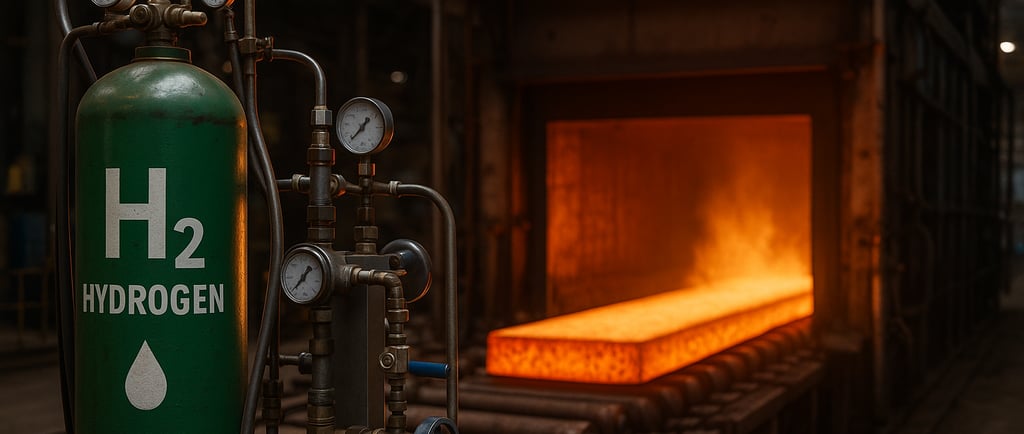
Introduction: Green Hydrogen as a Catalyst for Sustainable Change
Industrial decarbonization has become a defining priority for manufacturing leaders as emissions requirements tighten and corporate ESG expectations shift from optional to essential. Decades of reliance on coal, oil, and natural gas have locked many sectors into carbon-intensive modes of production—especially in high-temperature processes like annealing and reduction. As regulatory frameworks and investor sentiment rapidly evolve, industries are seeking proven alternatives to safeguard future competitiveness.
Enter green hydrogen—a renewable-based energy carrier now positioned at the frontline of industrial sustainability. Produced through water electrolysis powered by wind, solar, or hydroelectricity, green hydrogen allows for clean, high-grade heat without the carbon emissions that have traditionally accompanied metal and glassmaking.
But can green hydrogen transition from laboratory proofs to scalable, reliable decarbonization at the heart of industrial operations? Early adopters are already uncovering critical lessons, offering practical roadmaps and cautionary tales. This article will provide a comprehensive exploration of cost structures, risk mitigation, and compliance strategies for organizations eyeing green hydrogen as a catalyst for deep decarbonization, focusing on actionable tactics and real-world case studies. If you’re considering integrating green hydrogen into your operational footprint, these insights will inform your decisions and help future-proof your business strategy.
Section 1: Why Target Annealing and Reduction Processes?
The Carbon Challenge in Metal Processing
Annealing and reduction are fundamental stages within metals and materials manufacturing, such as steel rolling, aluminum extrusion, and glass tempering. These thermal processes demand exceptionally high, continuous heat—historically delivered by natural gas, coke, or other fossil fuels. Globally, energy use in the iron and steel sector alone accounts for nearly 8% of total CO2 emissions, according to the International Energy Agency (IEA).
Key drivers for decarbonizing these processes:
Regulatory Pressure: Landmark developments like the European Union’s Emissions Trading System (EU ETS), the U.S. Inflation Reduction Act’s clean manufacturing incentives, and carbon border adjustment mechanisms (CBAM) are accelerating the transition. Factories are now required to quantify Scope 1 direct emissions and demonstrate year-on-year reduction, or face escalating penalties and lost market access.
Customer & Investor Expectations: Major OEMs and consumer brands are embedding emissions performance into supplier scorecards, while institutional investors pour record sums into ESG-focused funds. Being an early mover in industrial decarbonization is now a business growth catalyst and a reputational shield.
Rising Carbon Costs: The price per ton of CO2 in leading carbon markets, such as the EU ETS, has surged from below €10 in 2016 to over €80 at the start of 2023. This escalation increasingly tips the scale in favor of low-carbon process investments, as the cost of inaction grows prohibitive.
Statistical Spotlight
The World Steel Association notes that direct energy use and energy-related emissions account for more than 90% of steel sector GHGs.
In glass manufacturing, fuel combustion for melting and shaping represents up to 80% of total production emissions, per the Glass Alliance Europe.
Transitioning annealing and reduction away from fossil fuels not only targets the bulk of energy-related emissions, but also positions these industries at the crux of the world’s net-zero ambitions.
Section 2: Green Hydrogen – Fundamentals and Value Proposition
What Sets Green Hydrogen Apart?
Green hydrogen is gaining momentum as a standout energy vector in industrial decarbonization. Distinct from grey hydrogen (from steam methane reforming) and blue hydrogen (which involves carbon capture), green hydrogen offers complete elimination of fossil fuel use in its production phase. Using electrolysis, water molecules are split into hydrogen and oxygen, powered entirely by renewable sources.
Core Benefits for Annealing and Reduction Processes
High-Quality Heat: Hydrogen combustion reaches temperatures above 1,800°C, exceeding natural gas and making it uniquely capable of meeting the intense demands of metallurgical and glass processes. This ensures that material properties—such as ductility and hardness in steel, or clarity in glass—are maintained without compromise.
Direct Substitutability: In many setups, green hydrogen can be integrated as a drop-in replacement within conventional industrial burners and processed gas systems. Retrofitting requirements range from moderate to extensive, depending on the furnace age and control scheme, but systematic assessment often reveals surprising adaptability.
Decarbonization Impact: Recent LCAs (Life Cycle Assessments) indicate that green hydrogen can reduce the carbon footprint of heat-intensive operations by 80–100%, contingent on local grid emissions factors and supply chain logistics. For example, McKinsey’s “Decarbonizing Steel” report notes that full hydrogen use in direct reduction can deliver near-zero operational emissions when powered by renewables.
Market Momentum in Green Hydrogen
Entities like the Hydrogen Council project that green hydrogen could meet 13–25% of global energy demand by 2050. The pipeline of announced industrial electrolysis projects soared to over 80 GW globally as of 2023, with heavy investments in European and Asian steel, aluminum, and chemicals operations. By pairing green hydrogen with existing process infrastructure, forward-thinking companies are positioning for regulatory compliance while unlocking new customer value streams centered on verified low-carbon products.
Section 3: Actionable Decarbonization Tactics – Cost, Risk, and Compliance
3.1 Cost Considerations: Making the Business Case
Conduct a Rigorous Life Cycle Assessment (LCA)
Begin by mapping the carbon and energy profile of each process step through a granular LCA. This assessment elucidates where emissions are concentrated and guides selective integration—such as targeting annealing stages with the highest fossil intensity or those with equipment most amenable to hydrogen retrofits.Evaluate Total Cost of Ownership (TCO)
Beyond headline hydrogen prices, a holistic TCO model should include:CAPEX: Costs for electrolyzer installation, hydrogen storage tanks, and furnace retrofits.
OPEX: Recurring expenses for green hydrogen procurement, utilities for on-site production, periodic maintenance, and safety upgrades.
Carbon Policy Dynamics: Factor in passenger carbon taxes, direct carbon offset cost savings, earning opportunities via credits, and available subsidies.
Incentives: Explore region-specific grants such as the EU Innovation Fund, US Department of Energy hydrogen initiatives, or tax credits under the Inflation Reduction Act, all of which can slash ROI payback periods.
Pro Tip:
Prioritize sourcing hydrogen from local, renewably powered facilities. This not only minimizes transport and storage expenses—boosting both economic and emissions savings—but frequently unlocks eligibility for jurisdictional funding, fast-tracking project approvals.
Cost Data Snapshot
As of 2024, green hydrogen prices average $3–$6 per kilogram in key EU and U.S. markets, with projections to reach $1–$2/kg by 2030 as electrolyzer scale and renewable supply expands (BloombergNEF).
The implementation of green hydrogen in steelmaking could increase finished product costs by 10–20%, though this is expected to close as carbon penalties and customer willingness to pay both rise.
3.2 Risk Management: Safeguarding Operations and Supply
Security of Supply
Ensuring stable access to green hydrogen is pivotal. Leaders are locking in offtake contracts with renewable hydrogen producers, while some are investing in on-site electrolysis for greater control—and hedging against feedstock price volatility.Safety Protocols
Hydrogen’s unique properties necessitate robust risk mitigation:Invest in advanced hydrogen detectors and sensor networks to ensure early leak detection.
Upgrade facility designs to incorporate adequate ventilation, pressure relief systems, and appropriately rated piping and valves.
Implement regular staff training in hydrogen-specific operational protocols, emergency response, and maintenance.
Technical Readiness
Adopt a phased, pilot-first approach:Start with a single annealing or reduction line to validate technical compatibility, hydrogen burner performance, and process integration challenges.
Foster technology partnerships with burner OEMs and engineering firms experienced in hydrogen applications.
Industry Insight
In Germany, for example, thyssenkrupp Steel piloted hydrogen in blast furnace operations, encountering and overcoming initial issues with flame stability and alloy performance adjustments—demonstrating the value of iterative, closely monitored pilots.
3.3 Compliance: Meeting and Exceeding Regulatory Standards
Certify Green Hydrogen Use
Securing third-party certification is key for ESG claims:In the EU, Guarantees of Origin (GOs) and CertifHy standards certify hydrogen’s renewable provenance.
In North America, Renewable Energy Certificate (REC)-backed hydrogen meets both regulatory and customer requirements, while established ISCC PLUS certifications are gaining traction for international verification.
Reporting and Verification
Embed green hydrogen milestones into your sustainability frameworks:Use leading standards such as the Global Reporting Initiative (GRI), Carbon Disclosure Project (CDP), or SASB to transparently document emissions reductions.
Incorporate external auditing and assurance to bolster credibility and minimize reputational or regulatory risk.
Stakeholder Engagement
Proactive communication builds trust with investors, customers, and regulators:Share third-party verified progress in annual sustainability reports, product marketing, and supply chain disclosures.
Participate in sectoral decarbonization alliances for shared learning and policy engagement.
Section 4: Case Studies – Early Pilots, Hard Numbers, Real Constraints
4.1 Steel: Hydrogen in Annealing and Reduction
Steel is the reference case for green hydrogen in high temperature processes. Several projects already provide real numbers that annealing and reduction teams can learn from.
Tenova HPH hydrogen bell annealing plants
Tenova’s HPH bell-type annealing plants use pure hydrogen as the protective and process gas for cold rolled strip. More than 3,500 bases have been supplied worldwide, and they already operate at up to 100 percent hydrogen for automotive exposed panels and high surface quality steels. tenova.com
Key lessons from this installed base:
Hydrogen atmospheres are already standard in many high value annealing lines, which shows that hydrogen handling inside furnaces is not new.
Users report:
Improved surface cleanliness and lower defect rates for exposed panels.
Better degreasing compared to nitrogen-rich atmospheres.
Stable mechanical properties once burners and controls are tuned.
The main remaining gap is not technical feasibility inside the furnace, but how to replace upstream grey hydrogen with certified green hydrogen at a viable cost and with reliable supply.
HYBRIT and hydrogen direct reduction
HYBRIT in Sweden runs a pilot direct reduction shaft that uses hydrogen to produce sponge iron, with on-site electrolyzers powered by fossil free electricity. HYBRIT+1
Takeaways for annealing and reduction teams:
This is a full primary reduction route, not only combustion. Hydrogen acts both as energy carrier and reducing agent.
Trials demonstrate that:
Hydrogen based DRI, when combined with EAF and renewable electricity, can cut process emissions by more than 90 percent compared to integrated blast furnace routes. OPUS 4
Process stability is achievable, but requires tight control of gas chemistry, temperature profiles, and pellet quality.
For secondary steelmakers, this shows how a hydrogen based reduction step can feed into scrap based EAF operations and still deliver near zero products.
Hydrogen in German steel transitions
In Germany, hydrogen based DRI capacity in Duisburg is planned to reduce at least 30 percent of CO2 emissions by 2025 for one major integrated site. ScienceDirect+1
For your strategy:
Expect staged replacement of coal and natural gas in reduction first, then broader use of hydrogen for reheating and annealing.
Pilot results highlight the need to:
Recalibrate metallurgical models for hydrogen rich atmospheres.
Manage new maintenance patterns for refractories exposed to different flame and gas conditions.
4.2 Glass: Hybrid Furnaces and Phase-in Hydrogen
Glass producers provide a valuable template for staged hydrogen integration.
One hybrid electric glass furnace project outlines two phases: first, significant electrification of melting, then replacement of remaining natural gas with green hydrogen.theclimatedrive.org
Lessons that transfer to annealing and reduction:
Do not treat hydrogen as an all-or-nothing decision. Combine electrification, heat recovery, and partial hydrogen firing.
Grid capacity and access to renewables are just as important as burner hardware.
Hybrid layouts help:
Keep process stability while learning how flames, convection, and batch behavior change with hydrogen.
Reduce total hydrogen demand, which lowers exposure to price and supply risk.
4.3 Cross-sector industrial heat: what the scenarios say
Scenario work on industrial heating indicates that green hydrogen could account for around 18 percent of total industrial thermal energy by 2050 in some decarbonization paths, with roughly double today’s total hydrogen use for heat. Renewable Thermal Collaborative
Implications:
Hydrogen will likely be a meaningful, but not dominant, share of industrial heat.
Annealing and reduction lines that need very high temperatures or strict atmospheres are strong candidates, since:
Heat pumps often cannot reach required temperatures.
Direct electrification can be limited by grid constraints or product quality concerns.
These case studies show that the main question is no longer “Does hydrogen work at temperature X” but “Where, and under what commercial and infrastructure conditions, does it deliver the best decarbonization benefit per unit of capital and risk.”
Section 5: Advanced LCA Methodology – Getting the Numbers Decision-Ready
Most early LCAs for green hydrogen projects use coarse averages. That is fine for first-pass screening, but not enough for major capital decisions. For annealing and reduction, your LCA should be detailed enough that procurement, operations, and finance can all rely on it.
5.1 Define a clear system boundary
Decide what you are counting. For hydrogen in annealing and reduction, a practical choice is “cradle to gate”:
Upstream:
Renewable electricity generation.
Electrolyzer manufacture and operation.
Compression, storage, and transport of hydrogen.
On-site:
Storage, distribution, and combustion in burners.
Auxiliary electricity use for blowers, controls, and safety systems.
Downstream:
Immediate post-anneal or post-reduction processing up to coil, slab, or glass product that leaves the line.
Avoid mixing downstream use-phase impacts into this LCA. Keep the scope focused on process heat and chemistry.
5.2 Model hydrogen supply with granularity
Many LCAs use a single “kg CO2 per kg H2” factor. For credible decisions, break this into entities and parameters:
Key entities for hydrogen:
Power source:
On-site solar or wind with direct connection.
Grid electricity with renewable PPAs.
Mix of renewable and residual grid power.
Electrolyzer type and efficiency:
PEM vs alkaline vs solid oxide.
Full load hours and partial load behavior.
Storage and distribution:
On-site compressed storage at different pressures.
Liquefaction if used.
Distance and mode from production site to plant.
Practical steps:
Use hourly or at least monthly profiles for grid emissions factors where possible, especially if electrolyzers follow renewable output.
Calculate hydrogen production emissions as:
Emissions per kWh of electricity × kWh per kg H2, plus
Embedded emissions from electrolyzer build if you want a more complete result.
Literature and IEA work show that hydrogen from fossil fuels can carry 8 to 12 kg CO2 per kg H2, while renewable based electrolysis, with clean power, can be well below 2 kg CO2 per kg H2. irena.org+1
5.3 Capture process-side entities and interactions
For annealing and reduction, the furnace and product side matter as much as the supply side. Track:
Furnace efficiency and losses:
Wall and roof losses.
Flue gas temperature and composition.
Effect of higher water vapor and different flame behavior with hydrogen.
Atmosphere composition:
Ratio of hydrogen to nitrogen and other carrier gases.
Dew point and its impact on oxidation, decarburization, and surface quality.
Product yield:
Scrap and downgrades due to surface or microstructural defects.
Extra rework or re-anneal cycles.
A hydrogen conversion that increases defect rates can erase the emissions benefit. Your LCA should include product yield as a first-class variable, not an afterthought.
5.4 Treat co-products and allocation carefully
Green hydrogen plants often produce:
Oxygen as a co-product.
Heat from compression and electrolysis.
Decide how you allocate emissions:
If oxygen is sold into nearby industry, you can allocate part of the upstream impact to that product.
If waste heat is used for space heating or low grade process heat, you can credit the hydrogen system with avoided boiler emissions.
Be transparent:
Document allocation rules.
Show both “allocated” and “no allocation” results so that internal and external stakeholders can see the range.
5.5 Turn LCA outputs into steering tools, not static reports
The best LCAs for green hydrogen projects behave more like living models:
Link LCA parameters to real procurement and operations data:
Actual electrolyzer runtime and efficiency.
Actual grid mix and PPA deliveries.
Actual hydrogen blends and furnace throughput.
Build scenarios:
High and low hydrogen price.
Different carbon price paths.
Different plant utilization rates.
Use these scenarios to answer questions such as:
Under what hydrogen price and carbon price combination does this line stay competitive?
How sensitive are emissions and cost per ton to changes in yield or furnace uptime?
Which asset gives you the most emissions reduction per dollar in the short term?
When your LCA reaches this level, it stops being a compliance tool and becomes a steering instrument for capital planning and commercial strategy.
Section 6: Technical Guidance – Retrofitting Annealing and Reduction Assets for Hydrogen
Retrofitting is where strategy meets plant reality. Hydrogen properties differ from natural gas in flame speed, density, and radiant characteristics. A serious retrofit plan acknowledges this and proceeds in deliberate stages.
6.1 Segment your furnace fleet
Start by mapping all relevant assets:
Type:
Bell-type annealing furnaces.
Continuous annealing lines.
Batch or continuous reduction furnaces.
Fuel and atmosphere:
Natural gas, coke oven gas, mixed gases.
Hydrogen/nitrogen mix already in use.
Age and controls:
Modern PLC/SCADA based systems vs older analog controls.
Availability of burner management systems and safety PLCs.
Classify assets into three groups:
“Hydrogen ready with modest upgrades”
“Hydrogen possible with significant modernization”
“Hydrogen unsuitable, plan for replacement or alternative decarbonization route”
6.2 Understand the combustion physics that matter
Hydrogen behaves differently from natural gas:
Energy content per unit volume:
For the same heat input, hydrogen volume flow is roughly 2.5 to 3 times that of natural gas.
Piping, valves, and burners must handle higher volumetric flow.Flame speed and ignition:
Hydrogen has a much higher laminar flame speed.
Burner design must prevent flashback and maintain stable flames at different load levels.NOx formation:
Higher flame temperatures can increase NOx.
Low-NOx burner designs and staged combustion become more important.
Work with burner OEMs that have certified hydrogen-capable burners for your temperature and throughput range. Ask for reference installations and test data.
6.3 Retrofit steps for annealing lines
A typical retrofit roadmap for an annealing furnace:
Atmosphere and product study
Map current dew point, hydrogen share, nitrogen share, and product mix.
Identify grades that are most sensitive to oxidation, decarburization, or grain growth changes.Burner and fuel train audit
Inspect all burners, valves, regulators, seals, and piping for hydrogen compatibility.
Identify components that must be replaced with hydrogen-rated versions.Pilot hydrogen blend
Begin with a modest hydrogen blend in fuel, for example 10 to 30 percent by volume, where safety and equipment limits allow.
Monitor:Temperature uniformity across the load.
Surface quality and hardness of products.
NOx emissions at the stack.
Control upgrades
Add fast-acting flow control and flame monitoring suitable for hydrogen.
Update burner management logic to handle different trip conditions, purge sequences, and restart procedures.Move toward higher hydrogen shares
Increase hydrogen share stepwise only after stable performance at each step.
In each step, verify:Product properties across several coils or batches.
Any change in refractory wear, burner tile condition, and seals.
6.4 Retrofit steps for reduction furnaces
Reduction furnaces often involve more complex gas-phase chemistry. For these assets:
Rebuild or recalibrate gas models
Hydrogen changes reduction kinetics and by-products.
Review reduction curves, residence times, and gas ratios.Reassess refractory and lining
Higher water vapor, changed gas composition, and different radiative spectrum can affect lining life.
Consider test coupons and accelerated wear studies where possible.Add advanced sensing where it matters
In-situ gas analyzers for hydrogen, water vapor, and oxygen.
Additional thermocouples to capture new hot spots or cold zones.
6.5 Safety architecture for hydrogen in existing plants
Hydrogen requires a structured safety approach:
Detection and ventilation
Install hydrogen detectors in roof spaces, near storage, and along distribution lines.
Ensure proper ventilation paths to prevent accumulation in confined spaces.Classification and grounding
Reassess hazardous area classifications.
Ensure electrical equipment in risk zones is appropriately rated.Procedures and training
Update hot work permits, lockout-tagout routines, and emergency procedures.
Train operators and maintenance teams on hydrogen-specific risks, especially invisible flames and leak behavior.
6.6 Digital and operational readiness
Hydrogen retrofits work best when paired with better monitoring and control:
Integrate furnace, hydrogen supply, and safety data into one view.
Set clear KPIs:
Hydrogen share in fuel.
Emissions per ton.
Product reject rates.
Run short learning cycles:
Weekly review of data from hydrogen-fired lines.
Small parameter adjustments with clear hypotheses behind each change.
Section 7: Market Participation Strategies – Turning Technical Change into Commercial Advantage
Once you can run hydrogen safely and reliably, the question becomes how to turn that capability into margin, access, and resilience.
7.1 Align with policy and incentive regimes
Policy can make or break a business case for green hydrogen in industrial heat.
In the United States, the 45V clean hydrogen production tax credit can provide up to 3 dollars per kilogram of qualifying hydrogen, depending on its lifecycle emissions. Reuters
Proposed changes to that credit show how exposed projects can be to policy shifts. Some analyses estimate that removal of the credit could endanger the majority of announced US green hydrogen projects. Financial Times
Practical steps:
Map all relevant incentives for your plant locations:
Production tax credits.
Capital subsidies.
Carbon contracts for difference.
Structure long term hydrogen offtake agreements to match the duration of key incentives.
Attach LCA and certification work to these contracts so that you can prove eligibility.
7.2 Build bankable “green product” offers
Customers will not pay more for vague sustainability claims. They will pay for certified, traceable low carbon products that help them meet their own targets.
For annealed or reduced products, develop offers such as:
“Hydrogen-annealed steel strip” with:
Verified reduction in Scope 1 emissions per ton.
Certification under schemes such as ISCC PLUS or equivalent.
Clear chain-of-custody documentation that links heat numbers to hydrogen operation logs.
“Low carbon glass containers” where:
Hydrogen use in the furnace is tied to batch, tonnage, and customer orders.
Emissions footprint is provided per unit or per ton, with a clear calculation note.
Back this up with:
Third party audits of your LCA and process.
Guarantees of Origin and similar certificates for hydrogen or electricity where available. JRC Publications Repository+1
7.3 Position in green steel and green materials value chains
New reports on the EU steel transition indicate that near zero emissions steel will rely heavily on hydrogen based DRI, EAF routes, and maximum scrap use. EEB - The European Environmental Bureau+1
This creates positioning opportunities:
If you operate annealing lines within integrated steel groups, your hydrogen work can:
Help the group qualify products for near zero labels.
Support automotive and construction customers that have their own net zero targets.
If you are an independent processor or service center:
Hydrogen use can differentiate your coils, sheets, or components in procurement tenders.
You can target customers that publish supplier decarbonization expectations and can pay a modest premium.
7.4 Manage exposure to hydrogen market volatility
Hydrogen markets are still young. Recent analysis shows that in many regions green hydrogen costs remain above 4 to 6 dollars per kg, and in some projects significantly higher, with uncertain downward trajectories. The Australian+3Green Skills for Hydrogen+3BloombergNEF+3
Practical risk management:
Avoid single-technology lock in:
Combine hydrogen with electrification and efficiency upgrades.
Keep optionality for other low carbon fuels where available.Use staged capacity:
Start with one or two lines on hydrogen, not the entire plant.
Keep the ability to switch back to natural gas in emergency conditions if regulations allow, with clear procedures.Structuring contracts:
Include floors and ceilings for hydrogen price in offtake deals.
Use indexation that reflects both power prices and carbon prices, since both affect hydrogen cost and your alternatives.
7.5 Engage in local and regional hydrogen clusters
Hydrogen is rarely a solo project. Many regions are building shared pipelines, storage, and port infrastructure. IEA+1
Industrial operators can:
Join regional consortia that bundle demand from several plants.
Influence routing and storage decisions so that annealing and reduction sites have priority access.
Co-locate new hydrogen-consuming assets near planned hydrogen hubs.
Doing so can reduce delivered hydrogen cost, improve reliability, and support long term competitiveness.
Conclusion: A Realistic but Ambitious Path for Green Hydrogen in Annealing and Reduction
Global hydrogen demand reached about 97 million tonnes in 2023. Less than a tenth of one percent went into new uses such as high temperature industrial heat and hydrogen based DRI. IEA+1
This tells you two things:
You are still early if you are considering hydrogen for annealing and reduction.
The window to shape standards, contracts, and technical norms is open right now.
From the early lessons covered here, a practical picture emerges.
Technically, hydrogen can supply the temperature, atmosphere control, and metallurgical performance that annealing and reduction lines need. Existing hydrogen annealing plants and pilot DRI projects show that clearly.
Economically, the case depends on careful LCA work, smart use of incentives, and clear customer offers that convert emissions reductions into value.
Operationally, success rests on detailed retrofit plans, serious safety work, and short learning cycles rather than one-off projects.
If you lead an industrial site today, a credible near term path looks like this:
Use a detailed LCA to rank all your thermal processes.
Identify one or two annealing or reduction assets that combine high emissions intensity, strong customer interest, and reasonable retrofit feasibility.
Build a pilot that pairs hydrogen, digital monitoring, and third party verification.
Turn that pilot into a certified product offer and a template for further lines.
Feed real performance data back into your capital and procurement planning.
Green hydrogen will not solve every problem in industrial decarbonization. Heat pumps, electrification, efficiency, and scrap strategies all have vital roles. For high temperature annealing and reduction, however, green hydrogen is one of the few tools that can deliver deep direct emissions cuts while preserving product quality.
If you treat it as a serious engineering and commercial program, not a marketing slogan, you can use this decade to move from pilots to a stable, lower carbon production base that your customers and regulators can trust.
Connect
Your trusted partner for scrap metal procurement.
CONTACT
About
haroon@tdcventures.com
+1-307-655-7593
© 2025. All rights reserved.
NEWSLETTER