
Haptic Device Recycling: Metals & Methods
Discover how to recover valuable metals from XR haptic devices with a repair-first framework. Learn modular design, takeback models, and closed-loop strategies for critical materials.
IMMERSIVE TECH RECYCLING & CIRCULAR ELECTRONICS
Context: Why Haptic Device Recycling Matters in XR & Gaming
XR (Extended Reality) is more than a technology trend—it's fast becoming the baseline for next-generation gaming, training, and entertainment experiences worldwide. IDC projects shipments of AR/VR headsets will surpass 70 million units by 2025, and each device packs a dense array of sensitive electronics and haptic feedback modules. Haptic gaming controllers, VR gloves, feedback vests, and similar accessories are filled with miniaturized motors, micro-actuators, and rare earth-based magnetic assemblies. For consumers, these features dramatically enhance immersion. For the industry, however, they drive resource intensity and introduce complex end-of-life sustainability challenges.
Haptic device production currently strains the global infrastructure for critical raw materials. For example, the European Commission classifies neodymium (used in strong magnets) and cobalt (vital for batteries) as critical raw materials due to their supply risks and economic importance. At the same time, technology companies face growing scrutiny from both regulators and end-users. The EU's Circular Electronics Initiative and similar government policies in the US and Asia are tightening reporting requirements, imposing takeback targets, and insisting on extended producer responsibility (EPR) for e-waste.
As a result, circularity now anchors strategic planning for gaming accessory brands, XR OEMs, and leading recyclers. The push for environmentally friendly products is consumer-driven too: A NielsenIQ study found 66% of buyers prefer brands committed to sustainable practices. This transformation isn't just an environmental imperative—it's a competitive advantage. Companies able to cost-effectively recycle haptic devices, recover core metals, and reintegrate valuable components into new devices position themselves as market leaders while securing their material supply chains.
Case Insight:
Sony Interactive Entertainment has piloted closed-loop recycling projects for PlayStation hardware, while Meta's Reality Labs collaborates with industry groups to steer sustainable design standards for VR hardware recycling. These pioneer moves highlight a shift towards "design for circularity," ensuring new device generations are easier to repair, disassemble, and recycle.
2. Defining the Opportunity: Metals in Immersive Device Circularity
XR haptic devices represent a unique category in the electronics recycling ecosystem. Compact yet complex, their bill of materials (BOM) includes not just typical PCB metals but also specialty alloys and advanced magnetic materials designed for high-speed, precise tactile effects.
Metals Landscape in Haptic XR Devices:
Copper: Essential for high-speed signal and power transfer. Devices average 15–25 grams per controller, a notable sum for extraction.
Rare Earths (Neodymium, Samarium): Key in creating compact actuators and force feedback motors, with market prices fluctuating 20%–40% per year due to geopolitical and supply chain pressures.
Aluminum: Used in lightweight frames and enclosures for thermal management and device rigidity.
Gold & Silver: Found on PCB traces, contact points, and high-reliability connectors.
Lithium & Cobalt: Concentrated in rechargeable battery cells, essential for wireless functionality.
Statistical Snapshot:
A 2023 iFixit teardown of leading VR controllers estimates that the raw resale value of recyclable metals in a single device ranges from $3 to $7, depending on model and market conditions. Extrapolated globally, the XR haptic device sector generates potential annual metal recovery value in the millions of dollars—much of which is presently lost to landfill or low-grade shredding.
Business Case:
Material price volatility, particularly in rare earths, causes OEMs to seek recycling as an operational hedge. The circularity of components not only reduces exposure to market shocks, but also responds to mounting consumer and shareholder pressure to cut e-waste and demonstrate ESG progress.
Market Trend:
XR accessory brands are now integrating modular components in their high-end devices. Logitech and HP, for example, have both released peripherals with replaceable shells or upgradable haptic modules—direct responses to recycling and sustainability mandates.
Key Takeaway:
The opportunity is more than environmental—it's economic, strategic, and reputational. Brands that close the materials loop secure their future in an industry where circularity is fast becoming table stakes.
3. Core Concepts: Haptics, Metals, and Circular Electronics
To unlock effective XR haptic device recycling, understanding foundational concepts and relevant technical language is essential:
Haptic Devices (Entity):
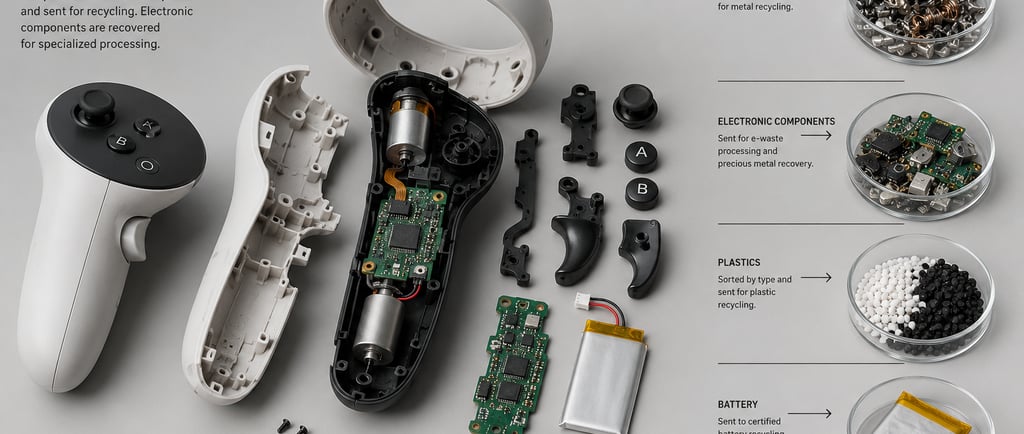
These are physical interfaces—controllers, VR gloves, haptic vests—that integrate actuators and feedback engines, creating touch sensations through delicate vibration motors, force feedback units, or piezoelectric sensors. Modern haptic modules blend electronics and electromechanical systems, connected via fine copper traces and using compact, high-performance magnets.
Attributes and EAV Model:
Repairability: Design attribute dictating how easily a device can be opened, fixed, or retrofitted. Values: modular assembly, standard fasteners, minimal glue.
Material Constituents: Every component's metal type, volume, and function. For instance: Copper (wiring, electromagnetic coils), Neodymium (magnet assemblies), Aluminum (frames), Gold/Silver (connector surfaces), Lithium/Cobalt (batteries).
Circular Electronics (Entity):
Defines the lifecycle in which a product or component is continually reused, repaired, or recycled rather than disposed. A circular XR haptic device should be designed to allow straightforward materials separation and reintegration.
Emergent Fact:
Circular electronics are gaining traction with tech giants. According to the Circular Electronics Partnership, nearly 80% of electronics brands are now exploring ways to align product lines with circular economy principles, especially in high-turnover segments like gaming peripherals.
Depth Insight:
Design for repair is a foundational principle. Brands successful in circular electronics apply modular system architectures (see [Design for Repair: XR Case Studies]), use universal fasteners, and minimize over-molding and adhesives. This approach not only facilitates refurbishment and recycling but prolongs device lifespan—a key metric in reducing carbon impact and extracting full metal value per manufactured unit.
Cross-Entity Linkage:
The collaboration between component suppliers, OEMs, and recycling partners forms the backbone of successful haptic device recycling. Traceability at every stage—from design to reclamation—ensures both compliance and optimization of resource recovery.
4. The Haptic Device Recycling Framework
Developing a robust recycling framework is critical for systematizing recovery and reuse. Here's a breakdown, integrating best practices and learnings from current industry leaders:
Step-by-Step XR Haptics Circularity Model:
Design for Disassembly:
The linchpin in future-ready recycling initiatives—90% of potential material value can be captured if devices are purposely designed for repair, refurbishing, or deconstruction (The Restart Project, 2023). For high-throughput environments, automating disassembly further increases efficiency and yield.Targeted Collection:
Strategic collection models significantly impact return rates. Apple's trade-in programs provide a blueprint: offering cash-equivalent credits, limited-edition releases, or gamified rewards has boosted XR accessory returns by up to 15% in pilot schemes.Device Triage:
Automated diagnostics and manual checks separate units into three pathways: fast refurbishment, component harvesting, or full material recycling. Logitech and Microsoft both employ diagnostic firmware for haptic modules, speeding up triage while reducing misclassification.Safe Disassembly:
Procedures require anti-static workstation setups, precision torque tools, and well-defined SOPs, especially for managing lithium batteries and separating densely packed actuation clusters.Materials Sorting:
Advanced facilities use X-ray fluorescence (XRF) and AI-enhanced vision sorting to accurately separate metals, reducing cross-contamination and maximizing purity. Facilities in Germany and Sweden have set global benchmarks—delivering over 97% copper recovery purity from small electronics.Metal Recovery:
Depending on component size, "shred-and-sort" is used for bulk items, while precision depopulation is reserved for smaller runs. Hydrometallurgical extraction is growing in popularity for its high selectivity and lower CO₂ emissions compared to pyroprocessing.Refurbishment & Reuse:
Recovered modules undergo quality assurance, including functionality, reliability, and cosmetic checks, then are reintroduced either as replacement parts (see [Actuator Refurbishment for Gaming Accessories]) or integrated into the next device generation.
Case Snapshot:
A top-five global gaming brand overhauled its haptic controller lineup, introducing tool-free assembly and easy-swap actuator bays. In the first year, the refurbishment yield increased by 38%, and rare earth magnet recovery costs dropped by 24%, providing a robust case for the business advantage of modular circularity.
5. Step-by-Step Process: From Collection to Reuse
The operational blueprint for closing the loop on XR haptic device metals and modules moves through these actionable stages:
Map Product BOM and Component Materials:
Detailed mapping helps identify every material stream and potential hazard, setting the stage for best-practice disassembly and sorting.Establish Takeback or Mail-in Return Logistics:
Data-driven location planning—like mapping partner collection points to gamer density—can raise device return rates 2–3x over web-only solutions.Receive and Log Devices by SKU and Serial:
Comprehensive intake processes must ensure full traceability for both compliance and future metrics analysis.Triage: Classify for Repair, Parts Harvest, or Full Recycling:
Devices passing diagnostic benchmarks flow to quick refurb; otherwise, they're directed to advanced component salvage or straight to metal recovery.Manual and Automated Disassembly (as Designed):
Incorporating robotic assistance (as seen in large OEMs) boosts safety and yields for high-value components, especially in high-volume programs.Isolate, Test, and Clean Reusable Parts (Motors, Sensors, Batteries):
Advanced cleaning (ultrasound/solvent) extends the lifespan of precision haptic modules and ensures warranty-grade performance post-refurbishment.Sort Metals by Type—Copper, Aluminum, Rare Earths, Gold-Plated Elements:
Proper binning is key; cross-contamination can reduce resale value by 30% or more in the metals spot market.Send Non-Salvageable PCBs/Metal to Downstream Metal Recovery Partners:
Partnering with certified processors (R2, e-Stewards) is essential for compliance and maximizing the purity of reclaimed metals.Upload Traceability Data to Compliance Portals:
Many jurisdictions now require detailed reporting. Live dashboards and automated uploads improve transparency and simplify audits.Integrate Reclaimed Metals and Components into New Builds:
Just-in-time supply chain integration leverages reclaimed stocks, cutting both costs and carbon footprints.Report KPIs (Recovery Rate, Refurbishment Yield, Cost Per Unit):
Periodic reporting provides both operational feedback and public validation of circular economy commitments. Brands publishing annual "circularity scorecards" elevate trust and competitive differentiation.
Example:
A prominent XR accessory company partnered with a leading recycler and implemented this closed-loop playbook. Over four product generations, they have reclaimed an estimated 1.2 metric tons of copper and 420 kilograms of rare earth elements, demonstrating both environmental and financial returns.
Metals Inside Haptic Devices: What Is Worth Recovering and Why
Haptic devices look small from the outside, but their material profile is dense. A VR controller, force-feedback wheel, haptic glove, wearable feedback vest, or motion-tracked accessory can contain copper windings, rare earth magnets, lithium-ion cells, aluminum frames, stainless-steel fasteners, printed circuit boards, gold-plated contacts, solder alloys, sensors, flex cables, speakers, vibration motors, and polymer housings. The recycling challenge is not that these devices lack value. The challenge is that the value is spread across many small components, often bonded, screwed, clipped, glued, or over-molded into compact assemblies.
The first metal stream to understand is copper. In haptic devices, copper appears in actuator coils, charging contacts, printed circuit boards, USB-C assemblies, flex cables, motors, wiring harnesses, and electromagnetic feedback units. Copper recovery matters because copper demand continues to rise across electrification, electronics, power infrastructure, and data centers. In small electronics, copper is often the most consistent recovery target because it appears across almost every product type, even when rare earth magnets or batteries vary by model. For haptic devices, copper is especially important because tactile feedback depends on small, fast, repeatable electrical signals. Every vibration motor, linear resonant actuator, trigger mechanism, and force-feedback assembly increases copper density compared with a passive plastic accessory.
The second high-value stream is rare earth magnetic material, especially neodymium-iron-boron magnets. These magnets allow compact motors to deliver strong tactile effects without making controllers bulky. They are also strategically sensitive. The EU Critical Raw Materials Act, which entered into force in 2024, lists 34 critical raw materials and 17 strategic raw materials. Rare earth elements sit at the center of that policy because they are essential to electronics, clean technologies, motors, and defense-related supply chains. The EU has also highlighted major supply concentration risks, including heavy dependence on China for several rare earth supply chains and high global concentration in cobalt extraction. For haptic device manufacturers, that means magnet recovery is no longer a niche recycling issue. It is a supply security issue.
The third stream is battery material. Wireless haptic devices usually contain lithium-ion batteries, especially controllers, gloves, body trackers, and wearable haptic accessories. Batteries add value through lithium, cobalt, nickel, copper, aluminum, and graphite, but they also add fire risk. This is why battery removal must happen early in the recycling process. A damaged lithium-ion cell can create thermal events during transport, storage, shredding, or manual handling. For XR and gaming accessories, battery design varies widely. Some devices use removable packs. Others hide pouch cells behind glued covers or compact screws. This one design choice can determine whether a device enters safe refurbishment, parts harvesting, or high-risk mixed e-waste processing.
The fourth stream is precious metals. Gold, silver, and palladium are not present in large visible chunks, but they appear in contacts, connectors, PCB finishes, sensors, charging pins, and high-reliability interfaces. The Global E-waste Monitor 2024 estimated that the world generated 62 million tonnes of e-waste in 2022, but only 22.3% was formally collected and recycled in an environmentally sound way. It also reported that e-waste contained billions of dollars in recoverable resources, while rare earth recovery from e-waste remains extremely low. This matters for haptic devices because they belong to the "small electronics" problem: many valuable parts, high material diversity, fast product refresh cycles, and poor consumer return behavior.
Aluminum and steel are lower-value per gram than gold or rare earths, but they matter for mass recovery, carbon accounting, and design. Premium XR controllers, force-feedback wheels, motion rigs, and wearable haptic accessories may use aluminum frames, stainless components, springs, rails, screws, brackets, heat spreaders, and internal reinforcement. These metals are easier to recover than rare earths if the device can be opened cleanly. They are harder to recover when bonded to mixed plastics or trapped in assemblies that are shredded before separation.
The overlooked material stream is not a metal. It is reusable electromechanical components. A working haptic motor, trigger actuator, IMU sensor, speaker, microphone, button module, charging port, or battery door can be worth more as a replacement part than as scrap. This is where haptic device recycling differs from ordinary metal recovery. The strongest circular model does not begin with shredding. It begins with triage. If a controller can be repaired with a new joystick, cleaned charging port, replaced battery, or harvested motor, the financial and environmental return is usually stronger than reducing the whole unit to mixed fractions.
This is also why product-level data matters. A recycler that knows the exact model, SKU, year, battery type, screw layout, magnet location, and failure pattern can recover more value than a recycler processing anonymous mixed electronics. A haptic controller with known drift issues may be a good candidate for joystick replacement. A glove with failed textile wiring may still contain reusable sensors. A feedback vest with worn straps may still contain valuable actuators, battery modules, and control boards. The more precise the intake data, the better the recovery pathway.
By 2026, the best recycling strategies for haptic devices should treat metals as only one layer of value. The full value stack is parts first, modules second, metals third, and plastics last. That order matters. It preserves function where possible, protects critical materials where necessary, and reduces the amount of mixed waste sent into low-grade processing.
Recovery Methods: Manual Disassembly, Automated Sorting, Hydrometallurgy, and Magnet Reuse
The right recycling method depends on the device category, product volume, material mix, labor cost, safety risk, and recovery target. Haptic devices do not fit neatly into one standard process because they combine consumer electronics, gaming peripherals, wearable devices, miniature motors, sensors, batteries, and sometimes textiles. A controller is not processed the same way as a haptic vest. A VR glove is not processed the same way as a force-feedback steering wheel. A mixed batch of old accessories requires different handling than a controlled OEM takeback stream.
Manual disassembly remains the most practical starting point for many haptic devices. Skilled workers can remove batteries, separate housings, harvest PCBs, pull motors, isolate magnets, and sort metal-rich assemblies before shredding. Manual processing is especially useful when the product has resale value, when the batch contains multiple models, or when the device includes fragile parts that can be reused. The problem is cost. Manual disassembly becomes expensive when screws are hidden, batteries are glued, parts are over-molded, or housings are designed to snap together permanently. In those cases, the labor cost can exceed the recovered value.
Semi-automated disassembly is the next step. This can include torque-controlled screw removal, guided workstations, barcode-based routing, computer vision checks, and model-specific work instructions. For recyclers handling large volumes of XR controllers or gaming accessories, guided disassembly can reduce errors, improve battery safety, and raise component recovery rates. The goal is not to replace workers in every step. The goal is to give technicians the right device instructions, sequence, tools, and hazard warnings at the exact moment of handling.
Automated sorting becomes useful after devices are opened or mechanically processed. X-ray fluorescence can identify metal composition. Optical systems can separate plastics and visible components. Eddy current systems can recover non-ferrous metals. Magnetic separation can recover ferrous fractions and some magnetic assemblies. Density separation can help sort mixed shredded fractions. The main limitation is purity. Haptic devices often contain tiny components attached to plastics, adhesives, foam, flex circuits, and small screws. If they are shredded too early, rare earth magnets, copper coils, and precious metal-bearing boards can become diluted into mixed fractions.
Hydrometallurgy is increasingly relevant for PCBs, battery metals, and certain mixed electronic fractions. Instead of using high-temperature smelting as the only route, hydrometallurgical processes use controlled chemical leaching, precipitation, solvent extraction, or electro-winning to recover selected metals. This approach can offer higher selectivity for certain materials and may reduce emissions compared with some high-temperature routes, depending on the process, energy mix, chemicals, and downstream controls. For haptic device recycling, hydrometallurgy is most useful when applied to concentrated streams, such as PCBs, battery black mass, or selected metal-bearing components, rather than unsorted whole devices.
Pyrometallurgy still has a role. Smelting can recover precious and base metals from electronic scrap, especially when material is sent to advanced downstream processors. However, smelting can lose or dilute some materials, especially rare earths, plastics, and certain light elements. It also works best when upstream sorting has already removed batteries and hazardous components. For haptic devices, pyrometallurgy should be treated as a downstream recovery route, not the default first step.
Rare earth magnet recovery is the most underdeveloped opportunity. Many haptic devices contain small neodymium magnets in motors and actuators, but these magnets are often too small, dispersed, or bonded to recover profitably in mixed consumer e-waste. Yet the strategic case is strong. The Global E-waste Monitor 2024 notes that only about 1% of rare earth element demand is currently met by e-waste recycling, even as global e-waste volumes keep rising. That gap makes magnet recovery one of the most important long-term opportunities in XR and gaming accessory circularity.
There are three practical pathways for magnets. The first is direct reuse, where magnets are removed from motors and reused in compatible parts after testing. This works best in controlled takeback programs where product design, magnet grade, and performance requirements are known. The second is magnet-to-magnet processing, where recovered magnets are cleaned, demagnetized, reprocessed, and made into new magnetic material. The third is chemical recovery, where rare earth elements are extracted from magnet scrap and refined for new production. Direct reuse offers the highest functional value, but it requires predictable product streams. Chemical recovery can handle more variability, but it requires greater processing depth.
Battery recycling is its own method chain. The correct route begins with safe removal, state-of-charge management, storage in approved containers, short-circuit prevention, and transport under applicable hazardous goods rules. Once removed, batteries can be sent to specialized recyclers for mechanical preprocessing and metal recovery. For haptic devices, the most important design choice is whether the battery can be removed without destroying the device. If removal is slow or risky, recyclers may downgrade the whole product into a less valuable pathway.
The best method, therefore, is not a single method. It is a sequence. Identify the device. Remove the battery. Test for reuse. Harvest high-value modules. Separate motors, magnets, boards, and metals. Send concentrated fractions to the right downstream processors. Report what was recovered. This sequence is what turns haptic recycling from a disposal exercise into a resource recovery program.
Design for Recycling: How OEMs Can Make Haptic Devices Easier to Repair, Reuse, and Recover
The most important recycling decision is made before the device is sold. It happens at the design stage. A recycler can improve tools, labor, sorting, and downstream partners, but a poorly designed device will still destroy value. If a haptic controller uses heavy glue, mixed materials, hidden clips, non-standard screws, soldered batteries, unidentified plastics, and bonded actuator assemblies, recovery becomes slow and expensive. If the same device uses modular screws, labeled parts, battery access, replaceable joysticks, snap-out actuators, and material marking, the end-of-life outcome changes completely.
Design for recycling begins with access. Batteries should be reachable without heat guns, destructive cutting, or puncture risk. Joysticks, triggers, buttons, charging ports, and haptic motors should be replaceable as modules. Screws should be standard, visible, and limited in variety. Adhesives should be used only where necessary, and when used, they should release with known procedures. Plastic housings should carry clear material markings. PCBs should be removable without breaking metal frames or damaging reusable components. These choices reduce repair time, improve parts harvesting, and make metal recovery cleaner.
Repairability matters because legislation is moving in that direction. The EU adopted its Right to Repair Directive in 2024 to make repair more accessible and attractive for consumers. The rules give consumers the right to request repair for technically repairable products covered under EU law and push manufacturers toward longer product lifetimes. While not every haptic accessory is treated the same way under every product category, the direction is clear: repair access, parts availability, transparent repair options, and longer use cycles are becoming normal expectations for electronics brands.
For haptic products, design for repair has an extra benefit. It protects performance parts. A haptic actuator is not just a lump of metal. It is a precision part. If removed carefully, it may be reused. If shredded, it becomes a low-grade recovery challenge. The same applies to tracking sensors, trigger modules, speakers, microphones, LED boards, flex cables, and charging assemblies. Modular design allows a recycler or repair center to preserve these parts at the highest possible value.
Design teams should also separate material families. Metal inserts molded into plastics can improve strength, but they make recycling harder if they cannot be separated. Magnets bonded inside motors are harder to recover than magnet assemblies designed for removal. Textile-based haptic wearables should avoid unnecessary material mixing, especially where conductive fibers, foam, electronics, and battery packs are permanently laminated. A haptic vest that cannot be separated into fabric, electronics, batteries, motors, and straps is far less recoverable than one designed with removable pods.
Digital product passports and serialized parts can add another layer of value. If each device carries a QR code, NFC tag, or internal product ID linked to disassembly instructions, material content, repair history, battery chemistry, and component layout, recyclers can make faster decisions. This is especially useful for product families with multiple generations. A technician should not have to guess whether a controller contains a pouch cell or cylindrical cell, whether the trigger motor is reusable, or whether the magnet assembly uses a specific rare earth grade. The device should tell the recovery system what it is.
OEMs should also design for parts markets. A working replacement trigger, joystick, actuator, battery cover, strap, sensor board, or charging port can extend the life of another device. In gaming communities, repair demand is strong because accessories fail through wear, drift, impact, sweat, charging damage, and battery aging. If brands make replacement parts available through certified repair networks, they reduce warranty costs, improve customer trust, and keep devices in use longer.
There is also a carbon case for repair and reuse. Manufacturing new electronics usually carries a higher environmental burden than extending the life of an existing product, especially when the product contains metals, batteries, semiconductors, and precision assemblies. The more complex the device, the stronger the case for keeping it in service. Haptic accessories are complex enough to deserve this treatment. A cheap controller may look disposable, but its internal supply chain is not cheap from a material and emissions perspective.
For OEMs, the design rule is simple: every part should have an end-of-life plan. A battery should have a removal plan. A motor should have a reuse or magnet recovery plan. A PCB should have a precious metal recovery plan. A housing should have a polymer sorting plan. A wearable textile should have an electronics removal plan. When this thinking enters the product brief, recycling stops being an afterthought and becomes part of product quality.
Business Models: Takeback, Refurbishment, Parts Harvesting, and Closed-Loop Supply
Haptic device recycling becomes commercially serious when it is tied to a business model. Without a clear return pathway, devices stay in drawers, get thrown into mixed waste, or reach recyclers as low-quality material. The industry needs models that make returns easy, make processing profitable, and make recovered parts useful.
The first model is OEM takeback. Brands can collect used controllers, gloves, trackers, vests, and accessories through mail-in programs, retail partners, warranty returns, trade-in campaigns, and upgrade offers. Takeback works better when the reward is clear. Store credit, accessory discounts, repair vouchers, loyalty points, limited-edition parts, or bundle upgrades can move consumers to act. The reward does not have to be large. It has to be simple, instant, and credible.
The second model is repair-first refurbishment. In this model, returned devices are tested, cleaned, repaired, and resold through certified refurbished channels. Haptic controllers are strong candidates because many failures are localized. A device may have stick drift, a weak battery, worn buttons, a cracked shell, or a damaged charging port while the core electronics and haptic modules still work. Refurbishment captures more value than material recycling because the product remains a product. It also supports lower-cost access for consumers who cannot or do not want to buy new accessories.
The third model is parts harvesting. Devices that cannot be refurbished can still become donors. A damaged controller may supply a working haptic motor, trigger, battery cover, speaker, sensor board, strap clip, screw set, charging port, or shell half. For XR devices, where replacement parts can be expensive or unavailable, parts harvesting can support repair networks and reduce the need for new part production. This model requires careful grading. Parts should be tested, cleaned, labeled, and stored with model compatibility data.
The fourth model is closed-loop material recovery. This is where metals and materials from returned products feed back into new production, packaging, replacement parts, or manufacturing inputs. Closed-loop recovery is harder than open-loop recycling because quality standards are higher. Recovered copper, aluminum, plastics, or magnets must meet specifications. Yet the strategic value is greater. It reduces exposure to virgin material volatility and helps brands prove circular progress with real material flow, not just collection claims.
The fifth model is recycler-OEM revenue sharing. In this setup, the OEM provides product data, disassembly guidance, and predictable supply. The recycler provides recovery operations, reporting, and downstream material routes. Both parties share value from refurbished units, harvested parts, and recovered metals. This model is useful when the OEM lacks recycling infrastructure but wants credible circular results.
The sixth model is enterprise return programs. Haptic devices are increasingly used in training, healthcare simulation, industrial design, defense training, education, and workforce safety programs. Enterprise customers often buy devices in fleets. That makes collection easier. A company that bought 2,000 controllers or 500 haptic gloves for training can return them in controlled batches. These returns are cleaner, better documented, and easier to process than scattered consumer returns. For recyclers, enterprise XR fleets may become one of the most attractive sources of high-quality haptic device material.
The seventh model is repair subscription or service-based ownership. Instead of selling every device as a disposable consumer product, brands can bundle repair, parts replacement, and return handling into subscriptions or service contracts. This is common in enterprise hardware categories and could expand into professional XR. When the brand remains responsible for the device across its life, it has a direct incentive to design for durability, repair, and recovery.
Market timing supports these models. IDC reported in March 2026 that global XR device shipments are forecast to grow 33.5% in 2026, with smart glasses driving much of the growth, and that the XR market is expected to grow at a 26.5% compound annual rate from 2026 through 2030. More devices in circulation means more accessories, more batteries, more actuators, more controllers, and eventually more end-of-life material. Even if headset volumes fluctuate, the accessory layer around XR and gaming remains material-intensive.
The economic case also improves when companies consider avoided costs. A product returned through a formal takeback program can reduce warranty waste, provide spare parts, support refurbished sales, create ESG reporting evidence, and reduce reputational risk. A product abandoned in drawers or discarded through mixed waste does none of that. The best business model is the one that keeps the device visible after sale.
For haptic brands, the question is no longer whether recycling should exist. The question is which value path each returned product should follow. New or lightly used devices should go to resale. Repairable devices should go to refurbishment. Broken devices should go to parts harvesting. Unsalvageable parts should go to material recovery. Hazardous fractions should go to certified downstream processors. Each pathway should be measured separately, because one blended recycling number hides too much.
Compliance, Certification, and Responsible Downstream Control
Haptic device recycling sits inside a wider compliance landscape. These products may contain batteries, circuit boards, flame-retardant plastics, adhesives, sensors, magnets, precious metals, and personal data stored in connected devices. That means companies need more than a collection bin. They need documented processes, safe handling, verified downstream partners, and auditable reporting.
The first compliance issue is e-waste regulation. The Global E-waste Monitor 2024 reported that global e-waste reached 62 million tonnes in 2022 and is projected to reach 82 million tonnes by 2030. It also found that documented formal collection and recycling covered only 22.3% of global e-waste in 2022. This gap matters because informal processing can expose workers and communities to hazardous substances, while valuable materials are lost through poor recovery practices.
The second issue is extended producer responsibility. EPR systems place responsibility on producers for collection, recycling, reporting, or financing of end-of-life product management. Rules differ by region, product type, and category, but the direction is clear. Electronics producers are being pushed to account for what happens after sale. XR and gaming accessory brands that operate globally need to map obligations by market, especially across the EU, UK, US states, Canada, Japan, South Korea, and major Asia-Pacific markets.
The third issue is battery safety. Haptic accessories with lithium-ion batteries must be handled with fire prevention in mind. Intake teams should inspect swelling, puncture risk, water damage, exposed wires, and crushed housings. Storage should separate damaged batteries from intact ones. Disassembly areas should use safe tools and clear escalation procedures. Logistics partners should follow applicable transport rules. Battery fires are not just safety incidents. They can destroy inventory, damage facilities, raise insurance costs, and undermine customer trust.
The fourth issue is certification. Recyclers handling haptic devices should be assessed for recognized electronics recycling standards, downstream transparency, worker safety, environmental controls, data security, and battery handling. Certifications such as R2 and e-Stewards are widely used in electronics recycling to signal responsible processing. Certification alone is not enough, but it is a strong starting point. OEMs should still verify downstream partners, review audit reports where available, confirm material destinations, and check whether high-value fractions are processed responsibly.
The fifth issue is data security. Some XR and gaming accessories may not store much user data on the device itself, but connected hardware can contain identifiers, pairing records, firmware logs, calibration data, or account-linked information. Enterprise XR devices may carry more sensitive usage records depending on system architecture. Recycling programs should include data wiping, reset procedures, chain-of-custody controls, and secure handling for any device that stores or connects to user profiles.
The sixth issue is claims control. Brands must be careful with phrases like "100% recycled," "zero waste," "closed loop," or "fully circular" unless they can prove them. Regulators and consumers are paying more attention to environmental claims. A better approach is to report specific metrics: number of devices collected, percentage refurbished, percentage harvested for parts, battery recovery rate, copper recovered, aluminum recovered, magnet assemblies recovered, downstream partner certifications, and emissions estimates where credible. Specific claims are stronger than broad claims.
The EU Critical Raw Materials Act adds another layer of pressure. It aims to strengthen raw material supply chains, reduce dependency risk, and increase sustainability in critical raw material consumption. For haptic device brands, this creates an opportunity to connect recycling programs with critical material strategy. Recovering rare earth magnets, copper, cobalt-bearing batteries, and precious metals is not just waste reduction. It supports supply resilience.
Compliance should also cover export controls and waste shipment rules. Mixed electronic waste should not be shipped into weakly regulated channels under vague reuse labels. If devices are exported for repair, refurbishment, or recycling, the exporter should be able to prove the receiving facility is legitimate and that the material is handled safely. This is especially important for low-value mixed electronics, where illegal dumping risk is higher.
A responsible haptic recycling program should create an evidence trail from collection to final outcome. That trail should include intake records, SKU counts, condition grades, battery removal logs, repair results, parts harvested, fractions shipped, downstream vendors, certificates of recycling, and final recovery data. For enterprise customers, this reporting can become part of ESG documentation. For OEMs, it can support regulatory reporting, investor disclosures, and product design feedback.
The strongest compliance systems do not treat reporting as paperwork at the end. They treat reporting as an operating system. Every product movement creates data. Every data point improves future product design, return forecasting, repair planning, and recovery economics.
KPIs, Benchmarks, and the Future of Haptic Device Recycling
A haptic device recycling program should be judged by more than the number of units collected. Collection is only the beginning. A brand can collect thousands of devices and still lose most of the value if the products are shredded without triage, batteries are mishandled, reusable parts are ignored, or downstream reporting is weak. The right KPIs must measure value preservation, material recovery, safety, and business performance.
The first KPI is collection rate. This measures the percentage of sold or eligible devices returned through formal channels. It should be measured by product line, region, channel, and customer type. Consumer programs may have lower return rates than enterprise fleet programs. Retail drop-off may outperform mail-in for some audiences. Trade-in offers may outperform awareness campaigns. The goal is to learn which return route actually changes behavior.
The second KPI is refurbishment yield. This measures the percentage of returned devices that can be repaired, cleaned, tested, and resold or redeployed. For haptic devices, this should be tracked by failure type. Stick drift, button failure, battery degradation, shell damage, charging issues, sensor failure, and firmware problems should not be grouped together. Each failure type tells the design team what to improve.
The third KPI is parts harvesting yield. This measures how many usable parts are recovered from non-refurbishable devices. It should include motors, actuators, triggers, joysticks, speakers, sensors, buttons, straps, housings, screws, charging ports, and battery doors. A strong parts harvesting program can reduce replacement part costs and improve repair availability.
The fourth KPI is battery removal success rate. This measures how many devices can have batteries removed safely within a target handling time. If battery removal takes too long or requires destructive handling, the product design should be reviewed. Battery access is one of the clearest indicators of whether a device was designed with end-of-life reality in mind.
The fifth KPI is material recovery rate by stream. Copper, aluminum, steel, PCBs, batteries, rare earth magnets, and plastics should be measured separately. A single "recycled percentage" hides too much. A program may recover aluminum well but lose rare earth magnets. It may recover PCBs but send plastics to energy recovery. It may collect batteries but fail to document downstream recovery. Stream-level reporting exposes these gaps.
The sixth KPI is purity. Recovered copper, aluminum, steel, and plastics are more valuable when contamination is low. Mixed fractions reduce resale value and can limit downstream options. For haptic devices, purity depends heavily on whether devices are opened before shredding. Early separation of batteries, boards, motors, magnets, and housings can improve both value and reporting quality.
The seventh KPI is cost per recovered unit. This should include collection, transport, labor, testing, disassembly, storage, downstream processing, compliance reporting, and customer incentives. It should also subtract recovered value from refurbished sales, parts reuse, and material sales. This gives a realistic view of program economics.
The eighth KPI is avoided new production. This estimates how many new replacement parts, modules, or devices were avoided because refurbished products or harvested parts were used. This is important because the highest-value circular outcome is often reuse, not raw material recovery.
The ninth KPI is downstream verification rate. This measures how much material is processed through verified partners with documented outcomes. The higher the verification rate, the stronger the program's credibility.
The tenth KPI is design feedback closure. Recycling data should feed directly into product engineering. If 28% of returned controllers fail due to joystick drift, that should influence joystick design. If battery removal takes seven minutes instead of two, that should influence the next housing design. If magnets are consistently lost in shredding, actuator design should change.
The future of haptic device recycling will be shaped by five trends.
The first is rising XR adoption. IDC's 2026 outlook points to renewed growth in XR device shipments, especially smart glasses, and a strong growth outlook through 2030. More devices mean more accessories and more end-of-life material.
The second trend is repair regulation. The EU Right to Repair Directive shows that repair access is moving from consumer preference into policy. Even where haptic devices are not directly targeted today, manufacturers should expect stronger repair expectations across electronics categories.
The third trend is critical material pressure. Rare earths, cobalt, lithium, copper, and other strategic materials are now tied to industrial policy, supply chain security, and price risk. Recycling will increasingly be judged not only by waste diversion but by material independence.
The fourth trend is AI-assisted sorting and disassembly guidance. Computer vision can identify models, detect screws, flag batteries, route devices by condition, and support technicians with step-by-step instructions. This is especially useful for mixed accessory streams where product variation is high.
The fifth trend is product passports. As electronics reporting becomes more detailed, product-linked data will help recyclers identify materials, hazards, repair routes, and recovery options faster. For haptic devices, this could be the difference between destructive processing and high-value recovery.
The benchmark for success in 2026 is clear. A serious haptic recycling program should collect devices through convenient channels, repair what can be repaired, harvest parts before shredding, remove batteries safely, recover metals by stream, verify downstream partners, publish specific metrics, and use recycling data to improve the next product generation.
Conclusion: Haptic Device Recycling Is a Materials Strategy, Not a Waste Task
Haptic device recycling matters because XR and gaming hardware are becoming more complex, more material-intensive, and more connected to critical mineral supply chains. Controllers, gloves, vests, trackers, and force-feedback accessories may look like small consumer products, but they contain copper, batteries, magnets, circuit boards, aluminum, steel, precious metals, sensors, and reusable modules. When these devices are discarded casually, the industry loses material value, repair value, and supply chain knowledge.
The global e-waste problem is already too large to ignore. The world generated 62 million tonnes of e-waste in 2022, and current projections point to 82 million tonnes by 2030. Formal recycling is still far behind generation, and rare earth recovery from e-waste remains extremely low. Haptic devices are not the largest e-waste category by weight, but they represent the kind of product that will define the next phase of circular electronics: compact, high-performance, battery-powered, sensor-rich, and difficult to recover unless designed properly.
The best path forward is repair-first, parts-second, metals-third. That sequence protects the most value. A working actuator should become a replacement part before it becomes scrap. A repairable controller should return to use before it enters metal recovery. A battery should be removed safely before any mechanical processing. A magnet should be tracked as a strategic material, not treated as invisible residue inside a motor.
For OEMs, the message is direct. Design choices now decide recycling outcomes later. Standard screws, accessible batteries, modular actuators, replaceable joysticks, material labels, product passports, and certified downstream partnerships all improve recovery. These choices also prepare brands for stricter repair rules, stronger EPR systems, and growing customer scrutiny.
For recyclers, the opportunity is to build specialized processes for XR and haptic accessories rather than treating them as generic small electronics. The winners will be the operators that combine safe battery handling, model-level triage, component testing, magnet recovery, PCB processing, and clear reporting.
For buyers, enterprise users, and sustainability teams, the practical question is simple: what happens to the device after it breaks, expires, or gets replaced? If the answer is unclear, the circular plan is incomplete.
Haptic device recycling is no longer a side topic. It is part of the future of immersive hardware. The companies that build repairable devices, recover critical materials, and prove what happens after collection will be better positioned for regulation, resource pressure, customer trust, and long-term hardware growth.
Connect
Your trusted partner for scrap metal procurement.
CONTACT
About
haroon@tdcventures.com
+1-307-655-7593
© 2025. All rights reserved.
NEWSLETTER