
HazMat Training that Sticks: Annual Plan & Drills
Avoid EPA fines & operational shutdowns. Our annual HazMat training plan & drill framework ensures scrap recycling facilities pass surprise audits and build a culture of safety.
COMPLIANCE & REGULATORY OPERATIONS IN RECYCLING

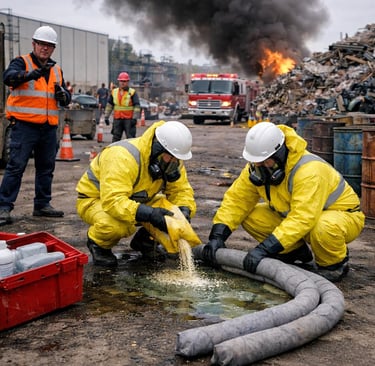
Scrap recycling facilities operate on thin margins, with high priorities placed on speed, throughput, and material flow. But every load of batteries, wires, or solvent drums introduces the potential for hazardous materials (HazMat) incidents. For Environment, Health & Safety (EHS) managers, operations supervisors, and HR leaders, the impact of HazMat compliance lapses is immediate and severe: regulatory agencies like the EPA, OSHA, and DOT don’t hesitate with fines, permit suspensions, or targeted audits.
Why is this climate tightening?
The U.S. Department of Labor’s Occupational Safety and Health Administration (OSHA) increased unannounced inspections at scrap facilities by 18% between 2017–2022, with over half involving documentation review and drill observations.
Insurance companies, driven by risk data, now factor HazMat violations into liability premiums, raising costs by up to 25% after a flagged incident.
EPA data shows that for each unresolved HazMat violation, scrap facilities face average penalties of $17,650 per case—often accompanied by mandatory retraining or operations suspension.
In the past, a dusty sign-in sheet sufficed. Today, regulatory focus has shifted to practical, scenario-based training and robust recordkeeping. Inspectors want evidence of actionable learning, staff engagement, and procedures tightly aligned with everyday risks. Failing to demonstrate these—especially during a surprise audit—can put your entire operations at risk.
2. Defining the HazMat Compliance Challenge
Balancing Real Risk with Real-World Operations
The challenge is both clear and daunting: “Train everyone, prove compliance, reduce risk—without stopping production.” The friction between compliance training and daily business is particularly acute in scrap recycling, an industry pressured by volatile scrap prices and constant staffing turnover.
Common symptoms of weak compliance include:
Superficial training: Annual PowerPoints and sign-in logs that do little to change staff behavior under stress.
Paper drills: Exercises run ‘on paper’ without real testing of crisis response, leading to complacency.
Reactive culture: Procedures are only updated after incidents or inspections, not proactively.
Inconsistent documentation: Missing drill logs, outdated SOPs, and murky retraining records put even solid programs at risk.
The True Cost of Getting It Wrong
Regulatory fines and permit loss: A single missed quarterly drill or incorrect log entry can trigger fines of $10,000–$50,000, as seen in well-publicized EPA enforcement actions against midwestern scrap processors.
Insurance hikes: After an incident that exposes compliance lapses, insurers average a 12–22% increase on annual premiums for similar facilities (source: Marsh McLennan 2023 Scrap Facility Risk Survey).
Staff safety and morale: When incidents occur, poorly trained teams experience higher injury rates—OSHA reports a 35% higher injury risk in facilities lacking regular drills.
Operational shutdowns: Unplanned ‘stop work’ orders during audits can cost facilities six figures in lost revenue over just a few days.
Long-term agency scrutiny: Repeated deficiencies often place facilities under corrective-action “enhanced oversight” programs, requiring more reporting and limiting operational flexibility.
The Takeaway
A compliance-first HazMat training plan is not a luxury—it’s now a core operational safeguard and strategic advantage.
3. Key HazMat Training Concepts for Scrap Facilities
To create a foundation for effective HazMat compliance, scrap facility leaders must embrace and communicate the following concepts:
Compliance: The ongoing demonstration that facility procedures, records, and everyday behaviors align with legal and regulatory requirements—particularly those defined by OSHA, EPA, and DOT. Compliance is dynamic, not static, and must evolve with changing materials, regulations, and staff composition.
Permits: Authorizations allowing specific HazMat operations. Permits require up-to-date, documented training for all personnel affected by hazardous materials. Lack of retraining can invalidate a permit, leading directly to production stoppage.
Audits: Both planned and surprise regulatory reviews that assess a facility’s paperwork, physical site walk-throughs, and staff’s ability to perform under pressure. The 2023 EPA HazMat Audit Playbook emphasized that “drill logs and scenario response records are as important as classroom training logs.”
Scenario-Based Training: Moves beyond abstract safety theory, using site-specific events—like a battery acid spill or a chemical drum rupture—to build realistic muscle memory.
Drills: Live, hands-on simulations that stress-test SOPs and team readiness. Drills are where theoretical compliance meets practical safety—and where most audit deficiencies originate.
Toolbox Talks: Bite-sized, frequent refresher sessions (typically 5–10 minutes) designed to keep compliance procedures top of mind throughout the year. Facilities using monthly toolbox talks report 20–30% higher regulatory audit scores.
The Compliance Vocabulary in Practice
Embedding these concepts in daily vocabulary encourages all employees to view compliance not as an obstacle, but as a pathway to safer, smoother operations. Leading scrap facilities institute regular briefings where EHS managers “translate” regulatory language into site-specific, actionable advice, reducing ambiguity and confusion among frontline staff.
4. The Compliance-First Training Framework
Building a Culture of Continuous Compliance
A robust HazMat training program centers on a proactive, layered approach—one that goes beyond the minimum legal checkboxes. Let’s break down the compliance-first framework into executable components:
1. Annual Training Calendar
Schedule all critical training dates (classroom, drills, toolbox talks) a year in advance to ensure visibility, minimize workflow disruption, and support recordkeeping. Use digital calendars (e.g., SharePoint, Google Calendar) with automated alerts for better accountability.
2. Layered Learning for All Levels
Annual Classroom Instruction: Sets the compliance baseline, introducing regulatory changes, core HazMat principles, and site-specific updates. Make sessions interactive (case studies, Q&A) to reinforce learning.
Quarterly Hands-On Drills: Rotate scenarios—chemical spills, fire response, emergency evacuation, PPE deployment—to touch every risk area and support permit obligations.
Monthly Toolbox Talks: Use trends from recent incidents and audit feedback to select timely discussion topics, making learning relevant and engaging.
3. Documentation That Stands Up to Audit
Maintain dual records:
Digital: Centralized in cloud platforms for indexability, searchability, and easy sharing with inspectors.
Physical: Bound “evidence kits” onsite, including signed logs, SOP versions, and drill debrief notes.
4. Continuous Improvement Cycle
After every major drill or incident:
Assess response effectiveness (timing, accuracy, risk mitigation).
Capture action items and lessons learned.
Update SOPs and redistribute them to the team within two weeks.
Solicit feedback from drill participants for grassroots improvement.
Drill Implementation Playbook
If your goal is “training that sticks,” your drills must do two things at once. They must create performance under stress, and they must create evidence that stands up to audit. Evidence does not mean binders for the sake of binders. It means a trail that proves three points: you trained the right people, on the right hazards, at the right frequency, and you corrected what the drill revealed.
Start by defining your drill system in three layers.
Layer 1: Micro-drills (10 to 20 minutes)
These are targeted, frequent, low-disruption reps. They fit between shift change and first loads.
Examples:
SDS retrieval drill. A supervisor asks, “Show me the SDS for solvent X and the required PPE.” Time it.
Label check drill. Walk two inbound areas, confirm labels, confirm secondary container labels, confirm that nothing is decanted into mystery bottles.
Spill kit readiness drill. Open the kit, check neutralizer, absorbents, disposal bags, tape, PPE sizing, and expiry.
Layer 2: Functional drills (30 to 60 minutes)
These test a workflow end-to-end with real movement. They should be quarterly if you can, because DOT and EPA training requirements are not the only expectation. OSHA expects emergency planning and training tied to your Emergency Action Plan, and your local fire authority will look for practical readiness, not posters.
Examples:
Battery thermal event drill at the sorting line.
Unknown drum inbound drill at the scale house.
Acid spill drill in the battery box area.
Layer 3: Full-scale drills (60 to 120 minutes)
These are the ones you invite observers to, including internal leadership, and sometimes local responders if the relationship is mature. You do not need many per year. Two is enough if you do them well and you close findings fast.
Before you run any drill, lock in the six design decisions that make drills work in scrap environments.
Decision 1: Choose scenarios that match today’s scrap stream
If your scenarios do not include lithium-ion batteries, damaged e-mobility packs, and battery-embedded devices, your drill program is behind reality. EPA has documented hundreds of publicly reported lithium-ion battery fire incidents in the waste and recycling system, and the sector continues to report rising facility fire counts year over year.
Decision 2: Set role-based objectives, not generic objectives
Every drill should have objectives per role, because auditors ask the frontline person questions, not the training manager.
Scale house objective: detect red flags, isolate load, trigger the right notification chain.
Equipment operator objective: stop-work, isolate area, do not spread the hazard, communicate clearly.
Supervisor objective: run the checklist, account for people, control scene until EHS arrives.
EHS objective: assess hazard class, decide containment, document and trigger waste handling steps.
Decision 3: Build a “no-hero” rule into the drill
In scrap facilities, people try to fix problems fast. That instinct can get them hurt. Your drill must train a disciplined pause.
Use a simple line in every pre-brief: If you do not know what it is, you do not touch it. You isolate, you notify, you wait.
Decision 4: Time the actions that matter
Do not just record “pass” or “fail.”
Record:
Time to stop-work.
Time to isolate a zone.
Time to retrieve SDS and identify required PPE.
Time to deploy the correct spill response materials.
Time to complete notifications.
Decision 5: Put documentation into the drill, not after it
If the paperwork happens later, it will get skipped during busy weeks.
Make the scribe role part of the drill. The scribe captures timestamps, decisions, and deviations. That becomes your audit evidence.
Decision 6: Close the loop within 14 days
A drill that produces findings and no changes trains cynicism. Your own framework already says “update SOPs within two weeks.” Keep it. That is the difference between a program and a performance.
A sample quarterly drill cadence that fits scrap operations
Quarter 1: Unknown inbound drum
Stress test scale house isolation, inbound rejection protocol, and supervisor communication.Quarter 2: Battery thermal event
Stress test detection, isolation, pile management, and fire response coordination.Quarter 3: Acid spill and PPE deployment
Stress test neutralization decisions, burn response readiness, and decontamination steps.Quarter 4: Evacuation and accountability
Stress test Emergency Action Plan roles, muster points, headcount accuracy, and re-entry controls. OSHA’s Emergency Action Plan standard requires a written plan and employee awareness of procedures, and OSHA’s guidance explicitly supports practice drills “as often as necessary.”
Where DOT, EPA, and OSHA fit without turning your blog into legal text
For many scrap facilities, HazMat compliance is a three-agency overlap:
DOT training applies when employees perform hazmat functions tied to shipping or transport, and recurrent training is required at least every three years.
EPA hazardous waste generator training applies when you operate as an LQG and must ensure personnel training under 40 CFR 262.17(a)(7).
OSHA HAZWOPER applies for covered hazardous waste operations and emergency response roles, with annual refresher expectations for covered employees.
Your drill program becomes the proof that these are lived requirements, not slide decks.
Measurement and Quality Assurance
Most facilities measure training the wrong way. They measure completion, not competence. Completion is easy to audit, but it does not predict safety outcomes.
Your measurement system should have three tiers: leading indicators, drill performance indicators, and lagging indicators.
Why leading indicators matter
A large safety evidence base supports the use of leading indicators to predict and prevent harm. Global estimates of work-related harm remain huge, which is why proactive measures are emphasized in modern safety management.
Leading indicators you can track without slowing production
Training coverage by role and hazard
Percent of employees in hazmat-touch roles current on required modules.
Percent of supervisors current on incident command basics.
Percent of contractors briefed before starting work.
Drill repetition and freshness
Micro-drills completed per month per department.
Time since last drill of each critical scenario type.
Hazard reporting signal
Near-miss reports per 100 employees per month.
Percent of near-miss reports that get a documented closeout within 14 days.
Toolbox talk effectiveness
Toolbox talks are widely used because they fit operations, and research continues to evaluate their role in improving safety communication and culture. Your program should track whether they are happening, and whether they change behavior.
Drill performance indicators that auditors respect because they are observable
Time-to-action metrics
Time to stop-work.
Time to isolate.
Time to PPE.
Time to SDS retrieval.
Time to complete notifications.
Accuracy metrics
Correct hazard identification rate.
Correct PPE selection rate.
Correct waste handling step selection rate.
Correct documentation completion rate.
Reliability metrics
Headcount accuracy during evacuation.
Radio clarity score, meaning did messages include location, hazard, and request.
Quality assurance routines that keep data honest
Use blind spot checks
Once per quarter, run one unannounced micro-drill in each high-risk area. Keep it short. Keep it safe. Capture performance.Do spot interviews
Ask three random employees one question each:Where is the SDS station?
What is the stop-work signal?
Where is the muster point?
If they cannot answer, you have a training gap regardless of completion records.
Audit your records like an inspector would
Inspectors look for consistency and recency. They look for version control. They look for retraining after changes.
Your internal QA audit should confirm:Every drill has a scenario description, date, participants, roles, objectives, timestamps, and after-action findings.
Every finding has an owner and due date.
Every SOP update has a version number and redistribution record.
Case Patterns
Scrap facilities tend to repeat the same failure modes. The materials change, but the pattern stays.
Pattern 1: Lithium-ion batteries inside “normal” inbound streams
This is now the dominant modern driver of fires across waste and recycling. EPA’s analysis documented 245 publicly identified fires from 2013–2020 across 28 states, and the broader industry has continued reporting rising facility fire totals in recent years.
What the pattern looks like on the ground
A small battery-embedded device enters a belt.
It gets crushed or punctured.
Thermal runaway starts.
The event spreads into paper, plastics, fluff, or fine shred fractions.
Training implications
Your best control is fast detection and disciplined isolation. Drills must train people not to kick a smoking item into a corner, and not to throw water blindly if your fire response plan says otherwise. Build the decision tree into the drill.
Pattern 2: Chronic chemical exposure, poor hazard communication
OSHA enforcement actions in recycling repeatedly cite failures tied to chemical hazards, including repeat and serious violations, and six-figure penalties. The dollar amount is not the point. The pattern is. When hazard communication is weak, workers do not know what they are handling until someone is hurt or a regulator shows up.
Training implications
Do not treat hazard communication as a classroom-only topic. Drill the real behaviors:
Can employees find the SDS?
Do they recognize pictograms and label elements?
Do they know required PPE and first-aid actions for common chemicals?
Pattern 3: Environmental enforcement exposure at scrap operations
EPA has published enforcement alerts for metal shredders, focused on emissions concerns, and notes the size of the shredder facility population and the history of enforcement actions.
Training implications
Your HazMat training plan should include “environmental response behaviors,” not just worker safety. That includes spill prevention, stormwater controls, and containment actions during incidents, because environmental impacts trigger a different level of scrutiny.
Pattern 4: Battery recycling and processing incidents can escalate into multi-day events
Large lithium battery processing incidents can force evacuations, extended fire response, and contamination concerns. NFPA has discussed the unique hazards involved in lithium-ion battery recycling following the Missouri plant fire.
Training implications
Even if you do not recycle batteries, your facility can still receive them. Your drill program must train “recognize, isolate, and escalate,” because the consequence curve is steep.
Scenarios and Conclusion
Below are four scenarios you can run as a complete set. Each one is designed to produce both competence and audit-ready evidence.
Scenario 1: The smoking device on the conveyor
Setup
A “smoke indicator” is triggered at a safe location on the line. Use a controlled training prop and follow your safety rules.
What you are testing
Stop-work discipline.
Isolation behavior.
Notification chain.
Fire response steps aligned to your plan.
Run steps
Operator calls stop-work and announces location.
Spotter identifies the item zone and clears unnecessary staff.
Supervisor establishes an exclusion zone.
EHS confirms the isolation method and directs handling.
Scribe records times and actions.
Pass criteria
Stop-work within 30 seconds.
Clear zone established within 2 minutes.
Correct notification steps completed within 5 minutes.
After-action identifies one improvement and assigns it within 14 days.
Why this scenario matters now
The industry continues reporting increasing facility fire totals tied to batteries in the stream, and EPA has documented this as a systemic problem.
Scenario 2: Unknown drum inbound at the scale house
Setup
An inbound load includes an unlabelled drum. It is staged in a controlled area for the drill.
What you are testing
Inbound rejection and isolation.
Driver management and communication.
“Do not touch” discipline.
Correct escalation.
Run steps
Scale operator pauses inbound flow and flags the load.
Supervisor isolates the vehicle and directs it to a quarantine zone.
EHS begins identification workflow, without opening the drum.
Documentation captures driver details, load origin, photos, and actions.
Pass criteria
No one touches or opens the drum.
Vehicle routed to quarantine within 10 minutes.
Correct internal notifications occur.
Documentation is complete and retrievable.
Scenario 3: Battery acid spill in the staging area
Setup
Simulate a spill with safe substitute liquid and mark boundaries.
What you are testing
PPE selection.
Spill kit readiness.
Neutralization and containment choices.
Medical response readiness.
Run steps
First observer calls it in and establishes distance.
Supervisor confirms correct PPE and assigns roles.
Responder deploys spill kit materials according to SOP.
Scribe records time to PPE and time to containment.
Post-drill, inspect the spill kit and restock immediately.
Pass criteria
Correct PPE selected.
Spill contained within set target time.
Waste handling steps identified correctly if regulated waste applies.
Scenario 4: Evacuation, accountability, and re-entry control
Setup
Trigger an evacuation signal during a normal shift window.
What you are testing
Emergency Action Plan execution.
Headcount accuracy.
Muster point discipline.
Re-entry controls.
Run steps
All departments evacuate to assigned muster points.
Supervisors run headcount and report to incident lead.
Incident lead confirms all accounted for, then authorizes controlled re-entry.
Pass criteria
Headcount complete within 7 minutes.
Zero re-entry until authorized.
Clear documentation of times and names.
OSHA requires Emergency Action Plans under 29 CFR 1910.38 and emphasizes training employees so they understand their roles, and practice drills are recommended as needed to keep readiness high.
Conclusion: what makes HazMat training “stick” in scrap
Training sticks when it becomes a set of repeated behaviors that survive a bad day.
Your annual calendar sets the rhythm.
Your micro-drills build muscle memory.
Your quarterly functional drills prove the system works under stress.
Your measurement system tells you the truth, not the story you want to hear.
Your closeout discipline turns drills into operational improvement.
Connect
Your trusted partner for scrap metal procurement.
CONTACT
About
haroon@tdcventures.com
+1-307-655-7593
© 2025. All rights reserved.
NEWSLETTER