
Heatwave-Ready Urban Furniture: Recycled Aluminum Resilience
Discover how recycled aluminum furniture creates heat-resilient public spaces. A guide to cool-node design, circular procurement, and climate-adaptive street infrastructure.
CLIMATE-RESILIENT INFRASTRUCTURE & CIRCULAR MATERIALS
1. Why heatwave-ready urban furniture is now core infrastructure
Cities are heating faster than most capital plans can keep up with, and the impact is no longer abstract. Heat is a public health risk, a service-reliability risk, and a credibility risk for municipal leaders. Between 2000 and 2019, studies cited by the World Health Organization estimate about 489,000 heat-related deaths occur each year globally, with large shares in Asia and Europe.  In Europe alone, the summer of 2022 saw an estimated 61,672 heat-related excess deaths, based on large-scale regional mortality analysis. 
That reality changes how you should think about “small” public assets. Benches, transit shelters, bike racks, litter bins, railings, shade structures, and queue rails stop being street décor and become contact points in the public health system. During heat events, people sit longer, wait longer, and search for any safe place to rest. If the public realm is built from layouts and materials that amplify heat exposure, you push risk onto the people with the least ability to adapt, including seniors, outdoor workers, children, and people with underlying health conditions.
This guide focuses on a practical response that cities can deploy and scale: heatwave-ready urban furniture built from recycled aluminum, designed as a circular, modular, measurable infrastructure layer. The objective is direct. Reduce heat exposure in everyday public life while lowering embodied emissions and making maintenance faster when the city is under stress.
2. Heat risk, urban heat islands, and why public-space hardware matters
Heat harms people through direct heat stress, cumulative exposure, and unequal exposure. Direct heat stress hits when the body cannot shed heat, core temperature rises, dehydration accelerates, and cardiovascular strain increases. Cumulative exposure is what makes multi-day events so dangerous, especially when nights stay warm and the body cannot recover. Unequal exposure is where heat becomes an equity issue, because some neighborhoods have less canopy, more impervious surface, fewer shaded waiting areas, and higher baseline temperatures.
Street furniture is part of that exposure pathway. A transit stop without shade is not neutral, it forces people to absorb solar radiation while waiting. A bench in full sun that becomes painfully hot is not a comfort amenity, it becomes unusable at the exact moment it is needed most. That is why furniture is a high-return adaptation target. It is relatively fast to deploy, repeatable, and easy to prioritize for the hottest, highest-dwell locations.
3. Why recycled aluminum is a serious resilience material
Aluminum is not a cure-all, but it has three traits that matter for heat adaptation programs. It can be durable and corrosion resistant when specified correctly, it has high circular potential because it can be recycled repeatedly, and it can deliver large energy and emissions advantages when recycled content displaces primary production.
The energy story is unusually clear. The International Aluminium Institute reports that recycled aluminum has a far lower primary energy demand than primary production, and cites a 95.5% energy saving in the comparison they publish.  Natural Resources Canada states secondary aluminum production requires about 95% less energy than primary production, which supports procurement narratives tied to climate targets and operational cost stability.  The Aluminum Association similarly notes that making recycled aluminum takes about 5% of the energy needed to make new aluminum, and that around 75% of all aluminum ever produced is still in use today, which reflects the material’s durability and recycling economics across long cycles. 
For cities, this matters because adaptation spending is increasingly expected to deliver mitigation benefits too. Recycled aluminum is one of the few materials where you can credibly connect durability, repairability, and circular recovery to real energy and emissions advantages.
4. Comfort and safety in heat, burn risk, glare, touch points, and shade strategy
Heatwave-ready furniture must be designed around human contact, not just structural survival. People will touch armrests, backrests, railings, bike racks, bin lids, and shelter rails. If those surfaces get too hot, people avoid them or get injured.
There is clear evidence that sun-exposed surfaces can reach temperatures linked to contact burns. In a study measuring surface temperatures under high solar load in a desert climate, sun-exposed metal reached 144°F, about 62°C, and the authors describe the relevance to burn-injury prevention.  Separate research on outdoor play environments found sun-exposed equipment and surfaces frequently exceeded skin-contact burn thresholds, with some materials exceeding 80°C, reinforcing that surface temperature is a real safety variable in public environments. 
The practical solution is not “avoid metal.” It is shade-first siting, smart detailing, and finishes that reduce heat absorption while controlling glare. Comfort-ready benches use slats or perforations that reduce heat buildup and allow air movement. Touch points can be designed with lower-conductivity caps or inserts where it matters most, without compromising the recyclability of the main structure. Glare risks can be reduced through matte finishes and controlled reflectance coatings.
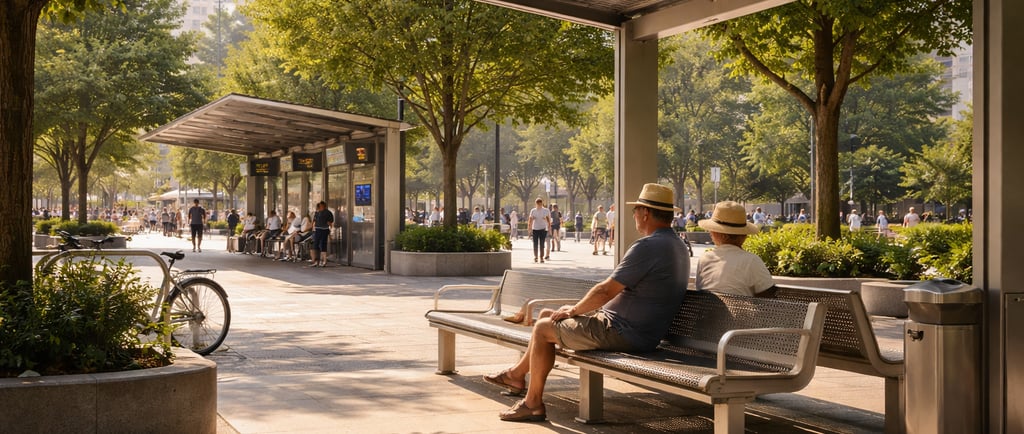
Shade is the multiplier. Even strong materials and coatings struggle under full midday sun. The most effective deployments treat furniture as part of a “cool node,” seating paired with shade and, in some contexts, hydration access.
5. Design requirements, performance specs, and material and coating choices
A scalable program needs specifications that turn intent into measurable requirements. If you want engineers, procurement leads, and risk managers to treat this as infrastructure, define performance across four layers.
Thermal performance
Require vendors to provide a testing approach for surface temperature under solar exposure for representative finishes. Then validate it in pilots across different microclimates using consistent measurement methods.
Structural performance and safety
Define load ratings, anchoring requirements, and vandal-resistance features. Modularity should increase serviceability without reducing stability.
Finish durability
Specify UV resistance, abrasion resistance, chemical resistance, and color stability. Finish failure drives premature replacement, which wipes out both budget and carbon benefits.
Circular design
Require design for disassembly. Favor standard fasteners and serviceable parts so components can be swapped and the material stream stays clean at end of life.
Coatings can play a supporting role in reducing heat buildup. Product literature for “low solar absorption” powder coatings claims improved solar reflectance and reduced heat buildup on coated components, including in darker shades. For example, AkzoNobel’s Interpon D Low Solar Absorption materials state that the coating reflects up to 65% of the sun’s energy, limiting heat buildup and thermal stress.  Use claims like this as candidates for validation during pilots, not as a substitute for shade and airflow design.
6. Circular procurement, traceability, and documentation that survives audits
Circular procurement fails most often because documentation is weak. If you want cities to scale recycled aluminum furniture, require an evidence stack that can survive finance review and public scrutiny.
At minimum, require verified recycled-content claims with clear definitions, favor EPDs where feasible, require chain-of-custody documentation when projects have climate-finance or reporting exposure, and mandate take-back terms that turn “recyclable” into “recovered and recycled.”
7. Installation models, modularity, and rapid repair in heat emergencies
Heatwaves stress operations. Crews face constraints. Service calls rise. That is why heat-ready street furniture should reduce labor intensity, not add to it.
Modular systems support rapid swaps, phased upgrades, and parts inventory planning. The transit sector has long pushed modular shelter approaches because adaptable designs can reduce manufacturing and maintenance expenses and simplify customization without rebuilding everything.  For cities, the operational logic is simple. Standard modules reduce downtime, standard mounting reduces install time, and standardized spares make repairs possible during peak season.
8. Equity, access, and public acceptance
Heat risk is uneven, and the public will notice if upgrades are uneven too. Equity-led siting should prioritize transit-dependent corridors, areas with low canopy and high impervious cover, routes to clinics and community services, and neighborhoods with older populations.
Acceptance also depends on comfort and aesthetics. People judge safety and usability in seconds. Shade integration, touch-point comfort, accessible layouts, and visible durability are what win trust, not claims.
9. Measurement plan, KPIs, lifecycle cost, and carbon accounting
A reference-grade guide needs a measurement backbone. Without it, teams cannot justify budgets, compare vendors, or defend decisions.
Build KPIs around four buckets: thermal exposure reduction through comparable surface-temperature readings and shade coverage, service reliability through downtime and repair time, lifecycle cost through labor and replacement frequency, and carbon and circularity through verified recycled content and documented recovery at end of life.
Shade performance belongs in that measurement plan too, because it can shift real heat exposure dramatically. Research reviews report that shade at bus stops can reduce physiological equivalent temperature by 19°C in relevant contexts, which is a major change in experienced heat. 
10. Likely market gaps and assumptions
Even as heat becomes a public-health and service-reliability issue, many cities still treat street furniture as a low-stakes line item. That mismatch is the core reason adoption stays slower than the climate curve. If you want heatwave-ready, recycled aluminum furniture to scale globally, you need to plan for the gaps below, because they show up in almost every procurement cycle, across North America, Europe, MENA, and APAC.
1. Supplier market mismatch, documentation, capacity, and the greenwashing problem
Demand for lower-carbon public assets is rising, but supplier readiness is uneven. Some vendors can build good furniture, but cannot prove recycled content, cannot provide credible Environmental Product Declarations, or cannot support take-back logistics. Others can provide sustainability paperwork but rely on far-away fabrication, which adds transport emissions and slows replacement during heat emergencies. You also face marketing-led claims, “contains recycled aluminum,” without a clear percentage, a defined boundary (post-consumer vs post-industrial), or a verification pathway.
This is not theoretical. Cities are actively trying to standardize and professionalize street-furniture contracting so they can reduce fragmentation and improve outcomes. The BC Transit Shelter Program describes how a wide mix of manufacturers and designs without standardization creates procurement and management challenges, and why a more consistent approach is needed. 
Strategic response
Set a minimum evidence stack in every RFP and score it hard. Treat it as pass-fail for critical claims. Require clear recycled-content percentages, a definition of what “recycled” means in that contract, and proof that stands up in audit conditions. When you can, favor suppliers that support local or regional fabrication and finishing, because your maintenance cycle is only as fast as your supply chain. Add contract language that prevents vague environmental claims, and ties payment milestones to verified documentation.
2. Performance data gaps, especially for microclimates and real use
Cities often have strong data on “air temperature,” but weak data on “felt heat” at street level, where sun exposure, wind, shade, and material surfaces drive real risk. Heat safety is not only about ambient temperature, it is about what surfaces do under solar load, and how people actually interact with them. Without field data, decision-makers either over-trust marketing brochures or they delay decisions waiting for perfect proof.
There is solid evidence that sun-exposed surfaces can reach contact-burn temperatures, and that metal surfaces under sun can run extremely hot depending on conditions. A study measuring outdoor surface temperatures recorded sun-exposed “metal” reaching 144°F (about 62°C) under high solar radiation in a desert climate, with explicit relevance to burn injury prevention.  Separate work on outdoor play environments found that sun-exposed equipment and surfaces frequently exceeded skin-contact burn thresholds, with some materials exceeding 80°C. 
Strategic response
Build a “proof loop” into deployment. Start with pilots in different microclimates, for example high-albedo waterfront corridors, dense canyon streets, suburban arterials, and transit interchanges. Instrument a small sample with surface-temperature sensors and basic usage counts. Publish a short, open dataset. The goal is not academic perfection, it is an operational benchmark your procurement team can reuse. Make performance monitoring part of routine maintenance, not a one-off research task.
3. Shade and shelter can help, but poor designs can also backfire
A bench finish matters, but shade and airflow often matter more. When you site furniture in full sun without shade, you force materials and coatings to do all the work. In practice, heat-ready furniture performs best as a “cool node” that pairs seating with shade and sensible airflow.
Evidence here is strong. Research has shown that shade and canopy around bus stops can moderate heat exposure and affect ridership patterns, which reinforces that stop design is not just comfort, it is system performance.  A 2025 review of bus-shelter research reports that shade at stops can reduce physiological equivalent temperature by 19°C in relevant contexts, which is a major change in the heat a human body experiences.  At the same time, research summaries and reporting also note that some shelter designs can trap heat and do harm, which means you must design for shade plus ventilation, not shade alone. 
Strategic response
Treat shade and airflow as first-class specifications. In every pilot, test at least two conditions, sun-exposed vs shaded. Avoid “glass box” shelters that block wind and trap radiant heat. Pair furniture with shade, and design shade as modular add-ons so you can retrofit quickly where heat risk is highest.
4. Community acceptance and equity are operational constraints, not PR issues
Even a technically strong program can fail if people do not trust it, cannot use it comfortably, or believe it serves the wrong areas. Heat risk is uneven, and public-space upgrades often arrive unevenly too. If the first rollouts land in tourist cores while heat-vulnerable neighborhoods wait, you will get pushback and you will lose momentum.
Strategic response
Make siting equity explicit and measurable. Use simple criteria: low canopy, high impervious cover, high pedestrian exposure, high transit dependence, proximity to clinics and community services, and areas with older populations. Add participatory pilots and real comfort testing. Most skepticism about metal furniture disappears when shade, touch-point detailing, and surface finishes are done correctly, and people experience the difference on a hot day.
5. Upfront cost misconceptions, and the “purchase price trap”
This category kills scale more than any technical issue. People compare line items, not outcomes. They compare purchase price, not service life, repair time, and operational downtime. They ignore the cost of staff labor over a decade, replacement cycles, complaint handling, and lost public-service quality during heat events.
Modularity helps here because it cuts replacement time and makes maintenance predictable. The transit industry has long pushed modular shelter designs because adaptable systems can reduce manufacturing and maintenance costs, and simplify customization without rebuilding everything. 
Strategic response
Make lifecycle cost the default language. Require vendors to provide service-life assumptions, coating life expectations, parts availability, and repair time estimates. Run a simple 10-year cost scenario that includes labor, downtime, and replacement frequency. Do not try to win by arguing “green,” win by proving operational reliability and cost stability under heat stress.
6. Recycling and end-of-life pathways, circularity only exists if you plan the reverse logistics
Aluminum is highly recyclable, but recyclability does not guarantee recovery. Circular performance depends on collection, disassembly, sorting, and take-back agreements that make it easy for a city crew to do the right thing under time pressure.
The good news is that aluminum recycling has one of the clearest energy and emissions advantages available to cities. The International Aluminium Institute reports that recycled aluminum’s primary energy demand is far lower than primary production, with a 95.5% energy saving in the comparison they publish.  Natural Resources Canada states secondary aluminum production requires about 95% less energy than primary production.  The Aluminum Association notes that making recycled aluminum takes about 5% of the energy needed to make new aluminum, and that around 75% of all aluminum ever produced is still in use today. 
Strategic response
Put circularity in the contract as enforceable steps, not intentions. Require design for disassembly, require spare-part availability, require take-back terms, and require proof of recovery and recycling at end of life. Use asset IDs, even simple QR-based tags, to track modules and improve recovery rates. If your program cannot prove recovery, it will struggle to justify climate claims and may lose eligibility for some funding streams over time.
Integrating the solution, next steps for city leaders
If you want this to become a repeatable global model, treat it like a program, not a product purchase. The winning approach is a staged build that creates proof, standardizes specs, and scales through predictable procurement.
Step 1, define the “cool node” standard
Write a baseline spec that includes seating, shade strategy, touch-point detailing, coating requirements, and serviceability. Then define where it will be deployed first, typically transit stops, queues, and high-dwell public areas.
Step 2, run pilots that measure what matters
Measure surface temperatures, shade effectiveness, comfort feedback, and maintenance time. Use the same sensor and measurement method everywhere, so the data is comparable.
Step 3, lock the documentation and circular terms
Require recycled-content verification, prefer EPDs where feasible, and mandate take-back and recovery reporting. If circular terms are optional, they will be ignored under budget pressure.
Step 4, standardize modules and spares
Scale happens when replacement becomes easy. Standard plates, standard fasteners, standard modules, and a simple spare-parts plan.
Step 5, publish results and keep improving
Public reporting builds trust and protects budget continuity. It also helps other cities replicate the model, which grows the supplier market and lowers costs over time.
Future trends, where this is going next
1. Smart, connected furniture that measures heat exposure in real time
Urban furniture is a natural sensor platform. Expect more cities to track surface temperature, usage, and maintenance signals at critical sites. That creates heat dashboards that show where the public realm is failing during heat events, and where investments create real exposure reductions.
2. Advanced surface technologies and heat-reflective coatings
Infrared-reflective pigments and “low solar absorption” powder coatings are being marketed directly as ways to reduce heat buildup on coated surfaces. For example, AkzoNobel’s Interpon D Low Solar Absorption materials state that the coating reflects up to 65% of the sun’s energy, limiting heat buildup and thermal stress.  You should treat these as tools that complement shade and ventilation, not replacements for them.
3. Regional circular supply networks and take-back systems
As more cities require recoverable modules, regional closed-loop pathways become more viable. That helps stabilize supply, improves recovery rates, and reduces total embodied emissions over time.
4. Stronger alignment with green public procurement and circular tenders
More public buyers are formalizing circular procurement in furniture tenders. The European Commission highlights Helsinki’s approach to circular and fair procurement for office and public furniture as a structured way to embed circular principles and social standards into purchasing. 
5. Co-design expectations will rise
As heat impacts become more visible, citizens will expect more say in public-space comfort and safety. Programs that run participatory pilots and publish performance data will move faster, because they reduce skepticism and create shared ownership.
Final thoughts, building cities that withstand heat at street level
Heatwaves are now a recurring stress test for public space. When the street fails, people get hurt, transit use drops, and trust erodes. Heatwave-ready urban furniture, built from recycled aluminum, gives cities a rare combination: rapid deployment, durability, circular potential, and measurable climate benefits. It also gives you a practical unit of action, a “cool node,” that can be deployed where risk is highest and scaled through standardized procurement.
If you combine shade-first siting, comfort-safe detailing, proven coatings, circular contracts, and a simple measurement program, you can turn benches and shelters into real resilience infrastructure. That is how you set a standard other cities can copy, and how you build a reference-grade model that stays useful year after year.
Connect
Your trusted partner for scrap metal procurement.
CONTACT
About
haroon@tdcventures.com
+1-307-655-7593
© 2025. All rights reserved.
NEWSLETTER