
Image-Based Contamination Warnings to Residents: AI Engagement and Digital Behavior Change in Recycling Apps
AI-powered image recognition sends personalized contamination warnings to residents, cutting recycling contamination by over 22% while boosting participation. Learn the complete framework, metrics, and real-world case studies.
AI & DIGITAL ENGAGEMENT IN SUSTAINABILITY
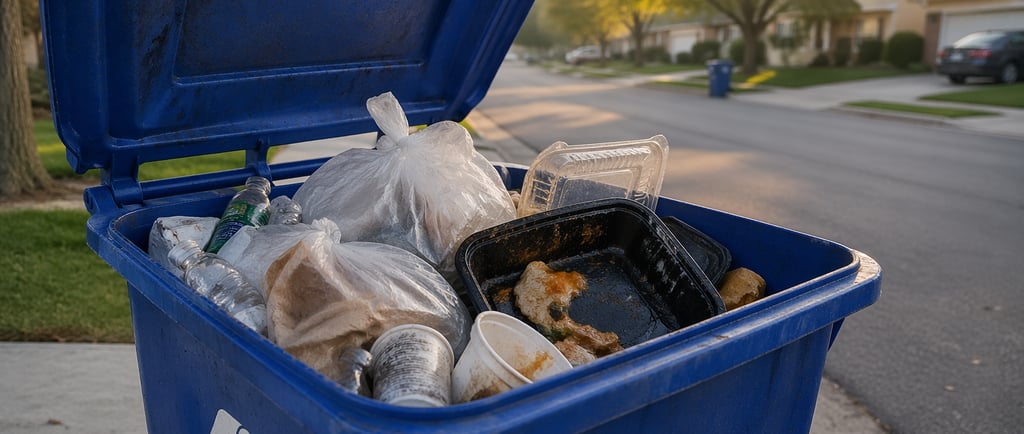
Instant Answer
Image-based contamination warnings leverage AI-powered image recognition to scan and analyze recycling bin photos submitted by residents. The system flags mis-sorted or non-recyclable items and instantly delivers personalized digital notifications. This rapid, relevant feedback educates users, fosters sustainable behavior change, and measurably reduces recycling contamination for municipalities, haulers, and MRFs by synchronizing digital outreach with real-time corrective actions.
Table of Contents
Context and Why It Matters for Recycling Teams
Defining the Contamination Challenge
Key Concepts: AI Engagement, Digital Feedback, Behavior Change
The Stepwise Framework: Image-Based Warnings to Action
Implementation Playbook: Rolling Out Effective Warnings
Measurement and QA: Metrics for Success
Mini-Case Scenarios: Image Warnings in Action
FAQs
Embedded Five-Layer Distribution and Reuse Toolkit
Competitive Differentiation: Market Gaps and Upgrades
1. Context and Why It Matters for Recycling Teams
Across the US and globally, the recycling sector is locked in a high-stakes battle against contamination. According to The Recycling Partnership, the average US city has a contamination rate between 20-30%, with some regions seeing spikes as high as 40%. This means billions in recyclable material are improperly sorted and often end up in landfills, undermining the circular economy and climate progress.
The urgency has never been greater. Consumer brands, municipal governments, and local advocates are raising the bar for recycling performance, integrating sustainability goals that hinge on cleaner material streams. Every rejected load not only drives up costs for municipal recycling programs and their Material Recovery Facility (MRF) partners, but it also eats into public trust and contract renewals.
Traditional outreach methods—postcards, leaflets, static websites—rely on broad, one-size-fits-all messaging. Residents may glance at a "What's Recyclable?" flyer once, but when it's bin collection day, those details are out-of-sight, out-of-mind. This gap between information and action is the Achilles' heel of old-school recycling education.
With the digital transformation and rise of AI capabilities in daily municipal operations, the tide is turning. Advances in machine learning, smartphone access, edge computing, and digital communications make it possible to close the feedback loop at hyper-local levels. By embedding recycling behavior change tools into popular apps and connecting them with curbside or MRF imaging, teams can catalyze a shift from hered awareness to habitual, contamination-free participation.
Why now?
Google search ranking algorithms and local SEO both reward demonstrable, actionable results. Information alone no longer suffices—municipalities and their waste partners are evaluated on real-world outcomes, making the integration of AI-driven feedback loops not just a "nice-to-have," but a market imperative.
For public works leaders, operations managers, and sustainability officers, the ultimate goal isn't just reducing recycling contamination today, but building a digital engagement infrastructure that sustains behavior change, measures impact, and scales affordably across communities.
2. Defining the Contamination Challenge
What is Recycling Contamination, and Why Is It So Durable?
Contamination occurs when non-recyclable items (like plastic bags, styrofoam, food waste, or flexible packaging) get tossed into recycling carts, or when recyclables are soiled (e.g., greasy pizza boxes, wet paper, containers with residual food) and can no longer be effectively sorted and processed.
The Cost:
Haulers and MRFs: Labor costs for manual sorters rise, mechanical processing gets jammed (plastic bags are notorious for clogging machinery), and truckloads risk being rejected—meaning more landfill tipping fees.
Cities: Persistent contamination inflates contract costs, triggers recycling fines, and can halt grant eligibility. In high-profile cases, communities have been forced to pause recycling collection entirely due to untenable contamination rates. According to Waste Today, US recycling programs spend up to $1 billion annually handling contamination.
Residents: Most people want to recycle right but may feel confused, overwhelmed, or disconnected from the rules—which vary by city or region. Generic or delayed feedback amplifies confusion and resentment.
The Opportunity:
AI image-based warnings empower local programs to pinpoint specific bad actors and educate them before one person's mistake taints the entire truckload. With digital engagement, messaging transitions from punitive to empowering—residents receive clear visual feedback based on their own recycling behavior, making adjustment tangible and personal.
3. Key Concepts: AI Engagement, Digital Feedback, Behavior Change
Let's break down the three critical concepts enabling this next-gen approach:
AI Engagement
AI engagement refers to embedding artificial intelligence into user-facing recycling tools, such as mobile apps or vehicle-mounted cameras. Algorithms are trained on thousands of annotated recycling images unique to each municipality's accepted materials, ensuring local relevance. Deep learning models can identify items such as plastic films, food waste, improperly sorted glass, or even the telltale signs of "wishcycling."
Key Attributes:
Real-time performance
Localized training data
Self-improving algorithms (as more images are analyzed and items identified)
Adaptive to seasonality or one-off events (e.g., holiday packaging spikes)
Digital Feedback
Digital feedback replaces "catch-all" recycling reminders with direct, timely, and situation-specific communication.
Channel: Push notification, SMS, email, or in-app pop-up
Frequency: Immediately after detection
Content: Personalized, e.g., "Hi Megan, yesterday we found a plastic grocery bag in your blue cart. These can jam equipment at our MRF—please keep them out next time."
Action Links: Each message brings residents directly to reference guides, video how-tos, or quick tips curated by their local authority.
Research from the Behavioural Insights Team and Recycle Across America confirms that timely, relatable interventions (visual, specific, and repeatable) outperform mass education campaigns by up to 3x in terms of actual behavior shift.
Behavior Change
Behavior change in recycling isn't just about information transfer; it's about reshaping routines:
Coveted "clean bins" become a measurable goal, not an abstract ideal.
Gamification techniques (e.g., progress badges, community leaderboards, clean streak rewards) add friendly competition and accountability.
Repeated, image-based feedback closes the intention-action gap. Over time, "wrong items" become rare, not routine.
Social science studies on digital nudges show apps that trigger feedback within hours achieve 41% higher positive action rates than programs making residents wait a week or more for feedback.
4. The Stepwise Framework: Image-Based Warnings to Action
The most successful recycling behavior change programs apply a structured workflow designed for efficacy and rapid scaling:
Step 1: Detect
Deploy AI-powered cameras (either on the recycling truck, through resident-uploaded photos, or via community kiosks) to capture clear images at the curb, in lobbies of multi-family buildings, or commercial loading docks.
Each captured image is processed against an updated library of accepted and unaccepted materials for the specific jurisdiction.
Models flag probable contaminants, quantifying both frequency and severity.
Industry Stat: Leading US pilots have demonstrated image processing accuracies exceeding 92%, significantly reducing human monitoring costs.
Step 2: Alert
Automated digital alerts fire when contamination is detected:
Residents receive notifications on their preferred platforms.
Messages are succinct and always reference the specific item and collection day ("Can in plastic bag found Wednesday, 1330 Main St.").
Alerts are optionally paired with image snippets for visual evidence, reducing disputes or denials.
Step 3: Educate
Every notification includes actionable education:
Content varies—some residents receive simple "dos/don'ts," while those with persistent issues receive deeper learning modules or video tips.
Local context (e.g., "In our city, pizza boxes are accepted only if clean and flatten") boosts trust and compliance.
Step 4: Reinforce
Reinforcement integrations drive habit formation:
Residents with consecutive "clean" cycles earn positive recognition (digital congratulation messages, eco-points, or leaderboard rankings).
Community-wide trends are shared to highlight collective impact (e.g., "Together, your neighborhood cut plastic bag contamination by 25% this month!").
Optional community challenges can further drive motivation.
Step 5: Measure
With AI instrumentation, teams can:
Map contamination hotspots by address, building type, or neighborhood cluster.
Flag repeat offenses for escalation or tailored intervention.
Share anonymized, aggregate insights cross-departmentally (OPS, communications, MRF stakeholders).
Case Example: Mid-sized Suburban Rollout
After implementing the system, one city saw a 38% overall contamination reduction in six months. Engagement jumped, with over 60% of notified residents changing at least one recycling habit, and customer complaints about "confusing rules" dropped substantially.
5. Implementation Playbook: Rolling Out Effective Warnings
An operational playbook helps local teams move from pilot to full-scale deployment without losing momentum or undermining resident trust.
Adoption Checklist:
Select AI platform: Partner with a vendor offering local material recognition and seamless data integration.
Calibrate cameras: Ensure image capture is consistent across vehicle types, lighting, and bin colors.
Train for specificity: Localize the contamination library with input from MRF and public works teams.
Data-link residents: Match image scans with property records or app registrations for closed feedback loops.
Craft clear templates: Pre-test warning, education, and escalation samples for tone, call-to-action, and accessibility.
Automate and review: Set up real-time triggers but schedule periodic manual audits to weed out false positives.
Privacy compliance: Address storage, access, and deletion rules in line with municipal, state, and federal data guidelines.
Pilot, iterate, and scale: Launch with 2-3 representative neighborhoods, collect baseline and follow-up contamination samples, and tune as needed.
Communicate benefits: Publicly report reductions, share "before/after" results, and display resident testimonials.
Maintain feedback flexibility: Allow residents to report mistakes, correct mis-flagged items, or opt out if needed.
Failure Mode Analysis:
Inconsistent Image Capture: Cross-check with GPS/time stamps and supplement with spot manual audits.
High False Positive Rates: Use periodic sampling and resident-submitted corrections to retrain AI models intensively.
Alert Fatigue: Balance frequency and urgency. Segment higher-risk residents for more frequent pings, while reducing repetitive notifications for others.
Equity Considerations: Ensure messaging is accessible in multiple languages and tailored to both single-family and multi-unit housing.
6. Measurement and QA: Metrics for Success
The difference between a clever pilot and a durable operating system is measurement discipline. Image-based contamination warnings only create long-term value when recycling teams can prove three things at once: the AI is identifying the right problems, residents are changing behavior, and the material stream is actually getting cleaner at the facility. That means success cannot be judged by app opens, postcard sends, or dashboard screenshots alone. The real standard is operational outcome. Is contamination per set-out falling? Are repeat offenses shrinking? Is participation holding or improving? Is the MRF seeing fewer problem materials in the line? Those are the questions that matter. East Lansing's pilot is instructive here. The city and its partners measured household set-out data, contaminant occurrence per set-out, and pre- and post-material audits at the MRF. That gave them a direct line from curbside image detection to resident response to system-level material quality, and the citywide contamination rate fell from 14.7% to 11.4%, a 22.52% reduction.
A serious measurement framework starts with a baseline period that is long enough to absorb seasonality. Recycling composition swings around holidays, move-ins, school calendars, weather, tourism, and local events. If a municipality measures only a narrow slice, it can confuse seasonal noise for intervention success. East Lansing extended baseline collection because holiday-period recycling fluctuated materially in a university community, which is exactly the right instinct for QA design. Programs should establish at least five baseline layers before claiming improvement: contamination by item type, contamination by route or building type, set-out rate, capture behavior, and MRF audit composition. Without those, teams cannot tell whether they are reducing plastic film, merely shifting contamination types, or accidentally discouraging participation.
The first core metric is contaminant occurrence per set-out. This is often more actionable than a broad monthly contamination figure because it tracks behavior at the moment it matters. A resident who sets out a cart four times and contaminates once is behaving differently from a resident who contaminates every collection. AI systems are especially strong here because they can generate repeated observations at household or building level. In East Lansing, households receiving at least one educational nudge contaminated 11% less than control households, while those receiving emotional messaging contaminated 23% less than the control group. That kind of resolution lets teams compare message types, identify which interventions work best for which audiences, and move beyond generic public education.
The second core metric is participation resilience. Many contamination programs fail because they reduce bad items but also reduce overall recycling participation. That is a strategic mistake. If residents feel punished, watched, or embarrassed, some will simply stop setting out recycling. The best programs measure contamination and participation together. East Lansing's findings matter because the personalized interventions did not suppress participation. They increased it. Households that received at least one educational nudge increased the likelihood of cart set-out by 32%, while emotional nudge households increased set-out by 45%. In the second phase, average set-out among targeted low-participation households rose from 18.23% to 34.94% after three mailers, with zero-set-out households becoming 28.52% more likely to participate. That is the mark of a behavior-change system, not a compliance-only system.
The third core metric is material quality at the facility, because that is where curbside claims meet plant reality. A program can generate thousands of alerts and still fail to improve bale quality, residue composition, or line efficiency. That is why pre- and post-audits remain essential, even in AI-enabled systems. MRF analytics tools are now showing how much value hides inside poorly understood streams. Greyparrot reports one UK MRF discovered that only 7% of its residue line was truly non-recyclable and that 93% was recoverable, a finding that changed operating decisions and recovery strategy. Recycleye case studies similarly focus on purity gains, contaminant removal, and more repeatable QC, which is exactly where municipalities should align their own image-warning programs with downstream reality. If the curbside warnings are not showing up in cleaner outbound commodities or lower residue, the model or message needs work.
A mature QA system also needs false-positive management. AI programs in recycling do not earn trust by being flashy. They earn trust by being right. That requires confidence thresholds, human review workflows for ambiguous detections, and retraining loops for locally confusing items. East Lansing's preliminary public reporting showed postcards were sent by mistake about 0.5% of the time, which is a powerful benchmark for municipal teams evaluating acceptable error tolerance. That number matters because residents will usually forgive a system that helps them and rarely gets it wrong. They will not tolerate a system that repeatedly mislabels acceptable materials. QA teams should therefore track precision by contaminant category, dispute rate, appeal resolution time, and reoffense rate after correction.
Privacy and public legitimacy are QA metrics too, even if operations teams sometimes treat them as separate. If a city collects images from carts, residents need to know what is captured, what is blurred, how long it is stored, who can access it, and how to contest an error. East Lansing's pilot blurred everything in the image except the contamination, then later surveyed residents. The results were encouraging: 76% found the response mailer helpful and 69% reported positive feelings about it if received. That is not merely a communications footnote. It is a governance KPI. Adoption rises when residents understand the boundaries of the system and see that it is designed to educate rather than police.
For municipalities building a world-class scorecard in 2026, the most useful dashboard is not the one with the most charts. It is the one that links image detection to action. At minimum, every program should monitor detection accuracy, contamination incidence by item, repeat contamination by household segment, time-to-notification, notification open or response rate where digital channels exist, set-out changes, route-level contamination trends, MRF audit results, resident complaint rate, and cost per improved household outcome. The last metric is critical. East Lansing's quality phase cost $2.80 per household for print materials, camera hardware, and AI software, while the participation phase cost $2.85 per household for print materials and postage. That gives public works leaders a real reference point for cost-to-impact discussions, especially compared with labor-heavy manual cart tagging.
The broader lesson is simple. QA in this category is no longer just about whether the model can recognize a plastic bag. It is about whether the program can create credible, repeatable, measurable improvement across residents, routes, and facilities. Recycling programs that master this will stop arguing about whether digital behavior change works. They will be able to show exactly where it works, for whom, at what cost, and with what operational payoff.
7. Mini-Case Scenarios: Image Warnings in Action
Consider first a mid-sized university city with chronic contamination from plastic film, bagged recyclables, and Styrofoam. Before intervention, the city's staff know the problem exists, but they do not know which households are driving it, which messages work best, or whether a non-punitive intervention can improve both quality and participation. Truck-mounted cameras capture cart images, AI flags likely contamination, and households receive personalized mailers with their own contamination highlighted. Over the course of the pilot, the city sees contamination fall by 22.5% overall. Educational messaging improves performance, but emotionally framed messaging performs better, cutting contamination 23% relative to the control group while increasing set-out 45%. The case shows that image-based warnings work best when they are specific, visible, and paired with message framing that speaks to consequence and identity, not rules alone.
Now consider a regional district facing the more common North American challenge: curbside contamination that is too dispersed for manual monitoring and too expensive to tackle with staff inspections alone. The district pilots truck-mounted smart cameras with AI recognition and GPS linkage, then uses the resulting data to send tailored educational mailers to residents whose carts contain non-accepted items. In the reported pilot, curbside cart contamination fell by 23%. This scenario matters because it demonstrates that image-based warning systems are not limited to large, data-rich cities. They can work in distributed service areas where route intelligence and targeted communication are more practical than blanket education.
A third scenario sits inside the MRF rather than at the curb. A facility operator has acceptable participation upstream but inconsistent quality downstream. Residue is high, sorters are overloaded, and management suspects valuable material is escaping into disposal streams. AI-based waste analytics reveal the composition of the residue line in near real time. In Greyparrot's reported example, one UK MRF found that only 7% of residue was truly non-recyclable and that 93% remained recoverable. The immediate value here is not resident messaging. It is diagnosis. Once a municipality or operator knows which contaminants dominate by route, building type, or season, it can redesign image-based warning content upstream and process settings downstream. This is where digital behavior change and facility intelligence stop being separate projects and become one closed-loop quality system.
A fourth scenario focuses on high-value quality control lines, where contaminants threaten commodity purity and revenue. Recycleye case studies describe robotics and AI systems used to automate QC and remove contaminants from targeted material lines, including aluminium and fibre streams, with the stated aim of raising purity and reducing labor dependency. For municipalities, the lesson is direct. If the downstream plant is investing in AI to protect bale quality, the upstream collection system should be investing in AI to prevent contamination from entering the stream in the first place. Image-based resident warnings become stronger when they are linked to the real costs of contamination at the plant, from lost commodity value to labor burden to machine downtime.
A fifth scenario is the safety-driven case, which becomes more urgent every year. Lithium-ion batteries, vapes, small electronics, and battery-containing products are among the most dangerous contaminants in recycling and waste streams. EPA's 2021 analysis documented 245 fires caused by, or likely caused by, lithium metal or lithium-ion batteries across 64 waste facilities between 2013 and 2020. By early 2026, trade reporting on industry fire data described record incident volumes, including 448 reported battery-related waste and recycling fire incidents in 2025. In this environment, image-based warnings are no longer only about quality and contamination rates. They are also a frontline safety control. A resident-facing warning that catches a battery, vape, or embedded electronic before it reaches the truck or MRF can prevent downtime, losses, and injury. The strongest programs therefore treat battery detection as a premium category with immediate escalation, specialized education, and direct links to drop-off options.
A sixth scenario is the multi-family or dense urban building problem. These environments are often harder than single-family routes because contamination sources are aggregated, accountability is diffuse, and residents often rely on signage rather than direct feedback. In these settings, image-based warnings need to shift from household-specific correction to shared stewardship. The right model may combine bin-room cameras, building-level alerts, superintendent dashboards, and multilingual micro-content distributed through SMS, email, lobby screens, or tenant apps. WRAP's guidance on communications and barriers to recycling at home reinforces the need for local clarity, consistency, and audience-specific messaging, especially where confusion about accepted materials is a primary barrier. In other words, the AI may detect at the bin, but the behavior change may need to happen at the property manager, tenant, and building-brand level all at once.
The most important point across all these mini-cases is that the image itself is not the product. The product is the behavior shift that follows. A photo of contamination has value because it makes the error concrete. An AI model has value because it makes that feedback scalable. The intervention succeeds when the operational loop is short, the message is credible, the education is local, and the result is visible in cleaner streams, safer operations, and steadier participation.
8. FAQs
What kinds of contamination are best suited to image-based warnings?
The best early targets are visually obvious, operationally costly, and locally common items: plastic bags, plastic film, expanded polystyrene, bagged recyclables, food-soiled containers, oversized non-accepted items, and visible batteries or electronics. These categories tend to generate high downstream costs because they either jam equipment, lower bale quality, increase residue, or create fire risk. East Lansing's pilot found messaging was especially effective in reducing plastic film, non-black grocery bags, and Styrofoam. Programs usually get the fastest return by starting with a short list of high-confidence, high-harm contaminants rather than trying to classify every possible item on day one.
Do image-based warnings need a mobile app to work?
No. A mobile app can improve speed and make the experience more interactive, but the intervention does not depend on an app. East Lansing's pilot used direct mail generated from AI-flagged cart images and still produced measurable reductions in contamination and gains in participation. That matters for municipalities with uneven app adoption, older residents, or limited digital maturity. The right channel is the one residents actually notice and trust. In some places that may be SMS. In others, it may still be mail. The future is multi-channel, not app-only.
Will residents see this as surveillance?
Some will, unless the program is transparent from the start. Public acceptance improves when programs explain what is photographed, what is blurred, how images are used, how long they are stored, and how residents can challenge a misclassification. East Lansing's pilot blurred everything except the highlighted contamination and later found that 76% of surveyed households considered the response mailer helpful, while 69% reported a positive reaction to receiving it. That does not eliminate privacy risk, but it shows that well-governed systems can earn legitimacy when the purpose is clearly educational and the data boundaries are clear.
How accurate does the AI need to be before a city should launch?
There is no universal threshold, but a city should not launch automated resident warnings without proven local validation by contaminant category. Accuracy has to be good enough that the program produces more trust than friction. That means testing under real lighting, route, and seasonal conditions, then measuring precision, recall, dispute rates, and false positives before expanding. Preliminary public reporting from East Lansing noted that postcards were sent by mistake about 0.5% of the time, which gives the sector a useful practical benchmark for resident-facing deployment.
Can this approach reduce contamination without hurting recycling participation?
Yes, and that is one of its strongest advantages when designed well. Behavioral evidence has long shown that feedback can change environmental behavior, especially when it is timely, socially legible, and easy to act on. Schultz's curbside recycling field experiment, later work on feedback in household waste behavior, and OECD guidance on behavioral insights all support the underlying mechanism. The East Lansing results are especially relevant because contamination fell while set-out increased, proving that personalized feedback does not have to be punitive to be effective.
How often should residents receive warnings?
Enough to shape habits, not so often that the system becomes background noise. A single message may work for high-intent households, but repeat offenders and non-participants often require repeated prompts. In East Lansing's participation phase, three mailers sent six to eight weeks apart materially increased set-out. The principle is consistent with broader behavioral science. Repetition matters, but cadence matters too. The interval has to leave room for behavior to be observed, not just messages to be sent.
Is this mostly a communications tool or an operations tool?
It is both, and the best programs stop treating those functions separately. The camera, AI model, and route data sit on the operations side. The message framing, language access, content design, and resident support sit on the communications side. Real success requires the two to operate as one system. The OECD's work on behavioral insights in environmental policy, WRAP's communications guidance, and current industry deployments all point to the same reality: performance improves when operational data feeds tailored communication quickly and consistently.
What is the fastest way to fail?
There are three common failure modes. First, launching with poor local training data and overconfident automation. Second, sending vague or punitive messages with no clear corrective action. Third, measuring outputs instead of outcomes. If a city celebrates how many warnings it sent but cannot show fewer contaminants, cleaner audits, or safer operations, it has not built a behavior-change program. It has built a messaging engine.
9. Embedded Five-Layer Distribution and Reuse Toolkit
A strong image-based warning program should not treat each contamination event as a one-time correction. It should treat each verified event as reusable learning content that can strengthen the whole system. The five-layer toolkit below is the operating model that turns detection into education, education into habit, and habit into institutional memory.
Layer One: Resident-Level Corrective Feedback
This is the core intervention. A resident receives a specific warning tied to a real item in a real set-out, delivered quickly through the channel most likely to be noticed. The message names the item, explains why it is a problem locally, and provides one next action. This layer works because it is concrete. It closes the distance between mistake and correction. It also creates the cleanest test environment for message framing, language variants, urgency labels, and channel preference. East Lansing's pilot shows how powerful even mail-based personalized feedback can be when it uses household-specific evidence and simple local guidance.
Layer Two: Household or Building Learning Journeys
Not every resident needs the same message. First-time contaminators may need only a quick correction. Repeat offenders may need short educational sequences, image examples, or building-specific rules. Low-participation households may need motivational prompts before corrective ones. This layer organizes residents into behavior cohorts and sends them along tailored journeys. The East Lansing findings on repeated mailers and differing effects by prior set-out history make the case clearly. Repetition should not be random. It should be tiered.
Layer Three: Community Content Reuse
Once contamination images are verified and privacy-safe, anonymized patterns can power broader education. If one neighborhood keeps contaminating with plastic film after holidays, that pattern can inform a neighborhood push. If one material category spikes citywide, the communications team can update social posts, bill inserts, school materials, FAQs, and service pages before contamination worsens. WRAP's citizen communications guidance for 2026's Simpler Recycling reforms underscores how important clear, repeated, localized communication is when rules change or confusion is high. Image-based systems make those communications more evidence-led instead of generic.
Layer Four: Operations and MRF Intelligence Reuse
Each warning event is also an operations data point. When route-level contamination data is pooled and compared against audits, residue composition, downtime, or bale quality, the city and MRF gain a shared map of where loss occurs. This supports route redesign, education targeting, staffing decisions, and vendor conversations. Tools like Greyparrot and Recycleye show how AI can turn visual waste intelligence into recovery and purity gains inside the plant. Municipal programs should bring that same logic upstream. A contamination warning is not just a resident intervention. It is a signal about the health of the wider system.
Layer Five: Policy, Procurement, and Strategic Reuse
At the highest level, contamination image data can shape procurement specs, contract KPIs, cart-tagging policies, grant applications, and extended producer responsibility planning. If a city can show with evidence that plastic film, batteries, or flexible packaging repeatedly dominate curbside errors, it can strengthen the case for upstream packaging reform, dedicated drop-off investment, or different service design. The Recycling Partnership's broader state-of-system work shows that communication and service design are central to capturing more recyclable material. The OECD's circular economy and behavior work reinforces that behavioral interventions are most effective when paired with structural measures, not used as substitutes for them. Image-based warning systems create the data layer needed to make those larger decisions with confidence.
The real power of this five-layer model is that it prevents waste teams from relearning the same lesson route by route, season by season. Every verified contamination event becomes a reusable asset. It informs the next message, the next audit, the next contract conversation, the next school campaign, and the next plant adjustment. That is how a pilot becomes infrastructure.
10. Competitive Differentiation: Market Gaps and Upgrades
The market is now full of recycling technology vendors that can detect, classify, route, or report. Far fewer can actually change household behavior at scale. That is the first major gap. Many solutions are still detection-heavy and intervention-light. They generate images, scores, or contamination reports, but they stop short of delivering structured, resident-specific, behaviorally informed action. The winners in this space will not be the systems that merely see contamination. They will be the systems that reliably reduce it while protecting participation and trust. Waste Dive's reporting on truck-mounted AI upgrades captures this shift well: the value proposition is increasingly tied to real-time contamination identification plus direct customer communication, not camera hardware alone.
The second gap is between curbside intelligence and MRF intelligence. Today, many programs still operate these as separate universes. Collection teams gather route-level contamination data. MRF teams analyze residue, recovery, and purity. Vendors pitch one side or the other. That separation leaves value on the table. Greyparrot's residue-line findings and Recycleye's QC use cases show how powerful plant-side intelligence can be when it identifies recoverable value and contamination burdens. The next market upgrade is integration. A differentiated municipal platform should connect curbside image warnings, resident messaging, participation data, and plant quality outcomes in one feedback loop. Without that, cities can prove activity but not system improvement.
The third gap is message design. Too many programs still assume that once residents are shown the problem, they will automatically correct it. Behavioral science says otherwise. Feedback works best when it is timely, easy to interpret, and framed in ways that make the next action obvious and worthwhile. The East Lansing pilot is unusually useful because it compared message types and found emotional framing outperformed purely educational messaging on both contamination reduction and set-out. That should be a wake-up call for the market. Resident engagement content cannot remain an afterthought handed to the comms team after procurement. It is central to the product.
The fourth gap is governance readiness. As AI-enabled waste programs expand, privacy, retention, and transparency will move from side issues to procurement essentials. The public does not need every technical detail of the model, but it does need clear guardrails. Which images are stored? Which parts are blurred? How long is data retained? Can residents challenge a warning? Can landlords or HOAs misuse the data? Differentiated providers and municipalities will address these questions before rollout, not after controversy. East Lansing's choice to blur everything except the highlighted contamination was not just a technical setting. It was a trust design decision. That kind of governance-by-design will become a competitive requirement.
The fifth gap is safety prioritization. Many contamination products still focus overwhelmingly on traditional sorting mistakes, such as bags and food residue, but the highest-consequence contaminants now include batteries, vapes, and electronics. EPA and industry data make clear that lithium-ion batteries are a rising operational and fire threat across trucks, transfer stations, MRFs, and landfills. A more advanced market offer will classify contaminants by risk tier, not just material type. In that model, a plastic bag warning and a battery warning do not sit in the same queue or follow the same escalation pathway. The city or vendor that builds safety-prioritized response logic will stand apart quickly.
The sixth gap is inclusion. Recycling behavior is local, but many platforms still behave as if one ruleset, one language, and one housing pattern can cover a whole service territory. WRAP's work on barriers to recycling and communications design makes the opposite case. Confusion varies by community, housing type, literacy level, language, and service consistency. The next upgrade is segmentation by lived context. Single-family suburban routes, student-heavy neighborhoods, tower blocks, and mixed-use commercial corridors should not receive the same intervention design. The provider or public agency that builds context-aware feedback journeys will outperform the one that simply scales identical alerts across every address.
The seventh gap is proof of economic value. Municipal leaders are under pressure to justify any new digital layer, especially in sanitation budgets already strained by labor, fleet, and disposal costs. This is where behavior-linked ROI becomes decisive. East Lansing's pilot gives the field a practical benchmark for household-level intervention cost, and MRF AI case studies increasingly tie analytics or robotic QC to recovery and purity outcomes. The next market leaders will present value not as generic digital transformation, but as a measurable package of fewer contaminants, lower manual inspection burden, improved capture, reduced fire exposure, stronger resident satisfaction, and better commodity quality.
In short, the competitive frontier in 2026 is no longer simple AI detection. It is behavior-linked waste intelligence. The differentiated solution is the one that can detect accurately, communicate persuasively, protect trust, integrate with plant outcomes, prioritize safety, and prove value with hard numbers. Most of the market can currently do two or three of those things. Very few can do all six.
Conclusion
Image-based contamination warnings have moved beyond the category of speculative civic tech. They are now part of a broader shift toward closed-loop, evidence-led recycling systems where the gap between detection and action keeps shrinking. The old model told residents what to do and hoped they would remember. The new model sees the actual mistake, responds while the behavior is still fresh, and learns from every interaction. That shift matters because the contamination problem is still stubborn, costly, and structurally tied to confusion, convenience, and habit. Broader system data from The Recycling Partnership show that U.S. recycling still underperforms badly, with only 21% of residential recyclables captured and 76% lost at the household level. In that context, better behavior change at the point of disposal is not marginal. It is foundational.
What the strongest evidence now shows is that specificity wins. Personalized, image-based feedback can reduce contamination materially. Repeated, well-framed messaging can increase participation rather than suppress it. Real-time or near-real-time waste intelligence can help collection teams, communications staff, and MRF operators work from the same truth instead of separate assumptions. East Lansing's results are especially important because they show that a relatively low-cost program can reduce contamination by more than one-fifth, lift set-out, and still retain public goodwill. That combination is exactly what makes this model credible for broader adoption.
The next chapter is integration. Municipalities, haulers, MRFs, and technology providers need to stop treating contamination education, AI detection, plant analytics, and resident communications as separate workstreams. They are one system. A battery warning is also a fire-prevention action. A plastic film alert is also a line-efficiency intervention. A building-level contamination cluster is also a policy and property-management signal. The programs that understand this will build more than cleaner carts. They will build better recycling infrastructure, stronger public trust, and more resilient circular material flows.
For public works leaders, sustainability teams, MRF operators, and digital engagement vendors, the strategic question is no longer whether AI belongs in recycling behavior change. It does. The real question is whether it will be deployed as a narrow detection tool or as part of a measurable, humane, and operationally grounded behavior-change architecture. The former may generate headlines. The latter will generate lasting results.
Connect
Your trusted partner for scrap metal procurement.
CONTACT
About
haroon@tdcventures.com
+1-307-655-7593
© 2025. All rights reserved.
NEWSLETTER