
Indigenous Circular Practices in Arctic: Lessons for Modern Metals
Discover how Indigenous circular practices in the Arctic—rooted in reuse, repair, and stewardship—offer a proven framework for modern metals teams to cut logistics costs, meet ESG standards, and build resilient, culturally aligned operations.
CULTURAL SUSTAINABILITY & INDIGENOUS CIRCULAR PRACTICES
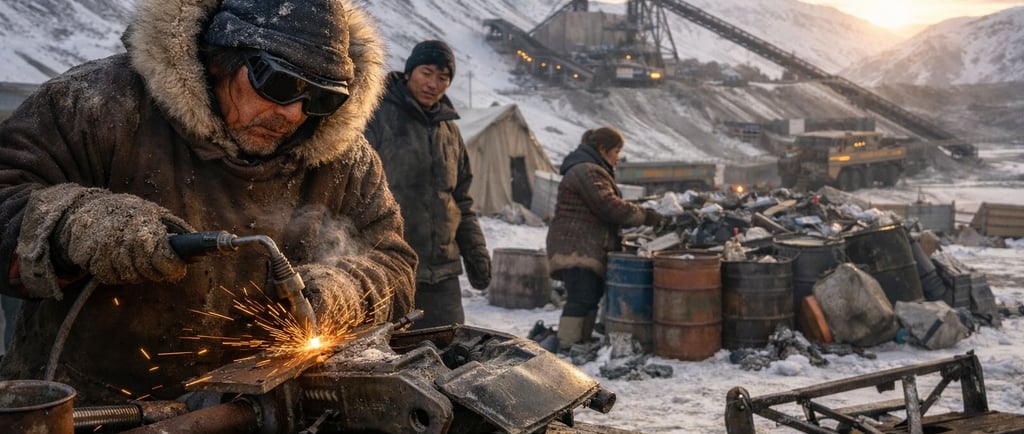
Context and Why Indigenous Circularity Matters for Remote Metals Teams
Arctic infrastructure and metals management don’t just face technical and economic challenges—they operate in a zone where logistical cost, climate vulnerability, and cultural complexity converge. In these conditions, the pressure to optimize every aspect of the resource lifecycle intensifies: each kilogram of metal brought north carries not just a price tag, but a carbon footprint, and the potential to leave a lasting impact on Indigenous lands and communities.
Modern mining and infrastructure operators are on the front lines of this shift. Global ESG (Environmental, Social, and Governance) standards, like GRI and SABS, now require proof of sustainability outcomes—going beyond simple “compliance” to demonstrate that organizations are meaningfully investing in circular economy models. But in the Arctic, the real opportunity is deeper: aligning with the tested stewardship principles of Indigenous communities. For centuries, Arctic Indigenous cultures such as the Inuit, Saami, and Dene have embodied a circular approach that emphasizes respect, reciprocity, and ingenuity over extractive linear consumption.
By embracing Indigenous circular models, Arctic teams can not only meet or exceed contemporary ESG requirements but future-proof their operations against regulatory, reputational, and logistical risk. The insights go beyond ethics—they translate into lower material throughput, greater operational resilience, and closer alignment with modern standards for low-waste, culturally engaged supply chains.
Emerging Trends Accelerating Relevance
Recent shifts make this conversation urgent:
ESG Audits Rising: Investors and partners increasingly demand disclosure of circularity outcomes, particularly in Indigenous lands. According to MSCI, companies with robust Indigenous engagement see 19% lower ESG controversy rates.
Regulatory Leverage Shifting: Bill C-15 and other frameworks are codifying the UN Declaration on the Rights of Indigenous Peoples into law—meaning Indigenous stewardship practices are moving from “optional” to “required” in project approvals.
Supply Chain Instability: Global disruptions underscore the cost of overreliance on linear, remote supply. Circular models built on local regeneration and reuse provide a hedge against future volatility.
2. Defining the Problem: Metals, Waste, and Arctic Stewardship Gaps
The Linear Trap in Arctic Metals Management
Most metals supply chains for Arctic infrastructure—from exploration camps to energy installations—depend on a classic linear model: extract → transport → use → dispose. This approach is increasingly unsustainable, producing pronounced pain points:
Excess Import Burden: In Nunavut, inbound freight costs for construction metals can exceed 15% of total project budgets (NWT Construction Association, 2022).
Landfill and Abandonment: Without robust end-of-life planning, metals and equipment accumulate in fragile tundra, causing environmental and reputational hazards (Canadian Press, 2023).
Top-Down Decisions: Projects often default to imported best practices, sidelining Indigenous insights that would emphasize sufficiency, reuse, and cultural alignment.
Quantifying the Waste Legacy
A recent Nunavik metals lifecycle study (Makivik Corp, 2021) found that less than 25% of metals from mining operations were effectively recirculated or repurposed locally—even where clear opportunities existed. The remainder persisted as expensive waste, requiring removal or remediation years later. This leads to:
Higher costs for clean-up and logistics
Lost secondary material value
Friction with community stakeholders over unclaimed “legacy” junk
Gaps in Community Integration
Indigenous communities have observed for decades that their expertise in repairing, adapting, and recirculating materials—developed out of necessity and creativity—remains underutilized in modern metals programs. Instead, they are often brought in tokenistically, rather than as genuine collaborators or knowledge partners.
Closing these gaps requires:
Engaging Indigenous co-design from project inception
Building permanent reuse/repair infrastructure at camps and regional hubs
Institutionalizing asset flows and transparent reporting
Strategic Imperatives for Modern Teams
By shifting from linear to circular, and from transactional to participatory, Arctic metals teams can:
Cut fly-in/fly-out logistics and reduce emissions by maximizing in-region asset recirculation
Build trust and partnership with Indigenous communities—improving the “social license” to operate
Align performance metrics with both global ESG frameworks and local priorities
Reference: See [Arctic Metals Lifecycle: Challenges & Solutions] for in-depth analysis of logistics costs and waste impact in northern projects.
3. Key Concepts: Indigenous Reuse, Repair, and Cultural Sustainability
Indigenous Stewardship: Governance Rooted in Place
At the heart of Indigenous metals stewardship is an integrated governance system. Unlike corporate or government hierarchies, stewardship is distributed—elders, youth, artisans, and hunters all play a role. Decisions on resource use and disposal are filtered through rigorous observation, oral history, and explicit accountability.
Entity: Indigenous Arctic Stewardship
Attributes: Accountability, continual adaptation, community consensus, knowledge transfer
Reuse and Repair: Maximizing Metal Utility
Indigenous Arctic traditions treat every tool, nail, and knife as precious—extensions of both livelihood and cultural identity. Tools are built for disassembly, and materials find new life as circumstances change.
Example: In the Western Arctic, each part of a snowmobile—frame, runners, metal fasteners—is tracked, repaired, and, when beyond use, repurposed into sleds or fishing tools.
Statistics: Studies show that in some remote Arctic villages, repair rates for vital metal assets exceed 80% over a decade (University of Alaska Fairbanks, 2020).
Circular Practices: Community-Driven Closed Loops
Rather than export scrap or rely on distant recycling centers, circular systems in Indigenous contexts keep value circulating in the region. Metal from decommissioned mining equipment can become construction material for new housing, or transformed into cultural art.
Entity: Community Circular Economy
Attributes: Local recirculation, skill diversity, adaptive upcycling, minimal external waste
Cultural Sustainability: Material Management + Identity
True circularity goes beyond just reducing waste; it sustains cultural continuity and sovereignty. By embedding reuse and repair in daily life, communities ensure that each asset—whether a cooking pot or a generator part—serves as a bridge to the past and a tool for future resilience.
Phrase optimization: When mining teams prioritize culturally informed material flows, they don’t just protect ecosystems—they unlock a pathway for reconciliation, local employment, and enduring stewardship partnerships.
4. Arctic Indigenous Circular Framework: Mapping to Modern Metal Cycles
Resilient Loops: Translating Tradition to Modern Complexity
Remote Arctic regions have always demanded ingenuity—where replacement parts are weeks away, what’s available is transformed again and again. This wisdom flows directly into the modern “repair, reuse, recirculate” loop that global circular economy advocates promote, but in the Arctic, it’s a lived reality.
Indigenous Circularity Framework: Operational Steps
Participatory Assessment
Engage local Indigenous stewards as technical advisors from the project’s start.
Combine oral histories and contemporary materials data to create a unified inventory.
Resource Sufficiency Audit
Challenge procurement teams to differentiate between absolute needs and imported “wants.”
A Kivalliq gold project recently achieved a 28% reduction in new metal imports using sufficiency protocols (2022).
Modular Procurement
Tools and assemblies chosen for their capacity to be easily maintained, repaired, and reconfigured by local craftspeople.
Example: Ordering modular solar panel frames that can be repaired or rebuilt with simple hand tools.
Structured Reuse Systems
All surplus and end-of-life scrap is catalogued—not discarded—using a digital ledger accessible to both site and community.
Establish scrap libraries where community members can source approved materials for local use.
Repair and Upcycling Workshops
Host regular co-led events where skills and techniques are exchanged: TIG welding, traditional metal joining, creative adaptation.
Impact: Studies in the Northwest Territories found these workshops increased circular asset utilization by 34%.
Reciprocal Sharing Agreements
Formalize channels for surplus distribution: community centers, neighboring camps, and emerging social enterprises.
Supports both economic diversification (e.g., community-run repair businesses) and local employment.
Ongoing Knowledge Transfer
Every repair or repurpose event is documented in both story and image, preserving techniques for future staff and community youth.
Digital archives are developed collaboratively (see [Knowledge Transfer: Oral to Digital]).
Worked Example: Nunavut Mining Camp Metals Cycle
A gold exploration camp in Nunavut demonstrates best practice:
Monthly, all outgoing equipment and metal scrap are inventoried together with Inuit technical advisors.
Usable steel is earmarked for community housing projects.
Workshops led by local craftsmen revive and apply both welding and traditional binding methods.
Transparent reporting is provided to both ESG auditors and local stakeholders—demonstrating reduced waste and increased economic value retained regionally.
Implementation Playbook: How Modern Metals Teams Can Put Indigenous Circularity to Work
The hardest part of circularity in Arctic metals is not writing policy language. It is turning respect, repair, and recirculation into routines that survive procurement cycles, staff turnover, seasonal logistics, and mine-life pressures. In remote regions, circularity fails when it remains a pilot or a side program. It works when it is built into the operating model.
That means Indigenous circular practice has to move from consultation notes into work orders, inventory rules, contract clauses, repair standards, closure plans, and training budgets. The implementation question is simple: what would a metals team do differently on Monday morning if it took Indigenous circularity seriously?
The first shift is governance.
Before any material audit or reuse plan begins, the project needs a co-governance mechanism that has actual decision weight. Canada’s UN Declaration framework is explicit that Indigenous peoples have the right to participate in decisions affecting them, and the federal implementation pathway is now formal public policy, not a vague aspiration. In practical terms, that means circularity decisions should not sit only with procurement, environment, or operations teams. They should be reviewed through a standing body that includes Indigenous representatives, land users, knowledge holders, and site decision-makers, with a mandate over material flows, reuse priorities, surplus distribution, and closure-stage asset decisions. Where companies do this early, they usually reduce conflict later because the conversation shifts from “what are you dumping here?” to “what should stay in useful circulation, for whom, and under what rules?”
The second shift is inventory.
Most remote sites know what they buy, but they do not always know what they strand. A real circular playbook starts with a northern material ledger. Every piece of steel stock, cable, fastener, container, framing element, skid, scrap pile, damaged assembly, and idle machine component needs a status tag. Not just owned or retired, but reusable on site, repairable locally, transferable to community use, harvestable for parts, recyclable out of region, or hazardous and requiring controlled removal. Northern waste guidance in Canada exists for exactly this reason: remote communities face distinct challenges linked to weather, geology, population size, and access constraints, and weak waste systems can create direct environmental and health risks. In the Arctic, the inventory is not paperwork. It is the foundation for lower imports, lower waste, and fewer future liabilities.
The third shift is procurement discipline.
Circularity is often lost before the asset even arrives. Imported equipment that is sealed, over-specialized, hard to disassemble, or dependent on proprietary parts performs poorly in the North because replacement intervals are long and shipping volatility is high. The better standard is modular procurement. Buy components that can be opened, repaired, rebuilt, cannibalized for parts, and maintained with tools people already use. This is where Indigenous practical knowledge and maintenance culture have direct value. In remote settings, the best asset is rarely the one with the most features. It is the one that survives rough use, can be adapted, and does not become dead inventory after one failure. That is also where circularity becomes an economic strategy. The World Economic Forum argued in March 2026 that circular approaches are now being treated as a resource-security and competitiveness strategy because they reduce exposure to external shocks and strengthen regional capability. Arctic metals teams should read that as a logistics lesson, not just a sustainability slogan.
The fourth shift is building repair capacity where the material actually lives.
A repair-first system cannot be flown in after a failure. It needs bench space, tools, documented salvage rules, and paid time. For many Arctic and sub-Arctic operations, the missing link is not the absence of scrap. It is the absence of infrastructure to assess, clean, sort, test, and repurpose it. This is why repair hubs matter. A site-level or regional repair hub can handle welding, frame straightening, cable recovery, small-part machining, bracket fabrication, container refurbishment, and parts harvesting. It can also become a training and employment site if structured with Indigenous partners from the start. Evidence from procurement and supplier participation in northern operations shows why local capability matters financially. The Canadian Council for Indigenous Business found that companies working with Indigenous suppliers often cut costs by reducing the need for flights, accommodation, and long-distance service mobilization, with northern operations reporting significant savings from using nearby firms because travel in the North is costly and unpredictable.
The fifth shift is defining what can move into community circulation, and what cannot.
This part needs careful rules, because circularity can turn exploitative if companies dump unwanted material under the language of “reuse.” The answer is a structured surplus protocol. Materials have to be inspected, categorized, documented, and transferred only when they are safe, useful, and requested. Community-facing reuse streams might include structural steel suitable for workshops or sheds, containers that can be refurbished, fabrication offcuts, racks, handrails, marine hardware, non-hazardous pipe, or equipment housings. They should not include contaminated, half-failed, or expensive-to-dispose assets disguised as donations. A fair system puts Indigenous partners in charge of defining utility thresholds and refusal rights. The principle is simple: reuse should retain value locally, not transfer risk locally. That principle is consistent with both sound stewardship and good closure practice.
The sixth shift is connecting circularity to closure planning years earlier than most operators do.
Too many northern sites treat closure as a late-stage engineering exercise, when in reality the waste legacy starts during active operations. The Nunavik experience shows the cost of waiting. A Kativik Regional Government and Makivik Corporation remediation effort found 403 non-validated abandoned mining exploration sites in northern Quebec, with 193 sites visited during one assessment phase and 90 characterized as abandoned mining sites, plus nearly 300 other potential sites across the territory. That is what happens when materials are not tracked, responsibilities blur, and “temporary” northern equipment becomes permanent debris. Circularity in this context is partly a recovery strategy, but it is also a prevention strategy. Every year of active operations should reduce the eventual closure burden, not enlarge it.
The seventh shift is documenting knowledge transfer in two forms at once, technical and cultural.
A strong Arctic circular program records torque specs, alloy compatibility, salvage rates, welding methods, and fit-for-purpose rules. It also records land-based observations, use histories, local hazard knowledge, place-based access constraints, and lessons from past failures. This is where a lot of corporate programs break down. They are good at capturing numeric data, but poor at preserving practice. Indigenous circular systems have always depended on continuity, intergenerational learning, and accountability to place. A modern metals team should reflect that by treating every repair, repurpose, and material handoff as both an operational event and a knowledge event.
The eighth shift is money.
If the budget is real, the system becomes real. If circularity depends on goodwill, it disappears at the first cost squeeze. Companies should create a protected circularity line item tied to avoided freight, avoided disposal, repair labor, community training, and closure-liability reduction. This is more than an accounting preference. It allows operators to show that reuse and repair are not abstract ESG outputs. They are drivers of lower imported volume, better asset use, lower future remediation exposure, and stronger local business participation. In a world where the UNEP says global resource extraction has climbed from 30 billion tonnes in 1970 to 106 billion tonnes and that extraction and processing account for over 60 percent of climate impacts, Arctic circularity should be understood as a high-value form of material restraint in one of the most expensive logistics environments on earth.
Metrics That Matter: What to Measure if You Want Circularity to Be Real
The wrong metrics will make any circularity program look successful. If a company measures only tonnes recycled, it can miss the more important question, which is whether the system reduced imports, extended asset life, cut closure liabilities, and created shared value with Indigenous communities. Arctic circularity needs a broader scorecard.
Start with material intensity. Track imported metal per unit of output, per worker camp population, or per project phase. Then track how much of that demand was avoided through reuse, repair, or repurposing. Avoided imports are one of the strongest northern indicators because freight is expensive, carbon-heavy, and often delayed. If the site can show that reused steel, refurbished skids, recovered cable, or repaired equipment prevented a shipment, that is a real result. It is especially important in remote regions where supply chain delays can directly slow operations. Circularity is not only about what leaves the site as scrap. It is about what never had to arrive in the first place.
Next, measure asset life extension. For high-value assemblies, track original expected service life, repair interventions, post-repair operating time, and replacement deferral. In practical terms, how many more months or seasons did the item remain useful because a repair culture existed? This metric matters because circularity often wins through deferral, not disposal. A generator housing that lasts two extra seasons, a steel staircase refurbished instead of replaced, or a cargo rack rebuilt from harvested components may never appear dramatic in a sustainability report, but across a northern portfolio those decisions compound into major savings.
Then track local retention of material value. This is one of the most important Indigenous circularity metrics because it shows whether the project is actually keeping usable value in-region. Measure the percentage of surplus materials transferred into approved local use, the dollar value of locally repurposed materials, and the percentage of scrap streams processed first for repair, reuse, or part harvesting before export or disposal. This is where many programs reveal their true character. A company that exports almost everything south as “waste management” may have a cleaner spreadsheet, but not a better circular system.
Community participation metrics should sit beside material metrics, not below them. Count how many decisions on materials passed through co-governance review. Count the number of Indigenous knowledge-holder sessions that changed procurement, handling, routing, or closure choices. Track paid hours for Indigenous participation in repair, salvage, monitoring, and design. Track contracts awarded to Indigenous businesses that support the circular chain, including sorting, fabrication, transport, storage, or refurbishment. Evidence from northern procurement shows why this matters. Local Indigenous suppliers can reduce travel-related costs and service delays, while broader OECD work shows Indigenous participation in mining-linked regional economies can coincide with stronger incomes, stronger workforce presence, and more durable place-based benefit when the ecosystem is built intentionally. In Northern Ontario, for example, Indigenous workers represented almost 15 percent of the mining workforce in 2021, and more than 140 agreements had been signed with mining companies. That is not a direct Arctic metric, but it is strong evidence that structured participation changes outcomes.
Trust and accountability metrics also matter, even though they are harder to quantify. A strong program should track grievance volume linked to waste, abandoned materials, access, or closure concerns. It should measure response time to community-raised issues. It should record how many circularity commitments made in engagement sessions were completed, delayed, or dropped. Too many companies report activity, not follow-through. For Arctic operations, trust is built less by announcing goals and more by closing loops visibly and on time.
Logistics and carbon metrics should be tied directly to circular actions. Measure flights avoided, barge volume avoided, truckloads avoided, and estimated emissions avoided through local reuse and life extension. Canada’s circular economy work frames reuse, repair, sharing, remanufacturing, and redesign as central strategies for both resilience and economic opportunity. In the Arctic, these are also transport reduction strategies. Because transport is a major cost and risk multiplier, circularity should be linked to logistics resilience in every executive review.
A final metric, and one many operators ignore, is closure readiness. Every year, the site should be able to answer five questions. How much material on site has a defined end-of-life path? How much stranded metal lacks ownership, classification, or destination? How many abandoned-material hotspots were reduced this year? How many community-approved reuse channels are active? How much future remediation cost was likely avoided? The best circular programs do not wait until year fifteen to discover what year one left behind.
Expanded Case Studies: What Good Practice and Bad Legacy Actually Look Like
Raglan Mine in Nunavik
Raglan Mine in Nunavik is one of the clearest examples of why circularity and Indigenous stewardship should be treated together. Glencore’s Raglan materials do not describe the operation in circular-economy branding language, but they show something more important, a long-running governance structure where Inuit partners have shaped remediation and closure thinking. The Raglan Steering Committee was created in 2005 to develop a tailings, waste rock, and water management remediation concept tailored to the mine and informed by expected climate impacts. That matters because it moves Indigenous input from generic engagement into one of the most consequential decisions in the mine life cycle, what remains on the land and how it will be managed. The lesson for metals teams is direct. Circularity becomes credible when Indigenous governance is built into closure, residuals, and long-life material decisions, not just workforce programs.
Diavik
Diavik offers a second lesson, this time about transition. In February 2026, Rio Tinto announced a closure agreement with the Tłı̨chǫ Government. The companies’ relationship stretches back to 2000, and the closure announcement makes clear that Tłı̨chǫ citizens built work experience, trades and technical skills, and business capacity over the life of the agreement, while Elders and community members provided Traditional Knowledge during construction, operations, closure planning, and remediation. The agreement also includes funding for socio-economic mitigation and commitments to employment, training, and business opportunities during closure. This is important because it shows what a better end-state can look like. Closure is not treated as a technical wind-down happening to the community. It becomes a negotiated phase with labor, contracting, stewardship, and accountability built in. For Arctic metals teams, this is the model to study if they want circularity to survive beyond active production. Materials, labor, and land stewardship all need a post-production pathway.
The Nunavik abandoned exploration sites work
The Nunavik abandoned exploration sites work is the cautionary case, and every modern operator should study it with humility. The Kativik Regional Government and Makivik Corporation documented a landscape where hundreds of legacy sites were still unresolved. In one assessment stream, 193 sites were visited, 90 were characterized as abandoned, and there were nearly 300 other potential sites distributed across the territory. A practical guide was then developed to transfer skills and knowledge to local communities for safe handling, storage, and transportation of hazardous materials during cleanup. This case matters for two reasons. First, it shows the long tail of poor material stewardship. Second, it shows that remediation knowledge itself can and should be localized. The best Arctic circular systems are not only about retaining value. They are also about preventing future cleanup burdens and making sure northern communities are not left waiting for someone else to solve an old southern-era mess.
Baffinland’s Mary River
Baffinland’s Mary River materials provide another useful signal, especially on how knowledge integration changes operating practice. In its 2023 reporting, Baffinland described Inuit Knowledge Holders and Community Resource Guides as critical to guiding senior management decision-making and knowledge transfer. It also stated that Inuit Qaujimajatuqangit had led to multiple project modifications, and that Inuit training in 2023 totaled 34,450 hours, representing 29.9 percent of total training provided by the company. This is not a full circularity case on its own, but it is highly relevant because it shows how Indigenous knowledge moves from ceremonial mention into operational adjustment. It also shows that training and leadership development can be structured in culturally grounded ways. A mature circular metals program would build directly on this logic by tying those same knowledge and training systems to repair, reuse, salvage, and materials governance.
A broader Canadian lesson from outside the high Arctic
There is also a broader Canadian lesson from outside the high Arctic that still applies strongly to Arctic and sub-Arctic operations. The OECD’s 2025 work on mining regions in Northern Ontario found that Indigenous workers made up almost 15 percent of the mining workforce in 2021, that more than 140 agreements had been signed with mining companies, and that the region combines mining production with a wider support ecosystem of research, training, and environmental rehabilitation. Sudbury’s land rehabilitation history, with more than fourteen million trees planted, is relevant here not because tree planting equals circularity, but because it proves long-horizon regional repair is possible when industry, institutions, and communities build local capability instead of relying on short-term extraction logic. The Arctic needs the same instinct, adapted to its own geographies and rights context.
Taken together, these cases show four clear patterns. First, Indigenous participation changes outcomes most when it is built into governance, not appended to reporting. Second, closure and remediation are where circularity becomes real or collapses. Third, local business, training, and repair capacity are not side benefits, they are part of the circular infrastructure. Fourth, legacy waste is the bill that arrives when material accountability is weak during active operations.
Conclusion: The Arctic Already Knows What Circularity Requires
The metals sector often speaks about circularity as if it were a new invention. In the Arctic, that claim does not hold. Indigenous communities have long practiced the core rules that modern circular economy strategies are still trying to systematize: take less, use longer, repair early, share value locally, and leave as little damage behind as possible. What industry adds today is not the philosophy. It adds scale, capital, engineering, and the ability to either support that logic or overwhelm it.
That is why this conversation matters now. Global material use has already tripled since 1970, and the world is still moving in the wrong direction on circularity. The Circularity Gap Report 2025 says the global economy remains far from circular, while UNEP’s resource outlook shows the environmental burden of extraction and processing is already severe. In a period where critical minerals, Arctic shipping, northern infrastructure, and geopolitical supply security are all rising in importance, the Arctic cannot afford a model that treats remote lands as expendable inputs and remote communities as late-stage consultees.
For modern metals teams, the lesson is practical. Indigenous circularity is not a moral garnish on top of operations. It is a tested operating logic for harsh environments. It lowers dependence on fragile supply chains. It reduces the odds of future abandonment and cleanup burdens. It creates room for local enterprise, skills, and stewardship. It strengthens closure planning. It also aligns with the legal and policy direction of travel in Canada, where Indigenous rights, partnership, and accountability are now embedded more firmly in the operating landscape than they were a decade ago.
The best Arctic metals strategies over the next decade will not be the ones that import the most equipment or write the longest ESG reports. They will be the ones that can prove they kept useful material in motion, reduced unnecessary inflows, built repair and reuse capacity close to the land, and made Indigenous partners part of the decision system from the beginning to the end. That is how circularity stops being a corporate phrase and becomes a northern capability.
Connect
Your trusted partner for scrap metal procurement.
CONTACT
About
haroon@tdcventures.com
+1-307-655-7593
© 2025. All rights reserved.
NEWSLETTER