
Indigenous Circular Practices in Maori Aotearoa: Lessons for Modern Metals
Discover how Māori circular practices like kaitiakitanga and whakapapa offer a practical framework for metals management in Aotearoa—moving beyond recycling to repair, reuse, and culturally grounded stewardship across infrastructure and asset lifecycles.
CULTURAL SUSTAINABILITY & INDIGENOUS CIRCULAR PRACTICES
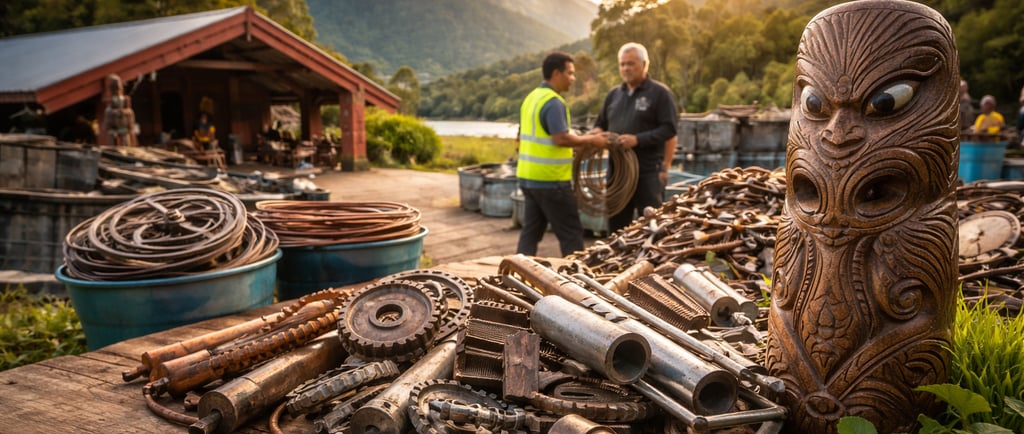
Context: Why Māori circularity matters for metals in Aotearoa in 2026
If you want to understand where metals management in Aotearoa New Zealand is heading, you need to start with two facts. First, the pressure on material systems is rising, not falling. UNEP’s Global Resources Outlook says global extraction of natural resources has tripled over the past 50 years and could rise another 60 percent by 2060. Second, Aotearoa still loses too much value too early in the materials cycle. MBIE’s circular advanced manufacturing work found that, in 2019, New Zealand generated 17,288 kilotonnes of waste, 92 percent ended up in landfill, and two-thirds of all metal waste, 547 kilotonnes, was exported for processing outside the country. That means the country is not only wasting material, it is exporting processing value, jobs, learning, and strategic control over secondary metals.
This is exactly where Māori circular practice becomes more than a cultural lens. It becomes a practical operating model. The Ministry for the Environment’s waste and resource efficiency strategy sets national priorities for minimising waste and improving waste management, while MBIE’s te ao Māori guidance explains that Māori worldviews are grounded in interconnection between people and nature, tikanga, and mātauranga. In metals, that changes the question from “How do we dispose of this asset cheaply?” to “How do we keep value, relationship, story, and utility alive for as long as possible?”
That shift matters because metals are not marginal materials. They sit inside transport networks, street furniture, water systems, power systems, community buildings, marine infrastructure, and the growing stream of electronics and batteries. UNITAR’s Global E-waste Monitor 2024 estimated that 31 million tonnes of metals were embedded in e-waste generated in 2022, with a value of US$91 billion, including US$19 billion in copper, US$15 billion in gold, and US$16 billion in iron. Yet only a fraction was documented as recovered through formal channels. In a country like New Zealand, where distance, scale, and import dependence matter, every tonne kept in circulation has outsized value.
Māori circularity also lands at a moment when Māori economic capability is stronger than many outdated narratives assume. MBIE reports that the Māori economy grew from $17 billion in GDP contribution in 2018 to $32 billion in 2023, while the Māori asset base rose from $69 billion to $126 billion. There were nearly 24,000 Māori-owned businesses in 2023, with sharp growth in self-employment and employers. This matters because circularity is not only about waste systems. It is also about ownership, procurement, design authority, land relationships, and who captures the value created by repair, reuse, remanufacture, and recovery.
2. The problem: modern metals systems still break value too early
Mainstream metals management still follows a familiar pattern. Buy new. Install fast. Maintain unevenly. Replace early. Strip value late. Recover scrap by weight. Report tonnes diverted. Move on. That model misses what matters most. It rarely tracks provenance well. It often treats repair as a cost rather than a value-preserving step. It tends to reward lowest upfront price rather than longest useful life. It can also separate technical decisions from cultural obligations, especially when assets sit on or affect whenua that carries deep ancestral significance.
The scale of the problem is plain in the built environment. The Ministry for the Environment’s 2025 baseline found that an estimated 5.25 million tonnes of construction and demolition waste were disposed of at levied facilities in 2023, representing 69.4 percent of all waste disposed at those facilities. Only 18.5 percent of C&D waste received at disposal facilities was successfully diverted, and most of it still went to landfills or lower-grade disposal routes rather than staying high in the value chain. The report also notes that more than 75 percent diversion has been reported in some source-based assessments, but that performance is not substantiated across the full national picture. In other words, pockets of good practice exist, but the system as a whole is still leaking material value.
That leakage is expensive. It raises replacement costs, deepens import dependence, increases embodied emissions, and strips local economies of work that could sit in repair, fabrication, tracking, refurbishment, and redistribution. It also weakens public trust when communities see assets discarded that still had use left in them, or when councils and infrastructure providers claim circularity but can only show recycling tonnages, not the full life story of the materials they manage.
3. The Māori Foundation: Kaitiakitanga, Whakapapa, Mauri, and Taonga
To build a better metals system, you need a better operating language. Te ao Māori offers one. MBIE describes te ao Māori as a worldview centred on relationships between nature and people. In that worldview, materials are not isolated units. They sit within whakapapa, networks of origin, connection, and continuity. Kaitiakitanga frames responsibility to care for resources across generations. Mauri points to life force, vitality, and the condition of a thing within its wider relationships. Taonga signals value that is not purely monetary.
Applied to metals, these concepts are practical. Whakapapa asks where a metal came from, how it was used, what happened to it, who worked on it, what place it served, and what possibilities remain. Kaitiakitanga asks whether the current decision protects future options rather than exhausting them. Mauri asks whether an asset remains fit, meaningful, and worthy of continuation through repair, repurposing, or careful recovery. Taonga asks whether an object or material stream carries social, historic, place-based, or cultural weight that should shape what happens next.
This does not mean every pipe, bracket, railing, transformer casing, or decommissioned component becomes sacred or untouchable. It means decisions become more disciplined. Instead of reducing all end-of-life choices to scrap price and logistics, Māori-informed practice widens the test. Can this be repaired? Can it stay in service longer? Can it be repurposed for community use? Can parts be harvested before bulk recycling? Is there a story, a place, or a relationship that should shape the route taken? Those questions can make systems slower at the front end, but they usually make them smarter, cheaper, and more trusted over time.
4. Why this is already aligned with global circular economy logic
Some readers may assume Māori circularity is a local cultural add-on. It is not. It lines up closely with the best global material strategy, but it goes further. The Ministry for the Environment describes circular economy logic as designing out waste and pollution, keeping products and materials in use, and regenerating natural systems. Māori principles support the same direction, but they add place, ancestry, relationship, and intergenerational duty in a way that makes the model harder to hollow out into a branding exercise.
The climate logic is strong. Recycling aluminium uses 95.5 percent less energy than primary production, according to the International Aluminium Institute, with recycled aluminium requiring 8.3 gigajoules per tonne versus 186 gigajoules per tonne for primary production. That is a huge gain, but repair and direct reuse can keep even more value intact because they avoid remelting and reprocessing steps altogether. This is why a Māori-informed hierarchy often pushes you above recycling and closer to maintenance, repair, adaptive reuse, and redistribution.
The same holds for infrastructure-heavy economies. UNEP warns that rising resource extraction could derail climate and biodiversity goals. For Aotearoa, whose infrastructure system will keep absorbing metals for decades, the winning strategy is not simply to recycle more at the back end. It is to buy better, track better, repair earlier, extend life, and recover with purpose when end of life finally arrives. Māori circular practice provides a language and governance base for doing that with more care and more discipline.
5. A Māori-informed framework for the metals lifecycle
A practical framework for modern metals in Aotearoa can be built around five linked moves.
Design and procurement. Before metal enters service, buyers should ask whether the item is modular, repairable, traceable, and likely to stay useful over time. Te Waihanga’s work on Māori engagement in infrastructure shows that procurement and supply-chain design are already live policy territory, including efforts to identify Māori businesses that can participate directly or through subcontracting. If procurement sets the wrong incentives, the rest of the lifecycle struggles to recover value later.
Use and care. Metals stay circular longest when maintenance is timely and visible. A Māori lens treats care as stewardship, not overhead. That is especially important for public assets where deferred maintenance often turns repairable items into waste.
Repair and adaptation. If an asset can no longer serve its original purpose, the next question is whether it can serve another one. Adaptive reuse in New Zealand’s built environment is now receiving more attention because it cuts waste, retains value, and supports resilience. That logic applies to many metal assets, from structural components and fittings to public realm hardware and industrial equipment.
Redistribution and remanufacture. Materials that leave one site do not need to leave the economy. Reuse and redistribution work best when asset owners, councils, iwi, repair enterprises, and community groups share channels and standards rather than operating as isolated projects. Wellington’s 2026 Reuse, Repair and Share research, commissioned by the city council, shows that councils are now actively mapping these networks and looking for scale.
Culturally grounded recovery. When recycling is the right path, the work should still preserve data, provenance, and respect. Material recovery should not be a black box. In some cases, ceremony, documentation, or community involvement may be part of closing the loop. In all cases, the decision should be legible, justified, and accountable.
6. Governance: why partnership is the difference between a project and a system
Many circular pilots fail because they stay technical. They improve a process but not the governance around it. Te Waihanga’s infrastructure research is clear that Māori engagement needs to move beyond thin consultation toward stronger collaboration, co-design, and shared decision-making. Its case studies also show that Māori are not only stakeholders affected by infrastructure. In many contexts they are owners, co-investors, landlords, operators, suppliers, and strategic partners across energy, health, education, and place-based development.
That matters for metals because stewardship decisions often sit inside procurement policies, capital works plans, maintenance standards, lease settings, and disposal rules. If mana whenua are only brought in late, after a preferred technical option has already formed, the result is usually weak trust and poor design. If they are involved early, circularity can be designed into the asset system from the start. The Ministry for the Environment’s 2025 case studies on waste funds underline the same principle in plainer language: seed funding helps, complementary actions matter, and relationships drive results.
This is also where progressive procurement becomes practical. Te Waihanga notes that agencies can identify Māori businesses, work with them to enter supply chains, and in some cases directly source or create procurement pathways that generate public value while increasing Māori participation. For metals, that can shape fabrication, maintenance, deconstruction, salvage, sorting, remanufacture, and traceability services.
7. What good practice looks like on the ground
Good practice in Māori circular metals management is unlikely to arrive as a single national template. It will show up as a pattern across places.
One pattern is marae- and iwi-led zero waste work that proves cultural framing changes behaviour. Para Kore has spent years building zero-waste practice from a Māori worldview, with support from government and community partners. The significance here is not that every activity involves metals directly. It is that Māori-led resource practice can shift norms, governance, and everyday handling of materials at scale, which is exactly what metals systems need if they are to move from one-off salvage to normalised stewardship.
Another pattern is regional resource recovery planning. Auckland’s Zero Waste by 2040 plan targets a 30 percent reduction in council- and private-sector-influenced waste to landfill by 2030, cutting the baseline from 873 kg to 611 kg per person per year. That target is not metals-specific, but metals-rich streams such as construction products, public infrastructure hardware, appliances, and commercial fit-out material sit squarely inside the opportunity set. A city cannot hit serious waste targets without getting better at how it handles durable materials.
A third pattern is Māori participation in infrastructure ownership and development itself. Te Waihanga documents cases such as Tauhara North No. 2 Trust, whose land hosts major geothermal infrastructure, including the 140 MW Ngā Awa Pūrua power station, described in the report as the largest single turbine geothermal power station in the world as of April 2024. These examples matter because they show Māori engagement is already part of the infrastructure economy at serious scale. Circular metals practice is stronger when it is built into those ownership and development settings, not added later as a waste initiative.
8. Measurement: what should councils and infrastructure managers actually count?
If you only count tonnes recycled, you will miss most of the value. Better measurement starts with four layers.
The first layer is physical performance. Track asset life extension, repair frequency, component harvesting, reuse rates, remanufacture rates, and final recycling yield. The 2025 C&D baseline shows why this matters. Without better data, claims of high diversion can hide large system losses.
The second layer is carbon and energy. For some materials, especially aluminium, the gap between primary and recycled production is so large that even simple substitution metrics can show major savings. But again, reuse and repair often beat recycling on avoided processing.
The third layer is economic retention. MBIE’s metal waste profile shows New Zealand exports a large share of metal waste for offshore processing. That should push councils and firms to ask how much value is retained locally through repair, salvage, refurbishment, or local reprocessing rather than lost overseas.
The fourth layer is cultural and relational performance. Was mana whenua involved early? Were tikanga checkpoints built into decisions? Was provenance retained? Did the chosen route increase community trust, skills, or access? These are harder to quantify, but Te Waihanga and MBIE both make clear that relationships, interconnection, and long-term wellbeing are not side issues. In this model, they are part of performance.
9. The opportunity in front of Aotearoa
Aotearoa does not need to copy another country’s circular metals model line for line. Its advantage lies in combining strong place-based Māori knowledge with better asset data, better procurement, and better recovery systems. The policy direction is already moving that way. The waste and resource efficiency strategy is in place. Circular economy language is now established in central government material. Council-level reuse and recovery work is expanding. Māori business capability is growing. Infrastructure research is pushing public entities toward deeper Māori engagement.
The gap is execution. The country still lacks full traceability for many metal assets. Repair pathways remain uneven. Construction and demolition systems still leak value. Reporting remains too focused on disposal and diversion, not life extension and relationship outcomes. Those are precisely the gaps a Māori-informed framework can help close.
10. From principle to practice: the bridge into the toolkit
Once you accept the foundation, the next step is no longer abstract. You need operating tools. You need governance methods that translate kaitiakitanga into decisions. You need asset tracking that records whakapapa, not only serial numbers. You need repair and redistribution systems that keep metals in use locally. You need ways to assess mauri when an asset is no longer serving well. You need reporting that captures environmental gain, community benefit, and cultural integrity in the same frame.
11. Embedded Five-Layer Toolkit
If Māori circularity is going to shape how metals are procured, tracked, repaired, reused, and recovered in Aotearoa, it needs to be built into operating systems, not left at the level of intent. Councils, infrastructure owners, utilities, ports, contractors, fabricators, and resource recovery partners all need a working toolkit that can survive budget cycles, staff turnover, procurement changes, and political shifts. In 2026, that toolkit has to do three things at once. It has to protect cultural integrity. It has to improve material outcomes. It has to fit real operational environments where asset managers are already dealing with cost pressure, compliance pressure, climate risk, and aging infrastructure. The strongest version of this toolkit is layered, because no single intervention fixes a linear materials system.
Layer 1: Frameworks and governance that make tikanga operational
The first layer is governance. Without it, circularity stays stuck in isolated projects. The practical move here is to translate Māori principles into formal decision architecture. Kaitiakitanga cannot remain a value statement in a strategy document. It has to appear in procurement criteria, asset renewal plans, decommissioning decisions, maintenance triggers, and reporting obligations. Te Waihanga’s Māori engagement work points in exactly this direction. Its research and 2026 summary report call for infrastructure approaches that integrate environmental, cultural, social, and economic outcomes, support iwi values, contribute to intergenerational wellbeing, and strengthen the ability of Māori businesses to participate meaningfully in project delivery. That means Māori circularity belongs in governance charters, board papers, capital approval gateways, and supplier selection, not only in consultation plans.
In practice, that means councils and infrastructure agencies should establish standing governance hui with mana whenua rather than one-off consultation events. It means creating shared material stewardship protocols that define what must happen before a metal asset is replaced, scrapped, or exported. It also means adding tikanga checkpoints into lifecycle decisions. Before a renewal project signs off on disposal, someone should have to answer a structured set of questions: What is the asset’s provenance? Has reuse been tested? Has community redistribution been considered? Does this item or location carry place-based significance? Are there Māori-owned businesses or iwi-linked entities that could participate in the next use phase? These are not symbolic questions. They are the controls that keep a circular system from sliding back into a scrap-by-default culture.
A strong governance layer also needs legal and commercial backbone. Memoranda of understanding, procurement clauses, asset stewardship policies, co-governance panels, and agreed dispute pathways all help convert shared intent into durable practice. This is especially important in infrastructure, where assets often last decades and where a single contract structure can either preserve or destroy future circular options. Te Waihanga’s work is clear that Māori engagement across infrastructure should not stop at consultation. It should move toward collaboration, co-design, and, where appropriate, empowerment. That is the level at which metals stewardship starts to change system-wide behaviour.
Layer 2: Whakapapa and asset tracking tools that record more than technical data
The second layer is data. Most infrastructure systems can tell you an asset class, location, installation date, and maybe maintenance history. Far fewer can tell you enough to make a high-quality circular decision. A Māori-informed metals system needs a richer register. It needs to record the whakapapa of material assets, not only their serial identity. That means origin, composition, fabrication path, prior use, repair history, modifications, ownership changes, and end-of-life decisions. It also means leaving room for cultural context, local narratives, place significance, or iwi commentary where relevant.
This kind of traceability is becoming more important globally, not less. The new ISO 59000 circular economy standards were developed to support measurable circular economy outcomes, guide design and procurement, and improve resource tracking and value network coordination. Aotearoa’s Māori circular model fits this direction well, but pushes it further. It says traceability should not stop at technical compliance or chain-of-custody reporting. It should also tell you whether the asset has retained meaning, trust, and future usefulness in the community where it sits.
For metals, this can be operationalised through upgraded asset registers, QR or RFID tagging, materials passports for major components, and digital logs linked to maintenance and capital systems. The point is not flashy technology for its own sake. The point is decision quality. If a council knows a decommissioned handrail system is made of recoverable stainless steel, was refurbished once already, came from a site with strong local significance, and can be adapted for use in another public project, then the disposal pathway changes. If a utility can see that a bank of metal housings has known repair history, compatible dimensions, and remaining serviceable life, then replacement can be delayed or staged rather than done in bulk. Better data is what allows Māori principles to act inside technical workflows rather than beside them.
There is also a wider strategic reason to invest in this layer. New Zealand still loses too much material value too early. WasteMINZ’s 2025 research, based on NZIER work, says the waste, resource recovery, and contaminated land management sectors contribute more than $3.3 billion to the economy and support more than $6 billion in economic activity, while waste inefficiencies cost the country $222.8 million a year in avoidable disposal costs. The same research says material productivity in New Zealand sits at only 59 percent of the OECD average, despite high per-capita material consumption, and estimates that 40 percent of waste sent to class 1 landfills is divertible. Traceability is not a nice-to-have in that context. It is basic economic discipline.
Layer 3: Repair and redistribution networks that keep metals in use at their highest value
The third layer is where circularity starts to become visible in communities. Repair and redistribution are the difference between a system that merely recycles and a system that retains value. For metals, this means creating practical pathways for component salvage, fabrication, remanufacture, refurbishment, community transfer, and local redeployment before items drop into bulk scrap streams. It also means developing the labour, space, and logistics needed to make those pathways normal rather than exceptional.
This is not a fringe idea. It is now mainstream circular economy logic. Auckland’s Resource Recovery Network was created to maximise diversion of reusable and recyclable materials, keeping resources out of landfill while generating environmental, social, cultural, and economic benefits. The network sits inside Auckland’s Zero Waste by 2040 vision, which explicitly frames circular economy as using resources for their best and highest value for as long as possible while taking care of people and the environment. That is a direct fit with Māori circular practice. In a metals context, the lesson is clear. A working network matters more than isolated good intentions. Once reuse and repair routes are visible, staffed, and trusted, asset owners are more likely to use them.
Wellington’s 2026 Reuse, Repair and Share research shows the same logic from another angle. Commissioned by Wellington City Council, the study identified 456 discrete reuse, repair, and share initiatives available to residents and businesses in Wellington City, while also noting uneven provision and service gaps. That finding matters because it shows two things at once. First, the ecosystem already exists in meaningful volume. Second, scale alone is not enough if access is patchy and pathways are fragmented. Metals stewardship in Māori Aotearoa will need the same lesson applied: local networks must be mapped, coordinated, and made easy to use. Otherwise high-value material still defaults to landfill or low-value recycling because the practical route is simpler.
In operational terms, councils and infrastructure owners should co-invest with iwi, Māori enterprises, social enterprises, and private recyclers in repair hubs, salvage depots, deconstruction partnerships, and certified redistribution channels. They should train procurement and project teams to design for disassembly. They should require demolition and renewal contractors to identify reusable metal components before removal. They should create digital marketplaces or internal exchanges for surplus components, fittings, housings, framing members, and fabricated steel elements. They should also fund apprenticeships that bridge conventional metalwork with indigenous stewardship values, because circular systems fail fast when the skills base is thin. Te Waihanga’s 2026 summary report specifically highlights the need to strengthen Māori business participation in infrastructure through training, mentorship, funding pathways, and long-term capability development. That recommendation lands directly here.
Layer 4: Mauri assessment protocols that guide end-of-life decisions with more intelligence
The fourth layer is often the hardest for conventional systems to understand, but it is one of the most useful. Mauri assessment gives organisations a disciplined way to ask whether a material or asset still carries life, usefulness, and relationship value, and what respectful next steps look like when that vitality is weakening. In engineering language, you can think of it as a richer threshold model. It does not replace technical condition assessment. It extends it.
A mauri assessment for metals can include five linked dimensions.
Technical fitness: structural integrity, contamination, corrosion, fatigue, and safety.
Environmental burden: what extraction, energy, transport, and waste impacts are avoided if the item is repaired or reused instead of replaced.
Social usefulness: whether the item can still serve a community, school, marae, local enterprise, or public facility.
Cultural alignment: whether provenance, place, story, or tikanga should shape what happens next.
Future potential: whether the item is more valuable as a complete unit, a remanufactured part, a source of harvested components, or a recycling feedstock.
This kind of protocol matters because conventional end-of-life logic is often too blunt. Assets are commonly replaced on schedule, by budget cycle, or because documentation is weak, not because the highest-value pathway has genuinely been exhausted. A mauri-based process slows that reflex. It requires documented reasoning. It makes reuse and repair visible options. It also helps organisations distinguish between materials that should circulate again and materials whose next step should be controlled recovery. This is especially important for complex metal streams like e-products, energy equipment, or mixed assemblies that contain both valuable and hazardous components.
The global case for this is strong. The Global E-waste Monitor 2024 reports that e-waste generated in 2022 contained 31 billion kg of metals, including roughly 24 billion kg of iron and steel, 3.9 billion kg of aluminium, and 2.1 billion kg of copper. Yet only 22.3 percent of total e-waste was formally collected and recycled, and the report estimates 12 billion kg of metals were lost through current e-waste management practices. For Māori Aotearoa, the implication is obvious. If a system waits until the last moment and then treats everything as waste, it will keep throwing away value, trust, and strategic material. Mauri assessment offers a structured way to intervene earlier.
Layer 5: Reporting, feedback, and continuous learning that make stewardship visible
The fifth layer is reporting. If organisations cannot show what is happening, circularity remains fragile. Reporting in a Māori circular metals system should move well beyond tonnes recycled. It should track life extension, repair rates, avoided replacement spend, value retained locally, Māori business participation, community redistribution outcomes, cultural governance activity, and the quality of provenance data held in asset systems. It should also include stories, because stories are not soft evidence in this context. They are part of how whakapapa is retained and shared.
This is exactly where the new circular economy standards are useful. ISO 59000 and related guidance have helped create a clearer shared language for boundary setting, measurement, resource tracking, and circular outcomes. That gives councils and infrastructure agencies a stronger base for formal reporting. But a Māori-informed model should add what many international systems still omit: the social and cultural outcomes of circular action. If a metal asset has stayed in use for another decade, that matters. If it avoided replacement emissions, that matters. If it was transferred to a local use that created skills, pride, and practical benefit, that matters too.
Public dashboards, annual material stewardship reports, iwi-led review sessions, and project post-mortems all have a role. So do digital records that include photos, oral history, te reo Māori tags, and maintenance narratives for significant assets. The point is not to burden already stretched teams with performative reporting. The point is to build memory into the system. When staff move on or budgets tighten, the record should still show what worked, what value was retained, and what cultural commitments were made. That is how circular practice survives long enough to become standard practice.
12. Assumed market gaps, and what this Māori-informed approach adds
Aotearoa’s metals and infrastructure sectors are not starting from zero. There is better policy language now than there was even five years ago. There is stronger circular economy literacy. There are real reuse and recovery initiatives at city level. There is far more recognition of Māori participation in economic development and infrastructure. But the market still contains major gaps that limit performance.
The first gap is incomplete traceability. Too many metal assets still enter and exit service with thin documentation. That weakens confidence in reuse, complicates maintenance planning, and pushes organisations toward replacement because it feels administratively safer. The second gap is fragmented repair capacity. Repair and remanufacture pathways exist, but they are unevenly distributed, poorly mapped, or disconnected from mainstream procurement and asset management systems. Wellington’s 2026 stocktake found hundreds of initiatives, yet still identified significant gaps in coverage and accessibility. The same pattern exists more broadly across Aotearoa. Activity exists, but it is not yet arranged as a fully legible national system.
The third gap is cultural disconnect. Māori values are increasingly acknowledged in strategy language, but operational integration is still inconsistent. Many projects still treat cultural engagement as a workstream beside delivery, rather than as a design condition that shapes the delivery model itself. Te Waihanga’s infrastructure research exists precisely because this gap remains unresolved across the system. The fourth gap is weak performance measurement. Waste reporting still leans heavily on tonnages and disposal categories. That leaves major blind spots around asset life extension, retained local value, cultural safety, and community benefit. The 2025 C&D baseline was important precisely because it improved national visibility into a major waste stream that had long been poorly quantified.
The Māori-inspired approach adds something more disciplined than generic sustainability language. It adds deep local legitimacy through partnership with mana whenua. It adds a stronger hierarchy of value retention by treating repair, reuse, and redistribution as default questions rather than niche options. It adds better social licence because projects that visibly honour place, relationship, and intergenerational duty are less likely to be experienced as extractive or tone-deaf. It adds a governance logic that helps agencies meet practical obligations rather than relying on symbolic commitments. It also adds a replicable operating model. Once a council or infrastructure owner has tikanga checkpoints, richer asset registers, repair pathways, mauri assessments, and better reporting in place, the model can spread from one asset class to another.
Most importantly, it aligns local values with global best practice. The world is moving toward material traceability, product stewardship, design for circularity, and credible measurement of circular outcomes. Māori circularity is not outside that movement. It strengthens it by grounding it in relationship, place, and responsibility.
Future trends: where Māori circularity and metal management are heading
The first major trend is the rise of digitised cultural asset registers. Asset registers are moving from static inventories toward living systems that connect materials data, maintenance history, location, and circular options. In Aotearoa, the next step is clear. These systems will increasingly need to hold cultural metadata as well as technical data. That could include iwi-linked permissions, place significance, historic narratives, and structured decision records about reuse or recovery. As circular economy reporting matures, these richer registers will become the backbone of credible stewardship claims.
The second trend is co-governed resource recovery hubs. Auckland’s Resource Recovery Network and Wellington’s 2026 mapping work both point to the same future: networks matter, and local infrastructure for reuse and repair needs coordination. The likely next phase is stronger co-governance, where councils, mana whenua, Māori enterprises, and private operators share more responsibility for local circular infrastructure. That model is attractive because it spreads value across environmental, economic, social, and cultural outcomes at the same time.
The third trend is smarter use of AI and data analytics. This is not about handing cultural judgment to an algorithm. It is about using machine learning and rules-based systems to improve sorting, forecast repair value, identify reusable components, map material flows, and suggest higher-value pathways before disposal decisions are locked in. As traceability improves, AI tools will become more useful in triaging large asset portfolios and identifying which metal streams have the strongest case for refurbishment, redistribution, harvest, or compliant recovery. That is particularly relevant in complex streams like e-products and battery systems, where metals are valuable but mixed with hazards and intricate component structures.
The fourth trend is regulatory and procurement shift. New Zealand’s waste and resource efficiency strategy, combined with growing interest in circular procurement and the spread of ISO circular economy standards, points toward a system that will ask more demanding questions than simple recycling rates. The pressure will move toward proof of life extension, reuse, product stewardship, domestic processing capability, and better data. For infrastructure, this will likely mean tighter expectations around deconstruction planning, material passports, procurement for repairability, and clearer reporting on the fate of public assets.
The fifth trend is international indigenous learning exchange. Māori-led approaches are increasingly relevant far beyond New Zealand because many countries are trying to make circular economy policy more place-based, socially credible, and less extractive in practice. As the global resource challenge intensifies, indigenous frameworks that have always prioritised relationship and continuity are likely to become more valuable, not less.
Additional case studies, statistics, and facts that sharpen the case
One of the strongest live examples in Aotearoa is Para Kore. Its work began in the Waikato with a pilot involving three marae, and by 2025 it had evolved into a mature kaupapa Māori organisation with a vision centred on Oranga Taiao, Oranga Marae, and Oranga Whānau, explicitly educating and advocating for zero-carbon, zero-waste whānau, hapū, iwi, and hapori Māori. Para Kore is not a metals programme alone, but that is precisely why it matters. It shows that Māori-led resource stewardship can build enduring institutional form, survive funding shifts, and influence practice across communities rather than inside a single pilot site. For metals policy, it is proof that worldview-led systems can scale when governance, education, and community trust are aligned.
A second case study sits in city-level systems change. Auckland’s Resource Recovery Network was established to maximise the diversion of reusable and recyclable materials and to support a Zero Waste by 2040 vision. That matters for metals because built-environment waste streams contain reusable timber, metals, kitchens, plumbing, fixtures, and components that are too often buried or downgraded. A functioning network changes the economics of recovery by creating channels through which materials can move at higher value.
A third case study comes from Wellington’s 2026 reuse, repair, and share research. The report found 456 initiatives available to residents and businesses in Wellington City. That figure is important because it shows the circular economy is not a distant concept. It already exists as a dense ecosystem of practical services. But the same report found service gaps and uneven provision, which is the exact reason Māori circular metals systems need deliberate coordination rather than passive hope. Visibility without integration is not enough.
The statistics reinforce the urgency. New Zealand’s 2025 construction and demolition baseline estimated 5.25 million tonnes of C&D waste disposed of at levied facilities in 2023, representing 69.4 percent of all waste disposed of at those facilities, with only 18.5 percent of C&D waste received at disposal facilities successfully diverted. WasteMINZ’s 2025 research says waste inefficiencies cost the country $222.8 million annually in avoidable disposal costs, that the wider sector contributes over $3.3 billion to the economy, and that an estimated 40 percent of waste sent to class 1 landfills is divertible. At the global level, the 2024 Global E-waste Monitor says the world generated 62 billion kg of e-waste in 2022, containing 31 billion kg of metals, while only 22.3 percent was formally collected and recycled. These are not small gaps at the margin. They are system-level signals that the prevailing model still destroys value too early.
The climate figures matter too. The International Aluminium Institute reports that recycled aluminium requires 8.3 gigajoules per tonne versus 186 gigajoules per tonne for primary aluminium production, a 95.5 percent energy saving. In carbon terms, it cites 15.1 tonnes of CO2e per tonne for global primary aluminium production in 2022 versus 0.52 tonnes of CO2e per tonne for recycled aluminium, though those boundaries are not identical and should be interpreted carefully. Even with that caution, the message is clear. Every time a Māori circular system keeps an aluminium component in use, or at least routes it into compliant recycling instead of waste, the energy and emissions stakes are significant.
Another figure worth holding onto is from Te Ōhanga Māori 2023. The Māori asset base grew from $69 billion in 2018 to $126 billion in 2023, while Māori GDP contribution rose from $17 billion to $32 billion. This is not a side detail. It means Māori circularity should be understood not only as a cultural contribution to public policy, but as part of a larger Māori economic and enterprise reality with real capacity to shape procurement, infrastructure, materials innovation, and place-based development.
Conclusion: from principles to durable systems
Māori circular practices offer Aotearoa something that many circular economy frameworks still struggle to deliver. They connect material efficiency with meaning. They connect infrastructure with place. They connect technical decision-making with intergenerational responsibility. In metals management, that matters because metals are both economically valuable and culturally consequential. They sit inside the systems communities rely on every day, and they carry heavy environmental and financial costs when handled badly.
A Māori-informed metals system does not reject modern asset management. It strengthens it. It gives councils and infrastructure owners better governance through tikanga checkpoints and co-designed decision rules. It gives them better data through whakapapa-aware asset registers and stronger traceability. It gives them better value retention through repair, redistribution, and local recovery pathways. It gives them better end-of-life judgment through mauri assessment. It gives them better accountability through reporting that captures environmental, economic, social, and cultural outcomes together.
That is why this approach matters in 2026. Aotearoa is under pressure to reduce waste, improve material productivity, lower emissions, manage infrastructure better, and build fairer economic systems. Māori circularity does not sit outside those goals. It offers one of the clearest ways to meet them with credibility. If the country wants a metals future that is less wasteful, more traceable, more locally valuable, and more aligned with the realities of place and people, then Māori circular practice is not a niche lesson. It is one of the strongest foundations available.
Connect
Your trusted partner for scrap metal procurement.
CONTACT
About
haroon@tdcventures.com
+1-307-655-7593
© 2025. All rights reserved.
NEWSLETTER