
Indigenous Circular Practices in Pacific Northwest: Lessons for Modern Metals
Discover how Indigenous circular practices in the Pacific Northwest offer a blueprint for modern metals management, enhancing reuse, repair, and community value in recycling systems.
CULTURAL SUSTAINABILITY & INDIGENOUS CIRCULAR PRACTICES
Instant Answer
Indigenous circular practices in the Pacific Northwest prioritize stewardship, repair, and reuse—minimizing waste by extending material life through community sharing and respectful cycles. These traditions offer actionable lessons for modern metals management, helping municipal and recycling leaders align cultural sustainability with today’s circular economy goals in waste and recycling systems.
Table of Contents
Context: Why Indigenous Circularity Matters for Metals Leaders
The Problem: Fragmented Reuse and Missed Opportunities
Key Concepts: Stewardship, Reuse, Repair, and Cultural Sustainability
The CORE Framework: Mapping Indigenous Practice to Metals
Implementation Playbook: Bridging Traditions and Operations
Measurement and Quality Assurance
Case Patterns and Scenarios
Frequently Asked Questions (FAQs)
Embedded Five-Layer Toolkit
Competitive Differentiation
1. Context: Why Indigenous Circularity Matters for Metals Leaders
For city waste managers, tribal sustainability directors, and stakeholders in metals recycling, the pressure for effective, ethical, and future-proof materials recovery is higher than ever. The convergence of ESG expectations, demand for cultural authenticity, and the push for advanced circular economy infrastructure foregrounds one challenging question: Can our metals management systems learn from Indigenous stewardship practices that have delivered resilience and low-waste cycles for generations?
The Pacific Northwest, stretching from Northern California through British Columbia, serves as both a historic homeland and a living innovation lab for dozens of Indigenous nations. These communities—such as the Coast Salish, Chinook, Lummi, and Nez Perce—cultivated resource management techniques that optimized for longevity, community access, ecological balance, and respect for all material flows. For millennia, they circulated salmon, wood, stone, metals, and textiles by designing communal repair cycles and resource-sharing economies that minimized extraction and loss.
Today, however, the disconnect is glaring: while a single city like Seattle ships over 60,000 tons of scrap metals annually (Seattle Public Utilities, 2022), only a fraction is prepared for advanced reuse or high-value local reintegration. Linear models dominate—products are used, discarded, and typically downcycled or landfilled, with little attention to retaining local value or respecting community legacy. This loss is not merely technical or economic—it erases culture and opportunity.
Integrating Indigenous circular principles into municipal and industrial recycling systems is much more than an environmental box-check. It creates a pathway for superior resource performance, builds trust and legitimacy with local communities, and ensures metals recovery aligns with region-specific traditions of respect and stewardship. Moreover, circular practices informed by Indigenous knowledge directly support ESG metrics such as social impact, decarbonization, and community engagement—essentials for cities and companies seeking to stay competitive, compliant, and credible.
2. The Problem: Fragmented Reuse and Missed Opportunities
Despite massive investment, Pacific Northwest municipalities face tough ceilings on recycling and diversion rates. Average municipal solid waste (MSW) diversion in Oregon and Washington lingers between 35-45% (2022 state reports), even as new recycling programs launch every year. Dig deeper, and the metals sector is rife with “leakage”: tons of reusable steel, aluminum, and copper accumulate in transfer stations, salvage yards, or go directly to low-value export and smelting.
Why is this happening? Industry audits and third-party studies (e.g., EPA Region 10, 2021) consistently cite three culprits:
Loss of Product Stewardship Culture: For many residents and businesses, the end of a product’s first life marks a “throwaway” moment. Durable goods—appliances, tools, equipment—are discarded even when repair or repurposing is viable. Most recycling systems lack the built-in incentives and infrastructure to prioritize reuse.
Minimal Local Repair and Job Creation: In the absence of decentralized repair hubs or skilled trades networks, valuable revenue and talent “leak” out of communities. Repair jobs that could support local economies instead shift to distant recyclers or disappear entirely.
Community Trust Gaps: Especially among Indigenous and marginalized groups, process exclusion erodes trust and weakens ESG credibility. Many communities see metals recycling as imposed or extractive, rather than inclusive and beneficial.
These gaps carry measurable impacts. According to the Institute of Scrap Recycling Industries (ISRI), up to 30% of potentially reusable metals are downcycled or lost each year—representing tens of millions in lost asset value across the Pacific Northwest. More seriously, the disappearance of repair ecosystems limits not just recycling rates but also the intergenerational transfer of hands-on skills and community pride.
To create resilient, circular metals systems that fully exploit economic and environmental opportunity, cities and industry must re-integrate social and cultural dimensions often missing in modern waste management. That means going beyond facility upgrades—reviving and adapting the Indigenous practices that proved effective for centuries.
3. Key Concepts: Stewardship, Reuse, Repair, and Cultural Sustainability
To appreciate what truly differentiates Indigenous circularity, it’s critical for metals professionals to understand core concepts—each with their own attributes, protocols, and relevant entities in both traditional and present-day contexts.
Stewardship
Stewardship in Indigenous frameworks is far more than compliance. Among the Coast Salish, stewardship meant participating consistently in “potlatch” cycles—redistributing resources communally, ensuring everyone’s needs were met without depletion. In a metals context, stewardship is a relationship of responsibility that ensures extracted or crafted materials—such as iron knives, copper tools, or aluminum fixtures—retain their usefulness across as many lifecycles as possible.
Modern translation: adopt accountability for the full asset life, not just the point of disposal.
Reuse
Reuse involves actively seeking secondary or extended lives for materials, tools, or metal products before consigning them to recycling or waste streams. For Indigenous communities, this could mean adapting a broken harpoon into fishing gear, or repurposing an iron pot into cooking hardware over multiple generations.
Modern translation: enable product take-back, refurbishing, or repurposing pathways before last-resort recycling, boosting both environmental and economic value.
Repair
Repair is not merely a technical fix—traditionally, it’s a social event, integrating skill transfer, intergenerational learning, and communal benefit. In tribal settings, repair days or seasonal working bees restored not just objects but relationships and local capability.
Modern translation: facilitate accessible, community-based repair resources (pop-up clinics, apprenticeship programs) alongside industrial-scale refurbishing where possible, closing the gap between asset lifespan and landfill.
Cultural Sustainability
Cultural sustainability in this context means protecting, renewing, and transmitting practices that ensure material and social resilience over generations. It’s not just about keeping “old ways” alive, but about embedding these proven approaches into new systems so that they retain local legitimacy and foster long-term participation.
Modern translation: prioritize cultural continuity and inclusion in every aspect of metals reuse, from governance to workforce design and public engagement.
4. The CORE Framework: Mapping Indigenous Practice to Metals
Bridging Indigenous circular principles into today’s metals value chain demands a clear operational framework. Enter the CORE Framework (Communal Ownership–Organized Repair–Respectful Extension): this structure is designed for cities, tribal agencies, and recycling operators eager to translate philosophy into real, high-impact practice.
Step-by-Step Process
1. Communal Ownership
At the heart of Indigenous practice is the pooling of resources for maximum accessibility and longevity.
Translating this for modern metals management, entities can create shared asset pools—tool libraries, community salvage hubs, and centralized repair banks—to shift metals from single-owner cycles to vibrant, multi-use assets. The repairable, loanable supply chain increases metals utilization rates while deepening community engagement.
2. Organized Repair
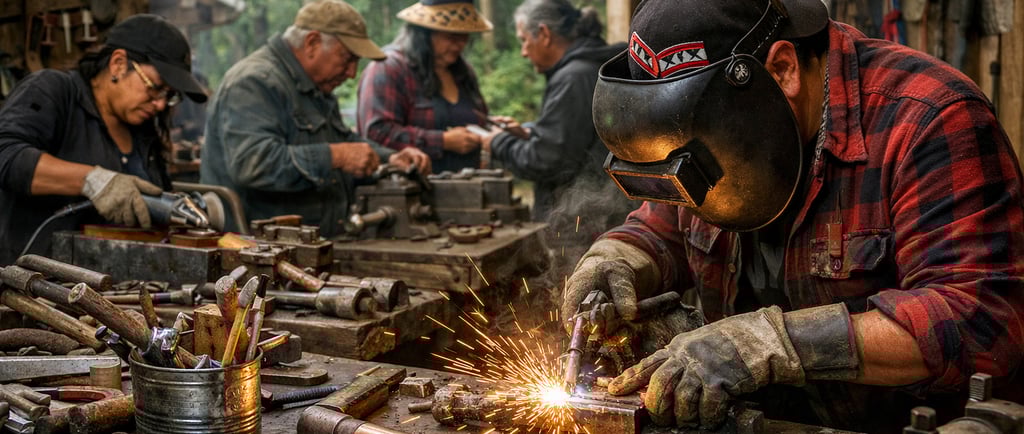
The second pillar is intentional repair infrastructure. Co-create community-based repair clinics with local tribes and trades professionals. These clinics serve as micro-training centers, reviving lost crafts (welding, metal-shaping, mechanical repair) and upskilling residents, including youth and Indigenous apprentices. By systematizing repair, the process becomes normalized—and more assets avoid premature recycling or disposal.
3. Respectful Extension
Before recycling, prioritize products and materials entering a refurbishing or upcycling loop. This could mean reconditioning appliances for resale, repurposing metals into community art, or designing for modular re-use across industries. In every scenario, treat the material’s journey with cultural acknowledgment: document the history of the asset (e.g., tags or data records), include narratives when items are restored, and celebrate the return of metals to productive life.
4. Ethical End-of-Life
Not every metal item can be reused. For end-of-life flows, Indigenous-informed models require transparent, culturally sensitive processing—pairing traditional knowledge about resource sources (e.g., historic mining lands) with equitable profit-sharing when appropriate. Choose recyclers that offer transparency, consent-based engagement, and direct community benefit.
Worked Example: Municipal Metals Reuse Pilot
Scenario:
The City of Tacoma launches a collaborative metals reuse hub with the Puyallup Tribe. Key features:
Intake of used bikes, commercial kitchen equipment, tools, and stainless steel offcuts through public and business donations.
Monthly “Repair Day” events co-staffed by tribal welders, local apprentices, and municipal workers.
Impact: 60% of items repaired and returned to local users; others respectfully recycled with acknowledgment of their resource origin and contribution to community infrastructure.
Data insights: After 6 months, asset recovery rates improved by 40%; local apprentice participation doubled, and stakeholder surveys showed an 80% increase in program trust among Indigenous residents.
This type of pilot demonstrates the viability and positive outcomes of applying the CORE Framework—showcasing how combining cultural knowledge with operational rigor results in measurable wins for cities, tribes, and the metals economy alike.
5. Implementation Playbook: Bridging Traditions and Operations
Translating theory into action is the biggest challenge facing metals leaders—especially when integrating cross-cultural and ESG imperatives. A phased, principle-driven playbook enables organizations to bridge traditions with operational effectiveness and measurable value.
Action Checklist (15 Steps)
Map current metal flows and barriers: Audit both technical and social obstacles, such as transportation bottlenecks, regulatory gaps, or community hesitance.
Engage tribal leaders and Indigenous organizations early: Build mutual understanding and trust, securing permission and input as co-equals.
Assess local repair skills and talent: Identify traditional and emerging craftspeople; invite tribal artisans and youth into advisory boards and paid roles.
Secure a hub or central asset library: Choose accessible locations for intake, repair, and storage of recoverable metals.
Co-design intake, repair, and reuse policies: Prioritize consent, transparency, and respect for cultural traditions in every process stage.
Train municipal and partner staff: Deliver onboarding in stewardship, cultural competence, and anti-bias awareness; empower all participants as sustainability ambassadors.
Pilot regular repair and reuse events: Track attendance, completion rate, and satisfaction; experiment with different outreach and inclusion strategies.
Develop revenue/cost-sharing models: Ensure fair benefit distribution for all participants, including transparent profit-sharing with tribal and local partners.
Integrate cultural literacy into ongoing education: Make history, protocol, and inclusivity modules a requirement for all involved in metals management and engagement activities.
Choose ethical end-of-life processors: Select recyclers and scrap facilities that demonstrate transparency, offer Indigenous partnership, and return a portion of economic uplift to the community.
Quarterly material flow modeling: Use data to adjust program operations, identifying points of leakage or underutilization.
Public education integration: Include local history and resource stewardship education at all community events, reinforcing the “why” behind the system.
Collect and analyze participant feedback: Use surveys and interviews to ensure inclusivity, satisfaction, and innovation in the process.
Publish shared impact reports: Co-author regular reports with tribal partners to build legitimacy and shared ownership.
Plan for expansion: Use metrics to determine when and how to replicate or grow the program regionally, sharing lessons learned.
Decision Points and Failure Modes
Minimal tribal consultation?
High risk of tokenism and participation burnout. Solution: Pause scaling, focus on genuine trust-building and capacity development.
Lagging repair participation?
Low turnout or weak engagement signals unaddressed skill or access barriers. Solution: Reinvigorate community outreach; re-evaluate skills mapping; increase incentives for participation.
Rising costs without value recovery?
Review inventory intake, asset selection criteria, and cost-sharing formulas. Adjust to prioritize the highest-yield and most culturally relevant assets.
Mini Decision Tree
Is there a formal tribal/Indigenous partner at the table?
Yes: Advance to co-design and implementation.
No: Delay pilot, dedicate resources to deepen partnership.
Do asset flows show more than 40% of items are repairable or reusable metals?
Yes: Proceed to robust repair and upcycling programming.
No: Adjust collection strategy to capture more durable goods and higher-quality scrap.
Measurement and Quality Assurance
If Section 5 is where an Indigenous-informed circular metals program gets built, Section 6 is where it either becomes credible or collapses into branding. This is the section most organizations skip. They launch a pilot, hold a few repair events, publish photos, and claim success. But in modern metals management, that is not enough. If a city, tribal government, recycler, or producer wants this work to survive procurement review, ESG scrutiny, grant audits, and community accountability, it needs a measurement system that tracks material outcomes, social outcomes, governance quality, and cultural integrity at the same time.
That is especially important because circularity is moving into a more formal standards environment. ISO 59004:2024 now gives organizations guidance for implementing circular economy principles, and the same standards family explicitly references measurement of circularity performance through ISO 59020 and traceability of recovered secondary materials through ISO 59014. At the same time, the U.S. EPA states that the recycling system still lacks consistent measurement methodologies, and that more standardized metrics are needed to set goals and track progress. In other words, the direction of travel is clear. Circular claims now need evidence, traceability, and repeatable methods.
For Indigenous circularity in metals, the right approach is not a single diversion-rate KPI. It is a balanced scorecard built around four measurement domains.
The first domain is material performance. This is the most familiar one to operations teams. It covers intake tonnage, repairable share, reuse yield, resale or redeployment rate, contamination rate, downcycling rate, and residual disposal rate. It should also track local recirculation, meaning how much metal stays in the local or regional economy through repair, remanufacture, fabrication, community use, or resale. That last metric matters because a program can look circular on paper while still exporting value away from the community.
The second domain is climate and resource performance. Metal flows carry huge embodied energy differences depending on whether the system preserves products, refurbishes parts, or melts scrap. Secondary aluminium requires far less energy than primary production, with the International Aluminium Institute putting the saving at 95.5%. The Bureau of International Recycling reports energy savings of more than 95% for aluminium, more than 85% for copper, and more than 74% for steel when recycled rather than produced from virgin feedstock. Those numbers make it obvious why measurement cannot stop at tonnage. A tonne of stainless equipment reconditioned for another ten years is not equal to a tonne shredded immediately. The retained carbon value is different, the labour value is different, and the community value is different.
The third domain is community and cultural performance. This is where Indigenous-informed circularity separates itself from conventional waste diversion programs. You need to measure whether Indigenous partners were involved early, whether governance was shared or merely consultative, whether paid opportunities were created for Indigenous technicians and youth, whether training included cultural protocols, whether participation barriers were reduced, and whether trust is actually improving. If a program grows tonnage while deepening distrust, it is failing on the very principle it claims to adopt.
The fourth domain is rights, governance, and data integrity. In British Columbia, the Declaration on the Rights of Indigenous Peoples Act establishes the UN Declaration as the province’s framework for reconciliation. Federally, Canada’s UNDRIP Act requires the Government of Canada, in consultation and cooperation with Indigenous peoples, to align federal laws with the Declaration and implement an action plan. Justice Canada’s guidance also states that free, prior and informed consent builds on and goes beyond the legal duty to consult. That means quality assurance in this space is not just about scales, tags, and invoices. It is also about whether the program design respects rights, participation, and accountability.
A strong measurement system for Indigenous circular metals management should include at least the following indicators.
Capture rate should track the share of recoverable metals entering the reuse, repair, refurbish, remanufacture, or recycling pathway rather than disposal.
Repair yield should track the percentage of items accepted for repair that are successfully restored to safe use.
First-pass repair rate should track how many items are fixed without needing repeated interventions.
Reuse retention rate should measure how many items remain in service after 6 and 12 months. This prevents inflated claims based only on event-day redistribution.
Local value retention should track the dollar value of assets that stay in community circulation through repair, resale, leasing, or redeployment.
Indigenous participation rate should measure paid roles, apprenticeships, co-design hours, and governance seats held by Indigenous partners.
Protocol compliance rate should track whether intake, storytelling, signage, public education, and data use followed agreed cultural and governance protocols.
Contamination and mis-sort rate should be measured at intake and downstream transfer points.
Community trust score should be drawn from periodic surveys, focus groups, and partner interviews.
Complaint resolution time should measure how quickly operational, cultural, or safety concerns are addressed.
The best programs also add a “right order” metric. This checks whether the organization is actually following the hierarchy it claims to value: reduce first, then maintain, repair, share, refurbish, repurpose, recycle, and only then dispose. Canada’s circular economy guidance stresses reuse, repair, and sharing as central circular strategies, not side activities. Toronto’s circular economy roadmap made the same point clearly, stating that prevention, reuse, and repair should come ahead of recycling, because recycling alone is not enough.
Quality assurance then needs to move from metrics into operating discipline. That means documented intake criteria, visual inspection standards, electrical and mechanical testing where relevant, clear material grading, safety sign-off, chain-of-custody records, and periodic audits. For programs that handle higher-value metals or equipment, digital asset passports are worth adopting. These do not need to be complex at the start. A simple record with item type, alloy or material class, source, repair history, testing result, destination, and cultural handling notes is enough to build accountability.
For programs working with First Nations data or community knowledge, data governance must also respect OCAP, which stands for Ownership, Control, Access, and Possession. FNIGC describes OCAP as a tool supporting strong information governance and First Nations data sovereignty. That matters here because a metals program can collect culturally sensitive information very quickly: community participation data, oral histories, repair knowledge, local mapping of salvage flows, and even site-specific material provenance. None of that should be treated as generic program data by default.
A practical measurement and QA cycle looks like this. Establish the baseline. Define your material categories. Agree on Indigenous governance and data rules. Set monthly operating KPIs and quarterly outcome KPIs. Audit a sample of repaired or redistributed items. Review contamination and leakage points. Publish a joint impact update. Adjust the program. Repeat. This is slower than a typical recycling pilot. It is also far more durable.
Case Patterns and Scenarios
The strongest way to understand Indigenous circularity in metals is to look at patterns already visible on the ground. Not every case will be a perfect metals-only case. That is fine. The point is to identify operating logic that can transfer into metals systems.
The first pattern is Indigenous-led logistics and technical support in underserved geographies. In British Columbia and other remote parts of Canada, access to recycling is shaped by transport limits, seasonality, weather, and small dispersed populations. RPRA’s 2025 profile of Indigenous-led efforts notes that IZWTAG helps streamline recycling logistics, improve access by coordinating pickups across multiple waste streams, and provide on-the-ground support and mobile depots, especially in harsh winter conditions. Recycle BC’s First Nation programs also point to partner-led service expansion and explicitly link their work to Indigenous stewardship, care, and leadership. For metals leaders, the lesson is direct. Circularity in remote or under-served regions is not mainly a sorting problem. It is a governance and logistics problem. Once Indigenous-led coordination is built into the model, materials recovery becomes more feasible and more trusted.
Translate that into metals and you get a practical scenario. A regional district, tribal government, and metal recycler create a scheduled collection circuit for appliances, tools, bike frames, farm equipment parts, copper offcuts, and stainless fixtures. Mobile intake teams do first-pass grading on site. Repairable items are separated before bulk scrap shipment. Some move to local repair clinics. Some go to fabricators. Only the balance moves to final recycling. The result is fewer unnecessary shipments, less contamination, more local labor capture, and higher public confidence. The core insight is that the system should intercept value before it becomes anonymous scrap.
The second pattern is repair as community infrastructure, not just volunteer activity. Portland’s Repair Cafés offer a simple but powerful case. The city describes them as community-led events where volunteers fix broken items ranging from lamps to bikes while building knowledge and connections. That may sound modest, but operationally it matters. A repair event changes the psychological threshold between “broken” and “waste.” It also creates a visible skill commons. In metals systems, that can be adapted into tool repair days, small-appliance refurbishing clinics, bike and mobility equipment rebuild days, and welding or fastening workshops linked to reuse hubs.
Now imagine that model redesigned with Indigenous partnership from the start. The event is not just a fix-it station. It includes protocol on what enters the program, paid Indigenous technicians, youth apprenticeship slots, cultural interpretation where appropriate, and a pathway for certain items to be transformed into community assets rather than sold immediately. That shift turns repair from a side program into a local circular economy institution.
The third pattern is reuse embedded into public waste infrastructure. Metro Vancouver’s Scaling Reuse Study is highly relevant here. The study, prepared for Metro Vancouver, examined how to scale Reuse Days from the North Shore Recycling and Waste Centre to more sites, drawing on observation, staff feedback, and interviews with 14 reuse organizations. It developed four potential reuse models and identified both short-term and long-term ways to expand reuse at recycling and waste centres, including donation drop-off and on-site attendants trained to recognize reusable items. That is exactly the kind of operational design metals systems need.
For metals management, the implication is simple and powerful. Transfer stations and waste centres should not treat metals as a single exit stream. They should have triage. One stream for immediate reuse. One for repairable assemblies. One for clean commodity scrap. One for hazardous or mixed items needing specialist handling. On-site attendants need training to identify value in products, not just weight in commodities.
The fourth pattern is the scale of metal flow already available in public systems. King County’s 2024 Solid Waste Division report says its transfer stations and drop boxes collected 31,779 tons of recyclable material, including 6,194 tons of scrap metal. Seattle also reports that businesses and non-profits recycled or composted 188,747 tons of material in 2024, equal to 58% of commercial waste. These numbers matter because they show the opportunity is not hypothetical. Public systems in the Pacific Northwest are already handling large metal volumes. The missing layer is not access to material. It is smarter interception, community-centered recirculation, and stronger pre-recycling recovery.
The fifth pattern is that circularity already has a labor and economic case. EPA’s REI report finds that recycling and reuse activities in the United States accounted for 681,000 jobs, $37.8 billion in wages, and $5.5 billion in tax revenues, with ferrous metals making the largest contribution among material categories. This matters for Indigenous circularity because it moves the discussion beyond ethics alone. A well-designed metals reuse and repair system is not charity. It is economic development, workforce development, and industrial resilience.
Taken together, these cases reveal a consistent formula. The winning programs do five things well. They intercept materials earlier. They treat repair as a real service layer. They localize value before exporting scrap. They respect governance and cultural legitimacy. They make reuse visible inside public infrastructure rather than relegating it to the margins.
Frequently Asked Questions
One of the biggest barriers to adoption is that organizations assume Indigenous circularity is abstract, political, or hard to operationalize. Most of the time, that is not true. The real issue is that people ask the wrong questions too late. These are the questions that actually matter.
Is this about replacing modern recycling with traditional practice?
No. It is about changing the logic of the system. Modern recycling remains necessary, especially for end-of-life metal streams. But Indigenous circularity shifts the order of priorities toward stewardship, maintenance, repair, sharing, respectful extension, and community benefit before final recycling. Canada’s circular economy guidance explicitly places reuse, repair, and sharing at the center of circular practice, and EPA likewise states that products should only be recycled if they cannot first be reduced or reused.
Do we need a perfect legal framework before starting?
No, but you do need a real governance framework. In British Columbia, the Declaration Act already creates a strong rights-based context. Federally, the UNDRIP Act provides a consultation-and-cooperation framework. You do not need every detail solved before a pilot begins, but you do need clear roles, decision rights, data handling rules, and benefit-sharing principles.
What is the first material stream to start with?
Start with bulky, visible, repairable, metal-rich products. Bikes, hand tools, small appliances, commercial kitchen equipment, shelving, fixtures, mobility devices, and farm or workshop equipment usually perform better than mixed small scrap at the pilot stage. They are easier to triage, easier to explain to the public, and more likely to create visible wins.
How do we avoid tokenism?
By shifting from consultation theater to shared design and shared benefit. Indigenous partners should help define goals, intake rules, communications, training, data governance, and revenue or procurement pathways. If Indigenous participation is unpaid, invited late, or limited to ceremonial endorsement, the model is weak from day one.
How do we handle cultural knowledge without exploiting it?
Use explicit protocol. Not every story, place-based practice, or repair tradition should be documented, branded, or shared. First Nations data governance guidance through OCAP makes this point clearly. Some knowledge can inform design without being extracted into public content or organizational IP.
What if our current recycler only buys by weight?
Then you have identified one of the biggest structural barriers in the system. A weight-only commercial model pushes everything toward shredding and melting. The fix is not always to replace the recycler. Sometimes it is to add an upstream triage and repair layer before commodity sale. Sometimes it is to create separate contracts for reusable equipment, serviceable parts, and commodity scrap.
Can this work in a dense city, not just rural or remote communities?
Yes. In fact, urban systems may have an easier time building repair density and reuse markets. Portland’s Repair Cafés, Metro Vancouver’s reuse scaling work, and Seattle’s large commercial recovery volumes all point to strong urban potential. The challenge in cities is coordination, not viability.
How do we prove this is better than standard recycling?
Measure what standard recycling usually ignores: product life extension, local value retention, job creation, Indigenous participation, emissions avoided, contamination reduction, and community trust. If the program only reports tonnage, it will understate its value and invite skepticism.
What should procurement teams ask for?
They should ask bidders and partners for reuse-first operating procedures, documented triage logic, Indigenous partnership structure, workforce development commitments, material traceability, contamination controls, and evidence of circularity measurement aligned with emerging standards such as ISO 59004 and ISO 59020.
Is this mainly an ESG story?
No. It is also a resilience story, a labor story, a rights story, and a competitiveness story. ESG is one lens. It is not the whole picture.
Embedded Five-Layer Toolkit
A strong theory is useful. A strong operating toolkit is better. For Indigenous circularity in metals, the most effective model is a five-layer toolkit that can sit inside municipal systems, producer-responsibility systems, tribal sustainability programs, or private recycling and remanufacturing operations.
Layer One: Governance and Consent Architecture
This layer answers a basic question. Who has standing to shape the system?
Start by mapping affected Indigenous nations, municipal agencies, stewards, operators, local repair groups, fabricators, and end-market buyers. Then create a governance charter. That charter should define participation rules, decision rights, cultural protocol, revenue principles, and dispute resolution. In British Columbia and Canada, this should be designed in light of the Declaration Act and the federal UNDRIP Act, not as an afterthought. If the program will collect community-level data, it should also set out OCAP-aligned data rules where relevant.
Minimum operating tools in this layer include a partner charter, a memorandum of understanding, meeting cadence, protocol checklist, compensation policy for Indigenous advisors and technicians, and a data governance appendix.
Layer Two: Material Intelligence and Asset Triage
This layer answers the question. What exactly are we handling, and what should happen to it first?
Create a triage ladder for metal-bearing items. Category A is immediate reuse with minor cleaning or testing.
Category B is repairable. Category C is refurbishable or remanufacturable. Category D is parts harvesting.
Category E is clean commodity scrap. Category F is hazardous or mixed material requiring specialist handling. Then build simple intake sheets and inspection scripts around that ladder.
This is where modern circular standards and local knowledge can work together. ISO’s circular standards family is moving toward more formal measurement, traceability, and product circularity documentation. A local metals program does not need enterprise software on day one, but it does need enough classification discipline to stop valuable goods from disappearing into the shred pile.
Minimum tools here include a material taxonomy, item grading guide, safety screen, repairability checklist, basic asset-passport template, and contamination flags.
Layer Three: Repair, Reuse, and Skills Infrastructure
This layer answers the question. Who will do the work of extension?
Many programs fail because they collect materials without building a repair and redeployment engine. That is backwards. You need technicians, apprentices, volunteer mentors where appropriate, parts supply, tools, storage, and clear handoff points. Portland’s Repair Cafés show the community side of this. Metro Vancouver’s reuse scaling work shows the public-infrastructure side. IZWTAG’s work shows the Indigenous-led support side.
Together, they point toward a blended model: public sites for intake, community events for visibility, technical hubs for skilled repair, and Indigenous-led participation that is paid, structured, and continuous.
Minimum tools here include repair event SOPs, technician qualification matrix, youth apprenticeship plan, parts inventory rules, test-and-release procedures, and a local partner map.
Layer Four: Market Design and Value Retention
This layer answers the question. How does the program keep value local instead of leaking it away?
A circular metals system should have more than one market channel. Repaired goods can go to community users, non-profits, small businesses, schools, makerspaces, or affordable resale. Parts can feed local repair ecosystems.
Surplus clean metal can still go to recyclers. The point is to create a cascade of value. Public procurement can help here too. A city can commit to buying remanufactured benches, repaired tools, reused fixtures, or community-fabricated products where standards permit. Canada’s circular economy initiatives explicitly connect circular practice to procurement, life-cycle thinking, and economic opportunity.
Minimum tools here include a channel strategy, resale and donation criteria, Indigenous procurement targets, pricing bands, benefit-sharing principles, and buyer agreements.
Layer Five: Assurance, Reporting, and Continuous Learning
This layer answers the question. How do we know the system is actually improving?
This is where this part comes to life. Build a dashboard that tracks material, climate, labor, governance, and trust indicators. Review it monthly for operations and quarterly for strategy. Publish short, joint impact summaries. Audit a sample of repaired or redistributed goods. Compare actual performance against the triage hierarchy. Then correct the system.
This layer also prevents a common failure mode. Programs often celebrate launch energy but never learn fast enough from leakage, low turnout, poor item selection, or culture-process misalignment. A disciplined assurance loop fixes that.
Minimum tools here include a KPI dictionary, dashboard template, audit plan, survey instruments, escalation matrix, and quarterly learning review.
What makes this a true embedded toolkit is that the layers depend on one another. Governance without triage becomes symbolic. Triage without repair capacity becomes stockpiling. Repair without markets becomes clutter. Markets without assurance become greenwashing. Assurance without Indigenous governance becomes extractive measurement. The toolkit works only when all five layers are built together.
Competitive Differentiation
For many leaders, this is the section that finally turns interest into action. Ethics matter. Reconciliation matters. Stewardship matters. But organizations also move when they see a clear strategic edge. Indigenous circularity in metals creates that edge in at least five ways.
First, it creates stronger legitimacy. In a region where Indigenous rights, public trust, and environmental scrutiny are increasingly central, a metals strategy built with real Indigenous partnership is simply more credible than a standard diversion program with generic community outreach. In British Columbia, the legal and policy environment is already moving toward more structured recognition of Indigenous rights and participation. Operators who adapt early will be better positioned than those who keep treating Indigenous engagement as a compliance add-on.
Second, it creates better material economics. The closer an organization can keep metal products to their highest-value use, the more economic value it retains. That is especially true for aluminum, copper, stainless assemblies, commercial fixtures, tools, and equipment where the jump from reuse to scrap can destroy labor, carbon, and functional value instantly. Since recycled aluminium alone can save roughly 95.5% of primary energy, and steel and copper also carry major energy savings when recycled, the case for preserving utility before melting is even stronger. You are protecting both material value and avoided energy intensity.
Third, it builds resilient labor pipelines. The circular economy is labor-rich where repair, maintenance, refurbishment, and reuse are taken seriously. EPA’s REI report shows the scale of existing economic value in U.S. recycling and reuse, and its data shows ferrous and non-ferrous metals already play an outsized role. A local Indigenous circularity model goes one step further by creating a place-based training and employment engine tied to real materials, real shops, and real public needs. That matters in a market where skilled trades, repair capacity, and circular remanufacturing talent are increasingly strategic assets.
Fourth, it improves access to public funding, partnerships, and procurement. Governments in Canada are explicitly supporting circular economy expansion through reuse, repair, sharing, procurement reform, and remanufacturing strategies. Municipalities and firms that can show rights-aware governance, measurable circularity, and local community benefit are more likely to stand out in grants, partnerships, climate plans, stewardship agreements, and public procurement discussions.
Fifth, it gives organizations a story competitors cannot easily copy. Any recycler can claim diversion. Far fewer can show a system that combines Indigenous partnership, local repair infrastructure, material traceability, public participation, workforce development, and credible quality assurance. That combination is difficult to fake because it depends on relationships, not just equipment. In markets crowded with generic sustainability language, that is a serious differentiator.
There is also a defensive advantage. As circular economy standards mature and expectations rise, organizations that still measure success only by tonnage risk looking outdated. EPA is already clear that the U.S. recycling system needs more consistent metrics. ISO’s circular standards family is already building a vocabulary, implementation guidance, measurement framework, and traceability direction. Organizations that develop Indigenous-informed circular systems now are not just doing something culturally and environmentally stronger.
They are getting ahead of where reporting, procurement, and stakeholder scrutiny are heading.
Actionable Strategies for Adopting Indigenous Circularity in Modern Metals Management
For readers who want the practical next move, here is the adoption path that works best.
Start narrow. Choose one geography, one Indigenous partner structure, and one material family or product cluster. Bikes, tools, appliances, kitchen equipment, building fixtures, or agricultural equipment are usually easier starting points than fully mixed scrap.
Build governance before branding. Do not launch public-facing messaging until the Indigenous partnership model, compensation, and data rules are agreed.
Install triage before volume. A smaller volume of properly sorted material is better than a large tonnage stream that erases reuse value.
Pay for skills. Repair and cultural participation should not rely on unpaid goodwill. Budget for Indigenous technicians, coordinators, youth placements, and trusted local repair capacity.
Use public infrastructure intelligently. Transfer stations, depots, civic works yards, reuse days, and libraries of tools or parts can all act as circular nodes if staff are trained to intercept reusable metal-bearing items.
Measure what matters. Track material recovery, product life extension, trust, participation, and governance quality together. Do not let diversion rate dominate the whole story.
Publish joint results. Even a short quarterly update co-authored with partners will do more for credibility than a glossy annual sustainability claim written by one side alone.
Design for replication. The first pilot should produce templates, not just outputs. Intake scripts, consent procedures, dashboard logic, training modules, and procurement language should all be built so they can be reused elsewhere.
Conclusion
Indigenous circular practices in the Pacific Northwest should not be treated as historical inspiration alone. They are operating intelligence for the next era of metals management.
The current linear system still destroys too much value too early. It turns useful products into anonymous scrap, sends economic opportunity out of community, underinvests in repair capacity, and too often excludes the very Indigenous nations whose stewardship traditions have long modeled a more durable relationship with material resources. That is the gap this article has tried to close.
The lesson is not to romanticize the past. It is to recognize that many of the principles modern circular economy advocates now promote, stewardship, repair, sharing, respectful use, value retention, and accountability across lifecycles, were already being practiced in Indigenous systems long before the term circular economy became fashionable. Canada’s own circular economy discussions acknowledge First Nations, Inuit, and Métis peoples as long-standing stewards who preserved natural cycles through reciprocal relationships with land and resources. The question for modern metals leaders is whether they are willing to build systems worthy of that insight.
For municipalities, this means redesigning metal collection and transfer systems so that reuse and repair are not afterthoughts. For tribal governments and Indigenous organizations, it means claiming space not only as stakeholders but as co-designers, operators, rights holders, and economic participants. For recyclers and producers, it means understanding that the future is not secured by more volume alone. It is secured by better hierarchy, better traceability, better community relationships, and better retention of value.
This is also a competitive choice. The organizations that win in the coming decade will be the ones that can prove more than diversion. They will be able to prove stewardship. They will be able to show that materials stayed useful longer, that local people gained skills and income, that Indigenous rights and governance were respected, that reporting was credible, and that the metals economy became stronger because it became more circular and more accountable.
That is the real promise of Indigenous circularity in modern metals management. It does not ask the sector to become less industrial. It asks it to become more intelligent, more disciplined, and more grounded in relationships that actually last.
Connect
Your trusted partner for scrap metal procurement.
CONTACT
About
haroon@tdcventures.com
+1-307-655-7593
© 2025. All rights reserved.
NEWSLETTER