
Indigenous Circular Practices in Sahel: Lessons for Modern Metals
Discover how Sahelian indigenous circular practices—rooted in blacksmith stewardship, barter systems, and repair culture—offer scalable, high-retention models for modern metals management and e-waste challenges.
CULTURAL SUSTAINABILITY & INDIGENOUS CIRCULAR PRACTICES
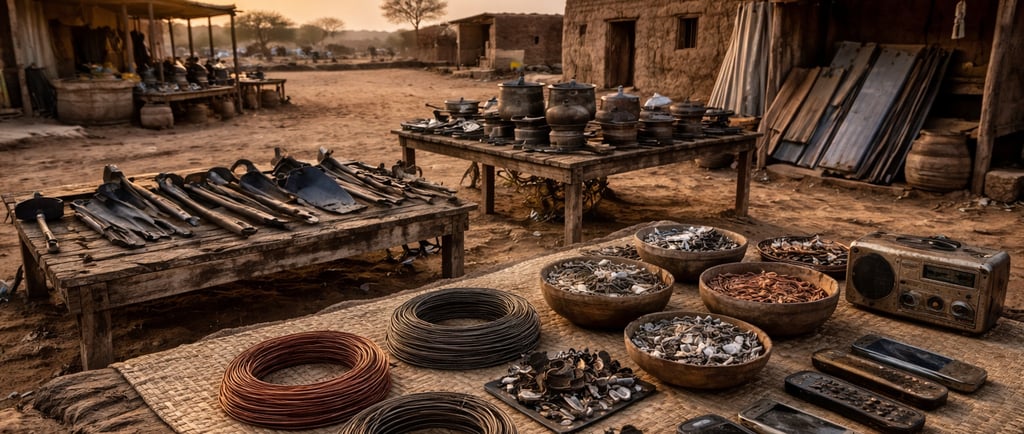
Context: Why Indigenous Circular Practices Matter in Sahel and Metals
West Africa’s Sahel region is a vivid case study in resource pressure—its economies face mounting risks from climate change, import dependency, and urbanizing populations. The interplay between soaring demand for durable goods (notably tools, wires, electronics, and consumer products containing metals) and precarious resource flows has elevated metal cycles as a sustainability “pressure point.” According to the World Bank, Africa generates over 2.9 million metric tons of e-waste annually (2023), yet formal recycling infrastructure lags far behind the growth of discarded goods.
Yet, Sahelian societies, stretching from Senegal and Mali to Niger and Chad, have shown generational expertise in thriving within limits. Anthropological studies (UNESCO, 2018) detail how traditional livelihoods—farming, herding, craftsmanship—demanded hyper-efficient use of every resource, especially the valued metals used in daily implements. Blacksmiths (known variously as “maalems” or “forgerons”) are more than artisans; they are custodians of material wisdom, transforming, repairing, and repurposing metals as collective patrimony.
When global development teams or sustainability experts overlook these existing circular models, they risk implanting expensive, culturally incongruent systems that fail to deliver lasting change. Conversely, honoring localized wisdom offers adaptation insights for global struggles with overconsumption and e-waste—key levers for advancing the circular economy agenda not just in Africa, but worldwide.
In essence, indigenous circular practices in the Sahel are not relics—they are live laboratories for sustainable material management, blending social cohesion, environmental stewardship, and economic resilience in ways that modern frameworks aspire to replicate. For metals in particular, these practices reveal affordable, scalable pathways for decoupling prosperity from waste.
2. Defining the Problem and Opportunity
The Problem:
Despite rising investment in sustainability, West Africa’s formal recycling sector has not succeeded in closing the loop for metal goods. The International Telecommunication Union (ITU, 2022) highlights that less than 10% of e-waste—rich in metals like copper, aluminum, and steel—is safely processed in sub-Saharan Africa. Informal actors such as market fixers, roaming repairers, and small blacksmiths remain invisible in official policy, leading to fragmented materials flow and increasing environmental hazards from open burning and dumping.
In parallel, imported e-waste and cheap metal products crowd traditional markets, pushing out established craftspeople and eroding local traditions of repair and extended use. This risks both material inefficiency and cultural dilution, threatening jobs, lost knowledge, and higher landfill volumes.
The Opportunity:
Data from the African Circular Economy Alliance (ACEA) shows formal-sector pilots that entrench local repair systems witness 30-50% higher resource retention than externally designed recycling programs. Embedding Sahelian methods—like communal repair days and barter-based redistribution—into modern metal management can catalyze job creation, trust, and higher recovery rates. When NGOs, policymakers, and formal industry recognize and amplify these approaches, they build systems where local legitimacy, efficiency, and resilience reinforce each other.
Moreover, integrating indigenous models aligns with the Sustainable Development Goals (SDGs): SDG 12 (Responsible Consumption and Production), SDG 8 (Decent Work), and SDG 11 (Sustainable Cities/Communities).
Operational Stakes—Expanded with Factors and Data
Missed resource efficiencies: Informal repair and barter networks can double product lifespan (UNEP, 2021), but remain underutilized by formal sector schemes.
Cultural loss: In Mali, youth apprenticeship rates in blacksmithing have dropped 40% (2010–2022), risking intergenerational skill transfer.
Marginalization of informal actors: The Global E-Waste Monitor notes that up to 80% of end-of-life electronics in West Africa pass through unregulated informal channels, leaving workers exposed to hazards and unstable incomes.
Program underperformance: Donor-funded recycling pilots that failed to consult local artisans in Niger recovered only 12% of intended scrap—one-third the rate of community-driven barter programs.
Potential as global exemplar: With tailored support, Sahelian models could inform repair and reuse protocols globally, offering unique African innovation to worldwide material stewardship.
3. Key Concepts: Indigenous Stewardship, Reuse, and Cultural Sustainability
Indigenous Circular Practices—Analysis and Entities
Rooted in local context, indigenous circular practices are sophisticated forms of “environmental engineering,” shaped by social norms and ritual as much as by functional necessity. These practices are not static: studies from Senegal’s Fouta Toro region (Mbodj, 2019) describe evolving barter, repair, and resource-sharing systems that flex with droughts, migration, and new market goods, ensuring materials are rarely wasted and stewardship is collective.
Stewardship (Primary Entity):
Community-based, stewardship extends beyond utility—items are managed as a shared resource with rituals framing their use, repair, and redistribution. In the Sahel, blacksmiths hold unique social status, not only as skilled repairers but as mediators of resource flows, acting as arbiters for the “life” of an object from initial fabrication to final repurposing.
Reuse:
Metal implements, from ploughshares to cookware, embark on multi-phased lifecycles. According to fieldwork by the West African Metalwork Initiative (2020), a single hoe blade in a rural Malian household is typically repaired or repurposed four times before exiting active use. Adaptations abound—one survey found 68% of metal containers in Nigerien markets had prior agricultural or household uses.
Cultural Sustainability:
Preserving the integrity and authority of local knowledge is both an ethical and practical imperative. Programs that align with indigenous stewardship principles see higher community engagement and lower attrition. Example: In Burkina Faso’s Gourma region, integrating traditional ceremonies into repair events led to a 25% increase in tool return rates for community libraries (Ouedraogo, 2021).
Metal Cycle Alignment—Entity Relationships:
Entities: Blacksmiths (knowledge holders), metal goods (objects in flow), community users, barter markets, repair apprentices, ceremonial leaders.
Attributes: Skill status, frequency of reuse, degree of repurposing, embedded cultural value, repair volume, community recognition.
By focusing on entity-attribute-value structures—such as the number of tools repaired per blacksmith per season, or frequency of redistribution at festivals—policy teams and NGOs can track outcomes rooted in local reality, enhancing both impact and cultural fit.
4. Sahelian Circular Practices Framework—Mapped to Metal Cycles
The Core Framework—Expanded with Analysis and Examples
Acquisition:
Metal goods flow into communities via trade, aid shipments, or local manufacture. For instance, in the region around Bamako, up to 45% of new farm tools are now imported, but secondary acquisition (buying used or inheriting) remains prevalent.
Use:
Objects are intensively utilized—handled daily for farming, cooking, herding, or craftwork. A study by Sahelian Material Cultures Center (2022) reports that average tool utilization rates exceed those in comparable rural zones globally, due to scarcity-driven optimization.
Repair:
Community blacksmiths and repairers are essential. In Senegal, the “takkamaar” or tool repairer is often paid in barter (grain, labor, or goods). Annual repair events—marked by celebration or ritual exchange—anchor the social aspect of reuse.
Barter/Redistribution:
Redistribution relies on social mapping: family ties, social standing, and seasonal need dictate who swaps, keeps, or gifts items. At Niger’s annual “Gossi” festival, a third of village metalware changes hands through barter.
Repurposing:
Out-of-use implements are reimagined. Examples include ploughshares recast as blade tips, or tin cans transformed into intricate lanterns sold in artisanal markets. This adaptability showcases living design thinking, where form and function are continuously re-assessed.
Stewardship and Ritual:
Ceremonial oversight marks both the initiation of new objects and the respectful retirement or redistribution of old ones. Such rituals encode collective values: waste is taboo, and material “life” is revered.
End-of-Life Barter or Upcycling:
Even micro-fragments, like wire scraps or broken bolt heads, find value as craft components or barter tokens (e.g., as credit at local smithies). In urban peripheries, youth collect “useless” metal pieces, aggregating them for sale to city recyclers.
Step-by-Step Process—Deeper Example
Mapping Practices:
In Zinder, Niger, women’s cooperatives were interviewed with asset-mapping tools to track every metal utensil’s journey: from imported saucepan to child’s toy, to market stall repair, and finally to scrap dealer’s cart for recasting as jewelry trinkets.
Actors:
The cast includes blacksmiths, matriarchal leaders (who oversee redistribution of household goods), young apprentices, market traders and, increasingly, urban recyclers specializing in “last-mile” collection.
Cultural Protocols:
Repair rituals may include blessing ceremonies or marking the repaired object with a symbolic stamp, conferring social status on the repairer and reinforcing collective stewardship values.
Visual Map Example:
A recent visual tracking exercise mapped an e-waste component: cell phone → household (charging radio) → youth repairer (removes copper wire) → village festival (bartered for maize) → scrap for city processor.
Community Incentives and Feedback:
Motivations stretch beyond economics—social reputation, inclusion in village councils, and the ability to access community resources flow from visible participation in circular practices. When disruptions occur—say, a surge in cheap imported goods—communities may request workshops or co-design sessions to update repair protocols, melding tradition with innovation.
5. Implementation Playbook: How to Build a Sahel-Aligned Circular Metals System That Actually Works
The first rule is simple. Do not start with a recycling plant. Start with a flow map.
Too many metal recovery projects in low-capacity markets begin with the visible end of the chain: bins, trucks, sheds, crushers, or donor-funded processing units. That approach looks decisive, but it usually misses the real engine of recovery, which is the social system that already moves objects from first use to second use, from household value to repair value, from repair value to barter value, and only then to scrap value. Across Africa, formal collection remains patchy, informal actors carry a large share of resource recovery work, and many cities still struggle to collect waste consistently at all. That means the highest-return intervention is usually not “replace the informal system.” It is “map it, de-risk it, raise its yield, and connect it to safer downstream channels.”
In Sahelian settings, that mapping step has to include more than volumes and locations. It must include authority. Who decides whether a broken hoe gets repaired, sold, gifted, or stripped for parts? Who mediates disputes over ownership of aging tools, household metalware, cable, batteries, or obsolete electronics? Who can convene households for a repair event or a material hand-in day without creating suspicion? In many places, the real answer is not the municipality alone. It is a layered mix of market leaders, lineage heads, women’s groups, blacksmiths, repairers, itinerant fixers, youth collectors, and trusted traders. If your program cannot name these actors and explain how metal moves through their hands, your baseline is not ready.
A strong implementation sequence starts with six phases.
Phase One: Build a metal-lifecycle census
This is the operational backbone. Select two or three pilot geographies that reflect real variation, for example one secondary town, one peri-urban settlement, and one market-centered rural cluster. Then document the main metal object families in daily circulation: agricultural tools, cookware, roofing sheets, bicycles, wiring, batteries, small appliances, phones, radios, and vehicle parts. Track where each category enters, how long it stays in use, who repairs it, when it gets cannibalized for parts, and what finally pushes it into discard. ITU data shows that e-waste contains both hazardous substances and high-value embedded metals, while OECD work shows that repair and reuse extend service life and slow extraction pressure. A local census turns those general truths into a real operating map.
This census should not be built by outside consultants alone. Use mixed teams. Pair enumerators with local repairers and respected community members. Add women’s groups because household metal flows often move through domestic decision-making long before they show up in market records. Add youth because they often control low-value salvage and last-mile collection. The result is not just better data. It is better permission.
Phase Two: Classify materials by the highest-value next use
Most bad metal policy starts by treating all end-of-life items as waste. Sahelian practice teaches the opposite. An object is not waste just because its first function is over. The system should classify every item by its best next state. That state is usually one of five: direct reuse, repair, component harvesting, recasting or fabrication, and only then commodity scrap recovery.
This matters because the economics differ sharply. A working used tool may hold higher community value than its scrap weight. A damaged radio may hold more value as spare components than as mixed metal. A cable bundle may be worth far more if separated safely than if burned. World Bank documentation from Ghana shows the damage that comes when e-waste moves into crude dismantling and open burning, releasing heavy metals, dioxins, furans, and fine particles into air, soil, waterways, and the food chain. The playbook therefore has to rank next uses in a strict value-and-safety hierarchy. Keep whole products in use first. Keep components in use second. Recover clean material third. Never let open burning become a default sorting method.
Phase Three: Formalize without crushing the local system
This is where many projects fail. They confuse formalization with replacement. In practice, the African Union’s Continental Circular Economy Action Plan points in a different direction. It explicitly calls for identifying and promoting repair, reuse, and refurbishment initiatives, supporting informal initiatives where welcomed, and embedding circularity in business models through collaboration with local knowledge holders, informal associations, academia, and the private sector. UNIDO makes a similar case by recommending national registries of repairers, reuse and repair hubs, and materials data systems.
For a Sahel metals program, that means a light-touch pathway. Register blacksmiths, repairers, and collectors voluntarily. Give them access to safer work practices, basic bookkeeping support, tool grants, and preferred links to downstream buyers. Offer group insurance where possible. Set simple occupational safety standards that do not depend on expensive imported compliance systems. Formalization should give local actors better margins, steadier demand, and lower risk. If it only gives them forms to fill and new fees to pay, they will route around it, and rightly so.
Phase Four: Create repair-and-return nodes before you create scrap depots
The highest-yield circular move in a low-income, metal-scarce environment is usually repair, not shredding. A repair-and-return node can be a market stall cluster, a municipal yard annex, a cooperative workshop, or a periodic village event. What matters is function. The node should inspect, triage, repair, harvest parts, and record outcomes. It should handle common objects first, because throughput matters more than novelty in early pilots.
The industrial logic is clear. Product life extension lowers raw material demand, slows waste generation, and preserves embedded value. OECD guidance and broader circular economy literature consistently place repair and reuse above material recovery for exactly that reason. In job terms, this also matters. ILO data now estimates that between 121 million and 142 million people globally work in circular economy sectors, and more than 74 million of them work informally. That means a serious circular metals strategy in the Sahel is also a labor strategy. It should make repair more productive, more visible, and safer.
Phase Five: Build clean downstream channels for the fraction that cannot stay in use
Eventually, some fraction of metals and e-waste will need material recovery. This is where the system needs disciplined aggregation, safe dismantling, and contracted offtake. Ghana’s experience shows why. Where collection and processing infrastructure remain weak, crude methods persist and the health burden rises. A Sahelian system should therefore create simple transfer rules: no open burning, no acid stripping in uncontrolled settings, no mixed hazardous storage, and no sale of dangerous fractions to unverified buyers. Use designated consolidation points. Sort into clean ferrous, aluminum, copper-bearing fractions, stainless, lead-bearing batteries, small electronics, and mixed residuals. Then connect each stream to an approved next processor.
This is also where data starts to matter commercially. Buyers will pay more for cleaner, better-separated fractions. A registry of sellers, weights, contamination levels, and payment records can raise trust fast. Even a simple digital ledger, updated by phone, can cut leakage and disputes. UNIDO’s recommendation for a materials data hub becomes highly practical here. The Sahel version does not need to start as a national platform. It can begin as a district-level ledger for metal flows, repair output, and scrap grades.
Phase Six: Anchor the system in culture, not only compliance
This is the part many engineers skip, and it is often the difference between pilot success and quiet collapse. If communities view the program as an extraction exercise, participation drops. If they see it as a way to preserve utility, dignity, and local earning power, participation rises. The implementation plan should therefore include community repair days, school demonstrations, visible recognition for master repairers, apprenticeship pathways, and ceremonies or public acknowledgments that align with local practice. UNESCO’s recognition of ancient ferrous metallurgy sites in Burkina Faso as evidence of a long and technically rich ironworking tradition should remind policymakers that metalwork in the Sahel is not peripheral craft. It is part of the region’s civilizational knowledge base. A circular metals program should behave accordingly.
The best practical model is a “triple-track system.” Track one keeps goods in use. Track two refurbishes and harvests parts. Track three recovers clean material safely. Every intervention should push objects to the highest-value viable track, not the fastest disposal track.
6. Measurement and Quality Assurance: What to Track, How to Prove It, and How to Avoid Fake Success
A weak circular project measures tonnage alone. A strong one measures retained function.
That distinction matters because a ton of scrap recovered can look impressive while hiding system failure. If households lose affordable access to repaired tools, if local repairers lose income, if hazardous handling shifts out of sight, or if imported low-quality replacements flood back in, then tonnage goes up while resilience goes down. A serious quality framework for Sahelian metal systems should measure five layers at once: material retention, utility retention, livelihood quality, safety performance, and cultural fit.
Start with material retention. Measure the share of collected items that go to direct reuse, repair, component harvesting, and material recycling. In a healthy circular system, the top of the hierarchy should expand over time. Repair and reuse should rise before raw recovery does. OECD guidance supports this logic because longer product life slows extraction and waste generation more effectively than end-stage recycling alone.
Then measure utility retention. This is the question that matters to households and farmers: how many more months or seasons of service did the system create? A repaired plough, a restored wheelbarrow, a reconditioned fan, or a working radio often matters more than kilograms diverted. Utility retention can be tracked through simple follow-up checks at 30, 90, and 180 days. The right KPI is not just “item repaired.” It is “item still working after one season,” or “device still functional after six months.” That is the difference between a repair culture and a patch culture.
Third, track livelihoods. Since more than half of all circular economy workers globally are in the informal economy, and many of them operate without stable protection, the question is not whether informality exists. The question is whether your program reduces precarity. Track average monthly earnings for registered repairers and collectors, payment time, repeat customer rates, training uptake, and transition into safer work practices. If incomes flatten while compliance costs rise, you are formalizing people into failure.
Fourth, measure safety with discipline. This is non-negotiable for metals and e-waste. World Bank documentation from Ghana makes clear that crude handling can expose workers and communities to lead, mercury, cadmium, dioxins, furans, and fine particles. Quality assurance therefore needs a simple but real control plan: PPE use checks, prohibited-practice monitoring, incident logging, battery storage rules, separation of hazardous fractions, smoke-event tracking, and environmental sampling in hotspots when budgets allow. One avoided burn site may matter more than five extra tonnes collected.
Fifth, measure cultural fit. This is the most neglected layer and often the decisive one. You can track it with participation quality indicators: repeat participation in community repair days, share of materials handed in through trusted local channels rather than anonymous drop-offs, number of apprentices retained, and stakeholder satisfaction among blacksmiths, women’s groups, traders, and local leaders. Low cultural fit usually shows up before the financial model breaks. It shows up as low turnout, hoarding, distrust, side-selling, and refusal to disclose inventories.
A high-quality dashboard for a Sahel metals program should therefore answer a set of practical questions every month. How much metal stayed in service? How much value stayed local? How much hazardous handling was avoided? How many workers earned more safely? How many households trusted the system enough to use it twice?
Quality assurance should also include four hard gates.
The first gate is traceability. Every batch of end-of-life material should have a recorded source, handler, condition, and destination. The system can start on paper and migrate to mobile tools later. What matters is continuity.
The second gate is functionality verification. Repaired goods should be tested before return or resale. This can be very basic: a powered device check, a blade integrity check, a wiring continuity check, a wheel and axle check. No “repaired” item should leave the node untested.
The third gate is contamination control. Mixed hazardous and non-hazardous fractions destroy value and raise risk. Separate batteries, circuit boards, cables, ferrous, aluminum, and reusable components early. Do not let handling shortcuts create downstream problems.
The fourth gate is community review. Hold periodic review meetings with local actors and publish simple results. This prevents the common donor-project problem in which metrics travel upward but learning does not travel sideways. Programs improve fastest when repairers, collectors, and users can see the data and challenge it.
If you want one headline metric for external reporting, use this: local metal value retained per tonne collected. That metric forces the system to care about reuse, repair, local fabrication, safe part harvesting, and price realization, not just volume. It is harder to game and closer to the real point of circularity.
7. Case Patterns and Scenarios: What Success Looks Like in Practice
The most useful way to think about Sahelian circular metals systems is not through one perfect model. It is through recurring patterns. When you study successful circular systems in difficult environments, the same shapes appear again and again: dense social trust, thin formal infrastructure, high material ingenuity, and strong local knowledge that formal systems often ignore. Africa-wide evidence on informal recovery, municipal cooperation, reuse and repair policy, and electronics circularity all point in that direction.
Pattern One: The market-repair cluster
This is the most natural entry point in many Sahel towns. A central market already concentrates broken goods, spare parts, metal offcuts, traders, and repair talent. Instead of building a new facility at the urban edge, the program strengthens the existing cluster. It provides covered work areas, basic safety gear, testing tools, a parts shelf, simple recordkeeping, and a route for non-repairable residues to approved buyers.
Why this pattern works is straightforward. It cuts transport friction. It keeps customers close to repairers. It preserves the social visibility that builds trust. It also raises yield because repair decisions happen near the point of exchange. UNIDO’s support for repair hubs and repairer registries fits this model closely, and African city experience shows that working with existing informal actors can expand service coverage at lower cost than trying to build parallel systems from scratch.
Imagine a town where farmers bring damaged hoes, householders bring broken stoves and fans, and youth collectors bring cable and dead chargers. The node triages items. Forty percent go back into use after light repair. Twenty percent become donor parts. Thirty percent become clean-sorted metal fractions. Ten percent become hazardous or residual waste for controlled handling. The visible result is less dumping. The deeper result is that money circulates locally several times before material leaves the town.
Pattern Two: The village repair day linked to seasonal cycles
In dispersed rural zones, permanent facilities may not make sense. Periodic repair days do. These events can align with planting, harvest, or market cycles, when tool readiness matters most and households already gather. The program sends a trained team with local blacksmiths, parts kits, weighing tools, and a simple intake ledger. Damaged agricultural and domestic metal goods are repaired on site where possible. Unfixable items are classified for part harvesting, recasting, or collection.
This pattern has three advantages. It respects local rhythms. It lowers travel burdens. It lets repair function as a social event rather than a bureaucratic service. That matters in places where trust is built collectively. It also provides an apprenticeship stage. Younger participants can learn sorting, diagnosis, and basic repair under a master craftsperson. Over time, these periodic events can become the backbone of a distributed circular system.
Pattern Three: The urban-peri-urban aggregation corridor
As Sahelian towns expand, peri-urban areas often become the zone where broken electronics, construction metal, transport parts, and household scrap accumulate. Collection is uneven, open dumping rises, and informal dismantling spreads. A corridor model connects neighborhood collectors to a peri-urban aggregation point with sorting standards and scheduled offtake.
This pattern works best when the city does not try to eliminate informal collection but instead gives it a safer route. African municipal experience suggests that cooperative or contracted engagement with informal workers can improve collection coverage and low-cost recycling performance. The corridor model does exactly that. Collectors keep their territory and local knowledge. The aggregation point improves separation, price discovery, and safety.
The industrial lesson here is important. Reverse supply chains do not begin in warehouses. They begin with whoever can identify, gather, and move dispersed material at low cost. In much of the Global South, that actor is already present.
Pattern Four: The electronics refurbishment spine
This pattern matters because the metals conversation is moving fast toward electrical and electronic goods. Phones, chargers, radios, small appliances, IT equipment, and network hardware now carry a growing share of embedded metal value and hazard risk. ITU’s latest monitoring shows the global e-waste stream reached 62 million tonnes in 2022, with only a modest share formally documented as collected and recycled. In Africa, 2019 documented collection was extremely low, around 0.9 percent in the available monitoring baseline. That gap is exactly why refurbishment matters.
A refurbishment spine moves selected electronics through diagnosis, data wiping where relevant, part replacement, testing, grading, resale or redistribution, and only then dismantling for materials. Egypt’s recent UNIDO-linked effort to establish a reconditioning and recycling ecosystem for phones, IT equipment, and network hardware shows the direction of travel. It aims to create a viable high-quality second-hand market while building technician skills and supporting a national target to raise recycling rates. The Sahel can adapt that logic on a smaller and more distributed scale.
The key is to avoid a false choice between repair and recycling. The better sequence is refurbishment first, controlled material recovery second. Every device kept in service defers a replacement purchase, preserves embedded metal value, and reduces pressure on crude recovery practices.
Pattern Five: The heritage-to-enterprise transition
This is the pattern with the most long-term promise. It links blacksmithing and traditional metal knowledge to modern enterprise development without stripping away cultural authority. Burkina Faso’s ancient ferrous metallurgy sites, recognized by UNESCO for showing a rich technical and cultural heritage with traditions still alive today, offer a useful reminder that the region’s metal knowledge base is deep. A modern program can build on that by supporting master artisans as trainers, certifiers, and designers of locally repairable goods.
In practice, that could mean training blacksmiths and repairers to produce improved stove parts, agricultural tool replacements, fasteners, brackets, hinges, and simple repair kits using recovered metal streams. It could also mean giving them a role in product design review. If imported goods fail quickly because they cannot be repaired locally, the circular system should say so, document it, and influence procurement. Circularity improves fastest when design, repair, and recovery talk to each other.
8. Frequently Asked Questions
Does this approach romanticize poverty or scarcity?
It should not. The point is not to celebrate deprivation. The point is to recognize that communities under material pressure have developed highly efficient reuse and repair practices that modern systems can learn from. A strong program takes those practices seriously, then adds safer handling, better tools, cleaner downstream processing, stronger incomes, and better data. It respects local intelligence while reducing risk.
Isn’t formal recycling still necessary?
Yes. Some metal and e-waste fractions require controlled processing, especially hazardous components. The argument here is about sequence and design, not denial. Keep products and components in use where possible, then move the irreparable fraction into clean and traceable recovery. World Bank evidence from Ghana shows why uncontrolled downstream handling is dangerous. Formal recovery matters, but it works best when it receives cleaner, better-sorted, and better-tracked material.
Can this model work at city scale?
Yes, but only if it scales as a network, not as one central facility. African cities often have incomplete collection coverage, informal settlements with weak service access, and a large informal recovery workforce. That means the practical scaling model is multi-node: market clusters, periodic repair days, aggregation corridors, and contracted downstream processors. City-scale success comes from coordination across many small and medium points, not from one large asset alone.
What is the biggest mistake donors, municipalities, or companies make?
They jump straight to visible infrastructure and skip system sociology. If you do not know who already repairs, collects, redistributes, and arbitrates material flows, you will underperform. The African Union’s own circular action plan points toward support for existing repair, reuse, and refurbishment initiatives, not their erasure.
9. Conclusion and Beyond: Why the Sahel Matters to the Future of Metals Stewardship
The deepest lesson from the Sahel is this: circularity is not only a technical design problem. It is a social operating system.
Modern metals strategy often focuses on smelters, recyclers, commodity markets, compliance systems, and infrastructure finance. Those matter. But they sit downstream from the more basic question of whether a society knows how to keep things useful. Sahelian indigenous practice answers that question with unusual clarity. It treats objects as assets with multiple lives. It distributes stewardship across community roles. It normalizes repair. It extracts value slowly and repeatedly, instead of once and destructively. For a world facing fast-growing e-waste, raw material volatility, fragile municipal waste systems, and growing pressure to create decent circular jobs, that is not folklore. It is operating logic.
This is also why the Sahel belongs in the global circular economy conversation, not at its margins. The world generated 62 million tonnes of e-waste in 2022, containing an estimated 31 million tonnes of embedded metals worth around USD 91 billion, while documented recycling failed to keep pace. At the same time, global circular employment already supports well over 100 million workers, many of them informal and many of them in the Global South. Those numbers tell a simple story. The future of circular metals will not be won by technology alone. It will be won by systems that can combine value retention, labor dignity, safety, and local legitimacy.
For policymakers, that means writing repairers and blacksmiths into strategy, budgets, procurement rules, and training pathways. For municipalities, it means building distributed reverse supply chains instead of waiting for a perfect centralized solution. For producers and recyclers, it means recognizing that safe downstream recovery depends on strong upstream reuse and repair. For NGOs and development partners, it means funding institutions of practice, not just facilities. And for researchers, it means measuring retained function, retained value, and retained trust, not just tonnes moved.
The next frontier is clear. The strongest Sahel circular metals systems will blend indigenous stewardship with modern traceability, safer handling, targeted finance, and practical quality standards. They will create repair registries, materials ledgers, and local enterprise pathways. They will connect village skill to city demand and city aggregation to clean downstream recovery. They will treat culture as infrastructure. When that happens, the Sahel will not just offer lessons for modern metals stewardship. It will offer one of its most credible working models.
Connect
Your trusted partner for scrap metal procurement.
CONTACT
About
haroon@tdcventures.com
+1-307-655-7593
© 2025. All rights reserved.
NEWSLETTER