
Indigenous Circular Practices in the Andes: Lessons for Modern Metals Stewardship
Discover how Andean Indigenous traditions of repair, reciprocity, and stewardship offer a practical blueprint for modern metals management. Learn to blend cultural wisdom with circular economy frameworks to reduce waste, build community trust, and create resilient metals systems.
CULTURAL SUSTAINABILITY & INDIGENOUS CIRCULAR PRACTICES
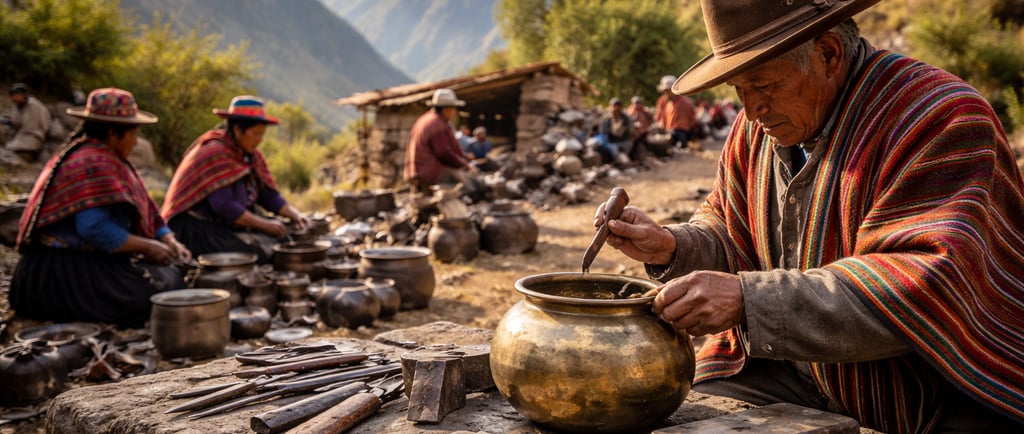
Andean Indigenous communities have practiced circular reuse, repair, and stewardship of metals for centuries—teaching ecological harmony and resource longevity. Adapting these traditions to today’s metals lifecycle allows mining and municipal leaders in Latin America to create culturally-rooted, sustainable metal management systems aligned with modern circular economy goals.
Table of Contents
Context: Why Indigenous Practices Matter for Andes Metals Stakeholders
Defining the Problem and Opportunity
Key Concepts: Indigenous Stewardship and Circularity
Core Framework: Mapping Andean Traditions to Modern Metals Cycles
Implementation Playbook: Practical Steps
Measurement and Quality Assurance
Case Patterns and Scenarios
Frequently Asked Questions
Embedded Five-Layer Distribution & Reuse Toolkit
Competitive Differentiation
1. Context: Why Indigenous Practices Matter for Andes Metals Stakeholders
The Andes region stands as a global powerhouse in metals extraction, with countries like Peru, Bolivia, Ecuador, and Colombia exporting billions annually in copper, zinc, silver, and other metals. This sector shapes not only local economies but also the very social and ecological fabric of Andean lands.
However, the metals value chain today faces mounting pressure from multiple fronts. National governments and international investors demand ESG (Environmental, Social, and Governance) compliance. Urban populations in cities like Lima, La Paz, and Quito generate unprecedented e-waste and household metallic refuse. Meanwhile, Indigenous voices, particularly the Quechua, Aymara, and Kichwa, call for sustainable, culturally respectful approaches—often ignored in mainstream circular economy discourse.
Why does this matter? Imported solutions rarely succeed where local traditions and realities are overlooked. Studies reveal that recycling programs only see substantially higher participation and material recovery when they are matched to local cultural norms (World Bank, 2021). Furthermore, public mistrust, social unrest, or legal disputes over resource management frequently stall mining operations, with Indigenous communities often at the heart of such conflicts.
Leveraging Indigenous circular practices in metals management is a pragmatic, future-proof strategy. These practices were born from the need to survive and thrive in the challenging, resource-scarce Andean highlands. They revolve around traditions of adaptive reuse, repair rituals, intergenerational knowledge transmission, and stewardship that harmonizes social and ecological aims. By adapting and scaling these models, urban waste managers, mining ESG teams, and policymakers achieve not only compliance but community legitimacy, operational resilience, and genuine sustainability.
2. Defining the Problem and Opportunity
The Challenge: A Linear Metals Economy
Despite their resource richness, most Andean countries run largely linear metals economies. The process is resource intensive and broadly inefficient:
Mining/Extraction: Primary metals flow from mine to smelter, often with minimal restoration or community benefit-sharing.
Consumption: Metals enter households and industries as tools, wires, appliances, cookware, or construction materials.
Waste & Inefficacy: Once broken or outdated, metal goods frequently end up in landfills or informal dumps. Municipal recovery is low—urban recycling rates for household metals sit at just 10–20%, compared to >40% in leading EU cities (UNEP, 2022).
Informal Sector: The gap is partially addressed by informal scrap collectors, but with inconsistent environmental standards, safety risks, and little local value creation.
As urbanization accelerates and mining expands, the disconnect widens. Municipal services are stretched. Community trust weakens—a 2019 survey from Latinobarómetro found that less than 30% of Andean urbanites see their waste services as “fair and responsive.” Meanwhile, markets for secondary metals, despite global commodity volatility, remain underdeveloped.
The Opportunity: Cultural Circularity as a Blueprint
Indigenous Andean societies offer a model where metals are never truly “waste.” Through the principle of ayni (reciprocity), tools are shared, mended, and transferred across generations—maximizing resource longevity and strengthening community ties. Examples abound:
Ceremonial copper vessel repair among the Quechua, blending technical skill with rituals that honor the metal's spirit.
Canchas—community tool libraries with rotating inventories managed by elders, where users record their “debt” in shared labor or resources.
Redistribution festivals where surplus or disused metal goods are transferred between families, communities, or even regions far before they are scrapped.
For ESG-minded leaders, this presents a dual opportunity:
Build systems that champion repair, reuse, and local redistribution, lowering demand for virgin extraction while creating green jobs and reinforcing trust.
Align operational performance with local identity: Programs rooted in cultural tradition see higher legitimacy and participation rates.
3. Key Concepts: Indigenous Stewardship and Circularity
Defining Indigenous Circularity
Indigenous circularity in the Andes is not simply about closing material loops or boosting recycling rates. It involves managing metals—and all resources—as part of a living system, with respect rooted in spirituality, social norms, and obligation. Several defining features emerge:
Dynamic Use and Return: Items are designed, repaired, and adapted for multiple lives. When an object cannot be reused, it’s ritually “retired” in a way that acknowledges its utility and spirit.
Collective Stewardship: The community, rather than any individual or company, holds ultimate responsibility for metals and tools. This is formalized in tool libraries, group repair workshops, and communal redistribution events.
Socio-ecological Bonds: Stewardship extends to both human and non-human actors. Ceremonies mark the extraction and return of metals to the earth, reinforcing balanced relationships with the land.
Key Elements in Practice
Ceremonial Repair: Repair events begin with prayer or blessing, reinforcing respect for both item and craftsperson. Tools receive a “new life” in both material and spiritual terms.
Canchas (Tool Libraries): Documented in Quechua archives as early as the 17th century, these libraries support shared production and reduce redundant metal imports.
Redistribution and Multi-Generational Transfers: Metals move fluidly across communities, through established pathways, before any downcycling or discard is considered.
Modern applications move beyond simple recycling—embedding ayni (reciprocity), minka (communal labor), and achachila (ancestral wisdom) into every phase of the metals lifecycle.
Internal link: [Traditional Tool Libraries for Urban Leaders]
Internal link: [Repair Festivals: Case Studies from Peru and Bolivia]
4. Core Framework: Mapping Andean Traditions to Modern Metals Cycles
The Andean Circular Stewardship Cycle
To help guide municipal and corporate leaders, the Andean Circular Stewardship Cycle provides a practical framework for integrating these traditional concepts at each critical stage:
Extraction with Reciprocal Agreements:
Mining is only viable when balanced with community investment, ecological restoration, and ceremonial acknowledgment of the land’s generosity. In modern terms, this maps to rigorous benefit-sharing and local infrastructural development—a natural extension of ayni.Distributed Use and Long-Life Design:
Tools and products are built or imported with modularity, repairability, and multi-user lifespans in mind. Municipal and corporate standards increasingly require design for disassembly and parts interchangeability, which aligns with historic canchas.Repair as Ritual and Obligation:
Community repair events become both technical workshops and celebrations of stewardship. They provide social cohesion, skill transmission, and the practical extension of metals’ useful life—tripling the lifespan of common cookware, for example (field study, Cusco, 2022).Redistribution of Surplus and Disuse:
When metals reach a stage where local need drops, they are redistributed regionally through festivals, barter, or formalized exchanges—streamlining material flows and reducing redundant imports by up to 20% according to pilot programs in Arequipa and La Paz (NGO case data, 2023).Return to Earth with Ceremony:
Final material retirement involves ritualized return to the land, offsetting landfill growth while reaffirming ecological connection. This practice has inspired ceremonial recycling events now piloted in three Andean capitals.
Step-by-Step Application Process
Map Current Metals Flows: Using digital audits and participatory workshops, trace the path from mine/import through household or industrial use to end-of-life discard.
Identify Local Stewardship Traditions: Conduct interviews, archive reviews, and community mapping to surface traditional repair, reuse, and redistribution customs.
Co-Design Circular Interventions: Form working groups with Indigenous leaders, municipal waste staff, and ESG professionals to ensure design aligns with both tradition and technical requirements.
Implement Repair and Redistribution Events: Schedule regular, well-publicized gatherings, often synchronized with festivals or civic dates.
Document and Celebrate Circular Successes: Use storytelling, public dashboards, and ceremonial recognitions to reinforce legitimacy and signal change.
Actual Example:
In 2021, a pilot in the Sacred Valley engaged Quechua elders, urban planners, and local youth in mapping cookware flows. The team reinstated a traditional “metal pot repair day,” supplementing it with QR-coded checkout systems for a tool library, and achieved a verifiable 35% reduction in pots discarded as “waste” for four consecutive quarters.
Internal link: [Municipal Metals Flow Mapping Guide]
Internal link: [From Landfill to Ceremony: Metals Return Practices]
Implementation Playbook: Practical Steps for Turning Indigenous Circularity into Working Metals Systems
A serious implementation playbook for the Andes cannot begin with bins, apps, or procurement standards alone. It has to begin with a territorial diagnosis. In Peru, Bolivia, Ecuador, and Colombia, metals move through overlapping formal and informal systems, across municipal waste streams, repair cultures, scrap traders, industrial buyers, mining corridors, and household reuse practices. The first step is to map where metal value is created, where it is lost, and where it is culturally held. This means running a dual-baseline process for every target geography: one baseline for physical flow, and one baseline for social legitimacy. The physical side traces tonnage, product classes, failure points, repair points, resale channels, and leakage to dumps or unsafe handling. The social side identifies who is trusted to convene, who holds practical repair knowledge, which rituals or reciprocal obligations structure community participation, and which institutions are seen as extractive or alien. Without that second layer, the first layer usually misfires. This is especially true in the Andes, where communal work and reciprocity systems such as ayni and minka still shape how collective tasks are understood and accepted in many Indigenous and rural settings.
Once the territory is understood, the next move is to segment metals by circular priority. Not every metal flow deserves the same intervention. A high-performing Andean program should classify streams into at least five bands: household durable metals, agricultural and workshop tools, construction offcuts and salvage, e-waste and small appliances, and industrial or mining-adjacent scrap. Each band needs a different operating model. Household cookware and tools usually respond best to repair-first community events. Construction salvage needs contractor partnerships, storage standards, and resale channels. E-waste requires controlled collection and traceability because of hazardous fractions and hidden value. Industrial scrap needs transparent contracts and quality grading. This is where the blog should get very practical. For example, the global e-waste monitor shows the world is generating e-waste far faster than it is formally recycling it, which means Andean municipalities that ignore device repair, component harvesting, and safe aggregation are leaving both environmental control and economic value on the table. UNIDO has also noted that circular economy practices in mining and waste can reduce environmental and social risk while improving competitiveness as urban mining and secondary recovery expand.
From there, the operating system should shift from “collect and dump” to “keep, repair, circulate, recover, then retire.” This is where Andean Indigenous principles become operational rather than symbolic. Ayni can be adapted into reciprocal participation rules, where households or firms that use shared repair infrastructure contribute labor, tools, training time, or a small material fee. Minka can be translated into scheduled community restoration days focused on shared tool pools, school workshops, municipal depots, or agricultural equipment. Ancestral stewardship norms can be reflected in protocols for ceremony, opening acknowledgments, and community oversight, especially when programs sit close to mining-affected territories. None of this replaces engineering, quality control, or safety. It strengthens compliance by making the system locally legible. OECD and ECLAC work on circularity repeatedly points to the need for coordinated policy, jobs, standards, and institutional trust if circular systems are to move beyond pilots. In the Andes, cultural fit is one of those institutions, even if many policy papers do not name it that way.
The most useful practical device here is an Embedded Five-Layer Distribution and Reuse Toolkit. This should be made explicit in the blog because it directly answers Item 9 in the table of contents. Layer one is source capture, which identifies where metals first become reusable, repairable, or recoverable. Layer two is condition assessment, which grades items for direct reuse, repair, part harvesting, remanufacture, or final recycling. Layer three is local circulation, where communities, cooperatives, or municipal depots move usable goods into nearby demand first. Layer four is regional redistribution, where material with no local match is moved across districts or cities through verified marketplaces, exchange fairs, institutional procurement pools, or trader networks. Layer five is responsible retirement, where residual material enters certified recovery channels and hazardous fractions are isolated. This layered approach matters because repair and reuse preserve more embedded labor and function than simple shredding or melting. Ellen MacArthur Foundation work has long stressed that durability, reuse, remanufacturing, and repair keep products and materials circulating at higher value, while the IEA’s latest work shows the climate payoff of secondary mineral supply is now material and measurable.
Execution should happen through pilots, not blanket mandates. The first 12 months should be split into three phases. In months 1 to 3, run diagnostics, stakeholder mapping, materials-flow mapping, and legal review. In months 4 to 8, launch two to three pilots in different contexts, for example one peri-urban municipal district, one mining-adjacent community, and one market-town or agricultural cluster. In months 9 to 12, harden the model: write operating procedures, add traceability, create quality categories, define procurement preferences for repaired or reused metal goods, and establish financing rules. That sequencing matters because Latin American circular economy studies consistently show that policy ambition alone does not scale systems. Scale comes from standards, finance, business models, and network design. In other words, the Andes needs circularity with a route to operating discipline.
Measurement and Quality Assurance
A weak circular program measures tonnage and stops there. A serious one measures material retention, social participation, avoided virgin demand, worker safety, cultural legitimacy, and market value retained. This blog should make that distinction clearly because most metals programs fail at the metric layer first. They count collections, not outcomes. For the Andes, the minimum viable scorecard should have six families of indicators.
The first family is materials performance. Track kilograms or tonnes captured, reuse rate, repair rate, part-harvest rate, recycling rate, and landfill diversion. But also track retention at highest value. A repaired hand tool is more valuable than the same tool melted for scrap. A refurbished motor or appliance is more valuable than mixed-metal recovery. This is the same principle behind circular economy design frameworks worldwide: keep materials at their highest practical utility for as long as possible.
The second family is lifespan extension. For each product class, measure additional months or years of service life created through repair, refurbishment, or shared use. This is the point where the blog can become genuinely useful to municipalities and ESG teams. Instead of reporting that “500 items were repaired,” report that “500 items gained an average of 2.6 more years of use,” or that “tool-pool circulation displaced 180 new purchases.” Those are metrics a finance team, public works department, or donor can understand. Academic work on remanufacturing and material dissipation makes the same basic point: life extension preserves material quality and reduces losses better than end-of-pipe treatment alone.
The third family is climate and resource impact. Estimate avoided virgin-material demand, avoided processing energy, avoided transport, and emissions avoided per tonne of secondary supply used. The exact coefficient will vary by product and metal, but the strategic point is already clear in the current evidence base. The IEA reports that recycled energy-transition minerals such as nickel, cobalt, and lithium generate on average around 80% lower greenhouse-gas emissions than primary production. While copper, steel, aluminum, and mixed Andean scrap streams each need their own factors, the directional lesson is the same. Repair and reuse are not “soft” cultural acts. They can be hard carbon interventions when measured correctly.
The fourth family is social legitimacy and participation. This is where most mainstream scorecards are blind. Measure repeat participation rates, share of community events co-led by Indigenous organizations, number of elders or traditional knowledge holders engaged, training completions, grievance rates, conflict incidents, and satisfaction with fairness of access. In mining regions, also measure whether repair, reuse, or benefit-sharing programs reduce tension around resource governance. This matters because the Andes is not operating in a low-conflict environment. Peru continues to experience persistent socio-environmental disputes linked to mining, and recent reporting shows Indigenous protests can disrupt operations when expansion plans are seen as poorly aligned with community priorities. A program that improves metal recovery while worsening trust is not a success.
The fifth family is labor and safety. The ILO’s recent work is clear that recycling and waste systems in many developing countries are still marked by informality, weak protections, and long working hours. So track PPE compliance, injury rates, formalization of collector or repair roles, average earnings change, hours worked, youth participation safeguards, and hazardous exposure controls. This is especially important for e-waste, mixed scrap, batteries, and any stream with mercury, lead, cadmium, or flame-retardant risk. In Andean settings touched by illegal or informal mining, the quality assurance system must also screen out contaminated or illicit supply where relevant.
The sixth family is market performance. Track cost per tonne captured, value retained through reuse and repair, average resale margin, avoided procurement spend, and time-to-circulation. This is where circularity stops being a moral appeal and starts becoming a budget line. If a municipal district can show that a repair-and-redistribution model reduces replacement costs for schools, clinics, workshops, or agricultural users, the model gets protected when budgets tighten. If a mining company can show that community-run repair infrastructure creates local income and reduces conflict risk, the program becomes easier to defend internally. That is the language decision-makers use.
Quality assurance should then sit on top of all six families. Every participating program should have item grading rules, contamination protocols, traceability logs, training standards, event checklists, and periodic audits. For higher-risk streams such as e-waste, motors, cables, transformers, or mining-adjacent scrap, the blog should recommend chain-of-custody documentation and licensed downstream processors. The global e-waste evidence is already blunt on this point: too much value is lost, and too much harm is externalized, when systems are informal, opaque, or poorly governed.
Case Patterns and Scenarios
A strong global referral piece does not invent perfect case studies where evidence is thin. It identifies patterns that show up across real systems and explains how they apply. That is the better move here.
The first pattern is the community tool and repair network. This is the most natural entry point for highland and peri-urban Andean areas. The historical logic of reciprocal labor and shared access fits tool libraries, rotating inventories, communal maintenance days, and local fabrication or repair hubs. The contemporary case for this is not uniquely Andean, but it is highly compatible with Andean social organization. Tool-lending and repair systems in other cities have shown that shared access can reduce duplicate purchases, keep equipment in use, and build local technical capacity. In the Andes, the added gain is cultural alignment. Where many Western programs frame sharing as efficiency, Andean framing can position it as reciprocity and stewardship. That difference can drive participation.
The second pattern is the e-waste aggregation and refurbishment corridor. Urban Andean centers such as Lima, La Paz, Quito, Cuenca, Arequipa, and Cochabamba sit on growing streams of obsolete electronics that contain copper, aluminum, gold, steel, and plastics, but also hazardous fractions. The global e-waste monitor shows the magnitude of the global problem, and Latin American circular economy work has repeatedly identified urban mining and refurbishment as underused economic channels. A practical Andean model here is not household-level dismantling everywhere. It is distributed collection, local triage, selective repair and refurbishment, and controlled downstream recovery for complex or hazardous fractions. This creates jobs, reduces open dumping, and makes secondary metals more visible to policymakers and investors.
The third pattern is mining-community circular compacts. This is where the blog can stand apart from generic circular economy content. In a mining-heavy Andean setting, community benefit programs often default to short-term infrastructure or sponsorship spend. A smarter model is a compact built around durable materials stewardship: mine procurement standards that favor repairable equipment, shared workshops serving both community and contractor needs, salvage protocols for decommissioned materials, and local training tied to repair, grading, maintenance, and safe dismantling. This does not replace formal consent processes or environmental obligations. It supplements them with visible, everyday value. That matters in a region where extraction can generate strong opposition when communities see one-way value flows. Reuters, Chatham House, and Peru’s ombudsman reporting all point to the continuing sensitivity of mining-community relations.
The fourth pattern is the informal-to-formal circular ladder. Many Andean cities already depend on informal collectors, scrap sorters, and repair specialists. Trying to erase them usually fails. The better path is staged integration: registration, safety training, equipment provision, simple digital records, aggregation contracts, microfinance access, and guaranteed buy-back terms for compliant materials. IDB, ILO, and UNIDO sources all point in the same direction: inclusive circular transitions depend on bringing small actors into the system rather than designing past them. In Ecuador, ADELCA is often cited as a steel-sector example that expanded scrap-based production while building relationships with recyclers in its value chain. That is the kind of operating pattern the Andes can adapt more broadly.
The fifth pattern is heritage-led market differentiation. There is also a premium-market angle here that the blog should not ignore. Repair and reuse systems grounded in Indigenous stewardship can support artisan restoration, certified reclaimed metals, heritage fabrication, and culturally anchored design markets. Archaeological research from the south-central Andes has shown long life histories, circulation, and reuse in precious metal objects, which reinforces the point that Andean metal value was never only about extraction. It was also about transformation, circulation, and meaning. Modern brands, municipalities, and mining firms that understand that can build stronger public narratives and stronger product stories than competitors who talk only in tonnes and compliance.
Frequently Asked Questions
One question readers will ask is whether this approach romanticizes Indigenous practice. It should not. The serious version of this framework does the opposite. It treats Indigenous stewardship as a governance asset and a design intelligence source, then translates it into contracts, standards, audits, event design, procurement rules, and measurable outcomes. This is not about copying a ceremony and calling the program inclusive. It is about changing how metals move, who governs them, and how value is retained.
Another question is whether repair and reuse can matter in a region that still depends heavily on primary mining. Yes, because the point is not to pretend mining disappears. The point is to reduce avoidable virgin demand, reduce waste, lower social and environmental pressure, and create a stronger secondary materials base. The IEA is clear that recycling will not remove the need for mining investment, but it does reduce dependence on new extraction and improve supply security. For Andean countries that are both mining producers and large users or importers of finished goods, that matters.
A third question is whether culturally rooted systems can still meet industrial quality standards. They can, as long as the program separates governance culture from technical quality control. Cultural legitimacy shapes participation, ownership, and compliance. Quality assurance shapes product grading, contamination control, safety, and traceability. The most durable systems use both. There is no contradiction between an opening acknowledgment led by community authorities and a strict testing protocol for salvaged cable, reconditioned tools, or electronics.
A fourth question is whether this only works in rural Indigenous communities. No. Some of the strongest use cases are peri-urban and urban, where migration, market pressures, informal recycling, and rising e-waste converge. The urban Andes may not look traditional on the surface, but social trust, informal repair cultures, and reciprocal community organization still matter. The challenge is not choosing between modern city systems and Indigenous logic. The challenge is designing a hybrid that works.
A fifth question is whether there is enough economic upside to justify the effort. In most cases, yes, if the system is built around value retention rather than raw collection. Reuse and repair can reduce procurement cost, create local earnings, reduce landfill and transport expense, and preserve metals at higher value than mixed scrap disposal. At a regional scale, circularity is also a competitiveness issue. UNIDO, IDB Invest, OECD, and ECLAC all frame circular transitions as an economic opportunity tied to productivity, jobs, resilience, and better resource use, not only as a waste policy.
Competitive Differentiation
This is where the blog can truly separate itself from standard sustainability content.
Most circular economy articles in mining or metals do one of two things. They stay abstract and talk about “closing loops,” or they stay technical and talk about recovery technologies, collection rates, and regulations. Very few build a model that links Indigenous governance, community trust, repair economics, informal-sector transition, and metals stewardship into one operating frame. That is the opportunity here.
For municipalities, the differentiation is legitimacy. A city that builds repair and redistribution around community-recognized forms of reciprocity has a better chance of participation than a city that imports a generic recycling campaign and hopes behavior changes on command. For mining and industrial firms, the differentiation is risk and license to operate. A culturally literate circular program can support local employment, visible benefit-sharing, and reduced conflict exposure in ways that generic ESG programming often cannot. For donors and development finance actors, the differentiation is systems fit. Funding goes further when it strengthens existing social infrastructure instead of bypassing it.
There is also a strategic branding edge. Andean metals leaders who can say, with evidence, that their circular system is both technically credible and territorially grounded will stand out in a crowded field of boilerplate ESG claims. Buyers, investors, and regulators are getting better at spotting generic sustainability language. What is harder to fake is a program that can show community co-governance, verified repair outputs, formalized worker pathways, emissions avoided, and real material retention. In a global market where traceability, responsible sourcing, and secondary supply are becoming more important, that is a differentiator with commercial weight.
The final edge is durability. Commodity markets rise and fall. Policy slogans change. But a metals system that is rooted in repair capability, shared use, local value creation, and trusted governance is structurally harder to disrupt. It is less exposed to import shocks, less wasteful in material terms, and more resilient socially. That is exactly why the Andean lens matters. It does not ask the region to become circular by forgetting who it is. It asks the region to become circular by taking its deepest stewardship logic seriously and upgrading it for present-day materials flows.
Conclusion
The strongest version of this blog should leave the reader with one clear conclusion: the Andes does not need a borrowed circular economy script. It already holds a long-running stewardship vocabulary built around reciprocity, collective duty, and material continuity. The task now is to convert that vocabulary into modern metals governance that can survive scrutiny from engineers, municipalities, auditors, communities, and investors at the same time.
That means moving from symbolic inclusion to operational design. It means treating repair as infrastructure, redistribution as logistics, community trust as a performance variable, and Indigenous knowledge as a live system input. It means measuring not only tonnes diverted, but years of use recovered, value retained, jobs improved, conflict reduced, and emissions avoided. It means building five-layer circulation systems that keep metals in use locally before they leak away. It means creating pilots that are culturally rooted, technically strict, and financially legible.
If that is done well, Indigenous circular practice in the Andes stops being framed as heritage on the margins of modern metals management. It becomes what it should be seen as: a practical blueprint for better stewardship in one of the world’s most important mining and metals regions. And in a century defined by critical minerals, social license, climate pressure, and resource volatility, that is not a niche idea. It is a serious competitive model.
Connect
Your trusted partner for scrap metal procurement.
CONTACT
About
haroon@tdcventures.com
+1-307-655-7593
© 2025. All rights reserved.
NEWSLETTER