
Industrial Symbiosis: Sharing Heat, Power and Materials in Eco-Industrial Parks
A practical guide to implementing industrial symbiosis in eco-industrial parks. Learn the business models, digital tools, and case studies that cut costs, reduce emissions, and turn waste into value.
WASTE-TO-RESOURCE & CIRCULAR ECONOMY SOLUTIONS
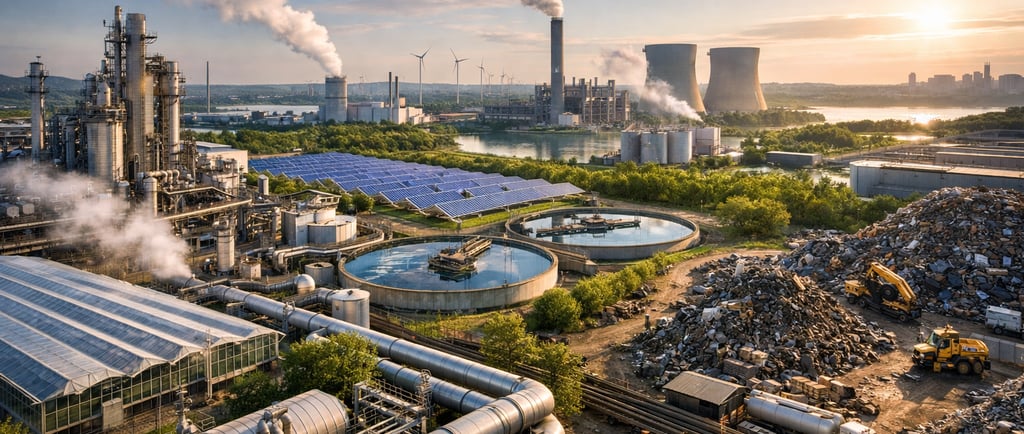
Industrial symbiosis is quickly emerging as a game-changing pillar in the pursuit of a truly circular economy. By forging collaborative networks among industries—whereby heat, water, energy, and materials are exchanged—eco-industrial parks (EIPs) are demonstrating real-world proof that waste from one process can become the feedstock for another. This systemic shift is creating new economic and environmental value streams, transforming how manufacturers fundamentally operate. In this comprehensive guide, we’ll explore what industrial symbiosis entails, its foundational role in reuse and remanufacturing, blueprints and digital tools that facilitate resource flow, transformative business models, and the future-ready trends reshaping industrial ecosystems.
What is Industrial Symbiosis?
Industrial symbiosis describes the process where traditionally separate industries engage in a close, mutually beneficial exchange of resources—including secondary materials, energy, water, and even logistics. Instead of operating in silos, companies actively seek opportunities to utilize one another’s by-products, surplus heat, treated water, or underutilized assets.
This collaborative approach sits at the heart of the circular economy—a system design that aims to decouple growth from resource consumption by keeping materials in use for as long as possible. It encompasses circular strategies such as reuse, remanufacturing, refurbishment, and reverse logistics. Unlike the “take-make-dispose” linear paradigm, circular economy models focus on minimizing waste and maximizing resource value, repeatedly cycling materials within industrial networks.
Did You Know?
According to the Ellen MacArthur Foundation, waste prevention and recycling via industrial symbiosis could save up to $630 billion every year for European manufacturing alone, merely by optimizing material loops within and between business clusters.
Core Concepts in Industrial Symbiosis
Resource Sharing: Companies use another’s process by-products—for example, capturing excess heat from a steel plant to warm greenhouses, or channeling purified process water from a beverage factory to serve neighboring industrial needs.
Collaborative Infrastructure: Joint investments in waste treatment, shared energy grids, heat recovery systems, or centralized logistics help participating businesses scale sustainability initiatives and spread otherwise prohibitive costs.
Circular Networks: Instead of linear flows, EIPs forge circular networks where one company’s waste stream becomes another’s valued input—an orchestrated ecosystem that eliminates resource leakage and maximizes collective benefit.
Why Industrial Symbiosis Matters in a Circular Economy
The transformative impact of industrial symbiosis is well-documented—both economically and environmentally. Here’s a closer look at its multi-dimensional value for modern enterprises and society at large:
Reduces Raw Material Demand: Reusing and cascading metals and materials slashes the need for virgin resource extraction, which in turn reduces environmental pressure, biodiversity loss, and global supply risks. The World Economic Forum forecasts that wide adoption of industrial symbiosis could cut raw material input by up to 25% in some sectors.
Cuts Emissions & Waste: Through efficient energy sharing and resource loops, businesses have documented up to 40% reductions in greenhouse gas emissions within established eco-industrial parks. Diverting by-products from landfill not only lessens disposal costs but also curbs methane and other emissions from decomposing industrial waste.
Drives Cost Savings: All participating organizations experience cost reductions—from lower input procurement to shared operating expenses. According to the International Resource Panel, some companies have achieved annual savings of over $15 million simply by engaging in closed-loop synergies with local partners.
Strengthens Corporate Responsibility & Compliance: Firms in EIPs win regulatory advantages such as credits, streamlined permitting, and easier access to tax incentives tied to circular economy and low-carbon compliance. Enhanced transparency also boosts reputational value among customers and investors focused on ESG (Environmental, Social, and Governance) outcomes.
Accelerates Global Sustainability Goals: Industrial symbiosis directly supports the UN Sustainable Development Goals (SDGs)—especially SDG 12 (Responsible Consumption and Production) and SDG 9 (Industry, Innovation and Infrastructure)—and aligns with the European Green Deal’s push toward resource efficiency and carbon neutrality.
A study by Circle Economy estimates that if just 30% of industrial parks adopted symbiotic principles, the impact could avoid over 200 million tons of CO2 emissions annually—almost as much as the annual emissions of Argentina.
Blueprints: Designing Thriving Eco-Industrial Parks
Delivering successful industrial symbiosis at scale starts with methodical planning and systems thinking. Blueprints for high-performance EIPs harness digital mapping, stakeholder engagement, and capital-efficient infrastructure designs for lasting circular value.
1. Mapping Resource Flows
A data-driven approach to mapping resource flows is essential for diagnosing potential synergies:
Material Flow Analysis (MFA): MFA provides a comprehensive, dashboard-style view of how materials, energy, and by-products traverse across facilities. For instance, a recent MFA in the Rotterdam harbor area identified over 50 possible reuse connections, ultimately incentivizing $60 million in resource-sharing investments.
GIS-based Modeling: By integrating Geographic Information System (GIS) data, planners analyze spatial proximity and logistical feasibility. This digital overlay helps EIPs aggregate participant profiles—allowing rapid alignment of excess outputs (e.g., metals scrap, steam) with potential off-takers within viable transport range.
In Singapore, the Jurong Island petrochemical cluster used GIS and MFA tools to pinpoint and validate more than a dozen high-impact synergy options, ranging from shared cooling water circuits to co-managed hazardous waste streams.
2. Establishing Partnership Networks
Achieving buy-in and sustained collaboration requires deliberate efforts to build trust:
Facilitated Workshops: Cluster managers and NGOs convene cross-company ideation sessions, reviewing pain points and surfacing symbiotic possibilities. Google’s “Design Sprints” have been adapted for EIP settings to fast-track partnership decisions.
Digital Collaboration Hubs: Confidential, secure online portals provide a space to share resource inventories, needs, and visions while protecting proprietary information, enabling incremental and secure alliance-building.
3. Shared Infrastructure Planning
Pooling infrastructure investments is critical for feasibility, especially for smaller and medium-sized enterprises (SMEs):
Centralized Material Recovery: Shared waste sorting, scrap metal processing, and hazardous material treatment facilities can reduce per-company costs by up to 70%, according to the OECD.
Integrated Logistics Platforms: Common transport assets reduce logistics overhead, optimize transport routes, and facilitate high-throughput reverse flows—essential for keeping post-use metals and materials in circulation.
Tools Empowering Eco-Industrial Symbiosis
Digitalization is revolutionizing the identification, execution, and scaling of industrial symbiosis. Next-gen platforms, IoT-enabled assets, and analytics solutions bring a new level of efficiency and transparency.
1. Digital Marketplaces for Secondary Resources
Purpose-built online exchanges connect companies seeking by-product outlets or sourcing recycled materials. Examples include the European Union’s “SYMBIOSIS” marketplace, which has enabled hundreds of inter-company resource trades involving metals, plastics, and process gases.
Smart Matching Algorithms: AI-driven tools consider quality, chemical composition, quantity, and proximity to recommend the most viable trading partners.
Transaction Safeguards: Blockchain-backed traceability solutions in some emerging platforms provide real-time tracking of resource provenance and compliance.
2. IoT Sensors and Real-Time Monitoring
Internet of Things (IoT) deployments provide granular insight into process status and resource trajectories:
Energy and Material Sensors: These measure heat flows, emissions, and residual materials, delivering live data that uncovers hidden reuse or recovery opportunities.
Automated Compliance Reporting: Real-time data integration automates the documentation required for regulatory audits, vastly reducing the administrative burden for reverse logistics and closed-loop reporting.
3. Decision Support Tools
Advanced decision support systems use both historical and real-time data to evaluate potential synergies against financial and environmental metrics:
Scenario Simulations: AI-powered models project how changes—like shifting to recycled metals or adopting shared logistics—affect the bottom line and sustainability KPIs.
Strategic Recommendations: The best tools advise on sequencing investments for the highest collective ROI, guiding cluster managers in prioritizing upgrades to infrastructure or partner networks.
Business Models That Make Industrial Symbiosis Work
Industrial symbiosis fails for one simple reason. People try to run it like a sustainability project. It needs to run like a commercial system with clear pricing, clear risk ownership, and clear uptime expectations.
The Park Operator as the Broker and Deal Desk
A dedicated park entity runs a “resource exchange desk.” It does not own every asset. It makes matches, standardizes data, and structures contracts.
How it makes money
Membership fees from tenants for access, audits, and match-making
Success fees per closed exchange, or per ton moved, or per MWh delivered
Data reporting fees for verified reporting packs for investors and regulators
Why it works
It solves the trust gap by acting as a neutral middle layer.
It keeps commercially sensitive information controlled and permissioned.
This model mirrors what made the UK’s National Industrial Symbiosis Programme effective at national level, using facilitation and structured project tracking rather than relying on chance connections.
Shared Utilities as a Concession Business
This is the core model behind many successful parks. A separate utility company owns and operates shared infrastructure.
Typical assets
Steam and hot water networks
Waste heat recovery and heat pumps
Cooling water loops
Industrial water reuse plants
Central effluent treatment
Shared compressed air, nitrogen, oxygen, or CO2 supply in specific clusters
Revenue pattern
Long-term take-or-pay contracts, 10–25 years
Indexation to energy prices, carbon prices, or inflation
Performance clauses, like minimum delivery temperature, flow, or uptime
If you want one simple pricing anchor for waste heat, use avoided cost. Example:
A user needs 10 MWth of heat for 4,000 hours per year.
Annual heat delivered equals 40,000 MWhth.
If their alternative is natural gas heat at €40/MWhth, avoided cost is €1.6M per year.
The supplier and user split that value after capex and opex are covered.
By-Product Offtake as a “Second Raw Material” Supply Chain
This turns a residual stream into a product with spec sheets, testing, and service levels.
Common patterns
Slag and ash into cement and construction products
Gypsum from flue gas desulfurization into drywall
Sulfur recovery into chemicals
Scrap, swarf, and fines into metal recovery routes
CO or CO2 streams into chemical production where feasible
Commercial structure
A spec-led contract, not a “waste disposal” agreement
Price formula: index minus discount plus quality adjustment
Sampling rules: frequency, method, chain-of-custody
Non-conformance rules: reject, rework, downgrade pricing
A major reason this works is reliability. A plant can plan around a stream only if volume and quality stay stable.
Central Resource Recovery Hubs Inside the Park
These are multi-tenant processing assets that sit between “waste” and “feedstock.”
Examples
Mixed material sorting and processing
Solvent recovery and reblending
Oil-water separation and reuse loops
Plastic regrind and pelletizing where suitable
Sludge drying and conversion pathways, depending on regulations
Revenue sources
Gate fees for treatment
Sale of recovered materials
Service contracts for guaranteed pickup and compliance reporting
Digital Marketplace Plus On-the-Ground Facilitation
Digital alone rarely closes deals. The best pattern is a platform plus a facilitator who does the operational work.
What the platform provides
Listings of available and required materials
Matching based on location, spec, and volume
Audit trail for transactions and compliance data
Real examples exist across regions, including the Symbiosis Platform concept in Europe and materials exchange programs such as the Austin Materials Marketplace model. Interreg Europe+1
A practical lesson from Austin is the program design: build participation first, then move toward self-funding through transaction-linked revenue as usage becomes habitual. Ellen MacArthur Foundation
Important caution: do not copy any single metric you cannot sanity-check. If a reported CO2 number looks off by orders of magnitude, exclude it and use verified program totals from larger datasets.
Verified Reporting Packs as a Paid Service
Industrial symbiosis increasingly sells twice.
First sale: the material, heat, or water.
Second sale: verified proof of impact for buyers, lenders, and ESG reporting.
What gets sold
Verified CO2e reductions, with method notes
Waste diversion totals by code and route
Water savings and discharge reductions
Traceability for secondary materials used in products
This becomes more valuable as buyers demand product-level transparency and regulators ask for structured data.
Global Case Studies You Can Use As Reference Points
Case Study 1: South Korea National Eco-Industrial Park Program
This is one of the clearest examples of industrial symbiosis delivered through a national program.
Reported outcomes include
About 6% reduction in annual energy consumption across industrial parks
Average annual GHG reductions around 2.1 million tons CO2e
Industrial water savings around 36.8 million tons per year
Total economic gains reported around US$665 million, with investment generation around US$763 million World Bank
Why it matters
It proves that industrial symbiosis can be implemented as a policy-backed industrial competitiveness program, not a niche pilot.
It shows the importance of program funding and structured facilitation, not random deal-making.
Case Study 2: Kalundborg, Denmark
Kalundborg is the classic reference, but it is useful only when you use hard metrics, not folklore.
A detailed LCA-based assessment reported, versus a baseline, a total net saving of just under 635,000 tonnes CO2. It also reports around 3.6 million m3 of drinking water saved, around 90,000 tonnes of material saved, and nearly 18,000 MWh of energy saved in the studied scenarios.
What to copy
Start with a few high-confidence exchanges, then expand.
Treat exchanges like core operations, with monitoring and accountability.
Case Study 3: Kwinana Industrial Area, Western Australia
Kwinana is a strong example of an industrial area that built a portfolio of exchanges over time.
Reported highlights include
More than 100 projects facilitated
Cost savings reported in the hundreds of millions, with one published figure exceeding $500 million
A water recycling plant cited at about A$25 million, supplying around 6 GL per year
What to copy
Focus on a portfolio, not a single flagship exchange.
Prioritize exchanges that cut input costs and supply risk, not only emissions.
Case Study 4: UK National Industrial Symbiosis Programme
This is a proof point for facilitation at scale, which is directly relevant to large EIPs.
Reported program outcomes across its operating years include
Around 47 million tonnes of landfill diversion
Around 42 million tonnes CO2 reduction
Around £1.17 billion additional sales and £1.21 billion cost savings
Around 10,000 jobs, plus private investment stimulated
What to copy
Put trained facilitators in the field.
Track projects like a pipeline.
Report outcomes in units that CFOs and regulators accept.
Case Study 5: Digital and Data Tools as Enablers
Industrial symbiosis matching can be improved through structured databases and recommendation methods, including platform approaches described in academic work on recommendation systems for waste-to-resource matching. ScienceDirect
What to copy
Build a standardized “resource passport” for each stream: composition, variability, contaminants, packaging, logistics constraints.
Do not publish sensitive details. Use tiered access.
Overcoming Barriers That Kill Projects In Real Life
Barrier 1: Trust and confidentiality
What goes wrong
Firms fear exposing process details or costs.
Teams stall in legal review.
What works
A neutral broker under strict NDAs.
Data tiers: public ranges, private exact specs shared only after intent-to-deal.
One-page “pre-term sheet” before legal teams get involved.
Barrier 2: Quality variability and contamination
What goes wrong
A residual stream varies, the buyer cannot run stable production.
Contamination creates regulatory exposure.
What works
Spec sheets with allowable ranges.
Sampling, chain-of-custody, and dispute rules.
Pre-treatment steps, even simple ones like dewatering or screening.
Barrier 3: Reliability and uptime
What goes wrong
Heat or material supply stops during maintenance.
The buyer needs backup capacity, making the project uneconomic.
What works
Redundancy and buffer storage.
Contracted fallback supply, priced into the deal.
Clear uptime targets with penalties only where controllable.
Barrier 4: Distance and logistics cost
What goes wrong
Transport cost wipes out savings.
Handling becomes the hidden cost.
What works
A hard distance rule for low-value bulky streams.
Shared logistics scheduling and shared storage nodes.
Densification or pre-processing to raise value per ton where feasible.
Barrier 5: Permitting and “waste vs by-product” status
What goes wrong
A stream is treated as waste, triggering heavy compliance burdens.
Delays kill momentum.
What works
Engage regulators early, with a compliance pack.
Document end-use, specs, and controls.
Use standards and recognized definitions where available, including CEN guidance on core elements for industrial symbiosis implementation. CEN-CENELEC
Barrier 6: Upfront capex and split incentives
What goes wrong
One party pays capex, another collects most benefits.
What works
Shared capex via a utility company or a joint venture.
Concession models with long-term contracts.
Performance-based payments tied to delivered units, like MWh of heat delivered or tons treated.
A UK government-commissioned review of industrial symbiosis highlights the same recurring blockers, like high transaction costs, lack of information, regulatory uncertainty, and limited access to finance, and it stresses the role of facilitation and policy support in making deals happen.
Future Outlook: What Changes Over The Next 3 To 10 Years
Product-level transparency will raise the value of traceable secondary materials
The EU Ecodesign for Sustainable Products Regulation is set up to introduce Digital Product Passports, which store product and material information to support sustainability and compliance. EUR-Lex+1
What this means for industrial symbiosis
Secondary material streams with traceable specs become easier to sell into regulated supply chains.
Parks that can provide verified data gain a commercial edge with buyers that care about footprint reporting.
Circular economy standards will push business model maturity
ISO 59010:2024 provides guidance on transitioning business models and value networks from linear to circular approaches. ISO
What this means
Expect more repeatable contracting patterns.
Expect more board-level scrutiny on how circular initiatives affect margins, risk, and supply security.
Digital monitoring will become a basic requirement
Real-time data reduces disputes, improves compliance, and makes verification easier. That is already visible in national programs that connect industrial park upgrades to digital monitoring and energy platforms. World Bank
Industrial parks will increasingly be treated as the unit of competitiveness
Major institutions are already positioning eco-industrial parks as a way to improve environmental performance and investment appeal, with evidence from multiple countries and quantified results. World Bank
Conclusion: The Practical Playbook For Building Industrial Symbiosis In An Eco-Industrial Park
If you want this to be repeatable, treat it like building a utility market inside a park.
Start with these steps
Build a resource inventory with specs, volumes, variability, and handling constraints.
Pick 5–10 anchor exchanges with clear economics and low technical risk. Heat, water, and single-material streams usually win first.
Create a neutral broker function with authority to run workshops, manage NDAs, and drive term sheets.
Standardize contracts: specs, sampling, liability, uptime, and fallback supply.
Fund shared assets through concession or joint ventures, backed by long-term offtake.
Measure impact in a way that survives audit. Use consistent boundaries and document assumptions.
Publish verified outcomes yearly. Use units executives trust: tons, MWh, m3, and cash.
The best proof is already on the record
National programs have delivered million-ton CO2e cuts and hundreds of millions in economic gains. World Bank
Mature clusters show that water, material, and energy savings can be quantified and managed like operations, not slogans.
Facilitation at scale can move tens of millions of tonnes away from landfill and cut tens of millions of tonnes of CO2.
Connect
Your trusted partner for scrap metal procurement.
CONTACT
About
haroon@tdcventures.com
+1-307-655-7593
© 2025. All rights reserved.
NEWSLETTER