
IoT Decommissioning: Secure Data + Metal Recovery
Learn a proven framework for secure IoT decommissioning that combines certified data erasure, chain-of-custody, and metal recovery for XR and electronics recycling—reducing risk and unlocking circular value.
IMMERSIVE TECH RECYCLING & CIRCULAR ELECTRONICS
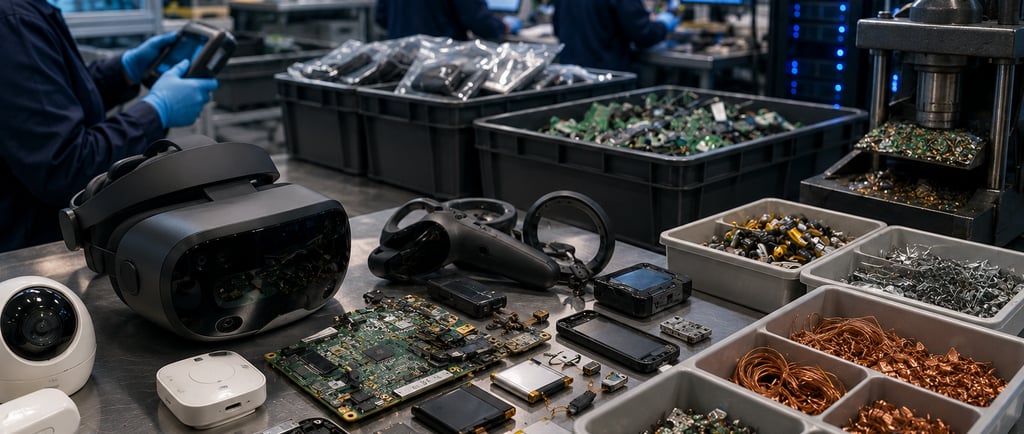
Instant Answer
Decommissioning IoT assets—including XR devices and industrial electronics—demands rigorous, secure data erasure, regulatory compliance, and efficient metal recovery. Enterprises and ITAD professionals must link airtight chain-of-custody, verifiable data wiping, smart reuse, and eco-toxic material recycling to minimize risk and maximize sustainability—directly supporting both circular economy and enterprise security targets.
Table of Contents
Context: Why Secure IoT Decommissioning Matters for Enterprises
Problem Definition: The High Stakes of XR and IoT Asset Obsolescence
Key Concepts and Definitions
Core Framework: Secure Decommissioning for Repair and Metal Recovery
Implementation Playbook: Step-By-Step Checklist
Measurement and QA: Tracking, Metrics, and Scorecard
Case Patterns and Example Scenarios
FAQs: IoT Decommissioning Best Practices
Embedded Five-Layer Toolkit: Distribution & Reuse Model
Competitive Differentiation: Where This Framework Excels
1. Context: Why Secure IoT Decommissioning Matters for Enterprises
As enterprises double down on digital transformation, the number of deployed IoT devices is exploding. According to Statista, global IoT endpoints reached 15 billion in 2023 and are projected to surpass 29 billion by 2030. This ecosystem includes XR (Extended Reality) headsets, smart sensors, machine controllers, medical wearables, and more. These devices are integral to mission-critical processes in manufacturing, logistics, energy, healthcare, and smart workplaces.
However, IoT asset obsolescence has become a significant risk vector. Improperly decommissioned devices can retain sensitive company data, user credentials, intellectual property, or even embedded security certificates. The result? Unwiped devices culled from the field can lead to data breaches—costing companies an average of $4.45 million per incident (IBM Data Breach Report 2023).
Beyond cybersecurity, regulators and eco-savvy procurement teams now expect enterprises to prove due diligence on both data and end-of-life (EOL) device handling. Regulations such as GDPR, the California Consumer Privacy Act (CCPA), and rapidly evolving e-waste laws (EU WEEE directive, R2, e-Stewards) elevate both compliance and reputational risks. Gartner predicts that by 2026, 60% of large enterprises will have formal EOL management programs governing XR/IoT decommissioning tied to climate and social governance KPIs.
The convergence of cybersecurity, compliance, IT asset disposition (ITAD), and sustainability is here. Successful organizations act holistically: protecting sensitive company data, meeting regulatory scrutiny, unlocking recovery value, and contributing to the broader circular economy.
2. Problem Definition: The High Stakes of XR and IoT Asset Obsolescence
Unlike desktops or laptops, modern IoT and XR assets such as AR headsets or wearable sensors are often deployed in distributed, unmanaged, or even outdoor environments. They are less likely to be covered by traditional IT management frameworks. Consequently, the risks multiply when these devices become obsolete:
Data Exposure: According to Verizon's 2022 Data Breach Investigations Report, misplaced or un-wiped IoT devices are now implicated in nearly 25% of manufacturing sector breaches. These devices can store confidential operational data, sensitive geolocation tracking, and unique IP—making them a gold mine for attackers if not properly sanitized.
Brand & Compliance Risk: The EU's General Data Protection Regulation levies penalties as high as €20 million or 4% of annual revenue for non-compliance. U.S. healthcare providers face similar fines under HIPAA, while NIST 800-88 and ISO 27001 create technical standards for EOL data handling. Enterprises in global supply chains must often demonstrate audit trails for every device removed from service—regardless of location or functional category.
Lost Recovery Value: Each year, the world generates more than 59 million metric tons of e-waste (2023), according to the Global E-waste Monitor. Precious metals represent over $57 billion in lost resource value annually, as unrecovered components are incinerated or landfilled. Companies that simply shred devices—rather than refurbishing or extracting key materials—leave significant financial and sustainability ROI on the table.
Operational Downtime: Disorganized retirements interrupt processes and disrupt service delivery. Untracked devices can introduce shadow IT risks, exposing operational technology networks to rogue endpoints. This undermines cyber hygiene and creates vulnerabilities for adversarial takeovers or device tampering at scale.
Bottom line: IoT and XR decommissioning is more than a tech afterthought—it's a high-stakes, cross-functional challenge spanning cybersecurity, recovery economics, compliance, and ESG strategy. Addressing it proactively supports long-term digital trust, cost efficiency, and brand leadership in responsible tech stewardship.
3. Key Concepts and Definitions
Getting smart with IoT decommissioning starts with a mutual understanding of crucial terms:
IoT Decommissioning: The comprehensive process by which organizations methodically retire IoT and XR assets—ranging from endpoint retrieval to certified data erasure to final disposition via reuse, recycling, or material recovery.
Secure Data Erasure: Techniques validated against standards such as NIST SP 800-88 that ensure total, irreversible removal of data from devices before they are transferred, resold, or recycled. For regulatory alignment, erasure must be certified—often with digital proof-of-wipe reports.
Chain-of-Custody: A continuous, documented record from collection through transport, erasure, inspection, and recycling. This chain provides an unbroken audit trail, making processes defensible against compliance challenges and internal reviews.
Metal Recovery: The targeted extraction of valuable and scarce materials such as copper, gold, lithium, cobalt, and rare earth elements from decommissioned electronics. Responsible recovery reduces new mining demand, lowers environmental impact, and aligns with circular economy goals.
Design for Repair/Refurb: An engineering initiative and procurement standard emphasizing modularity, accessible components, and open repair documentation. "Right to repair" policies are now echoed in EU EcoDesign and several US state laws—making it easier to refurbish and reuse, not just recycle.
Added context: These best-practice concepts serve as the foundation for robust IoT and XR disposition programs. They help organizations align executive mandates for cybersecurity, demonstrate verifiable compliance, and activate true sustainability through tangible material recovery and lifecycle extension.
4. Core Framework: Secure Decommissioning for Repair and Metal Recovery
The leading frameworks for IoT and XR asset decommissioning now integrate not only data security and compliance but also component reuse and ecological outcomes. Let's break down a scalable system:
1. Device Inventory & Selection
Comprehensive mapping is vital. Modern asset management uses RFID/QR labels, geolocation records, and integration with enterprise CMDBs (Configuration Management Databases).
Risk scoring helps stack-prioritize devices based on data richness, network access, and location. For instance, a head-mounted AR device with persistent Wi-Fi credentials on a shop floor is a higher risk than a single-use sensor in non-critical infrastructure.
2. Secure Chain-of-Custody & Transport
Initiate with tamper-evident packaging and barcode or RFID tagging.
Meticulously log every device handoff—transparency is the backbone of defensible ITAD.
High-functioning organizations now use digital chain-of-custody platforms—enabling real-time alerts for anomalies, geofencing for asset movement, and blockchain-backed record immutability.
3. Certified Data Erasure without Value Loss
Use software or hardware-based tools compliant with NIST SP 800-88 (e.g., Blancco, WhiteCanyon). These tools generate unalterable reports—critical for compliance or audit.
Only resort to physical destruction of storage (flash drives, SSDs) when irreparable risk exists, such as failed wipes or physically damaged media.
By only destroying storage components (Reconext-style approaches), organizations maintain device housing, screens, and high-value circuitry for reuse and further lifecycle extension.
4. Component Reuse, Repair, and Metal Recovery
After sanitization, triage devices for functional reuse. Many XR headsets and industrial sensors can be resold internally or externally once wiped and inspected.
For devices beyond repair, disassemble with attention to critical-metal content, like tantalum capacitors or lithium batteries, for specialized recovery.
Choose partners certified to R2v3 or e-Stewards standards—these certifications validate environmental, labor, and data handling integrity.
Step-by-Step Process
Launch asset review, leveraging live inventory tools.
Retrieve devices using a combination of schedule, location records, and responsible-party verification.
Apply unique chain-of-custody identifiers (QR code/barcode/RFID tags) to each unit.
Perform in-field or secure-facility data erasure using certified software.
Audit and digitally validate erasure via independently logged reports.
Inspect device conditions—physical/firmware assessment for repair potential.
Route repairable units to internal or authorized refurb centers.
Disassemble non-repairable devices to maximize material and component extraction.
Document process milestones for compliance and analytics.
Industrial XR Decommission Example
A multinational manufacturer ends the asset life of 50 industrial XR headsets. Teams leverage mobile audit apps to catalog and tag each device, then use in-house NIST-compliant wiping for data erasure. A full 60% of units meet specs for refurb and redeployment; the remainder feed an R2-certified recycler, focusing on extracting copper wiring, rare metals, and Li-ion batteries. Process details, wipe certificates, and material recovery sheets are archived for ongoing compliance and ESG (Environmental, Social, Governance) reporting.
5. Implementation Playbook: Step-By-Step Checklist
Full-lifecycle decommissioning needs discipline. Here's a comprehensive, operational checklist fine-tuned for any ITAD, OT, or cyber/NOC team:
Audit all active asset inventories: match field counts to management dashboards, flag exceptions.
Assign both an asset owner and an independent reviewer per device group or business unit.
Secure formal authorization on each decommission event; maintain digital sign-off records.
Schedule and execute collection: use tamper-evident, trackable containers.
Affix unique chain-of-custody labeling (QR/barcode/RFID) and initialize a live tracking template online.
Transport devices either internally or to a certified partner using secure, logged means.
Validate device status pre-erasure: assess for operational readiness, encryption states, and visible damage.
Select a data erasure method (software wiping for non-critical storage, physical destruction otherwise) per NIST SP 800-88 and enterprise infosec policy.
Run certified data wipes; collect, securely store, and back up resulting tool output reports.
Conduct secondary, independent quality assurance: confirm erasure using a separate forensic tool.
Update the asset tracker—devices now marked 'data-cleared.'
Assess device eligibility for repair, reimaging, and potential redeployment (using agreed standards).
If refurbishable, dispatch for repairs with full event logging and new asset IDs.
Direct failed devices to authorized recyclers for material/component disassembly.
Record recovered resource quantities, including estimated metals (as an example: 2g gold recovered per 100 units).
Finalize the chain-of-custody by archiving a signed completion record. Issue compliance proof (certification, dashboards, or regulatory filings as required).
Notify all relevant stakeholders of the project's outcome, highlighting recovery metrics and compliance status.
Common Failure Modes
Inventory Incompleteness: Mobile devices or untethered sensors often go missing from static registry lists—improve real-time discovery with SNMP tools or geolocation tracking.
QA Gaps: Skip-level data wipe validations lead to non-compliance—require dual audit for all high-sensitivity devices.
Chain-of-Custody Lapses: Missed handoff logs are a common liability—double up with digital signatures and live status dashboards to eliminate ambiguity.
Non-Certified Recycling Partners: Using low-cost, non-authorized recyclers exposes organizations to downstream e-waste dumping risks. Always vet providers and document contracts.
Decision Tree: "If This, Then That"
Sensitive device with enterprise wipe compatibility:
→ Run NIST-compliant software erasure, send to refurb/reuse pool.Device storage is physically compromised:
→ Destroy media, engage authorized recycler for remaining hardware.Device repairable under warranty:
→ Route to refurb partner for redeployment.Device irreparable, no recoverable metal:
→ Send for compliant material recycling and close event.
6. Measurement and QA: Tracking, Metrics, and Scorecard
To maintain program rigor and demonstrate ROI, every decommissioning initiative must run on high-integrity measurement and auditable metrics. Modern ITAM and compliance teams supplement manual audits with automated dashboards.
MetricExample Value (Estimate)Devices Decommissioned450 per month% Devices—Certified Data Wipe99%Chain-of-Custody Completion Rate100%% Devices Repaired/Reused60%% Material Weight Successfully Recycled35%EOL Compliance Incidents0Avg. Recovery Value per Device$12 (sample)Avg. Days Device Out of Operation7
Track Weekly: New devices flagged, failures, incomplete erasures, quarantined units, repair/refurbishment success percentages.
Track Monthly: Aggregate e-waste diverted, rare metal volume recovered, audit pass rates, and cost avoidance from internal redeployment versus new purchases.
QA Tactics:
Use scheduled sampling, dual-control checks, and exception reporting to catch breakdown points. Scorecards enable executive teams to visualize direct progress against both compliance baselines and circular economy goals.
Case Patterns and Example Scenarios
IoT decommissioning looks simple on paper. In practice, it breaks down because assets are small, scattered, vendor-locked, battery-powered, software-dependent, and often owned by departments outside central IT. A laptop normally appears in asset records, has a known user, and follows a familiar wipe process. An IoT device may sit on a warehouse wall, inside a machine cabinet, inside a vehicle, on a worker's body, in a hospital room, or inside a leased facility where nobody remembers who installed it.
That is why case patterns matter. They help teams predict risk before a device is removed from service. In 2026, the scale of this issue is no longer theoretical. IoT Analytics estimated that connected IoT devices reached 18.5 billion in 2024 and were expected to reach 21.1 billion by the end of 2025, with a forecast of 39 billion by 2030. That means enterprises are not dealing with a small tail of unusual devices. They are dealing with an expanding asset class that sits across security, facilities, operations, compliance, procurement, and sustainability.
The first common pattern is the industrial XR refresh. A manufacturer may deploy AR headsets for remote assistance, training, inspection, repair guidance, warehouse picking, or quality control. These devices usually contain Wi-Fi credentials, user accounts, workflow logs, photos, video captures, voice recordings, spatial maps, CAD overlays, maintenance instructions, and sometimes customer or supplier information. When the device reaches end of support, the risk changes. A working headset can still be useful, but an unsupported headset can become a security liability.
Microsoft's HoloLens 2 is a useful real-world example of this pattern. Microsoft ended production of HoloLens 2 and said support, including security updates, will end on December 31, 2027. For enterprises that built frontline workflows around HoloLens, this creates a planned decommissioning window. The smart response is not to wait until the last quarter of 2027. The better approach is to create an asset register in 2026, map each device to its user group and location, export required content, remove business accounts, verify data erasure, decide which units can be redeployed during the support window, and send failed units to an electronics recycler that can handle lithium batteries, optics, circuit boards, plastics, and small metal fractions.
In this pattern, the highest-value decision is often not recycling. It is controlled reuse. If 100 headsets are retired, the first question should be how many are still secure, functional, and suitable for redeployment before the support deadline. A unit with a good display, battery, sensors, and enclosure may have internal training value. A unit with failed storage may require media destruction and parts harvesting. A cracked display unit may still contain usable controllers, straps, cameras, speakers, fasteners, boards, and recoverable metals. The best program separates the device into risk classes instead of treating the whole batch as waste.
The second pattern is the smart building sensor retirement. Large commercial buildings now contain occupancy sensors, smart thermostats, lighting controllers, access readers, cameras, air quality monitors, leak detectors, energy meters, and building management gateways. These devices may look low-risk because they do not resemble computers. That assumption is dangerous. A sensor can reveal floor usage patterns, employee movement, restricted area access, energy usage, environmental conditions, or network paths into building systems. A gateway can contain certificates, passwords, device tokens, APIs, and cloud account links.
This matters because IoT devices can act as bridge points between physical spaces and digital systems. In 2025, Palo Alto Networks research reported in the press found that 48.2% of network connections from IoT devices to internal IT devices came from high-risk IoT gear, with another 4% from critical-risk devices. The issue was not only the device itself. The bigger risk came from unpatched vulnerabilities, weak configurations, insecure protocols, and poor network separation. A building sensor that is removed without deprovisioning can leave behind active cloud credentials, stale certificates, open integrations, and undocumented access paths.
A strong smart-building decommissioning case starts before the devices are physically removed. The team should export the device inventory from the building management system, identify the network segment, check whether devices use local credentials or cloud tokens, disable integrations, revoke certificates, remove device identities, confirm logs are retained where required, and then collect the hardware. Devices with no storage can still need account removal and physical tracking. Devices with embedded flash storage need sanitization or destruction. Battery-powered devices should be routed separately because lithium battery handling is a safety and compliance issue.
The third pattern is healthcare IoT and wearable retirement. Hospitals, clinics, dental offices, rehabilitation centers, and remote care providers now use connected monitors, tablets, diagnostic accessories, smart carts, patient wearables, imaging accessories, sterilization systems, and sensor-driven equipment. These assets can hold protected health information, patient identifiers, device logs, calibration records, wireless credentials, and app tokens. In this environment, the cost of poor decommissioning is not only regulatory. It can affect patient trust, clinical continuity, and insurance exposure.
IBM's 2025 Cost of a Data Breach Report found that the global average cost of a data breach was USD 4.44 million. That figure gives executives a clear comparison point. A certified erasure process, full custody record, and vetted downstream recycler usually cost far less than one avoidable breach event.
Healthcare decommissioning also requires stronger QA. A general IT wipe may not be enough if the device stores data across local memory, removable cards, companion apps, cloud dashboards, and vendor portals. The proper pattern is to treat each device as part of a system. The physical item is only one part. The account, cloud instance, API connection, mobile app, admin console, and vendor service record must be closed or transferred at the same time.
The fourth pattern is the logistics and fleet IoT refresh. Fleet operators use GPS trackers, dash cameras, fuel sensors, trailer monitors, tire sensors, telematics gateways, driver tablets, handheld scanners, RFID readers, and warehouse beacons. These devices may contain route histories, delivery points, customer addresses, driver identities, timestamps, commercial patterns, and operational data that competitors or criminals could misuse. If a fleet device is sold, scrapped, or returned to a vendor without sanitization, the company may expose customer routes, shipment patterns, or site access information.
A strong logistics case requires three layers of shutdown. First, remove the device from the fleet platform and revoke SIM, eSIM, or cellular service. Second, wipe or destroy local storage. Third, remove asset labels and custody links that could reveal customer or route relationships. Metal recovery comes after security. Handheld scanners and tablets may be repairable. Dash cameras and trackers may contain circuit boards, copper wiring, batteries, aluminum parts, and small precious metal content. The value per unit may be modest, but large fleets create material volume.
The fifth pattern is the enterprise electronics and XR lab cleanout. Many companies run pilots with smart glasses, VR headsets, sensors, dev kits, robotics modules, drones, and test devices. These units often escape formal procurement because they were purchased by innovation teams, engineering groups, or local branches. They may contain prototypes, internal Wi-Fi profiles, test footage, source code, vendor SDK credentials, unreleased product data, or customer test information. When the pilot ends, the devices get boxed, moved, forgotten, or informally resold.
This is where decommissioning must connect to procurement. Every IoT or XR pilot should include an exit plan at purchase. The exit plan should define who owns the asset record, what data may be stored, how data will be erased, whether the vendor supports certified wiping, what happens at end of support, and whether the device can be repaired, resold, donated, or recycled. Without this plan, the company may discover five years later that a box of pilot hardware still contains sensitive material.
The sixth pattern is material recovery from non-reusable devices. The world generated a record 62 million tonnes of e-waste in 2022, and the Global E-waste Monitor 2024 projects that this could rise to 82 million tonnes by 2030. The same report notes that only a tiny share of rare earth element demand is currently met by e-waste recycling. This creates a major gap between the amount of value inside discarded electronics and the amount actually recovered.
Real-world recovery projects show what is possible when electronics are treated as feedstock rather than junk. The Royal Mint in the United Kingdom opened an e-waste recovery facility designed to process up to 4,000 tonnes of circuit boards per year and recover gold, copper, silver, and palladium. Its stated expected output includes up to half a tonne of gold, 1,000 tonnes of copper, 2.5 tonnes of silver, and 50 kg of palladium. This matters for IoT and XR recycling because these devices contain many of the same recoverable streams, including printed circuit boards, connectors, copper wiring, small batteries, aluminum, magnets, sensors, cameras, and optical assemblies.
The strongest case pattern combines security and recovery in one flow. The device is inventoried, identified, sanitized, verified, triaged, and then routed. Working devices go to reuse. Repairable devices go to refurbishment. Failed devices go to parts harvesting. Residual fractions go to certified recycling. Batteries go to battery-safe handling. Boards go to metal recovery. Plastics and housings are separated where possible. Certificates, custody logs, wipe records, and recovery summaries are stored together.
This is the practical benchmark for 2026. A decommissioning program should not ask, "Did we get rid of the devices?" It should ask, "Did we prove data removal, preserve usable value, recover materials responsibly, close every digital identity, and create records that will survive an audit?"
FAQs: IoT Decommissioning Best Practices
What is IoT decommissioning?
IoT decommissioning is the controlled retirement of connected devices from service. It includes inventory confirmation, ownership approval, account removal, network disconnection, data sanitization, chain-of-custody tracking, reuse assessment, repair routing, certified recycling, and final reporting. It applies to sensors, gateways, wearables, XR headsets, smart cameras, industrial controllers, medical devices, handheld scanners, building systems, and connected tools.
The important point is that decommissioning is not the same as disposal. Disposal only removes the object. Decommissioning removes the risk. A device is not truly retired until its data, credentials, network access, cloud identity, asset record, and downstream handling are all closed.
Why is secure data erasure more important for IoT and XR than many companies think?
IoT and XR devices often store more sensitive information than they appear to. An XR headset can hold spatial maps, photos, videos, voice data, workflow records, login tokens, and enterprise Wi-Fi credentials. A smart camera can store footage, network settings, timestamps, and location data. A gateway can hold certificates, API keys, passwords, and device management profiles. A wearable can contain user identifiers, biometric signals, movement data, or health-related information.
NIST SP 800-88 Rev. 1 defines media sanitization as a process that makes access to target data infeasible for a given level of effort. That definition matters because the goal is not to "delete files." The goal is to prevent practical recovery of data based on the sensitivity of the information and the risk tied to the device.
What is the best standard for data wiping?
NIST SP 800-88 Rev. 1 remains one of the most important references for media sanitization. It guides organizations through practical decisions on clearing, purging, and destroying media based on confidentiality risk. For enterprise programs, the key is not only using a method aligned with NIST guidance. The key is proving it with logs, certificates, tool output, QA checks, and custody records.
For electronics processors and ITAD partners, R2v3 is also important because it ties responsible electronics handling to data protection, reuse, refurbishment, environmental controls, worker safety, and downstream accountability. SERI describes R2 as a standard that protects data, people, and the planet, which is exactly the combined risk profile found in IoT and XR decommissioning.
Should every IoT device be physically destroyed?
No. Physical destruction is necessary for some devices, but it should not be the default response. Destroying every device may reduce data risk, but it can also destroy reuse value, increase waste, reduce material recovery quality, and raise costs.
The better approach is risk-based routing. If the device supports verified software sanitization and can be reused safely, it should be wiped, tested, and redeployed or resold through controlled channels. If the device is damaged, locked, unsupported, or impossible to sanitize, storage media should be destroyed or the device should be routed to a secure destruction process. If the device has no resale value but contains recoverable metals, batteries, boards, or parts, it should go to certified material recovery after data risk is closed.
What should be included in a chain-of-custody record?
A strong chain-of-custody record should include the asset ID, device type, serial number, owner, location, collection date, collection person, transport container, handoff timestamps, receiving facility, wipe method, wipe result, QA result, repair decision, recycling decision, downstream processor, certificate reference, and final disposition date.
For high-risk devices, add more detail. Include photos, tamper-evident seal numbers, GPS-verified collection points, exception logs, dual approvals, and independent QA checks. The record should make it easy to answer four questions: where the device came from, who handled it, what happened to the data, and where the hardware went.
How should enterprises handle devices that cannot be wiped?
Devices that cannot be wiped should be quarantined. They should not enter resale, donation, redeployment, or general recycling streams. The team should document the reason the wipe failed, identify the storage type, determine whether media can be removed, and then either destroy the media or destroy the whole device under controlled conditions.
A failed wipe is not a minor technical issue. It is an exception event. It should trigger sign-off from security or compliance, especially when the device may contain personal data, health data, location data, credentials, trade secrets, customer records, operational data, or regulated information.
How does IoT decommissioning connect to e-waste laws?
IoT devices are physical electronics, so they often fall under e-waste rules, extended producer responsibility schemes, WEEE-style obligations, battery regulations, hazardous material controls, and local disposal laws. The exact obligation depends on region, device category, battery type, ownership model, and whether the company is a producer, importer, user, reseller, or recycler.
The EU is tightening product sustainability rules across electronics. For smartphones and tablets placed on the EU market from June 20, 2025 onward, Ecodesign and energy labelling requirements apply, including repairability and durability measures. While these rules do not cover every IoT or XR device, they show the direction of travel: longer product life, better repair access, clearer consumer information, and stronger end-of-life accountability.
How should batteries be handled during IoT and XR decommissioning?
Batteries should be separated into a specific safety stream. Many IoT and XR devices use lithium-based batteries that can create fire risk if crushed, punctured, overheated, mishandled, or shipped incorrectly. Battery condition should be checked during intake. Swollen, damaged, leaking, or unknown batteries should be isolated and handled under battery safety procedures.
Battery recovery is also becoming more important. The EU Battery Regulation sets waste portable battery collection targets of 63% by the end of 2027 and 73% by the end of 2030. It also sets lithium recovery targets of 50% by the end of 2027 and 80% by the end of 2031. These numbers show why battery routing must be built into decommissioning rather than treated as an afterthought.
How can companies measure whether their IoT decommissioning program is working?
The strongest measures combine security, financial, operational, and circular economy outcomes. A company should track the number of devices retired, the percentage with verified data erasure, wipe failure rate, chain-of-custody completion rate, missing asset rate, average days from collection to closure, percentage reused, percentage repaired, percentage harvested for parts, percentage recycled, battery recovery volume, board recovery volume, resale value, avoided purchase cost, and audit exceptions.
The best scorecard also tracks risk by device type. A smart camera, AR headset, medical wearable, and temperature sensor do not carry the same data risk. Grouping everything together creates false confidence. A high-performing program separates devices by sensitivity and applies stronger controls to the categories that carry more data, access, or compliance exposure.
What role should procurement play?
Procurement should require decommissioning terms before devices are bought. Every IoT and XR purchase should answer these questions: Does the vendor support certified data erasure? Are spare parts available? Can batteries be removed safely? Is storage removable? What happens at end of support? Can the device be reset without vendor lock-in? Does the vendor provide documentation? Are repair parts available? Are firmware updates guaranteed for a defined period? Can the device be resold, transferred, or recycled without legal or technical barriers?
This matters because the cost of decommissioning is often decided at purchase, not at retirement. A device that is easy to repair, wipe, disassemble, and document will cost less to retire. A sealed, locked, glued, unsupported device will cost more and may force destruction.
What is the best route for XR devices at end of life?
The best route is staged triage. First, identify the device, owner, software version, support status, and data risk. Second, remove accounts, cloud links, paired devices, Wi-Fi profiles, and management profiles. Third, perform certified erasure where supported. Fourth, test the device. Fifth, route it to one of four paths: redeploy, refurbish, harvest parts, or recycle.
XR devices deserve special attention because they combine storage, sensors, optics, cameras, audio systems, batteries, plastics, metals, straps, controllers, chargers, and accessories. They can also contain spatial data and recorded visual information from sensitive work areas. That makes XR decommissioning both a cybersecurity issue and a material recovery opportunity.
Embedded Five-Layer Toolkit: Distribution and Reuse Model
A strong IoT decommissioning program needs more than a checklist. It needs a repeatable operating model that moves each device through five layers: discovery, security, recovery, redistribution, and proof. Each layer has a different job. Together, they prevent data exposure, reduce waste, preserve value, and make the program easy to audit.
The first layer is discovery. This is where the company finds the devices that are actually in service, not only the devices listed in old spreadsheets. Discovery should combine procurement records, CMDB exports, mobile device management logs, building system inventories, network scans, cloud console exports, field audits, vendor portals, warehouse records, and department-level equipment lists. For IoT and XR, physical discovery is essential because many devices are installed outside normal IT control.
In practical terms, the discovery layer should create one clean record per asset. That record should capture the device type, serial number, business owner, physical location, user group, network status, vendor, firmware version, storage type, battery type, data category, support status, and replacement plan. The program should also flag orphaned devices. These are devices with no clear owner, no active support, no known purpose, or no matching purchase record. Orphaned devices are high-risk because nobody feels responsible for removing them safely.
The second layer is security. This layer closes every digital exposure before the hardware leaves control. Security starts with access removal. That means disabling cloud accounts, API tokens, certificates, SIMs, eSIMs, paired mobile apps, Wi-Fi profiles, device management profiles, and vendor portal access. Then comes data sanitization. Devices should be cleared, purged, or destroyed based on risk and technical limits. The security layer should also include QA. A wipe certificate is helpful, but a second check is stronger, especially for regulated devices or executive-level assets.
This layer should follow NIST SP 800-88 principles and document which sanitization method was used. A low-risk sensor with no storage may only require account removal and record closure. A headset used in a restricted production environment may require certified wiping plus manual verification. A medical wearable with failed storage may require physical destruction. The method should fit the device, not the other way around.
The third layer is recovery. Once data risk is handled, the question becomes: what value remains? Recovery begins with grading. Grade A devices may be redeployed with minimal work. Grade B devices may need cleaning, battery replacement, straps, chargers, firmware updates, or cosmetic repair. Grade C devices may be parts donors. Grade D devices may only be suitable for certified recycling.
This grading step can produce meaningful cost savings. For example, an enterprise retiring 500 handheld scanners may find that 200 can be redeployed, 150 can be refurbished, 100 can be used for parts, and only 50 need full recycling. If a replacement scanner costs USD 700 to USD 1,500, even a modest reuse rate can prevent six figures in new purchases. The same logic applies to XR headsets, rugged tablets, smart glasses, controllers, sensors, and gateways.
Recovery should also include material sorting. IoT and XR devices are small, but they contain valuable streams when aggregated. Printed circuit boards carry copper, gold, silver, palladium, and other metals. Cables and coils contain copper. Batteries contain lithium and other battery metals depending on chemistry. Housings may contain aluminum, magnesium, steel, or engineered plastics. Speakers, haptics, cameras, and sensors contain magnets, small metals, and specialized components. A recycler that simply shreds mixed devices may recover less value than a processor that separates batteries, boards, cables, metals, and plastics before downstream refining.
The fourth layer is redistribution. This is where sanitized and graded devices move into the best available second-life path. The preferred order should be internal reuse, controlled external resale, donation where appropriate, parts harvesting, and then recycling. Internal reuse usually carries the strongest value because the company avoids a new purchase while maintaining control of the asset. External resale can work when data is verified removed, warranties are clear, and the device is not restricted by contract or regulation. Donation can make sense for schools, labs, training centers, or nonprofits, but only if the device is safe, supported, and fully sanitized.
Redistribution should never become informal disposal. Devices should not be handed to staff, contractors, charities, brokers, or buyers without records. The company should know who received the device, what condition it was in, what data process was completed, what accessories were included, and what obligations remain. For regulated sectors, redistribution may require legal review, especially for medical, defense, telecom, financial, or critical infrastructure equipment.
The fifth layer is proof. This is the layer that makes the whole model defensible. Proof includes inventory closure, custody records, wipe certificates, destruction certificates, recycler certificates, reuse records, repair records, recovered material summaries, battery handling records, exception logs, and final sign-off. These records should be stored in a way that security, compliance, finance, ESG, procurement, and internal audit can access when needed.
Proof matters because decommissioning claims are easy to make and hard to defend without records. A company cannot credibly claim responsible recycling if it cannot identify the recycler, downstream processor, material stream, or certificate. It cannot claim secure data handling if it cannot show wipe reports, failed-wipe exceptions, or destruction records. It cannot claim circular economy progress if it does not measure reuse, repair, resale, and recovery.
This five-layer model also improves reporting. Instead of saying "450 devices were retired," a company can say: "450 devices were retired; 448 received verified data erasure; 2 failed erasure and were destroyed under exception control; 210 were redeployed internally; 90 were refurbished for resale; 70 were harvested for parts; 80 were recycled through an R2-certified processor; 96 kg of batteries were routed to a battery recycler; and all custody records were closed within 12 business days." That is the level of reporting that turns decommissioning into an executive-grade process.
The model also fits the regulatory direction of travel. EU product policy is pushing electronics toward durability, repairability, spare-part access, and better lifecycle management. Battery rules are pushing collection and recovery targets higher. E-waste volumes are rising. Data breach costs remain material. IoT device counts are increasing. In that environment, the best decommissioning system is not one that removes devices quickly. It is one that removes devices safely, keeps useful products in service, recovers materials where reuse is not possible, and proves every step.
Competitive Differentiation: Where This Model Excels
The strongest IoT decommissioning model wins because it connects four goals that many organizations still handle separately: security, compliance, reuse value, and material recovery. Many programs solve only one part of the problem. A cybersecurity-led program may destroy too much hardware. A recycling-led program may under-document data risk. A procurement-led program may focus on resale value without enough sanitization proof. A sustainability-led program may report diversion without enough detail on chain-of-custody. The best model brings these goals into one operating system.
The first advantage is lower breach exposure. IoT and XR devices increase the attack surface because they sit across physical and digital environments. They may hold credentials, network routes, photos, voice data, spatial maps, operational records, and personal information. A program that removes cloud identities, revokes access, sanitizes data, verifies results, and documents custody reduces the chance that a retired device becomes a breach source. With IBM placing the 2025 average global breach cost at USD 4.44 million, even one avoided incident can justify years of disciplined decommissioning work.
The second advantage is higher retained value. Destruction-first programs often look safe, but they burn value. A wipe-and-grade process can return usable devices to service, recover spare parts, reduce new purchases, support warranty claims, and create resale income. This is especially important for rugged electronics, enterprise XR devices, medical accessories, industrial scanners, gateways, controllers, cameras, and smart building equipment. These assets may have higher unit costs than normal office equipment, and many can remain useful after cleaning, repair, battery replacement, or firmware reset.
The third advantage is better compliance readiness. Regulations are moving toward proof, not promises. GDPR, CCPA-style privacy laws, healthcare privacy rules, security standards, e-waste obligations, battery rules, and product sustainability regulations all place pressure on companies to know what happened to devices and data. A complete decommissioning record gives the company a defensible answer. It can show when the asset was collected, who handled it, how data was removed, what QA was performed, where the device went, and what certificate closed the process.
The fourth advantage is stronger circular economy performance. Global e-waste reached 62 million tonnes in 2022 and is projected to reach 82 million tonnes by 2030. That growth makes "recycle more" too weak as a strategy. The better hierarchy is reuse first, repair second, parts recovery third, material recovery fourth, and disposal only as a last resort. This approach reduces demand for new devices, lowers waste volume, preserves embodied value, and improves material recovery quality.
The fifth advantage is better battery and critical material handling. IoT and XR assets contain growing numbers of small lithium batteries, circuit boards, sensors, magnets, connectors, and copper-rich components. Battery mishandling can create fire risk. Poor board processing can waste precious metals. Mixed shredding can reduce recovery value. A better model routes batteries, boards, metals, plastics, optics, and accessories into more suitable streams. This matters more as battery recovery targets tighten and critical minerals remain strategically important. The EU Battery Regulation's lithium recovery targets of 50% by the end of 2027 and 80% by the end of 2031 show how quickly recovery expectations are rising.
The sixth advantage is better vendor control. Many companies rely on brokers, local recyclers, facilities teams, repair vendors, and transport providers without a shared standard. This creates gaps. One vendor may wipe devices. Another may transport them. Another may refurbish them. Another may handle batteries. Another may process boards. If these parties are not connected through a clear custody and reporting model, the company carries hidden risk. R2v3-certified partners can help because the R2 standard is built around responsible reuse, data protection, environmental controls, and downstream accountability.
The seventh advantage is better readiness for device waves. IoT and XR decommissioning does not happen once. It comes in waves: pilot exits, facility closures, system upgrades, vendor changes, lease returns, merger cleanouts, end-of-support dates, security recalls, battery recalls, and office moves. A company that builds the process once can reuse it across every wave. This is where the model becomes operationally powerful. The same structure can handle 50 AR headsets, 5,000 smart sensors, 800 handheld scanners, 200 medical wearables, or 1,200 smart building devices.
The eighth advantage is better executive reporting. Leadership does not need a warehouse story. It needs risk, cost, and outcome reporting. A mature program can report avoided breach risk, certified wipe rate, reuse rate, repair rate, recovery value, material weight, audit exceptions, missing assets, battery volumes, and cost avoidance. This gives CISOs, CFOs, sustainability leads, procurement heads, and operations teams a shared view of performance.
The final advantage is market credibility. Buyers, investors, regulators, insurers, and enterprise customers increasingly care about how companies manage devices at end of life. A business that can prove secure retirement, responsible reuse, and verified recovery has a stronger story than one that only says it recycles. In competitive bids, supplier audits, ESG reviews, cyber insurance questionnaires, and customer security reviews, documented decommissioning can become a trust signal.
This is where the model excels most. It treats IoT and XR decommissioning as a value-preserving control system, not a cleanup task. It protects data, extends product life, recovers materials, reduces audit stress, and gives every stakeholder a clear answer.
Conclusion
IoT decommissioning has become a board-level issue because connected devices now sit inside the operating fabric of modern business. XR headsets guide frontline workers. Smart sensors control buildings. Wearables support healthcare and safety. Gateways connect machines. Cameras, scanners, trackers, and controllers generate operational intelligence every day. When these devices reach end of life, they do not become harmless hardware. They become containers of data, credentials, batteries, metals, components, contracts, and compliance obligations.
The global context makes the issue urgent. Connected IoT devices are moving toward tens of billions worldwide. E-waste is projected to rise from 62 million tonnes in 2022 to 82 million tonnes by 2030. Data breach costs remain high. Battery collection and lithium recovery targets are tightening. EU product rules are pushing electronics toward durability, repairability, and longer useful life. XR and IoT refresh cycles will create more retired devices, not fewer.
The winning response is disciplined and practical. Know every device. Remove every account. Revoke every credential. Sanitize every storage path. Verify every result. Track every handoff. Reuse what can be reused. Repair what can be repaired. Harvest what can still serve another device. Recover metals and batteries through certified channels. Close the process with records that can stand up to audit.
The organizations that treat decommissioning as disposal will keep losing value and carrying hidden risk. The organizations that treat it as a secure lifecycle process will reduce breach exposure, recover more value, improve compliance confidence, cut unnecessary purchasing, and contribute to a more credible circular electronics economy.
In 2026, the standard is clear. IoT and XR assets should not leave an enterprise as unknown waste. They should leave as verified, documented, risk-cleared resources with the best possible second-life or recovery path.
Connect
Your trusted partner for scrap metal procurement.
CONTACT
About
haroon@tdcventures.com
+1-307-655-7593
© 2025. All rights reserved.
NEWSLETTER